> Institutional Investors & Infrastructure Financing in Africa:
The Case for Caisses de Dépots By Arnaud Floris
Africa’s annual infrastructure financing need is estimated at $130$170 bn with a deficit of $52-$92bn, according to the Infrastructure Consortium for Africa (ICA) 2018 annual report.
O
verall commitments for infrastructure development in Africa, however, are on the rise, from $66.9bn in 2016 to $100.8bn in 2018. Government investments rose by 22 percent over the same period — significant, compared with historical trends. But the shortfall is considerable, and a growing number of countries are focusing on mobilising domestic resources.
"To what extent can these investors contribute to bridging the infrastructure financing gap?"
With approximately $634bn of assets under management (AuM) in 2017, African institutional investors — pension funds, insurance companies, Sovereign Wealth Funds (SWFs) and Caisses de Dépôts — stand as an important potential source of funding for infrastructure financing.
Given the nature of their liabilities, comprising inter-generational contractual commitments (pension funds, and insurance companies), public funds (SWFs) and mixed capital (Caisses des Dépôts), these institutions theoretically depend little on short-term refinancing capabilities and have considerable long-term resources at their disposal.
According to the African Development Bank1, these AuM should double this year, reaching $1.8tn. Two questions arise: (i) to what extent can these investors contribute to bridging the infrastructure financing gap? and (ii) is a particular type of investor better adapted to such long-term financing?
In practice, though, each of these actors faces specific challenges depending on its raison d’être and the environment in which it operates. Investment capabilities and strategies are dependent on the nature of the resources collected, the mechanisms used to mobilise them and the regulatory framework. Some investors,
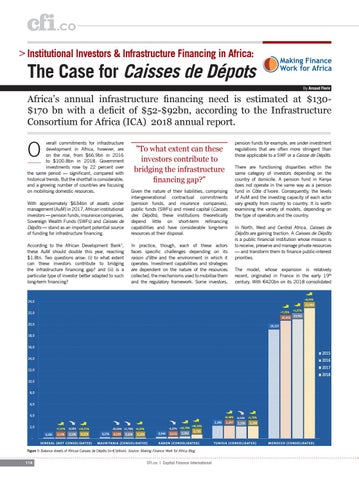
Figure 1: Balance sheets of African Caisses de Dépôts (in € billion). Source: Making Finance Work for Africa Blog
114
CFI.co | Capital Finance International
pension funds for example, are under investment regulations that are often more stringent than those applicable to a SWF or a Caisse de Dépôts. There are functioning disparities within the same category of investors depending on the country of domicile. A pension fund in Kenya does not operate in the same way as a pension fund in Côte d’Ivoire. Consequently, the levels of AuM and the investing capacity of each actor vary greatly from country to country. It is worth examining the variety of models, depending on the type of operators and the country. In North, West and Central Africa, Caisses de Dépôts are gaining traction. A Caisses de Dépôts is a public financial institution whose mission is to receive, preserve and manage private resources — and transform them to finance public-interest priorities. The model, whose expansion is relatively recent, originated in France in the early 19th century. With €420bn on its 2018 consolidated