Full Circle ISSUE NO. 3
A MAGAZINE FOR CHARLES E. SMITH LIFE COMMUNITIES
FALL WINTER
2026
STORIES OF LIFE, CONNECTION AND COMMUNITY
LIFE CAN BE VIEWED AS THREE CONCENTRIC CIRCLES. AT THE CORE IS FAMILY, THEN FRIENDS, AND THEN COMMUNITY. OUR LIVES SHOULD BE DEDICATED TO BUILDING AND STRENGTHENING THESE CIRCLES IN MUTUAL SUPPORT OF ONE ANOTHER. —Charles E. Smith
ii | Full Circle STORIES OF LIFE, CONNECTION AND COMMUNITY | FALL/WINTER 2026
ANGELA WILLINGHAM, CFRE
Vice President of Resource Development
Every person has a story Dear Friends, In my work at Charles E. Smith Life Communities (CESLC), I have the privilege of hearing what brings people here and what keeps them connected. These conversations often go well beyond surface-level niceties and I’m grateful for what people choose to share with me. There is something sacred about being invited into someone’s story. What they share may be a memory they hold close or something they are still finding the words to explain. I try to remember that I am being trusted with a part of their life, and that trust deserves care. I don’t need to have the right response or a similar experience to offer. Sometimes, my responsibility is simply to listen and give their story the space it deserves. In this issue of Full Circle, we share stories of our associates, residents, volunteers, and donors. While their experiences are different, genuine
connections run throughout these pages. We see how people become important to one another, sometimes with something as simple as sharing a newspaper or baking a loaf of pumpkin bread. This is what stays with me. When I think about the moments that mean the most, they often involve simple gestures that affirmatively answer the two questions we all wonder. Do you see me? Do I matter? In this age of constant distraction, I imagine we all need that reassurance more than we let on. I know how much it means to me when someone asks how I am and gives me time to answer. Or when they remember something I mentioned weeks ago and ask about it again. I feel valued when I realize that someone was listening, that something about my life stayed with them long after the conversation ended.
1 | CHARLES E. SMITH LIFE COMMUNITIES
We cannot always know when someone is feeling overlooked or unsure of their place. We can, however, take the time to know them well enough to move beyond pleasantries. We can invite someone to join a conversation or sit at our dinner table. These gestures may feel small to us, but they may mean the world to someone else. At CESLC, we have opportunities to make these connections every day. Our community brings us together with people we might never otherwise meet. What we do with those opportunities helps determine how it feels to live here, work here, or give here. Thank you for helping make CESLC a community where we take the time to know one another. With gratitude,
FULL CIRCLE is published by Hebrew Home of Greater Washington, Inc., DBA Charles E. Smith Life Communities. Hebrew Home is a registered charity in Maryland and Virginia. A copy of our financial statement is available from the Maryland Secretary of State or the Virginia State Office of Consumer Affairs.
Bruce J. Lederman, President/CEO Angela Willingham, Vice President, Resource Development , Willingham@ceslc.org Erica Heiney, Director of Communications Laura McDaniel, Editor Julie Babler, Creative Director
©
2026 by Hebrew Home of Greater Washington 6121 Montrose Road North Bethesda, MD 20852 Contact us: giving@ceslc.org www.smithlifecommunities.org Hebrew Home of Greater Washington 301-770-8470 Assisted Living 301-450-7433 Independent Living 301-450-7097
STORIES OF LIFE, CONNECTION AND COMMUNITY
Kenneth H. Becker, Chair
26 CREATING CONNECTIONS How resident-led groups foster friendships and a sense of belonging
FEATURES
14
Hirsh Health Center 301-816-5004 ElderSAFE® Center 301-816-5099
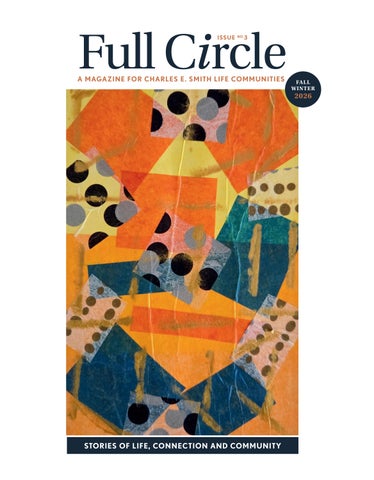
CHECK MATES ON THE COVER Artwork by a Ring House resident.
Bringing Generations Together at Revitz House
Full Circle ISSUE NO. 3
A MAGAZINE FOR CHARLES E. SMITH LIFE COMMUNITIES FALL WINTER
2026
DEPARTMENTS 4
ON CAMPUS News from around our community
8
ASSOCIATE SPOTLIGHT Mario Guillen Assisted Living Aide, Landow House and Cohen-Rosen House
12
SNAPSHOT Campus carnivals bring residents, associates together
37
OUR PAST A glimpse into the history of giving at Hebrew Home
32 LOUIS WITTEN Physicist has spent a lifetime asking questions
22 CARING FOR THOSE WHO CARE Remembering Dr. Richard M. Jacobs and his commitment to residents and colleagues
ONCampus
Celebrating 52 years of caring for others Long tenures with a single organization are becoming increasingly rare. Fifty-two years of service is remarkable. Fifty-two years of service as a certified nursing assistant, a demanding, handson role, is even more noteworthy. This summer, colleagues gathered to celebrate the retirement of Rkiya Bensguir, who dedicated more than five decades to caring for residents at Hebrew Home of Greater Washington. Those who worked with Rkiya described her using words like love, compassion, care, and commitment. They shared stories of a colleague who arrived an hour early, ready and waiting to begin the work she loved, and someone who was always willing to help out. As a CNA, Rkiya supported residents with some of their most personal needs, including grooming, bathing, and dressing. It is in this kind of role that close bonds are formed. You learn personalities and preferences, and have the opportunity to connect on a deeper level. Rkiya’s extraordinary tenure reflects a career spent doing meaningful work, and the knowledge that her work truly made a difference. We congratulate her on her retirement and wish her every joy in her next chapter.
“What you do matters more than you know.”
A LETTER FROM RKIYA Good morning/afternoon, My name is Rkiya Bensguir, and today is a very special moment for me. After 50 years of working as a nurse aide and medication aide, I will officially retire on June 30, 2026. When I first started, I never imagined this would become my life’s work. Over the years, it became much more than a job — it became my passion, my purpose, and my second family. Being a nurse aide and medication aide has taught me the true meaning of compassion. I have had the privilege of caring for many residents, and each has left a lasting place in my heart. From the smiles we shared to the quiet moments of comfort, these are memories I will carry with me forever. This work has not always been easy. There have been long days and emotional times, but there has also been so much love in what we do. Sometimes the smallest things — a gentle touch, a kind word, or simply being present — can mean everything to someone. To my coworkers, thank you for your support, teamwork, and friendship throughout the years. You have truly been like family to me. To the residents and their families, thank you for trusting me to care for your loved ones. It has been an honor I will never forget. As I enter retirement, I do so with a full heart. I am proud of the work I have done and grateful for every moment of this journey. To those continuing in this field, keep serving with kindness and patience. What you do matters more than you know. Thank you all for being part of my 50-year journey. I will miss you, but I will always carry you with me. Thank you.
4 | Full Circle STORIES OF LIFE, CONNECTION AND COMMUNITY | FALL/WINTER 2026
AWARDS + RECOGNITION
CESLC WORKPLACE CULTURE EARNS NATIONAL RECOGNITION Charles E. Smith Life Communities was recently named to Newsweek’s list of America’s Greatest Midsize Workplaces in Health Care 2026, a national recognition honoring organizations fostering positive work environments. The recognition reflects CESLC associates’ commitment to the organization’s mission to deliver quality care and meaningful life experiences to older adults with dignity and compassion rooted in Jewish values. Organizations were evaluated on working environment; culture and belonging; compensation and benefits; work-life balance; career progression; and training and company culture, based on more than 1.3 million online employee reviews. “We are incredibly proud that this recognition is based on our associates’ feedback and experiences,” said Melissa Davidson, senior vice president of human resources.
PHOTOS: Lisa Helfert
Charles E. Smith Life Communities has been named a recipient of the inaugural DRiWaterstone America’s Most Admired Non-Profit Culture Award. The award recognizes nonprofit organizations whose workplace cultures drive performance, innovation, and sustained impact. “Culture is not a program you launch. It is a standard you hold, every single day,” said Bruce J. Lederman, president and chief executive officer of Charles E. Smith Life Communities. “At CESLC, our values are present in every interaction with the older adults and families who have placed their trust in us. The fact that many of our associates have dedicated decades, and some more than 50 years, to this mission speaks to something real: when an organization stands for something meaningful and holds itself accountable to that standard, people commit their careers and their hearts to it. This recognition affirms what we have always believed. A culture built on Jewish values, human dignity, and an unwavering commitment to excellence is not just the right thing to do. It is what drives every measure of organizational performance that matters.”
5 | CHARLES E. SMITH LIFE COMMUNITIES
ONCampus NIH fellowship marks 10 years at CESLC For 10 years, Charles E. Smith Life Communities has been proud to partner with the National Institutes of Health (NIH) Hospice and Palliative Medicine Fellowship Program, helping physicians deepen their understanding of what person-centered care looks like in the place older adults call home. The one-year fellowship is designed to prepare physicians to care for people facing serious illnesses or the last phase of their life. As part of their training, fellows spend four weeks at Charles E. Smith Life Communities in addition to dedicated training on NIH’s campus and in a hospital setting. The fellows work alongside the physicians and care teams at Hebrew Home of Greater Washington, which provides post-acute and skilled nursing care; Landow House, home to our assisted living residents; and Cohen-Rosen House, our dedicated memory care community. As part of the fellowship, fellows join physicians on rounds, participate in family meetings, and spend time with residents. Dr. Stephannie Acha-Morfaw, the first of two fellows on campus this summer, described how meaningful those interactions were and emphasized the importance of getting to know residents and their loved ones beyond what can be captured in a medical chart. “It’s interesting to see their pictures and hear a little bit more about them and what their story is,” Dr. Acha-Morfaw said. “I think that has been the biggest piece I’ve valued here. [At Landow House], we saw a resident who was a Holocaust survivor, 100-plus years old. For me, there’s an impact there.” Over the past decade, our physicians, led by Executive Vice President of Medical Affairs, Chief Medical Officer and Medical Director Dr. Elisa Gil-Pires, MD, FACP, CMD, CPE, have helped shape the next generation of physicians. As we mark 10 years of this important partnership, we are grateful for the opportunity to prepare physicians to serve older adults.
6 | Full Circle STORIES OF LIFE, CONNECTION AND COMMUNITY | FALL/WINTER 2026
WORD WORD ON THE STREET
Ninety-four percent of loved ones of residents at Hebrew Home of Greater Washington would recommend Charles E. Smith Life Communities’ flagship skilled nursing center, according to the results of the 2025 Maryland Nursing Home Family Experience of Care Survey. This scoring exceeds averages for nursing homes in the state of Maryland by 22 percent. “What an honor to hear that nearly every one of the loved ones surveyed would recommend us to others,” said Vice President of Operations Brenda L. Rice. “These results speak to the dedication of every person on our team, from our medical team and nursing associates to all those working behind the scenes to ensure quality standards are exceeded.”
94%
Would Recommend Hebrew Home
7 | CHARLES E. SMITH LIFE COMMUNITIES
OUR People PHOTO: Gary Landsman
8 | Full Circle STORIES OF LIFE, CONNECTION AND COMMUNITY
MARIO GUILLEN Assisted Living Aide, Landow House and Cohen-Rosen House
Associate Spotlight KEY RESPONSIBILITIES As a CNA, I work with different residents [at Landow House and Cohen-Rosen House] and on different floors depending on where I’m needed. I assist residents with things like dressing, bathing, laundry, and eating.
EXPERIENCE AND EDUCATIONAL BACKGROUND I’m originally from Guatemala, where I began studying medicine. When I moved to the United States, I had to start over. I worked in construction and at Home Depot and did a lot of different things. My wife encouraged me to get back into the medical field, and I’m glad I did because I like it. I like helping people. I’ve worked on campus for about 15 years, first through Home Care Solutions [now SmithLife® Homecare], and I’ve been a CESLC associate for around 6 years.
WHAT I ENJOY MOST I like communicating with the residents. I try to smile and bring them happiness. I come with a lot of energy. Sometimes it’s something simple like sitting down to play cards or talking with someone.
A PERSONAL CONNECTION I try to get to know each person and understand what they like and what they need. I’ve brought LEGOs to a resident who liked them and made scarves as gifts in the winter. Patience is also important. Some residents need more time or more help, and you can’t rush them. My advice to someone new to being a CNA would be to have patience and always treat residents with kindness.
HOW I MEASURE SUCCESS I feel good when I know the residents I worked with are clean, comfortable, and happy with the care they received. That’s what is most important to me.
9 | CHARLES E. SMITH LIFE COMMUNITIES
ONCampus
MAKING AI A LITTLE LESS INTIMIDATING After participating in the Harold & Shirley Robinson Hebrew Home Youth Philanthropy (H2YP) Program, high school sophomore Mason Gaines found another reason to return to Charles E. Smith Life Communities: artificial intelligence. Over the summer, Mason created an interactive presentation designed to introduce residents to AI in a way that was informative, useful, and approachable. He explored how AI is already part of everyday life, ways it can be used to connect and learn, and tips for using the technology safely. “I created this presentation over the summer specifically for the residents,” Mason said. “It was not a school assignment and was something I developed independently.” Mason first shared his presentation with residents at Hebrew Home’s Wasserman and Smith-Kogod residences, where questions and conversation quickly became part of the program. He went on to present to another group of residents, becoming more comfortable adapting his explanations and connecting the technology to their own experiences. “I also thought about my own grandparents and wanted to make sure that people in a similar age group would feel wellversed in AI and more comfortable understanding it after my presentation,” he added. What began with H2YP became something more: a young volunteer sharing his interests and knowledge while building connections across generations.
HONORING
DR. DAMIEN DOYLE Dr. Damien Doyle, who spent nearly 23 years at Hebrew Home of Greater Washington and Charles E. Smith Life Communities as a physician, leader, and friend, passed away in March 2026. Dr. Doyle’s kindness and warm spirit touched every person he encountered. As medical director, Dr. Doyle provided steady leadership for many years. His care extended directly to residents of Landow House and Cohen-Rosen House, who continued to benefit from his dedication to their care and well-being as staff physician even after he left his full-time position. Dr. Doyle was deeply respected on campus and in his field, also having served as president of the Mid-Atlantic Medical Directors Association (MMDA) from 2022 to 2024. In March 2026, MMDA presented him with its prestigious Berman Award in recognition of his outstanding dedication and lifelong contributions to post-acute and long-term care. Dr. Doyle leaves behind a legacy of warmth and care that will stay with us for years to come. We hold close all those who knew, loved, and respected him. May his memory be a blessing.
10 | Full Circle STORIES OF LIFE, CONNECTION AND COMMUNITY | FALL/WINTER 2026
BIRTHDAY CELEBRATION AT REVITZ BRINGS JOY TO MANY For her 60th birthday, long-time supporter Tracey Friedlander could have celebrated just about anywhere. She chose Revitz House. When her husband, Andy, asked what she wanted to do for the milestone, Tracey knew she wanted residents to be part of the celebration. For someone who is always looking for ways to bring joy to others, sharing her birthday with friends and family at Charles E. Smith Life Communities felt right. Earlier this year, Tracey and Andy invited around 20 family members and friends to join about 25 Revitz House residents for the party. Red and white, Tracey’s favorite colors, filled the room, and everyone came dressed casually, just as she wanted. Residents, family, and friends gathered around the tables for dinner and birthday cake, while Andy took on another important role for the evening: bingo caller. And, of course, there were plenty of prizes for the winners.
PHOTOS: Lisa Helfert
Though everyone had gathered to celebrate Tracey, the evening became a celebration of something bigger — good food, laughter, friendship, and the simple joy of being together. For Tracey and Andy, the setting made the milestone even more meaningful. Their families’ connections to CESLC span three generations, with years of history and memories on campus. Now Tracey’s 60th birthday is part of that history, too. 11 | CHARLES E. SMITH LIFE COMMUNITIES
ONCampus SNAPSHOT
PHOTO: Lisa Helfert
CARNIVALS BRING RESIDENTS, ASSOCIATES TOGETHER County fairs and outdoor festivals are a hallmark of summer, one that Hebrew Home of Greater Washington’s Recreational Therapy Department brings to residents at Wasserman and Smith-Kogod residences each year in the form of mini-carnivals. Associates flex their creativity to develop inventive and accessible takes on carnival-themed favorites like tin can toss, airplane strike, human whack-a-mole and skeeball. Volunteers and associates from across campus man each station to ensure games run smoothly, and fair-inspired food and a petting zoo add to the festive atmosphere. Special events like our mini-carnivals contribute to the warm, homelike atmosphere at Hebrew Home. They bring residents together to create new memories and recall old ones, and give residents, associates, and volunteers plenty of opportunities to enjoy each other’s company.
{CONNECTIONS}
CHECK MATES Bringing Generations Together at Revitz House
BY SUZANNE POLLAK, FREELANCE WRITER
Reprinted with permission from Washington Jewish Week.
14 | Full Circle STORIES OF LIFE, CONNECTION AND COMMUNITY
E
ture, and the future is encouraging. The future is in good hands.”
mmet Miserendino was bothered after visiting his great-grandmother at her assisted living facility in North Carolina. He couldn’t stop thinking about all the residents who didn’t have any visitors. “I wanted to help,” the now-eighth grader at Cabin John Middle School said. He talked to Senior Rabbi Michael Safra at B’Nai Israel Congregation about how he could get involved. Since February 2024, he has visited residents at Revitz House, an independent living facility with the Charles E. Smith Life Communities in Rockville. He has become a fixture in Revitz’s lobby on Sunday mornings as he sits by the chessboard with his friends Ron Sigelman, 83, and Jerry Jacobson, 86. During visits, they also discuss sports, especially the Baltimore Ravens. These weekly visits turned into his bar mitzvah project and will continue “indefinitely,” Emmet said. “It’s just kind of fun. I feel happy that I’m really helping.” Also quite happy are his two friends, who at various times during a discussion with Washington Jewish Week called Emmet an expert chess player and a great kid. Sigelman recalled that a few years ago, he placed an ad in the Revitz newsletter seeking a partner to play chess. The next thing he knew, he was playing chess with someone decades younger than him who ended up “teaching me some things. We have a great time.”
Added Sigelman, “I’m from the generation that the grandparents moved in with the family.” That doesn’t happen as much now so the idea of a young person coming to where he lives “is really an interesting concept. I find it spectacularly uplifting to have a young person visit. He’s a wonderful young man.”
“I feel happy that I’m really helping.” Jacobson has been playing chess for 70 years and calls himself “a very strong player.” Emmet said he has only beaten Jacobson once. He has more success with Sigelman. “I think of all the games we’ve played, I’ve won all but two or three times,” he said, adding, “There were one or two draws.” Chess “is a good game against Alzheimer’s, which we don’t want to get. It’s good for your brain,” Jacobson noted. He described himself as “young at heart, young at spirit and young at mind.” “Every generation is concerned about the youth coming up,” Jacobson said, adding when he spends time with Emmet, “You see the fu-
15 | CHARLES E. SMITH LIFE COMMUNITIES
They have their moments. When Emmet said, “They are very old, and they are getting older and have nobody to visit,” Sigelman gently replied, it would be better to say, “senior citizens, not old people.” The two men both have loving family members who do visit. Jacobson’s daughter and grandchild come, and Sigelman’s son and twin grandchildren visit as well. Both men were invited to Emmet’s bar mitzvah on June 26. Sigelman attended. “I really felt like I was an honored guest. The rabbi had explained about our playing chess weekly. I just felt like I was with family. It was special.” Emmet has tried to convince some of his friends to spend time with residents living in senior facilities to no avail. “I do, but they don’t listen,” he said. Even though he really enjoys the friendship and chess games, Emmet stressed, “I did it solely for my greatgrandmother and for the people around her.”
PHOTO: Gary Landsman
{CONNECTIONS}
16 | Full Circle STORIES OF LIFE, CONNECTION AND COMMUNITY | FALL/WINTER 2026
BY ANGELA WILLINGHAM
BEA, THE LIGHT
I
t does not take long to discover something about Bea Rosenberg — she would much rather hear about someone else than talk about herself.
Ask Bea about her life, and she will tell you about her family. Ask about her years working at Charles E. Smith Life Communities, and she will tell you about the people she worked with and the residents she came to know. Ask about life today at Landow House, where she now lives, and she will talk about the friends she has made, the associates she appreciates, and the young volunteers who stop by to visit. It is a quality that CESLC volunteer Sydney Pires noticed almost immediately. “With a lot of the residents, it’s us asking them questions about their lives. But with Bea, she genuinely wanted to know who we were,” Sydney recalled. Sydney, daughter of Chief Medical Officer Dr. Elisa Gil-Pires and participant in the Harold and Shirley Robinson Hebrew Home Youth Philanthropy Program, began volunteering at CESLC in 2021, when she was in seventh grade.
17 | CHARLES E. SMITH LIFE COMMUNITIES
{CONNECTIONS}
“She would do ANYTHING for anyone.” At first, her visits with Bea were brief. It was just one stop among several she and her best friend, Erin, would make while volunteering. But over time, something changed. Bea was deeply curious about the girls. She asked about school, their friends, and what was happening in their lives. Their school uniforms reminded Bea of her late daughter, Jan, who had been a cheerleader at the University of Maryland, and the conversations grew longer and more personal. Eventually, Sydney stopped thinking of Bea as someone she came to visit. “It just felt like a friendship,” she said. By Sydney’s junior year, Bea was often the first person she wanted to see when she arrived, and sometimes the only person she managed to visit because their conversations lasted so long. Sydney and Bea began doing more than talking. When Sydney became interested in scrapbooking, she brought supplies and a photograph
of the two of them to Bea’s apartment. Bea was hesitant at first, worried she would not be good at it, but Sydney persuaded her to try. Today, Bea keeps the scrapbook page they made in her living room. “Do you remember when we did that?” she asks Sydney during their visits. For Sydney, the significance of that question goes far beyond a scrapbook page. Her friendship with Bea has changed the way she thinks about what it means to connect with another person. So much so, that Sydney chose to write about Bea in her college application essay. Sydney reflects on how her relationship with Bea helped her understand that communication does not always depend on conversation. Sometimes relationships are built through doing something together, paying attention, or simply being present. It was a lesson Sydney carried home with her. Sydney’s maternal grandparents
live with her and her family for part of the year, and since they do not share the same primary language, her experience with Bea helped her reconsider what that meant for her relationship with her grandparents. Instead of focusing on what they could not easily say to one another, Sydney began noticing all the other ways they could connect. She might cook crêpes with her grandmother, bring her grandfather his heating pad, or simply sit beside him and watch television. These small moments became meaningful ones. Her friendship with Bea, she realized, helped her redefine communication not only with her grandparents, but in other relationships as well. She became more conscious of how she showed up for friends and what it means to simply be available to another person. And it is Bea’s presence that Sydney finds so remarkable. Bea listens, asks questions, celebrates good news, and offers comfort on difficult days. She is also frank
18 | Full Circle STORIES OF LIFE, CONNECTION AND COMMUNITY | FALL/WINTER 2026
when she needs to be, Sydney said, making their friendship feel genuine rather than simply pleasant. That instinct for connection and deep curiosity about others has been part of Bea’s relationship with CESLC for decades. A native Washingtonian, Bea began her career with CESLC in 1989 after working for Electronic Data Systems. Bea recalls applying to Hebrew Home after deciding that her commute to Virginia had become too difficult. At the time, she could have never known that her work at CESLC would last more than 25 years. She served as executive assistant to Warren Slavin, CESLC’s longtime president and CEO and now CEO emeritus, before later transitioning to a part-time service coordinator role at Revitz House. There, she connected residents with community resources, transportation, government benefits, and other services that could make their lives a little easier.
maintained an extensive Rolodex of contacts. When Bea retired, she gave the Rolodex to Laurie, who still keeps it on her desk. The information may be outdated, but for Laurie, it remains a reminder of Bea’s resourcefulness and the care she brought to her work. As longtime Revitz House associate Sandi Bragin put it, “She made magic happen.”
evitz House social worker Laurie Rudorfer worked alongside Bea for more than 15 years and remembers someone who understood what residents needed, often before they asked. Although Bea was not a social worker by training, Laurie said she had a natural ability to connect with people and find ways to help.
R
But Bea’s generosity often extended well beyond her job description. When new residents arrived with few belongings, she sometimes purchased bed linens and other necessities with her own money. “She would do anything for anyone,” Laurie recalled. Yet Bea never saw herself as the one doing all the giving. As Laurie remembers, Bea would often tell her, “The residents give more to me than I give to them.”
She knew people throughout D.C. and Montgomery County and
Evidence of those years still has a place of honor in Bea’s apartment —
19 | CHARLES E. SMITH LIFE COMMUNITIES
an award recognizing 25 years of service and a photograph from her working days. And when Warren recently came to Landow House to visit his former assistant, Bea proudly introduced him to her friends. More than three decades after beginning her career at CESLC, Bea would come to know the community in an entirely different way. She had lived in her Potomac home for nearly 50 years when a fall and broken shoulder made it clear to her son, Alan, that it was time for a change. After a hospital stay and rehabilitation, Alan told her, “You’re going home.” “And he meant CESLC, of course,” Bea recalled. Today, Bea has her regular table at meals, attends a range of programming at Landow House, and particularly enjoys musical
{CONNECTIONS}
TOP: Bea surrounds herself with photos of the loved ones who mean so much to her. LEFT: Bea welcomed CESLC CEO Emeritus Warren Slavin for a visit in June 2026. RIGHT: Bea holds a vase presented to her in recognition of 25 years of service to CESLC.
20 | Full Circle STORIES OF LIFE, CONNECTION AND COMMUNITY | FALL/WINTER 2026
performances. She has also developed close friendships, including one with fellow Landow resident Mary Ann. They visit each other’s apartments, attend programs together, and share the everyday things that friendships are made of. “Alan subscribes to The Washington Post for me, and he always reminds me to share it with Mary Ann,” Bea said. Relationships have always mattered to Bea. Perhaps none more so than the one she shared with her husband, Morris “Mo” Rosenberg. They met at a synagogue dance, where Bea had arrived with girlfriends who made a pact that they would leave together. Then Mo asked Bea to dance. He was good. Good enough, apparently, that Bea’s girlfriends released her from the agreement and encouraged her to let him drive her home. Bea and Mo married in 1960 and spent 60 years together. Dancing remained part of their life and the couple even won several trophies that Bea displays on her dresser. Together they raised two children, Alan and Jan. Bea has also experienced profound grief, including the deaths of Jan, Jan’s husband, Paul, and their son, Joey. But each remains very much a part of Bea’s life, woven into the
“One of those people whose soul shines through.” stories she tells and the memories she shares. Perhaps that is one reason Sydney and Erin have become so special to her. Their youth and friendship remind Bea of Jan and her best friend, Jenny. Bea talks with them about school, college, friendships, and the ordinary details of teenage life. For Bea, those conversations offer a chance to remember and share Jan’s story with a new generation. The same warmth that drew Sydney into Bea’s life has long been felt by those around her. Longtime CESLC clergy member Rabbah Arlene Berger has seen that quality in Bea throughout their years together. “I can’t remember a time when Bea wasn’t here,” she said. “She has been such a part of the life of Landow.” The two have become close over the years, and Rabbah Arlene says Bea never fails to ask about her family
21 | CHARLES E. SMITH LIFE COMMUNITIES
and listens to the answer. “She has this talent of caring about everyone around her,” Rabbah Arlene said. “She makes you feel heard.” For Rabbah Arlene, Bea embodies something she often speaks about with residents — the importance of participating in community rather than simply living alongside one another. A smile, a question, or a few moments of genuine attention can make someone feel that they belong. She also believes that home is something people can continue to create for themselves, wherever life takes them. Bea has done just that. She arrived at Landow House and built a life filled with friendships, familiar routines, and opportunities to connect with others. She has made a home for herself, and through the simple act of reaching out, she helps make it feel like home for those around her. Rabbah Arlene describes Bea as “one of those people whose soul shines through.” Sydney has her own way of saying it. There are many words she uses to describe her friend — optimistic, positive, welcoming, genuine. But ultimately, she keeps returning to one image. Bea is a light. Not because she seeks attention for herself, but because she has spent a lifetime shining it on everyone else.
{CONNECTIONS}
CARING FOR THOSE WHO CARE BY ANGELA WILLINGHAM
Dr. Richard M. Jacobs had a specialty at Hebrew Home that had nothing to do with medicine. Pumpkin bread. For years, Dr. Jacobs (known throughout campus simply as “Dr. J”) baked loaves of his homemade pumpkin bread for the nurses and unit clerks who worked alongside him. There was just one condition: they had to save some for the housekeeping associates. It was a small gesture, but one that revealed a great deal about the physician who spent 13 years caring for residents at Charles E. Smith Life Communities. Dr. Jacobs understood that caring for older adults was never the work of one person. He noticed the people around him, valued what they contributed, and found his own ways to let them know they matter. Now, through a generous gift from his estate, Dr. Jacobs will continue caring for CESLC associates for generations to come. The Dr. Richard M. Jacobs Caring for Colleagues Fund will provide emergency financial assistance to CESLC associates experiencing unexpected financial hardship. Administered by the CESLC Office of Human Resources as part of the existing Caring for Colleagues program, the fund is a fitting legacy for a man whose relationships at Hebrew Home extended far beyond the patients he treated. 22 | CHARLES E. SMITH LIFE COMMUNITIES
A physician — and so much more To understand Dr. Jacobs’ legacy, it helps to understand the man himself. His wife, Debra Weingarten, described him as “tenacious, protective and loyal; smart and opinionated,” with a strong work ethic and deeply held principles. But there was also a whimsical side to him. On their first date, he asked Debra if she wanted to meet his mispocha — Yiddish for family — and then led her to the Great Ape House at the National Zoo. As Debra later recalled, she quickly realized their life together would always be “a mix of the fanciful and the factual.” He was, she said, a “true Renaissance man.” A man of science who loved mythology, he could explain aeronautics to a 9-year-old while still marveling at the wonder of flight. His musical tastes ranged from Donna Summer and Frank Sinatra to Gregorian chants, opera, and Holst’s “The Planets.” He could wallpaper a room, shingle a roof, and perform delicate foot surgery with extraordinary precision. That combination of curiosity, skill, and attention to detail carried into his work as a physician. Throughout his career, Dr. Jacobs cared for an extraordinarily wide range of patients, including young athletes, people with diabetes, older adults, and, for 20 years, people incarcerated in Maryland prisons.
23 | CHARLES E. SMITH LIFE COMMUNITIES
{CONNECTIONS}
“He recognized that it took a village.” Debra recalled that he treated every patient with care and respect. Some patients eventually became lifelong friends, while friends and colleagues sometimes became his patients. Even former prisoners traveled miles to continue receiving care from him after their release. At Hebrew Home, that same approach made Dr. J a beloved presence. In 2022, the Mid-Atlantic Society for Post-Acute and Long-Term Care Medicine named him its Clinician of the Year. That same year, the CESLC Board of Governors recognized him for his distinguished service. But perhaps an even greater testament to his impact came from the residents themselves. Even while he was away from work during his illness, Debra wrote that some residents continued asking when he would return. They were waiting for him with chocolate, handknitted hats, and even the occasional $5 or $10 bill offered in gratitude — money he would never accept. What he would give them instead was time. Dr. Jacobs understood that a resident might be lonely or frightened and simply need someone to sit with them. He would listen to sto-
ries, discuss politics, or watch a few minutes of whatever happened to be on television. Then he would go home and tell Debra about what he had learned or watched that day.
Caring for the people beside him His attention was not reserved for residents. Dr. Jacobs saw firsthand what it took to care for hundreds of older adults each day. “He recognized that it took a village,” Debra recalled. And that brings us back to the pumpkin bread. In appreciation for the associates who helped his days go smoothly, Dr. Jacobs baked. Nurses and unit clerks received the loaves, but they also received his instructions: make sure housekeeping gets some, too. “Everyone on campus knew Dr. J,” Debra remembered.
A legacy of caring The Dr. Richard M. Jacobs Caring for Colleagues Fund takes something that was central to Dr. Jacobs’ life and makes it permanent.
Where he once showed his appreciation through a conversation, a word of thanks, or a loaf of pumpkin bread, his estate gift will now be there for CESLC associates when they need assistance. It also reflects something Debra understood about her husband: his feelings were often expressed most powerfully through what he did. “His deeds spoke volumes,” she said. Near the end of his life, Dr. Jacobs told a hospice rabbi that it served no purpose to dwell on regrets. Instead, Debra recalled, “he hoped only that he had made the world a better place in the way he knew best.” Through the patients he cared for, the colleagues he valued, and now the associates who will receive help through the fund bearing his name, he did. And, of course, there is still his pumpkin bread. We are honored to share Dr. J’s famous recipe so that a tradition that once brought a little joy to associates throughout Hebrew Home can find its way into new kitchens, onto new tables, and perhaps be shared with someone who could use a little caring, too.
24 | Full Circle STORIES OF LIFE, CONNECTION AND COMMUNITY | FALL/WINTER 2026
DR. JACOBS’ ONE-BOWL PUMPKIN LOAF Adapted from a recipe by D iane Lux
2 cups flour o in my Preheat oven to 350° 370 c oven s) p cu /8 ri elect 2 cup s (~1 7
2 cups sugar slightly le ss than 2 tsp baking soda
Mix unsifted dry ingredients with a whisk until combined
2 tsp baking powder
Add pumpkin, eggs, and oil, using whisk
1 tsp ground cinnamon
Divide mixture into 2 foil-lined 9”x5” loaf pans
e; a litt le mpor 1 tsp ground cloves ~ 1 ¼ ts
Bake about 40-45 minutes or until cake tests done with a toothpick
1 tsp Kosher salt 2 cups unsweetened pumpkin (1 can)
Enjoy!
MAKES 2 PUMPKIN LOAVES; SLICE WHEN COOL
cup t han 1 to ss e l ly p of t he). t h g e sli w t h rin lo e b cup ” 8 / (= 1 m e as u g 1 cup corn oil NOTE: Only CORN oil should be used. 3 eggs
25 | CHARLES E. SMITH LIFE COMMUNITIES
{CONNECTIONS}
BY LAURA MCDANIEL
CREATING CONNECTIONS RESIDENT-LED GROUPS BRING PEOPLE TOGETHER Research shows that curiosity and social connection are among the key pillars of happiness, especially as we age. At Charles E. Smith Life Communities, residentand associate-created programming address both needs. One glance at the monthly program calendars and you’ll see days filled with a variety of events and programs. Among the most cherished are the affinity groups created, planned, and led by residents. The groups reflect the wide range of interests within the community, bringing residents together to study, create art, share laughter, test their trivia skills, or support and celebrate their LGBTQ friends and neighbors. Many of the groups have grown out of casual conversations that begin with a simple idea: “We should have a group for that.” From there, it is a matter of finding the right person to take the lead. The ideas gel quickly, with the help of life and leisure and recreational therapy associates. At Ring House, for example, the residents partner with Life and Leisure Manager Vica Carpio, and trust she will help turn their ideas into reality. The resident leaders bring genuine enthusiasm to their groups. They enjoy the topics and it’s a labor of love to prepare for the sessions. Just as important as preparing the programming is the sense of community they bring to each session by welcoming others and making space for laughter, learning, and, above all, connection.
YIDDISH GROUP The group that gathers weekly to hear, speak, sing, and study Yiddish began about seven years ago when Norma Krupenie overheard another woman say it would be nice to have a Yiddish group at Ring House. Though relatively new to the community, Krupenie agreed to lead, and the Yiddish Group soon found a regular place on the calendar: Saturdays at 3 p.m. by the fireplace in the lobby. The location is an intentional choice, according to Krupenie, because she doesn’t want it to feel like a lecture or a class. “There’s always a good laugh in Yiddish,” she said, and she wants this group to tap into the joy and nostalgia that she feels when she remembers her happy childhood home. “The idea is to get you to understand. I don’t like strict formality of waiting to the end of a lecture, I’m not teaching Yiddish and I’m not giving a lecture. People want to enjoy the language.”
“I try to teach them Judaism is a happy background no matter what happened to us, we still make jokes, we always have a joke. It’s always something to bring you up rather than pull you down.” Initially just a handful of curious people came, and now as many as 30 residents join each week, and all are welcome. “(Participants) don’t have to be Jewish, all they have to know is how to smile and ask questions and speak up. I try to get them to see we are seniors and it’s OK to not know everything,” Krupenie said.
NORMA KRUPENIE PHOTO: Capital Corner Creative
TALMUD STUDY Talmud Study got its start in a similar way — with a casual conversation and someone willing to take the lead. Carole Fox and another woman were talking, and she mentioned she had never studied the Talmud but would like to. Fox does not consider herself an expert, but has some background in grassroots activity from her career as a social worker, so she agreed to be the lead. They spend an hour each Saturday afternoon and make their way through a page or two of the Talmud and the scholarly commentary, historical background, and explanations of Jewish law and how it developed. For example, Jewish law is specific about which blessings to say over which kinds of foods. “The text is so alive, it could be as if a group of people, especially scholars who are very knowledgeable in Jewish law and the blessings, are sitting around a table discussing, how do we think G-d wants us to behave in the most proper way to express our gratitude for the food? It’s lively, even though the text is several thousand years old.”
CAROLE FOX PHOTO: Gary Landsman
“To me, it’s very cool to see how the Hebrew and Aramaic of the text relates to modern-day Hebrew. Modern-day Hebrew is spoken among Jews around the world who know modern conversational Hebrew. We use many of these ancient words. It’s really cool to see certain words and terms that go back thousands of years that are used today.”
{CONNECTIONS}
COMEDY NIGHT Resident Jerome Chapman leads the bi-monthly Comedy Night. The group started about two years ago, just after Jerome and his wife, Bunny, moved into Ring House. Jerome was telling jokes around the dinner table and one of the others suggested a joke-telling session for all residents. “So, I contacted Vica and we set it up,” he said.
BUNNY AND JEROME CHAPMAN PHOTO: Capital Corner Creative
“Hearing people laugh at me makes me happy. So that’s why I continue to do it. It’s a happy time for a lot of us.” The sessions follow a familiar format, with Jerome serving as emcee. He warms up the crowd with a few jokes before turning things over to Bunny, who shares a few riddles tied to seasonal topics. For example, in August a joke might be: “Why do eggs hate to go back to school? Because they crack under pressure.” Next, another resident plays clips from professional comedians, followed by jokes from the audience. The session ends with everyone singing what Jerome has dubbed the Ring House Alma Mater, “Let Me Call You Sweetheart,” with a playful twist on the final line: “Let me call you sweetheart, because I forgot your name.” “It’s a time for laughing,” Jerome said. “People walk away happy. That’s our deal twice a month.” The jokes are clean, often Jewish-themed. Sometimes original material, often “oldies but goodies,” as Jerome calls them. “I get the impression it does to some degree enhance the living here. Otherwise, people wouldn’t show up,” he said. Then, true to form, he added, “I’m the most modest person in the world, I’m also the most humble.” Perhaps that explains why the residents keep showing up.
28 | Full Circle STORIES OF LIFE, CONNECTION AND COMMUNITY
WOMEN’S GROUP Kitty Wertheimer’s idea for a Women’s Group at Landow House came from her desire to get to know the other residents. “I thought it would be helpful to get to know people’s backgrounds by telling their stories. I was the first person to share my story,” she said. Her presentation, “My Life, My Story, My Way,” included that she was born in Germany, emigrated to the United States by boat at 2 years old, and went to high school at Forest Hill School in New York. She attended the University of Maryland, married, and had two children. She likes to travel, dance, play mah-jongg, do arts and crafts, shop, and cook. Her favorite quote is “How can I help you?”
“Finding out how much we have in common has brought us closer together. I feel more comfortable talking to my fellow residents now that we have made a connection.” The idea took hold with the other women at Landow, who enjoy sharing their stories, showing photos from their careers, weddings, families, and hobbies. Family often share photographs and contribute content to the biography. Recreation Coordinator Nyah Quire works with residents and their loved ones to bring everything together in a PowerPoint presentation. One resident who was a baton twirler in her youth even brought a baton to demonstrate her skills. The presentations are open to all residents and family members. “I’ve learned so many things,” Wertheimer said. “We have so many talented people here.” The men of Landow have also taken notice. “What came out of it, by the way, is that the men are copying us,” she said. “I think that’s a great idea.”
KITTY WERTHEIMER PHOTO: Gary Landsman
29 | CHARLES E. SMITH LIFE COMMUNITIES
{CONNECTIONS}
LGBTQ DISCUSSION CLUB Several Hebrew Home residents wanted a welcoming space to discuss their identities, experiences, and issues affecting the LGBTQ community, past and present. Those conversations led to the creation of the LGBTQ Discussion Club. And what began as a small gathering has continued to grow over the past year.
“Some people of our age lived through a different environment than what’s going on today.” James Harrison was among the early participants. “I can see how we both felt isolated and alone,” he said, describing meeting another of the group’s participants. Annie Tran, director of recreational therapy, attends and ensures the meetings remain a welcoming space. She noted that attendance was sparse at first, but associates kept the bi-monthly meetings on the schedule. Participants appreciated the acknowledgment, and it mattered to them that the space would continue to be there. The group’s role at Hebrew Home has increased with its growth in membership. Members now have a hand in planning and celebrating Pride Month programs at Hebrew Home in June, including watch parties for Pride parades, and other opportunities for residents to connect and celebrate together.
JAMES HARRISON
30 | Full Circle STORIES OF LIFE, CONNECTION AND COMMUNITY | FALL/WINTER 2026
SANDY AND HELEN WINOKER PHOTO: Gary Landsman
DIAMOND ART Diamond art is a relatively new pastime, first developed around 2010 to make art accessible to everyone. It’s a cross between paint-bynumbers and mosaic in which the artist, using a prefabricated kit, places tiny resin “diamonds” onto a canvas. Helen Winoker had enjoyed a few diamond art projects before her husband, Sandy, discovered the craft while on a cruise. When they returned to Revitz House, they proposed establishing a set time for others to try this new craft. That was two years ago, and the group is going strong, meeting every other Thursday.
“It’s been nice and ongoing and fun. And we’ve met lots of nice people. It keeps everybody busy and out of trouble.” They’ve branched out quite a bit in the past two years, doing more than wall art from kits. Now they have diamond art-adorned “everything,” according to Helen. Tissue box covers, coasters, greeting cards, magnets. “Everything you can think of,” she said. Some even buy blank canvases and create their own designs. The creations were recently featured in a display case in the Revitz House lobby. The pieces drew such admiration that several people even asked if they were available for purchase. Helen’s husband Sandy is also active in the building’s welcoming committee and always promotes the Diamond Art Group as a way to enjoy some creativity and get to know the neighbors. “It’s a nice little social time for people. You can sit and chat while you’re doing your project,” Helen said. “That’s a good thing for a lot of people.”
31 | CHARLES E. SMITH LIFE COMMUNITIES
Q
{CONNECTIONS}
BY ANGELA WILLINGHAM
Physicist has spent a lifetime asking questions It started with a photograph.
Ring House resident Bob Stromberg, affectionately called “the mayor” by everyone who knows him, is a 101-year-old World War II veteran, scientist, painter, and photographer who dedicates much of his time to capturing life at Ring House through the lens of his camera. When visiting Ring House earlier this year, I noticed Bob taking down a photography exhibit. I offered to help, and with each photo we removed from the cork board he shared their stories — residents, associates, our chef, and even the official mayor of Rockville, Monique Ashton, who visited Ring House earlier in the year. But there was one picture that caught my eye. “Who is this?” I asked. “That’s Louis Witten. You don’t know Lou?” I shook my head and said, “no.” “You need to know him.”
Louis Witten
Theoretical physicist and professor, World War II veteran, researcher, author and editor, husband, father of four
Louis, he explained, is 105 years old and a theoretical physicist. They eat dinner together every night with Gary Moroff, the newly elected resident council president. “Lou’s brilliant. You should write about him for the magazine.” It isn’t surprising Bob recognized a story worth telling. As the unofficial mayor, he takes time to know his fellow residents. And anyone who knows Bob knows when he asks you to do something, you do it. It’s part of his charm. Back in my office, I did what most of us do when we hear about someone intriguing — I Googled him. I was not prepared for what I found. Right there in the first paragraph of Louis Witten’s Wikipedia page, I read that his research centered on classical gravitation, including the discovery of exact solutions to Einstein’s field equations. I read that sentence a few times. How, exactly, was this girl from Oklahoma — who didn’t even take physics in high school — going to interview a man who had spent his career building on Einstein’s work? And that was only part of his story.
PHOTO: Bob Stromberg
Over the course of 105 years, Louis has been many things: a World War II veteran, a physicist and professor, a researcher, an author and editor, a husband, and a father of four. He married his first wife, Lorraine, in 1949, and together they raised their four children Edward, Celia, Matthew, and Jesse. His professional life took him from university classrooms and research
QA laboratories to the Weizmann Institute of Science in Israel, where he was a Fulbright lecturer in physics. The more I learned, the more I realized that my traditional Q&A style interview might not be the best way to share Louis’s story with our Full Circle readers. So, I joined Bob, Louis, and Gary for dinner in the Ring House dining room, along with two new friends, Gerry and Roz, who recently moved from Leisure World. Over dinner, our conversation touched on Louis’s remarkable past, as well as some of the questions and ideas that still capture his attention today. Because to understand Dr. Louis Witten, it helps to understand something about questions. He has spent a lifetime asking them.
Why is Einstein famous? Louis Witten was born in Baltimore on April 13, 1921, to parents who had come to the United States from Eastern Europe as teenagers. He grew up in Baltimore and entered Johns Hopkins University, graduating in 1941 as a civil engineer. He seemed to be headed toward a career in engineering. Then history intervened. The United States entered World War II later that year, and Louis
was drafted into the U.S. Army Air Forces. The military sent the young engineer to school where he studied meteorology and radar and eventually became a radar weather officer, working at a time when radar itself was still a rapidly developing technology. Those years changed the direction of his life. As Louis recalled over dinner, he began thinking about what he would do when his military service ended. He knew he wanted something different. “I wanted to find out why Einstein is famous,” he shared. That question determined the course of the next eight decades of his life. Louis returned to Johns Hopkins, this time to study physics, earning his doctorate in 1951. He went on to conduct research at Princeton University, the University of Maryland, and MIT’s Lincoln Laboratory before joining the Research Institute for Advanced Study at the Martin Company in Baltimore. And somewhere along the way, Louis did considerably more than find out why Albert Einstein was famous. He became part of a generation of physicists who took Einstein’s ideas about gravity and general relativity and pushed them further. Einstein’s theory of general relativity had fundamentally changed the way scientists understood gravity. Rather than thinking of gravity simply as a force pulling objects toward one an-
A CONVERSATION WITH LOUIS WITTEN
other, Einstein described a universe in which matter and energy affect the geometry of space and time. Louis spent much of his career exploring the implications of those ideas. His research centered on gravitation and general relativity, including work on solutions to Einstein’s field equations — the mathematical framework scientists use to describe how matter, energy, space, and time interact. In 1959 alone, he published papers examining the geometry of gravitation and electromagnetism and the classification of spaces within general relativity.
A life in ideas Louis’s career placed him among scientists working during an important period in the development of modern gravitational physics. In 1957, he participated in the nowhistoric Chapel Hill Conference on the Role of Gravitation in Physics, which brought together many of the leading thinkers in the field at a time when scientists were renewing their attention to Einstein’s theory of general relativity. In 1962, Louis edited “Gravitation: An Introduction to Current Research,” bringing together the work of leading researchers in the field. The volume became part of the literature used by physicists studying gravitation and relativity.
Fulbright lecturer at the Weizmann Institute of Science in Israel. Then, in 1968, Louis joined the University of Cincinnati as a professor of physics. There he would spend more than two decades teaching, conducting research, mentoring graduate students, and helping shape the department before retiring in 1991. “Retiring,” however, is not quite the right word for what happened next.
How will the universe end? That continuing curiosity became particularly clear when our dinner conversation turned to Louis’s research. I asked him to describe, in everyday language, what he had spent his career studying.
Louis left his faculty position. He did not leave physics. He continued his research, including work at the University of Florida, and continued collaborating and publishing long after the age when most people have stepped away from their professions. In fact, one of the most remarkable entries on Louis’s long list of publications appeared only last year. In August 2025, at age 104, Louis co-authored a paper examining the properties of a particular kind of black hole. On the published paper, beneath his name, his affiliation is listed simply as “Independent Researcher.” The address beneath it is Ring House in Rockville, Maryland. More than 80 years after a young civil engineer decided he wanted to understand Einstein, Dr. Louis Witten was still at work.
His work also took him beyond the United States. He spent time as a
35 | CHARLES E. SMITH LIFE COMMUNITIES
In 1962, Louis edited “Gravitation: An Introduction to Current Research,” bringing together the work of leading researchers in the field.
“The history of the universe,” he said. “How it was created, how it evolved. Now, what’s going to happen to it?” It is difficult to imagine a larger subject. Louis offered his own conclusion — this universe, eventually, will disappear. That prompted what seemed like an obvious follow-up. Did he believe the universe was going to end?
lenged assumptions, and opened my mind to possibilities I hadn’t considered.
Curiosity beyond physics Physics, however, is only one expression of Louis’s curiosity.
me that Louis enjoys trivia, Gary noted his enduring loyalty to his hometown Baltimore Orioles, and Bob shared that he and Louis attend a seated exercise class together four times a week. Louis told me about the birthday T-shirts his son has made for him. Last year’s announced, “104 and still alive.” This year, naturally, the number changed to 105. “I give my hand-me-downs to Bob,” Louis joked.
The answer depended, Louis explained, on what I meant by “universe.”
His friends at Ring House describe a man whose interests extend into history, Judaism, literature, baseball, and whatever question happens to arise around the dinner table.
And suddenly we were talking about whether the universe is finite or infinite, where waves go, the meaning of size when contemplating something as vast as the universe, and whether the universe is open or closed.
One of his current pleasures is reading Yiddish literature, including the original stories of “Tevye the Dairyman” by Sholem Aleichem — the stories that would eventually inspire “Fiddler on the Roof.”
“I refuse to die,” he said.
There was no quick answer because, to Louis, the question itself needed more thought.
His friends also describe him as deeply knowledgeable about Judaism and Jewish history.
“I can’t give you a simple answer to any question,” he told me, “unless you make it sharp.”
“When a question comes up, I go to Louis,” Bob said. “I don’t go to a rabbi.”
That may have been my favorite thing he said all evening.
Louis dismissed my question about whether he had ever wanted to be a rabbi. He wasn’t interested in becoming one. He simply wanted to learn.
A sharp question, he explained, might be: Is the universe open or closed? So I asked.
That distinction feels important.
And he answered, “It all depends on the size of the universe.” And the discussion continued. What struck me was the way Louis approached each question. He wasn’t interested in giving an easy answer when the question itself needed more thought. With each of my admittedly not-always-“sharp” questions, he defined terms, chal-
Curiosity does not have to lead to a degree, a credential, or even a particular destination. Sometimes we ask questions simply because there is something we want to know.
With that, I had to ask, “What is your secret to longevity?”
Perhaps some questions really do have simple answers. From the young civil engineer who wanted to find out why Einstein was famous to the man still contemplating the fate of the universe, Louis has spent a lifetime following his curiosity wherever it leads. More than eight decades after one question changed the course of his life, there are still things he wants to know, ideas worth exploring, and questions worth asking. Preferably, of course, sharp ones.
In his own words Scan the QR code to read the transcript of Louis Witten’s 2011 oral history interview, which is included in the American Institute of Physics’ International Catalog of Sources for History of Physics and Allied Sciences.
As our conversation shifted from his past to his life today, his friends filled in some of the details. Roz told
36 | Full Circle STORIES OF LIFE, CONNECTION AND COMMUNITY | FALL/WINTER 2026
OUR Past
1923
FROM THE ARCHIVES
This giving envelope tells a story that is still being written. Then, $35 provided a full day of care at Hebrew Home. Today, the cost — and the care we provide — look very different. But for more than a century, one thing has endured: a community willing to care for one another. From the nickels and dimes collected by Hymen Goldman and his friends in 1910 to the gifts made today, every generation has played its part. Now, that story includes you.
Hebrew Home of Greater Washington 6121 Montrose Road North Bethesda, MD 20852
Nonprofit Org US Postage PAID Permit #2913 Gaithersburg, MD
RETURN SERVICE REQUESTED
A LEGACY BUILT ON LOVING-KINDNESS More than a century ago, our beloved “Aunt Minnie” Goldsmith turned her birthday into an act of gemilut chasadim (loving-kindness), inviting friends to celebrate by making contributions to Hebrew Home. Her generosity — and her belief in inspiring others to give — helped establish a tradition of philanthropy that continues today. Our annual Guardian Campaign donors carry that same spirit of loving-kindness forward, making contributions that help Hebrew Home of Greater Washington provide exceptional skilled nursing and rehabilitation, a vibrant spiritual life, engaging recreational therapy, and safety through ElderSAFE® Center — ensuring every resident is valued and celebrated no matter their financial circumstances.
BE PART OF THIS ENDURING LEGACY OF LOVING-KINDNESS.
GIVE TO THE 2026 GUARDIAN CAMPAIGN: bit.ly/2026-Guardian-Campaign