CEO MAGAZINE, VOL. 45
CEO MAGAZINE, VOL. 45
MBA MEGATRENDS: SHAPING
THE LEADERS OF TOMORROW
AI IN BUSINESS: THE FUTURE IS NOW – ARE YOU READY?
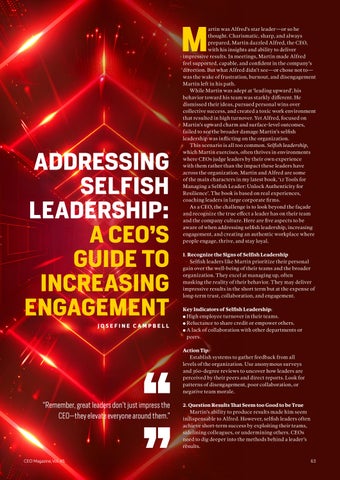
ADDRESSING SELFISH LEADERSHIP: A CEO’S GUIDE TO INCREASING ENGAGEMENT
MASTERING
THE ART OF BALANCED STRESS






AI IN BUSINESS: THE FUTURE IS NOW – ARE YOU READY? EU Business School





MASTERING THE ART OF BALANCED STRESS Adrian Kelly








Chris Harrison


EXPLORING NEW HORIZONS IN LEADERSHIP



THE USF DIFFERENCE
Frank Fletcher & Marco Tavanti

HOW ARE COMPANIES REALLY USING AI? A NEW REPORT HAS THE ANSWERS
Stefano Puntoni
52 THE CAREER ACCELERATOR
Daniel Serrot

56 THE HIDDEN GAME: UNCOVERING THE BUSINESS OF SPORTS
L. Felipe Monteiro


59
63
HI, MY NAME IS MBA. WILL I SURVIVE IN 2025?
Bert Wolfs
ADDRESSING SELFISH LEADERSHIP: A CEO’S GUIDE TO INCREASING ENGAGEMENT
Josefine Campbell
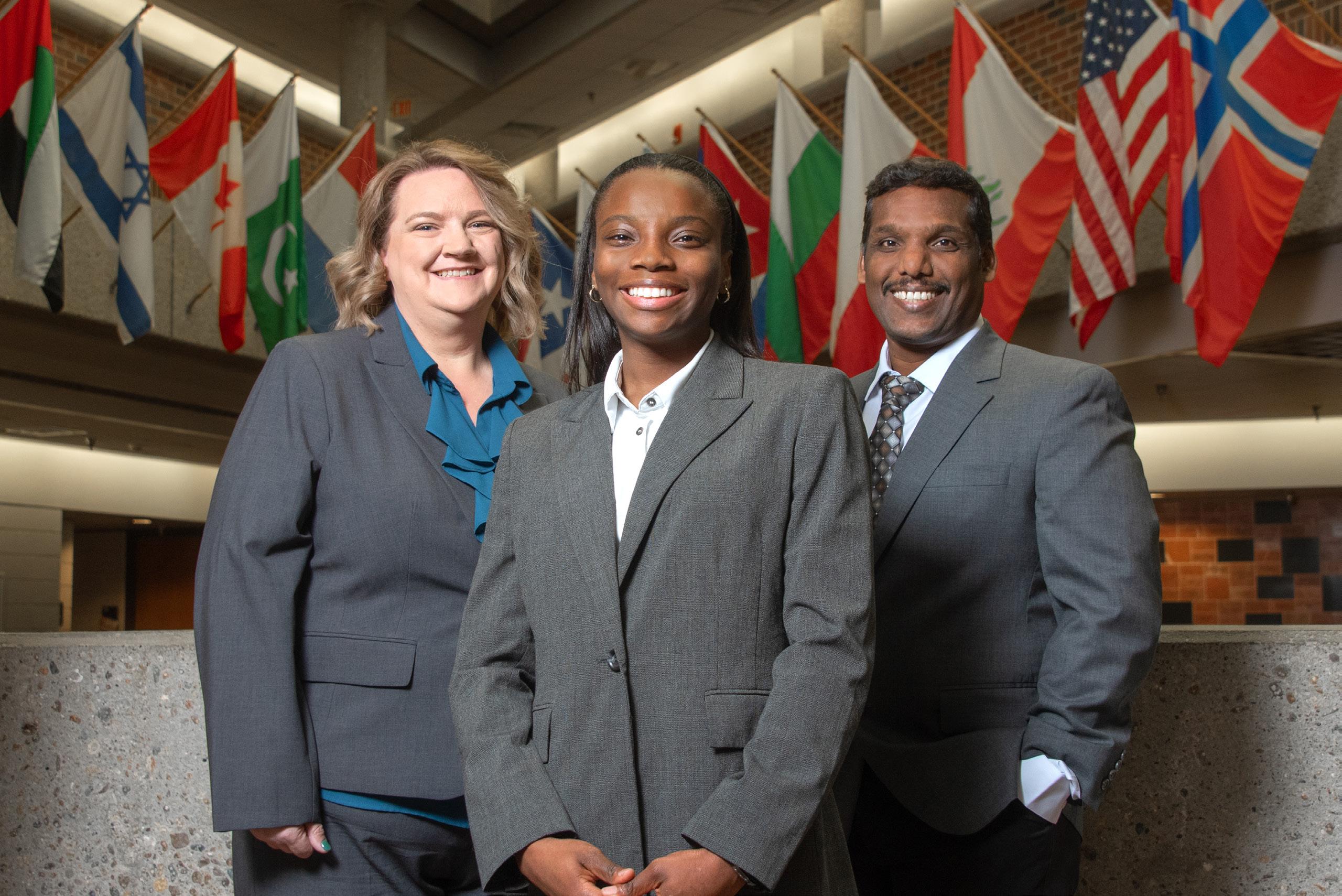
Earn the credentials to move up—or move on, with a flexibile graduate program designed for working professionals like you. MBA
Merit-based, competitive funding available for qualified candidates.
Immersive international experiences included in tuition. STEM-DESIGNATED

MSBA & MSAA qualify for up to 36 months of OPT for international students.
Network with other top-tier schools like Stanford, Duke, and UNC.
Collaborate with Fortune 500 companies like Humana, GE, and Brown-Forman.


TRAINING DIGITAL CITIZENS
Jose Maria Ortiz Ibarz

68
72
WHY WORKPLACES NEED FORMALISED RESILIENCE TRAINING
Beth Benatti Kennedy
LIST OF CONTRIBUTORS

CEO
Victor J. Callender
Group Editor-in-Chief
Alexandra Skinner
Sub-Editor
Krysia Whicher
Subscriptions
Gemma Westwood
Designer
PENTA Limited Financial Controller
Anthony Gordon Head of Production
Steven Whitaker Features Writer
Email: info@ceo-mag.com
Web: www.ceo-mag.com
@ceo_mag /CEOMagazineGlobal
Amber Callender Published by CEO Magazine. All rights reserved. No part of this publication may be reproduced without the expressed approval of the copyright owner. Whilst every effort has been made to ensure the accuracy of the information in this publication, the Publisher accepts no responsibility for errors or omissions. The Publisher disclaims responsibility for the views and opinions expressed herein by the contributors. Furthermore, the Publisher does not give any warranty regarding the accuracy thereof.
For further information on annual subscription rates visit: www.ceo-mag.com
Online MBA Ranked #38, CEO Magazine and #55, U.S. News, 2025
Industry-aligned specializations
Personalized business foundations curriculum
Full- and part-time options
Graduate in as few as three semesters or combine part-time studies with your career
STEM-designated analytics specialization

Management-level classmates with an average of 15 years of experience
Electives customized to student interests
International business specialization
Ranked #25 by CEO Magazine, 2025
Ranked #7 by Poets & Quants for Executive MBA programs with tuition under $115,000

Develop future-ready leadership skills
Pursue a leadership specialization or advance business learning through electives
Online program with synchronous class sessions for core courses
Curriculum prepares students for change management, inclusive leadership and human capital strategy

ALON ROZEN
The MBA landscape has always been a reflection of business evolution— adaptive and responsive but usually behind the curve. In 2024, this dynamism is unmistakable as generative AI, sustainability, technology literacy, and narrative-driven leadership, which will start to take centre stage in many MBAs around the world. Moreover, it looks like MBA candidates are increasingly seeking programmes that offer more than the classic MBA content (that is now available for free online in many cases)—they are now really hungry for transformative, multi-location experiences that expand both their personal and professional horizons, giving them as much in terms of experiences and emotions as simple knowledge. More broadly, I see a shift from seeking skills to seeking sense –i.e., understanding how their values and the issues they care about most can be effectively integrated into business, business models and leadership.
Generative AI: The New MBA Cornerstone
Despite the valid ethical debate, Generative AI, once a futuristic concept, is uncontestably becoming an integral part of business operations, on the one hand, and effective learning, on the other. MBA programmes are embracing this shift, integrating AI not just as a subject of study but as a learning companion. While a student can forget a topic they have learned during their MBA, personalised AIdriven knowledge managers help participants with perfect recall, contextual understanding, and extracting insights. GenAI is now part of my own ‘learning stack’. Personally, I use NotebookLM to search for connections between various subjects I am studying and to create study guides on the fly. I use
“When people outsource their thinking to technology, everyone loses, but when we enhance people skills with technology, a lot of value and efficiency can be created.”

ChatGPT and Perplexity to do deep dives on subjects. My research is accelerated and enhanced thanks to Semantic Scholar and Elicit Research. While Gamma, Canvas and Pitch help me create stunning presentations. We encourage our faculty to share their AI solution stacks with our MBAs, and we often discover new solutions worth testing.
Beyond its academic applications, AI raises multiple ethical, operational, and strategic questions. Leaders today need to understand how to deploy it responsibly. To this end, we have recently launched an ambitious Responsible Technology (ReTech) Centre to create clusters of excellence that link broader trends in robotics and machine learning, sustainable development, and multiple emerging technologies.
Most of us understand that a shift to sustainability is no longer optional. Circular business models, which prioritise resource efficiency, longevity, and regeneration, are redefining how value is created. The next generation of leaders must understand these principles and have the tools to implement them. We have embedded a Circular Economy certification programme into our LeadTech Executive MBA as participants need to understand key circular economy principles, in general, and, much more specifically, how to operationalise them with actionable insights. We see other MBA programmes also adding similar knowledge to their curricula. We are also trying to ensure that participants gain hands-on practice by adding a sustainability innovation project to the programme so that they are prepared for a world where purpose, planet and profitability must coexist.
At École des Ponts Business School, our commitment to ‘being in business to make a better world’ translates into programmes that blend technological insight with sustainable innovation. This fusion prepares leaders to thrive in an era where stakeholders increasingly demand both growth and responsibility. This also dovetails elegantly with the mission of our mother school, the École Nationale des Ponts et Chaussées engineering school, which is under the tutelage of the French Ministry of Ecological Transition. This allows us, as a school, to align purpose, values and mission – something we try to inspire our MBA participants to aim for as well.
Where I am encouraged, too, is when I see the broader community taking this into account. Case in point, I believe that CEO Magazine is planning to introduce a Green MBA ranking. This shows that sustainability
“Circular business models, which prioritise resource efficiency, longevity, and regeneration, are redefining how value is created.”
is not just another piece of the MBA puzzle but that MBA prospects now see sustainability as the centre-piece in their programme choice.
Today’s leaders must possess a ‘hardish’ understanding of technology—enough to grasp its strategic potential without needing to code. Blockchain, AI, Web3, and quantum computing are not just buzzwords; they are transformative forces creating new opportunities for companies to innovate and rethink their business models. MBAs are now tasked with understanding the implications of these technologies, leveraging them for strategic advantage, and explaining them to people who are not tech-savvy. This is something that I refer to as ‘simplexity’, the art of explaining complex concepts in simple terms that most people can relate to.
At the same time, technology literacy is as much about people as it is about tools. Leading teams that span time zones, cultures, and industries demands an empathetic, adaptive approach that is human-centric. We know, and the research shows, that when people outsource their thinking to technology, everyone loses, but when we enhance people skills with technology, a lot of value and efficiency can be created. Knowing how to manage people AND technology is one of the key skills that will define leadership in the coming decades.
In a noisy, digital-first and increasingly uncertain world, the ability to craft compelling narratives is truly a leadership superpower. Whether it’s rallying a team, pitching an idea, or engaging stakeholders, stories cut through complexity and foster connection. Leaders need to connect to stakeholders in authentic ways that create an ‘us’, that demonstrates empathy, that narrates rational (evidence-based rather than naïve hope-based) optimism, and leaves people with the agency to make mindful choices.
MBA programmes are increasingly recognising storytelling as an essential competency. At École des Ponts, we emphasise narrative as both a leadership and a strategic tool. Storytelling enables leaders to articulate a vision and inspire action even in the face of uncertainty, which probably means we need to encourage more politicians to do an MBA!
programmes must move beyond traditional frameworks to teach participants how to lead with agility and resilience. This involves fostering futures literacy—the capacity to use the future as a strategic resource – or by embracing new forms of leadership like adaptive leadership, conscious leadership and, one of our favourites, Theory U.
Leaders don’t need to try to predict the future, but MBA programmes need to prepare leaders who can help shape a more desirable future. By equipping participants with the tools to explore multiple scenarios and adapt to evolving contexts, MBAs are cultivating leaders who can thrive amid ambiguity.
MBA candidates today seek more than a degree; they seek an experience. Multidestination programmes, which immerse participants in diverse business ecosystems, are becoming a significant differentiator. These experiences go beyond academic enrichment, fostering global perspectives and networks that are invaluable in a connected world.
At École des Ponts Business School, we champion this approach, which is why we offer our LeadTech Executive MBA in partnership with EADA. Our dual degree programme includes three weeks in Paris, three weeks in Barcelona, one week in the Bay Area (San Francisco and Silicon Valley), and one week in Singapore. Spanish tapas and sangria, French croissants and wine, Silicon Valley technology and inspiration, and Asian innovation ecosystems, when combined with participants from 15 different countries, make for a programme that spans continents, cultures and contexts. These experiences not only enhance learning but also ensure that participants leave with a truly global mindset.
BIOGRAPHY
Alon Rozen is the Dean, CEO and Professor of Innovation at École des Ponts Business School.
Uncertainty, whether due to rising perceived complexity, or the feeling that we are reeling from one crisis to another, is the new norm. The ability to embrace uncertainty and manage effectively is a critical skill. MBA
The MBA is no longer a static qualification; it is a dynamic journey. When we redesigned our programme with an empty page in 2019, we understood that MBAs must now balance foundational knowledge - that which can be learned online with cutting-edge insights that can only happen on-site, and that you can only teach local relevance with global perspectives if you are not in one static location. We also saw the rising importance of ensuring that the leaders of tomorrow are equipped with technical skills and emotional intelligence, and that circular economy and sustainable development skills move from nice-to-know to need-to-master. By embracing these megatrends, MBA programmes can ensure they remain vital to the leaders of tomorrow. The road ahead is exciting, uncertain, and full of possibility—just the way we like it!



The benefits attached to an MBA are well documented: career progression, networking opportunities, personal development, salary... and the list goes on. However, in an increasingly congested market, selecting the right business school can be difficult, which is far from ideal given the time and investment involved.
Using a ranking system entirely geared and weighted to fact-based criteria, CEO Magazine aims to cut through the noise and provide potential students with a performance benchmark for those schools under review.

American
American University: Kogod
Arden University
Aston Business School
Auburn University: Harbert
Audencia Business school
Australian Institute of Business Australia
Bentley University: McCallum North America
Boston University: Questrom North America
Brunel Business School UK
Bryant University North America
Business School Netherlands The Netherlands
California State University-Chico North America
California State University-Long Beach North America
California State University-Northridge North America
California State University-San Bernardino North America
Central Queensland University Australia
College of William and Mary: Mason North America
Colorado Technical University North America
Concordia University Canada
Crummer Graduate School of Business at Rollins North America
Darmstadt Business School Germany
Deakin Business School Australia
Drexel University: LeBow North America
Duke University: Fuqua North America
Durham University Business School UK
EAE Business School Spain
EBS Business School Germany
École des Ponts Business School France
ESADE Business School Spain
Escuela de Negocios, Universidad de San Andrés Argentina
EU Business School Germany, Spain and Switzerland
Florida International University North America
Florida Southern College School of Business North America
GBSB Global Business School Spain
Georgia State University: Robinson North America
Grenoble Ecole de Management France
Griffith University
Australia
Business School Country
HEC Montréal Canada
Hofstra University: Zarb North America
Hult Internatonal Business School North America
IAE Business School Argentina
IFM Business School Switzerland
INCAE Business School Costa Rica
ISEG Portugal
ISM International School of Management Germany
The Instituto Tecnológico Autónomo de México (ITAM) Mexico
Jacksonville University North America
John Carroll University: Boler North America
Kennesaw State University North America
Kent State University: Crawford North America
Kingston Business School UK
Lagos Business School Nigeria
Lancaster University Management School UK
Leeds University Business School UK
Loyola Marymount University North America
Loyola University of Maryland North America
Maastricht University School of Business and Economics

The Netherlands
Macquarie Business School Australia
Marquette University North America
Massey University New Zealand
Millsaps College North America
Munich Business School Germany
Nebrija Business School Spain
Newcastle University Business School UK
Nyenrode Business University
The Netherlands
Oakland University North America
Pepperdine University: Graziadio North America
POLIMI School of Management Italy
RMIT University Australia
Rochester Institute of Technology: Saunders North America
Rome Business School Italy
Rutgers Business School North America
Saint Joseph's University: Haub North America
SBS Swiss Business School Switzerland
Seattle University: Albers North America
Simon Fraser University: Beedie Canada
Spain Business School Spain
Strathclyde Business School UK
Suffolk University: Sawyer North America
Swinburne University of Technology Australia
Texas Christian University: Neeley North America
Texas State University: McCoy North America
The Instituto Tecnológico Autónomo de México (ITAM) Mexico
The Lisbon MBA Catolica|Nova Portugal
Business School Country
The University of Liverpool Management School UK
The University of Texas at Dallas: Jindal North America
The University of Texas at San Antonio: Alvarez North America
Torrens University Australia Australia
Trinity College Dublin
School of Business Republic of Ireland
United International
Business Schools
Belgium, Italy, Japan, the Netherlands, Spain and Switzerland
University at Buffalo School of Management North America
University of Akron North America
University of Alberta Canada
University of Bath School of Management UK
University of Baltimore North America
University of Canterbury New Zealand
University of Capetown
Graduate School of Business South Africa
University of Chile FEN-UCHILE Chile
University of Cincinnati: Lindner North America
University of Delaware: Lerner North America
University of Denver: Daniels North America
University of Exeter UK
University of Glasgow: Adam Smith UK
University of Kentucky: Gatton North America
University of Louisiana at Lafayette North America
University of Louisville North America
University of Maine North America
University of Massachusetts-Lowell North America
University of Michigan-Flint North America
University of New Mexico: Anderson North America
University of North Carolina-Charlotte: Belk North America
University of North Florida: Coggin North America
University of Oklahoma: Price North America
University of Ottawa: Telfer Canada
University of Portland: Pamplin North America
University of PretoriaGordon Institute of Business Science South Africa
University of San Francisco: Masagung North America
University of Sheffield Management School UK
University of South Australia Australia
University of Tampa: Sykes North America
University of Texas at Arlington North America
University of the Witswatersrand South Africa
University of West Georgia North America
University of Western Australia Business School Australia
University of Wollongong Sydney
Business School Australia
Victoria University Business School Australia
Waikato Management School New Zealand
Willamette University: Atkinson North America
Xavier University North America TIER
Rank Country
1 University of Ottawa: Telfer Canada
2 École des Ponts Business SchoolEada Business School Global MBA
3 The Instituto Tecnológico Autónomo de México (ITAM) Mexico
4 IFM Business School Switzerland
=5 Rutgers Business School North America
=5 SBS Swiss Business School Switzerland
6 Nyenrode Business University The Netherlands
7 INCAE Business School Costa Rica
8 Escuela de Negocios, Universidad de San Andrés Argentina
=9 Hult Internatonal Business School North America
=9 Rome Business School Italy
=10 Massey University New Zealand
=10 Kennesaw State University North America
=11 University of Cape Town Graduate School of Business South Africa
=11 Arden University UK
12 Maastricht University School of Business and Economics The Netherlands
13 TBS Education France
14 The University of Texas at San Antonio: Alvarez North America
15 Grenoble Ecole de Management France
16 Business School Netherlands The Netherlands
17 University of Denver: Daniels North America
18 Strathclyde Business School UK
19 AIX Marseille Graduate School of Management France
20 Trinity College Dublin School of Business Republic of Ireland
21 Pontifical Catholic University of Chile Chile
22 Audencia Business school France
23 POLIMI School of Management Italy
24 University of San Francisco: Masagung North America
=25 Marquette University North America
=25 Drexel University: LeBow North America
26 Texas Christian University North America
=27 Washington State University: Carson North America
=27 Cork University Business School Republic of Ireland
28 EAE Business School Spain
29 University of PretoriaGordon Institute of Business Science
South Africa
=30 IAE Business School Argentina
=30 Concordia University Canada
=31 Simon Fraser University: Beedie EMBA-IBL Canada
Rank Country
=31 United International Business Schools
32 The University of Texas at Dallas: Jindal North America
33 Simon Fraser University: Beedie EMBA Canada
34 Villanova University North America
=35 RMIT University Australia
=35 American University of Beirut Beirut
=36 Aston Business School UK
=36 Pepperdine University: Graziadio North America
37 Baylor University: Hankamer North America
=38 University of Bradford School of Management UK
=38 Spain Business School Spain
=39 Rochester Institute of Technology: Saunders North America
=39 University of Tampa: Sykes North America
=40 Hofstra University: Zarb North America
=41 College of William and Mary: Mason North America
=41 Millsaps College North America
=42 Georgia State University: Robinson North America
=42 The Lisbon MBA Catolica|Nova* Portugal
=43 Oakland University North America
=43 Durham-EBS Executive MBA Germany and UK
44 Lagos Business School Nigeria
=45 California State UniversitySan Bernardino North America
=45 University of Oklahoma: Price - EMBA in Energy North America
=46 University of Oklahoma: PriceEMBA in Aerospace and Defence North America
=46 University of Texas at Arlington North America
47 Crummer Graduate School of Business at Rollins North America
48 University of Alberta Canada
49 California State UniversityLong Beach North America
50 Virginia Commonwealth University* North America
51 Esade Business School Spain
52 Auburn University: Harbert North America
53 Duke University: Fuqua North America
54 Saint Joseph's University: Haub North America
55 Xavier University North America
56 Florida International University* North America
57 Suffolk University: Sawyer* North America
58 University of North Carolina Wilmington: Cameron* North America
59 University of New Mexico: Anderson North America
60 Seattle University: Albers North America
Rank Country
1 EU Business School
2 Hult Internatonal Business School North America
3 Maastricht University School of Business and Economics The Netherlands
4 INCAE Business School Costa Rica
5 Trinity College Dublin School of Business Republic of Ireland
6 SBS Swiss Business School Switzerland
7 Nebrija Business School Spain
8 Business School Netherlands The Netherlands
9 OBS Business School with Universitat de Barcelona, Global MBA Spain
10 Torrens University AustraliaMBA (On-Demand) Australia
=11 Darmstadt Business School Germany
=11 OBS Business School with Universitat de Barcelona, EMBA
12 POLIMI School of Management: I-Flex EMBA Italy
13 The University of Liverpool Management School UK
14 IAE Business School Argentina
15 Rome Business School Italy
=16 Arden University UK
=16 Escuela de Negocios, Universidad de San Andrés Argentina
=17 Macquarie Business School Australia
=17 United International Business Schools
Belgium, Italy, Japan, the Netherlands, Spain and Switzerland
=18 Massey University New Zealand
=18 Deakin Business School Australia
=19 POLIMI School of Management: Flex EMBA
=19 University of South Australia Australia
=20 Griffith University Australia
=20 University of Bradford School of Management
21 Torrens University AustraliaMBAA and MBA Australia
22 Durham University Business School UK
23 Pepperdine University: Graziadio North America
24 Jack Welch Management Institute North America
=25 University of Maine North America
=25 Australian Institute of Business Australia
26 University of Denver: Daniels North America
27 Washington State University: Carson North America
=28 Purdue University: Mitch Daniels School of Business North America
=28 Instituto Europeo de Posgrado Spain
=29 University of San Francisco: Masagung North America
=29 University of Kentucky: Gatton North America
=30 Florida Southern College of Business North America
=30 Jacksonville University North America
31 University of Massachusetts-Lowell North America
32 College of William and Mary: Mason North America
=33 GBSB Global Business School Spain
=33 Central Queensland University Australia
34 La Trobe University Australia
35 Aston Business School UK
36 Rochester Institute of Technology: Saunders North America
Rank Country
37 Drexel University: LeBow North America
=38 Marquette University North America
=38 University of Exeter UK
=39 John Carroll University: Boler North America
=39 EAE Business School Spain
40 Central Queensland University Hyperflexible MBA Australia
=41 University of Wollongong, Sydney Business School Australia
=41 Spain Business School Spain
42 Victoria University Business School Australia
43 University of Cincinnati: Lindner North America
=44 RMIT University Australia
=44 Simon Fraser University: Beedie Canada
of
49 Kent State University: Crawford North America 50 California State University-Long Beach North America
51 Georgia WebMBA (Columbus State University, Georgia College, Georgia Southern University, Kennesaw State University, University of West Georgia, Valdosta State University)
52 California State University-Chico North America
=53 The University of Texas at Dallas: Jindal North America
=53 Seattle University: Albers North America
54 California State UniversitySan Bernardino North America
=55 American University: Kogod North America
=55 Bryant University North America 56 University of North Carolina-Charlotte: Belk North America
57 Oakland University North America 58 Bentley University: McCallum North America 59 Swinburne University of Technology Australia 60 Suffolk University: Sawyer* North America 61 University of Michigan - Flint* North America
62 University of Louisiana at Lafayette North America 63 Loyola University of Maryland North America 64 Hofstra University: Zarb North America
65 University of New Mexico: Anderson North America 66 Auburn University: Harbert North America
67 University of Wisconsin - Whitewater North America
68 Australian Institute of Management Australia
69 Xavier University North America
70 University of North Carolina-Wilmington: Cameron* North America
Appalachian State University North America 72 Colorado Technical University North America
73 Saint Joseph's University: Haub North America 74 University of Baltimore North America
75 University of Oklahoma North America
76 Georgia State University North America
77 University of Akron North America
78 University at Buffalo School of Management North America
79 Florida International University* North America
80 University of North Texas North America
81 Virginia Commonwealth University* North America
82 University of Texas at Arlington North America
83 Northwest Missouri State University North America

Based upon accreditation, quality of faculty, geography, and international standing, this year’s Global DBA Listing is designed to showcase the market’s premier DBA providers.
Aberdeen Business School
Abu Dhabi University
Antwerp Management School
Aston Business School
Athabasca University
Audencia Business School France
Baruch College, City University of New York: Zicklin North America
Bauer College of Business at the University of Houston North America
Beirut Arab University
Birmingham City University
Bournemouth University
Burgundy School of Business France
Business School Lausanne Switzerland
Case Western Reserve University: Weatherhead North America
Centrum PUCP Graduate Business School
City University of Hong Kong
Concordia University Canada
Copenhagen Business School Denmark
Cork University Business School Republic of Ireland
Creighton University: Heider North America
Crummer Graduate School of Business at Rollins North America
DePaul University: Kellstadt North America
Drexel University: LeBow North America
Durham University Business School
École Des Ponts Business School France
Emlyon Business School Global DBA Asia Track China & France
EU Business School Germany, Spain and Switzerland
Florida Institute of Technology: Bisk North America
Florida International University North America
Franklin University North America
GBSB Global Business School
Georgia State University: Robinson North America
Grenoble Ecole de Management France
Harvard Business School North America
Heriot Watt University Edinburgh Business School
Hong Kong Baptist University
Hult International Business school North America
IE Business School
ISM International School of Management Germany
International University of Monaco Monaco
IPAG Business School France
Jacksonville University North America
Kennesaw State University: Coles North America
Kingston University
Lagos Business School
Leeds Metropolitan University
Leeds University Business School
Liverpool John Moores University
London Metropolitan University
Manchester Metropolitan University
Massey University
Northumbria University
Nottingham Trent University UK
Nyenrode Business University
The Netherlands
Oklahoma State University North America
Pace University: Lubin North America
Paris-Dauphine PSL University France
Pennsylvania State University: Smeal North America
Business School Country
Pepperdine University: Graziadio North America
Pontifical Catholic University of Chile Chile
Rennes School of Business France
Saint Joseph's University: Haub North America
Sacred Heart University: Welch North America
SBS Swiss Business School Switzerland
SDA Bocconi Schoool of Management Italy
Sheffield Hallam University UK
St. Ambrose University North America
St. Thomas University North America
Swinburne University of Technology Australia
Teesside University UK
Temple University: Fox North America
The Durham DBA at Fudan Fudan
The Global DBA Durham-Emlyon
The University of Liverpool Management School
and France
Thomas Jefferson University North America
United Arab Emirates University
United Business Institutes Belgium
United International Business Schools
University of Bath
University of Bedfordshire
University of Birmingham
University of Bolton
Switzerland, Belgium, Spain, the Netherlands, Italy and Japan
University of Bradford School of Management
University of Calgary: Haskayne Canada
University of Dallas: Gupta North America
University of Florida North America
University of Glamorgan
University of Gloucestershire UK and Germany
University of Hertfordshire UK
University of Houston: Bauer North America
University of Huddersfield UK
University of Manchester: Alliance
UK
University of Maryland Global Campus North America
University of Missouri-St. Louis North America
University of North Carolina-Charlotte: Belk North America
University of North Texas North America
University of Otago Business School New Zealand
University of Pittsburgh: Katz North America
University of Portsmouth UK
University of Pretoria:
Gordon Institute of Business Science South Africa
University of Reading: Henley Business School UK
University of Rhode Island North America
University of South Florida: Muma North America
University of Southern Queensland Australia
University of Surrey UK
University of Tampa North America
University of Western Australia Australia
University of Wisconsin-Whitewater North America
Victoria University Business School Australia
Virginia Tech: Pamplin College North America
Vlerick Business School Belgium
Walsh College North America
Washington University in St. Louis: Olin North America
Zurich University of Applied Sciences Switzerland


Q. You were named the James H. Keyes Dean of Business Administration at Marquette University last summer. What attracted you to the post?
I am a proud Marquette alum and I come from a large family of Marquette graduates. I saw firsthand how a Marquette education instills the values and habits needed for a life of excellence, faith, leadership and service. Shaping that experience for the next generation of students is immensely meaningful to me.

I’ve also been on the other side, sourcing talent from Marquette to power strategic initiatives at each of my previous companies. Now it’s my turn to help create the next generation of ethical leaders. In my frequent visits to the college, I gained insights into what is possible at Marquette Business, and it is exciting. There are so many great assets: innovative faculty and staff, record new undergraduate classes, a fantastic new building, and engaged and supportive alumni, to name a few. We have the ingredients to do great things.
Q. Can you talk about your career prior to Marquette and how this will shape your leadership?
Before becoming dean of Marquette Business, I spent the previous 20 years in various corporations—Johnson Controls, Quad/Graphics, and Northwestern Mutual— leading corporate strategy, market research, and mergers and acquisitions at each of those stops.
My goal at each one of those companies was to help guide them through market changes. Higher education is at an inflection point right now; there are fewer undergraduate students in the current generation than in the previous one, and that’s having a huge impact on institutions across the country. The competition for students has never been greater.
The lessons I’ve learned in my prior career about staying agile, investing in technology and creating a better experience and outcomes for our customers will guide my approach to navigating this climate. I’m also fortunate to work with faculty and staff members who bring a wealth of their own expertise to bear on these challenges.
Q. Given the disruptive climate in which we live and work, some commentators have suggested that business schools have been slow to react to disruption, e.g., blockchain, AI, Web3, etc. With this in mind, do you feel your commercial background is an advantage, and how do you propose to keep Marquette at the forefront of executive education?
I was lucky enough to work at a start-up in Boston during the dot-com boom in the late 1990s. I was among the early wave of professionals who grew up learning how to
apply new technology to a business process to improve the outcome, and that has been a part of every role I’ve had since. It’s critical that the next wave of talent has strong skills in managing data and applying technology.
We are making applied artificial intelligence (AI) a major priority in our college. Our undergraduate curriculum will include a required ‘‘AI for All’’ class, giving students a fundamental grounding in the latest AI tools. The class will be supplemented with an Applied AI major, which we anticipate launching in fall 2026.
Within executive education and professional development, we have tremendous thought leadership on disruptive technology among our faculty, particularly in the areas of finance, data analytics, supply chain and marketing. We’ll be using that expertise to build out offerings for companies to stay current on how they can apply the latest tools to solve business challenges.
Q. Marquette’s strong Jesuit tradition is reflected in its student-centric approach to teaching and values-centered leadership. What does this mean for current and incoming students?
Marquette’s educational philosophy is highly relevant in today’s world because it addresses something that today’s learners want: connection. It's both connection to each other and connection to a mission.
Being student-centric means our learners are our highest priority. Small class sizes, one-on-one advising sessions and experiential learning are just some of the ways we do that. All these things are important for a student to succeed academically, but they’re even more vital in making them feel like a part of something bigger. Every student should know who to go to if they have a problem and feel valued in ways that go beyond their academic or career performance. Our college is invested in making these things happen.
We also want students to feel connected to our core mission of Business with Purpose. Professors in every department of our college incorporate service learning into their classes, from database development for local schools to the creation of marketing plans for economic development agencies in Central America. Jesuit education is about being men and women for and with others. This is something we try to put into practice every day.
“Teaching our students how to think, not what to think, is the best way to ensure that they are prepared for whatever lies ahead in their careers.”
“I saw firsthand the way a Marquette education instills the values and habits needed for a life of excellence, faith, leadership and service.”

BIOGRAPHY:
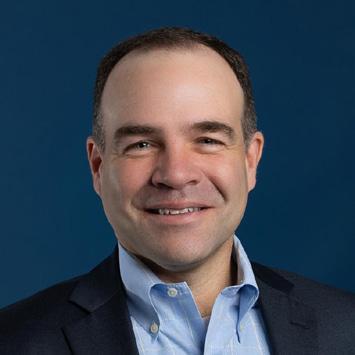
Andrew DeGuire is the James H. Keyes Dean of the College of Business Administration. DeGuire most recently served as the vice president of corporate strategy at Northwestern Mutual and was a member of the Northwestern Mutual Venture Fund investment committee and board chairman for Wysh Life & Health.
Q. Marquette opened Dr. E. J. and Margaret O’Brien Hall in 2023, a 109,000-square-foot collaborative space and the $60M home of Marquette Business and the University’s innovation leadership programs. Can you talk about the extent to which this speaks to Marquette’s ambitions and the impact this will have on current and future generations of students?
O’Brien Hall reflects our philosophy that Marquette should be a convening place. This building allows our broader community— colleagues from across the University, corporate partners, alumni, community groups, etc.—to interact with our faculty, staff and students. When these groups gather, our students forge connections that lead to jobs and internships, our local employers get an early look at the next wave of talented professionals, and our faculty members discover new possibilities for collaboration. This building was purposely designed to complement everything happening inside the classroom.
One of the things that always strikes me about O’Brien Hall is how it’s constantly in use. Whether you’re here at 7 a.m. or 11 p.m., someone will be studying in the hallway or getting coffee in the lobby. This building makes it easy for students to be around and learn from their peers, and that’s an immensely positive thing. Our greatest asset is our people. O’Brien Hall’s primary purpose is to maximize their time and talent.
Q. While business schools are increasingly embracing sustainability and CSR, leading with purpose is an integral part of Marquette’s DNA. Can you talk about how Marquette’s Sustainability Lab and events like the Nexus Sustainability Leaders Summit inform the student experience?
Our Sustainability Lab and the Nexus Sustainability Leaders Summit are great examples of collaborations between the business and engineering colleges and across the University. One of the central points from last year’s conference was the identification of different paths for companies and campuses to deploy technologies that save energy and the financing methods to pay for them. These are the kinds of questions and challenges that our graduates face. They require cross-functional work and expertise to make an impact.
We take the same approach with our real estate institute, supply chain management and advanced automation teams, as well as
our technical sales program. All of these have operational elements in both engineering and business.
MBA PERSPECTIVE: ASSISTANT DEAN OF GRADUATE PROGRAMS KAREN RINEHART
Q. Can you talk about the MBA pathways and delivery methods you currently offer?
Marquette offers an MBA, Online MBA, and Executive MBA (EMBA). The MBA is flexible, with online, on-campus, and hybrid course options. The Online MBA is fully asynchronous, and the EMBA combines on-campus sessions every other Saturday with online learning. MBA student Madison Sawyer sums it up well:
“Marquette’s MBA helps students balance work and studies while building strong inperson connections.”
Q. To what extent are students able to personalize their MBA experience?
Personalization is at the heart of Marquette’s MBA offerings. Students tailor electives to match career goals, with indemand options like negotiations, leadership, and management. We also factor prior business studies into decisions on whether to grant waivers for foundational-level courses, which can expedite program completion for students with business backgrounds.
In addition to MBA specializations in finance, marketing, and leadership, I want to particularly highlight the STEM-designated Business and Managerial Analytics specialization, which was launched in 2024 and has already been selected by 16% of new students. We’re also excited to support three new specializations planned for fall 2025: Data Science and AI, Systems Engineering and Clinical Immersion in Medical Device Design. The EMBA experience is also highly personalized through the tight-knit cohort format and electives offered based on students’ interests. Recent electives have included Interpersonal Influence, Authentic Leadership and Sponsorship and Mentorship.
Q. How does student diversity impact learning and support?
Diverse academic and professional perspectives greatly enrich Marquette's

MBA program, which is designed to support students with academic backgrounds within and beyond business.
MBA student Valeria Navarro Villegas:
“Collaborating with classmates from diverse industries has provided fresh perspectives and challenges me to think critically about innovative solutions to real-world problems.”
Within the EMBA, teams are purposefully mixed to foster dynamic learning—pairing, for example, service-industry pros with manufacturing experts, or technical minds with liberal arts thinkers.
Recent EMBA graduate Cynthia Baricos:
“My team had a marketing leader from France, an accounting leader from Upper Wisconsin, an ER Physician from Korea, and an operations leader in the legal field born in Colombia. This diversity offered different lenses with which to view the world and the materials I was learning. My experience was better for having them in my cohort and my life is richer because of our continued friendships.”
Q. Given the growing STEM talent shortage, can you talk about the opportunity attached to this program post-MBA?
Marquette’s analytics focus is designed to answer the growing demand for data-savvy leaders. The U.S. Bureau of Labor Statistics projects 11% job growth for management analysts, for instance, and our students are considering these trends when selecting a program. We are thinking about how best to set them up for their careers after graduation even in the formative stages of the program.
Student Vitus Hirschberg, who is pursuing the Business Managerial Analytics specialization, said the following:
"This specialization shifted my goal from marketing to consulting and data analytics, showing me the power of data-driven decisions.”
Q. Given the extended, post-MBA, optional practical training period STEM graduates are offered, currently three years, do you expect to see an uptick in international students? 240
unique experiences and goals in their personal statement. Valeria offers excellent advice:
“One EMBA student saved his company over a million dollars by applying the processes he learned in the business analytics course to his job.”
International students have long been part of Marquette’s community thanks to our supportive culture. Marquette welcomes each new student with a commitment to their development and success. Milwaukee is also a great city for graduate study and employment opportunities. Milwaukee ranks fifth on Forbes' recent list of the best U.S. cities for college students and graduates. Not only is Milwaukee a business hub with numerous internationally recognized companies within its metropolitan area, it has an international airport and is within a 90-minute drive of Chicago, which has direct flights to places all over the world.
International students are eligible for merit-based scholarships, including graduate assistantships and tuition scholarship credits.
Q. Marquette has forged deep industry connections, reflected throughout its programs and specialist areas, e.g., executive education, supply chain management, and real estate. With this in mind, how does industry inform the MBA curriculum and experiential learning opportunities?
Marquette’s deep industry ties provide consistent and valuable feedback that informs curriculum, strategy and collaborations. Industry involvement spans contributions to advisory boards from C-suite leaders across the country, guest speakers, mentoring programs and human resources connections with our Business Career Center.
Students regularly gain actionable insights from Marquette’s industry-informed curriculum. One EMBA student saved his company over a million dollars by applying the processes he learned in the business analytics course to his job.
Q. From an admissions standpoint, what advice would you give potential applicants?
Marquette values the whole person, so applicants are encouraged to share their
“Reflecting on your ‘why’ is important for pursuing an MBA. For me, it’s about creating a better future for my family and community.”
Requesting a conversation with an admissions counselor is a great first step; Marquette faculty and staff are interested in learning about each applicant to support their success.
Q. For applicants lacking the requisite academic/professional business milestones, do you offer alternative pathways?
The online Master in Management (MiM) is a great fit for aspiring leaders who are focusing on people development and strategic growth. With flexible electives and no GRE/ GMAT requirement for qualified applicants, MiM grads are ready to thrive as principled leaders in any environment.
Q. What does the future hold for Marquette in regard to your graduate and executive education offerings?
Lifelong learning is one of the things that distinguishes a Marquette graduate. We are driven by a constant desire to seek truth and to use that knowledge to better others’ lives. Our graduate and executive education offerings fit comfortably within that mission.
At the graduate level, we will be focused on preparing people to move between business units by emphasizing critical thinking and interdisciplinary learning. The professionals with the most staying power are the ones who can work cross-functionally to solve problems within their organizations. Teaching our students how to think, not what to think, is the best way to ensure that they are prepared for whatever lies ahead in their careers.
Executive education is a significant area of growth for us. We have a responsibility to share the knowledge in this building with the people in our community, and executive education lets us do that while creating a stronger business climate in Milwaukee and beyond. We continue to expand our offerings, ranging from finance to leadership development to applying AI to business processes, with more on the way.
ALEXANDRA SKINNER TALKS TO PAUL HARRISON
Q. What makes Deakin University’s MBA experience unique?
We have designed the Deakin MBA around flexibility, industry relevance, and leadership with real-world impact. We know our students are balancing busy professional and personal lives, so we’ve designed a program that fits around them, whether that means studying on-campus, online, or through immersive experiences like international consulting projects and study tours or residential intensives or a bit of all of these.
But for me, the critical thing is that we embrace complexity. Business (and life) isn’t black and white, and leadership isn’t about finding simple answers; it’s about how we navigate uncertainty, competing priorities, and constant change. We challenge students to engage with the real messiness of business, from balancing financial goals with ethical leadership to making strategic decisions in unpredictable contexts and managing teams in socially responsible and financially viable ways.
Q. Can you unpack the MBA pathways and delivery options you offer?
One of the best things about the Deakin MBA is its flexibility. At its core, the foundation of the Deakin MBA is online. So, we’ve built a world-class online learning experience that allows students to study from anywhere, at any time. But flexibility isn’t just
about being online; it means different things to different people, and we’ve designed the program to accommodate a wide range of needs and learning styles. For those looking for something different, we offer intensive study options. Our residential programs bring students together for short, high-impact learning experiences where they tackle business challenges as a team. We also have a study tour with international consulting projects, where students apply their skills in a global context, solving complex problems for organisations in different cultural and economic environments.
And there are also the stackable short courses (we refer to them as Masterclasses), which give students even more control over their learning journey. They can start small, build their skills over time, and eventually transition into the MBA when it makes sense for them. The bottom line is that we know our students have different goals, commitments, and ways of learning, so we’ve made sure the Deakin MBA is as flexible as possible without compromising in any way on quality.
“We’re making sure our students have the skills and knowledge to not just keep up with change but to drive it.”
“The biggest advantage of an MBA isn’t just the technical knowledge but learning how to think at a higher level, make better decisions, and lead through complexity.”
Q. Based upon these pathways, who is the Deakin MBA designed for?
At a broad level, I think what makes an MBA unique is that, unlike nearly every other degree, it’s about generalisation, not specialisation. Most degrees focus on developing deep technical expertise in a single field: finance, marketing, science, engineering, law. An MBA is different. It’s for people who are ready to move beyond technical skills and understand the whole organisation; how strategy, leadership, operations, finance, and people all connect. The thing that really defines the Deakin MBA cohort, though, is their mindset. We want students who are curious, open to challenging themselves and driven to do better. If you are someone who wants to grow, who is willing to question what you know, and isn’t afraid to take on complexity, then this is the MBA for you. That’s what makes the learning experience so powerful. Everyone brings their own background and perspective, but they’re all here to push themselves and each other to think bigger.
There’s no single type of person who does an MBA because people enrol for so many different reasons. Some want security, so they are looking for a qualification that future-proofs their career and gives them the confidence that they’ll always have options. Others are more focused on moving up in their current workplace, stepping into leadership roles or transitioning into new industries. And some come into the MBA because they want to make a bigger impact; they’re thinking beyond their career and looking at how they can contribute to meaningful change, whether through social impact, sustainability, or transforming industries from the inside.
Q. Increasingly, students want to align educational outcomes with career goals via specialisations. With this in mind, to what extent can students personalise their MBA journey?
Personalisation is a big focus for us because we know that everyone comes into an MBA with different career ambitions. Some students want to go deep into leadership and strategy, while others are more focused on digital transformation, finance, marketing, or entrepreneurship. That’s why we give students the ability to shape their learning experience, whether that’s specialising through their electives, industry projects, global consulting work, or short courses that let them build their expertise in areas that matter most to them. But we also encourage students to go even further than that. An MBA can be specialised for those who want to think about the role of business in a more connected way. That’s why we encourage our students to consider other discipline units when developing their electives suite. Are there other areas they’re curious about? Science, philosophy, human behaviour? They’re at one of the best universities in the world; why not take advantage of that? Because if we’re truly encouraging curiosity and critical thinking, we’re going to do better as a society. The best leaders aren’t just great at business; they can take ideas from different disciplines, challenge their own assumptions, and apply what they’ve learned in unexpected ways. That’s what makes this MBA different.
Q. What does this mean in terms of ROI— employability, industry readiness, and career future-proofing?
The biggest advantage of an MBA isn’t just the technical knowledge but learning how to think at a higher level, make better decisions, and lead through complexity. Our students aren’t here to memorise frameworks; they’re here to challenge themselves, refine how they approach problems and gain insights that go beyond their industry. One of our
graduates, Gioia Zitslaff, came into the MBA with a background in neuroscience, working in scientific research and development. The MBA gave her the strategic, commercial, and leadership skills to make a bold career move, transitioning into a senior marketing role in the cutting-edge field of cell and gene therapy at Miltenyi Biotech. She was able to bridge the gap between science and business, bringing a unique perspective to a highly specialised industry. By expanding her understanding of business strategy, market positioning, and organisational leadership, she was not just changing jobs—she was positioning herself at the forefront of an industry that is transforming modern medicine.
I think this is what sets our graduates apart. They don’t just leave with a degree. They leave with a more sophisticated, futurefocused way of thinking that allows them to navigate uncertainty, manage large-scale change, and lead with confidence. This is why so many of our students move into C-suite roles, take on board positions, or drive major business transformations before they have even completed the program. Beyond immediate career impact, our MBA is about ensuring long-term relevance. The world of work is shifting. Artificial intelligence, automation, digital transformation, and sustainability pressures are redefining industries. Leaders who understand these forces, who can adapt, innovate, and think strategically, will be the ones who shape the future of business.
Q. How important are industry partnerships, and to what extent do they inform the curriculum?
Industry partnerships are central to what we do. We have an incredibly connected Advisory Board with MBA alumni and business experts across digital technology, public health, marketing, public policy, and law. We don’t just bring industry into the classroom—we send our students out into the real world to work on live projects and solve real business challenges. For example, our students recently worked with ActionAid Italy to help develop a new market strategy around segmentation. We’ve examined the
Asylum Seeker Resource Centre’s Journeys Café on social enterprise models. We’ve partnered with the Stroke Foundation and Beyond Blue to explore behavioural change challenges in healthcare. And we’ve worked closely with businesses like The Gospel Distillers, founded by Deakin MBA alumni Andrew Fitzgerald, which is a great example of how entrepreneurship and business strategy come together in the real world. These partnerships make sure our curriculum stays relevant, but more importantly, they give our students the chance to apply their skills, make connections, and gain experience that makes them stand out in the job market.
Q. Looking ahead, what can current and future students expect from Deakin over the next 12-18 months?
We’ve got some exciting changes on the way. The MBA is about to launch a major refresh to ensure it’s even more future-focused. We’re expanding industry partnerships, embedding sustainability and alternative forms of knowledge into the curriculum, creating more opportunities for hands-on learning, and continuing to evolve how we deliver the program so students have even more flexibility. One of the biggest shifts I am particularly proud of is the increased focus on sustainability, ethical and responsible management, and governance. We know that businesses today need leaders who can balance profit with purpose; people who can make smart, ethical decisions and navigate the challenges of environmental and social responsibility. That’s going to be embedded throughout the curriculum. At the same time, we’re also incorporating the emerging areas of digital transformation and data analytics. Leaders today need to be comfortable working with technology, whether AI, big data, or emerging digital business models. We’re making sure our students have the skills and knowledge to not just keep up with change but to drive it.
Beyond that, we’re working with colleagues at four of our partner universities to develop exciting new initiatives for First Nations business leaders, which we’re really proud of. It’s about creating a pathway for Indigenous business leaders and making sure the future of business leadership in Australia is collaborative, diverse, inclusive, and deeply connected to the community.
“Our students aren’t here to memorise frameworks; they’re here to challenge themselves, refine how they approach problems and gain insights that go beyond their industry.”

BIOGRAPHY
MBA Director Paul Harrison is a senior lecturer and the Unit Chair of Consumer Behaviour in the Department of Marketing in Deakin Business
School.
Imagine hearing that an AI-powered chatbot negotiated a multi-million-dollar deal between two Fortune 500 companies. Sounds like science fiction. Well, it’s not. Just last year, an AI model assisted in a major corporate merger, demonstrating that artificial intelligence is no longer a futuristic concept; it’s today’s reality. AI is not only shaping new business models but also redefining traditional industries. Recently, JPMorgan Chase deployed an AI-driven fraud detection system that saved the bank millions by identifying fraudulent transactions in real time. In the world of marketing, AI-driven recommendation engines have helped companies like Netflix and Amazon significantly increase user engagement and revenue by offering hyper-personalized content. The retail sector is also seeing massive AI-driven changes, with brands like Zara using AI to manage inventory and predict trends, reducing waste and improving efficiency.
Artificial intelligence is transforming the business landscape at an unprecedented rate. From predicting market trends to optimizing supply chains, AI is not just a tool; it’s a strategic imperative. Businesses across industries are rapidly adopting AI,

recognizing its potential to revolutionize operations and improve decision-making.
Yet, while AI is a powerful tool, its real impact depends on how well organizations can integrate it into their business strategies.
According to a study by PwC, AI could contribute up to $15.7 trillion to the global economy by 2030, making it one of the most transformative forces of our time. The real question is: are today’s business leaders equipped to leverage AI effectively?
“We don’t just teach AI; we teach how to use AI as a transformative force in every single aspect of a business.”

AI is not confined to tech giants like Google or Amazon; it’s reshaping industries across the board. The financial sector, for instance, has seen remarkable AI-driven innovations, with investment firms using AI to analyze market data and predict stock performance with extraordinary accuracy. Hedge funds and trading platforms now rely on AI-powered algorithms to execute trades at lightning speed, capitalizing on market trends before human traders can react. Meanwhile,
insurance companies are deploying AI-driven chatbots and claim processing systems, significantly reducing the time needed to settle claims and improving customer satisfaction.
Marketing has also been profoundly transformed by AI. Brands such as Coca-Cola leverage AI to analyze customer sentiment and optimize advertising campaigns. By processing vast amounts of social media data, AI helps companies understand what resonates with consumers, allowing them to create highly targeted ad campaigns. Similarly, AI-powered dynamic pricing has become a game-changer in the travel and hospitality industries. Airlines like Delta and hotel chains like Marriott use AI to adjust prices in real time based on demand fluctuations, ensuring maximum profitability while offering competitive rates.
Logistics is another area where AI is making a massive impact. Companies like FedEx and UPS rely on AI to optimize delivery routes, reducing fuel consumption and improving efficiency. AI-powered predictive maintenance has also proven invaluable in reducing downtime for shipping and airline industries, ensuring that vehicles and aircraft remain operational for longer periods of time. Human resources departments are increasingly using AI to streamline recruitment processes, with platforms like LinkedIn using AI-driven algorithms to match candidates with job opportunities more accurately. AI-powered HR software helps companies analyze employee performance, predict turnover, and improve workplace engagement strategies.
As AI continues to evolve, businesses that fail to adapt risk being left behind. According to Deloitte, 82% of early AI adopters have already seen positive financial returns. The writing is on the wall—companies that fail to integrate AI into their core business strategy will struggle to compete in the digital era.
The advantages of AI in business are undeniable. AI automates routine tasks,
“The question is not if AI will impact your industry but how prepared you are to leverage it.”

allowing employees to focus on higher-value work, which has led to significant gains in productivity. A report from Accenture estimates that AI could boost labor productivity by up to 40%, freeing up human resources for more strategic and creative roles. AI has also become a powerful tool for service personalization. Streaming services like Spotify and YouTube Music rely on AI to curate customized playlists based on users’ listening habits. Retailers like Sephora use AI-powered chatbots to offer personalized skincare and makeup recommendations, enhancing the shopping experience.
Predictive analytics has been another breakthrough enabled by AI. Banks use AI to assess credit risk and detect fraudulent transactions, while hospitals employ AIpowered diagnostics to identify diseases with greater accuracy than traditional methods. AI’s ability to analyze vast datasets and generate actionable insights has transformed industries ranging from healthcare to retail. Task automation has also proven invaluable, with AI-powered systems now handling everything from answering customer inquiries via chatbots to optimizing supply chain logistics in real time.
Yet, while the potential is vast, unlocking AI’s full benefits requires more than just implementing technology; it demands expertise. Despite AI’s growing prevalence, there is a glaring skills gap in the workforce.
BUSINESS SCHOOL PROFILE
EU Business School (EU) has been educating future entrepreneurs and business leaders since 1973. We offer innovative foundation, bachelor’s, master’s and MBA programmes on our campuses in Barcelona, Geneva and Munich, as well as on our Digital Campus. We believe in hands-on, pragmatic learning that will give you the real-world skills to excel in the workplace of the future.
A survey by Gartner found that 56% of business executives struggle to implement AI due to a lack of in-house expertise. This gap underscores the urgent need for professionals who not only understand AI but know how to apply it strategically to drive business success. This is where EU Business School’s Master’s in Artificial Intelligence for Business comes in. Designed for forward-thinking professionals, the program equips students with the knowledge and hands-on experience needed to drive AI-powered transformation in any industry. The curriculum is tailored to address real-world business challenges, ensuring that graduates can seamlessly integrate AI into business strategies and decision-making processes. The program focuses on building strategic leadership skills, ensuring that students are proficient in AI technology and capable of guiding businesses through the complexities of digital transformation.
Key Differentiators of the Master’s Program
What makes this program stand out is its practical approach, with students working on real-world AI projects and gaining hands-on
experience with cutting-edge technologies. The faculty comprises AI specialists, data scientists, and business leaders who are actively shaping the future of AI in business, offering unparalleled industry insights. The program also emphasizes strategic skill development, going beyond technical expertise to focus on leadership and decisionmaking in AI-driven business environments.
EU Business School lecturer and marketing, digital business and artificial intelligence expert Pablo Gilardini Ricci puts it best:
“Our students are prepared for realworld scenarios. They are exposed to the latest AI technologies and learn how AI impacts businesses. More importantly, they discover how to leverage AI to enhance business practices, promote sustainability, and foster innovation. We don’t just teach AI; we teach how to use AI as a transformative force in every single aspect of a business.”
Industry Insights: Why AI in Business is the Future
Industry leaders recognize the urgency of AI adoption. Sundar Pichai, CEO of Alphabet, famously stated that AI is one of the most profound things on which humanity is working, more profound than fire or electricity. Meanwhile, a Deloitte report found that businesses that successfully integrate AI into their operations are seeing measurable improvements in efficiency, revenue growth, and customer satisfaction. Dr. Lisa Chen, an AI strategy consultant, notes that companies that fail to embrace AI risk becoming obsolete in an increasingly data-driven world. AI is no longer just a competitive advantage; it is a necessity for survival and growth.
Conclusion: The Future Belongs to AI-Ready Leaders
The AI revolution is here, and it’s reshaping the way businesses operate. The question is not if AI will impact your industry but how prepared you are to leverage it. For professionals looking to stay ahead, investing in AI education is the smartest move. EU Business School’s Master’s in AI for Business offers the perfect blend of technical knowledge and strategic insight to equip future business leaders for the AI-driven world.
Are you ready to lead the AI revolution? Learn more about how this program can transform your career and position you at the forefront of business innovation.


In the modern pursuit of success, stress is often seen as an unwelcome burden— an inevitable tax on our ambitions. Yet, rethinking stress as an ally rather than an adversary can transform our relationship with it and fuel exceptional performance. The story of US tennis player Mardy Fish exemplifies this perspective, illustrating that when properly managed, stress can be the engine that drives us to peak performance. Mismanaged, however, stress can also be a slippery slope to burnout.
At first glance, Mardy Fish’s career seemed typical for a professional athlete. Early on, he was a talented player rising through the ranks, yet he hadn’t made a significant mark on the world stage. A decision late in his career, however, led to a transformation. He decided to defy expectations and give his tennis career
one final push. A move that was intrinsically motivated by the knowledge that he could never rest easy in retirement, knowing he hadn’t truly pushed himself to the limit to see what he was capable of.
So, at the end of the 2008 season, he established a series of goals, including losing weight and reaching peak physical fitness. He reorganised his training team and began to work as hard as he could. All day, every day. He stopped drinking alcohol and went on a strict athlete’s diet. He started to get more sleep, sometimes going to bed as early as 7.30 pm. He stopped seeing friends. He was obsessed; every decision in his life involved tennis. The fitter he became, the longer he trained. He slept in a hyperbaric oxygen chamber to speed up recovery from training. In two-and-half months, he lost 31lbs. This transformation catapulted him from 123rd in world rankings to 7th in just two years; an incredible achievement. This rise wasn’t just about technical skills and fitness but a psychological metamorphosis—a shift in his approach to an edgier, more aggressive style. Fish became relentless, embodying a fierce drive to prove himself. However, this greater intensity brought other challenges that would ultimately destabilise his ability to maintain this success.
His initial performance breakthrough had led to packed schedules, high expectations, and the need to consistently perform at an elite level. As his schedule intensified, Fish found it increasingly difficult to decompress. In an attempt to manage his stress, he turned to methods like sleep aids to handle time zone adjustments. Yet, these quick fixes could only do so much. His energy began to dwindle, and mental fatigue set in. The relentless demands created a steady buildup of what psychologists
call a ‘life load’—an accumulation of stress from various sources that together can lead to a tipping point.
The wear and tear on Fish’s mind and body manifested in anxiety attacks, which increased in intensity. In a critical moment during the 2012 US Open, Fish was set to face tennis legend Roger Federer, but he could no longer go on and withdrew from the match, effectively marking the end of his career. Fish’s story shows us that we all have limits as individuals. His career serves as a reminder that without balance, any of us can find ourselves at the mercy of stress.
Our Autonomic Nervous System (ANS) plays a crucial role in regulating stress and recovery. It manages essential functions like heart rate, digestion, and breathing. The ANS has two components: the sympathetic system, which activates our ‘fight or flight’ response, and the parasympathetic system, which is responsible for rest and digestion. A balanced interplay between these systems is essential for managing stress. Lifestyle changes, prolonged stress, and unexpected events can disrupt this balance, pushing us into a state of chronic stress. Over time, the body’s ability to respond effectively to stress weakens, making it challenging to perform at one’s best.
Heart rate variability (HRV) offers valuable insights into the body’s stress response to factors such as these and our recovery capabilities. HRV measures the variation between heartbeats; higher variability generally indicates a relaxed state, while lower variability can signal that the body is under stress. Monitoring HRV can provide a window into whether our bodies are in recovery mode or bracing for action.
Learning from Fish’s experience, athletes and those in any walk of life can benefit from integrating recovery into their training and performance cycles to prevent the detrimental effects of prolonged stress.
Another important factor is that for many business professionals and athletes alike, identity can be closely tied to performance. This can be empowering but also creates vulnerabilities. Fish’s story reveals how deeply one’s sense of self can be wrapped up in achievement and how dangerous this
“Athletes and those in any walk of life can benefit from integrating recovery into their training and performance cycles to prevent the detrimental effects of prolonged stress.”

“Over time, the body’s ability to respond effectively to stress weakens, making it challenging to perform at one’s best.”


BIOGRAPHY
Adrian Kelly is a former solicitor who has transitioned into business and sports-performance coaching. Adrian has been active as a business advisor and coach, assisting companies across both Northern Ireland and the Republic of Ireland. His advisory work notably includes supporting businesses impacted by Brexit through a contract with InterTradeIreland. Alongside his team, Adrian has worked individually with over 100 businesses, helping them navigate complex issues such as import/ export operations. Having played and coached baseball for the last 10 years, he has a keen interest in promoting sport and wellbeing and is the current chairman of the award-winning, multimillion-euro Peace Link Sport Complex Clones, County Monaghan. Adrian’s new book, The Success Complex, is published by Practical Inspiration Publishing.
can be if not carefully managed. His journey is a reminder that a career, no matter how passionate, should not be allowed to define one’s entire identity. Being a committed professional should not mean that you become a hostage to your career. There should always be a space, however small, that allows for the possibility of retreat, recalibration and even reinvention. We should maintain a balanced perspective that allows us to manoeuvre when the landscape changes, as it invariably will.
In the world of elite sports at that time, players like Fish also competed in a culture of machoism. A culture which suppressed emotions, which were seen as a weakness. A factor which can stifle their ability to cope effectively with stress by acknowledging it and talking about it to trusted friends and trained professionals. When people ignore their emotional needs, stress intensifies and can ultimately lead to burnout. A balanced approach would recognise the value of nurturing one’s emotional well-being as an integral part of the pursuit of success.
The Role of Resilience
Resilience is often touted as the secret ingredient for enduring stress; however, resilience isn’t about being invulnerable but about finding ways to recharge amid challenges. Harvard professor David Eddie explains that resilience can be built through regular, meaningful recovery, such as engaging in creative or restful activities. These moments allow the mind and body to recover and grow stronger, increasing our overall capacity to manage stress. For Fish, implementing structured recovery periods could have provided a buffer against the relentless pressures he faced.
Dr Van Someren, a world-leading expert in the area, likens these restorative activities to plugging in a smartphone. While smartphone batteries tend to degrade over time, our body’s batteries can grow and expand. This expansion is often a result of enduring significant stress while experiencing quality, deep physical, mental and emotional recovery. The key, it seems, lies in subjecting the body
and mind to productive stress (training, performance, demanding more of ourselves) and then following it with profound physical, mental and emotional rejuvenation.
Crafting a Sustainable Path
Mardy Fish’s career serves as a powerful case study on the value of balanced stress, and he’s gone on to be an inspiring beacon postretirement, raising awareness of the subject. In the Netflix documentary ‘Breaking Point’ he shares his insightful and remarkable story with the world.
In summary, to reach our peak, we shouldn’t necessarily avoid stress but instead manage it wisely. This requires strategic planning that includes time for rest, gratitude, and moments of genuine replenishment. Fish’s journey is a reminder that success requires not only hard work but also a deep understanding of one’s limits and a willingness to prioritise well-being alongside ambition.
Building resilience, mastering stress, and achieving peak performance are interconnected goals. By respecting the rhythm of our bodies and allowing for adequate recovery we can create a sustainable path to success.
We believe pu rpose and great id eas impac t how our world works, connec t s, and lives .
Take the nex t step in your career with our unique, industr y- connected and design-thinking centred MBA , run by Australia’s largest business school.
Challenge your self to change, engaging in our reimagined MBA programs leveraging RMIT’s international strengths in design, technology and enterprise
Through our MBA , you will develop the capabilities, knowledge and tools to be successful in any industr y or entrepreneurial set ting around the world This degree is suited to young and aspiring professionals with limited experience.
The RMIT E xecutive MBA is designed for the leader s of tomorrow seeking to learn, net work, take control of their career and lead sustainable organizations. Emily McPher son Scholar ships covering full tuition-fees are available. Learn on your terms at a speed that suits you.
RMIT is ideally located in the centre of Melbourne, one of the world’s most liveable cities
To find out more on our MBA programs visit rmit .ed u. au /postgr ad
For the Emily McPher son Scholar ship visit rmit .edu.au/students/work-study-oppor tunities
ALEXANDRA SKINNER TALKS TO THE AUSTRALIAN INSTITUTE OF BUSINESS
For many professionals, the hardest part of pursuing an MBA isn’t deciding to take the leap – it’s finding a programme that delivers real career outcomes. The Australian Institute of Business (AIB) stands out for its flexible, online and practically focused programme. AIB’s MBA is designed for working professionals who want to apply what they have learned in real-time. This hands-on approach has empowered thousands of graduates to accelerate their careers without pausing their professional or personal commitments.
The versatility of the AIB MBA allows graduates to explore diverse and rewarding career opportunities, whether it’s climbing the corporate ladder, launching a business, stepping into the boardroom or advancing into research. But how does this transformation unfold in real life? What does life after the MBA really look like?
In this article, we showcase four AIB alumni who leveraged their MBA experience to achieve extraordinary success. From earning high-powered promotions to building companies from the ground up, these stories highlight how the lessons, networks and confidence gained from an MBA can shape careers in profound ways.
ENTREPRENEURSHIP AND EDUCATION:
Carmen Garcia’s Business Success Story
Launching a new business is a challenging venture; making a business last is even harder. Data from the Australian Bureau of Statistics (2022) revealed that 48% of all new Australian business start-ups fail within the first four years, with 23% failing within the first year.
Understanding the challenges ahead, Carmen Garcia pursued an AIB MBA to enhance her skills as an entrepreneur and strengthen her credibility.
Carmen is the CEO and Founder of the award-winning diversity and inclusion certified social enterprise, Community Corporate. The organisation partners with corporations to create job opportunities for underrepresented groups, including refugees, migrants, mature women and young people–many of whom are overlooked, especially with AI-driven hiring. Community Corporate works on both sides of the hiring process, strengthening employers' inclusion capacity while empowering diverse job seekers with the skills and confidence to take on new opportunities.
Carmen’s specialised Marketing MBA provided valuable insights into consumer behaviour, transforming her decision-making. It also gave her the confidence to navigate boardrooms and the skills to translate complex ideas into business language, making her more effective in engaging with senior
leaders. AIB’s practical curriculum allowed her to apply industry learnings to real-world challenges as she progressed in her studies.
“There are a lot of MBAs that are very theoretical, but, particularly for entrepreneurs or small business owners, AIB’s MBA really enables you to integrate theory with your actual business. My final project explored how CSR can influence customer attraction and retention for me. We need to prove to businesses that doing good is not just good for business, but there is a financial return on investment.
Understanding persona avatars, motivators, and quality indicators that drive business decisions is critical to this and something I really enjoyed.”
As Carmen Garcia expands Community Corporate in 2025, she remains dedicated to continuous learning and innovation. After piloting new initiatives last year, the organisation now has a clear roadmap for refining strategies to better meet customer expectations and drive long-term success.
“The MBA played a strong role in building my confidence to test ideas and assess risk before making an investment of time or money. As a result, Community Corporate has become leaner, more agile, and quick to move on new opportunities with the rigour behind decision-making now BAU.”
Carmen’s advice to those aspiring to start a business:
“It's not a part-time gig; be prepared for late nights and early mornings and have enough fuel in the tank to push through. It comes down to confidence and courage in yourself and your offering. For me, it was about my genuine desire to lead change in my space. I encourage many of my colleagues, friends, and partners to consider the MBA as it is not just about professional growth but personal growth, especially for those embarking on a career in business and entrepreneurship.”

ALUMNUS: Carmen Garcia AM CEO and Founder, Community Corporate
For many professionals, joining a board represents a defining career accomplishment. The 2024 Watermark Search International Board Diversity Index reports that one in five ASX300 board directors holds an MBA, highlighting its value in securing and succeeding in board roles.
Ruth Palmer, executive director of the Property Council of Australia in the Northern Territory Division, is an expert in the field of membership-based organisations. Having left school before completing Year 11, Ruth’s career had been shaped primarily by handson experience. After seven years in her current role, she saw the MBA as a valuable opportunity to formalise the practical knowledge gained throughout her career. AIB offered her the unique advantage of entry based on professional experience rather than a traditional degree. With the ability to study online while working full-time in Darwin, the programme was the perfect opportunity to upskill and further develop her leadership capabilities.
Since completing her MBA, Ruth has been invited to serve on numerous boards and committees that have significantly contributed to the Northern Territory's development. Currently, she is the President of Gymnastics NT and Neighbourhood Watch NT, a board member of the Salvation Army Advisory Board, and a member of the Darwin Activate Board, INPEX Business Advisory Committee, and NT Business Council. She also holds roles such as Executive Sponsor of the Indigenous Advisory Group and is a member of the Economic Vibrancy Committee for the City of Palmerston.
The MBA was transformative in transitioning Ruth’s career towards leadership and influence in the boardroom.
“Three months after graduation, I secured my first board position, a testament to the strategic thinking, financial acumen and governance knowledge I gained during the MBA.”
Ruth’s MBA experience was defined by subjects like Leadership and Strategic Management, which strengthened her adaptability and decision-making skills for board leadership. The Capstone Project offered real-world applications of her learning, while interactions with peers and mentors broadened her professional perspective.
“Three months after graduation, I secured my first board position, a testament to the strategic thinking, financial acumen and governance knowledge I gained during the MBA.”
“The AIB alumni network has been an invaluable resource, providing a platform to connect with like-minded professionals who share similar goals and challenges. The network has fostered opportunities to collaborate on initiatives and access mentorship and advice from experienced leaders.”
Ruth’s advice to those aspiring to join a board:
foundation to complement his entrepreneurial instincts. He decided to pursue an AIB MBA to learn business frameworks and principles to position himself for future growth and leadership opportunities.
Since completing his MBA, Chris has built a diverse career across both public and private sectors, ultimately advancing to the C-suite. In 2020, he joined Jones Radiology as Chief Marketing Officer. One of the defining moments in Chris’s time at Jones Radiology was leading the rebrand from Dr Jones & Partners Medical Imaging to Jones Radiology. He played a key role in maintaining the company’s rich, century-long legacy while positioning it for the future, a challenge he navigated successfully using the strategic and leadership skills gained through his MBA.

“Perseverance and strategic preparation are key. Set clear goals and actively seek opportunities to build the experience required for board roles. My journey from not completing Year 11 to obtaining an MBA and securing board positions reflects the power of resilience and long-term focus. Engage with mentors, pursue professional development and remain adaptable. Most importantly, identify causes and organisations that align with your values – passion drives purpose, and purpose attracts opportunity.”

“Don't wait for a title to seek opportunities to lead, even in small ways, and focus on empowering others to achieve success.”

Executive Director Northern Territory Division, Property Council of Australia of AIB alumni have applied the MBA in their job or business 96%
Chris Ogilvie’s
“The MBA contributed to my career success without a doubt. It equipped me with tools and insights that have been instrumental in navigating complex business challenges and scaling my impact as a leader.”

As the highest level of corporate leadership, C-suite executives play a pivotal role in shaping their organisations as well as broader industry trends. By exposing leaders to diverse business functions, an MBA ensures they develop the versatility needed to navigate a wide range of complex business challenges. Nearly 40% of C-suite executives on the 2022 Fortune 1000 list hold an MBA, according to proprietary research by Fortune.
Chris Ogilvie’s career has been built on hands-on experience, beginning in small business and then founding several ventures in a variety of industries. Chris had an understanding of business management; however, he wanted a stronger theoretical

Building on his impressive career trajectory, Chris is now the CEO and CoFounder of Solved Development Labs, a startup software company focused on automation, integration and driving success through digitisation.
“Many of the principles I learned during the MBA remain relevant today. Whether it’s making strategic decisions, understanding organisational dynamics or managing risk. I often draw on lessons learnt in my MBA to navigate my responsibilities as a C-suite leader. My textbooks are never far away in my study bookshelf, nor are the individual subject study guides.”
Chris’s advice to those aspiring to reach the C-suite:
“Stay curious and embrace continuous learning. As you commence your studies, use every opportunity within your workplace to seek to apply your learnings. I believe I saw 12 different versions of my organisation as I completed each of the 12 subjects. Don't wait for a title to seek opportunities to lead, even in small ways, and focus on empowering others to achieve success.”

Vaso Charitsis’s Continued Pursuit of Excellence
An MBA not only accelerates career progression but also opens doors to further educational opportunities. Research degrees such as the Doctorate of Business Administration (DBA) build on the MBA’s foundation, offering professionals the chance to engage in high-level research and delve into specialised areas. Vaso Charitsis’s story exemplifies the transformative power of continuing education as she leveraged her MBA to achieve significant success in a highly competitive field.
Vaso is a seasoned communications and marketing professional with over 15 years of experience providing impactful counsel to organisations across diverse sectors. As well as having a number of qualifications from Canadian institutions, she holds an MBA from AIB, graduating as valedictorian and earning the Dean’s Merit Award.
Vaso leveraged the skills and knowledge gained from AIB’s practical and immersive MBA to secure a role in the corporate communications team of a digital hospital. This career transition reflected both the strength of her education and her ability to apply it in a dynamic, real-world setting. Her MBA at AIB also had a significant financial imapct, leading to a significant salary increase.
learning journey, and I’m profoundly grateful for the lasting impact they’ve made.”
Vaso’s advice to those considering a master’s or doctoral degree:
“Education is not only about personal and professional growth but also about empowering oneself to make a meaningful difference in the world. Pursuing an MBA or further studies opens the door to a wealth of opportunities – not just to enhance your own skills and career but to contribute to the betterment of your community, industry, and society. For those considering this path, I encourage you to view it as an investment, not just in your future, but in the lives you can touch and the positive impact you can create.”
ALUMNUS:

Vaso Charitsis

“The design of the programme, blending theory with practical application to solve realworld problems, ensures you not only acquire the foundational strategies but also have the opportunity to immediately implement them in work settings. Given the flexibility to study at any time, I could advance my career without having to compromise personal and professional responsibilities or income.”
After selling her cherished family business, Vaso found herself at a crossroads. Passionate about lifelong learning, she sought to expand her expertise not just for personal growth but to make a meaningful impact on the industries and communities she serves. Building upon the strong foundation from her MBA, Vaso decided to pursue a DBA at AIB.
“My MBA played a pivotal role in preparing me for this next academic pursuit, providing a strong foundation of critical thinking, strategic decision-making and research skills. The DBA offers the chance to refine my research skills and capabilities in the pursuit of exploring a research problem in an applied manner. The AIB professors are more than just educators; they are dedicated mentors who bring unparalleled expertise and passion to every lesson. Their unwavering support and guidance left an indelible mark on my


AIB DBA Research Candidate
of AIB alumni received a salary increase since starting the MBA
“The AIB professors are more than just educators; they are dedicated mentors who bring unparalleled expertise and passion to every lesson.”

SCHOOL PROFILE
AIB is the largest online MBA provider in Australia*, with 40 years of history and a global network of more than 20,000 students, alumni, academics and industry experts from 100 countries. AIB’s online MBA is designed to support working professionals achieve career outcomes faster with no exams and practical assignments you can apply to your workplace from day one.
The insights provided were garnered from AIB’s 2023 Alumni Insights Report, which was sent to 7,650 of AIB’s global MBA alumni who graduated between 2005 and 2023.
*20 Biggest Online MBA Providers, MBA News (July 2024).






Chris Harrison, CEO of Horizon River and a Kennesaw State University

Executive Master of Business Administration (EMBA) graduate, has built his career on leadership, innovation, and strategic growth. Since taking on his current role, he has been focused on revitalizing his team, fostering sustainable business expansion, and leveraging the skills he honed during his time in KSU’s EMBA program. In this interview, Harrison shares insights on leadership, the value of an EMBA education, and how his networking initiative, AscendX, is strengthening connections between students and alumni.

Q. Can you tell us a little about your role at Horizon River Technologies?
I took over as the CEO of Horizon River about seven months ago. We run a boutiquemanaged network and cybersecurity firm that supports restaurants and retailers with locations across the country. We provide all the connections for the stores, manage and monitor them, and keep them up and connected 24/7. Our goal is to make it easy for our clients to focus on their business without worrying about their network and cybersecurity needs. We handle everything from Wi-Fi connections to 24-hour troubleshooting, ensuring their operations run smoothly.
Q. How did you get to where you are today in your career?
I spent most of my career on the technology side, starting with fixing computers in bank branches, then installing networks, and eventually designing networks for large companies. About 12 years ago, I left the big corporate world to start a smaller firm with a partner, bringing enterprise experience to restaurants and retailers. I started at SunTrust Bank, then moved to Fiserv, and later to Genuine Parts Company. Each step taught me a lot about building and managing large-scale networks. Now, I use that experience to help smaller businesses with their tech needs.
Q. What inspired you to get into this line of work?
Growing up, when computers were new and exciting, I was drawn to it. I did a lot with computers in middle and high school, which got me interested in technology. I actually burnt myself out on computers by the time I started college, so I tried accounting for a bit, but after a couple of classes, I realized it wasn't for me. I went back to technology because it felt like there was always new territory to explore. One of the biggest things I’ve learned about myself is that I’m a problem solver, and that’s exactly how I’d describe what I do. It used to be tech problems and now it's business problems. That's what motivates me and gives me energy when I get up in the morning.
“The program didn't just give me the technical knowledge I needed; it made me a more effective and compassionate leader.”

Q. Why did you choose KSU for your EMBA?
KSU is just 12 minutes away from my house, and it's a great school with a highly ranked EMBA program. The convenience, cost, and quality of the program made it an easy choice. If I had known that the EMBA path was available to me, I probably would have pursued it five to ten years earlier. I just never looked because I assumed it was a closed door.
The realization that I could join the program without a traditional academic background gave me the confidence to take the leap.
Q. How has the program influenced your role as CEO?
The program really changed the way I approach leadership and business. I came into the program looking for hard skills like accounting and marketing, but what I walked away with was so much more. The personal development and soft skills I gained were much more valuable. They taught me to be more empathetic and people-focused, which has transformed my leadership style. The program didn't just give me the technical knowledge I needed; it made me a more effective and compassionate leader.
“The personal development and networking opportunities are worth every bit of effort and investment.”

“The convenience, cost, and quality of the program made it an easy choice.”

BIOGRAPHY
Q. Can you talk about AscendX and the intention behind it?
AscendX is a networking group I started to connect alumni and current students of the EMBA program. We organize networking breakfasts and other events to help people get to know each other and share leadership experiences. During the program, I realized how important it is to build strong relationships with peers. AscendX helps bridge the gap between different cohorts so that everyone can support each other and grow together. This group has really helped create a sense of community and collaboration among EMBA students.
Q. What was the most impactful part of the EMBA program for you?
The personal development track was a game-changer. We really dove into mission statements and core values and were challenged to create a personal mission statement.
That exercise, the self-reflection, figuring out who I am, what is important to me, and what I am trying to achieve, was incredibly eye-opening. It has carried over into my role as CEO. When I took over, I asked all the employees what our core values were, and no one could tell me. So, we had an allhands meeting where everyone contributed to defining our core values. It was not just about what I thought they should be but what everyone in the company valued.
Q. Can you share an experience from the EMBA program that stood out to you?
One standout experience was developing a business idea from scratch and presenting it to real investors, like Shark Tank. This exercise was very enlightening, giving us hands-on entrepreneurial experience. It helped me apply what we learned in class to a real-world scenario, deepening my understanding of business development and strategy. The feedback from the investors was very helpful, refining my ideas and approach. It was such an awesome experience because, even though I've been in the entrepreneurial space for a while, I hadn't personally gone through the entire process, from the seed of an idea all the way through to pitching it to people. Seeing the whole process from start to finish was incredibly valuable.
Q. How did the EMBA study abroad trip change your perspective?
The international trip was a highlight of the program. We traveled to Santiago, Chile, where we learned about their business culture and consulted with a local company on real business problems. This experience was incredibly insightful, helping me build connections and understand global business practices. It was amazing to see how businesses operate in different cultural contexts and to apply our skills to help solve their challenges. I enjoyed the trip so much that I returned to Santiago to participate in an entrepreneurial festival. The event gave me the chance to mentor local entrepreneurs and strengthen my connections in South America. Seeing the companies implement some of our suggested recommendations was very rewarding.
Q. What would you say to someone considering the KSU EMBA program?
What are you waiting for? Do it right now. So many people get stuck in the same spot, thinking they need hard skills to get involved, but this program gives you all that you need. The personal development and networking opportunities are worth every bit of effort and investment. I tell everyone I talk to about the program and why they should join. The program didn’t change who I am at my core, but it sparked a new energy in me and fresh ways to share it with the world. It's truly transformational. Apply as fast as you can!






ALEXANDRA SKINNER TALKS TO THE UNIVERSITY OF SAN FRANCISCO’S MBA DIRECTOR, FRANK FLETCHER
Q. Can you talk about the MBA pathways and delivery methods you offer at USF?
The MBA is offered as a two-year, fulltime MBA, an online part-time MBA, and an Executive MBA (EMBA). The full-time and EMBA programs are delivered in person.
Q. What makes the University of San Francisco’s (USF) MBA unique?
The USF MBA is more than a degree—it’s an immersive, career-shaping experience at the heart of one of the world’s most dynamic business hubs. USF’s MBA isn’t confined to the classroom. Through client projects with leading companies, access to top industry conferences, and daily networking opportunities, students are constantly engaged with the city’s innovation and business ecosystem. With small class sizesindividual classes never exceed 30 students - and a cohort that brings global perspectives and diverse professional backgrounds, students collaborate closely, building meaningful relationships that last a lifetime.
Students pursuing the full-time MBA choose a Career Accelerator Platform (CAP) in the spring of their first year. This is a dynamic, industry-focused initiative designed to equip MBA students with the skills, experiences, and connections needed to advance their careers. One of the highlights of the CAP experience is a 14-week clientfacing project. In addition, students receive personalized career coaching, exclusive networking opportunities with top employers, and a fully curated academic journey led by some of our top faculty. By integrating career development directly into the MBA experience, the CAP empowers students to navigate their professional journeys with confidence and impact.
“Once you’re in the program, prioritize networking with peers, faculty, and industry professionals. The relationships you build will be just as valuable as the knowledge you gain.”

One of the advantages of the USF MBA program is that it fosters a dynamic and collaborative learning environment by bringing together students from all three program formats—full-time, online part-time, and EMBA—through shared academic and cocurricular experiences. Elective courses and the Horizon Core, a flexible core curriculum, allow students to engage with peers across programs, enriching discussions with diverse perspectives and professional insights. Beyond the classroom, networking events, industry speaker series, and conferences create opportunities for students to build meaningful connections, gain industry knowledge, and expand their professional networks. This integrated approach ensures that all USF MBA students benefit from a broad, cross-program learning community that enhances their education and career growth.
Q. Students have access to a host of experiential learning opportunities, from project and consulting work to domestic (Silicon Valley) and global immersions. Can you unpack these opportunities for our readers and talk about the benefits attached?
Experiential learning is at the heart of the USF MBA program, providing students with hands-on opportunities to apply their knowledge in real-world business settings. Course-embedded projects integrate live case studies and industry collaborations, allowing students to tackle real business challenges within their coursework, while the 14-week CAP project connects students with companies for immersive, project-based work that enhances their industry expertise and professional networks.
The Magis Final Project serves as a capstone experience, where students synthesize their learning to develop strategic, high-impact solutions for real organizations. Additionally, the Malloy Group, USF’s student-run consulting club, enables students to engage with businesses and nonprofits, sharpening their consulting skills while making a tangible impact. Together, these experiential learning opportunities ensure
that USF MBA students graduate with the knowledge and hands-on experience needed to drive meaningful change in their careers.
Q. Given that the Bay Area breathes tech, one might assume this is the default sector for most of your graduates. Is this the case?
While the tech sector is a major draw for many graduates of the USF MBA program, our location in one of the most diverse economies in the U.S. provides students with a wealth of career opportunities beyond technology. Our graduates leverage this sector diversity to explore careers in financial services, advisory services, healthcare, travel and tourism, and agriculture, among others. This broad economic landscape not only expands job prospects but also attracts a diverse student body with varied professional backgrounds and career aspirations. As a result, the learning experience is enriched by a wide range of perspectives, fostering dynamic discussions, cross-industry insights, and a stronger professional network that extends far beyond the classroom.
Q. From an admissions standpoint, what advice would you give potential applicants?
Applying to the USF MBA program is an opportunity to take a transformative step in your career, but it starts with authenticity. Your application should reflect who you truly are—your experiences, aspirations, and the unique perspective you bring to the program. Take the self-reflection process seriously; an MBA is not just a credential but a deeply personal and professional journey. Think critically about the kind of learning experience that resonates with you most. Consider the Who, Where, What, and Why of your decision: Who do you want to share this experience with and learn from? Where do you want to immerse yourself in business education? What are you hoping to achieve, both during and after your MBA? And most importantly, Why is this the right time for you to pursue it? Thoughtful answers to these questions will not only strengthen your application but also ensure that you choose the MBA experience that aligns best with your goals and values.

BIOGRAPHY
Frank Fletcher is the senior director of MBA programs at the University of San Francisco’s Masagung Graduate School of Management.

“USF is more than a school, it’s a family that believes in you and stands by you every step of the way.”
PROFESSOR MARCO TAVANTI
Q. Can you talk about the relationships you enjoy with industry, how these inform the curricula, and what this means for your students?
I enjoy dynamic relationships with various industries and sectors, which deeply inform the curricula I design and deliver. As president of the Sustainable Capacity International Institute and CEO of SDG Services, I provide consulting on sustainable development and organizational impact mapping. My 35 years of experience in sustainable development projects and collaborations with the United Nations Global Compact, United Nations Development Programs, and other international organizations have equipped me with the expertise to integrate both the theory and practice of sustainability into my leadership and management courses.
My interdisciplinary work spans the private sector, including the robotics industry, inter-governmental organizations such as the United Nations, and the social-nonprofit sector through NGOs, social enterprises, and foundations. This broad spectrum of experience allows me to curate a diverse range of case studies and projects that resonate with real-world challenges and solutions, making my teaching highly relevant and impactful for students.
From time-to-time, I also invite guest speakers such as Dr. Alfredo Sfeir Younis, a mentor and collaborator. Dr. Sfeir Younis, renowned as the first environmental economist hired by the World Bank and its former director, brings invaluable insights into sustainability from his dual perspective

as an economist and Buddhist. This enhances the learning experience by exposing students to diverse perspectives on sustainability leadership.
Through these industry connections and collaborations, I aim to prepare students not only to excel academically but also to become effective, value-driven leaders who can navigate and address complex sustainability challenges across sectors.
Q. While the number of business schools adding electives in sustainability and ESGfocused practices is increasing, sustainable management education is one of the School of Management’s key pillars. Can you talk about how this is reflected in your MBA provision?
Sustainable management education is deeply embedded in our MBA programs. As the faculty lead for Sustainability in Management Education and program director for the Master in Sustainable Business Management, I leverage my international expertise as a sustainability professional and researcher to shape these programs. My extensive experience includes numerous publications on sustainability, as well as consulting and capacity-building for global organizations, including the United Nations. This role allows me to ensure that sustainability principles are not just electives but core components of the curriculum. Students are increasingly eager to learn about the leadership mindsets and technical skills necessary for roles like chief sustainability officer or chief impact officer. To meet these demands, we focus on two critical areas for student development:
● Mastery of Sustainability Reporting Standards and Regulatory Compliance: Students learn about key sustainability and ESG reporting frameworks such as GRI (Global Reporting Initiative), the UNGC-COP (United Nations Global Compact - Communication on Progress), and the forthcoming compliance requirements under California SB 253 and SB 261. These state laws will require companies to disclose their GHG emissions, including Scope 3, beginning in 2025 and 2026. Students also explore the global regulatory landscape, including Europe's CSRD (Corporate Sustainability Reporting Directive) and CS3D (Corporate Sustainability Due Diligence Directive). This knowledge equips them to understand and apply ESG best practices and navigate compliance in multinational corporations, SMEs, and impact-driven enterprises.
● Integration of Sustainability and Technology: Our MBA programs emphasize the intersection of sustainability and emerging technologies. Students explore the use of platforms like Salesforce Net Zero Cloud, which enables tracking and reporting on Scope 3 emissions, a requirement for compliance with California's climate regulations and the SEC's forthcoming climate disclosure rules. Furthermore, we examine the role of generative AI in sustainability reporting and the potential of blockchain technology for product traceability and sustainable supply chain management (SSCM). These technologies are transforming how companies track, verify, and report ESG data, enabling more transparent and resilient supply chains.
Through these areas of focus, we aim to prepare students for leadership roles where they can shape the future of sustainable business. While some leaders and policies may attempt to roll back progress, we see it as our responsibility to develop the next generation of leaders who will be equipped to drive impactful change, face climate challenges, and seize sustainability opportunities in an evolving business landscape.
MBA STUDENT

Mary Sia Konoyima
Q. Why did you want to pursue an MBA, and what made you select USF?
M.S.K.: An MBA was not just a career move for me; it was a step towards becoming a leader who blends strategy, empathy, and impact, someone capable of driving meaningful change in both the corporate and community worlds. USF stood out not only as a school but as a community that genuinely cares about its students' success and well-being. Their warmth and support were undeniable from the moment I began my application. Even when I faced my hardest setback, being denied a visa, they didn’t give up on me. USF gave me the courage to keep going, and that’s why I chose them; they chose
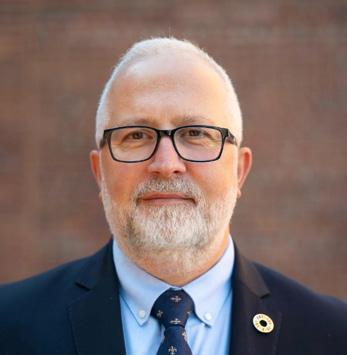
BIOGRAPHY
Dr. Marco Tavanti is a professor of leadership and sustainability at the University of San Francisco’s Masagung Graduate School of Management.
“An MBA is not just a credential but a deeply personal and professional journey.”

me first. The exceptional quality of education, the values of inclusivity, and their investment in students' holistic growth made USF the perfect choice for me.

Robyn Carnie
R.C.: In my search for an MBA program, I was drawn to USF for its emphasis on business analytics and customer success—areas I recognized as essential for my professional growth. I wanted to enhance my skill set with a deeper understanding of business analytics and finance. After meeting the admissions team and attending a data mining lecture with Vijay Mehrotra, I knew USF was the right fit. The beautiful downtown campus, intimate class sizes, and practical, data-driven curriculum sealed the decision.
Q. What were your career goals coming into the program, and have these evolved over the course of your studies?
R.C.: Initially, my primary goal was to transition into a product management role within the tech sector. However, through the diverse coursework and projects I’ve completed during the program, I’ve discovered a deeper passion for solving complex problems through data-driven solutions. The program has allowed me to refine one of my key strengths, bridging communication between stakeholders and envisioning how this can be combined with analytical tools to drive impactful decisions.
M.S.K.: When I started, I was laser-focused on enhancing my leadership and analytics skills and transitioning into a tech-driven role. However, USF has done more than refine my goals; it has reshaped how I see the world. The program is teaching me that success is not just about achieving; it’s about the impact you leave behind. My vision now includes leading with purpose, using the tools I have gained to inspire others, and creating opportunities that uplift my communities.
Q. Can you talk about the pedigree of your fellow MBA participants and what they bring to the program and your learning experience?
R.C.: My peers have an incredibly diverse range of experiences I would not have encountered outside this program.
From fashion enthusiasts to environmental advocates and engineers to accountants, everyone brings a unique perspective to every project.
Q. What has been the most challenging aspect of returning to education, and what mechanisms have you put in place to manage the increased workload?
R.C.: The first semester was the most challenging. It had been around eight years since I was last in a classroom and nearly 18 years since I tackled subjects like accounting. Adapting to business subjects like finance and strategy and learning foundational concepts required effort.
To fully engage in the program, I chose to get involved in clubs, which allowed me to connect with peers beyond the classroom and build a stronger sense of community. I primarily relied on Google Calendar to stay organized, keeping on top of assignments and club activities and ensuring effective group meetings. This proactive approach helped me balance my responsibilities while making the most of my MBA experience.
Q. What do you consider to be the highlight of the program thus far or a moment of significant growth?
R.C.: One of the standout moments of the program was being given the opportunity to host a fireside chat with a key VC partner in Silicon Valley. This experience pushed me out of my comfort zone.
The preparation process required me to research both the VC partner and the start-up landscape, finding unique questions to ensure the conversation would resonate with a diverse audience of SOM students and faculty. On the day of the event, I had the opportunity to see the fruits of the preparation I had done and the hours I had spent practicing public speaking in the Public Speaking Club we started in our first year. I felt honored to be offered this opportunity and really enjoyed the experience.
Q. Are there unique elements of the program that you feel will enhance your career objectives?
R.C.: One of the most unique elements of the program has been its emphasis on storytelling and business analytics as tools to drive better business decisions. Through coursework and projects, I’ve learned how to leverage data, not just to analyze trends but to craft compelling narratives that will lead to action.
M.S.K.: USF doesn’t just teach you; it prepares you for the world. Their career development course is unlike anything I have experienced; it helps you discover who you
are, what you stand for, and where you want to go. From resume building to interview prep, they ensure you are ready to succeed.
Q. How would you summarise your MBA experience at USF?
R.C.: My MBA experience at USF has been an amazing journey so far; a blend of academic learning, leadership opportunities, and meaningful connections that have prepared me to take the next step in my career with confidence.
M.S.K.: It’s been a transformative journey of growth, resilience, and connection. USF is more than a school; it’s a family that believes in you and stands by you every step of the way. The experience has not only expanded my knowledge but deepened my sense of purpose as a leader. They have taught me that leadership is about heart and success is about lifting others as you climb.
Q. What advice would you give potential applicants?
R.C.: My advice to potential applicants is to embrace the MBA as a holistic growth opportunity. The journey begins even before you apply, so take the time to reflect on your goals and motivations. Writing a thoughtful
statement of purpose is a great way to clarify why an MBA is the right step for you and how it aligns with your career aspirations. It’s equally important to research the curriculum of the programs you’re considering. Understand what courses and concentrations are offered and how they fit into your desired career path. Look for unique aspects of the program, such as experiential learning projects or specialized tracks, that resonate with your interests and ambitions.
Connecting with alumni is another invaluable step. Their firsthand insights into the program’s culture, strengths, and opportunities can help you determine if it’s the right fit. Alumni can also share tips on maximising your MBA experience and building meaningful connections within the program.
Once you’re in the program, prioritize networking with peers, faculty, and industry professionals. The relationships you build will be just as valuable as the knowledge you gain. Approach challenging projects with curiosity and an open mind, as they’re opportunities to stretch your skills and learn from others’ perspectives. The MBA isn’t just about academics—it’s about growing as a professional, a leader, and a person.

As a CEO in a highly competitive industry, my world often felt confined to the demands of my business.
The EMBA widened my horizons, reinforcing that leadership is not just about navigating the known but embracing the unknown with confidence and a strategic mindset. It reminded me that differences are not barriers but strengths and that by fostering diverse perspectives, we build more resilient and innovative teams.
Dee Bustos USF EMBA '25, CEO Care Indeed

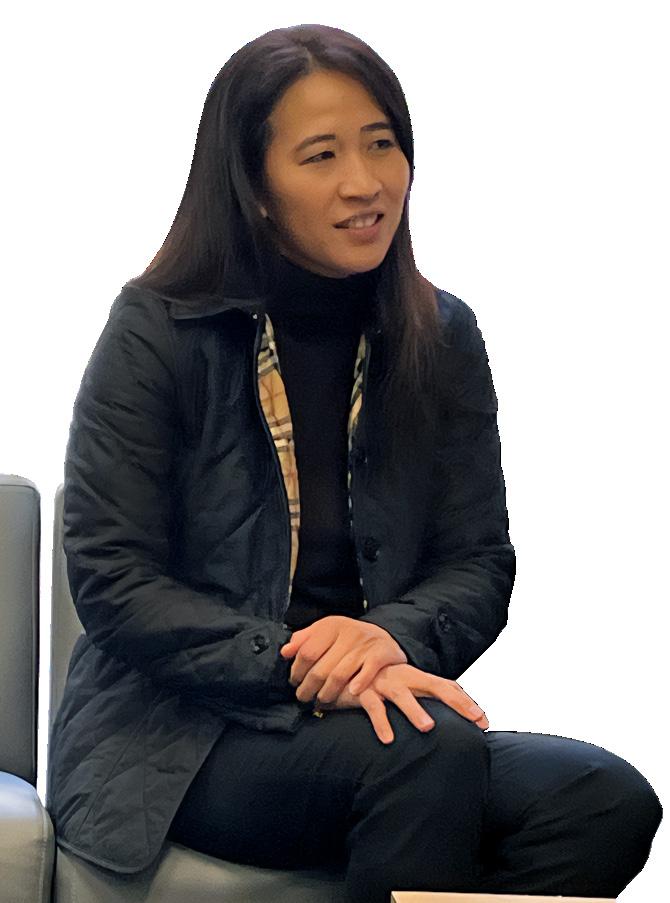

Generative artificial intelligence is transitioning from a curious toy to an indispensable tool that more companies are integrating into daily operations, according to a new report by Wharton experts and marketing consultancy GBK Collective.
“Growing Up: Navigating Gen AI’s Early Years” is a survey of more than 800 senior business leaders in large organizations that reveals a seismic shift in their attitudes and applications of AI in just a short time. In 2023, the first year of the survey, only 37% reported using AI weekly. That number has risen to 72% in 2024. Negative perceptions, namely worry and skepticism, are softening as decision-makers explore how this evolving technology can help their firms become better.
“I was quite pleased to see the results. The picture we are getting is that people are learning about gen AI — and what they are learning, they like,” said Wharton marketing professor Stefano Puntoni, who is also faculty co-director of AI at Wharton. He wrote the report along with Jeremy Korst, partner at GBK Collective, and Mary Purk, executive director of AI at Wharton.
According to the survey, generative AI is being widely deployed across functions, even in departments such as marketing and human resources that were initially slower to adopt it. The highest use is in document and proposal writing and editing with 64%, followed closely by data analyses and analytics at 62%.
Other high-use functions include customer service and support (58%), fraud detection and prevention (55%), and financial forecasting and planning (53%).
Puntoni said the survey also shows the gap is closing between the two extreme beliefs about AI being either a harbinger of doom or a gateway to utopia. As people become more acquainted with it, they are less curious and less fearful. They’re more willing to experiment with AI while understanding its limitations, including false information known as hallucinations. Survey participants cited accuracy, bias, data privacy, team integration, and ethics as their top concerns.
“You should think of it as a tool, and tools are not intrinsically bad,” Puntoni said. “The danger is that you come to accept anything it says, and we need to build in systems to fact check.”
Puntoni said the survey is generally positive about the future of AI, but he did not want to speculate about what the same questions might reveal five years from now. However, he’s sure about one thing: Organizations will keep experimenting with AI to figure out how it works best for them. And as it evolves, so will the other technology required to make it more useable and practical, such as voice interface.
“I don’t believe the hallucination problem is ever going to be completely solved, but it’s clear we are making massive progress,” he said. “There’s a lot of gas in the tank in terms of learning how to use this technology and developing complementary innovation.”
Although AI has been in development for decades, Puntoni and his colleagues agree that the rapid advancements of the last few years have ushered in a new era, one in which the transitions will come much faster than, say, the 40 years it took factories to move from using steam engines to using electricity.
“This is only the beginning,” Puntoni said. “I think the big rewards are not going to come from doing things better; the big rewards are going to come from doing better things.”

BIOGRAPHY
Stefano Puntoni is the Sebastian S. Kresge Professor of Marketing at The Wharton School and faculty co-director of AI at Wharton.
ACKNOWLEDGEMENT
Republished with permission from Knowledge at Wharton(http:// knowledge.wharton.upenn.edu), the online research and business analysis journal of the Wharton School of the University of Pennsylvania.
ALEXANDRA SKINNER TALKS TO DANIEL SERROT, EXECUTIVE MBA DIRECTOR
“The EMBA is transformative, and applicants with curiosity, ambition, and a desire to push their limits will definitely benefit.”
Q. Can you talk about the design and delivery of your Executive MBA offering at the University of San Andrés?
With a comprehensive academic proposal, individualised instruction, and the most recent learning methodologies, our Executive MBA (EMBA) is centred on the student experience, offering a worldwide network, leadership development, and a strategic business vision. Our programme aims to create and nurture high-impact business leaders by improving analytical and business acumen, strengthening leadership skills, and increasing the output of both innovation and entrepreneurship.
We offer a part-time programme with on-campus classes every two weeks. These are coupled with online classes, which provide our high-profile students with a high degree of flexibility. For example, we are the only business school utilising ‘augmented attendance’, which allows students to engage in classes remotely as if they were physically present, even during business trips or while unable to attend campus. Students also benefit from the recording of all classes, which are thereafter accessible in the Virtual Campus. The AI Panopto technology assists students in locating certain moments of the class they wish to revisit.
Q. How much emphasis do you place on soft skills and why?
Soft skill development is the focus of the EMBA’s Professional Development and Leadership track. In addition to a set of elective courses on leadership skills from which students must select four courses, the track offers a combination of required courses on smart careers, professional development, and a workshop on personal and professional strategic planning. Students can also choose to go on a career development trip to Punta del Este, Uruguay.
Students are divided into groups of no more than six, and each group is paired with a certified coach who leads a series of group and individual sessions. Additionally, students are trained to do peer mentoring among themselves. Beyond peer learning opportunities, we also provide board meeting simulations and meet-up sessions. We offer the Professional Development and Leadership track because we firmly believe in the transformative impact our EMBA has on students who appreciate engaging in selfawareness and 360-degree review exercises to discover their true identities and aspirations regarding their personal lives and career prospects.
Q. Whom is your EMBA designed for?
Participants with a wealth of professional experience and strong managerial potential are given preference in the EMBA. In this sense, we only accept students who are at least 27 years old and have five years of working experience or more. Currently, the average student is 39 years old and has 14 years of professional experience. Our students have a strong track record, and as a result of their undergraduate studies, seek management, leadership, and professional growth, as well
as a broad understanding of business and analytical decision-making.
Q. In promoting diversity, how does this impact the learning experience for your MBA students?
The EMBA highlights diversity as a key element of the learning experience. This diversity comes in multiple forms—academic backgrounds, professional experience, nationality, age diversity, and gender balance—enriches classroom discussions and broadens perspectives. By engaging with peers from diverse backgrounds and specialisations, students are able to tackle business problems from a variety of perspectives, resulting in more creative and comprehensive solutions. Improved crossfunctional teamwork, emotional intelligence, and adaptability, essential leadership traits, are also enhanced.
Finally, the programme's mix of professionals, which includes entrepreneurs, executives, and experts in marketing, technology, finance and other disciplines, generates beneficial networking possibilities. Consequently, the curriculum promotes pluralistic thinking in which students constructively critique one another's perspectives and hone their strategic thinking.
Q. You recently launched a regional EMBA. What prompted this decision?
To reach professionals who want oncampus classes. To reduce the frequency of their visits to our campus, classes take place on Thursday, Friday, and Saturday every three weeks. We launched the programme in August, and we will accommodate approximately 60 domestic and international students.
“Via our lifelong learning initiatives, we guarantee ongoing access to knowledge, enabling alumni to stay abreast of changing market trends long after earning their MBA.”
The Regional EMBA will give us access to candidates year-round, enhancing our strong leadership position in Argentina as the premier MBA programme – we are in the top three regional rankings.
The programme schedule also allows us to invite additional visiting professors, as it requires just two flights to Buenos Aires. Thus, students have access to exceptional educators in addition to our local faculty.
Finally, the programme will include Babson Build, a one-week programme designed to take students inside the new venture creation process in Boston, USA, thereby unleashing their entrepreneurial mindset.
Q. While many business schools are just adding AI and Blockchain to their electives, these subjects form part of a much wider list of electives on offer at the University of San Andrés, for example, AgTech and Business in the Metaverse. How important is innovation to the University, and to what extent does this help to future-proof your students’ careers?
The EMBA is centred on innovation, which influences both its curriculum and the entire educational process. Business courses on artificial intelligence (AI), blockchain, data science, and neuroscience offer a thorough grasp of the technologies causing change. We feel that students who are exposed to disruptive technologies acquire the skills necessary to foresee and manage change, which increases their resilience and adaptability in unpredictable corporate settings.
Students actively apply innovation, developing business models that can succeed in emerging markets via the New Business Launchpad track and SparkLab, our startup
incubator. Through initiatives like Deep Dive Destinations, students also have the option to travel to Silicon Valley, New York, Boston, Singapore or China to gain firsthand knowledge of cutting-edge companies and potential future markets.
Via our lifelong learning initiatives, we guarantee ongoing access to knowledge, enabling alumni to stay abreast of changing market trends long after earning their MBA. We ensure our graduates don't merely respond to change but actively promote it by integrating innovation into every facet of their careers.
Q. Your EMBA students have the opportunity to spend a semester at one of your partner schools in the U.S., Latin America or Europe. How does this inform real-world learning and the subsequent skills your students accrue?
The EMBA’s international exchange opportunities offer students a transformative learning experience that extends beyond the classroom. Students acquire firsthand knowledge of global marketplaces, business models, and cultural dynamics by studying in the location they choose. This, in turn, supports their strategic decision-making and leadership capabilities in international settings. Students who live and study abroad are forced to exercise critical thinking and quick adaptation, two skills that are essential for managers running businesses in quickly evolving marketplaces.
Q. To what extent do sustainability and social enterprise factor into your EMBA offering?
Sustainability and social enterprise are firmly incorporated into the EMBA, reflecting the School's commitment to creating and nurturing high-impact business leaders. These values are integrated throughout the programme, preparing graduates for the increasing emphasis on sustainable business practices and social impact. Sustainability, Energy & Business, Impact Investments, Behavioural Finance, and Social and Environmental Business Models are just some of the elective courses we offer in this area.
The New Business Launchpad track helps students create profitable, socially responsible businesses, while the SparkLab
incubator helps students create social and environmental companies. Courses like Adaptive Leadership and Competing in a Sustainable and Exponential World prepare students to lead enterprises that benefit society.
Finally, the alumni network collaborates on sustainable innovation and social entrepreneurial projects.
Q. Can you talk about the post-MBA impact of your EMBA graduates?
The EMBA equips graduates with leadership skills, a strategic attitude, and a network to revolutionise their industry. By emphasising innovation, leadership, and lifelong learning, alumni stay impactful after graduation. The programme also champions innovation and company creation, leading alumni to launch startups and social enterprises.
Our ‘Lifelong Learning’ offer helps graduates upgrade their leadership and strategic skills, keeping them abreast of market trends—many return as guest lecturers, mentors, or advisers, enriching the University's vibrant learning community. For example, we have a strong connection with Endeavor Argentina, and the executive director is an EMBA graduate.
Q. What advice would you give to potential applicants?
For EMBA applicants to enhance their experience and get the most out of the programme, consider your goals. Are you interested in career growth, entrepreneurship, leadership development, or networking? The EMBA is a transformative process, so having a clear vision will help candidates seize every opportunity.
Balancing work, study, and personal life requires time management, but our alumni and peer network provide support, connecting classmates with professors and industry leaders. We also recommend the use of networking, mentorship, and Lifelong Learning tools.
Participation is also strongly encouraged, as debates and case studies frequently yield the deepest insights.
Once enrolled on the programme, students can apply all they learn to their current work environment. It is a space to present real-world problems and utilise the learning process to test risk-free solutions. The EMBA is transformative, and applicants with
curiosity, ambition, and a desire to push their limits will definitely benefit.
Q. What can current and future students expect from the University of San Andrés over the next 12-18 months?
We will continue to strengthen our EMBA in the areas of strategic business vision, innovation, leadership development and international engagement. Some examples of the initiatives we are considering for the next 12 to 18 months include:
● Augmentation of electives offering, with an emphasis on AI, Blockchain, AgTech, and FinTech, ensuring students and alumni remain at the forefront of disruptive innovations. ‘AI impact on the future of work’ and ‘EdTech’ are examples.
● Increasing integration of sustainability and ESG strategies into corporate decision-making.
● Further international exchange initiatives with premier business schools in the U.S., Europe, Asia and Latin America.
● Enhanced assurance of learning processes in line with international accreditation standards.
● Enhancements to hybrid and distance learning, enabling students and alumni to access recorded lectures, digital resources, and interactive synchronous and asynchronous sessions.
● Implementation of AI-powered educational technologies to customise learning and enhance the experiences of students and alumni.
The future looks bright for our students!
“The EMBA equips graduates with leadership skills, a strategic attitude, and a
network to revolutionise their industry.”

BIOGRAPHY
Daniel Serrot is the director of the Executive MBA at the University of San Andrés.
Anail-biting penalty shootout. A sprint title decided by mere milliseconds. A championship that comes down to the wire. From baseball to badminton, sport has a remarkable ability to unite millions of people around the world and leave them on the edge of their seats, whether they’re watching the action unfold in person or tuning in from afar.
Behind the scenes, the business of sports is much more intricate than many fans may imagine. It is a vast, complex industry that extends far beyond what is visible to spectators, driven by everything from globalisation to geopolitics to digitalisation. Below, we pull back the curtain on five key business trends that define the world of sports today.
The intersection of sports and other industries, including media, finance and fashion, is a goldmine for collaborative ventures. The majority of sports teams’ revenues are derived from global television rights, which were estimated to be worth around US$56 billion in 2023 (including nonteam sports). The transition to streaming has reshaped the landscape, creating fresh investment possibilities and redefining how sports is consumed and monetised. Think Netflix’s foray into sports documentaries such as “Formula 1: Drive to Survive” and “Break Point”, or its livestream of the landmark boxing match between Jake Paul and Mike Tyson that drew 108 million global viewers.
While sport thrives on unpredictability and passion, it increasingly relies on financial support – be it in the form of private equity, venture capital, sovereign wealth funds or deep-pocketed individual investors – to grow. A prime example is the US$1.9 billion renovation of Santiago Bernabéu Stadium (football club Real Madrid’s home turf), which would have been impossible without significant external financial backing.
In the world of fashion, luxury apparel brands have been ramping up their partnerships with sports teams and individual athletes (e.g. Louis Vuitton and freestyle skier Eileen Gu and Rolex and tennis player Carlos Alcaraz). Teams and athletes gain prestige and financial support, while luxury labels access a broader, more diverse audience and enhance their cultural relevance. Collaborations with companies in sectors such as nutrition, healthcare, music and education are also accelerating, increasing the connections and blurring the lines between sports and other industries.
The globalisation of sports cuts across all other trends mentioned in this piece and serves as the driving force behind them. Football is a prime example of a sport that has shed its local roots and become a global, multi-billion-dollar phenomenon that is now one of the most commercially driven sports in modern culture.
Regardless of the sport, athletes, teams and leagues must now think beyond their local fan base and adapt their product to audiences across different countries and time zones. This doesn’t just entail optimising kick-off times so that as many people as possible can catch a game live. It also requires global outreach and strategically building an international presence to remain competitive.
This can be achieved through tweaking formats to adapt to other cultures and audiences, increasing the physical presence of a sport within a country, such as sending teams to play exhibition games in different regions during the off-season or nations hosting major sporting events, and initiatives to support local fan engagement.
Unlike the days when club ownership often lay in the hands of devoted fans or local businessmen, the landscape is now more complex. This demands a new level of professionalism to handle sports’ sophisticated infrastructure. The rising returns and valuations of sports teams have investors – from private equity to sovereign wealth funds – flocking towards the sector, seizing opportunities for substantial returns and cultural influence.
Nowhere is this more apparent than in the United States, where investors have poured into the National Football League, the National Basketball Association (NBA) and Major League Baseball, among others. Women’s sports teams – long overshadowed by their male counterparts – are also getting in on the action, with billionaire Michele Kang recently investing millions into football clubs across the US, the United Kingdom and France.
Investment in infrastructure is also propelling the professionalisation of sports, elevating standards for training, competition and event management to lure top-tier talent and foster a culture of excellence. European football is seeing a new wave of stadium developments, with clubs including FC Barcelona, AC Milan and major Premier League teams in the UK transforming their stadiums into year-round multi-purpose entertainment hubs to propel financial growth.
Digital transformation and AI
Digital technologies have and will continue to transform how sport is consumed. Social media has emerged as the primary form of fan engagement, content consumption and marketing strategies, with over 90 percent of Gen Z fans using it to access sports content.
“What was once perceived primarily as a pastime has evolved into a dynamic, multifaceted industry, offering opportunities to build impactful careers and achieve even greater innovation and growth.”
BIOGRAPHY
L. Felipe Monteiro is a senior affiliate professor of strategy at INSEAD.
ACKNOWLEDGEMENT
This article is republished courtesy of INSEAD Knowledge (http://knowledge. insead.edu). Copyright INSEAD 2025.
”In parallel to the professionalisation of the sector, investors are recognising sports as a high-potential asset class.”
Beyond teams, star athletes are harnessing social media as a vital source of revenue. Take footballer Cristiano Ronaldo, who has amassed more than 648 million followers on Instagram and reportedly earns around US$3.23 million per post.
Younger fans are more likely to watch highlights online or interact with athletes via social media than watch sports live. Sporting organisations are therefore using streaming and video platforms such as Twitch, TikTok and YouTube Shorts to spotlight engaging offthe-field moments – from player interviews to behind-the-scenes snippets – that resonate with a Gen Z audience.
In addition, advanced technologies and innovative data-driven methods are being deployed both on and off the field. Data analytics can provide valuable insights for improving team performance – be it AIoptimised training programmes, scouting reports and game strategies or using predictive analytics for injury prevention. On the commercial side, the technology is used to inform dynamic ticket pricing, personalise fan interactions and enhance the in-stadium experience. As a result, partnerships have flourished between sports teams and data companies (the NBA’s Golden State Warriors teaming up with Oracle and Formula One’s Aston Martin collaborating with Arm, to name a couple).
Beyond performance and profit, the sports sector is extending its focus to encompass social responsibility and environmental stewardship. The former involves promoting inclusivity by empowering women in sports, as well as addressing poverty through community engagement, such as investing
in youth sports and education in less economically developed countries.
Women’s elite sports are forecasted to generate over US$1 billion annually, with the value of the US’ National Women’s Soccer League and Women's National Basketball Association projected to grow by at least US$1.6 billion over the next three years. To ensure consistent and sustainable growth, investment must be directed at the right places, including encouraging fan loyalty, player welfare, competition and allocating primetime broadcast slots.
On the environmental front, the sports industry has launched numerous initiatives to mitigate its sizeable carbon footprint and become more sustainable. For instance, the organisers of last year’s Paris Olympics pledged to halve greenhouse gas emissions compared to previous Games. The entire event was powered by renewable energy, and 95 percent of competition venues were either pre-existing or temporary, with the latter designed to reduce their impact on biodiversity.
Elsewhere, sports teams have embraced “green” stadium designs that feature solar panels and water-efficient fixtures, while Formula One is currently developing a sustainable fuel to be used in its racing cars by 2026.
The world of sports encompasses more than athletes pushing their physical and mental limits in the pursuit of excellence. They are backed by a complex network of professionals, businesses and communities that are working in tandem to drive the industry forward.
In parallel to the professionalisation of the sector, investors are recognising sports as a high-potential asset class. What was once perceived primarily as a pastime has evolved into a dynamic, multifaceted industry, offering opportunities to build impactful careers and achieve even greater innovation and growth.

DR BERT WOLFS
The number of Master of Business Administration (MBA) applications has fluctuated in recent years and depends on factors such as region, programme format (full-time, part-time, executive), and the economic climate. Globally, there is a decline in full-time MBA applications, mainly due to stricter visa regulations and a robust job market.
On the other hand, there has been a rise in applications to executive and part-time MBA programmes globally. This increase is driven by professionals who want to continue working while earning their degrees. These programmes offer flexibility and allow students to apply what they learn directly to their current roles, an andragogical approach!
Many professionals, particularly those in their 30s and beyond, prefer the flexibility of an online MBA, as it allows them to balance work, study, and personal commitments.
As the landscape of business and education evolves, MBA programmes must adapt to remain relevant and valuable.
“As programmes evolve to meet the needs of modern professionals, those seeking to advance their careers will find that the MBA remains a powerful tool for achieving their goals.”

This year, several trends and programmatic changes in the broader MBA market reflect the growing demand for skills relevant to an increasingly digitally driven economy. The following analysis will highlight the critical shifts expected in MBA programmes, their significance for prospective students, and their broader career advancement implications.
1. A Need for Permaskilling Permaskilling is essential in today’s rapidly changing job market because it ensures professionals stay relevant and adaptable. Unlike traditional upskilling, which focuses on learning new skills for immediate needs, Perma skilling emphasises continuous learning throughout one's career. As technology evolves and industries transform, continuously acquiring new skills becomes crucial for career longevity. It helps individuals navigate disruptions like automation and digitalisation, fostering agility in problem-solving and innovation. Moreover, Perma skilling supports long-term professional growth, ensuring employees remain competitive and valuable in a dynamic business environment.
2. The Rise of Hybrid Learning Models
In 2025, hybrid MBA programmes combining online and in-person learning will continue to dominate the market. As many professionals have to balance career and personal commitments, flexible learning options are more attractive than traditional full-time, in-person programmes. In this context, MBA programmes are being restructured to offer increased flexibility in course delivery. Hybrid models allow students to access world-class education from anywhere while maintaining the opportunity for in-person networking and collaboration—an essential part of the MBA experience. These programmes cater to working professionals who cannot afford to take significant time away from their careers but still seek an MBA's academic rigour and prestige.
Emphasis will also be placed on refining these models to integrate digital tools with physical classroom experiences seamlessly. This will include using immersive technologies like virtual and augmented reality to enhance the interactive and practical aspects of MBA courses.
Focus on
The business world is increasingly focusing on sustainability, corporate social responsibility (CSR), and ethical leadership. As younger generations demand greater accountability from organisations regarding environmental and social issues, MBA programmes are following suit. For those seeking career advancement, particularly in leadership roles, navigating these emerging demands is becoming critical.
MBA programmes will increasingly incorporate sustainability and CSR into their core curricula, moving beyond electives or specialisations. This shift reflects the recognition that businesses must address environmental and social challenges to remain competitive. MBA institutions like SBS Swiss Business School have already incorporated the 17 UN Sustainable Development Goals into their curriculum.

For career-focused individuals, leading in these areas offers a competitive advantage, especially as industries evolve towards greener, more sustainable practices. Students graduating from MBA programmes emphasising these issues will be wellpositioned to take on leadership roles in industries like renewable energy, sustainable finance, and responsible supply chain management.
In 2025, MBA programmes will continue to evolve to meet the growing demand for professionals with strong technological and analytical skills. As businesses increasingly rely on data-driven decision-making, MBA graduates must have a deep understanding of data analytics, artificial intelligence, and emerging technologies such as blockchain and machine learning.
This shift is already underway, with many MBA programmes introducing courses that focus on the intersection of business strategy and technology. The challenge for business schools is finding tech-advanced faculty members to share these insights with students.
The ability to harness technology and data analytics will be essential for professionals seeking career advancement, particularly those in mid-level management roles. Employers across industries are looking for leaders who can interpret data and leverage it to drive business growth and innovation. MBA programmes emphasising these skills will equip graduates with the tools to succeed in a digital-first business environment.
As the global economy becomes increasingly interconnected, MBA programmes are evolving to reflect this reality. To this end, MBA students will expect a curriculum that prepares them to navigate global markets, understand cross-cultural management, and lead internationally. This global focus will be significant for professionals seeking to advance their careers in multinational organisations or industries with a solid global presence.
To meet this demand, MBA programmes will emphasise international business, global finance, and cross-border collaboration. Additionally, partnerships between MBA programmes and global corporations will become more common, allowing students to engage in real-world projects with multinational firms.
International study tours and exchange programmes will also become more integral to the MBA experience. These initiatives will give students the cultural intelligence and
global perspective to thrive in international business environments.
For professionals keen to take on leadership roles in global organisations, an MBA programme with a solid international component will provide the knowledge and experiences necessary for career advancement. These programmes will help students develop a global mindset, an essential attribute in today's interconnected world.
Gone are the days when a one-size-fits-all MBA was the norm. Working professionals seeking career advancement will find MBA programmes are increasingly offering specialised tracks and customisable learning pathways. This trend is driven by the recognition that different industries and roles require unique skill sets, and students want programmes that align with their specific career goals.
Whether it’s finance, healthcare, entrepreneurship, or marketing, MBA programmes will offer more tailored specialisations to meet the needs of various sectors. This level of customisation allows students to focus on areas of personal interest or align their studies with the demands of their current or future roles.
For professionals who already have some experience in the workforce, the ability to tailor an MBA to their career goals can significantly enhance their career trajectory. Whether aiming for a C-suite role or pivoting to a new industry, specialised MBAs provide the targeted skills and knowledge needed for success.
While technical skills like data analytics and financial acumen remain critical, soft skills such as communication, emotional intelligence, and leadership are becoming increasingly important for career advancement. In response, MBA programmes will emphasise leadership development, team dynamics, and interpersonal skills. Programmes will introduce more experiential learning opportunities, such as leadership boot camps, coaching, and teambased projects, to help students develop these essential soft skills. The focus on leadership development will remain dominant in most MBA programmes.
For professionals seeking career advancement, leading effectively, managing teams, and navigating complex organisational dynamics are often the keys to success. MBA programmes prioritising these skills will
“MBA
programmes will increasingly incorporate sustainability and CSR into their core curricula, moving beyond electives or specialisations.”
“As businesses increasingly rely on data-driven decisionmaking, MBA graduates must have a deep understanding of data analytics, artificial intelligence, and emerging technologies such as blockchain and machine learning.”

equip graduates with the confidence and capabilities required to excel in leadership roles.
As the pace of change in business continues to accelerate, lifelong learning is becoming more critical. Students can expect MBA programmes to emphasise access to ongoing education and professional development opportunities even after graduation. This could include offering alumni access to online courses, executive education programmes, and industry-specific certifications.
For MBA graduates, the ability to continually update skills and stay connected to their academic network will be invaluable. Schools that invest in alumni engagement and lifelong learning will create a stronger sense of community and offer their graduates a lasting competitive advantage in an everevolving business landscape.
Your job prospects with an MBA depend on several factors, such as the reputation of the business school, your chosen specialisation, and the industry you wish to enter. To maximise your chances of securing a desirable job, it’s essential to leverage the networking opportunities, career services, and real-world experience (such as internships or consulting projects) an MBA programme offers.
For working professionals, an EMBA can provide the necessary credentials to advance into higher leadership roles, explore new industries, or even start a business. It’s essential to align your EMBA studies with your career goals to ensure that the investment in time and money translates into the desired job outcomes.
The MBA landscape is undergoing significant changes, driven by technological advances, evolving global markets, and shifting business priorities. For professionals seeking career advancement, these programmatic changes present exciting opportunities to acquire the skills, knowledge, and experiences necessary to succeed in a rapidly changing business environment.
BIOGRAPHY
Dr Bert Wolfs, a long-time contributor to CEO Magazine, is the academic dean of SBS Swiss Business School, Kloten, Switzerland.
Hybrid learning models, sustainabilityfocused curricula, increased emphasis on technology, and a focus on global business are some of the critical shifts taking place in the broader MBA market. As programmes evolve to meet the needs of modern professionals, those seeking to advance their careers will find that the MBA remains a powerful tool for achieving their goals.

JOSEFINE CAMPBELL
Martin was Alfred’s star leader—or so he thought. Charismatic, sharp, and always prepared, Martin dazzled Alfred, the CEO, with his insights and ability to deliver impressive results. In meetings, Martin made Alfred feel supported, capable, and confident in the company’s direction. But what Alfred didn’t see—or chose not to— was the wake of frustration, burnout, and disengagement Martin left in his path.
While Martin was adept at ‘leading upward’, his behavior toward his team was starkly different. He dismissed their ideas, pursued personal wins over collective success, and created a toxic work environment that resulted in high turnover. Yet Alfred, focused on Martin’s upward charm and surface-level outcomes, failed to see the broader damage Martin’s selfish leadership was inflicting on the organization.
This scenario is all too common. Selfish leadership, which Martin exercises, often thrives in environments where CEOs judge leaders by their own experience with them rather than the impact these leaders have across the organization. Martin and Alfred are some of the main characters in my latest book, ‘12 Tools for Managing a Selfish Leader: Unlock Authenticity for Resilience’. The book is based on real experiences, coaching leaders in large corporate firms.
As a CEO, the challenge is to look beyond the façade and recognize the true effect a leader has on their team and the company culture. Here are five aspects to be aware of when addressing selfish leadership, increasing engagement, and creating an authentic workplace where people engage, thrive, and stay loyal.
1. Recognize the Signs of Selfish Leadership
Selfish leaders like Martin prioritize their personal gain over the well-being of their teams and the broader organization. They excel at managing up, often masking the reality of their behavior. They may deliver impressive results in the short term but at the expense of long-term trust, collaboration, and engagement.
Key Indicators of Selfish Leadership:
● High employee turnover in their teams.
● Reluctance to share credit or empower others.
● A lack of collaboration with other departments or peers.
Action Tip:
Establish systems to gather feedback from all levels of the organization. Use anonymous surveys and 360-degree reviews to uncover how leaders are perceived by their peers and direct reports. Look for patterns of disengagement, poor collaboration, or negative team morale.
“Remember, great leaders don’t just impress the CEO—they elevate everyone around them.”
2. Question Results That Seem too Good to be True Martin’s ability to produce results made him seem indispensable to Alfred. However, selfish leaders often achieve short-term success by exploiting their teams, sidelining colleagues, or undermining others. CEOs need to dig deeper into the methods behind a leader’s results.

Josefine Campbell is an executive coach and founder of Campbell Co., a top leadership development consulting firm for multinational companies. Campbell inspires and coaches leaders, teams, and talents in large organizations such as McDonald’s, Deloitte, Maersk, Novo Nordisk, and Carlsberg Group. Her approach combines the practical and the pragmatic. A four-time jiu-jitsu champion, she is particularly interested in developing personal leadership under challenging circumstances, as is often the case in modern work life. Previously, Campbell was a serial entrepreneur and an external lecturer at Copenhagen Business School. Her first book, published by Armin Lear Press in 2023, is Power Barometer: Manage Personal Energy for Business Success.
Action Tip:
Analyze team performance data holistically. For example:
● Compare team engagement scores against performance metrics.
● Investigate whether high turnover or dissatisfaction exists in high-performing teams.
● Ensure results are achieved ethically and sustainably.
When results come at the cost of trust, engagement, or collaboration, the long-term damage far outweighs the short-term wins.
3. Evaluate Leaders on Their Impact Across the Organization
Martin’s charm blinded Alfred to the broader organizational damage he caused. Selfish leaders often behave impeccably with the CEO while disregarding the needs of others. CEOs must focus on how leaders treat everyone —not just themselves.
Key Questions to Ask:
● Does this leader exhibit enterprise thinking or focus on personal or departmental wins?
● What is the turnover rate and engagement level within their team?
● How do they collaborate with peers and cross-functional teams?
Action Tip:
Make it standard practice to collect peer feedback during leadership evaluations. Direct reports, peers, and collaborators often provide invaluable insights into a leader’s true behavior and impact.
4. Address Selfish Leadership With Clarity and Accountability
When Alfred finally recognized Martin’s selfish tendencies, the damage had already been done. Employees were disengaged, and collaboration between teams had eroded. CEOs must address selfish leadership as soon as it’s identified, setting clear expectations for improvement.
Action Tip:
Develop a structured plan for addressing selfish leadership:
● Set clear behavioral expectations: Define the behaviors you want to see, such as collaboration and respect for others.
● Provide coaching: Help leaders like Martin develop emotional intelligence and adopt a more servant-leadership approach.
● Monitor progress: Use metrics like turnover rates, engagement scores, and feedback loops to measure improvement.
If a leader fails to change, don’t hesitate to make tough decisions for the health of the organization.
5. Lead by Example to Create an Authentic Workplace
The antidote to selfish leadership is an authentic workplace where trust, collaboration, and engagement are paramount. CEOs like Alfred must model the behaviors they expect from their leaders. When the CEO embodies transparency, empathy, and a focus on collective success, these values cascade throughout the organization.
Action Tip:
● Host open forums where employees can share feedback about leadership without fear of reprisal.
● Celebrate leaders who exemplify enterprise thinking and prioritize the well-being of their teams.
● Share your leadership philosophy and hold yourself accountable to the same standards.
Shifting From Selfish to Authentic Leadership
For Alfred, the realization of Martin’s selfish leadership came too late. But for CEOs willing to look beyond surface-level results and upward charm, there’s an opportunity to prevent such damage and create a culture of authenticity and engagement.
By evaluating leaders holistically, holding them accountable for their impact on others, and fostering an environment where collaboration and respect are celebrated, CEOs can increase engagement by 10 percent or more and build a workplace where employees thrive. We have experienced in our work as consultants how engagement numbers skyrocket when we shift from selfish to authentic leadership.
Remember, great leaders don’t just impress the CEO—they elevate everyone around them. As a CEO, your role is to see the whole picture and ensure every leader contributes positively to the organization’s culture and success.


JOSE MARIA ORTIZ IBARZ
Highly disruptive technologies generate many opportunities to improve citizens' quality of life. They now have at their disposal an endless number of possibilities that were previously unthinkable, such as access to goods, leisure, entertainment, financing, information, and improved health.
At the same time, we also see risks, dangers, and threats emerging. We are faced with a context that we must continue to investigate to try and respond to new needs and opportunities, propose solutions or alternatives to the risks involved, and educate people to be better digital citizens.
For this reason, business schools must demonstrate the close relationship between technology, new ways of working, new business models, emerging regulations and rights, and an ethic based on personal dignity. Above all, we have an obligation to train our students in critical thinking and the promotion of diversity.
The Internet of Things and Artificial Intelligence (AI, now in its generative version) are perhaps the advances destined to most rapidly transform our ways of life, work, relationships, consumption, and leisure. The data we generate, use, buy, and sell condition our decisions, and they affect us. New technologies can make us better or worse.
Technology is accelerating anthropological and ethical questions of the first order. AI has wholly entered a new field of research related to human capabilities, specifically the magnitude of knowing and mastering reality. The door has been opened for us to consider the emergence of an artificial personality.
The idea that legal entities and human beings are subject to rights was already peacefully incorporated into social discourse. Now, we are beginning to talk about artificial beings and their rights. With this, we are accepting that a technologically advanced human creation can become autonomous, making its own decisions independently of who created it.
One of the most recent breakthroughs in AI has been its use in generating text. It is true that machine learning can be helpful in solving many problems, but it can also degrade our science. However useful these programs may be in certain areas, we know from the science of linguistics and the philosophy of knowledge that they differ profoundly from how humans reason and use language. Unlike engines such as ChatGPT, which collect large amounts of data, the human mind can operate with small amounts of information, not necessarily to infer correlations but to create explanations.
When children are learning a language, they are able to establish logical relationships and parameters between words and sentences from the little knowledge they have. This grammar can be understood as an expression of the innate, genetically installed operating system that allows humans to generate complex sentences and series of thoughts, completely different from a machine learning program.
As Noam Chomsky explains, these applications are not really intelligent because they lack critical capacity. While they can describe and predict “what is, was, and will be”, they are not able to explain “what is not and what cannot be”. Suppose we have an apple in our hand, and we drop it, saying, “The apple falls.” That is a description. A prediction could have been, “The apple will fall if I open my hand.”
Both statements are valuable and may be correct. However, an explanation is something more: it includes not only descriptions and predictions but also counterfactual conjectures such as “any such object would fall” or the additional clause “because of the force of gravity”. That is a causal explanation (the apple would not have fallen were it not for the force of gravity): that is thinking.

“Difference and diversity are always a source of wealth because uniformity imposes and does not allow growth.”
Although people can also make mistakes, making mistakes is part of thinking since, to be correct, it must be possible to make mistakes.
Furthermore, AI systems lack moral reasoning: they cannot distinguish what should and should not be done within ethical frameworks. ChatGPT and its brethren are constitutively unable to balance creativity with restraint. They either over-generate (producing both truths and falsehoods, supporting ethical and unethical decisions alike) or under-generate (showing a lack of commitment to any decision and indifference to the consequences).
When knowledge seeks to solve complex problems, and intelligence is considered a function of data, we miss out on one of the most enriching experiences of human knowledge, namely, the ability to reveal (unravel) mysteries.
A mystery is a reality that we can only know if someone tells it to us. It is an experience that is difficult to understand for a mindset that seeks to dominate everything. Even in mathematical science, we have reached theorems that are there but that we cannot prove or refute, not to mention practical reasons, for which there is rarely a single valid solution to a problem posed.
Personal networks are much more than platforms. We need to share and foster contacts. Individual identity is also increasingly better expressed by numerous biometric data. But more than individuals (individualized, separate and isolatable), we are people. In reality, we not only have relationships, we are them. Quantum physics has shown us that in the depths of reality, we do not find monads or substances, but relationships.
The fascinating panorama of AI signifies a unique stage in our history. So much so that we have called this disruptive moment, without a proportionate or explainable precedent, in which a kind of quantum leap takes place, a singularity. We are surely living it–it is a change of era. It is a moment in which we feel (not for the first time) that we have the seeds of something wonderful or disastrous in our hands.
The common language of data indeed minimizes some of the risks inherent in a society that has become a Tower of Babel. However, difference and diversity are always a source of wealth because uniformity imposes and does not allow growth. Diversity forces us to learn together. Differences stimulate creativity, creating a tension that makes us mature.
The ability of some devices to produce syntactically and semantically coherent texts is no guarantee of reliability. They can be triggered by disinformation campaigns that spread fake news, leading to a growing distrust of the media.
Confidentiality, data ownership and intellectual property are other areas where serious risks arise, such as discrimination, interference in electoral processes, the establishment of a society that monitors and
controls people, and digital exclusion.
Furthermore, technologies that use a large number of algorithms can extract data that allow people's mental and relational habits to be controlled for commercial or political purposes, often without their knowledge, limiting conscious freedom of choice.
The reliability of a person applying for a loan, the suitability of an individual for a job, or the likelihood of a convicted person reoffending could all be determined by AI systems. However, the lack of diversified levels of mediation that these systems introduce means that they are particularly vulnerable to numerous forms of discrimination.
Fundamental respect for human dignity means refusing to identify a person’s uniqueness with a set of data. We must not allow algorithms to determine how we understand human rights, set aside essential values, or eliminate the possibility for an individual to change and leave the past behind.
Not everything can be calculated, because then man forgets his most important condition. Gödel's incompleteness theorems teach us that reality is beyond our calculations. The definitive thing is not that our intelligence is limited but that (like life) we have received it as a gift.
Nebrija Business and Technology School
In line with this vision, the programs offered by Nebrija Business and Technology School aim to prepare leaders who can navigate and harness the opportunities and challenges of this transformative era.
Programs such as the MBA-Tech, Master in Business Analytics and Master in Management of AI & Machine Learning equip students with the skills to analyze and apply data-driven insights while the focus is on mastering the ethical and practical implementation of advanced technologies.
Furthermore, the Master in Management, Master in Advanced Finance, Master in Commercial and Marketing Management, and Master in Human Resources Management provide a comprehensive understanding of business strategy, leadership, and decisionmaking in environments reshaped by digital innovation.
By combining critical thinking with technical proficiency, these programs ensure graduates are prepared to excel in their fields and contribute to a more ethical, inclusive, and innovative global business landscape.
“By combining critical thinking with technical proficiency, these programs ensure graduates are prepared to excel in their fields and contribute to a more ethical, inclusive, and innovative global business landscape.”
BIOGRAPHY
Jose Maria Ortiz Ibarz is the dean of Nebrija Business and Technology School.
BETH BENATTI KENNEDY
The VUCA (volatile, uncertain, complex, ambiguous) environment in which we live and work requires career resilience. Career resilience is the ability to adapt to changing career circumstances, even when the circumstances are discouraging or disruptive. When you possess career resilience, an unexpected obstacle does not derail you; you take responsibility for your career and personal growth while maintaining commitment to your organization’s success.
For organizations, the benefits of a resilient workforce include employees who are adaptable, teams that are more productive due to increased self-awareness and flexibility, and improved retention. On the flip side, I often hear clients and friends talk about the challenges of being in a burnout culture. A burnout culture, characterized by relentless work demands and the glorification of overworking, can lead to severe physical and mental health issues. Employees experiencing burnout face chronic stress, fatigue, and a sense of helplessness. This not only affects their well-being but also their productivity and job satisfaction.
Burnout can also be contagious. When individuals in a workplace experience burnout, their negative emotions and behaviours can spread to colleagues through

a phenomenon known as emotional contagion or second-hand stress. This can create a toxic work environment where cynicism, disengagement, and low morale become pervasive. A study by the McKinsey Health Institute (2024) found that employees exposed to high levels of toxic behaviour were eight times more likely to experience burnout symptoms.
To achieve a resilient workforce, organizations must implement a formal resilience training program to foster a culture where individuals can thrive, not just survive. Resilience can be learned. While we often assume resilience is common sense, many individuals lack a clear understanding of what it truly means to be resilient. Resilience is not putting our heads down and powering through; it’s having the skills to handle change and recover and recharge ourselves so we have the energy needed for productive, engaging careers and lives. Implementing a formal resilience training program not
only equips employees with a toolbox of resilience strategies but also promotes a supportive and adaptive work environment, ultimately driving long-term success for the organization. To effectively build and sustain resilience within your workforce, a structured approach is essential. This is where my Benatti Resiliency Model® comes into play.
The Model was developed several years ago as a result of coaching employees in a company that had been acquired. I observed differences between those with career resilience and those who were thrown off by the transition. The individuals with career resilience were able to navigate much more effectively through the process. They drove their careers, chose not to let the acquisition ‘ruin’ their lives, and found opportunities even in a challenging situation. They continued to contribute their skills and experiences to the organization, even though many did not know if they would still have jobs in the new company. I identified five strategies these resilient people had in common as part of their career toolbox.
As I passed on these strategies to clients over the years, I saw how developing resilience enables professionals to have the careers and lives they want and avoid burnout. I turned these strategies into my Benatti Resiliency Model, now one of the cornerstones of my leadership coaching practice and the training classes I offer.

“In an ever-changing business environment, resilience is not just a desirable trait but a necessary business competency.”
“Career resilience is the ability to adapt to changing career circumstances, even when the circumstances are discouraging or disruptive.”

The Benatti Resiliency Model is a comprehensive framework designed to enhance resilience in individuals and organizations. The model focuses on five key strategies: well-being, self-awareness, brand, connection and innovation.
Well-being: Prioritize physical and mental health to ensure employees are in the best state to face challenges. This includes promoting healthy work-life synergy, providing access to wellness programs, and encouraging regular physical activity and mindfulness practices.
Self-awareness: Encourage individuals to understand their strengths, opportunity areas, and emotional responses to better navigate workplace dynamics. Tools such as personality assessments, regular feedback sessions, and personal reflection exercises can enhance self-awareness. Taking time to think about one’s purpose can also be extremely motivating.
Brand: Help employees develop a strong personal and professional brand that reflects their values and goals. This involves coaching on professional development, creating opportunities for skill enhancement, and fostering an environment where personal values align with organizational goals.
Connection: Build strong relationships within the organization to foster a sense of community and support. Regular teambuilding activities, lunch-and-learn programs, and open communication channels are crucial. Encouraging a culture of empathy and collaboration strengthens these connections.
Innovation: Promote creativity and adaptability to encourage employees to find new solutions to problems and embrace change. Providing platforms for idea sharing, recognizing and rewarding innovation, and creating an environment where risk-taking is supported can drive innovation.
I have had the opportunity to see the success of teaching and applying the Benatti Resiliency Model in diverse organizations, but every organization has a unique culture that needs to be considered before implementing a resilience training program. There are five steps to take: assessment, customization, training, support systems, and evaluation.
Assessment: Begin with a thorough assessment of the current state of resilience within the organization. This can include surveys, interviews, and focus groups to gather data on employee well-being, selfawareness, personal branding, connection, and innovation.
Customization: Tailor the resilience training program to meet the specific needs identified in the assessment. Develop customized training modules, workshops, and activities that address the unique challenges and opportunities within your organization. For example, when I worked with a biotech company, they did a pulse survey. A key theme
that emerged was that individuals felt a sense of overwhelm daily and felt that although they had benefits, such as access to health clubs and meditation apps, they were struggling with the urgency-addicted culture. We made sure to address these issues in our Career ReCharge training program. It also became a topic that the CEO mentioned in a town hall meeting so employees could see it was not just another flavour-of-the-month training.
Training and development: Implement the formal resilience training program. This can include a mix of workshops, online courses, coaching sessions, and experiential learning activities. Ensure the training is continuous and evolving to meet changing organizational needs.
Support systems: Establish support systems to sustain resilience practices. This can include creating peer support groups, providing access to mental health resources, and setting up regular check-ins to monitor progress. A unique feature of the resilience training programs I design and facilitate is that they have a built-in support system for those employees who want to take advantage of it. We call them Career ReCharge Teams, and they are triads that meet once a month, either in person or by video, to track their resilience goals and share resources. I have had teams continue to meet even after they reach the post-training six-month mark.
Evaluation and adjustment: Regularly evaluate the effectiveness of the resilience training program. Use feedback from employees and performance metrics to make necessary adjustments and improvements. Continually refine the program to ensure it remains relevant and impactful.
In addition, for a resilience training program to be successful, it is essential that the CEO and senior leadership team believe in resilience and walk the talk. A CEO that I coach makes sure he shares his resilience wins and challenges with his leadership team. He also supports the resilience initiative by having once-a-month lunches with employees who have taken the resilience training to explore what is working with the organisation and how he and the leadership team can best support having a resilience culture.
The Benefits Engagement: Resilient employees are more engaged and committed to their work. They feel valued and supported, leading to
higher job satisfaction and retention rates and decreased burnout.
Increased productivity: Employees who are equipped with resilience skills can better manage stress and maintain focus, leading to increased productivity and efficiency.
Improved team dynamics: Resilience training fosters better communication, collaboration, and conflict resolution skills. This leads to stronger team dynamics and a more positive work environment.
Greater organizational agility: A resilient workforce can quickly adapt to changes and challenges, making the organization more agile and better equipped to navigate the complexities of the business landscape.
Positive impact on mental health: By prioritizing well-being and providing support systems, resilience training can have a positive impact on employees' mental health, reducing the risk of burnout and promoting a healthier workplace.
In an ever-changing business environment, resilience is not just a desirable trait but a necessary business competency. Implementing a formal resilience training program, with the framework of the Benatti Resiliency Model, can transform your organization. It equips employees with the skills needed to thrive amidst challenges, fosters a supportive and adaptive culture, and ultimately drives long-term success. By investing in resilience training, organizations can build a workforce that is not only capable of handling adversity but also empowered to innovate, collaborate, and excel. Embrace the power of resilience and watch your organization flourish.
“For a resilience training program to be successful, it is essential that the CEO and senior leadership team believe in resilience and walk the talk.”


BIOGRAPHY
Beth Benatti Kennedy has more than twenty-five years of experience as a leadership and team coach, resiliency-training expert, and speaker. She is also the best-selling author of Career ReCharge: Five Strategies to Boost Resilience and Beat Burnout.
Marquette University ● L. Felipe Monteiro
Australian Institute
of Business
Josefine Campbell
Robyn Carnie
Deakin University
Andrew DeGuire
École des Ponts
Business School EU Business School
Frank Fletcher
Paul Harrison
Nebrija Business ● and Technology
School
● University of Pennsylvania – Wharton
Stefano Puntoni
Karen Rinehart
Alon Rozen
Jose Maria Ortiz Ibarz
INSEAD
Adrian Kelly
Beth Benatti Kennedy
Kennesaw State University:
Coles
Mary Sia Konoyima
University of San Andrés
SBS Swiss Business School
Daniel Serrot
Marco Tavanti
Torrens AustraliaUniversity
Bert Wolfs