Marine Operations Safety of Navigation We would like to reiterate the importance of practising safe navigation by following the International Regulations for preventing Collisions at Sea , 1972 (COLREGS) and fully comprehending the contents of the Navigation Operational Manual by all the officers and crew engaged in navigation. Maintaining the highest standards of navigational safety is of paramount importance for the safety of the crew, ship, cargo and the environment.
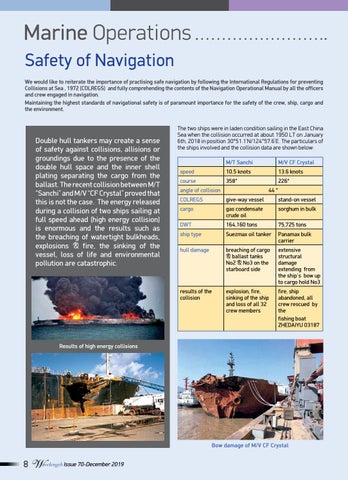
Double hull tankers may create a sense of safety against collisions, allisions or groundings due to the presence of the double hull space and the inner shell plating separating the cargo from the ballast. The recent collision between M/T “Sanchi” and M/V “CF Crystal” proved that this is not the case. The energy released during a collision of two ships sailing at full speed ahead (high energy collision) is enormous and the results such as the breaching of watertight bulkheads, explosions & fire, the sinking of the vessel, loss of life and environmental pollution are catastrophic.
The two ships were in laden condition sailing in the East China Sea when the collision occurred at about 1950 LT on January 6th, 2018 in position 30°51.1’N/124°57.6’E. The particulars of the ships involved and the collision data are shown below: M/T Sanchi
M/V CF Crystal
speed
10.5 knots
13.6 knots
course
358°
226°
angle of collision
44 °
COLREGS
give-way vessel
stand-on vessel
cargo
gas condensate crude oil
sorghum in bulk
DWT
164,160 tons
75,725 tons
ship type
Suezmax oil tanker
Panamax bulk carrier
hull damage
breaching of cargo & ballast tanks No2 & No3 on the starboard side
extensive structural damage extending from the ship's bow up to cargo hold No3
results of the collision
explosion, fire, sinking of the ship and loss of all 32 crew members
fire, ship abandoned, all crew rescued by the fishing boat ZHEDAIYU 03187
Results of high energy collisions
Bow damage of M/V CF Crystal
8
Issue 70-December 2019