The affect of Net Herd Replacement Cost on profitability T
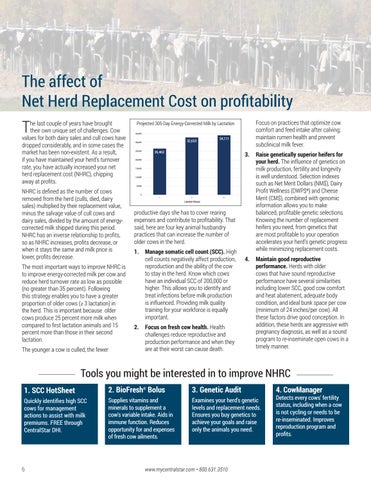
he last couple of years have brought their own unique set of challenges. Cow values for both dairy sales and cull cows have dropped considerably, and in some cases the market has been non-existent. As a result, if you have maintained your herd’s turnover rate, you have actually increased your net herd replacement cost (NHRC), chipping away at profits. NHRC is defined as the number of cows removed from the herd (culls, died, dairy sales) multiplied by their replacement value, minus the salvage value of cull cows and dairy sales, divided by the amount of energycorrected milk shipped during this period. NHRC has an inverse relationship to profits, so as NHRC increases, profits decrease, or when it stays the same and milk price is lower, profits decrease. The most important ways to improve NHRC is to improve energy-corrected milk per cow and reduce herd turnover rate as low as possible (no greater than 35 percent). Following this strategy enables you to have a greater proportion of older cows (≥ 3 lactation) in the herd. This is important because older cows produce 25 percent more milk when compared to first lactation animals and 15 percent more than those in their second lactation. The younger a cow is culled, the fewer
Projected 305-Day Energy-Corrected Milk by Lactation 32,653
34,111
26,463
Lactation Groups
productive days she has to cover rearing expenses and contribute to profitability. That said, here are four key animal husbandry practices that can increase the number of older cows in the herd. 1. Manage somatic cell count (SCC). High cell counts negatively affect production, reproduction and the ability of the cow to stay in the herd. Know which cows have an individual SCC of 200,000 or higher. This allows you to identify and treat infections before milk production is influenced. Providing milk quality training for your workforce is equally important. 2. Focus on fresh cow health. Health challenges reduce reproductive and production performance and when they are at their worst can cause death.
Focus on practices that optimize cow comfort and feed intake after calving; maintain rumen health and prevent subclinical milk fever. 3. Raise genetically superior heifers for your herd. The influence of genetics on milk production, fertility and longevity is well understood. Selection indexes such as Net Merit Dollars (NM$), Dairy Profit Wellness (DWP$®) and Cheese Merit (CM$), combined with genomic information allows you to make balanced, profitable genetic selections. Knowing the number of replacement heifers you need, from genetics that are most profitable to your operation accelerates your herd’s genetic progress while minimizing replacement costs. 4. Maintain good reproductive performance. Herds with older cows that have sound reproductive performance have several similarities including lower SCC, good cow comfort and heat abatement, adequate body condition, and ideal bunk space per cow (minimum of 24 inches/per cow). All these factors drive good conception. In addition, these herds are aggressive with pregnancy diagnosis, as well as a sound program to re-inseminate open cows in a timely manner.
Tools you might be interested in to improve NHRC 1. SCC HotSheet
2. BioFresh® Bolus
3. Genetic Audit
Quickly identifies high SCC cows for management actions to assist with milk premiums. FREE through CentralStar DHI.
Supplies vitamins and minerals to supplement a cow's variable intake. Aids in immune function. Reduces opportunity for and expenses of fresh cow ailments.
Examines your herd's genetic levels and replacement needs. Ensures you buy genetics to achieve your goals and raise only the animals you need.
6
www.mycentralstar.com • 800.631.3510
4. CowManager
Detects every cows' fertility status, including when a cow is not cycling or needs to be re-inseminated. Improves reproduction program and profits.