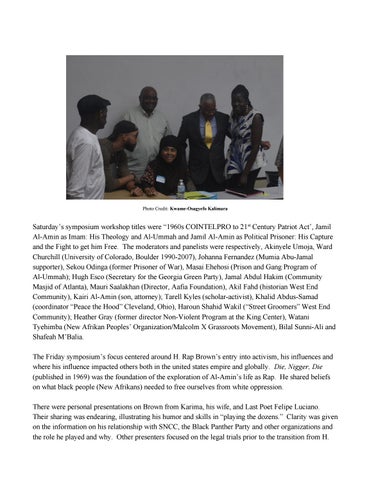
Photo Credit: Kwame-Osagyefo Kalimara
Saturday’s symposium workshop titles were “1960s COINTELPRO to 21st Century Patriot Act’, Jamil Al-Amin as Imam: His Theology and Al-Ummah and Jamil Al-Amin as Political Prisoner: His Capture and the Fight to get him Free. The moderators and panelists were respectively, Akinyele Umoja, Ward Churchill (University of Colorado, Boulder 1990-2007), Johanna Fernandez (Mumia Abu-Jamal supporter), Sekou Odinga (former Prisoner of War), Masai Ehehosi (Prison and Gang Program of Al-Ummah); Hugh Esco (Secretary for the Georgia Green Party), Jamal Abdul Hakim (Community Masjid of Atlanta), Mauri Saalakhan (Director, Aafia Foundation), Akil Fahd (historian West End Community), Kairi Al-Amin (son, attorney); Tarell Kyles (scholar-activist), Khalid Abdus-Samad (coordinator “Peace the Hood” Cleveland, Ohio), Haroun Shahid Wakil (“Street Groomers” West End Community); Heather Gray (former director Non-Violent Program at the King Center), Watani Tyehimba (New Afrikan Peoples’ Organization/Malcolm X Grassroots Movement), Bilal Sunni-Ali and Shafeah M’Balia. The Friday symposium’s focus centered around H. Rap Brown’s entry into activism, his influences and where his influence impacted others both in the united states empire and globally. Die, Nigger, Die (published in 1969) was the foundation of the exploration of Al-Amin’s life as Rap. He shared beliefs on what black people (New Afrikans) needed to free ourselves from white oppression. There were personal presentations on Brown from Karima, his wife, and Last Poet Felipe Luciano. Their sharing was endearing, illustrating his humor and skills in “playing the dozens.” Clarity was given on the information on his relationship with SNCC, the Black Panther Party and other organizations and the role he played and why. Other presenters focused on the legal trials prior to the transition from H.