ON CAMPUS
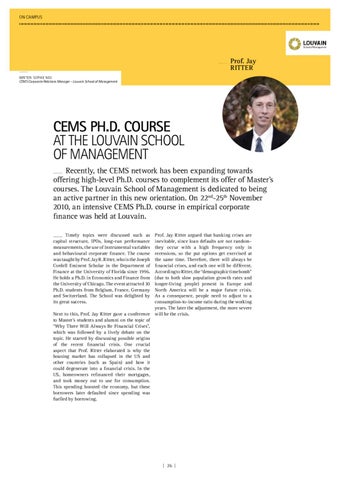
Prof. Jay Ritter WRITER: Sophie Neu CEMS Corporate Relations Manager – Louvain School of Management
CEMS Ph.D. Course at the Louvain School of Management Recently, the CEMS network has been expanding towards offering high-level Ph.D. courses to complement its offer of Master’s courses. The Louvain School of Management is dedicated to being an active partner in this new orientation. On 22nd-25th November 2010, an intensive CEMS Ph.D. course in empirical corporate finance was held at Louvain. Timely topics were discussed such as capital structure, IPOs, long-run performance measurements, the use of instrumental variables and behavioural corporate finance. The course was taught by Prof. Jay R. Ritter, who is the Joseph Cordell Eminent Scholar in the Department of Finance at the University of Florida since 1996. He holds a Ph.D. in Economics and Finance from the University of Chicago. The event attracted 30 Ph.D. students from Belgium, France, Germany and Switzerland. The School was delighted by its great success. Next to this, Prof. Jay Ritter gave a conference to Master’s students and alumni on the topic of “Why There Will Always Be Financial Crises”, which was followed by a lively debate on the topic. He started by discussing possible origins of the recent financial crisis. One crucial aspect that Prof. Ritter elaborated is why the housing market has collapsed in the US and other countries (such as Spain) and how it could degenerate into a financial crisis. In the US, homeowners refinanced their mortgages, and took money out to use for consumption. This spending boosted the economy, but these borrowers later defaulted since spending was fuelled by borrowing.
Prof. Jay Ritter argued that banking crises are inevitable, since loan defaults are not random– they occur with a high frequency only in recessions, so the put options get exercised at the same time. Therefore, there will always be financial crises, and each one will be different. According to Ritter, the “demographic time bomb” (due to both slow population growth rates and longer-living people) present in Europe and North America will be a major future crisis. As a consequence, people need to adjust to a consumption-to-income ratio during the working years. The later the adjustment, the more severe will be the crisis.
| 26 |