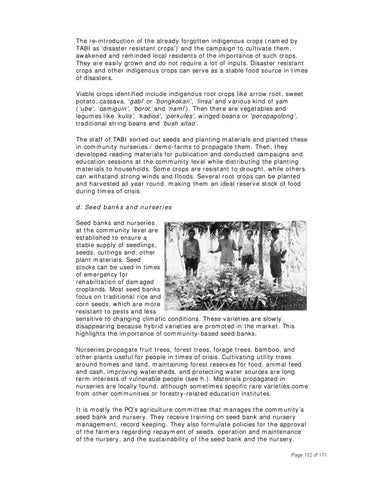
The re-introduction of the already forgotten indigenous crops (named by TABI as ‘disaster resistant crops’) and the campaign to cultivate them, awakened and reminded local residents of the importance of such crops. They are easily grown and do not require a lot of inputs. Disaster resistant crops and other indigenous crops can serve as a stable food source in times of disasters. Viable crops identified include indigenous root crops like arrow root, sweet potato, cassava, ‘gabi’ or ‘bongkokan’, ‘linsa’ and various kind of yam (‘ube’, ‘camiguin’, ‘borot’ and ‘nami’). Then there are vegetables and legumes like ‘kulis’, ‘kadios’, ‘perkules’, winged beans or ‘poropagolong’, traditional string beans and ‘bush sitao’. The staff of TABI sorted out seeds and planting materials and planted these in community nurseries / demo-farms to propagate them. Then, they developed reading materials for publication and conducted campaigns and education sessions at the community level while distributing the planting materials to households. Some crops are resistant to drought, while others can withstand strong winds and floods. Several root crops can be planted and harvested all year round, making them an ideal reserve stock of food during times of crisis. d. Seed banks and nurseries Seed banks and nurseries at the community level are established to ensure a stable supply of seedlings, seeds, cuttings and, other plant materials. Seed stocks can be used in times of emergency for rehabilitation of damaged croplands. Most seed banks focus on traditional rice and corn seeds, which are more resistant to pests and less sensitive to changing climatic conditions. These varieties are slowly disappearing because hybrid varieties are promoted in the market. This highlights the importance of community-based seed banks. Nurseries propagate fruit trees, forest trees, forage trees, bamboo, and other plants useful for people in times of crisis. Cultivating utility trees around homes and land, maintaining forest reserves for food, animal feed and cash, improving watersheds, and protecting water sources are long term interests of vulnerable people (see h.). Materials propagated in nurseries are locally found, although sometimes specific rare varieties come from other communities or forestry-related education institutes. It is mostly the PO’s agriculture committee that manages the community’s seed bank and nursery. They receive training on seed bank and nursery management, record keeping. They also formulate policies for the approval of the farmers regarding repayment of seeds, operation and maintenance of the nursery, and the sustainability of the seed bank and the nursery. Page 102 of 171
Citizenry-Based & Development-Oriented Disaster Response
Issuu converts static files into: and more. Sign up and create your flipbook.