Limited Scope Retainers
Ethical and Practical Issues
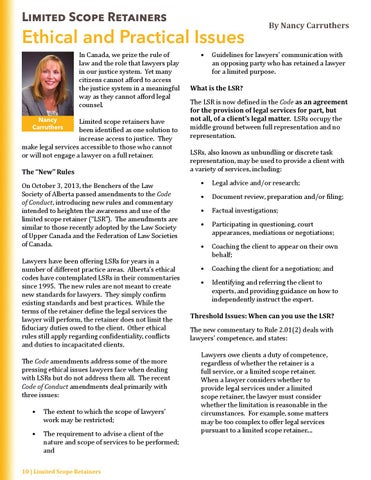
Nancy Carruthers
In Canada, we prize the rule of law and the role that lawyers play in our justice system. Yet many citizens cannot afford to access the justice system in a meaningful way as they cannot afford legal counsel.
Limited scope retainers have been identified as one solution to increase access to justice. They make legal services accessible to those who cannot or will not engage a lawyer on a full retainer. The “New” Rules
On October 3, 2013, the Benchers of the Law Society of Alberta passed amendments to the Code of Conduct, introducing new rules and commentary intended to heighten the awareness and use of the limited scope retainer (“LSR”). The amendments are similar to those recently adopted by the Law Society of Upper Canada and the Federation of Law Societies of Canada.
Lawyers have been offering LSRs for years in a number of different practice areas. Alberta’s ethical codes have contemplated LSRs in their commentaries since 1995. The new rules are not meant to create new standards for lawyers. They simply confirm existing standards and best practices. While the terms of the retainer define the legal services the lawyer will perform, the retainer does not limit the fiduciary duties owed to the client. Other ethical rules still apply regarding confidentiality, conflicts and duties to incapacitated clients. The Code amendments address some of the more pressing ethical issues lawyers face when dealing with LSRs but do not address them all. The recent Code of Conduct amendments deal primarily with three issues: • The extent to which the scope of lawyers’ work may be restricted;
• The requirement to advise a client of the nature and scope of services to be performed; and
10 | Limited Scope Retainers
By Nancy Carruthers
• Guidelines for lawyers’ communication with an opposing party who has retained a lawyer for a limited purpose.
What is the LSR?
The LSR is now defined in the Code as an agreement for the provision of legal services for part, but not all, of a client’s legal matter. LSRs occupy the middle ground between full representation and no representation. LSRs, also known as unbundling or discrete task representation, may be used to provide a client with a variety of services, including: • Legal advice and/or research;
• Document review, preparation and/or filing; • Factual investigations;
• Participating in questioning, court appearances, mediations or negotiations;
• Coaching the client to appear on their own behalf; • Coaching the client for a negotiation; and
• Identifying and referring the client to experts, and providing guidance on how to independently instruct the expert.
Threshold Issues: When can you use the LSR? The new commentary to Rule 2.01(2) deals with lawyers’ competence, and states: Lawyers owe clients a duty of competence, regardless of whether the retainer is a full service, or a limited scope retainer. When a lawyer considers whether to provide legal services under a limited scope retainer, the lawyer must consider whether the limitation is reasonable in the circumstances. For example, some matters may be too complex to offer legal services pursuant to a limited scope retainer....