A3
NEWS
Wednesday, October 24, 2012 | The Cavalier Daily
Three-Day Weather Forecast
Provided by the Cavalier Weather Service
TODAY High of 78˚
TONIGHT Low of 53˚
TOMORROW High of 79˚
Mostly sunny skies with a calm southwest wind around 5 mph. Temperatures rise into the upper 70s.
Partly cloudy with a south wind between 5-10 mph. Temperatures fall into the low 50s.
Mostly sunny skies with a continuing southwest wind between 5-10 mph. Temperatures in upper 70s.
TOMORROW NIGHT Low of 56˚
FRIDAY High of 77˚
Clear skies with temperatures only dropping into the mid to upper 50s.
Sunny with temperatures reaching the mid to upper 70s.
High pressure moves out of the region today, but another high pressure system moves in for the end of the week and the weekend. Expect another beautiful day on the Lawn today, with less than a 10 percent chance of precipitation.
To receive Cavalier Weather Service forecasts via email, contact weather@virginia.edu
NEWS
Lazing on the Lawn
IN BRIEF
Dukes wins award
Jenna Truong | Cavalier Daily
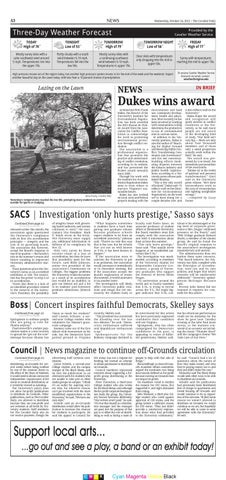
Yesterday’s temperatures reached the low 80s, prompting many students to venture outside for sports or studying.
Architecture Prof. Frank Dukes, the director of the University’s Institute for Environmental Negotiation, has been awarded the 2012 Sharon M. Pickett Award from the Association for Conflict Resolution to acknowledge his work in promoting environmental protection through conflict resolution. The association is a professional organization that promotes the practice and understanding of conflict resolution, according to its website, and has presented the Pickett award annually since 2008. Through his work with the Institute for Environmental Negotiation Dukes aims to train others to nurture Virginia’s sustainable future. Dukes has also worked on local, state and federal projects dealing with the
environment and land use, community development, health and education. Most recently, he has been involved in working with communities to help determine the productive re-use of contaminated sites in various states. In addition to his University position, Dukes is also the author of “Reaching for Higher Ground and Resolving Public Conflict: Transforming Community and Governance” and has led consensusbuilding efforts mediating disputes between the tobacco industry and public health organizations, according to a University press release published Monday. “This is the only award of its kind,” Dukes said. “It reflects well on the [Institute for Environmental Negotiation], on the work we’ve been doing for a couple decades now and
it also reflects well on the University.” Dukes hopes the award and recognition will spark interest in conflict resolution at the University, as he said many people are not aware of the developing field of study. “Our field isn’t very big — there are only about four thousand members and of those only a small proportion actually work within the field,” he said. The award was presented by Lou Gieszl, the immediate past president of the association. “[Dukes is] at the realm of spiritual and personal transformation,” Giezl said in the University press release. “He’s done extraordinary work in the area of reconciliation and righting unrightable wrongs.” —compiled by Lizzy Turner
SACS | Investigation ‘only hurts prestige,’ Sasso says Continued from page A1 released earlier this month, the association again questioned the University’s compliance with its first two accreditation principles — integrity and the role of its governing board. The association did, however, accept the Board’s response to one of its qualms — the faculty’s role in the summer’s events and future standing in important University administrative matters. These questions place the University’s status as an accredited institution at risk. The association has the power to strip it of its accreditation. “Given that there is a lack of an identified procedure related to the removal of the institution’s President, the possibility
of integrity issues with governing board authority and actions continues to exist,” the association’s Vice President Mark V. Smith wrote in the letter. The University must supply any additional information in defense of its compliance by Nov. 12. Only very rarely do these reviews result in a loss of accreditation, but they do leave that possibility open for the future, said Mike Johnson, senior vice president of the association’s Commission on Colleges. The biggest problems the University would encounter as a result of its accreditation loss would be an inability to give out federal aid and a hit to its students’ post-University graduate admissions, Johnson said.
“What happens sometimes is students have a hard time getting into graduate schools b e c a u s e g ra d u a t e s c h o o l s expect students to be from an accredited university,” Johnson said. “There’s no rule that says that is the case, but for schools that are not as well known as U.Va. it has been known to happen.” If the association were to sanction the University or put it on probation, the association would announce it immediately at its December meeting. But if the association accepts the Board’s explanation of events this summer, it would announce it via another letter. The investigation will likely affect University public relations and image, but not necessarily the student body or
faculty, said Pietro Sasso, an assistant professor of student affairs at Monmouth University. But Board members must first comply with the association and send it information about their actions this summer. “This only hurts prestige,” Sasso said. “This usually never happens at an established university like U.Va,” The investigation was muchneeded, according to members of the University Alumni for Responsible Corporate Governance , a group of University graduates who support the removal of Rector Helen Dragas. “To universities around the world and to faculty members that U.Va. is trying to recruit across the U.S., the single biggest indicator that U.Va. con-
tinues to be mismanaged at the top level of corporate governance is Mrs. Dragas’ continued presence on the Board,” said 1966 College graduate Richard Marks, a member of the alumni group. He said he found the Board’s original response to the association’s investigation unsatisfactory and unclear. The administration does not harbor these same concerns. “The Board believes the University has fully complied with the Principles of Accreditation, state law and its own policies, and hopes that SACS’s concerns will be satisfactorily addressed,” University spokesperson McGregor McCance said. Provost John Simon did not respond to requests for comment for this article.
Boss| Concert inspires faithful Democrats, Skelley says Continued from page A1 Springsteen to enthuse people who are going to vote for Obama anyway.” Charlottesville’s student population makes it a key location to spread the “get out the vote” message because Obama has
“done so much for students” said Lauren Schauer, a second-year College student who volunteers for Obama’s grassroots campaign. Romney came out of the first debate with momentum on his side, but the Democrats have gained ground in Virginia
recently, Skelley said. “The president has staunched the bleeding over the last two debates,” he said. “Democratic enthusiasm suffered and Republican enthusiasm is up.” Spokespersons for the Romney campaign declined to
be interviewed for this article but have previously expressed confidence their candidate will win Virginia. Springsteen, who has often campaigned for Democratic candidates in the past, is appealing to voters of different generations, Skelley said.
But his afternoon performance could not be mistaken for the show he gave later Tuesday evening at the John Paul Jones Arena, as the matinee consisted of an acoustic set including the classic “Thunder Road” and the campaign’s theme “We Take Care of Our Own.”
Council | News magazine to continue off-Grounds circulation Continued from page A1 distributing on-Grounds for several weeks before being notified by one of the assistant deans in the office of the Dean of Students it would need to obtain contracted independent organization (CIO) status to continue distribution, or it would be viewed as soliciting. The University’s policy does not allow for-profit publications to distribute on Grounds. Other publications, such as The Cavalier Daily, are allowed to distribute because they are non-profit and are overseen at all levels by University students. Staff members for The Cavalier Daily also do not receive payment, though the
advertising staff receives commission. James Scheibt, a second-year College student and the campus manger of The Black Sheep, said he sees the publication as an alternative path for students who are unable to take part in other media groups on campus. “I think it’s an outlet for aspiring writers who, for whatever reason, can’t get involved with the more established organizations at the University,” he said. “We have our own style.” Scheibt said an on-Grounds distribution would allow the publication to increase the chances for students to participate. He said the appeal to Council for
CIO status was not a request for funding, but instead an attempt to obtain permission to distribute on Grounds. Council members expressed concerns about supporting a forprofit group distributing at the University. Peter Finnochio, a third-year College student who also works for the Black Sheep, said although the for-profit corporate headquarters leads the group, the University branch functions differently. “Our writers aren’t paid,” he said. “It’s true that myself as a distribution manager and the manager are paid, but the purpose of that pay is to offset the cost of distributing as well as hiring a team of
C M Y K
people to help with that side of things.” Klaus Dollhopf, co-chair of Council’s Academic Affairs committee, argued the institution was being inaccurately defined as for-profit because moving on Grounds does not impact its profit. Six members voted to decline the request for CIO status, five supported it, and eight abstained from voting. John Woolard, a third-year College student who voted against approval of CIO status, said the group lacked a sufficient reason for CIO status. “They just didn’t provide a satisfactory explanation about what they provided to the University community,”
Cyan Magenta Yellow Black
he said. “Council had a lot of questions about the nature of how they make money and who they’re paying money out to and they just didn’t make the case.” Finnochio said The Black Sheep would seek other ways to be able to distribute on Grounds. Scheibt said the publication had previously been distributed free of charge to apartments and Greek housing off Grounds and would continue to do so regardless of the outcome. “If [for] some reason we weren’t allowed to distribute on Grounds we would continue as we are, but hopefully we will be able to come to some agreement with the University,” he said.