A P UB LI CAT I ON O F T H E D I O C E S E O F SH R E V E P O R T
CATHOLIC CONNECTION VOL. 36 NO. 3 | OCTOBER 2026
Rediscover the Liturgy OCTOBER 2026 1
CATHOLIC CONNECTION PUBLISHER
Bishop Robert W. Marshall, Jr.
EDITOR
Sophia Romanski White
EDITORIAL BOARD
OCTOBER 2026
Volume 36 Number 3 REDISCOVER THE LITURGY
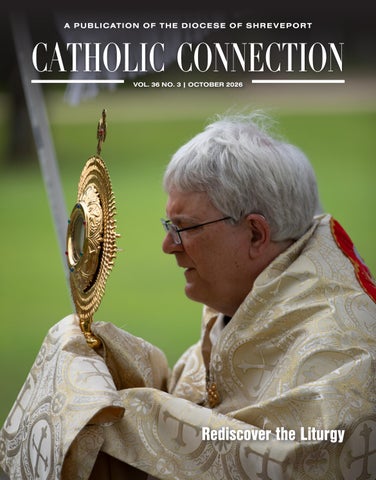
Pope Leo XIV's Prayer Intention For The Month of October FOR MENTAL HEALTH MINISTRY. Let us pray that the mental health ministry be established throughout the Church, helping to overcome the stigma and discrimination of persons with mental illnesses Cover photo: Rev. Mark Watson leads a Eucharistic Procession for the feast of Corpus Christi at St. Mary of the Pines Parish in Shreveport, LA. Photo by Sophia Romanski White
SUBSCRIPTIONS & ADDRESS CHANGES Blanca Vice bvice@dioshpt.org 318-868-4441
Deacon Charles Thomas, OFS
SUBMISSIONS
Sophia Romanski sromanski@dioshpt.org Rev. Kevin Mues
The Catholic Connection is a member of the Catholic Media Association The Diocese of Shreveport complies with Virtus' Protecting God's Children program (www.virtus.org). Online sessions are available. To report child sexual abuse by a cleric or church worker in the Diocese of Shreveport, call your local law enforcement agency and Mary Arcement Alexander, Diocesan Victim Assistance Coordinator at 318-588-2120. Thank you for helping to keep our children and vulnerable adults safe.
Karla Alvarez
Rosalba Quiroz
The Catholic Connection is funded in part by a grant from the Catholic Home Missions Appeal and donations to the Catholic Service Appeal.
MISSION STATEMENT Tracie Stroud
CONTRIBUTORS Mary Arcement Alexander Karla Alvarez Linda Bader Dr. S. Germain Cassiere Celeste Dickson Diane Libro Polly Maciulski Lisa Marcalus 2 CATHOLIC CONNECTION
Sharon McCabe Lucy Medvec Jennifer Nix Elise Reis Tracie Stroud Mike Van Vranken Very Rev. Mark Watson, vf
The Catholic Connection is a monthly publication funded by your Catholic Service Appeal, mailed to every known Catholic household in the Diocese of Shreveport. Our mission is to advance knowledge and understanding of our Catholic faith among the faithful. We seek to foster the application of Christ's teachings and our Church's mission in our daily lives and to encourage our sense of Catholic identity within our family, parish, and faith community.
October Second Collections OCTOBER 17 & 18 WORLD MISSION SUNDAY will celebrate its 100th Anniversary this year! Donations support young, poor, or struggling dioceses across the globe and enable them to share the Good News.
October SUNDAY
MONDAY
TUESDAY
WEDNESDAY
THURSDAY 1
Memorial of St. Thérèse of the Child Jesus Bishop Robert W. Marshall
4
Fr. Gabriel Cisneros Campos
11
Fr. Keith Garvin
18
Fr. Joseph Maddala
5
Memorial of St. Faustina Kowalska Fr. Rigoberto Betancurt Cortés
Fr. James Moran Fr. Philip Michiels
Feasts, Solemnities, & Memorials Priest(s) in the Diocese of Shreveport to pray for daily Special Events in the Diocese of Shreveport
Fr. Karl Daigle
7
Memorial of Our Lady of the Rosary Fr. Jerry Daigle, Jr.
8
Fr. Nicholas Duncan
People of Hope Museum at Catholic Charities of North Louisiana 902 Olive Street, Shreveport, LA 10:00 AM - 6:00 PM
SATURDAY
2
Memorial of The Holy Guardian Angels Msgr. Rothell Price
3
Fr. Joseph Ampatt Diocesan Youth Summit; St. Jude Catholic Church, Benton, LA 10:00 AM - 6:00 PM
9
10
Memorial of St. John Henry Newman Fr. Adrian Fischer, OFM
Fr. Mark Franklin
12
13
14
15
16
17
19
20
21
22
23
24
Fr. Charles Glorioso
Fr. Patrick Madden
Annual White Mass for Doctors, Healthcare Professionals, and Medical Students; Cathedral of St. John Berchmans; 11:00 AM
25
6
FRIDAY
26
Fr. Richard Norsworthy Fr. Kevin Mues
Fr. Joseph C. Howard, Jr.
Fr. Calistus Barasa Makokha, FMH
27
Fr. Charles Ssennyondo Fr. James Dominic Thekkemury
Fr. Timothy Hurd
Fr. Peter Romanus Mallya, FMH
28
Memorial of Sts. Simon & Jude, Apostles Fr. LaVerne “Pike” Thomas Fr. Kelby Tingle
Memorial of St. Teresa Memorial of St. Memorial of St. Ignatius of Jesus Margaret Mary Alacoque of Antioch Fr. Raney Johnson Fr. Osang Idagbo, CM Fr. Matthew T. Long
Memorial of St. John Paul II Fr. Joseph Martina, Jr. Fr. Jean Bosco Uwamungu
29
Fr. Duane Trombetta Fr. Stanisbus Savio Arokia
Fr. James McLelland Fr. Peter Mangum
30
Fr. Mark Watson Fr. Do Minh Vu, ICM
Fr. Fidel Mondragón Fr. Peter Bwalya Mobe
31
All deceased priests of the Diocese of Shreveport
SUGGESTED PRAYER FOR OUR PRIESTS:
Help our priests to be strong in their vocation. Set their souls on fire with love for your people.
Gospel. Allow them to experience joy in their ministry.
Gracious and loving God, we thank you for the gift of our priests. Especially ___________________________________ (insert name(s) here) Through them, we experience your presence in the sacraments.
Grant them the wisdom, understanding, and strength they need to follow in the footsteps of Jesus. Inspire them with the vision of your Kingdom.
Help them to become instruments of your divine grace.
Give them the words they need to spread the
We ask this through Jesus Christ, who lives and reigns as our Eternal Priest. Amen.
OCTOBER 2026 3
OCTOBER
CONTENTS
From the Apostolic Administrator
06
The Liturgy of Heaven Brought to Earth
10
The Power of Amen
11
Catholic Liturgy Matters
12
Portable Sacraments
13
The Courage to Stay in the Pew
14
The Eternal and Salvific Aspects of the Eucharist
16
When Music Serves Silence
18
Heaven on Earth
22
Our Duty and Our Salvation
24
A Liturgical Approach to Sacrifice
26
The Communion We Receive, The Communion We Live
27
Seminarian Burses
28
Finding Gratitude in the Mass
30
Blessing of the Graves Schedule 2026
31
School News
34
Around the Diocese
37
By Celeste Dickson By Jennifer Nix
By Mary Arcement Alexander By Lisa Marcalus
By Dr. S. Germain Cassiere
By Very Rev. Mark Watson, vf By Tracie Stroud
By Linda Bader
By Karla Alvarez By Diane Libro
By Mike Van Vranken
By Lucy Medvec
24
Our Duty and Our Salvation Karla Alvarez on being transformed by the Eucharist and transforming the world. 4 CATHOLIC CONNECTION
14
The Courage to Stay in the Pew Dr. S.G. Cassiere’s
Thoughts from the Pew reflection this month considers the choice to abstain from Holy Communion when not in a worthy state.
16
The Eternal and Salvific Eucharist Very Rev. Mark Watson, vf ’s essay on two important aspects of the Eucharist.
18
When Music Serves Silence
Director of Communications Tracie Stroud sits down with St. Pius X Music Director Marc-André Bougie to discuss liturgical music.
FROM THE EDITOR Friends, readers, countrymen, it is good to be back! Our Director of Communications, Tracie Stroud, did a phenomenal job with last month’s issue. Let’s give it up for our emergency editor! I had a wonderful assignment upon my return: to rediscover Catholic liturgy through the eyes of our intelligent, faithful, talented writers. Truly, there’s no better way to rejuvenate one’s love for the complex, beautiful tapestry of our Mass than to spend a month ruminating on it from a dozen different perspectives. While creating this issue, I remembered what it means to value the minutiae of our faith. Every Mass is nothing short of a miracle, and we are all so blessed to live in a country and time where this miracle is so readily available to us. Every action, every prayer, every second of the liturgy is designed to engage our hearts, minds, and souls on every level, thus bringing our entire beings to the present so that we may appreciate the awesome majesty of our God and the astounding love He has for us. It is my hope and my prediction that each of you will find a similar joy as you journey through these pages. May God, through the diverse voices and unique experiences of our dear contributors, renew your zeal for the most precious gift of Catholic Liturgy. OCTOBER 2026 5
FROM THE APOSTOLIC ADMINISTRATOR
M
any times over the years, as the only priest in a parish and now as a bishop, I have lived alone. While I enjoy others’ company, I must admit it is nice to keep my own schedule and not try to coordinate with other household members. However, I still miss company at meal time and find it difficult to cook for just one person. It is wonderful to be gathered around a table with a large group or just one other person, sharing a conversation and a meal – formal or informal, haute cuisine or simple and basic. Yes, food naturally gathers us together.
It is no accident, therefore, that of all the ways that our Lord Jesus Christ could choose to continue His Real Presence on earth after His Ascension, He chose the basic building blocks of the cuisine of His time and culture (and of many others in the centuries that followed): ordinary bread and ordinary wine. The Lord revealed His wonderful gift, the Sacrament of Unity, at the Last Supper. That Sacrament prefigured His Passion and Death on the following afternoon, and it found its deepest meaning in His Resurrection on Easter Sunday – but it originated in the context of a meal, and our daily celebration of Mass re-presents the Life, Death, and Resurrection of 6
CATHOLIC CONNECTION
Jesus Christ in that same context. Just as Jesus’ Apostles surrounded Him at the Last Supper, we too gather with the larger Christian community for the celebration of Mass – to break open the Word and to be nourished by His Body and Blood. Nourishment is essential to our understanding of food. We eat some foods primarily because we enjoy them – they remind of us something we ate growing up, satisfy a craving (sweet, salty, or spicy) we developed, or are a sheer pleasure to eat. We also eat to build or keep up our strength or health, realizing that consuming food is essential to our life – if we do not eat or drink, we eventually die. The Eucharist both reminds us of our need for physical nourishment and provides us with the life-giving spiritual nourishment of our intimate connection with the Lord. In the Sacrament of the Altar, our souls are nourished and sustained. And, the Eucharist comes to us in the communal celebration of Mass – the family of God gathered in prayer and worship, uniting our hopes, dreams, joys, and sorrows with the offering of bread and wine that we invite the Holy Spirit to transform for us. We rejoice
that the Eucharist remains available for us for private prayer after Mass (in the tabernacle) and as food for those who cannot gather with us – taken often to those who are sick and homebound for an individual encounter with the Lord that flows directly from the larger celebration of the Sacrament. My friends, we want and need a personal relationship with Jesus Christ. We need our time alone with Him to remember His presence. We need to speak with Him and to listen to Him in the silence of our hearts. But each authentic encounter with the Lord also leads us beyond ourselves. Christ always opens our eyes to others’ needs and our hearts to care and compassion for our brothers and sisters. At the Holy Sacrifice of the Mass, we are invited beyond praise and adoration into that mystical, intimate relationship we call Holy Communion, so named because our reception of the Eucharist allows us to enter into communion with God and with one another.
por el administrador apostólico
M
uchas veces, a lo largo de los años, como único sacerdote en una parroquia y ahora como obispo, he vivido solo. Aunque disfruto de la compañía de los demás, debo admitir que es agradable poder organizar mi propio horario sin tener que coordinarme con otros miembros del hogar. Sin embargo, sigo extrañando la compañía a la hora de comer y me resulta difícil cocinar para una sola persona. Es maravilloso reunirse alrededor de una mesa, ya sea con un grupo grande o con una sola persona, compartiendo una conversación y una comida —formal o informal, de alta cocina o sencilla y básica—. Sí, la comida, por naturaleza, nos reúne.
Por lo tanto, no es casualidad que, entre todas las maneras que nuestro Señor Jesucristo pudo haber elegido para continuar Su Presencia Real en la tierra después de Su Ascensión, eligiera los elementos básicos de la alimentación de Su tiempo y cultura (y de muchas otras culturas en los siglos posteriores): pan común y vino común. El Señor reveló Su maravilloso don, el Sacramento de la Unidad, en la Última Cena. Ese Sacramento prefiguró Su Pasión y Muerte la tarde siguiente, y encontró su significado más profundo en Su
Resurrección el Domingo de Pascua; pero tuvo su origen en el contexto de una comida, y nuestra celebración diaria de la Misa hace presente nuevamente la Vida, Muerte y Resurrección de Jesucristo en ese mismo contexto. Así como los Apóstoles de Jesús lo rodearon en la Última Cena, nosotros también nos reunimos con la comunidad cristiana para la celebración de la Misa, para abrirnos a la Palabra y ser alimentados por Su Cuerpo y Su Sangre.
con el Señor. En el Sacramento del Altar, nuestras almas son alimentadas y sostenidas. Además, la Eucaristía llega a nosotros en la celebración comunitaria de la Misa: la familia de Dios reunida en oración y adoración, uniendo nuestras esperanzas, sueños, alegrías y tristezas a la ofrenda del pan y del vino, que pedimos al Espíritu Santo que transforme para nosotros. Nos alegramos de que la Eucaristía permanezca disponible después de la Misa para nuestra oración personal —en el sagrario— y como alimento para quienes no pueden reunirse con nosotros. Con frecuencia, es llevada a los enfermos y a quienes no pueden.
El alimento es esencial para nuestra comprensión de la comida. Comemos ciertos alimentos principalmente porque los disfrutamos: nos recuerdan algo que comíamos mientras crecíamos, satisfacen algún antojo que hemos desarrollado —ya sea dulce, salado o picante— o simplemente nos producen placer al comerlos. También comemos para fortalecer o conservar nuestra fuerza y nuestra salud, conscientes de Para obtener más que alimentarnos es esencial información sobre las para la vida: si no comemos ni oportunidades del bebemos, finalmente morimos. Ministerio Multicultural en La Eucaristía nos recuerda nuestra la Diócesis de Shreveport necesidad de alimento físico y, al y para encontrar nuestros mismo tiempo, nos proporciona horarios y lugares de misa en español, por favor el alimento espiritual que da vida escanee el código aquí. mediante nuestra íntima unión
OCTOBER 2026 7
8
CATHOLIC CONNECTION
OCTOBER 2026 9
The Liturgy of Heaven Brought to Earth
F
aithful Catholics striving to live their life of Christian holiness to the full will inevitably plunge into the depths of the Church’s liturgy and seek to understand its mysteries. Liturgy is the presentation on earth of what goes on eternally in Heaven. So, our understanding of it will never be fully complete until our eternal destiny is met. However, our Holy Mother Church teaches the truth of what we experience in the liturgy, and all Catholics can benefit from frequent reminders of what truly occurs during these sacred rites. Let us examine the liturgy through three lenses: the Blessed Trinity, sacramental theology, and the participation of the faithful.
At its core, every liturgical action demonstrates by earthly means the activity of the Trinity. As the Father sent the Son, so does the Son send the Holy Spirit to inspire the Church to perpetuate Trinitarian acts of love. This activity can be described as a dialogue, since the “Trinity is the Father who speaks, the Son who is spoken, and the Spirit who sustains with loving breath the eternal dialogue between them” (Carstens, Principles of Sacred Liturgy: Forming a Sacramental Vision, 177). This heavenly dialogue is made physically audible on earth when we, the Church, engage in the liturgy. An example is the sung or spoken acclamation from the priest to the people: “The Lord be with you” … “And with your spirit.” When you attend Mass and sing or say these words, you are entering into the inner dialogue of the Trinity by means of liturgical action. Sacrosanctum Concilium, from the Second Vatican Council, teaches that Jesus Christ, sent by the Father, began this liturgical action by His work 10 CATHOLIC CONNECTION
of redemption: His Passion, Death, and Resurrection. From that moment on, the Holy Spirit never ceases to ensure the making of a liturgy, which has lasted through the ages. In this way, Christ is present in the liturgy, as He sent His Spirit to the Apostles who delivered the Sacred Liturgy to us. Not only is He present in all liturgical celebrations by His apostolic minister, but most
At its core, every liturgical action demonstrates by earthly means the activity of the Trinity. concretely, He is present under the form of the Eucharistic species. It is He who speaks the words of the liturgy (in persona Christi) as He commits the action of our salvation – the same sacrifice which occurred on Calvary. He performs this sacrifice through His priestly minister, and it is in this way that the liturgy is the activity of Christ Himself. The members of His Mystical Body participate and join themselves to Christ’s action through the priest. In Christ’s teaching ministry, He not only taught the truth of the triune God, but He also passed down the framework of a sacrament. A sacrament
is a sign, just as we understand in normal human life: something that refers to a reality elsewhere (i.e., the red light refers to the meaning of stop). However, when Jesus Christ chose seven natural signs (i.e., the pouring of water, blessing of oil, bread, and wine, etc.), He elevated them to the level of a sacramental sign, which renders active and present the reality it signifies. The Eucharistic bread makes present the reality it signifies, which is Christ’s Bodily Presence. This is where the theological terms ex opere operato and ex opere operantis have their purpose. A sacramental act is done ex opere operato, meaning “by the work worked,” or “by the very act of the rite being performed.” If the matter and form necessary are there (i.e., bread and wine and the words of the priest), the sacramental sign will be made present necessarily. When an act is done ex opere operantis, this means it is accomplished “by the work of the worker.” So, when one receives the Sacrament of the Eucharist, Christ is always present ex opere operato: if the liturgy was validly celebrated, He is guaranteed to be there. But the capacity for the Catholic communicant to receive the graces available is done ex opere operantis: reception of the graces is not guaranteed, but dependent upon the merit or disposition of that individual person to come in a state of grace, opening his or her heart to Christ’s sacramental presence. A phrase from Sacrosanctum Concilium known to most Catholics is active participation. This state can only be reached if the faithful know what they are partaking in during the
The Power of Amen “Let us sing or say the Great Amen with all our hearts united to all our brothers.” - St. Jerome liturgy. We must know its two goals: the glorification of God, and the sanctification of man, since it is by this act of worship that man is made more perfect (Flannery, “The Constitution on the Sacred Liturgy, Sacrosanctum Concilium”). To acheive these ends, it is essential that the faithful come to Mass with the “proper dispositions,” with their “minds attuned to their voices,” and ready to “cooperate with divine grace” (Sacrosactum Concilium). This state of awareness should result in an active engagement and enrichment from its effects. “To promote active participation, the people should be encouraged to take part by means of acclamations, responses, psalmody, antiphons, and songs, as well as by actions, gestures, and bodily attitudes. And at the proper times all should observe a reverent silence” (Sacrosanctum Concilium, 30). Because the liturgy has as one of its goals the sanctification of man and is the summit from which all the Church’s power and grace flow, all other activities which contribute to man’s sanctification therefore draw their grace from the liturgy. We can receive this grace by active participation, with our bodies and our minds, in these mysteries of the heavenly liturgy on earth.
A
Celeste Dickson is a full-time mother
St. Jerome said, “Let us sing or say the Great Amen with all our hearts united to all our brothers. Let it resound the whole world over, as the Amen of our early brothers in the faith ‘resounded in heaven, as a celestial thunderclap.’”
and wife. She attends Holy Trinity Catholic Church in Shreveport, LA, where Celeste assists in Music Direction and plays the organ.
men is a word we say often: at the end of every prayer, sometimes as a statement of agreement, and at times of distraction, we utter it as a force of habit. I discovered that when I dove into exactly what the word meant and applied its meaning to every utterance, my prayers were transformed. It is a powerful word that essentially serves as a proclamation of belief. According to The Catechism of the Catholic Church (CCC), “‘Amen’ means ‘So be it’ thus ratifying with our ‘Amen’ what is contained in the prayer” (CCC No. 2856) In a way, this is our stamp of agreement, approval, and acceptance – almost like a creed in a single word. If you apply the true meaning of Amen throughout the liturgy, your participation in the Holy Mass is irrevocably enriched. For example, when we pray the Lord’s Prayer and finish with Amen – we are saying that we believe all of these requests can be fulfilled by our Father in Heaven, and we also believe that, with His Grace, we can do our best to build up the Kingdom of Heaven on earth by being forgiving and fighting temptations. Then, there is the climax of the Mass – often referred to as the Great Amen – which occurs at the conclusion of the priest’s Eucharistic Prayer, as he raises the Body, Blood, Soul, and Divinity of our Lord Jesus Christ before the congregation. As the organ bellows, in one accord with the angels in Heaven, we sing, “Amen!”
With this Amen we are joyously singing: “Yes! I believe that this is truly Jesus Christ! I honor and glorify my loving, triune God!” What an exciting proclamation that we are so blessed to have come to truly believe! This is an Amen that can shake light into the darkness. Finally, in my opinion, comes the greatest Amen of all of liturgy – the moment we come, bow our heads, and are presented with the Eucharist. This Amen is everything. It’s the reason we all come to Mass. When we hear those words, “The Body of Christ” and the Eucharist is held in front of us, our Amen is a beautiful statement of complete faith that this is truly Jesus Christ. It is a promise of belief that His Presence has power. It is a proclamation that we are in a state of grace to receive Him. And most of all, it is an announcement of our hunger for Him to fill our souls. Every Amen offers the power to grow in confidence in the belief that what we pray is not only possible, it is true. I pray that we all come to know the importance of our Amen, that we all learn to grow in confidence in our ability to ask our Father for what we need, and that our faith may continue to grow — so when we say Amen, we know He can make it so. Amen.
Jennifer Nix is a catechist and Youth
Minister at St. Elizabeth Ann Seton Parish in Shreveport, LA. OCTOBER 2026 11
Catholic Liturgy Matters
T
here is the moment, right after the priest begins Mass with the Sign of the Cross and the congregation falls quiet, when I realize that millions of people around the world – coming from different homes and experiencing different worries and joys — all become one body preparing to meet Jesus. This realization fills my heart and quiets my soul, knowing that, as a community of believers, we are all anticipating both the Liturgy of the Word and the Liturgy of the Eucharist. And these liturgies are not performances we watch; rather, they are a mystery we all enter into together.
As Catholics, we are sometimes faced with others (both Protestants and non-Christians alike) who judge the Mass as being rigid or repetitive, something to get through rather than something to cherish and savor. What they lack is the true understanding of the liturgy. The word itself comes from the Greek word leitourgia, meaning "the work of the people" – hence, the Mass is not a show performed for an audience (think stages, lights and full bands), but instead an assembly of the priest and people, together offering themselves to Jesus and receiving Him in return. Every gesture we make throughout the Mass carries centuries of love, tradition, and reverence behind it. The Sign of the Cross traces the very shape of our salvation onto our bodies. It is both a prayer and a remembrance of Jesus’ sacrifice for us. When we bow before the altar, when we strike our breast during the Confiteor, and when we stand for the Gospel, we are not displaying empty customs. We use our bodies to pray alongside our hearts just as the Church has taught us for nearly two thousand years. We are not disembodied spirits, we are flesh and blood, made in God’s image, brothers and sisters of Christ. I love having structure in my life. Now, as I write this article about Catholic liturgy that is all about structure, I can’t help but wonder, is this reality the why behind my desire for structure? Either way, I love how the structure of the Mass tells its own quiet story. It begins with the Word that is filled with truth, love, commandments, stories, and so much more. From the first reading to the Gospel, we hear a conversation that stretches back thousands of years, and yet, it remains alive, 12
CATHOLIC CONNECTION
inspiring, and relevant. As the Liturgy of the Word ends, we reverently enter into the pentacle of the Mass: the Liturgy of the Eucharist. Where ordinary bread and wine become the Body, Blood, Soul, and Divinity of Christ. This mystery reaches far beyond our full comprehension as mere humans. This mystery is Jesus speaking to us while simultaneously fully giving Himself to us. It is not a symbol nor a memory, it is the Real Presence of our Lord and Savior. Beyond the Mass itself, we have the liturgical calendar as a map for our lives. We navigate the year, from the fifty days of estatic celebration of our Lord’s Resurrection during the season of Easter, to the small, everyday moments of holiness we find in the mundanaity of Ordinary Time. The familiar pattern of the liturgical calendar guides us through the highs, lows, and plateaus of our lives, providing insight and guidance. With it, we walk beside our Lord through his life and ministy, trusting that, through his Church, He will offer us exactly what we need. Brothers and sisters, as you enter Mass thinking of the Liturgy of the Word and the Liturgy of the Eucharist, remember also the curling upward movement of incense burning, the familiarity of praying the Lord’s Prayer in unison, the sign of peace we offer one another, and the angels and saints worshiping with us, never ceasing their prayers. To love the liturgy is to trust that Jesus still comes to meet His people in bread, in word, in silence, in song. It is to believe that Heaven truly touches earth, right there in the pew, in every Mass, in every church, throughout the world.
Mary Arcement Alexander is a Licensed Professional Counselor & the Diocesan Victim Assistance Coordinator.
From the Archives
Portable Sacraments
Meeting Spiritual Needs Beyond Church Walls This is the ninth article in our series exploring significant events, archival holdings, and select churches in the Diocese of Shreveport’s 40-year history.
S
ituations sometimes require priests to administer sacraments in nontraditional locations where a full altar is not available. Sick call cabinets, sick call crucifixes, and traveling Mass kits have provided priests the versatility to quickly transform bedrooms, battlefields, and ordinary settings into sacred places.
Childbirth, medical care, and death typically occurred at home until the early 20th century, when medical advancements shifted treatment of the sick and dying to hospitals. Before this transition, devout Catholic families – especially those newly arrived in the U.S. – traditionally kept shadow box-style sick call cabinets, often received as wedding or housewarming gifts, that could be hung on a wall or kept on a dresser. Because priests could not easily carry a large, formal apparatus from house to house when visiting the sick or dying, such sets were vital for spiritual care, especially during an emergency. The beautiful, late Victorian-era viaticum (Latin for “provision for a journey”) cabinet pictured here – a gift from Peggy Green to the Cathedral of St. John Berchmans – is two feet tall and four inches deep, with a chalkware (painted plaster figure) of a Pietà behind glass with a stained glassstyle border. “Blessed Be Thy Holy Name” is written on the bottom. The lower door, with an image of Leonardo da Vinci’s Last Supper, opens to create a makeshift altar and reveal a compartment for a paten, candles, a holy water bottle, linens, and other smallscale, necessary items. Ornate brass candle holders swing out for use. During this same era, compact “sick call crucifixes” were also staples of Catholic homes. They, too, were popular wedding gifts, intended for newlyweds to
hang over their beds for daily devotion and always readily accessible for priests to use in critical situations. The one pictured here belongs to Allison Cook, and it shows a hollow compartment for important liturgical items: two candles, a holy water bottle, and a cotton ball (or piece of absorbent material); others might include a small linen cloth. The crucifix was set in a recessed area of the base to anchor it. These are still available today from numerous church supply companies. The production and use of portable “field Communion” sets began during World War I, when military chaplains went to the front lines to celebrate Mass and administer Last Rites (as the sacrament was called then). These durable, briefcase-style kits contained all the essentials, including a crucifix, pyx (a small, locket-like vessel for carrying consecrated hosts), ciborium, paten, chalice, bowl and aspergillum (holy water sprinkler) and altar linens, candles, and holy oils, with other effects added as needed. They remain popular among priests who travel to celebrate Mass in combat zones, remote locations, mission settings and at retreats. The one pictured here is kept in the sacristy of St. Vincent’s Chapel at the Catholic Center. With these specialized kits, emergency ministry and the sacraments were always close at hand.
Lisa Marcalus is the archivist for the Diocese of Shreveport.
OCTOBER 2026 13
The Courage to Stay in the Pew Recovering Reverence for the Sacrament We Receive
T
here is a quiet moment during Mass that can reveal more than we want to admit.
The Communion line begins. Row after row empties. The faithful step into the aisle and move toward the altar. Then, someone remains seated. Perhaps an older man. Perhaps a young mother. Perhaps a visitor. Perhaps a Catholic who has not been to confession. Perhaps someone who knows exactly why he should not receive that day. And then, the glances begin. Not always openly. Not always harshly. Sometimes only in passing. Still, the question can rise silently in the minds of others: I wonder what he did? That question is often more revealing of the one asking it than of the one remaining in the pew. The pew is not a pillory. A Catholic who does not receive Holy Communion is not automatically announcing scandal. He may be grieving. He may be ill. He may be fasting from Communion for a reason known only to God. He may be a non-Catholic guest. He may be confused. He may be scrupulous and in need of steady pastoral guidance. Or he may be doing something deeply reverent: refusing to receive the Body and Blood of Christ unworthily. Sometimes the most Eucharistic act a Catholic can make is not walking forward, but remaining still. 14
CATHOLIC CONNECTION
That sounds strange only because many parishes have grown accustomed to automatic Communion. Nearly everyone goes forward. Nearly everyone receives. The Communion line can begin to look less like an approach to the Lamb of God and more like a parish procession in which absence seems suspicious. But the Communion line is not a parade. It is not a declaration that all is well. It is not a social badge proving that one belongs. It is the reception of Jesus Christ Himself: Body, Blood, Soul, and Divinity. The Real Presence should create reverence before it creates movement. The Church has never taught that every Catholic present at Mass must receive Holy Communion. She encourages frequent and devout reception, but she also teaches that those conscious of grave sin must first be reconciled through sacramental confession before receiving. This is not severity – it is mercy joined to truth. Holy Communion is not spiritual comfort detached from conversion. It is union with Christ. To receive Him while knowingly refusing repentance is not reverence. It is presumption. Yet, there is a painful pressure in many Catholic pews. A person may know he should not receive. He may know he needs the Sacrament of Confession. He may know his soul is not properly disposed. But when the row moves, embarrassment can become powerful. The fear of remaining seated can become stronger than the fear of receiving unworthily. It is worth asking
how many sacrilegious Communions have been escorted to the altar not by disbelief, but by shame. That should trouble us. A parish has lost something sacred when not receiving Holy Communion appears more scandalous than receiving unworthily. We should tremble more before the Real Presence than before the opinions of the people sitting behind us. This is where the matter becomes larger than personal conscience. Catholics are regularly encouraged to go to confession. They should be. Confession restores the soul, strengthens the will, humbles pride, and prepares the faithful to receive Holy Communion worthily. But if a typical parish offers public confession for only a brief time each week, the math does not compute. One hour of scheduled confession cannot realistically carry the sacramental needs of an entire parish being urged to confess regularly. “By appointment” may help one soul. It does not form a parish culture. A public sacrament needs public availability. If confession is preached often but the sacrament offered sparsely, the faithful receive two messages at once. The first says, “Go to mercy.” The second says, “Find a narrow opening if you can.” This is not a complaint against priests, many of whom are stretched thin, carrying more responsibilities than most parishioners ever see. Still, the problem remains. If worthy Communion matters, then access to
w
confession must matter in practice, not merely in theory. The confessional cannot be essential in doctrine and peripheral on the parish calendar. The problem becomes especially sharp after Holy Days of Obligation: Holy Days are gifts to the Church, drawing our eyes to the mysteries of Christ, the Blessed Mother, and the saints. They should sanctify time, interrupt routine, and remind Catholics that the calendar belongs to God before it belongs to work, errands, or convenience. But many faithful Catholics face real conflicts: work schedules, caregiving responsibilities, illness, lack of transportation, and limited Mass times can make attendance difficult or even impossible. Missing a Holy Day through indifference is one thing, while missing because of a serious reason is another. Catholics need clear teaching here, not vague anxiety. Obligation is real, but culpability is not always simple. A feast day meant to sanctify the faithful should not become a fog of confusion, shame, and quiet sacrilege. What happens when a Catholic misses a Holy Day, is unsure of his culpability, cannot easily get to confession, and then arrives at Sunday Mass? The Communion line forms. The social pressure returns. Does he stay in the pew and risk the glances? Does he receive and hope God understands? Does he make an appointment later, while receiving now? Does he know whom to ask? Does he know the difference between serious reason and excuse? These are not imaginary questions. They live in ordinary Catholic life. And beneath all of them is the same wound: loss of Eucharistic reverence. When Eucharistic reverence weakens, confession becomes optional, Communion becomes automatic, the pew becomes suspicious, Holy Days
become burdensome, and sacrilege becomes easier to rationalize. But when reverence is alive, everything changes. The altar is approached with awe. The confessional is loved as a place of mercy. The person who stays seated is not treated as a public sinner. The person who receives does so with gratitude and holy fear. The parish remembers that the Eucharist is not a symbol of belonging to the crowd, but of the living Christ. This does not mean Catholics should become fearful, scrupulous, or paralyzed. Scrupulous souls need steady guidance and should obey a regular confessor rather than make fear their spiritual director. The goal is not spiritual selftorture. The goal is truth, mercy, and reverence. A Catholic who needs confession should not despair – he should go. A Catholic who is properly disposed should receive with joy. A Catholic uncertain about his situation should seek sound counsel. But no Catholic should receive the Body of Christ merely to avoid the eyes of the Body of Christ. The overlooked person in this whole scene may be the one who remains in the pew. The overlooked virtue may be reverence. The overlooked sacrament may be Confession. The overlooked danger may be sacrilege hidden beneath routine. And the overlooked Christ may be the One waiting not only on the altar, but also in the confessional, in the wounded conscience, and in the humble soul willing to stop pretending. The Church does not need longer Communion lines purchased by thinner consciences. She needs Catholics who love the Eucharist enough to receive worthily and, when necessary, to remain in the pew until mercy has met them in the Sacrament of Confession.
There is courage in walking toward the altar with a clean heart. There is also courage in staying seated when the soul is not ready. Both can be acts of faith. But in an age of automatic Communion, the quiet Catholic who remains in the pew may be preaching a homily no one expected: Christ is truly present, and because He is truly present, He must not be received casually.
S. Germain Cassiere, MD, FACP is a retired Internist and parishioner at the Cathedral of St. John Berchmans, writing on faith, virtue, and the Catholic spiritual life from the pew perspective. OCTOBER 2026 15
The Eternal and Salvific Aspects of the Eucharist 16
CATHOLIC CONNECTION
T
here is a wonderful depth to the liturgy, the Mass – its meaning includes the True Presence of Christ: in the Assembly, in the proclamation of the Word of God, in the Priest, and in the Body and Blood of Christ. This depth is seen in the liturgy as a meal of unity and as a Memorial Sacrifice. Additionally, we experience such depth in our encounters with the Holy Spirit’s active presence during the liturgy and in the call to bring what we have received and become in the liturgy out to the world. While each of these aspects is central to understanding the liturgy, I focus here on the liturgy’s future and eternal aspects.
The Constitution of the Sacred Liturgy (Sacrosanctum Concilium [SC]) of Vatican II summarized the liturgy in this way, “Nevertheless the liturgy is the summit toward which the activity of the church is directed; at the same time it is the font from which all her power flows” (SC, no. 10). The liturgy as summit does not end with its celebration on earth but also unites the assembly to the heavenly liturgy and anticipates eternal life (Catechism of the Catholic Church [CCC], 1326). Revelation 7:9-17 describes the heavenly liturgy in a majestic scene, where angels, elders, and martyrs prostrate themselves before God on His throne and the Lamb, crying out: “Amen! Praise, glory and wisdom, thanksgiving and honor, power and might, be to our God forever and ever. Amen.” In the Letter to the Hebrews, St. Paul presents Jesus Christ as the Great High Priest who ministers in the true tabernacle built by God. Christ entered it through His Sacrifice on the Cross. The heavenly liturgy includes the eternal intercession of Christ for believers. The author of Hebrews writes, “For which reason he is able for all time to save those who approach God through him, since he always lives to make intercession for
them” (Heb 7:25).
Gospel of John, 224).
Each liturgy in which we participate is an experience of the heavenly liturgy. The beauty of the ministers’ vestments, the statues, and the stained glass windows and the references to the saints and Mary in the Eucharistic prayer all assist us in experiencing the heavenly liturgy while participating in the liturgy in our daily lives.
The liturgy leads to its future completion, its fulfillment, in the Kingdom of God for all eternity. The Third and Fourth Eucharistic Prayers state that Christ will suffer, die, rise from the dead, ascend into heaven and “come in glory.” Fr. Kevin Irwin writes, “Our ‘future’ in God is already ‘present’ in the Eucharist.” The liturgy is the “unique and privileged experience for the church of God’s Kingdom among us” (Models of the Eucharist, page 201). What we celebrate in the liturgy leads to its fulfillment in the “supper of the Lamb.”
The Bread of Life Discourse in the sixth chapter of the Gospel of John, is important in understanding the liturgy’s salvific aspect. Jesus here presents himself as the Bread of Life who is sent from God the Father. Beginning in verse 22, the Gospel presents Jesus as the one who reveals God the Father, and He reveals that those who receive Him in faith will be raised up on the last day. The Discourse’s final section then becomes explicitly Eucharistic, as seen clearly in the following verse, “Amen, amen, I say to you, unless you eat the flesh of the Son of Man and drink his blood you have no life in you; those who eat my flesh and drink my blood have eternal life, and I will raise them up on the last day” (John 6:53-54). Jesus makes the remarkable claim that those who eat His flesh and drink His blood will have eternal life and will be raised up on the last day. His words look ahead to His Death on the Cross, as well as call Christians to receive the Flesh and Blood of Jesus in the Eucharist with faith. Jesus promises that He will live in those that receive Him in faith. The scripture scholar, Francis J. Moloney, S.D.B, writes about this faith to which we are called: “The believer encounters the broken flesh and spilled blood of Jesus on the cross, the believer is called to make a decision for or against the revelation of God in that encounter” (verses 56-58), thus “gaining or losing life because of it”(verses 53-54) (Francis J. Moloney, S.D.B., Sacra Pagina: The
Fr. Irwin also writes that just as the Eucharist is viaticum or food for the journey for those who are near death, so each time the Eucharist is received by believers, it is viaticum or food for our journey to eternal life, in that it provides us with strength and hope on our journey to union with God. The liturgy is a prayer for the final coming of the Kingdom of God. Thus, we not only experience heaven and are given hope of eternal life each time we receive the Eucharist with faith, but each liturgy is also a prayer in which we pray for the coming of the Lord. In the Didache 10:6, written around A.D. 90 to 110, we read about the liturgy: “Whoever is holy, let him come, whoever is not, let him repent. Marana tha. Amen.” Marana tha is an ancient Christian prayer which means “Come, Lord Jesus.” At each Mass, may we pray with confidence that Our Lord will come soon.
Very Rev. Mark Watson, vf is pastor of St. Mary of Pines Catholic Parish in Shreveport, LA. OCTOBER 2026 17
When Music Serves Silence M
y life is rarely quiet. Between buzzing phone alerts and the hum of afternoon traffic, we spend our days rushing to smother any stillness before it settles in, scrolling or tapping just to outrun our thoughts. In today’s noisy, busy world, we can easily forget the importance of silence, but Catholic worship asks for something completely upside down to our modern sensibilities: it pulls our hurried bodies out of the daily rush and 18 CATHOLIC CONNECTION
expects our crowded minds to sit in stillness before the altar of God. I sat down with Marc-André Bougie, Director of Sacred Music at St. Pius X Catholic Church in Shreveport, to discuss music in the liturgy from his perspective as an accomplished composer, conductor, educator, and church musician. I expected to talk about beautiful music, its importance in worship, and what makes music truly
sacred. I didn’t expect our conversation about music to become, in many ways, a lesson about silence. What exactly is sacred liturgical music, and what is it supposed to do? Bougie begins with the liturgy itself. Sacred music isn’t meant to become the focus of the Mass or compete with the rituals at the altar. It refuses to treat the sanctuary like a concert hall. “Music elevates the liturgy,” he explained. “At
silence.” It’s a striking way to think about church music. Instead of asking whether a song is beautiful, familiar, or meaningful to us, the question becomes: How does this music serve what the Church is doing at this moment? Realizing that an ill-timed chord or a self-indulgent vocal run is not just poor taste, but the jarring shattering of a holy space, might alter everything we thought we knew about church music. That sobering standard mirrors the guidance found in Sing to the Lord: Music in Divine Worship, the United States Conference of Catholic Bishops’ pastoral document that Bougie urges every church musician to study. In it, the bishops ask those preparing music to consider its liturgical, pastoral, and musical qualities together: Does it fit the rite and its text? Does it serve this congregation? Is it musically appropriate and well-crafted? Music should serve the liturgy rather than dominate it, entertain the congregation, or draw attention to the musicians. For Bougie, that sense of purpose is deeply connected to tradition. “The whole thing is not meant to be reinvented, just like the structure of the Mass is the same every week,” he said. “You’re not meant to reinvent everything.”
the very least, it does not distract from liturgical action.” Then he went somewhere I didn’t expect. “One of the most beautiful sounds in creation is the sound of silence,” he said. “There you find peace and spirit of mind. So, to disrupt silence with sound, especially within a Mass or sacred event, you must understand that. You are breaking something sacred: sacred
That doesn’t mean nothing new belongs in the Church. Bougie continues to compose new sacred music himself. Rather, he sees the Church’s musical tradition as something each generation receives, learns from, and adds to. “We’re not trying to be busy,” he said. “We’re trying to connect.”
A Living Musical Tradition Pope Leo XIV has brought tradition back into sharp view, often speaking about the discipline of sacred silence and contemplation and the irreplaceable
role of Gregorian chant. Many Catholics may be surprised by how clearly the Church continues to encourage some of its oldest musical traditions. While Sing to the Lord acknowledges the vernacular as our everyday standard across the United States, it still urges us to preserve Latin in the Ordinary of the Mass. Chant is not an antique museum relic. Instead, it serves as a contemplative anchor, binding our present moment to generations of believers who knelt before the exact same words. For Bougie, Latin and chant matter beyond history. He recalls Pope Leo chanting familiar Marian antiphons while pilgrims from every continent joined in one voice. That shared song, he said, demonstrates something essential about the Church’s universality. Imagine traveling thousands of miles from home and attending Mass in a country where you don’t speak the language. The readings may be completely unfamiliar to your ear. Then the congregation begins a Latin prayer you know. “Now you’re part of something, and that gets you right in the heart,” Bougie said, “because you realize that the whole thing is universal and it’s meant to bring you together.” He calls Latin a fixed language rather than a dead one, providing a sacred bridge across geography and passing centuries. “When you sing these ancient prayers in the original language, you become part of a community of people who have been praying these prayers for centuries,” he said. It’s a reminder that Catholic worship doesn’t begin and end with the people gathered in one building on one Sunday morning.
Beauty That Engages the Whole Person Sacred music is only one part of that experience. Bougie described attending Mass in Paris at the Basilica of SainteClotilde, surrounded by sacred art and architecture and the sound of a worldOCTOBER 2026 19
class organist. Even an ocean away from Louisiana, the rite was entirely recognizable. “You’re at home 5,000 miles from home,” he said. There’s something distinctly Catholic, he explained, about the way the liturgy engages the whole person. “The combination of the prayer experience, of the liturgical experience, of the aesthetic experience, how the church looks, how the church smells with incense, the beauty of the vestments, the beauty of the architecture, of the paintings, of the stained-glass windows. The beauty of sight, the beauty of sound.” When those elements come together, emotion may naturally follow. Music shouldn’t be chosen merely to manufacture an emotional response, Bougie cautions. The Eucharist always remains the focus of the Mass. At the same time, he believes we shouldn’t fear beauty that moves us. Music joins sight, sound, movement, sacred art, vesture, incense, and silence in directing our attention toward God. The bishops make a similar point in Sing to the Lord, describing the many verbal and nonverbal elements of worship that should work together as one unified liturgical experience. Music can express meaning and feeling that words alone cannot. Beauty, then, isn’t simply a decorative trim. Bougie reminded me that Europe’s architects poured their labor into stone and stained glass, knowing they would never live to see the work finished. “The beauty is the purpose,” he insists. Not because beauty replaces faith, but because beauty can direct us beyond ourselves, quieting us long enough to break our selfabsorption and pay attention. That may be particularly important now. Bougie sees young people living amid constant sensory overload and 20 CATHOLIC CONNECTION
Music ... can carry “the essence of the timeless.” stimulation. For a generation drowning in algorithmic noise and flashing screens, the deliberate counter-cultural quiet of a reverent Mass stands out like a beacon. Why should an hour spent at Mass simply recreate the noise and busyness that surround us during the rest of the week? “Once you’ve been to a Mass where all the elements of liturgy are put together as they should be, where there’s room for sacred silence, where the liturgical action doesn’t distract from anything else, where music is really there to elevate the experience,” he said, “something changes.” The Church doesn’t need to compete with the noise outside its doors. Bougie has encountered many converts whose journey toward the Church began not with formal catechesis, but with sacred music that touched something deep in their souls. Music, he said, can carry “the essence of the timeless.”
Sacred Music in an Ordinary Parish For a small parish with limited resources, all of this can sound daunting. North Louisiana has many rural communities without professional music directors, large choirs, or trained organists. Bougie acknowledges the challenge, but he doesn’t believe sacred music is beyond their reach. “It is not a bigger challenge than it was for the
first Christians who had no instruments,” he explained, reminding me that the early Church owned neither printed hymnals nor audio recordings. Chant requires nothing but the breath in our lungs. Bougie encourages small parishes to introduce a single simple chant that can be sung a cappella, building confidence week after week. When an instrument is available, the Church awards the pipe organ pride of place, but Bougie believes that every young musician should build basic piano keyboard skills to grasp harmonic accompaniment. Flutes and guitars are lovely, but keys build church organists. Yet technique is only half the battle. Liturgical musicians are pastoral ministers before they are performers, meaning they need formation in Church teaching and liturgical purpose just as much as vocal training. That approach fits the Church’s guidance in Sing to the Lord. A parish doesn’t need a conservatory-trained choir or a magnificent pipe organ to begin. It needs people willing to learn, to sing, and to understand what their music is serving.
Breaking the Silence After more than an hour talking about chant and organs, composers and cathedrals, Latin and parish choirs, I asked Bougie what he most wanted the average Catholic to understand about music in the Mass. His answer brought us back to where our conversation began. “Music, as it breaks silence, needs to break silence for a good reason.” Silence in the liturgy isn’t empty time waiting to be filled. Sing to the Lord describes it as a space in which the community can reflect on what it has heard and experienced and open its heart to the
mystery being celebrated. Bougie believes sacred music should respect that space. It shouldn’t add to the busyness we already carry into church. At its best, it can even help clear some of that busyness away. The goal is simplicity without being simplistic: music beautiful enough to elevate us, but humble enough to step aside so that God can be heard. And that may be why our ancient musical inheritance continues to find fresh life. Not because everything new is wrong or everything old is automatically better, but because the liturgy offers something increasingly rare: it offers sanctuary. In an exhausted culture that screams for our constant attention, liturgy asks us to stop. To listen. To sing together. To encounter beauty. To allow silence to remain silence. And, for a little while, to turn our attention away from ourselves. “Once you feel that,” Bougie said, “you don’t want to go back to anything else, because the liturgy has done its job to take you away from the world for an hour and show you perhaps a smidgen of what eternity might be.”
Tracie Stroud is the Director of Communications for the Diocese of Shreveport, LA.
OCTOBER 2026 21
Heaven on Earth
A
n unusual movie animation, “The Greatest Miracle” (2011) brings attention to the incredible and real interactions during Mass between us and those in Heaven. Far more happens than our sitting, standing, and kneeling. Very real grace pours into us, even into that child who never stopped crying...
And that grace poured in even more enlivens our soul when we actively join our Heavenly brethren in worship, to inspire us with insights, heal our sorrows, and uplift our hearts and minds to the utter joy shared by those who see God. Sound different than your Sunday Mass? It was different than Masses I’d attended for decades – and I am so grateful for being taught to participate! Mass is the closest we get to Heaven this side of death – to the Trinity and all who perpetually accompany them: Mary, the other saints, and the angels. Our loved ones who accepted God’s grace and completed any needed purification in Purgatory are there, too. This incredible encounter begins in each Mass as the priest processes to the altar. My mind’s eye sees angels fill the air and empty pews around us, their rejoicing and love lifting or consoling my spirit as they sing God’s praises with us. God’s first thoughts for us can spring from the entrance song’s words as the music inclines our soul in His direction. The
22 CATHOLIC CONNECTION
repetition in the Mass ritual provides a framework for our worship that lets us relax in the moments when we hear “fresh” words in the priest’s welcome and opening prayers. There, we can seek and listen for God’s guidance for us. Recalling our latest sins – not to grovel, but so He can enlighten and guide us – we clear the air for our good, again recognizing our need for Him to overcome our sin and His “eager” willingness to provide that help. Did you know… sincere repentance here grants forgiveness of our venial sins? Even still, we need the Sacrament of Confession to enable us to overcome habitual ones. Cleansed of the week’s venial falls, we sing my favorite part: the Gloria! A musical rendition makes it so easy to picture Heaven’s family gathered around, above, and below our Father, Savior, and the Holy Spirit as the family sings “in exultation” with us, celebrating that we can participate in the Trinity’s glory. No rock concert comes close to the depth, intensity, and excitement Heaven shares with us at this moment. Ask your guardian angel to help you join in!
God’s Written and Living Word With thoughts now turned heavenward, we hear our Scriptures read, as did the Corinthians and Philippians about 2,000 years ago. But these are not words just for ancient times. Listening for a word or phrase that stands out, we can ask God how these words relate to our current circumstances, thus inviting the Holy Spirit to inspire us and transform ancient wisdom into His relevant and Living Word specifically oriented to each of us today. It is tempting to lose focus during the readings. An advisor once shared that a good way to refocus is to pick a word or phrase that “stands out.” Letting these roll around in our heads, we ask God to shed His light on them. And when thoughts of life’s circumstances keep overwhelming our attempts to be more “studious,” the spiritual director advised considering that He might have a thought for us on those circumstances and is waiting for us to invite Him into them. If, at times, God has seemed intimidating, it may be wise to turn to a saint or our guardian angels. They represent God and love as He loves – and they respond as He does, drawing us closer to Him as they share their insights. God gave them the role of helping us, He wants us to call on them, too. We’ll learn the reason in its fullness one day, but for now… accept the gift freely given. You’ll be helping a saint or angel fulfill their desire to help us.
The homily is another opportunity to open our hearts to what God has to say, and for us to bring to Him what lies on our hearts. We should ask, “God, what do you want me to do with this?” There are times an answer is not obvious and so it simmers for days or longer. Tempted to feel that it “didn’t work,” we need to trust that God knew these thoughts should come to the forefront, and He’ll provide more insight and action when the time is right. From listening to action, we bodily respond to the Word as a community, standing (if we can) to profess our faith through the Creed and confidently request His aid for the Church, world, leaders, those with particular needs, and ourselves. And, like incense rising, the angels carry our prayers directly before the face of God.
Bringing Ourselves to the Eucharist Another adult-age revelation for me: everything about my life since my last Mass is brought with the bread and wine to the altar. The good, not good, boring, celebrations, sorrows, and worries – everything is presented as gifts with the bread and wine and all together are transformed into a perfect offering for God the Father by Jesus, His Son… for us. It’s especially humbling to recall on the weeks when everything needs more transforming to become a “perfect offering” than other weeks… but it also brings strength and inspiration to try harder. The Liturgy of the Eucharist turns our focus entirely on the Trinity’s gift of our salvation – listen carefully! These prayers are the richest in our faith. Picture heaven and listen. Mentally say, “Amen,” as the priest pauses between prayers, affirming your communion with Christ and His Church. Listen for new insights to these so-often-heard words, whose meaning shifts for us with our ever-changing lives. The angels and saints bow down at the consecration – God arrives in the Eucharist, still humble in appearance. And after the “Amen,” our statement of agreement with all previously said, we pray as one people the prayer given to us directly by Jesus: the Lord’s Prayer. The enormity of it all is jubilantly released when we join the highest choir of angels in their constant praise, “Holy, Holy, Holy!” The consecration is so sacred that some souls are released from Purgatory at every Mass because of the Mass.
When moving through new-to-him buildings, Pope St. John Paul II was known to spontaneously open unmarked doors – when he sensed Jesus in the Eucharist behind them, he had to stop to visit. Even satanists believe in the Presence, and so, seek consecrated Hosts to desecrate them. A priest shared that members of dark sects and gangs visiting their friends at the hospital would yell at him from down the hall when he entered the floor, because Jesus’ Presence hurt them, even when they couldn’t see the priest. That would be a frightening scene to a bystander! So, know that our Savior waits for you as we walk forward. We unite in a sacred, uniquely intimate way with Him. And through Him, we connect with everyone in Heaven and every other faithful person receiving Communion. If a relationship needs forgiveness or healing, now is a great time to ask for help! Jesus’ Presence remains for the time it takes the Body and Blood to dissolve in our bodies – 10-15 minutes. Remember that… before leaving early or when road rage emerges as you head home. What would Jesus – who is currently Present in you – do at this moment? Remember it, too, after Mass, when some try to pray a little longer, while His Presence remains. Unlike our Protestant brethren, in our worship space, Christ is present physically and is due reverence while we’re in this small space – all the outside world remains available for questions and conversations. Silence is a kindness for those still trying to pray and an added respect for our Savior and Creator.
Christ to the World Accompanied, inspired, nourished, healed, comforted, and strengthened, we carry Christ’s gift to us into the world. We’re to share it with those ignorant of Christ and those seated around us. Heaven’s intimacy withdraws, but our guardian angels remain as close as ever. We leave, ideally, uplifted in our life’s joys and struggles. It is through this Catholic liturgy that we share earthly and heavenly encounters with our community, we’re renewed for the days and week ahead, and we find and express gratitude that we can draw so close to the greatest Being e v e r.
Communion “If angels could be jealous of men, they would be so for one reason: Holy Communion,” said St. Maximilian Kolbe, and it’s no exaggeration! The Eucharist is Christ’s Body, Blood, Soul, and Divinity – even the tiniest speck – His full and complete Presence. And He is here, on earth, at our “request” through the consecration, to nourish us through this life and bring us to Heaven.
Linda Bader is a writer and copy editor for Catholic publishers who enjoys making faith concepts relatable in daily life. OCTOBER 2026 23
Our Duty and Our Salvation: The Eucharist and Christian Mission
O
ne of my favorite moments in the Mass is hearing the words: “It is truly right and just, our duty and our salvation, always and everywhere to give you thanks.” These words are the foundation for my reflection on Catholic Liturgy and its place in the life and mission of the Church. Over the past year, I participated in conference calls, in-person meetings, and Zoom gatherings with Catholic leaders throughout the United States. Numerous conversations centered on ministry, evangelization, leadership, and the ways we serve our communities. Through these experiences, one conviction has continued to grow in me: everything we do in the Church must ultimately lead us to the Eucharist. We cannot build lasting ministries, programs, meetings, or initiatives without the Eucharist at the center. This means more than beginning a meeting or conference with prayer or Mass. It means allowing what we celebrate in the liturgy to shape our vision, priorities, leadership, and service. The Eucharist is not simply one activity among many; it is the source and summit of the Church’s life and mission (Pope Benedict XVI, Sacramentum Caritatis, no. 3).
The Catechism of the Catholic Church (CCC) helps us understand why the liturgy holds such a central place in the Church’s life. In the liturgy, the Church responds in faith and love to God while receiving the saving gifts. Through the liturgy, the Church praises and gives thanks to the Father and asks that the fruits of Christ’s Death and Resurrection be brought forth in the faithful and throughout the world (CCC, no. 1083). Likewise, “In the liturgy, all Christian prayer finds its source and goal” (CCC,
no. 1073). What we celebrate in the liturgy, then, cannot remain disconnected from the rest of our lives. The liturgy forms us. It shapes how we worship, how we understand our relationship with God, and ultimately, how we live, lead, and serve. Whether in ministry, our professions, our families, or our communities, we are called to bear witness to Jesus Christ. This leads us to an important question: Does what we celebrate in the liturgy transform the way we live outside of it? We are not called to remain permanently within the limits of our comfort. The Eucharist gathers us into Christ’s sacrifice and forms us in the selfgiving love that must continue beyond the liturgy. Our participation in the Eucharist should therefore become visible in the way we treat others, accept responsibility, serve the Church, and respond to the needs of the world. This is where the relationship between liturgy and mission becomes especially important. The Eucharist cannot remain confined to the church building or become merely a religious experience separated from daily life. Through the liturgy, Christ forms and transforms his people and sends them into the world to live what they have celebrated. Pope Benedict XVI wrote that “the love that we celebrate in the sacrament is not something we can keep to ourselves. By its very nature it demands to be shared with all.” For this reason, the Eucharist is “the source and summit not only of the Church’s life, but also of her mission” (Sacramentum Caritatis, no. 84). We are not the only ones in need of Christ’s love. We are called to help
24 by CATHOLIC CONNECTION Photo Grant Whitty in partnership with the National Eucharistic Congress.
the world encounter that love. Having received the Body and Blood of Christ and having been united more deeply to His Mystical Body, we are sent forth to proclaim the Gospel through both our words and our lives (USCCB, The Mystery of the Eucharist in the Life of the Church, no. 56). The dismissal makes this relationship between worship and mission particularly clear: “Go in peace, glorifying the Lord by your life.” We leave the liturgy carrying Christ’s love into our families, workplaces, ministries, and communities. What we celebrate at the altar must bear fruit through our witness, service, sacrifice, and love of neighbor. In this way, the Eucharist is not merely a symbol of our Catholic identity. It is the living source of our mission and our ongoing conversion. We are rooted in Christ, nourished by His Body and Blood, and sent into the world to announce the Good News – not only through what we say, but through the way we live.
Karla Alvarez is the Director
of Multicultural Ministry for the Diocese of Shreveport.
U
Nuestro deber y salvación: La Eucaristía y la misión cristiana
no de mis momentos favoritos de la Misa es escuchar las palabras: «En verdad es justo y necesario, es nuestro deber y salvación darte gracias siempre y en todo lugar». Estas palabras proporcionan el fundamento para mi reflexión sobre la liturgia católica y su lugar en la vida y la misión de la Iglesia.
Durante el último año, he participado en conferencias, reuniones presenciales y encuentros por Zoom con líderes católicos de distintas partes de los Estados Unidos. Muchas de estas conversaciones se han centrado en el ministerio, la evangelización, el liderazgo y las maneras en que servimos a nuestras comunidades. A través de estas experiencias, una convicción ha continuado creciendo en mí: todo lo que hacemos en la Iglesia debe llevarnos a la Eucaristía. No podemos construir ministerios, programas, reuniones o iniciativas duraderas sin tener la Eucaristía en el centro. Esto significa mucho más que comenzar una reunión o conferencia con la Misa o con una oración. Significa permitir que aquello que celebramos en la liturgia dé forma a nuestra visión, nuestras prioridades, nuestro liderazgo y nuestro servicio. La Eucaristía no es simplemente una actividad entre muchas; es fuente y culmen de la vida y la misión de la Iglesia. (Papa Benedicto XVI. Sacramentum Caritatis, no. 3). El Catecismo nos ayuda a comprender por qué la liturgia ocupa un lugar tan central en la vida de la Iglesia. En la liturgia, la Iglesia responde a Dios con fe y amor mientras recibe los dones de salvación que Él continúa comunicando a su pueblo. A través de la liturgia, la Iglesia alaba y da gracias al Padre y pide que los frutos de la muerte y Resurrección de Cristo se
hagan presentes en los fieles y en todo el mundo (CIC 1083). Asimismo, «en la liturgia toda la oración cristiana encuentra su fuente y su término» (CIC 1073). Lo que celebramos en la liturgia no puede quedar desconectado de nuestras vidas. La liturgia nos forma. Moldea cómo adoramos, cómo entendemos nuestra relación con Dios y, en última instancia, cómo vivimos, lideramos y servimos. Ya sea en el ministerio, en nuestras profesiones, en nuestras familias o en nuestras comunidades, estamos llamados a dar testimonio de Jesucristo. Esto nos lleva a una pregunta importante: ¿Lo que celebramos en la liturgia transforma la forma en que vivimos fuera de ella? No estamos llamados a permanecer permanentemente dentro de los límites de nuestra comodidad. La Eucaristía nos introduce en el sacrificio de Cristo y nos forma en el amor que se entrega a sí mismo, un amor que debe continuar más allá de la liturgia. Nuestra participación en la Eucaristía, por lo tanto, debe hacerse visible en la manera en que tratamos a los demás, asumimos nuestras responsabilidades, servimos a la Iglesia y respondemos a las necesidades del mundo. Aquí es donde la relación entre liturgia y misión se vuelve especialmente importante. La Eucaristía no puede permanecer confinada dentro del templo ni convertirse simplemente en una experiencia religiosa separada de la vida cotidiana. A través de la liturgia, Cristo forma y transforma a su pueblo y lo envía al mundo para vivir lo que han celebrado. El Papa Benedicto XVI escribe que «el amor que celebramos en el Sacramento no es algo que podamos guardar
para nosotros mismos. Por su propia naturaleza, exige ser comunicado a todos». Por esta razón, la Eucaristía es «fuente y culmen no sólo de la vida de la Iglesia, sino también de su misión». (Papa Benedicto XVI. Sacramentum Caritatis, no. 84). No somos los únicos que necesitamos el amor de Cristo. Estamos llamados a ayudar al mundo a encontrarse con ese amor. Después de haber recibido el Cuerpo y la Sangre de Cristo y de habernos unido más profundamente a su Cuerpo Místico, somos enviados a proclamar el Evangelio tanto con nuestras palabras como con nuestra vida. (USCCB. The Mystery of the Eucharist in the Life of the Church, no. 56). El envío hace que la relación entre adoración y misión sea especialmente clara: «Pueden ir en paz, glorificando al Señor con su vida». Salimos de la liturgia llevando el amor de Cristo a nuestras familias, lugares de trabajo, ministerios y comunidades. Lo que celebramos en el altar debe dar fruto a través de nuestro testimonio, servicio, sacrificio y amor al prójimo. De esta manera, la Eucaristía no es simplemente un símbolo de nuestra identidad católica. Es la fuente viva de nuestra misión y de nuestra conversión continua. Estamos arraigados en Cristo, alimentados por su Cuerpo y su Sangre, y enviados al mundo para anunciar la Buena Nueva, no solamente a través de lo que decimos, sino también por medio de nuestra manera de vivir. Y así, las palabras que proclamamos en cada Misa no son simplemente parte de la liturgia; describen la vida que estamos llamados a vivir: «En verdad es justo y necesario, es nuestro deber y salvación darte gracias siempre y en todo lugar». OCTOBER 2026 25
A Liturgical Approach to Service
F
or a simple understanding of liturgy, think of it as organized prayer. We use the same format, words, and gestures at each celebration, and everyone knows what to do and how to engage.
There is goodness when everyone knows how to participate, but the shadow side can be a rote presentation that is more organized than prayerful. Similarly, the national staff at Catholic Charities likes to say we "organize love." As a big picture idea of what we do, it's brilliant. We put structures in place so many people can serve and be served. The shadow side is that forms and checked boxes get in the way of dignity. We can take a lesson from liturgists, who elevate the organization of prayer to the next level, where people's hearts are compelled to act. I learned about the power of liturgy from my mother. She was a technical theater major in college, a degree path that never generated income, but the church was a great beneficiary. Mom saw the power in a beautiful setting and organized presentation to move people. So, she used her creativity and skills as a designer and seamstress to help make the liturgy come alive. I remember being dragged to a monument company in the spring of 1991 when she searched for red, white, and gray stones. They filled our garage as she arranged them to depict a river reflecting the baptismal imagery of Isaiah 1:18: "Though your sins are like scarlet, they shall be as white as snow."
Pope Benedict XVI wrote: "The Church's deepest nature is expressed in her three-fold responsibility: of proclaiming the Word of God (kerygma-martyria), celebrating the sacraments (leitourgia), and exercising the ministry of charity (diakonia). These duties presuppose each other and are inseparable" (Deus Caritas Est, 25). Inseparable. Just like our bodies and souls. We have to fuel both. When I talk about Catholic Charities locally, I emphasize our model for designing programs for education and material assistance. Our approach to service mirrors Pope Benedict's framework: we feed the mind, spirit, and body with the goal of independence. Organization is critical to making this happen (ask our accountant), but true service is about more than structure. It is love for each person, engagement of their intellect, and tangible help. Those who have heard me speak have likely heard Shena's story. A single mom working a good sales job and covering her expenses, she found another job when sales slowed, but her first paycheck wouldn’t arrive until after rent was due. So, she came to us for help and left with knowledge and relief. She said: "I like that Catholic Charities doesn’t just give me the money. They teach you so you can learn what to do better in the future." In body, mind and soul, we worship and we serve.
Cemented together, the stones formed the facade of the baptismal font that was first used at St. Mary of the Pines' Easter Vigil that year and, presumably, ever since. That was also the first Easter Vigil I remember attending, and it is still a core spiritual memory of how environment, prayer, and music work together to bring us closer to God. Good liturgy requires all of our senses. Then, when we are fueled by worship and the presence of God, we can go out and share God's love in word and deed. 26 CATHOLIC CONNECTION
Diane Libro is Executive Director
of Catholic Charities of North Louisiana.
The Communion We Receive, The Communion We Live
D
uring my reflections on the Mass over the decades, I am always consoled with God’s overarching grace that the Mass continues to open itself for us in both new and ancient ways. The graces of the Mass continue because the experience is always an encounter with Christ. And that encounter can be as different for each of us as the proverbial snowflakes of which no two are alike. In other words, while my encounters offer me a different experience at every Mass, your encounters will also come in a variety of experiences. For me, there is no reductionism where the Mass is concerned; rather, the unlimited graces that continue unfolding for each of us also unfold for all of us, each occurrence in its own way.
In the Eucharist, Jesus touches us individually and communally. We individually gather in Him and become one, then we are sent out individually, but still as one. The communion here is what we receive and what we live, no matter how we encounter Christ in the process. It is Christ who gathers us individuals into one assembly. There is an encounter with Christ in our just showing up for Mass. What brought us here? What movements in me lead to the conclusion to participate in Mass today? Was it preaching that brought me? Was it the penitential rite, where we acknowledge a damage or breach in our communion with Christ and each other? Did my love for the music bring me to this Mass, or did I come despite it? Does the profession of faith touch me in different ways on different days? Do I realize that the Real Presence of Christ is made possible in the celebrant, in the Word, in the sacred Meal, and in each other? Do I ponder the meaning that even though we are one in communion, our individuality stays intact? And of course, once the gathering is over, how is Christ asking me to live these graces long after the church is locked up for the day?
language, music, or gestures we use. The four gospels inform us that Jesus called His disciples to follow Him. We must see that He’s calling us too. Following Him is not easy. But with the gift of the Mass, we build communion, we take Communion, and we become communion with Christ, with everyone else, and with all of creation. Praise God! What a gift!
Another reflection helps me see there is a tension in all of this. Receiving Communion and living communion are two different responses to our encounters with Christ. Both are good and holy. And, I would add, both are necessary if we want to become what we eat – the Body of Christ. But when we sincerely receive Christ, we can no longer remain indifferent to the people there with us. You know, the lonely parishioner, the poor sitting in the back, and of course, the person sitting next to me with whom I disagree about the
Mike Van Vranken is a spiritual
director for the Diocese of Shreveport and a teacher of new spiritual directors for the Archdiocese of New Orleans. OCTOBER 2026 27
Seminarian Burses Thanks to our Recent Donors: (005)2 Cathedral of St. John Berchmans Burse #2 The Congregation of St. John’s Roman Catholic Church
(023)2 Msgr. Edmund J. Moore Memorial Burse #2 Patricia L McGraw
(030) Ottis and Anne Krupa Littlejohn Memorial Burse Mr. & Mrs. Joseph W. Littlejohn
(054) Fr. Franz Graef Memorial Burse Mr. & Mrs. James E. McKeithen
(062) Joan E. Memorial Burse
Anderson
Sneed
Mr. Billy G. Sneed
(067) VanHoy Family Burse Dr. Tess B. and Brig Gen Robert W. VanHoy, II
Incomplete Burses: (001)2 Fr. Mike Bakowski Memorial Burse #2 ($1450) (002) Joseph & Antoinette Bakowski Memorial Burse ($3250) (003) Sam R. Maranto Memorial Burse ($1750) (004) Kathryn Atherton Cook Memorial Burse ($450) (005)2 Cathedral of St. John Berchmans Burse #2 ($7076) (006)3 Msgr. J. Carson LaCaze Memorial Burse #3 ($1150) (007) Dr. Carol Christopher Memorial Burse ($1200) (009) St. John Berchmans Knights of Columbus Council 10728 Burse ($1550) (011)2 Rev. David Richter Memorial Burse #2 ($9150) 28 CATHOLIC CATHOLIC CONNECTION CONNECTION
(015) Bishop’s Seminarian Burse ($9318) (016) Elaine Malloy Frantz Memorial Burse ($1000) (017)2 Msgr. George Martinez Knights of Columbus Council 1337 Burse #2 ($5004) (018) Knights of St. Peter Claver Council 144 Burse ($1500) (021) Rev. Edmund “Larry” Niehoff Memorial Burse ($5050) (023)2 Msgr. Edmund J. Moore Memorial Burse #2 ($5900) (024)2 Rev. Joseph Puthuppally Memorial Burse #2 ($500) (025) Kathleen Hightower Memorial Burse ($800) (027)4 Rev. Richard Lombard Memorial Burse #4 ($5000) (028) Friends-n-Faith Burse ($750) (029) Rev. Kenneth Williams Memorial Burse ($1400) (030) Ottis and Anne Krupa Littlejohn Memorial Burse ($9800) (035)5 Dr. James V. & Rosemary C. Ward Burse #5 ($3970) (036)7 Msgr. Earl Vincent Provenza Burse #7 ($5001) (038) The Malone Family Burse ($500) (039) St. Elizabeth Ann Seton Knights of Columbus Council 9260 Burse ($1600) (045) Sister Martinette Rivers, OLS Memorial Burse ($700) (046) Domestic Church Burse ($5000) (047) Troops of St. George Burse ($7000) (048) Rev. Joseph Kallookalam, CMI Burse ($5000) (050)3 St. Joseph Shreveport Mary’s Workers Burse #3 ($395) (052) Dr. Matthew Ragan Green, Jr.
Memorial Burse ($2875) (054) Fr. Franz Graef Memorial Burse ($7500) (056) Hazel Iles and John Paul Woodley, Sr. Memorial Burse ($860) (057) Father Robert Inzina Memorial Burse ($5000) (058) Monsignor Warren T. Larroque Memorial Burse ($5000) (059) ACTS of Northwest Louisiana Burse ($1800) (060) Father David Buss Memorial Burse ($5000) (061) Sister Maria Smith, DC Memorial Burse ($6700) (062) Joan E. Anderson Sneed Memorial Burse ($2600) (063) Rev. Charles Glorioso Burse ($7950) (064) Richard Whatley Memorial Burse ($2825) (065) Jacquie Bierwirth Memorial Burse ($2050) (066) AMCA Trevison ($1000) (067) VanHoy Family Burse ($500)
To donate to an established seminarian burse, please scan here!
To donate to the Catholic Service Appeal, please scan here!
Gifts to the Diocese of Shreveport's Seminarian Burse Program create a legacy of giving in support of our seminarians. It currently costs an average of $50,000 per year to educate and support one seminarian and we are blessed to have six at this time. A seminary burse can be opened with a donation of $250 or more. A burse is completed when it reaches $10,000. Once a burse is open, it can receive donations in any amount. Burses can be opened to memorialize a loved one, honor a priest, and represent a group or organization. Anyone can contribute to any of the diocese's incomplete burses. For a list of incomplete and completed burses, please scan the QR code on this page or visit www.dioshpt.org/ seminarian-burses For more information on how to establish or contribute to a burse, please contact the Development Office at (318) 219-7260.
What is an Apostolic Administrator?
T
he astute among you, lovely readers, may have noticed that our diocese experienced a rather monumental event. Our Bishop, the Most Reverend Francis I. Malone, retired from active service. We wish him all the best.
This does mean that we are temporarily without a shepherd. To rectify this, the Vatican has appointed an Apostolic Administrator. Bishop Robert W. Marshall, Jr. of the Diocese of Alexandria will serve in this capacity until the Holy Father chooses a new Bishop of Shreveport.
HELP US CLOSE THESE BURSES: (030) Ottis & Anne Krupa Littlejohn Burse ($9800) (015) Bishop’s Seminarian Burse ($9318) (011)2 Rev. David Richter Memorial Burse #2 ($9150) (063) Rev. Charles Glorioso Burse ($7950)
Bishop Marshall is not our new bishop. We are simply borrowing Bishop Marshall’s time and talents until we receive our own new Bishop. Some of you may recall the era prior to Bishop Emeritus Malone’s appointment to Shreveport, when we were guided by a Diocesan Administrator. This is similar. The difference lies in office: a Diocesan Administrator is a priest without a bishop’s authority, even though he serves in a similar capacity. An Apostolic Administrator is a bishop who does have the full authority of the office. The administrator oversees the diocese’s day-to-day operations. Bishop Marshall will continue serving the Diocese of Alexandria while he serves as our Administrator. This is no small task, so we wish him well, offer to help when we can, and, crucially, continue to pray for a new bishop.
OCTOBER 2026 29
Finding Gratitude in the Mass Let us give thanks to the Lord, our God. It is right and just. It is truly right and just, our duty and our salvation, always and everywhere to give you thanks.
I
recently listened to a homily titled “Our Duty to be Grateful” by a priest in Tulsa, Oklahoma, and his message has stayed with me. The priest used the words from the Preface of the Mass to explain that giving thanks to God is an act of justice, while failing to express gratitude is an act of injustice.
He further explained that when we proclaim, “It is right and just, our duty and our salvation,” we are understanding that our gratitude to God is tied to our salvation. That as Christians, every day we should be living a life of gratitude. We listen and respond to these words in Mass each week, but do we truly understand them? Do we see that Jesus is the ultimate example of gratitude and sacrifice? He “took bread, gave thanks, blessed and broke it.” He gave us the gift of the Eucharist in preparation for the ultimate sacrifice – for us. It is our duty to truly give thanks to the Lord, our God. Our duty to live a life of gratitude. Where do we begin? Start with a life of stewardship. Not just the stewardship of giving, but also a commitment to prayer and to service. Begin by acknowledging that God has given us everything. That even when life isn’t perfect, God still works in our lives, does good things for us, and is the giver of every good gift. Attend Mass with a heart of gratitude. God is allowing us weekly to participate in the Mass, to share our time, talent, and treasure, to sacrifice and participate in the life of the Church, and to build our parishes and diocese into something really special. 30 CATHOLIC CONNECTION
We get to choose every day to be grateful or ungrateful with our actions, our words, and our sacrifices. The gift of the beautiful life we have been given should be lived with gratitude. Next time you go to Mass, go with a heart of gratitude for all that Jesus has done for you. He has given us the gift of the Eucharist, the gift of the Mass, the gift of each other, and the gift of our salvation in Jesus Christ. Be grateful for the gifts God has given you and be open to sharing them for the good of others. When we come together to support the ministries of our Church, we live our lives as a living sacrifice, holy and beloved to God. Prayerfully consider a gift to our Catholic Service Appeal. Your support can help so many in our diocese. Let us give thanks to the Lord, our God.
Join your fellow parishioners today by giving to the 2026 Catholic Service Appeal
Lucy Medvec is the Director of Development and Stewardship for the Diocese of Shreveport.
2026 Blessing of the Graves Eastern Deanery
Saturday, October 31st Kilbourne Cemetery Maple Street, Kilbourne 8:00 AM Oak Grove Cemetery 144 North Old Kilbourne Road, Oak Grove 9:30 AM Forest Line Cemetery 7445 Highway 17, Pioneer 11:30 AM Riverview Cemetery 3901 South Grand Street, Monroe 1:00 PM
Sunday, November 1st St. Lucy Cemetery 1100 South Second Street, Hodge 11:00 AM St. Matthew Cemetery 314 North 11th Street, Monroe 1:30 PM St. Paschal Cemetery 1500 Arkansas Road, West Monroe 3:30 PM Mulhearn Cemetery 623 Highway 80 East, Monroe 3:00 PM
Monday, November 2nd Lake Providence City Memorial 1450 Lake Street, Lake Providence 9:00 AM Providence Memorial Park 7278 Highway 134, Lake Providence 10:30 AM Richwood Memorial Gardens 2705 Richwood Road 2, Richwood 10:00 AM
Sunday, November 8th St. Joseph Cemetery 760 North Washington Street, Bastrop 1:00 PM
OCTOBER 2026 31
2026 Blessing of the Graves Southern Deanery Sunday, November 1st
St. Joseph Cemetery 305 Hammond Street, Zwolle
St. John the Baptist Catholic Cemetery 1130 San Antonio Avenue, Many
10:00 AM
5:30 PM
Immaculate Conception & Rock Chapel Cemeteries – 1822 Smithport Lake Road, Carmel
Monday, November 2nd
8:15 AM
St. Francis Xavier Cemetery 611 Friendship Road, Frierson 7:15 AM St. Ann Cemetery #2 Jeanne Lane, Stonewall 8:00 AM St. Ann Cemetery #1 2264 Highway 171, Stonewall 8:15 AM Mansfield Cemetery 303 Van Buren Street, Mansfield
St. John the Baptist Cemetery 21527 Highway 175, Pelican 11:45 AM St. Mary’s Cemetery - Blessing & Social 1009 Highway 346, Pelican 12:00 PM St. Catherine Cemetery 878 Highway 1218, Noble 2:00 PM
Tuesday, November 3rd St. Ann Cemetery 5272 Highway 482, Noble
9:15 AM
10:00 AM
Highland Cemetery 1500 Old Jefferson Highway, Mansfield
Old St. Joseph Cemetery Bucky Murdock Road, Zwolle
9:45 AM
2:00 PM
32 CATHOLIC CONNECTION
2026 Blessing of the Graves Western Deanery Sunday, November 1st
Sunday, November 8th
St. Joseph Cemetery 2100 Texas Avenue, Shreveport 2:00 PM
Forest Park Cemetery 3700 St. Vincent Avenue, Shreveport 1:00 PM
Saturday, November 7th
Northwest Louisiana Veterans Cemetery 7970 Mike Clark Road, Keithville
Hill Crest Memorial Park Cemetery 601 Highway 80 East, Haughton 11:00 AM
2:00 PM Rose-Neath Cemetery 5185 Swan Lake Spur, Bossier City 2:00 PM
Lincoln Memorial Park Cemetery 6915 West 70th Street, Shreveport 11:00 AM
Round Grove Memorial Gardens Cemetery 2869 Round Grove Lane, Shreveport 2:20 PM
Centuries Memorial Park Cemetery 8801 Mansfield Road, Shreveport 11:00 AM
Forest Park Cemetery 4000 Meriwether Road, Shreveport 2:30 PM
OCTOBER 2026 33
St. Joseph Catholic School School Masses Form Future Parish Leaders
O
ne of the most beautiful things about being at a Catholic school is attending weekly school Masses. From the procession to the readings, offertory procession, and recessional hymn, it is just a different experience in the most wonderful way. Catholic liturgy is always powerful and lovely, but there is something unique about hearing children's voices raised in song – not just singing along but leading the congregation. Then come the altar servers, who choose to participate in the ministry of assisting the priest at the altar: they are trained to be there for our priests, and they get to be just feet away from the most amazing gift this life has to offer. The student lector walks forward, fighting through nervous butterflies to stand before the entire student body and read Scripture to us. They prepare and practice; every opportunity to serve in this way is an opportunity to build self-confidence. The same goes for our younger students who read the Prayers of the Faithful and bring up the gifts: it's easy to miss them searching the church for their proud parents or teacher's direction and approval, but it's happening. However, the most joyful moment comes while watching our students come forward to receive our Lord in the Eucharist. Witnessing these children stepping forward to receive the Body of Christ is truly remarkable, and when we stop to ponder all that is taking place... there are no words to appropriately describe it. 34 CATHOLIC CONNECTION
As St. John Vianney said, “If we knew the value of the Holy Sacrifice of the Mass, how much greater effort we would put forth in order to assist at it!” The opportunity offered by Catholic schools for children to experience the Mass every week is priceless: the chance to lead classmates through song, scriptures, altar serving, prayer, and bringing up the gifts is not only about building confidence, it also trains them to serve their parish as adults. Just look around St. Joseph Catholic Church – you will find countless parishioners who were once students in those same pews and who now serve on parish or diocesan councils, as lectors or sacristans. As we read in Proverbs 22:6, "Train the young in the way they should go; even when old, they will not swerve from it." SJS strives every day to train the young in the way they should go, especially when it comes to the Mass.
Polly Maciulski is the middle school religion teacher at St. Joseph Catholic School in Shreveport, LA.
Our Lady of Fatima Catholic School Celebrate Freedom Week
S
tudents at Our Lady of Fatima Catholic School observed Celebrate Freedom Week from September 14-18, along with other schools throughout Louisiana, as part of the state’s K-12 Civics education mandate enacted in 2022. The mandate’s main goal is to teach students about American freedoms and the duties of good citizenship. Throughout the week, teachers explained the U.S. Constitution and the Declaration of Independence. We were honored on September 16 to have the Knights of Columbus demonstrate flag etiquette and handling to our third through eighth grade students. Students enjoyed learning about the American flag’s history and symbolism. On Thursday, September 17, the school community and parish church united to provide hamburger plates for first responders in the Monroe City and Ouachita Parish community. Our National Junior Honor Society students and Student Council members served lunch to about 200 first responders. We extend a huge "THANK YOU” to the Knights of Columbus at Our Lady of Fatima Catholic Church for supplying and grilling the hamburgers. Sincere thanks are also given to Brookshire’s for donating desserts and to Firehouse Subs for donating chips. And finally, we are grateful to the parents of Our Lady of Fatima for going above and beyond in supplying plates, cups, drinks, napkins, condiments, and toppings for the hamburgers… as well as extra chips and desserts, when we realized at the last minute that triple the number of first responders would be served than last year.
Elise Reis is the Math and 7th grade
Social Studies teacher at Our Lady of Fatima Catholic School in Monroe, LA. OCTOBER 2026 35
St. Jude Day School & Mother’s Day Out Journey in Joy
W
e are in full swing at St. Jude Day School and MDO – we are back at school, and it is an exciting and anxious time for students, parents, and teachers. Summer vacation has come to an end, and school has begun. Students are hoping some friends will be in their class and wondering what new friends they will make. They are excited to meet their teacher and discover what kind of toys and books she has. They imagine what the playground is like. Will I have my favorite snacks? Although parents, teachers, and children may have different questions, we all want a school environment that is fun, safe and inspiring. Parents look for a school where the children can grow and learn, with the encouragement of a caring staff. At St. Jude Day School and MDO, this is exactly what you will find.
We are always looking for ways to improve our curriculum, our communication, how we celebrate, and the way we teach our Catholic faith. Our theme this year is the Fruits of the Spirit. Here at St. Jude Day School and MDO, love is seen in every morning greeting and felt in our loving care throughout the day. Joy shines through every classroom singing, dancing, playing, and creating. Joy continues to our playground as children run, play, swing, and slide. Sometimes, it’s simply time to sit with a teacher and feel peace and love. As we journey through this school year, we are excited to guide our year with joy, love, patience, goodness, faithfulness, gentleness, and self-control. Please join us in praying for our children and families. Isaiah 54:13 “All your sons will be taught by the Lord, and great will be your children’s peace.” If you would like more information on St. Jude Day School sand MDO, please contact Amanda Chapa at 318-746-2508 ext. 201 or Sjds@stjudebossier.org.
Sharon MaCabe is the Pre-K 3 teacher at St. Jude Day School & Mother’s Day Out in Benton, LA. 36
CATHOLIC CONNECTION
Around the diocese...
OCTOBER 2026 37
38 CATHOLIC CONNECTION
OCTOBER 2026 39
CATHOLIC CONNECTION DIOCESE OF SHREVEPORT 3500 Fairfield Ave. • Shreveport, LA 71104
Catholic Connection USPS 024-824 is published monthly except for July by the Diocese of Shreveport, 3500 Fairfield Ave., Shreveport, LA 71104. Periodicals Postage PAID at Shreveport, LA 71102. POSTMASTER: Send address changes to Catholic Connection, 3500 Fairfield Ave, Shreveport, LA 71104.
C
o S
PHOTO OF THE MONTH: Bishop Robert W. Marshall chats with parishioners on the steps of the Cathedral of St. John Berchmans after celebrating his first Mass as Apostolic Administrator of the Diocese of Shreveport. 40 CATHOLIC CONNECTION