A P UB LI CAT I ON O F T H E D I O C E S E O F SH R E V E P O R T
CATHOLIC CONNECTION VOL. 35 NO. 6 | JANUARY 2026
Respect For All Life DECEMBER 2025 1
CATHOLIC CONNECTION PUBLISHER
Bishop Francis I. Malone
EDITOR
Sophia Romanski
EDITORIAL BOARD
JANUARY 2026
Volume 35 Number 6 RESPECT FOR ALL LIFE
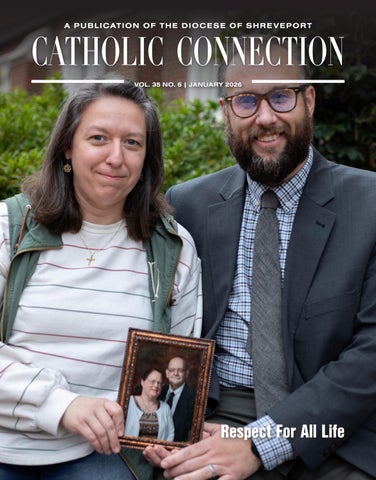
Pope Leo XIV's Prayer Intention For The Month of January FOR PRAYER WITH THE WORD OF GOD Let us pray that praying with the Word of God be nourishment for our lives and a source of hope in our communities, helping us to build a more fraternal and missionary Church. Cover photo: St. John Berchmans Cathedral School principal, Mr. T.C. Veit, and his wife, Lynace Veit, pose with a photo of her father, Mr. Wallace Pabst, in the Prayer Garden of the Cathedral of St. John Berchmans. Photo by Sophia Romanski
SUBSCRIPTIONS & ADDRESS CHANGES Blanca Vice bvice@dioshpt.org 318-868-4441
SUBMISSIONS
Deacon Charles Thomas, OFS
Sophia Romanski sromanski@dioshpt.org The Catholic Connection is a member of the Catholic Media Association Rev. Kevin Mues
The Diocese of Shreveport complies with Virtus' Protecting God's Children program (www.virtus.org). Online sessions are available. To report child sexual abuse by a cleric or church worker in the Diocese of Shreveport, call your loval law enforcement agency and Mary Arcement Alexander, Diocesan Victim Assistance Coordinator at 318-588-2120. Thank you for helping to keep our children and vulnerable adults safe.
The Catholic Connection is funded in part by a grant from the Catholic Home Missions Appeal and donations to the Catholic Service Appeal.
Karla Alvarez
MISSION STATEMENT
Rosalba Quiroz
CONTRIBUTORS Mary Arcement Alexander Dr. S. Germain Cassiere Clayton Cobb Karen Dill Jordan Harris Diane Libro Lisa Marcalus Sharon McCabe Lucy Medvec 2
CATHOLIC CONNECTION
Lisa Miller Jennifer Nix Elise Reis Sarah Romanski Noemi Saybe Shelly Schmidt T.C. Veit Mike Van Vranken Very Rev, Mark Watson
The Catholic Connection is a monthly publication funded by your Catholic Service Appeal, mailed to every known Catholic household in the Diocese of Shreveport. Our mission is to advance knowledge and understanding of our Catholic faith among the faithful. We seek to foster the application of Christ's teachings and our Church's mission in our daily lives and to encourage our sense of Catholic identity within our family, parish, and faith community.
January Second Collections JANUARY 17 & 18 THE CHURCH IN LATIN AMERICA funds a wide range of pastoral activities and
programs, from evangelization programs to pregnancy centers to leadership development of community leaders based on Catholic Social Teaching.
January SUNDAY
MONDAY
4
Solemnity of the Epiphany of the Lord
5
Fr. Kelby Tingle
TUESDAY
6
Fr. Nicholas Duncan
WEDNESDAY
7
Fr. Raney Johnson
THURSDAY
FRIDAY
SATURDAY
1
2
Solemnity of the Blessed Virgin Mary, Mother of God
Memorial of St. Basil the Great and St. Gregory Nazianzen
Bishop Francis I. Malone
Msgr. Rothell Price
8
Fr. Kevin Mues
9
3
Rev. Matthew T. Long
10
Fr. Duane Trombetta
Fr. Calistus Barasa Makokha
Fr. Gabriel Cisneros Campos
11
12
Feast of the Baptism of the Lord Fr. Fidel Mondragón
Fr. Jerry Daigle, Jr.
13
14 Fr. Keith Garvin
15 Fr. Do Minh Vu
16
Fr. Peter Mangum Louisiana Conference of Catholic Bishops’ meeting; New Orleans, 9:30 AM – 1:00 PM
17
Fr. Michael Thang’wa
Memorial of St. Anthony Fr. Peter Romanus Mallya
Region V Bishops’ Retreat, Archdiocese of New Orleans Retreat Center, New Orleans
18 Fr. Jean Bosco Uwamungu, Fr. Joseph C. Howard, Jr.
19
Fr. Charles Ssennyondo, Fr. Joseph Maddala
21
20
Fr. Mark Franklin, Fr. Karl Daigle
22
Memorial of St. Agnes Fr. James McLelland, Fr. Charles Glorioso
Fr. Mark Watson
23
24
Fr. Timothy Hurd, Fr. James Moran
Memorial of St. Feancis de Sales
Diocesan Student of the Year Competition; Catholic Center, Shreveport; 8:30 AM
Fr. LaVerne “Pike” Thomas
LA Right to Life presents 318 Comedy Night; Celebration Church; 7:00 p.m.
25
26
27
Fr. James Dominic Thekkemury
Memortial of St. Timothy and St. Titus
Confirmation; Little Flower of Jesus Church, Monroe; 9:00 AM
Fr. Richard Norsworthy, Fr. Rigoberto Betancurt Cortés
Feasts & Solemnities Priest(s) in the Diocese of Shreveport to pray for daily
Bishop Malone's Calendar Special Events in the Diocese of Shreveport
Fr. Joseph Ampatt 2026 Catholic Service Appeal Reception; Bayou DeSiard Country Club, Monroe; 6:00 PM – 8:00 PM
28
Memorial of St. Thomas Aquinas
29
Fr. Philip Michiels
30
31
Fr. Adrian Fischer, Fr. Patrick Madden
Fr. Joseph Martina, Msgr. Earl Provenza
SUGGESTED PRAYER FOR OUR PRIESTS:
Help our priests to be strong in their vocation. Set their souls on fire with love for your people.
Gracious and loving God, we thank you for the gift of our priests. Especially ___________________________________ (insert name(s) here) Through them, we experience your presence in the sacraments.
Grant them the wisdom, understanding, and strength they need to follow in the footsteps of Jesus. Inspire them with the vision of your Kingdom.
Memorial of St. John Bosco All deceased priests of the Diocese of Shreveport
Allow them to experience joy in their ministry. Help them to become instruments of your divine grace. We ask this through Jesus Christ, who lives and reigns as our Eternal Priest. Amen.
Give them the words they need to spread the Gospel.
DECEMBER 2025 3
JANUARY
CONTENTS
From the Bishop
06
Respecting All Life from Womb to Eternity
08
Natural Family Planning: How Truly Special A Woman's Body Is
10
A Year of Celebration!
14
With Grand Beginnings: The Origins of the Diocese of Shreveport
15
Living a Consistent Ethic of Life
16
When the Doctors are Wrong
18
It's a Hard Knock Life
20
Justice Starts with Dignity
21
The Miracle of Seeing
22
To "Bring Glad Tidings to the Poor"
24
Do You See Me?
25
Seminarian Burses
26
School News
28
Around the Diocese
32
By Dr. S.G. Cassiere
By Noemi Saybe and Diocesan NFP Mentors
By Lucy Medvec
By Lisa Marcalus
By Very Rev. Mark Watson
By T.C. Veit
By Karen Dill
By Diane Libro By Jennifer Nix
By Mike Van Vranken
By Mary Arcement Alexander
25
Do You See Me? Mary
Arcement Alexander reflects on the importance of recognizing all people as fellow children of God, made in His image and likeness. 4
CATHOLIC CONNECTION
ON THE COVER
N E R
16
Living a Consistent Ethic of Life Very Rev. Mark Watson
on church teaching regarding the protection of life at all stages and in every circumstance.
15
Introducing "From the Archives" Diocesan Archivist
Lisa Marcalus deburs her new monthly column in preparation for the Diocese of Shreveport's upcoming 40th Anniversary. Check in every month for a look into our rich history!
18
When the Doctors are Wrong St. John
Berchmans Cathedral School principal, T.C. Veit, shares the heartwarming story of his father-in-law's battle for health and the importance of caring for the sick.
FROM THE EDITOR
Sometimes I get emotional about cave paintings. This one, from the Rouffignac Cave in France (c. 13,000 BC), was featured in a 2006 study that posited that many of the paintings in this part of the cave were made by children, possibly as young as three years old. Some of the drawings are too high on the wall for a small child to reach on their own. This means an adult must have lifted the child, perhaps sat them on their shoulders and held them tightly by their little swinging feet, as they guided the child's hand. This is who we've always been, since the beginning of time. We've been artists and storytellers, pressing our handprints into the cold stone and shouting to the generations to come: we were here, and somebody loved us. It's this common desire - to be seen and acknowledged and loved - that unites us all, no matter where we come from or what we believe or what we've done with our brief time on Earth. This commonality, this unity, requires that we look at one another with love, the way God looks at each of us. It's a tall order. We don't always want to love everyone. We don't always see a little kid with swinging feet and eager hands when we look at ourselves, our families, our neighbors. We don't always want to see our enemies as equally eager, equally small, and equally deserving of the gracious support of a loving God. But that's what we're called to do. We're called to recognize our shared humanity. We're called to acknowledge each other, see each other, and love each other the way God loves us, especially when it seems impossible. We're called to make sure that love - for each other, for our children, and for our God - is the refrain that echoes through the next 13,000 years. DECEMBER 2025 5
FROM THE BISHOP
L
ife! It’s one of those things covering so many aspects of the human existence that we often only think of it as a subject when its place in our lives is put at risk or taken away.
I left the bank just a few moments ago and, while there, noticed Mr. Pham conducting business with a teller. You may remember him, his daughter, Hannah, a Loyola graduate, died suddenly during her freshman year in college. She used a wheelchair for most of her short life, and her passing touched many people. Seeing Mr. Pham just days before Christmas made me think more about how difficult this time of year must be for Hannah’s parents, as Christmas is a family time of year. It also reminded me of a Vince Gill song, “It Won’t Be The Same This Year,” in which he sings of Christmas without his brother. And it’s probably true for every family experiencing Christmas for the first time without a loved one who recently passed away. I don’t think it’s coincidental for such 6
CATHOLIC CONNECTION
thoughts to come to mind as we close out one year and enter a new one, especially as we step right into January wherein we focus on life and issues of life that touch our own lives. We intentionally recall the value of life from conception to natural death – and all the ways in which human life’s value should come to mind. There should come from within us both a promise to respect and protect human life from within and a recommitting of ourselves to speaking out on behalf of the life the Lord has given each of us. It shouldn’t be difficult for us to embrace the quality of human life, as was done by a beautiful young couple I encountered after this past Sunday’s Mass. My homily had included a story of a priest called to a single mom’s home where her son of only four or five years was very close to the end of his life because of a brain tumor. Lifting the child up into his arm, the priest asked if he believed in Christmas. The boy said, “Yes!” And when asked, “Do you believe in Christmas Land?” the child again answered, “Yes.” The priest then told him, “Very soon, you are going to
go to Christmas Land, and you’ll be very happy.” Within minutes the boy passed. When leaving the Cathedral after Mass, a young couple introduced themselves to me then told me their child in utero “went to Christmas Land!” Life for them means everything as they miss their child, who now looks into the face of God; very much like the Phams miss their daughter and any one of us who, having lost a loved one, recalls at Christmas time how precious life is and how fragile is the time we get to keep our loved ones. Although you are reading this after Christmas, my wish for you and your families as we begin a New Year is to embrace the gift of human life as the unique and precious gift from God to us. Embrace it once again in words and prayers of thanksgiving to the Author of Life and renew your own commitment to protect and cherish the gift that comes from Him alone.
por el obispo
L
a vida! Es una de esas realidades que abarcan tantos aspectos de la existencia humana que, a menudo, solo pensamos en ella como tema cuando su lugar en nuestras vidas se ve amenazado o nos es arrebatado.
Salí del banco hace apenas unos momentos y, mientras estaba allí, noté al Sr. Pham realizando una transacción con un cajero. Quizá lo recuerden: su hija, Hannah, graduada de Loyola, falleció repentinamente durante su primer año de universidad. Utilizó una silla de ruedas durante la mayor parte de su corta vida, y su partida conmovió a muchas personas. Ver al Sr. Pham a pocos días de la Navidad me hizo pensar aún más en lo difícil que debe ser esta época del año para los padres de Hannah, ya que la Navidad es un tiempo especialmente familiar. También me recordó una canción de Vince Gill, “It Won’t Be The Same This Year”, en la que canta sobre una Navidad sin su hermano. Y probablemente esto sea cierto para toda familia que vive la Navidad por primera vez sin un ser querido que ha fallecido recientemente. No creo que sea coincidencia que estos pensamientos surjan al cerrar un año y comenzar otro, especialmente al adentrarnos en enero, un mes en el que nos enfocamos en la vida y en las cuestiones relacionadas con
ella que tocan nuestras propias vidas. Recordamos de manera intencional el valor de la vida desde la concepción hasta la muerte natural, y todas las formas en que debe hacerse presente el valor de la vida humana. De lo más profundo de nuestro ser debe surgir tanto la promesa de respetar y proteger la vida humana como un renovado compromiso de alzar la voz en favor de la vida que el Señor ha dado a cada uno de nosotros. No debería resultarnos difícil abrazar la dignidad de la vida humana, como lo hizo una hermosa pareja joven con la que me encontré después de la Misa de este domingo pasado.
vientre materno “fue a la Tierra de la Navidad”. Para ellos, la vida lo es todo, aun cuando extrañan a su hijo, que ahora contempla el rostro de Dios; de manera muy similar a como los Pham extrañan a su hija y como cualquiera de nosotros que, al haber perdido a un ser querido, recuerda en Navidad cuán preciosa es la vida y cuán frágil es el tiempo que se nos concede con quienes amamos. Aunque estén leyendo esto después de la Navidad, mi deseo para ustedes y sus familias, al comenzar un nuevo año, es que abracen el don de la vida humana como el regalo único y precioso que Dios nos concede. Abrácenlo una vez más con palabras y oraciones de acción de gracias al Autor de la Vida, y renueven su propio compromiso de proteger y valorar el don que proviene solo de Él.
Mi homilía incluyó la historia de un sacerdote que fue llamado a la casa de una madre soltera, donde su hijo de apenas cuatro o cinco años estaba muy cerca del final de su vida a causa de un tumor cerebral. Al tomar al niño en sus brazos, el sacerdote le preguntó si creía en la Navidad. El niño respondió: “¡Sí!”. Y cuando le preguntó: “¿Crees en la Tierra de la Navidad?”, el niño volvió a responder: “Sí”. Entonces el sacerdote le dijo: Para obtener más “Muy pronto vas a ir a la Tierra información sobre las de la Navidad, y serás muy feliz”. oportunidades del Minutos después, el niño falleció. Ministerio Multicultural en Al salir de la Catedral después de la Misa, una joven pareja se me acercó para presentarse y luego me dijo que su hijo en el
la Diócesis de Shreveport y para encontrar nuestros horarios y lugares de misa en español, por favor escanee el código aquí.
DECEMBER 2025 7
Respecting All Life From Womb to Eternity: The Eternal Opportunity of Every Life
W
e measure the value of many things – careers, possessions, achievements – but when it comes to life itself, our culture often falls short. Is life only valued when it is strong, useful, or desired? Or does every human life, from the first heartbeat to the final breath, possess a worth that cannot be measured at all?
The life God gives to each of us – through parental love – is nothing less than an eternal opportunity: the chance to be with Him in His eternal present, that timeless “now” of which St. Augustine wrote, referring to God’s eternity as the changeless “now” that neither comes nor goes (Confessions, Book XI). Each life is the one opportunity given to every soul to reach eternal communion with God. In that divine perspective, every life, however brief, broken, or burdened, matters infinitely, because it exists within the gaze of the Eternal. Each January, the Church invites us to remember this truth: to be pro-life is to be pro-eternity. The culture of life is not merely about extending earthly years; it is about defending the eternal destiny of every soul. The human soul is so valuable in God’s eyes that the Incarnate Word would have entered history, suffered His Passion, and died for a single soul (cf. St. Thomas Aquinas, Summa Theologiae III, q.1, a.2, ad. 2). That is the true value each and every one of us carries – a value beyond all earthly measure and understanding. The Incarnation reveals not only God’s power but His personal love – a love that calls each soul by name, as the Good Shepherd calls His sheep (cf. John 10:3). To defend life, then, is to defend the very object of Christ’s Passion. Every child (unborn or not), every elder, every prisoner, every forgotten one carries a worth so immense that Heaven itself once bled for it. Life begins when God creates a soul out of nothing at conception, not when we decide it is convenient. “Before I formed you in the womb, I knew you” (Jeremiah 1:5). From that moment, the Creator’s image is already imprinted – not 8
CATHOLIC CONNECTION
potential, but presence (cf. CCC, no. 2270). The unborn child, unseen yet infinitely known, stands at the threshold of eternity. To defend that life is to defend God’s creative act itself. Yet protection must be paired with mercy – compassion for mothers and fathers who face the fear, isolation, or uncertainty of a pregnancy as a heavy cross . Where the world often condemns or abandons, the culture of life accompanies – reminding every parent that their child’s first heartbeat echoes in eternity, because every new life is not a burden imposed but an invitation offered by God into His eternal plan. When strength fades and days grow few, the temptation arises to see life as finished. Yet, in God’s sight, the elderly stand closer to the radiant door of eternity. Their suffering draws them more deeply into Christ’s own Passion. One obedience of faith is accepting from God both the gift of life and the hour of death He appoints. Euthanasia and assisted suicide reject this obedience, claiming mastery over life’s final chapter. They promise compassion but deliver control. Yet, one of the deepest acts of faith is to accept the death God’s providence has prepared for us, trusting that even our dying has meaning in His plan – an obedience praised by St. Alphonsus Liguori in Uniformity with God’s Will and echoed by St. Francis de Sales, who wrote in Treatise on the Love of God (Book IX, Ch. XIII) that “to die well is to die in the love of God – accepting death as He wills, when He wills, and how He wills.” The culture of life sees age not as decline, but as deepening participation in divine life. To visit, listen, and honor our elders is to show reverence for souls standing at the threshold of the eternal “now.” Even when society brands a life unworthy, God does not. Justice may demand accountability, but mercy always seeks
redemption. The Church upholds the sanctity of every soul – even the guilty – because each remains capable of conversion until the final breath. Even in the shadow of guilt, God’s mercy waits. The repentant thief crucified beside Jesus was guilty by human judgment, yet grace found him in his final hour. Christ did not condemn him but forgave him and promised, “Today you will be with Me in Paradise” (Luke 23:43). That moment, at once terrible and tender, reveals that no life – no matter how marred by sin – is beyond the reach of redemption. The same grace touched Alessandro Serenelli, the young man who murdered St. Maria Goretti. After years in prison, he repented deeply and sought forgiveness, even attending Maria’s canonization. His conversion stands as living proof that God’s mercy can bring resurrection out of ruin. Thus, the culture of life extends even to prison walls, reminding the world that repentance can turn a cross into a door to Heaven. If repentance is to come, its hour must not be cut short by human justice. To pray for the condemned is to stand beside the Crucified Christ Himself, offering mercy where the world demands only judgment. Our Lord hides Himself in those the world overlooks – the disabled, poor, mentally ill, lawful refugee seeking safety and peace, and unborn. “As you did it to one of the least of these, you did it to Me” (Matthew 25:40). The culture of life begins with vision – seeing beyond appearance, beyond mortal attributes, to the immortal soul within. When we serve the hidden ones, we touch the mystery of the Incarnation itself, honoring God’s image – obscured but never erased. What begins in the womb must be nurtured in the home. The first and most enduring sanctuary of life is the family. Within our homes, children learn reverence for the weak, respect for their elders, and compassion for the suffering. In the home, love becomes incarnate in the ordinary. Every act of patience, every word of encouragement, every meal shared with gratitude forms the heart in habits of eternity.
Each life is the one opportunity given to every soul to reach eternal communion with God. not a campaign but a conversion – of sight itself, from the temporary to the timeless. The life God gives us is that eternal opportunity – to love, suffer, repent, and prepare for the life that never ends. One day, time itself will cease, and what remains will be what and how we have loved in God. To love as God loves is to see every moment as preparation for eternity (CCC, 1023-1024). Let this January be more than remembrance. Let it be renewal – a turning of our hearts toward the Eternal Present, where all life finds its worth, its dignity, and its destiny in Him.
A home that protects life in all its stages, from conception to natural death, becomes a dwelling of the eternal present – a place where time is already touched by eternity. Our age measures worth by productivity and independence, but God measures by love. And in the end, as St. John of the Cross reminds us, “In the evening of life, we will be judged on love” (Sayings of Light and Love, 64). To respect life is to see as He sees – every soul as an immortal mystery, every moment as a step toward eternity. The culture of life is
S. Germain Cassiere, MD, FACP is a retired Internist and parishioner at the Cathedral of St. John Berchmans, writing on faith, virtue, and the Catholic spiritual life from the pew perspective.
DECEMBER 2025 9
Natural Family Planning: How Truly Special a Woman’s Body Is Testimonies from Diocesan NFP Mentors
Planificación Natural de la Familia: Cuan especial es el Cuerpo de la Mujer Testimonios de mentores diocesanos de NFP
10
CATHOLIC CONNECTION
M
arried for 27 wonderful years and blessed with three amazing children, my husband, Doug, and I have embraced NFP (Natural Family Planning) as part of our family journey. We took the course in an outof-state parish and joke that “we “failed,” getting pregnant during the four-month course! In truth, NFP isn’t only for avoiding pregnancy – it can also help achieve it. Early in the course, we discovered how truly special our bodies are, especially that of a woman, and understanding how the reproductive system works was eye-opening for me.
Doug and I then shared our NFP journey with many young couples until we moved to Monroe, where I realized few people were familiar with it or even knew what the NFP acronym meant. I sadly discovered that our new diocese didn’t have instructors to teach it, so couples lived their marriage bond without its guidance on such a vital part of Church teaching for family life. But when the diocesan Office of Marriage and Family Life sought candidates for NFP certification, I immediately knew I wanted that training, to be part of the solution. Before this opportunity, I had served in youth ministry for fifteen years, often teaching Theology of the Body – which relays the dangers of contraception and the Church teachings on chastity while also answering teens’ many questions. Knowing they’ll look elsewhere for answers if we don’t acknowledge them, educating early helps our youth understand, and live according to, their dignity and selfworth. When my youngest son graduated from high school, I moved to training young adults, couples, and moms. For all of this time, I’ve been discerning where God was calling me. As I now become a certified NFP instructor, I am certain this is the ministry for which God has been preparing me. My hope is to inspire others in our diocese — especially in Northeast Louisiana — to learn about NFP so they can experience the many blessings and graces that come from living God’s plan for marriage and family life.
- Shelly Schmidt
C
asada con Doug por 27 maravillosos años y bendecida con tres hijos increíbles, la PNF— Planificación Natural de la Familia— ha sido parte de nuestro caminar. Tomamos el curso en una parroquia fuera del estado. En tono de broma, decimos que “reprobamos” la clase ¡al quedar embarazados durante los cuatro meses del curso! En realidad, la PNF no es solo para evitar embarazos— también ayuda a concebir. Desde el principio, descubrimos lo verdaderamente especial que es nuestro cuerpo, especialmente el de la mujer. Comprender cómo funciona el sistema reproductivo fue una revelación para mí.
En pareja, solíamos compartir nuestra experiencia de la PNF con muchas parejas jóvenes. Luego, las cosas cambiaron cuando nos mudamos a Monroe. Me di cuenta de que muy pocas personas estaban familiarizadas con la PNF o incluso sabían qué significaba la abreviatura. Tristemente, descubrí que nuestra diócesis no contaba con instructores y que muchas parejas vivían su vínculo matrimonial sin orientación sobre una parte tan vital de la enseñanza de la Iglesia respecto a la vida familiar. Pero cuando la Oficina Diocesana de Matrimonio y Vida Familiar comenzó a reclutar candidatos para la certificación en PNF, supe de inmediato que quería recibir la formación y ser parte de la solución. Antes de tomar esta oportunidad, serví al ministerio juvenil durante quince años, enseñando con frecuencia la Teología del Cuerpo—los peligros de la anticoncepción y las enseñanzas de la Iglesia sobre la castidad—respondiendo a las muchas preguntas que los jóvenes tienen, sabiendo que buscarán respuestas en otro lugar si no las abordamos nosotros. Empezar temprano ayuda a los jóvenes a comprender su dignidad y su valor propio. Luego, mi hijo menor se graduó de la escuela secundaria y pasé del ministerio juvenil al trabajo con jóvenes adultos, parejas y madres. Durante todo este tiempo, he estado discerniendo hacia dónde me llamaba Dios. Ahora, al certificarme como instructora de PNF, siento con certeza que este es el ministerio para el que Dios me ha estado preparando. Espero inspirar a otros en nuestra diócesis—especialmente en NELA—a conocer la PNF y experimentar las bendiciones y gracias que provienen de vivir el plan de Dios para el matrimonio y la vida familiar. DECEMBER 2025 11
A
fter more than two decades away from the corporate world, I reentered the job market with renewed purpose. “A polished self-starter with an eye for quality and exactness. Whether volunteering or employed, I manage my responsibilities with communication, time management, and respect for confidentiality. Dedicated to deadlines and goals, with a true knack for improving processes for greater efficiency. If it’s not fast-paced, I’ll make it so – just ask my five children,” reads my resume.
Seeking a workplace where I could share my Catholic faith with those around me, in 2023, I began working at the Cathedral of St. John Berchmans. The following year, I embraced the role of Director of Faith Formation, doing what I love most – talking about God, sharing the Catholic faith, and working with children.
D
espués de más de dos décadas fuera del mundo corporativo, volví al mercado laboral con un propósito renovado. “Una persona proactiva y pulida, con un ojo para la calidad y la precisión. Ya sea como voluntaria o empleada, manejo mis responsabilidades con comunicación, gestión del tiempo y respeto por la confidencialidad. Comprometida con los plazos y las metas, con un verdadero talento para mejorar los procesos y lograr una mayor eficiencia. Si no es un entorno acelerado, yo lo haré– solo pregúntales a mis cinco hijos,” se lee en mi currículum. Buscaba un lugar de trabajo donde pudiera compartir mi fe católica con quienes me rodean, y en 2023 comencé a trabajar en la Catedral de San Juan Berchmans. Al año siguiente, asumí el cargo de Directora de Formación de Fe, haciendo lo que más amo: hablar de Dios, compartir la fe católica y trabajar con los niños.
Last year, I was invited to become a Natural Family Planning Instructor using the BOMA (Billings Ovulation Method), which my husband and I practiced to achieve our four pregnancies. It is my deepest hope to empower women and men to recognize the beauty of their uniqueness as God’s design. As the giver of life, He offers us a way to understand our bodies and plan our families with love, grace, and faith. How great is our God! As I complete my BOMA training and continue working at the Cathedral, I pray that God uses my gifts to help women know their bodies, trust in His plan, and shape their futures through love, prayer, and a life centered on Him.
- Sarah Romanski 12
CATHOLIC CONNECTION
nuestro Dios!
El año pasado, fui invitada a convertirme en Instructora de Planificación Natural de la Familia utilizando el método BOMA, el mismo que mi esposo y yo practicamos para lograr nuestros cuatro embarazos. Mi esperanza más profunda es capacitar a mujeres y hombres para que reconozcan la belleza de su singularidad como parte del diseño de Dios. Como dador de vida, Él nos ofrece una manera de comprender nuestros cuerpos y planificar nuestras familias con amor, gracia y fe. ¡Cuán grande es
Mientras completo mi formación en el método BOMA y continúo mi labor en la Catedral, oro para que Dios use mis dones para ayudar a las mujeres a conocer su cuerpo, confiar en Su plan y formar su futuro a través del amor, la oración y una vida centrada en Él.
W
hen I was pastor of Christ the King Parish in Bossier City, I met a dynamic couple, Mardeli and Reynaldo, both physicians. Mardeli was the Coordinator of Oasis, the parish’s Hispanic Young Adult Group that weekly studied a different area of Church teaching. Reynaldo and Mardeli soon had three children, moved to a new home near St. Mary of the Pines, and became parishioners. I was later appointed there and thus continue as their pastor. In our new community, their primary ministry became teaching NFP to couples preparing for marriage in the Hispanic community. When asked to recommend them for NFP certification, I was fully supportive, knowing they would serve other bilingual and monolingual couples with both professionalism and spiritual dedication. I am deeply impressed by how active they are in parish life and how well they balance fulfilling their ministry with caring for their young family and supporting their elderly parents. Not only I, but the entire St. Mary of the Pines community, feel blessed to have such a young family who exemplifies the beauty and vocation of Catholic marriage.
C
uando fui párroco de Cristo Rey en Bossier City, conocí a una pareja muy dinámica: Mardeli y Reynaldo. Ambos eran médicos. Mardeli también era la coordinadora de Oasis, el grupo de jóvenes adultos hispanos de la parroquia. Cada semana estudiábamos un área diferente de la enseñanza de la Iglesia. Pronto, Reynaldo y Mardeli tuvieron tres hijos. Se mudaron a una nueva casa cerca de la iglesia de Santa Maria de los Pinos, donde se hicieron feligreses, y yo seguí siendo su párroco después de ser asignado a servir en esa parroquia. En nuestra nueva comunidad, su ministerio principal pasó a ser la enseñanza de la PNF—Planificación Natural de la Familia— a las parejas que se preparaban para el matrimonio dentro de la comunidad hispana. Por eso, cuando se me pidió recomendarlos para la certificación en PNF, los apoyé plenamente, sabiendo que servirían a otras parejas bilingües y monolingües con profesionalismo y dedicación espiritual. Estoy profundamente impresionado por lo activos que son en la vida parroquial y por cómo logran equilibrar su ministerio, el cuidado de su joven familia y el apoyo a sus padres mayores. No solo yo, sino toda la comunidad parroquial somos bendecidos de contar con una familia joven que ejemplifica la belleza y la vocación del matrimonio cristiano.
- Very Rev. Mark Watson Our diocesan NFP instructors are available to serve several parishes. For details about a prenuptial group session or individual consultation of married and unmarried couples (“one-on-one”) instruction, please contact Noemi Saybe at marriagefamily@ dioshpt.org
Nuestros instructores diocesanos pueden servir múltiples iglesias. Para más información acerca de la PNF—Planificación Natural de la Familia, en grupo prenupcial, o en sesiones individuales para parejas casadas o solo juntas, comuníquese Noemi Saybe marriagefamily@ DECEMBER 2025 13 dioshpt.org
athedral of St. John Berchmans Blessed ment Christ the King Holy Trinity Jesus Good Shepherd Little Flower of Jesus Queen of Peace Our Lady of Fatima Our of Perpetual Help Our Lady of the Blessed ment Sacred Heart St. Ann St. Benedic Clement St. Elizabeth Ann Seton St. John aptist St. Joseph St. Jude St. Lawrence Lucy St. Margaret St. Mary of the Pines tthew St. Paschal St. Patrick St. Paul S of Celebration! ius XAYear St. Terence St. Thomas Aquinas
In Christ, We Are One H
appy New Year! Happy Anniversary! In case you don’t know, the Diocese of Shreveport will celebrate its 40th Anniversary on June 16, 2026. This is an amazing blessing for all of us, so for the next 12 months, we are highlighting its history and accomplishments from the past 40 years, much of it made possible by your donations to the Catholic Service Appeal. The annual Catholic Service Appeal kicks off next month with our theme, “In Christ, We Are One,” which represents us as Catholics in so many ways and was inspired by Pope Leo XIV’s episcopal motto, “In Illo uno unum,” “In the One, we are one.” Pope Leo’s motto reflects his desire for unity and community during his pontificate, but it also reflects that through Christ and the Eucharist, we Catholics are united as one.
and diocesan-wide events, such as the Chrism Mass during Holy Week and the Anniversary Mass on June 16. Together, we are a community of Catholics who worship together and support one another. Speaking of support… when you receive the annual Catholic Service Appeal information, whether by mail or in the pews, please prayerfully consider making a donation. Our ministries have grown so much these past four decades, and it is because of your generous support. If we all come together as one, we will continue to do amazing things. In Christ, We Are One.
While our diocese is geographically large (over 11,000 square miles in size), its Catholic population is small, less than 4% of the total population. We have 34 parishes and mission churches in 16 civic parishes . We attend Mass each week at our home parish, but it is through the Mass and Holy Eucharist that we unite as one community. In Christ, We Are One. I invite you to celebrate with us during this coming year. Visit another church for Mass, or attend events in other parishes 14
CATHOLIC CONNECTION
Lucy Medvec is the Director of
Development and Stewardship for the Diocese of Shreveport.
sus Our ed dict ohn nce s St.
From the Archives
With Grand Beginnings: The Origins of the Diocese of Shreveport
W
e mark a momentous occasion this year: the Diocese of Shreveport celebrates its 40th Anniversary! To commemorate this milestone, we’re looking back at our rich history and exploring the roots of our diocese with a monthly feature on significant events, milestones, and churches. We start with how we got here, looking at the Diocese of Shreveport’s genealogy in a journey that spans over three centuries and two continents.
Our story begins in 1699 when the Diocese of Québec, under French colonial rule, was charged with care of the area that now makes up north Louisiana. Nearly 90 years later, in 1787, the Diocese of San Cristóbal de la Habana was erected when Spain took over territory that included north Louisiana. Formation of the Diocese of Louisiana and the Two Floridas quickly followed in 1793, with New Orleans designated as the See City. In 1850, the Archdiocese of New Orleans was formed for all of Louisiana, and three short years later, the Church’s work in northern Louisiana began in earnest with a further division: the establishment of the Diocese of Natchitoches in 1853.
In 1910, the See transferred from Natchitoches to Alexandria, and in 1977, in recognition of northwest Louisiana’s growing population, the Diocese of Alexandria was officially redesignated as the Diocese of Alexandria-Shreveport, with co-cathedrals in each city. Our current era began on June 16, 1986, when that diocese split into two distinct entities, and Pope St. John Paul II designated St. John Berchmans as the diocesan cathedral, appointing Most. Rev. William B. Friend – then Bishop of the Diocese of Alexandria-Shreveport – as our first bishop on June 24. The Rev. E. J. Jacques, S.J., had the distinction of being the cathedral’s first rector. This new Diocese of Shreveport was comprised of 36 churches, 16 mission churches, 14 elementary schools, four secondary schools, and Holy Angels school, serving more than 40,000 faithful Catholics. Sixty-one priests, three permanent deacons, approximately 125 religious sisters, and three religious brothers served at the time. While Shreveport is the smallest diocese by population with approximately 33,000 Catholics, it is the largest in terms of geographical area, covering over 11,000 square miles and 16 civil parishes. It remains grand, indeed!
A diocesan shield is a majestic coat of arms with symbolic components that tell the story about a region and its spiritual heritage. Ours is composed of a red field, representing the Red River that flows through the See City, on which is a gold sunburst charged with the heraldic symbol and the monogram IHS, for The Holy Name, in honor of the Jesuit order that played a significant role in Shreveport’s church history. The three wavy bars that issue from the sunburst represent the three rivers that run through the diocese – the Red, Mississippi, and Ouachita.
Lisa Marcalus is the archivist for the Diocese of Shreveport.
DECEMBER 2025 15
LIVING A CONSISTENT ETHIC OF LIFE
W
hen I arrived at St. Mary Seminary in Baltimore at 31 years old, I had for years stood up passionately for life issues. I worked with the Missionaries of Charity Sisters in a soup kitchen in Madrid during high school and as a Medical Social Worker at the LSU Medical Center in Shreveport for the four years before attending seminary. During those four years, I worked with 16
CATHOLIC CONNECTION
Sr. Margaret McCaffery as a member of Paz Christi and the Louisiana Coalition to Abolish the Death Penalty, helping in the latter by leading prayer services in front of the Caddo Parish Court House on the evenings when persons were scheduled to be executed. And I protested alone in front of the Abortion Clinic near Centenary College. Photo: Attr. Rembrandt van Rijn."Suffer the little childtren to come unto me." 1620s. Oil on canvas.
It was the seminary’s Social Ethics class that gave me an organized way to express the interconnectedness of the various human life issues, using Cardinal Joseph Bernardin’s Seamless Garment philosophy, now also called the Consistent Ethic of Life. We read the speeches where he presented this teaching at college campuses throughout the 1980’s. In 2023, Blase Cardinal Cupich authored an article in America Magazine about this Consistent Ethic of Life, stating that the approach began when Cardinal Bernardin was invited in 1983 to discuss at Fordham University The Challenge of Peace: God's Promise and Our Response document he had helped author. Six months earlier, the document made headlines for stating that the United States’ nuclear weapons were only to be used as a deterrent to nuclear war. Cardinal Bernardin argued in his speech at Fordham that not only was nuclear war unjust but abortion was as well: “For the spectrum of life cuts across the issues of genetics, abortion, capital punishment, modern warfare and the care of the terminally ill.” In other presentations he included additional issues in which life was to be protected, including the hungry, homeless, undocumented immigrants, and unemployed workers. The Seamless Garment approach identifies each of these issues as interconnected and through each it shows the value of the human person. Pope Saint John Paul II argued in his 1995 encyclical The Gospel of Life, as had Cardinal Bernardin before him, that all the life issues are interconnected. He shows in the encyclical that it is not only in killing but also in not respecting the dignity of each person that we act against the commandment which calls us to not kill. The Pope states that law can never legitimize direct abortion nor euthanasia as they are the taking of innocent human life. He supports the new interest in finding non-violent means to counter armed aggressors, and he states that while the death penalty can be seen a “legitimate defense on the part of society,” it should be used very rarely. The Pope also includes poverty as a form of violence against human life and sees efforts to decrease biodiversity as a threat to life. In his 2023 article, Cardinal Cupich wrote about two life issues that did not exist when Cardinal Bernardin spoke about the Consistent Ethic of life. For the first , although Roe vs. Wade has been overturned, Cardinal Cupich said, we need to address the increasing availability of abortion pharmaceuticals, which are readily accessible by mail. Catholics need to contact our Representatives and Senators to take these off the market and support expectant and new mothers through guaranteed paid family leave, affordable childcare, and workplace protections for expectant mothers.
caused by the increased use of fossil fuels and the significantly greater number of wildfires, hurricanes and floods in the last few decades, resulting in greater numbers of immigrants being forced from their homes. Given the current level of polarization in the U.S., Cardinal Cupich wrote, only compassion will bring us together around these issues. Fourteen years ago, the United States Conference of Catholic Bishops undertook a research project, funded by the Lily Endowment, that sought a bridge between those Catholics who were passionate about ending abortion but opposed to the Church’s broader stand on quality-oflife issues and those Catholics who were passionate about Catholic teaching regarding the poor but opposed to or neutral to the protection of the unborn. The study found that compassion is the virtue that can unite people who are divided on life issues. I conclude this article with two thoughts. First, Pope Francis wrote that we live in a throw-away society. Every year, as we approach Christmas, children beg to receive certain toys as if these are the most important toys in the world, and they must have them. Shortly after Christmas, these same toys have little value and are thrown away. In an analogous way, many feel that some people in society have little value and can be thrown away: the unborn, the poor, those of another country or ethnicity, and the elderly. My second, related, thought is that this throw-away perspective leads us to be “indifferent” to the suffering of others. Many of us have no problem watching news reports about the end of the USAID Program without considering the consequences, the killing of tens of thousands from Gaza, the genocide in Sudan, and the immigration of hundreds of thousands from Sudan. In a world of violence, war, disease, and starvation, we must decide how we can make a difference through our financial generosity and our political action.
Very Rev. Mark Watson is the pastor of St. Mary of the Pines Parish, Shreveport, LA
The second additional life issue Cardinal Cupich addressed was Climate Change. He wrote about the loss of biodiversity DECEMBER 2025 17
COVER STORY
When the Doctors are Wrong
I
n 2000, after noticing some pain and discomfort, my fatherin-law visited his doctor and endured series of tests and screenings. While waiting for the results, my mother- and father-in-law’s presence were requested to discuss the findings with the doctor. Together, they learned that my father-in-law was in the final stages of prostate cancer and had less than six months to live.
They sought second opinions, but all returned the same prognosis. Next came getting affairs in order and preparing for the inevitable, but they did not entirely give up. Further conversations with doctors determined that Papaw was eligible for a new experimental treatment that was yielding positive results in other tests. Deciding it was better to put up a fight with the hope for more time, or at the very least, provide others in the future with better treatment, he began the experimental treatment. Six months
18
CATHOLIC CONNECTION
turned into years, and six years later, he was in complete remission from his cancer! However, in 2010, he and his wife were once more called in by the doctor and given the grave news that he had only months to live. The cancer was now in the form of multiple myeloma attacking his vertebrae, and he would soon experience far more debilitating and severe symptoms before the cancer took him. They again chose an experimental therapy that was yielding positive results under conditions similar to his. While my father-in-law will never obtain remission a second time, he is still with us today, and the most debilitating projected symptoms have been overcome or removed. While it was my father-in-law’s right to altogether refuse treatment given the nature of his prognosis and severity of the proposed treatment’s side effects, thankfully, euthanasia was never presented or considered as an option. The Catholic Church could not be clearer about matters surrounding life. “Human life is sacred because from its beginning it involves the creative action of God and it remains forever in a special relationship with the Creator, who is its sole end” (CCC, 2258). Created in God’s image and likeness, we must “recognize that their dignity is a gift from God and is not something earned or
lost” based on phases or conditions of health (United States Conference of Catholic Bishops [USCCB], Culture of Life and the Penalty of Death, p. 11). As such, the Church considers euthanasia or the willful assistance in ending one’s life as gravely immoral and murder.
Freedom Proponents of euthanasia assert that they present the suffering person with the freedom that others are unwilling to recognize. It is more compassionate to allow someone to end their life than to endure suffering toward the same eventual ending. In 2011, the USCCB released the document "To Live Each Day with Dignity: A Statement on Physician-Assisted Suicide" that sought to refute these claims. We shall explore some of their proposals below. A first crucial point to consider is the person’s mental health. Anyone who receives a deadly prognosis from a doctor is not in a healthy state of mind for making major life decisions. "Medical professionals recognize that people who take their own lives commonly suffer from a mental illness, such as clinical depression" (To Live Each Day, p. 2). This vulnerable group of people needs an advocate and to know that they are loved and cared for and that their purpose is not complete until they are called home by God. Providing someone in this situation with a means to end his or her life is not to care for that person – it is rather to neglect them. “Which of you, if your son asks for bread, will give him a stone? Or if he asks for a fish, will give him a snake? (Mt. 7:9-
10). We are called to love the person in need, and simply allowing them to give up is in no way love or assistance. Counseling, support groups, and, when appropriate, medication can all help individuals return to a healthy emotional state. Such decisions are rarely made without undue influence, thereby limiting the person's freedom to choose what is true and good. The legalization of suicide seeks to outline a specific class of people for whom it is appropriate: those who are not expected to live beyond six additional months. This, too, is troubling because such predictions, as with my father-inlaw, are notoriously inaccurate. The government and private industry have become compliant in the labeling of such cases. It can be far cheaper to end someone's life than keep them alive through specialty therapies and expensive medications. Thus today, “government programs and private insurers may even limit support for care that could extend life, while emphasizing the ‘cost-effective’ solution of the doctor-prescribed death” (To Live Each Day, p. 5). Finally, the right to life is the fundamental right upon which all other rights stand. To take away life is to take away all the other rights of the person, including personhood itself. Life “is the most fundamental element of our God-given human dignity” (To Live Each Day, p. 4). To reject the gift of life is to reject the one who gives the gift.
Compassion Advocates for dying with dignity argue that allowing the person to avoid suffering is an act of compassion. The reality is that nothing is less compassionate than taking one's life. By reducing a person's existence to pain and suffering, they reduce and objectify the person to a problem. Genuine compassion "helps vulnerable
people with their problems instead of treating them as the problem" (To Live Each Day, p. 4). As St. Teresa of Calcutta stated, “The greatest disease in the West today is not TB or leprosy; it is being unwanted, unloved, and uncared for. We can cure physical diseases with medicine, but the only cure for loneliness, despair, and hopelessness is love.” Her quote perfectly leads to my final point. The CDF states: "The pleas of gravely ill people who sometimes ask for death are not to be understood as implying a true desire for euthanasia; in fact, it is almost always a case of an anguished plea for help and love. What a sick person needs, besides medical care, is love" (Declaration on Euthanasia, Sacred Congregation for the Doctrine of the Faith, section 2). As Christians, we are continually called to live in the Imago Dei. The image of Christ is one that goes out to the sick and the dying. Never does Christ shy away from the leper, the lame, the blind, or the possessed. Furthermore, He never takes away the life that they possess but rather seeks to elevate their temporal existence in order for them to see that He is pointing to something beyond this life. Now, His love is not without sacrifice; we see the rich young man go dismally away because he could not see past his temporal goods — to see that through the sufferings of this life, there awaits an even greater good. For the Catholic who understands man’s final end, the view of suffering
in this life is quite different. When it’s united to Christ on the cross and endured with grace, this life’s great trials can be persevered and bear fruit. With Christ, not only is this possible, it can provide great grace and elevate our faith in an efficacious manner saving to the person. My father-in-law understands this reality. While there can be fits of depression, he is surrounded by a strong support network that compassionately brings him through the bad days and gives him a reason to continue the fight. Like Christ, who died for others, he has participated in experimental procedures that will provide others with a greater chance of survival. This is the sacrificial love, the greatest good, that leads man toward his final end. This article was originally written in 2020. My father in-law passed on to his eternal reward on January 4, 2022.
T.C. Veit is the principal of St.
John Berchmans Cathedral School in Shreveport, LA. DECEMBER 2025 19
IT’S A HARD KNOCK LIFE
T
he world of foster care is an aspect of the pro-life movement that often gets little attention.
As a licensed counselor several years ago, I worked with this population both as a therapist on a psychiatric unit and in my private practice, which often involved coordinating with state caseworkers, foster parents, and biological parents of children in foster care. The most rewarding, but troubling, aspect was working with the children and adolescents themselves, where I received an insider’s view of the struggles and challenges everyone in the system faced. With social problems growing in intensity in our community, I feel certain these difficulties will become even more complex. Imagine being a helpless child who 20
CATHOLIC CONNECTION
has been neglected, abused, and often unwanted. Imagine suddenly being taken out of your home, delivered into strangers’ hands, then placed in a temporary living environment while the adults in charge figure out what to do with you. Picture yourself being shuffled from placement to placement while these same adults worked out a plan to reunite you with your family, if that was possible. And that plan involved lots of helpers in the form of therapists, lawyers, and foster families. Meanwhile, you have to adjust to a new home, new school, and new foster siblings while dealing with the emotions of fear, helplessness, and rage. All kids have issues; foster kids have uniquely difficult ones. But this morning, the local news featured an inspiring story about a young couple in Haughton. Blessed with a large house and two children of their own, they adopted seven more children and provided temporary shelter for over 100 foster kids. The mother shared during the interview that she didn’t start out wanting to do this, but her faith told her she must. She was happy and carefree, doing whatever she felt like doing, she said, until she and her husband suddenly felt this urgent need to serve. However, what first looked like self-sacrifice became a source of tremendous blessing, both for the couple themselves and the diverse group of foster kids they have welcomed into their home. Those kids are nurtured, taught, and cherished. Sometimes they are disciplined, but as one youngster testified, “When I do bad things, I am punished, but my mom and dad still tell me they love me.” These parents are truly Christian missionaries. Their actions hold the key to solving our local problems of violence, truancy, homelessness, hunger… the list could go on and on.
My parish is starting a foster care support group. Every Sunday, I watch two families bring their foster babies up for a blessing in the Communion line. They tell me the huge risk in foster parenting is falling in love with a child that could ultimately return to the biological parent(s). Yet, they bravely put their hearts into this challenge. I know that several more children who were adopted occupy our pews. Parishioners unable to get directly involved with fostering are encouraged to organize and donate to fund raisers that meet the immediate needs of families in the system. And I’m proud to say that the CEO of the Gingerbread House in Shreveport is a fellow parishioner – if you’re looking for an organization to support, that’s a great one! They offer counseling services to children who are victims of abuse, along with legal assistance to defend their rights. As the scriptures tell us, the harvest is plentiful but the workers are few. Every child in the foster care system was intentionally created by God. I vividly remember so many of the children who came to my office, and in many cases, their stories had a positive ending. They each taught me spiritual lessons and brought me the joy that comes from helping to make a small difference in their troubled lives. Each foster child gives us the opportunity to step out of our comfort zones and join the effort to save a soul, and together they are among those Jesus spoke of in Matthew 25: “the least of my brethren.”
Karen Dill is a spiritual director
for the Diocese of Shreveport and a parishioner at St. Elizabeth Ann Seton Parish, Shreveport, LA.
T
Justice Starts with Dignity
he fundamental principle of Catholic Social Teaching is the dignity of each and every human person.
It goes back to the very beginning when God created men and women in His image and found them “very good” (Gen. 1:31) and continues through Pope Leo XIV’s Dilexi Te: “The dignity of every person must be respected today, not tomorrow, and the extreme poverty of all those to whom this dignity is denied should constantly weigh upon our consciences” (92). At its most basic, dignity is about “right to life.” On a deeper level, it is about a right to live as a child of God. It forms the core not only of what we do at Catholic Charities, but how we do it. Band-Aids are not dignified. That's why companies are always trying to make them blend into your skin. Similarly, it is not enough to just hand out assistance. Caring for someone with dignity means we listen to them, acknowledge their story, and see their potential. So, what does it look like to provide services that are dignified? Photo: Raphael."Justice" medallion on the ceiling of the Stanza della Segnatura. 1511. Fresco. Vatican Museums, Vatican City.
It starts with when someone walks in the door or picks up the phone and finds a warm greeting on the other end. Our receptionist is one of the most important positions in the office! We listen. Everyone requesting help with rent or diapers has a chance to tell their story. People come to us because they are in crisis, and sometimes, because they have lived a lifetime of poverty. Regardless, listening says, “You matter,” and on a practical level, it helps the case manager give better direction. We trust in clients’ resourcefulness. They only receive help from us once every two years, so they have to figure out how to manage their bills the other 23 months. So, we know they can. Also, all of our clients have some skin in the game, such as paying a portion of their bill or earning points for a new car seat. We trust in their intelligence and their desire to do the best they can for their families. Through Money School and our parenting classes, we try not to preach but to give people tools they can use. We keep our promises, and we don’t make promises we can’t keep. The
last several months of uncertain government funding have left us with less than usual for rent or utilities, which means we have to be careful about what we say. But if we can help, we will. We see men and women who walk through our doors as whole people with physical, emotional, and spiritual needs. If it seems appropriate, we pray with them. And when they have needs we can’t meet, we connect them to other resources in the community. Dignity is the first of the seven themes of Catholic Social Teaching, and it is also the foundation. When we start any interaction with this framework, we can start to build systems that promote subsidiarity, community, options for the poor, the importance of work, solidarity, and care for the Earth. We can build a community where everyone knows they are a child of God.
Diane Libro is the Executive Director of Catholic Charities of North Louisiana. DECEMBER 2025 21
Photo: Gioacchino Assereto. "Saints Peter and John Healing the Lame Man." 1600 - 1649. Fresco. Basilica della Santissima Annunziata del Vastato, Genoa, Italy
22
CATHOLIC CONNECTION
The Miracle of Seeing "I have neither silver nor gold, but what I do have I give to you; in the name of Jesus Christ the Nazorean, rise and walk." - Acts 3:6
O
ne of my favorite miracles in the Bible occurs in the Acts of the Apostles’ third chapter, when Peter and John encounter a man lame from birth who is begging for alms at the temple gate. Their first words to him are, “Look at us.” At first, I wondered why it was important for the man look at them. After all, miracles were not dependent on eye contact. But then I realized that for this man, that was a life-changing command. This is a man who, due to his disability in a culture that is not accessible, survived by means of begging and relying on strangers’ pity. He was likely stepped over and ignored by a majority of the temple-goers and had been transformed into an invisible obstacle. He was someone who probably felt at times that life may not be worth living.
How many times in our daily lives do we see someone struggling, and it makes us uncomfortable? Maybe we look away quickly. Maybe we pretend we don’t see them at all. Perhaps this happens when we see that man lying on the downtown bus stop bench; the man who has started to believe he is invisible and dead to the world, that his life is not worthy of a miracle. What if all he needs is for someone to say, “Look at me,” and yet, we shield ourselves from feeling the discomfort and look away? Notice that in this encounter in Acts, the man is asking for money, but Peter and John give him so much more than that. We do not have to give money to change lives. In fact, HOPE Connections conducted a study on panhandlers in Shreveport and found that almost all panhandlers were not actually homeless, and the ones that were had already been connected to services to address their needs. They do not need our money – they need to be seen! They need to believe they can be blessed by a true miracle that exceeds in value
anything that money can buy – they need to know they are truly loved. The value of a human life should never be dependent on what they can or will contribute. Instead, we must remember that human life has irrevocable value because every single person was created to be loved by God and by all members of His Kingdom. Sometimes, just letting someone know they are worth being seen can solidify in their minds that they have intrinsic value. That is where a small miracle begins – a tiny “resurrection” of sorts – where someone who feels they were dead to the world is awakened by finally being seen for the beloved child they absolutely are. All it takes is looking and truly seeing. If you perceive that someone you know is living unhoused, visit the HOPE Connections website at nwlahope.org, and click “Share a Concern.” The HOPE Street Outreach Team will try to locate the person and provide the services they need.
Jennifer Nix is a parishioner and
catechist at St. Elizabeth Ann Seton Catholic Church in Shreveport and the Day Service Coordinator at Hope Connections. DECEMBER 2025 23
To "Bring Glad Tidings to the Poor"
M
any call it the “Rejection at Nazareth,” but perhaps a better name for this gospel story is “Jesus Explains Why He Came.” After his dramatic baptism and subsequent forty days in the desert, Jesus heads home for Nazareth, and there in the synagogue, he reads from Isaiah. Luke narrates the scene like this:
"
He came to Nazareth, where he had grown up, and went according to his custom into the synagogue on the sabbath day. He stood up to read and was handed the scroll of the prophet Isaiah. He unrolled the scroll and found the passage where it was written: ‘The Spirit of the Lord is upon me, because he has anointed me to bring glad tidings to the poor. He has sent me to proclaim liberty to captives and recovery of sight to the blind, to let the oppressed go free, and to proclaim a year acceptable to the Lord.’ —Luke 4:16-19
Jesus left no doubt in His explanations of why He came. His preference was for the poor, the captives, those who don’t see, the oppressed, and those who were considered undeserving in his day and culture. In his most famous sermon, “Sermon on the Mount,” and in His “Sermon on the Plain” in Luke, He began by proclaiming how blessed are the poor in spirit and the poor! There are others on his list, such as the hungry, weeping, hated, excluded, insulted, denounced, meek, merciful, clean of heart, and peacemakers. Whenever He shows His special love for all of these, He often begins with the poor. So, each of the 20 or more times that Jesus says, “Follow Me,” in the four gospels, I’m guessing He’s asking us to have the same preference for the poor and oppressed that He does. In defending the dignity and rights of people, Jesus focused on those in need, and His life is our treasure of examples of how we should respond to the poor in our day. So, the more we are awakened to those in desperate need, the better we can assist the oppressed in our time. 24
CATHOLIC CONNECTION
How do we know that humans have dignity and rights? The best explanation I know is:
"
"Then God said: Let us make human beings in our image and after our likeness. Let them have dominion over the fish of the sea, the birds of the air, the tame animals, all the wild animals, and all the creatures that crawl on the earth. God created mankind in his image; in the image of God he created them; male and female he created them." — Genesis 1:26, 27 There is one characteristic every human being has in common: we are made in the image and likeness of God. I’ve heard “image and likeness” explained in several ways, but the bottom line is that every single person – no matter how they act, what they’ve done, where they live, or how they live – is somehow an image and a likeness of God. It appears that Jesus actually believed this, lived His life accordingly, and asked us to follow Him and do the same. He literally said He came to bring good news to those images of God who are poor, hungry, hated, and oppressed. This is what it means to give dignity and love to everyone around us. We, too, are here to bring the same good news to every child of God we encounter. Are you ready?
Mike Van Vranken is a spiritual
director for the Diocese of Shreveport and a teacher of new spiritual directors for the Archdiocese of New Orleans.
Do You See Me?
I
remember many years ago hearing about two groups of people in India who lived gravely below the poverty level, and as a result, they were being ostracized by their community in such a way that they were essentially forced to live underground. They are referred to as the Dalits and the Adivasis. I can still recall the horror I felt when I learned about this reality in India. I am not naive enough to think that India is the only country where certain people are treated inhumanely. Sadly, I've been in this world long enough to know that lots of people around the world are treated so unbelievably horribly that it is almost unbearable to hear about them, much less see them. Learning about the Dalits and the Adivasis impacted me for numerous reasons, with the main one being how easy it can become to treat people as if they are indeed invisible. I want to pose a question: when was the last time you avoided eye contact with a homeless person, pretending or maybe hoping they were not there? I would love to say I have never done so, but I would be lying. Every time I see a homeless person standing at an intersection, I do my best to get over to the other lane. I don’t behave this way because I think they are less than or that I am better, rather I avoid them because I can’t bear to see them fully. My instinct is to avoid until, that is, God whispers, “Not this time Mary.” I recall one such occasion earlier this year when I pulled up next to a homeless man and asked if he was hungry. He
said yes. I then asked him if he would remain there while I went to buy him food and he politely replied yes. I did my part, he did his part, and then as soon as I gave him his food the light turned red. Awkward! I could have rolled my window up and looked forward but in that moment it did not feel right. Instead I looked him in the eyes and asked his name. For the next few seconds we conversed, and as I began to drive off I made a point to say his name, Brian. I did this simple act to let him know that I see him. As Catholics, whenever we hear “respecting all life” we tend to immediately think of unborn children. In reality, respecting all life as a Catholic means looking at all human beings as having worth and value, even the ones we don't like, the ones that make us feel uncomfortable, and the ones who do really horrible, terrible things in this world. While we need to continue to speak up for those who have no voice such as the unborn, we also need to pay attention to those people who do have a voice, but as a result of their situation they have never used it. Oftentimes they have not been allowed to use it or they are too afraid to speak up. This brings to mind a question: What exactly can we do for such people? How would we actually help them? Do we give them the proverbial fish or do we teach them how to fish? Would they want our help? Would they know what to do in response to our love and kindness? When a person is treated as a subhuman for an extended period
of time, they may reach a point where they begin to reject kindness and love. Sadly, they can become conditioned to believe that they are indeed worthless and deserve to be treated in an inhumane way. My brothers and sisters, we cannot look at this reality and shrug our shoulders as we say, “Oh well, I guess there's nothing we can do.” This line of thinking will eventually lead us down a very slippery slope that ends in indifference and cynicism. Jesus calls us as His sons and daughters to be His hands and feet. We live in a world where non-Christians mock us and ask, “Where is your God?” They want to know why our God is allowing all of these atrocities to take place in the world. Truth be told, we need to do a better job of speaking up and standing up for God because He is not the wrongdoer here; we are. While He does allow it, He also sits back patiently waiting for us to reach out and step up to the plate. We cannot continue to be the onlookers afraid to say anything for fear of what others will think or fear of being ostracized ourselves. The time to see our “invisible” brothers and sisters is now.
Mary Arcement Alexander is a Licensed Professional Counselor & the Diocesan Victim Assistance Coordinator.
DECEMBER 2025 25
Seminarian Burses Thanks to our Recent Donors: (005)2 Cathedral of Berchmans Burse #2
St.
John
The Congregation of St. Johns Roman Catholic Church John & Emily Nickelson Mr. & Mrs. John M. Zimmel
(008) St. Jude Parish Burse Anonymous
(011)2 Rev. David Richter Memorial Burse #2
Anonymous William & Dolores Walker
(022) Rev. Blane O'Neil, OFM Memorial Burse
Anonymous
(035)4 Dr. James V. & Rosemary C. Ward Burse #4 Mr. Richard W. Ward - Law Office of Richard Ward Mrs. Rosemary C. Ward
(036)6 Msgr. Earl V. Provenza Burse #6
Anonymous Mr. & Mrs. L.L. Elford Paul & Rosalyn Tuminello Ms. Debora L. Prest
(047) Troops of St. George Burse Aaron & Alicia Lirette
(049) Rev. Philip Michiels Burse Mrs. Kathryn Green Reid & Jo Ann Williams Mr. & Mrs. Robert McGowen Deborah Macy
(053)2 Leo N. Plette Burse #2
Mary Queen of Peace Seminarian Bake Sale
Incomplete Burses: (001) Fr. Mike Bakowski Memorial Burse #2 ($1450) (002) Joseph & Antoinette Bakowski Memorial Burse ($3250) (003) Sam R. Maranto Memorial Burse ($1750) (004) Kathryn Atherton Cook Memorial Burse ($450) 26 CATHOLIC CATHOLICCONNECTION CONNECTION
(005) Cathedral of St. John Berchmans Burse #2 ($2951) (007) Dr. Carol Christopher Memorial Burse ($1200) (008) St. Jude Parish Burse ($9600) (009) St. John Berchmans Knights of Columbus Council 10728 Burse ($1550) (011) Rev. David Richter Memorial Burse #2 ($7250) (015) Bishop’s Seminarian Burse ($5785) (016) Elaine Malloy Frantz Memorial Burse ($1000) (017) Msgr. George Martinez Knights of Columbus Council 1337 Burse #2 ($2004) (018) Knights of St. Peter Claver Council 144 Burse ($1500) (021) Rev. Edmund "Larry" Niehoff Memorial Burse ($2350) (022) Rev. Blane O'Neil, OFM Memorial Burse ($6000) (023) Msgr. Edmund J. Moore Memorial Burse #2 ($4150) (024) Rev. Joseph Puthuppally Memorial Burse ($7750) (025) Kathleen Hightower Memorial Burse ($800) (027) Rev. Richard Lombard Memorial Burse #4 ($5000) (028) Friends-n-Faith Burse ($750) (029) Rev. Kenneth Williams Memorial Burse ($400) (030) Otis & Anne Krupa Littlejohn Memorial Burse ($9000) (032) Madeline & Joe Tiller Memorial Burse ($8450) (035) Dr. James V. & Rosemary C. Ward Burse #4 ($2720) (036) Msgr. Earl Vincent Provenza Burse #6 ($5401)
(037) Manuel & Catherine Licciardi, and John & Beverly Miller Burse ($7000) (038) The Malone Family Burse ($500) (039) St. Elizabeth Ann Seton Knights of Columbus Council 9260 Burse ($800) (045) Sister Martinette Rivers Memorial Burse ($600) (046) Domestic Church Burse ($5000) (047) Troops of St. George Burse ($7000) (048) Rev. Joseph Kallookalam Burse ($5000) (049) Rev. Philip Michiels Burse ($9150) (050) St. Joseph Shreveport Mary's Workers Burse #2 ($395) (052) Dr. Matthew Ragan Green, Jr. Memorial Burse ($1950) NEW BURSE (053) Leo N. Plette Memorial Burse #2 ($1376) (054) Msgr. Franz Graef Memorial Burse ($5000) (056) Hazel Iles & John Paul Woodley, Sr. Memorial Burse ($500) (057) Father Robert Inzina Memorial Burse ($5000) (058) Msgr. Warren T. Larroque Memorial Burse ($2500) (059) ACTS of Northwest Louisiana Burse ($800) (060) Fr. David Buss Memorial Burse ($2500) (061) Sister Maria Smith, DC Memorial Burse ($3500) (062) Joan E. Anderson Sneed Memorial Burse ($2000) (063) Rev. Charles Glorioso Burse ($2000)
Pictured (left to right): Sam Vandiver, Jordan Fegert, Angel Gomez, Kay Nader, Vocations Director Rev. Raney Johnson, Very Rev. Msgr. Earl V. Provenza, and Brett Reggio at the Mass of Thanksgiving and banquet for donors to the Seminarian Burse Program hosted by the Diocese of Shreveport on December 18, 2025. We extend our heartfelt holiday wishes and prayers to seminarians Tristan Frisk and Nathan Lirette, who are not pictured here.
To donate to an established seminarian burse, please scan here!
Gifts to the Diocese of Shreveport's Seminarian Burse Program create a legacy of giving in support of our seminarians. It currently costs an average of $50,000 per year to educate and support one seminarian and we are blessed to have six at this time. A seminary burse can be opened with a donation of $250 or more. A burse is completed when it reaches $10,000. Once a burse is open, it can receive donations in any amount. Burses can be opened to memorialize a loved one, honor a priest, and represent a group or organization. Anyone can contribute to any of the diocese's incomplete burses. For a list of incomplete and completed burses, please scan the QR code on this page or visit www.dioshpt.org/ seminarian-burses For more information on how to establish or contribute to a burse, please contact the Development Office at (318) 219-7260.
To donate to the Catholic Service Appeal, please scan here! DECEMBER 2025 27
St. Frederick High School
Influencers for Christ:
Discipleship at St. Frederick High School
T
o be a disciple means to be a committed learner and follower who learns from, imitates, and is transformed by a teacher or spiritual leader. Several years ago, St. Frederick High School (SFHS) engaged the Holy Sacred Menard Discipleship Team to conduct retreats for each class. It was such a meaningful experience for the students – SFHS is eternally grateful for the Discipleship Team's partnership – school leadership formed a team of our own in 2018 enable team members to continue to “disciple” their fellow classmates throughout the year.
This team has become one of the most sought-after organizations on campus, with just 12 members selected each year to match the 12 Apostles of Christ. Students submit an application at the end of their junior year to join the Discipleship Team and agree to abide by the conditions of membership, then complete an interview process with the discernment committee. Once members are selected, the team goes on a retreat to develop relationships, deepen their faith, and brainstorm ways to make a difference in the lives of other students. Each member is matched with a spiritual leader in the community for monthly mentoring meetings throughout the year. The students actively prepare and participate in Wednesday school Masses and conduct off-campus retreats for each 28
CATHOLIC CONNECTION
class. Throughout the year, their religion class, taught by Mrs. Olga Trejo, includes both the Senior Religion curriculum and discussions on programming for the entire school and identifying students who may need additional support - or simply someone to talk to. This year's canonizations of St. Pier Giorgio Frassati and St. Carlo Acutis highlighted the profound impact young people can have on others' faith, prompting the team to adopt “Influencers for Christ” as their motto. Posters throughout the school, encouraging all students to become influencers for Christ, display the scripture: “Don’t let anyone look down on you because you are young, but set an example for the believers in speech, in conduct, in love, in faith, and in purity.” — 1 Timothy 4:12 Discipleship Team members shared what being on the team means to them: Elizabeth Southwell: "Being on the Discipleship Team is the most rewarding feeling. We plan retreats and pray over the students, then when the time comes for the retreat, it holds much power. One of our main goals is to plant just one seed into one student. If we can spread the word of God to one person, that is all
we need to know that we did a job well done. Then, that student can spread the word of God as well, and then a waterfall effect begins. Our Lord and Savior is so good! This team is a blessing for St. Frederick High School!" Clayton Turpin: "For my whole life I have been an Episcopalian, not truly believing in the Eucharist. Being on this team has strengthened my faith life. I have learned so much about the Catholic religion. Mrs. Trejo is the best teacher! She has answered every question that I have had. Now, I am finally becoming Catholic, truly believing the Eucharist is the presence of God. I believe the Eucharist is the highway to heaven." All of the team members expressed how being a part of this team has strengthened their faith, improved their relationship with God, and encouraged them to live the life Christ has planned for them. The program significantly impacted their lives - and their daily testimonies make an even greater impact on every student at St. Frederick High School.
Lisa Miller is the Director of Development at St. Frederick High School in Monroe, LA.
St. Jude Day School & Mother's Day Out
T
his time of year is a favorite of mine, and not just because we get to wear our favorite sweaters, decorate with pumpkins, and get an extra hour of sleep. The Fall season at St. Jude Day School and MDO is full of faith and fun as we celebrate All Saints Day and All Hallows Eve, or as we know it, “Halloween.” On Halloween, the children arrived ready and excited to show off their costumes, then trick-or-treat throughout the festive halls before their families joined us for a pizza party and fellowship. There is no denying it was a “sweet” event!
We devoted the following week to the saints. We read inspiring books, colored meaningful pictures and watched engaging videos about God's heavenly friends. We discussed how we can ALL be saints, as we are called to be. During chapel, Deacon Steve enlightened us about All Saints Day and inspired us with the hopeful message of Noah and God's promises. Ms. Gwen led us in singing “When the Saints go Marching In.” A very fitting choice! It is always heartwarming to hear the children sing. We wrapped up this very special week by dressing as our favorite saint. In came St. Joan of Arc and St. Michael the Archangel to defend us in battle. Everywhere you looked, there was Mother Mary to intercede for us. Our Lady of
Guadalupe appeared, and St. Elizabeth of Hungary arrived with her basket of flowers. St. Francis of Assisi and St. Joseph also entered the building, along with, of course, our patron St. Jude. What a beautiful sight to see the playground filled with precious little saints. To help share our faith, we sent home little treat bags of goodies that are symbolic of our saints, such as goldfish crackers for the Apostles and animal crackers for St. Francis of Assisi. Now we are practicing songs for Thanksgiving and Christmas and enjoying a wonderful Advent season. “Be who God meant you to be and you will set the world on fire.” - St. Catherine of Sienna.
Sharon McCabe is the Pre-K 3 teacher at St. Jude Day School & Mother's Day Out.
DECEMBER 2025 29
St. Joseph Catholic School
E
ach year, families with schoolage children discern which academic institution will best serve their children’s needs. I invite those who read the Catholic Connection to consider St. Joseph Catholic School for the 2026-2027 school year. I could share all the reasons a family should choose St. Joseph, but offer three key ones: it is an opportunity to learn in a loving and safe environment, students are challenged academically to be thoroughly prepared for success at each stage in life, and its environment envelops the students with our faith’s virtues, enabling each child to be formed into the person Christ calls them to be. Having all this in mind, why not choose St. Joseph?
St. Joseph celebrates 75 years of Catholic education in Shreveport on
September 17. Since its founding in 1951 under the direction of Bishop Charles Greco and Fr. Joseph Gremillion, our school has striven to be true to its purpose: providing a Catholic education, not to fulfill others’ responsibilities but as our responsibility as a Catholic school to aid parents in their mission as the primary educators of their children. Thus, we embrace the task to not only provide an enriched academic program but also faith formation that fosters every parent’s goal – our children’s sainthood. Catholic education is not merely a gift or responsibility. The late Holy Father, Pope Francis, describes education as an “act of hope.” As we live in a world that confronts young people with challenges and obstacles, we pray that
we are answering the call to provide access to such a hope, which is not only desired by the people of God but designed by God Himself. Call St. Joseph Catholic School today to set up a visit . We hope to partner with you in this endeavor of education. It’s a great time to be a Falcon!
Clayton Cobb is the principal of St. Joseph Catholic School in Shreveport.
OPEN HOUSE JANUARY 28 5:00-7:00 PM
Academic EXCELLENCE Surrounded by FAITH
Discover the difference at St. Joseph Catholic School For 74 years St. Joseph Catholic School has been shaping young hearts and minds through Academic Excellence Surrounded by Faith. Come see what makes our K3 - 8th grade community so special — where students learn, grow, and thrive in a Christcentered environment. (318) 865-3585
30
CATHOLIC CONNECTION
|
www.sjsfalcons.org
|
1210 Anniston Avenue, Shreveport
Loyola College Prep
2025 Hall of Honor Inductees Announced
L
oyola College Prep is proud to announce the 2025 Hall of Honor Inductees: Jon Alston ’01, Pat Harrington ’79, and Jerry Mosely (honorary). All three inductees have contributed significantly to the school, its legacy, and its students.
PAT HARRINGTON ‘79
Now a dedicated photographer and community leader based in Shreveport, Pat Harrington was a member of the 1976 state championship team and the 1978 semifinal team. As the owner and main photographer of The Harrington House Photographic Studio and Gallery in Shreveport, he has built a distinguished career spanning over four decades. Harrington is recognized for his exceptional skill and artistry as a certified photographer with the Professional Photographer Association. As a founding member of Business Exchange Inc., he has also contributed significantly to the local business community, earning awards for his years of dedicated service. Harrington’s commitment extends beyond his professional achievements. Deeply rooted in his faith and community, he has served St. Joseph Catholic Church on the Parish Pastoral Council and as a catechist for Confirmation classes. For over 20 years as a volunteer, he has photographed for the Diocese of Shreveport, donated school portraits to low-income families, and supported initiatives like Operation Santa Claus with toy donations.
JERRY MOSLEY
As this year’s Honorary Alumnus, Jerry Mosley is one of the legendary teachers at Loyola. Born in Fordyce, AR., and a former college football player at Southern Arkansas, he retired from the Bossier Parish public school system after 25 years of service as a coach, principal, and supervisor. Mosley came to Loyola in 1986 and served as an assistant coach for six years, then continued as the team’s video coordinator. He is also one of the best-remembered world history teachers the school has ever had – some of the stories he told in class are remembered to this day. He retired in 2011 after 25 years. Both of his gransons are Loyola graduates.
JON ALSTON ‘01
In addition to being one of the top football players in school history, Jon Alston has also had a distinguished career in the film and entertainment industry. As an All-State player for the Flyers, Alston played free safety, linebacker, offensive tackle, and running back in his career at Loyola. He was a sophomore starter on the 1998 semifinal team and became a recordsetting running back in his senior year. He played at Stanford University as a second-team All-Pac 12 linebacker. Alston was a third-round pick in the
2006 NFL draft and played for three teams over a five-year career. He has since become an awardwinning director, writer, and producer of film and television and is currently living in California. Alston has written and produced for critically acclaimed shows such as S.W.A.T. and All American. His first feature-length film, Red Butterfly, debuted at the 23rd Annual St. Louis International Film Festival. His second film, Augustus, received 24 wins and five nominations since its debut in 2020, winning the Directorial Discovery Grand Prize at the Rhode Island International Film Festival. The Flyer Alumni Association hosted a banquet to honor these three individuals on October 16, and the inductees were recognized during the Flyer Football game halftime the next day.
Jordan Harris is the Director of Marketing & Communications at Loyola College Prep in Shreveport, LA.
DECEMBER 2025 31
Around the diocese... While commemorating the annual “Mass of Remembrance” on Sunday, November 2, 2025, Pastor Fr. Mark Watson and parishioners of St. Mary of the Pines Catholic Church in Shreveport, LA, celebrated all the faithfully departed who have left this world. Fr. Mark Watson reflected on the life and passing of his mother, Mrs. Gwendolyn Watson. We have all lost someone dear to us. Therefore, it’s okay for us to feel sadness about them. We can also offer thanksgiving to all our loved ones who died in Christ have the promise of eternal life.
Merry Chtistmas from Mary, Queen of Peace Parish!
32
CATHOLIC CONNECTION
Join us for an evening of food, friends, family and birthday cake celebrating the 10th Birthday of Mary's House. Let's make a difference and have a great time too. Don't miss out on what one person calls the "Pro-Life Prom!" Buy your tickets and tables now! Call Mary’s House 318-220-8009.
DECEMBER 2025 33
34
CATHOLIC CONNECTION
Family Night, Ladies Night, Youth Group or Just Because You Like to Laugh!
The Pregnancy Centers, Heart of Hope Maternity Home, and Louisiana Right to Life are hosting 318 Comedy Night on January 23rd, Friday at 7:00 p.m. Here’s what people say: “People repeatedly invite him because the material is always brand new, 100% clean, and very, very funny.” - Gloria Leyda, Ambassador Speakers Don’t miss this fun night – Adult tickets start at $10 - Use QR code for tickets or visit www.318ComedyNight.org DIOCESE OF SHREVEPORT | 3500 Fairfield Avenue | Shreveport, LA 71104 | 318.868.4441 ☐ Yes! I/We want to support our Catholic priests, families, young people and the less fortunate in our diocese. With a gift of: ☐ $100 ☐ $500 ☐ $250 ☐ $750 Other $
☐ $1000 ☐ $2000 ☐ $1500 ☐ $5000
I/We will make our payment(s) ☐ One-time ☐ Monthly (through December 2025)
Building our Faith Member(s) of: Name: Address: City: Spouse Name: Cell Phone: Email:
Church,
Please list below any special intentions for which you would like prayer assistance.
City
ST: ___ Zip:
For assistance or other inquiries, contact us at (318) 868-4441 x263 or bvice@dioshpt.org
(over)
DECEMBER 2025 35
CATHOLIC CONNECTION DIOCESE OF SHREVEPORT 3500 Fairf ield Ave. • Shreveport, LA 71104
Catholic Connection USPS 024-824 is published monthly except for July by the Diocese of Shreveport, 3500 Fairfield Ave., Shreveport, LA 71104. Periodicals Postage PAID at Shreveport, LA 71102. POSTMASTER: Send address changes to Catholic Connection, 3500 Fairfield Ave, Shreveport, LA 71104.
PHOTO OF THE MONTH: Priests & Seminarians (back row) and Red River Catholics men's team (front row) pose for a group photo after RRC's win at the annual Western Deanery Seminarian Basketball Game on December 13, 2025. 36
CATHOLIC CONNECTION