Prices
Under
e r u s s e r P
The price of doing business will show up in your electric bill By Megan McKoy–Noe
“Electric co-ops have an obligation to keep the lights on and electric bills affordable at a time when the costs for fuel and raw materials to build new generation are steadily rising.” —Glenn English, NRECA
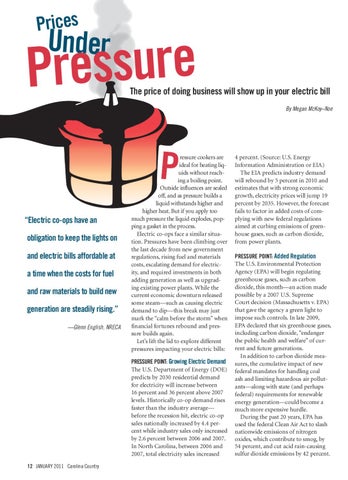
ressure cookers are ideal for heating liquids without reaching a boiling point. Outside influences are sealed off, and as pressure builds a liquid withstands higher and higher heat. But if you apply too much pressure the liquid explodes, popping a gasket in the process. Electric co-ops face a similar situation. Pressures have been climbing over the last decade from new government regulations, rising fuel and materials costs, escalating demand for electricity, and required investments in both adding generation as well as upgrading existing power plants. While the current economic downturn released some steam—such as causing electric demand to dip—this break may just mark the “calm before the storm” when financial fortunes rebound and pressure builds again. Let’s lift the lid to explore different pressures impacting your electric bills: PRESSURE POINT: Growing Electric Demand The U.S. Department of Energy (DOE) predicts by 2030 residential demand for electricity will increase between 16 percent and 36 percent above 2007 levels. Historically co-op demand rises faster than the industry average— before the recession hit, electric co-op sales nationally increased by 4.4 percent while industry sales only increased by 2.6 percent between 2006 and 2007. In North Carolina, between 2006 and 2007, total electricity sales increased
12 JANUARY 2011 Carolina Country
4 percent. (Source: U.S. Energy Information Administration or EIA) The EIA predicts industry demand will rebound by 5 percent in 2010 and estimates that with strong economic growth, electricity prices will jump 19 percent by 2035. However, the forecast fails to factor in added costs of complying with new federal regulations aimed at curbing emissions of greenhouse gases, such as carbon dioxide, from power plants. PRESSURE POINT: Added Regulation The U.S. Environmental Protection Agency (EPA) will begin regulating greenhouse gases, such as carbon dioxide, this month—an action made possible by a 2007 U.S. Supreme Court decision (Massachusetts v. EPA) that gave the agency a green light to impose such controls. In late 2009, EPA declared that six greenhouse gases, including carbon dioxide, “endanger the public health and welfare” of current and future generations. In addition to carbon dioxide measures, the cumulative impact of new federal mandates for handling coal ash and limiting hazardous air pollutants—along with state (and perhaps federal) requirements for renewable energy generation—could become a much more expensive hurdle. During the past 20 years, EPA has used the federal Clean Air Act to slash nationwide emissions of nitrogen oxides, which contribute to smog, by 54 percent, and cut acid rain-causing sulfur dioxide emissions by 42 percent.