PPP Procurement
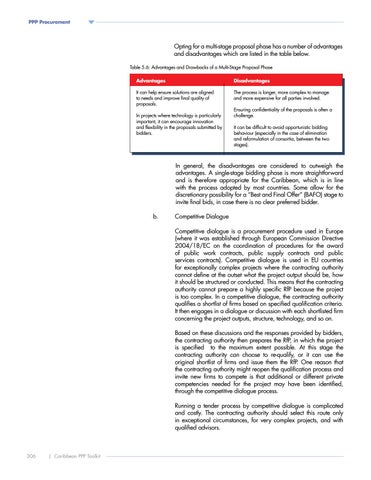
Opting for a multi-stage proposal phase has a number of advantages and disadvantages which are listed in the table below.
Table 5.6: Advantages and Drawbacks of a Multi-Stage Proposal Phase Advantages
Disadvantages
It can help ensure solutions are aligned to needs and improve final quality of proposals.
The process is longer, more complex to manage and more expensive for all parties involved.
In projects where technology is particularly important, it can encourage innovation and flexibility in the proposals submitted by bidders.
Ensuring confidentiality of the proposals is often a challenge. It can be difficult to avoid opportunistic bidding behaviour (especially in the case of elimination and reformulation of consortia, between the two stages).
In general, the disadvantages are considered to outweigh the advantages. A single-stage bidding phase is more straightforward and is therefore appropriate for the Caribbean, which is in line with the process adopted by most countries. Some allow for the discretionary possibility for a “Best and Final Offer� (BAFO) stage to invite final bids, in case there is no clear preferred bidder.
306
| Caribbean PPP Toolkit
b.
Competitive Dialogue
Competitive dialogue is a procurement procedure used in Europe (where it was established through European Commission Directive 2004/18/EC on the coordination of procedures for the award of public work contracts, public supply contracts and public services contracts). Competitive dialogue is used in EU countries for exceptionally complex projects where the contracting authority cannot define at the outset what the project output should be, how it should be structured or conducted. This means that the contracting authority cannot prepare a highly specific RfP because the project is too complex. In a competitive dialogue, the contracting authority qualifies a shortlist of firms based on specified qualification criteria. It then engages in a dialogue or discussion with each shortlisted firm concerning the project outputs, structure, technology, and so on.
Based on these discussions and the responses provided by bidders, the contracting authority then prepares the RfP, in which the project is specified to the maximum extent possible. At this stage the contracting authority can choose to re-qualify, or it can use the original shortlist of firms and issue them the RfP. One reason that the contracting authority might reopen the qualification process and invite new firms to compete is that additional or different private competencies needed for the project may have been identified, through the competitive dialogue process.
Running a tender process by competitive dialogue is complicated and costly. The contracting authority should select this route only in exceptional circumstances, for very complex projects, and with qualified advisors.