Micro, Small & Medium Enterprise Development in the Caribbean: Towards A New Frontier - | 24
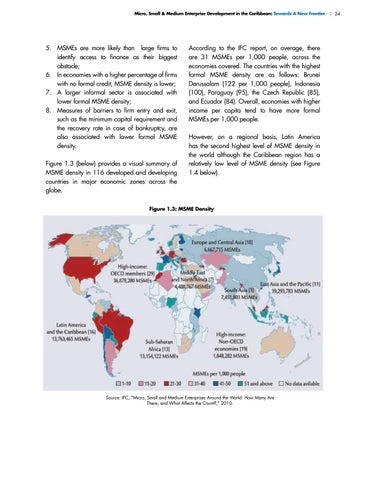
5. MSMEs are more likely than large firms to identify access to finance as their biggest obstacle; 6. In economies with a higher percentage of firms with no formal credit, MSME density is lower; 7. A larger informal sector is associated with lower formal MSME density; 8. Measures of barriers to firm entry and exit, such as the minimum capital requirement and the recovery rate in case of bankruptcy, are also associated with lower formal MSME density. Figure 1.3 (below) provides a visual summary of MSME density in 116 developed and developing countries in major economic zones across the globe.
According to the IFC report, on average, there are 31 MSMEs per 1,000 people, across the economies covered. The countries with the highest formal MSME density are as follows: Brunei Darussalam (122 per 1,000 people), Indonesia (100), Paraguay (95), the Czech Republic (85), and Ecuador (84). Overall, economies with higher income per capita tend to have more formal MSMEs per 1,000 people. However, on a regional basis, Latin America has the second highest level of MSME density in the world although the Caribbean region has a relatively low level of MSME density (see Figure 1.4 below).
Figure 1.3: MSME Density
Source: IFC, “Micro, Small and Medium Enterprises Around the World: How Many Are There, and What Affects the Count?,� 2010.