Jamaica Highway 2000 Case Study were acquired, 90% of which were already owned by the Government; as shown in Table 2 below.11
NROCC held consultations with persons and owners of businesses who would be affected by the Highway, and resettlement alternatives were offered at full replacement costs for losses including lands, buildings, other structures, crops, trees, businesses and incomes lost, all at prevailing market values. In addition to relocation, there were other challenges to overcome:
15
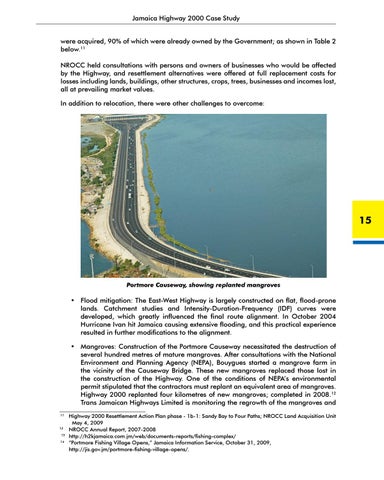
Portmore Causeway, showing replanted mangroves
• Flood mitigation: The East-West Highway is largely constructed on flat, flood-prone lands. Catchment studies and Intensity-Duration-Frequency (IDF) curves were developed, which greatly influenced the final route alignment. In October 2004 Hurricane Ivan hit Jamaica causing extensive flooding, and this practical experience resulted in further modifications to the alignment. • Mangroves: Construction of the Portmore Causeway necessitated the destruction of several hundred metres of mature mangroves. After consultations with the National Environment and Planning Agency (NEPA), Bouygues started a mangrove farm in the vicinity of the Causeway Bridge. These new mangroves replaced those lost in the construction of the Highway. One of the conditions of NEPA’s environmental permit stipulated that the contractors must replant an equivalent area of mangroves. Highway 2000 replanted four kilometres of new mangroves; completed in 2008.12 Trans Jamaican Highways Limited is monitoring the regrowth of the mangroves and Highway 2000 Resettlement Action Plan phase - 1b-1: Sandy Bay to Four Paths; NROCC Land Acquisition Unit May 4, 2009 12 NROCC Annual Report, 2007-2008 13 http://h2kjamaica.com.jm/web/documents-reports/fishing-complex/ 14 “Portmore Fishing Village Opens,” Jamaica Information Service, October 31, 2009, http://jis.gov.jm/portmore-fishing-village-opens/. 11