MAKE A DIFFERENCE
|
Do things differently with our green getaway guide
A DAY IN THE LIFE | REVAMP YOUR ROUTINE Meet the influencer who can help you go zero-waste
canvas &glass
The plastic-free revolution starts at your desk
How to live plastic free Working
together th
The communities harnessing people power against plastic
Issue No. 2 | April 2019
-
A few words
...
I
t’s finally April, spring has sprung and we’re starting to leave our houses a little more. In our last issue we spent some time on a windy Welsh beach. This time we explored a Surfers Against Sewage approved plastic-free village (still windy, still in Wales) and met some inspiring people who we hope you’ll find inspiring too. We’ve also spoken to Elena Proffitt, the student from Bolton who left her life in London behind to travel, only to find herself helping Keralan locals set up a river-cleaning scheme. The slogan of the cleaning project is ‘think global, act local’, and that’s something we aim to embody here at canvas & glass. In this issue we’re also bringing you positive progress from across the globe in all things plastic-free. From India to Aberporth, there’s always something happening in our community. As always, this issue is packed with tips on plastic-free living, including pet care, stationary and looking after your locks. There are so many ways to make a difference and protect our planet from the harmful impact of plastic, from changing your hairbrush to getting out on the campaign trail. What counts is that you’re actually doing something. This April, it’s time to get out and explore plastic-free places, shout about the good things and tackle the bad.
The team x Keep in touch @canvasandglass @canvasandglass_ @canvasandglassmag canvasandglassmagazine
APRIL
Contents
MAKING WAVES
MEET OUR FOLK
5 HIDDEN PLASTIC
22
Hidden plastics are everywhere; here are five to watch out for
DAY IN THE LIFE
Influencer Georgina Caro takes us through a typical plastic-free day
6-7 GLOBAL CHANGE REPORT 23 - 25 CLEANING UP KERALA Elena Proffitt takes positive action on her Indian getaway
How different countries around the world are reducing their plastic use
8-9 ACTIVE CHANGES
NOT JUST A PRETTY FACE
Our favourite sports companies in the UK are making conscious changes
27
SHAKE UP YOUR SPACE
10-11 THE SUSTAINABLE STUDY Little ways to make your office aesthetically plastic-free
Some of our favourite sustainable style solutions for you to try at home
28-29 RELAX WITHOUT PLASTIC Caring for your body, mind, soul and the planet
30-31 HAIR ROUTINE
STAND OUT FROM THE CROWD
Take care of your luscious locks with these home solutions
12-13 GREEN GETAWAYS How to make your holidays more environmentally friendly
CONSCIOUS KITCHEN
14-15 PAWS FOR THOUGHT
32-33 OUR TAKE
The plastic-free alternatives for all your pet’s needs
Is our takeaway generation damaging the planet?
17-21 CONSCIOUS COMMUNITIES We meet the communities harnessing people power to become plastic-free
UPCYCLE YOUR STYLE
34
Share
HOW DO YOU BREW? How do you like your cuppa? Check out these plastic-free options
What are your thoughts on April’s issue? Tell us what you think using #WeArePlasticFree
TISSUE PRODUCTS MADE FROM 100% BAMBOO Sustainable
Skin Friendly thecheekypanda.co.uk
Socially responsible
Making waves
Hidden Plastic We all know about the plastic in bottles, bags and straws - but what about the plastic that isn’t so obvious? canvas & glass take a look at the top six worst offenders for hidden plastic By Maria Mellor
Chewing gum
Produce stickers
Contains a polymer to make it extra chewy and long-lasting. You can buy plastic-free, plant-based chewing gum from Iceland.
Ruins loose fruit and veg with a tiny bit of plastic. Buy loose food from your local market to avoid plastic stickers.
Clothes Up to 64% of new clothes made today are made of plastic. Check the label on clothes to make sure it’s made from natural materials.
Tea bags Wrapping paper Often laminated with plastic for a glitter effect or to make it stronger. To be able to be recycled, wrapping paper must pass the ‘scrunch test’ - if it springs back after scrunching up, it can’t be recycled.
Plastic stops teabags from splitting in the box or cup. Buy loose-leaf tea instead of tea bags to avoid plastic - turn to page 34 for tea and coffee tips!
Crisp packets Disguised as foil, crisp packets are mostly plastic. Companies like Two Farmers make crisps in biodegradable packets.
5
Global
change report
We take a look at this month’s positive plastic-free progress across the globe
Pakistan
The government in Pakistan is launching an initiative to make its capital plastic-free. Zartaj Gul, the Minister of State for Climate Change, has announced a plastic-free Islamabad initiative, saying that “a clean climate and environment is our future”. The campaign is in its first phase and has been launched with the main aim of keeping Pakistan’s capital as environmentally friendly as possible. Pakistan has also introduced a program to plant more trees alongside roads in Islamabad, as well as work towards overcoming water shortages in the country. Climate change is on Pakistan’s agenda, and great steps are being taken to reduce the damage that has already been done.
The Pakistani government wants an environmentally friendly capital
Thailand
It’s a fact that Thailand is one of the world’s largest plastic polluters - 2m tonnes of plastic are generated in the country each year. However, only 500,000 tonnes are actually recycled; the rest ends up in household rubbish bins and eventually landfill. Following the youth strikes across Europe, in March 60 students in Bangkok lobbied the government against the use of plastic. The Ministry of Natural Resources and Environment is currently proposing a total ban on the import of plastic by 2020. If the ban is approved, the country could see a significant increase in locally-recycled plastic waste in the next decade, by as much as 100%.
6
Ontario is banning single-use plastic bags
Making waves Jamaica has launched a plastic bag ban
Pop–punk and plastic–free
Searching for plastic-free #inspo? Check out these musicians doing their bit By Lydia Caunce
Dougie Poynter Jamaica
In February 2019, Jamaica’s government launched a ban on several single-use plastic items including bags, straws and Styrofoam packaging. The ban also covers the making, importing and selling of plastic bags. The move is led by Jamaican Senator Matthew Samuda, a founding member of Jamaica’s first complete recycling company which reduces the amount of waste going to landfill. Before the ban, Jamaica had been making headlines for all the wrong reasons - it was the country using the most plastic bags per person, using around 500 bags each per year.
Canada
Single-use plastics are set to be banned in Ontario. Currently, for every person in the province, a tonne of plastic waste is produced. The government has already highlighted its desire to reduce litter. “Plastic is a priority from our government’s point of view, particularly as we talk about plastics in our waterways,” said Environment Minister, Rod Phillips. A recent paper published by the Canadian government estimates that each year up to 10,000 tonnes of waste enters the country’s lakes. While a recycling program, Blue Box, aims to collect as much plastic waste as possible, in the last year it has only been able to collect around 28%. A decision on the ban is set to be made in the next few months.
Famously known for being the bass guitarist in McFly, Dougie Poynter is also an environmental activist who is releasing a new book this year called ‘Plastic Sucks! You can make a difference’. Publishing the book on 5th September 2019, the aim is to raise awareness in young people about the problems plastic causes and share his own experiences in the fight against plastic waste. The illustrated non-fiction title will include step-by-step guides and infographics on how to ditch plastic, as well as introducing young people to key environmentalists who are against single use plastics. Poynter has been an environmental activist for a few years after meeting Dr Marcus Eriksen opened his eyes to the harmful effects plastic is having on our environment.
Zachary Merrick Zachary Merrick is most commonly known as the bassist in All Time Low, however what people may not know is that he is also an environmental activist who is against single use plastic. The 30 year old lives in Hawaii where he regularly joins in beach cleanups with 808 Cleanups who are an alliance of volunteers who are trying to make Hawaii cleaner. One of his posts on Instagram said, “just because it’s not ours doesn’t mean we can’t pick it up.” This seems to be a mantra he lives by with a lot of his instagram consisting of him doing various beach sweeps and cleanups.
By Kirstie Sutherland
7
A
ctive
MAKING AN Plastic is everywhere and the sport industry is no exception. Whether it’s the water bottles used in marathons, packaging on sports equipment or in the equipment itself. Some organisations are becoming wise to this plastic problem and are deciding to do something different.
The eco-friendly energy tabs in action
Lucozade Sport Swapping water bottles for reusable cups
howaboutdave photography
CHANGE
RACING TO A plastic-free FUTURE The Croyde Ocean Triathlon, recently set up in Devon, has been successful in fulfilling its pledge to go plastic-free. The founders of the race noticed how much plastic was being used in sporting events, including lots of water bottles and packaging. Pete Wright, race director of the triathlon says living in an area of outstanding natural beauty and seeing plastic waste littered on the beaches, they wanted to put on a great event without spoiling the environment. The race partners with The Pickwell Foundation, a local environmental charity, who according to Pete, are trying to go beyond legislation and “prove it’s possible to do events like this.” Race organisers have also worked with Plastic-Free North Devon to produce a plastic-free sports event toolkit for anyone hoping to follow in their footsteps, which can be found on their website. “We’ve also worked a lot with our suppliers, if we’ve ordered stuff from overseas, like our medals, which would initially come in ziplock bags for a single medal,” says Pete. “So we said ‘we don’t need the bags, can you just wrap them?’”
howaboutdave photography
Pete acknowledges that it’s different organising a large event like The London Marathon as a plastic-free race, but believes small events such as his can motivate larger organisations to reduce their plastic use.
If you’re looking to enter the Croyde Ocean Triathlon, it takes place on 13th July. Entry details are on their website.
Plastic-free ENERGY Lucozade recently announced a change to the packaging of their energy gels often used at racing events. In their attempt to go a little more plastic-free, they are trialling edible seaweed packaging by Ooho rather than the usual plastic to reduce the huge amount of plastic littering courses following racing events. Michelle Norman, Lucozade’s director of external affairs and sustainability said: “We are determined to minimise our impact on the environment and we’ll be trialling these Oohos, which are edible, biodegradable and compostable, at selected races this year.”
Making waves
Plastic-free
FAIRWAYS Golfware company Lynx Golf recently announced they would be removing all plastic packaging from their products. The company, based in Surrey, pledged in 2018 to spend £30,000 on alternative packaging to replace the single-use plastic currently being used. They’ve swapped polythene with paper and used recycled paper-wadding to replace bubble wrap in an effort to reduce their plastic-waste. CFO Stephanie Zinser told Golf Monthly last year they were making these changes to create a better future for the children and grandchildren of their employees.
Golf can have a huge impact on the environment with the amount of water and energy used to maintain courses, so anything the golfing community can do reduce their impact is a welcome change.
“We want our children to have a world in which they can live safely,
healthily and happily”
Lynx Golf are opting for alternatives such as paper wadding
SUPPORTING plastic-free BearHug Sports, a company based in Caerphilly makes plastic-free sports support products entirely from bamboo. They recently discovered the heat regulation and durability capabilities of bamboo charcoal fibres would work well for their products. Instead of the usual neoprene used in joint supports, which takes over 80 years to decompose, they decided to use bamboo, an entirely biodegradable material.
Neoprene takes over 80 years to decompose Going plastic-free wasn’t the first thing on BearHug’s mind when they developed their products - they use bamboo for the sole reason that it works better than its synthetic rubber counterpart and it has proved a great success with famous customers such as Welsh professional rugby player Josh Navidi. The bamboo sport supports are entirely biodegradable Photo credit: All about you photography
By Elis Williams
9
The
Sustainable Study Don’t mix business with plastic
Refill not landfill
Switch up your scrawl today and stop buying disposable stationery. Reusable pens may cost a little more but they’re a great addition to your pencil case and you’ll just need to buy the refills once you’ve bought one. Most pen refills on the market are encased in plastic so why not try a glass refillable cartridge? Reducing your use from the inside out. Try penheaven.co.uk
Over 1.5m pens are thrown away each year - United States Environmental Protection Agency
Take note
Lots of jotter pads come plastic-backed for a ‘wipe-clean’ finish, but we can’t wipe clean the long-term effect that pads like these will have on the environment. A good alternative to plastic-covered notepads is leather - wipe-clean and you can often buy a refill insert when you’re finished. The PVA used to bind most books and pads is actually biodegradable and non-toxic but, for the sake of aesthetics, take a look at this hand-bound leather journal from Paper High. Paper High journals come handmade from a family in India who use recycled cotton from local garment factories, and they can be monogrammed for that added luxury. Try Paper High - notonthehighstreet.com
10
Sustainable
storage
Plastic magazine files are an unnecessary addition to your office so try opting for a metal or cardboard one instead. You won’t struggle to find one in your local stationery shop and it won’t break the bank. It’s better to reuse than to recycle, but it’s also better buy recycled than brand new. Lots of pencil cases are plastic-free (though watch out for plastic zips) but few are made from recycled materials. You may be familiar with recycled-tyre pencil cases if you were an 80s or 90s baby and, if you ask us, it’s about time they came back around. You can get hold of them easily on Amazon or, if you’re looking to have a complete stationery overhaul, head to remarkable.co.uk. Plastic pen pot? How about switching to a plastic-free plant pot. Pen pots are a nice way to add some colour to your desk space so why not get crafty and repurpose an old terracotta pot - all you’ll need is some acrylic paint. Looking for a more minimalist desk? Check out this steel pot from Ikea.
Shake up your space
Decorate
your desk
A desk is an essential for your office space. Instead of buying a cheap flat-pack one, have a look on Etsy - they have some great wooden options which aren’t too expensive. If you really want to put your own plastic-free stamp on your study, there are carpentry weekend workshops all over the UK where you can learn how to make your own furniture. This could be a fun activity and an easy way to ensure your office is completely plastic-free.
Your indoor garden Instead of buying plastic plants to perk up your office space, why not buy real succulents instead? Succulents and cacti only need to be watered once a week so they’re a fail-safe option for those of us who struggle to keep plants alive. Also, if you do go for the real thing, remember to make sure to buy them in ceramic rather than plastic pots.
Mood lighting Looking to freshen up your office with candles? Remember to use matches to light them - disposable lighters are riddled with plastic. When deciding what candles to buy, it’s a good idea to buy soy candles. They’re slightly more expensive but soy wax is made from soybeans as opposed to paraffin (a by-product of crude oil refining). Also, soy candles burn for longer than paraffin and the scent lasts longer, so they’re well worth the money.
Eco-electronics
Sitting pretty
Looking for a new laptop case? There are some great alternatives to the usual plastic options. This leather laptop case is handmade but you can get one just like it on Etsy. canvas & glass loves: toxleather @ Etsy
Instead of buying a plastic chair, try and find wooden alternative - it doesn’t have to be an upright solid chair just because it’s plastic-free. Alternatively, ottoman stools like this one from Homebase are comfy, plastic-free and a great storage option if your office is a
bit pokey. Why not try exploring a charity shop if you’re wanting to do some more conscious spending on your quest for plastic-free living. They’re a great way to save some money and also a good way to upcycle some unloved furniture and give it a new home.
By Lucy Smith & Lydia Caunce
11
Green getaways
Your guide to eliminating plastic from your holidays You can stock up on as much glass (and canvas!) as you like to replace plastic at home, but out and about it’s a little harder to do. Whether you’re staying in the UK or flying abroad, exploring a city or lounging on the beach, there are ways you can make your holidays plastic-free.
Drink up
Recycled beachwear
Most traditional swimwear is made from plastic - so why not buy from companies who use recycled plastic? Fourth Element make swimming costumes, bikinis and trunks out of nylon from recycled fishing nets. Or if you’re looking for something a little more jazzy, Batoko decorate their swimwear with bold prints, such as puffins and killer whales. Batoko make swimwear out of recycled plastic
Water can be an issue when travelling to other countries - not every place has clean drinking water for you to refill your reusable bottle. Don’t be afraid to ask hotels, bars and restaurants if you can use their drinking water taps, especially if it’s hot outside. Most people won’t want you getting dehydrated - it’s not great for business. There’s an app called Refill you can download and find participating establishments which will let you fill up your bottle. It’s available for iPhone and Android, and is mainly for UK travel, but has started to expand worldwide.
Refill your bottle - TK Maxx £7
12 Credit: Alex Kydd
Stand out from the crowd Take a cotton towel Amazon £8.99
Accessorise your holiday
A lot of beach towels sadly contain plastic. While there’s no need to throw out your current fully-functioning towels, if you are looking to buy a new one, make sure you look at the label for a towel made with natural fibres like cotton. Sunglasses are usually made from plastic, but there are other options. Rather than picking some fad-fashion sunnies that will only last one season, buy a pair that will endure for at least a few years. You could even invest in a pair made entirely from wood and bamboo.We like the ones from Old Youth for £69.99. This company also plants one tree for each pair of sunnies they sell.
Essential snacking
There’s no harm in bringing a small tin or jar on holiday to carry around some snacks. Many people get caught in the trap of buying food from tourist-orientated cafes and shops, usually wrapped in plastic and double the price you would usually pay for snacks in the UK. Get familiar with the delis and supermarkets where you’ll be staying so you can buy loose food to save money and reduce your plastic consumption.
PLASTIC-FREE ACCOMODATION AKYRA TAS SUKHUMVIT, BANGKOK , Sukhumvit Akyra TAS Bangkok
The Akyra TAS Sukhumvit in Bangkok was the first hotel in Asia to go plastic-free. All guests are given a stainless steel refillable bottle on arrival, and there is a water cooler for refills on every floor. Biodegradable bin bags are used in every room, and toiletries are given in locally-made ceramic containers.
COHORT HOSTEL, CORNWALL
Closer to home, Cohort Hostel in St Ives has started its ‘Skip the Plastic’ campaign to encourage guests to reduce their plastic use. They make their own glass cleaner and use paper bags instead of single-use laundry sachets. Additionally Cohort has set up a plastic bottle deposit scheme and have installed a water bottle refill point in their lounge.
Cohort Hostel, Cornwall
By Maria Mellor
13
Paws
for thought
From poo bags to chew toys, our pets generate a lot of plastic waste. Whether you have a gerbil, lizard, or dog, you have a responsibility to give them the best life, and what better way to start than reducing their plastic paw print? By Corrie David
Plastic-free play - Avoid buying your dog toys with squeakers inside, as they still contain plastic and they can be a choking hazard for your pet. Instead, you can try ones made out of rope - Caged animals love running through tubes, so why not make your own out of leftover toilet and kitchen rolls? - Pro level: On walks use natural toys such as sticks. Many toys like frisbees are lost and contribute to the litter problem
Economic eating - Tinned foods are always a better option than food sachets. Aluminium is 100% recyclable - it can be completely melted down and reshaped into a new tin - While most food bags have a paper lining inside, the plastic outside makes the waste awkward to dispose of efficiently. Either buy dry food from a cardboard box, or try making your own
Make it
14
e uppy rop Just for p 0 .0 3 bone ÂŁ
- 1 slice of carrot peel, diced up - 1 branch of broccoli, diced up - A slice of apple - A pinch of lentils - A pinch of sunflower seeds - A pinch of popcorn kernels
All products available at Pets at Home
Stand out from the crowd
Waste-not walkies - Use a biodegradable poo bag to clear up your dog’s waste responsibly. If possible, dispose of it in a delegated dog waste bin so the bag will be given the space to decompose properly - Horse rope leads make great dog leads. They’re thick enough that should you need to tie your dog up, it can’t chew through it - they’re also long enough to let your dog explore to its heart’s content
A leather collar is a great choice for your furry friend
Sustainable sleeping - For animals like cats and dogs, buy them a cotton bed that’s machine washable. Or repurpose an old pillow for ultimate comfy snoozing - You can home your rabbits and rodents in a wooden or bamboo hutch rather than a plastic one. For smaller animals such as gerbils and hamsters, shred paper for the bottom layer of bedding. Try contacting a local carpenter for sawdust for a thicker, softer alternative
able s degrad Beco bag gs £6.00 poop ba
BecoTh
ings eco friendly food bowl £2 .50
Formidable fleas
Pico d Eco o o .00 w e £55 Rose r hom e t s ham
Finding a plastic-free flea treatment is almost impossible. However, there are many things you can do to avoid the single-use plastic treatment: - Sprinkle some food grade diatomaceous earth (powdered granulation) down your animal’s spine and rub through the fur with your hands. Make sure to avoid their eyes and ears. - Use a flea comb to reduce the chance of fleas spreading in your home - Wash any bedding immediately and leave to dry outside
Share
Show your hamster you love them with a homemade meal
Tag photos of your plastic-free pets with #WeArePlasticFree
15
We’re rubbish. Literally.
@batoko
batoko.com
Conscious communities
By Juliette Rowsell, Kirstie Sutherland and Elis Williams
17
We talk to the people making their communities plastic-free across the UK
N
estled in a small bay on the coast of Ceredigion in Wales, there’s a village making a big difference. In 2017 the people of Aberporth, with a population of just under 3,000, decided to reduce the plastic waste they produce. Aberporth became one of the first of 476 communities across the UK that decided to say goodbye to plastic, making them Wales’ first plastic-free village. “I was sceptical at first,” says Gethin James, owner of local café Cwtch Glanmordy. “I thought, ‘I own a café. How are we going to manage that?’” However, this attitude didn’t last for long. The campaign to make Aberporth plastic-free was started by Gail Tudor, a local filmmaker who decided to take action after noticing the amount of rubbish washed up on the Ceredigion shoreline. Soon, change was happening all over the village. Village supermarket owner Mike Allen described the initial impact of Gail’s campaign. “Gail went on the Sky Ocean Challenge and they went around the coast of the UK raising awareness about the impact people have had on the coastline,” he explains. “She came back and was talking to someone in the pub about plastics. Somebody at the pub overheard and said: ‘We can do something about this.’” Mike then decided to research viable plastic-free alternatives to the products he sells in his store and realised how much of a change is possible with just a few simple swaps. “It’s about giving people the choice. They choose that, it costs no more, and they think ‘Oh, I feel good about myself, I’m saving the planet one toothbrush at a time,’” he says.
By removing things like plastic straws, toothbrushes and tea bags and replacing them with plastic-free options, as well as introducing glass milk bottles, Mike cut down his plastic waste. Despite these changes, he is very aware that the responsibility shouldn’t be on him as a small business owner to promote change. Mike admits that even with the village’s success in reducing plastic, “You can’t just completely eradicate [plastic] without manufacturers finding a viable alternative. It’s got to be on them as well.”
“I’m no eco-warrior”
This is a view shared by other residents of the town, such as Gethin, who has made many changes to the packaging of his food and drink for the plastic-free cause in his café. “If anything, the main plastics industry and the raw material packaging really is what has to change, that whole ethos has to change,” he says. By swapping non-recyclable coffee cups for compostable ones and making as many changes to his stock as he could, Gethin has done all he can to support the cause. Despite this, for many of his products there simply aren’t the alternatives on the market, and until manufacturers make changes, it’s very difficult for businesses to go entirely plastic-free. Even with this difficulty in finding plastic-free alternatives, it’s an opinion held by everyone involved in Aberporth’s movement that the actions of small businesses and communities put pressure on big businesses to change their habits.
Stand out from the crowd
some plastic on the ground and don’t pick it up, it’s as In 2017 Aberporth’s achievement bad as you throwing it there in my opinion,” says Jan. became worldwide news and with “When it’s half-term you’d expect there to be a many communities and businesses load of litter everywhere but there just isn’t. The only following suit, it’s only a matter thing I think is bad is when people buy these takeaway of time before manufacturers “It’s everybod y doing thei containers that aren’t recyclable, throw them on the take notice. r little bit” - Gethin Jam ground and it doesn’t look too good,” he says. People “Manufacturers now realise es around here are pretty good.” that the general public are quite Jan points to how it can be a shock to go from the passionate about this and they village to wider areas where people aren’t so ecoare starting to listen,” says Mike. conscious. “Sometimes you’re travelling along the main roads and Gethin, whose business has perhaps seen the most drastic you see litter everywhere and that gets me,” he confesses. shift in products since the village switched to reduced plastics agrees Aberporth might just be one town, but its impact stretches wider it is the actions of regular people which will force big companies’ hands than the town could have ever imagined. And it’s not just about in going plastic-free. short-term solutions. The town is investing in its own future, and in The café owner insists he is “no eco-warrior” despite all his doing so is investing the in the future of the planet. business is doing to reduce their plastic usage. “It’s everybody “Lots of news outlets have picked up on it, little Aberporth,” Mike doing their little bit and raising awareness to make the says. He points to how one village going plastic-free has created manufacturers think ‘We’re going to have to change that now’ worldwide attention for our over-reliance on plastic. and find better products,” Gethin adds. “Aberporth’s school was one of the first in Wales to have the ecoWith many communities now following suit and reducing their schools flag. Our eldest son was involved in the initial getting the flag plastic usage, it’s only a matter of time until these small changes actually,” explained Mike. “So the village community has always been make a big difference. aware of that sort of thing anyway, and the community has as well, and because the kids have been involved I’ve always been aware of A true sense of community the plastic side of things.” The decision to go plastic-free has been widely celebrated by the village’s residents. In fact, it’s a much loved decision. A plastic-free future “Quite honestly it’s one of the best places we’ve ever been,” In Aberporth, the idea of investing in simple says local artist, Jan Nielsen. Originally swaps to help save the planet has become from Denmark, Jan and his partner such a norm that its residents easily forget the lived in Australia before deciding to pack impact such actions can have. their bags and move to the secluded Gethin and his partner Jess spoke about Welsh town. how the school’s eco-free status has had a “It’s like a big family here,” he says. It trickle-up effect that has meant these young is this community as a whole, he explains, Welsh school kids have been teaching the village’s that has made the change to go plasticadults a thing or two about the environment. free so successful. “The schools here are plastic-free and they’re “We’re a small village but everyone being educated about plastic, about recycling. collects rubbish off the beach. If you see
“It put us on the map” - Jan Nielsen
19
“I f you see some plastic on the ground and don’t pick it up, it’s as bad as you throwing it there” The secondary school in Cardigan is plastic-free, and it’s catching on,” said Jess. This isn’t just a short term solution. With the impact of the recent youth climate change strikes, Aberporth’s children are fitting into a wider social trend: young people who are now ready to make changes in order to pick up the problems created by over 70 years of plastic consumption. “They are making the kids buy a long-life plastic bottle and then they can fill it up with water or squash,” she says. “It’s really having a knockon effect from here.” Aberporth is demonstrating how the impact of local action can lead to big change and a long-lasting shift in most people’s mindset. As Gethin says, it is not about being an ‘eco-warrior’ to make change. In fact, it’s about having the initial motivation to make a real impact in your area. You don’t need to be militant in your views to save the planet Te real change starts with every piece of rubbish you pick up off the street, every reusable You can visi t Aberporth and stay in cup that’s bought instead of plastic-free their holiday hom es like these single-use ones, and what it’s ones really all about educating our children to help create a better, more sustainable future. It’s all about showing the sceptics that they can make a difference, and that attitude for change is infectious. Aberporth: showing how the revolution truly begins at home.
20
Conscious cities Many of the UK’s plastic-free places are close-knit communities, but what are our cities doing?
Chester On Christmas Eve 2018, it was announced that Chester achieved plastic-free status. The city has committed to promoting the benefits of plastic-free products in schools, getting local council and local businesses to cut back on plastic use and raising awareness of the effects of plastic.
London London has recently launched its ‘Plastic-Free City’ campaign, which looks to help businesses and workers reduce plastic consumption. 43 business have signed up, including the Bank of England, and covers 61,704 workers.
Plymouth Plymouth is said to be the UK’s first major plastic-free city, achieving official ‘plastic free’ status in June 2018. The city secured accreditation after it adopted Surfers Against Sewage’s ‘Plan for Plastics’, which encourages people to avoid using singleuse plastic, increase recycling, encourage academic research and to educate young people on plastic pollution.
Manchester Former footballer Gary Neville is now a plastic-free pioneer. He has helped lead the ‘Plastic-Free Greater Manchester’ bid, which aims to make the city plastic-free by 2020. Gary said, “Reducing the use of plastics is a key priority for us.”
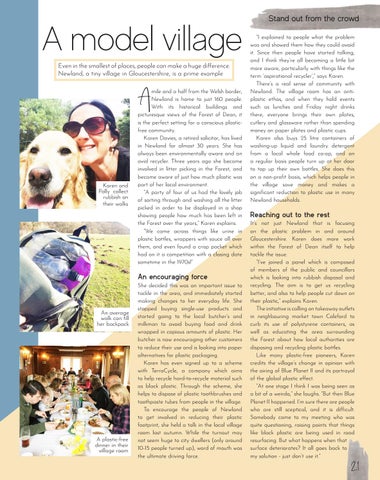
A model village Even in the smallest of places, people can make a huge difference. Newland, a tiny village in Gloucestershire, is a prime example
A
Karen and Polly collect rubbish on their walks
mile and a half from the Welsh border, Newland is home to just 160 people. With its historical buildings and picturesque views of the Forest of Dean, it is the perfect setting for a conscious plasticfree community. Karen Davies, a retired solicitor, has lived in Newland for almost 30 years. She has always been environmentally aware and an avid recycler. Three years ago she became involved in litter picking in the Forest, and became aware of just how much plastic was part of her local environment. “A party of four of us had the lovely job of sorting through and washing all the litter picked in order to be displayed in a shop showing people how much has been left in the Forest over the years,” Karen explains. “We came across things like urine in plastic bottles, wrappers with sauce all over them, and even found a crisp packet which had on it a competition with a closing date sometime in the 1970s!”
An encouraging force
An average walk can fill her backpack
A plastic-free dinner in their village room
She decided this was an important issue to tackle in the area, and immediately started making changes to her everyday life. She stopped buying single-use products and started going to the local butcher’s and milkman to avoid buying food and drink wrapped in copious amounts of plastic. Her butcher is now encouraging other customers to reduce their use and is looking into paper alternatives for plastic packaging. Karen has even signed up to a scheme with TerraCycle, a company which aims to help recycle hard-to-recycle material such as black plastic. Through the scheme, she helps to dispose of plastic toothbrushes and toothpaste tubes from people in the village. To encourage the people of Newland to get involved in reducing their plastic footprint, she held a talk in the local village room last autumn. While the turnout may not seem huge to city dwellers (only around 10-15 people turned up), word of mouth was the ultimate driving force.
Stand out from the crowd “I explained to people what the problem was and showed them how they could avoid it. Since then people have started talking, and I think they’re all becoming a little bit more aware, particularly with things like the term ‘aspirational recycler’,” says Karen. There’s a real sense of community with Newland. The village room has an antiplastic ethos, and when they hold events such as lunches and Friday night drinks there, everyone brings their own plates, cutlery and glassware rather than spending money on paper plates and plastic cups. Karen also buys 25 litre containers of washing-up liquid and laundry detergent from a local whole food co-op, and on a regular basis people turn up at her door to top up their own bottles. She does this on a non-profit basis, which helps people in the village save money and makes a significant reduction to plastic use in many Newland households.
Reaching out to the rest
It’s not just Newland that is focusing on the plastic problem in and around Gloucestershire. Karen does more work within the Forest of Dean itself to help tackle the issue. “I’ve joined a panel which is composed of members of the public and councillors which is looking into rubbish disposal and recycling. The aim is to get us recycling better, and also to help people cut down on their plastic,” explains Karen. The initiative is calling on takeaway outlets in neighbouring market town Coleford to curb its use of polystyrene containers, as well as educating the area surrounding the Forest about how local authorities are disposing and recycling plastic bottles. Like many plastic-free pioneers, Karen credits the village’s change in opinion with the airing of Blue Planet II and its portrayal of the global plastic effect. “At one stage I think I was being seen as a bit of a weirdo,” she laughs. “But then Blue Planet II happened. I’m sure there are people who are still sceptical, and it is difficult. Somebody came to my meeting who was quite questioning, raising points that things like black plastic are being used in road resurfacing. But what happens when that surface deteriorates? It all goes back to my solution - just don’t use it.”
21
A day in the life... of a plastic-free influencer With over 15,000 Twitter followers, Georgina Caro is a successful zero-waste blogger. Her blog aims to educate people on sustainable and minimalist living. Here we follow her on a typical day in Cornwall.
7.10am: Kicking off the day
I make the kids packed lunches using Stasher Bags. Having tried a variety of different sustainable food wraps I find these work the best and as they’re made of silicone they will last for a long time. They can also go in the dishwasher! The kids also both have their own reusable water bottles.
7.45am: Beauty routine
Cold water for my face, soap for washing; shampoo bars if I’m washing my hair. For deodorant, I use an alum stone. I have also made my own zero waste toothpaste in the past. For exfoliating my body I use a wooden body brush and if I’m shaving I use my safety razor.
8.30am: Breakfast time Once I’ve got the kids to school I have breakfast which consists of porridge oats, chia seeds, flaxseeds and blueberries mixed together with almond milk. I’ve managed to find porridge oats from Lidl that come just in paper packaging. I also get my blueberries from there which come frozen in just a cardboard box.
8.45am: Getting to work
I start work in our home office where I always have my reusable water bottle handy with fresh water and copious amounts of
green tea. My website is powered by 100% renewable energy and all electricity in our home is also from 100% renewable energy. This makes me feel much better about being on my computer for most of the day.
12.30pm: Lunchtime This usually consists of leftovers from the night before. A typical example would be sweet & sour tofu, rice and greens, with more green tea!
2.45pm: Picking up the kids I’m trying to walk this journey as much as possible but this isn’t always possible. I have recently bought a much smaller car with very low emissions. My other half has a hybrid car.
3.30pm: Food shopping On a food shop day I try to buy as much of our food without packaging as I can. This isn’t always easy, as most supermarkets are not quite on board yet. I buy most of our fruit and veg from our local farm shop. They are more than happy for me to go in with reusable produce bags.
5.30pm: Dinner time
I always prep and put away our food as soon as I get home. I have tried many different ways to store food including beeswax wraps,
G eorgina Caro leftover plastic containers and bowl covers. The one thing that really works for us is clear glass food containers with bamboo lids from IKEA. They work so well as you can see exactly what you have in the fridge so you don’t miss things.
8.15pm: The kids' bedtime Kids go to bed, which means more time to work for me.
10pm: Evening routine My beauty routine is something I’ve been working on for a few years now. I now only use bamboo toothbrushes, as do the kids. To floss, I use my water flosser. I wash my face with warm water, and occasionally I’ll make my own face scrub which consists of brown sugar and olive oil. I also use my reusable makeup wipes which I usually buy from Cheeky Wipes, as well as coconut oil to remove it.
10.15pm: Bedtime I read a few chapters of a book and then it’s time for bed.
To keep up-to-date with Georgina and her plastic-free, zero waste life, follow her:
@ginacaro1
gypsysoul.co.uk @Gina_Caro
Meet our folk
Cleaning up Kerala Elena Proffitt left London life behind to travel and ended up setting up a river-cleaning scheme in Kerala’s beautiful backwaters
T
ravelling her way through South Asia, Elena’s postuniversity gap year could have been spent getting drunk in Thailand. Instead, she’s in India helping Keralan locals set up a tourist scheme to clean their rivers. After studying for her history degree in London, she decided to hop on a plane to India for a change of scenery. Like most travellers, she wanted to explore new ways of life, food, culture and become more aware of the world around her. After ten months exploring India and Nepal, Elena came to Kerala and fell in love with the area. “To experience Kerala’s backwaters has always been on my ‘to-do’ list,” says Elena. “Budget travelling made me quickly realise the recommended way of experiencing the backwaters by renting a houseboat was out of my budget. Then I met Edison (the co-founder of the scheme) after arriving in Alleppey in January 2019, and he recommended I take one of his kayaking backwater sunrise trips.” Edison runs cheaper trips around the vast network of waterways in the coastal city of Alleppey. These tours also
don’t pollute the water with petrol, unlike the traditional houseboat transportation. The following morning, Elena, three other tourists and a local captain, Anni, set out on their kayaking trip. After stopping for a chai tea, the group agreed the beauty of the waters was marred by the huge amount of plastic floating around them. Elena asked Anni if they could collect as many of the plastic bottles floating in the water as they could for the duration of the trip. Anni agreed, and they filled their kayaks with plastic from the river. Buzzing with energy, Elena says she then met with Edison to talk about what more they could do. “I met Edison to talk about the trip and explain the idea I had that socially-conscious tourists like myself would jump at the chance to take part in this social action to explore the backwaters in return,” says Elena. “Thankfully, Edison’s vision of a plastic-free Kerala aligned with mine, and we began to talk about how to extend his tour operation to include plastic collections.”
23
The impact of this plastic-dumping ripples beyond just detracting from the beauty of the backwaters. Local communities are unaware of the impact the waste will have on the fish from these waters. Fish is an essential part of a Keralan diet and an integral part of the area’s food culture, so local guide Edison says it’s important to try and change local perspectives on plastic pollution.
Sharing knowledge is power
Elena set up Opulence in Action with her friend Edison
A project with impact
Based in Alleppey, a small city well known for its beautiful network of waterways, Elena and Edison set up a volunteering scheme, Opulence in Action, to tackle river plastic pollution. “We currently take volunteers, usually international travellers, into the backwaters once a week to collect as much plastic waste from the water as possible,” says Elena. The project will work as a volunteer tourism project, where environmentally-passionate travellers arriving in Alleppey can experience this part of India while restoring its natural beauty. Initially, the project began as a payment-free volunteer exchange where volunteers could have a free backwater tour in a kayak or canoe if they helped to clean up any plastic in the water. According to Elena, who is returning to London in September to study a Masters in Development Studies, despite Kerala’s high education levels, awareness of the impact of plastic is relatively low. “Neighbouring state Tamil Nadu and Maharashtra in central India have recently introduced government initiatives to ban single-use plastics commercially, which from my six week travel experience in Tamil Nadu, seem to be working relatively well.” However, her experience in Kerala has not been so positive. The lack of regulation on houseboats, two thousand of which are registered in the backwaters of this part of Kerala, means the residents are not required to dispose of waste properly. The majority of plastic waste is simply dumped into the river.
Elena believes in the power of sharing knowledge and cultural experiences. She says, “One of the reasons Edison is so keen to include tourists in this project is because he has found they are so much more aware of environmental issues. He hopes that by extending this influence he can educate the locals in Malayalam (the language of Kerala) on the litter-collecting kayak routes.” Edison hopes this project will evolve from raising awareness and short-term cleaning with tourists, to an educational initiative that will provide resources take the project into schools in the area to teach children about the environmental impact, who can take what they’ve learnt back to their communities. The project relies heavily on tourist funding. Elena says, “As a non-profit initiative, the importance of funding is crucial. In its early stages, not much money is needed to keep this once-weekly project running - 500 Indian Rupees, or just over £5, to pay our captain Anni.” Anni’s family home was completely destroyed in the 2018 floods, so financial obligations such as this mean full financial devotion to the project can be hard for locals to sustain. “This is definitely a worry that Edison and I both consider,” says Elena. If the project is to take off, it needs support from sources like crowdfunding, philanthropic grants, or even selling the plastic they collect from the river. “If one or more of these options are viable, we may find a way to make this initiative sustainable without Edison, Anni, and everyone else involved having to sacrifice their own income too heavily,” says Elena.
"Actions ,no matter how small, can make a difference"
Meet our folk Although awareness of the impact of plastic on the planet is minimal for many of the locals in Alleppy, Elena and Edison hope that through projects such as theirs, people will start to realise the importance of taking care of the planet. Elena is unable to stay long-term in India to see the project grow because of her commitments back in London. She says she’ll continue to manage the social media channels she’s set up for the project. “Liking and sharing our content and increasing awareness will always be a positive way to educate as many people as possible,” says Elena. It’s also the best way recruit any volunteers or likeminded people who want to get involved. The project encourages travellers in Kerala, or anywhere else in the world, to try and make a change. Positive change and actions, no matter how small, can make a difference. This is why Edison and Elena champion the slogan ‘think global, act local’. “In a localised economy and food chain such as in Kerala, awareness of plastic pollution is growing,” says Elena. “We hope that through this initiative and the education Edison hopes to build alongside it, environmental sustainability will be among the priorities of these wonderful communities.”
By Louella Berryman
Plastic is collected from the rivers in kayaks
How can you get involved? Share the love
Show your support by liking and sharing Opulence in Action’s Facebook page - the power of social media is really important for start-up projects like this one. Make a difference If you’re planning long-term travels, make local connections and keep an open mind. You never know where there might be an opportunity to make a difference. Help at home Not going away anytime soon? No worries. There are plenty of schemes happening in the UK. Head to the campaigns section of our website to find opportunities in your area at: jomec.co.uk/canvasandglass
Elena can collect a lot of plastic in her small boat
Volunteers come to the river to help Opulence in Action
25
recommends...
canvas & glass
The plastic-free PICNIC
4. Bamboo cutlery set, Bambaw - £10.38 1. 2.
3.
4.
Coffee cups three ways: 1. Stainless steel travel mug, Bodum - £20 2. Bamboo silicone cup, Ecoffee - starting at £10.95 3. Ceramic travel mug, Paperchase - £12
5. Bamboo lunchbox, Leon (@ John Lewis) - £13
7. Set of 8 stainless steel drinking straws, Eco Slurpers (on Amazon) - £8.95 5.
7.
6.
6. Beeswax food wrap (set of 3 large wraps), The Beeswax Wrap Co. - £30
Buy it
If you want to have a plasticfree picnic of your own, find all the items you need at jomec.co.uk/canvasandglass
Not just a pretty face
Upcycle
your style
Transform your clothes to make the most of what you have
01
From shirt to dress
02
Do you have an old baggy shirt that’s just been left at the back of the wardrobe? These can be turned into fun dresses by taking in the short sleeves and cutting and sewing the bottom of them, near the armpit, tighter together. Once done, take a piece of elastic, and glue it on the inside of the dress, ideally ruched up around the waist to disguise the hint of elastic.
03
Repurposing flip-flops One of the problems with the humble flip flop is the tendency for straps to break and trip you up any time you walk faster than 3mph. But don’t just immediately throw them away! If you have any old t-shirts lying around, you can cut them into strips and braid them together. Sew the ends of the braids to ensure they don’t unravel and, hey presto, you’ve got some new straps for your flip-flops.
Share
Do you have any upcycling tips of your own? Tell us by using #WeArePlasticFree
Graphic pillows Mark out the design on your chosen graphic tee within a square, and make another square about 4cm larger than the original. Cut around the outer circle and remove the corner squares from the outer square. Along the remaining sides of the outer square, cut thin strips, but only cut up to the lines of the inner square. Once done, place the stuffing between the two sides of the shirt, and sew it together.
04
T-shirt wall art Some upcycling doesn’t have to be just for you. Sometimes it can be something for your home that everyone can enjoy. Add a little splash of colour to your walls by taking a well loved, well worn t-shirt and give it a new home! Try stretching your t-shirt over canvas to create some new artwork for your living room that you can show off to your friends and family.
By Naomi Sanders
27
Relax without plastic Self-care at home doesn’t have be at the expense of the environment. Why not try the latest trends in plastic-free living to feed the body and soul?
Reed diffuser Why not swap the standard home air freshener you use at home, usually packaged in a plastic bottle, for a metal or ceramic reed diffuser? Reed diffusers are the perfect way of scenting your home without negative environmental impact as each element is natural and biodegradable. With a variety of scents and aromas, reed diffusers are a really simple way of promoting relaxation and positive wellbeing in the home. If you really want to go that extra mile, why not make one yourself ? Reed diffusers are simple to make and are excellent as presents. Holisticshop.co.uk sell reed diffusers in a variety of scents for ÂŁ7.80.
28
Semi-precious coasters Probably the most aesthetically pleasing of plastic-free holistic items, semi-precious stone coasters are the best way to bring colour and positive energy into the home without the clutter. Doubling up as literal coasters on which you can place your matcha or peppermint tea, they come in a variety of colours and styles to suit your room. Rose quartz, best known for promoting the vibration of love and feminine energy or the less conventional agate, restoring peace and harmony and establishing a calm and happy home, are great choices. Elizabautista.com has a beautiful range of coasters at ÂŁ12 for a set of four.
Ceramic water filters Plastic water filters need to be replaced each month, but ceramic alternatives are a considerably more affordable and sustainable alternative. A ceramic water filter is a traditional alternative that encourages the cleanest and clearest water in your home. The natural ceramic quality filters the water from your tap at home through the pores of the ceramic. Water filters such as these are very popular among backpackers, or can be a very welcome addition to patios in the summer.
Not just a pretty face
Yu Ling rollers Popular among health fanatics, Yu Ling are popular facial massagers that reduce visceral puffiness, fatigue and encourage blood flow to tired skin. They are available in a whole range of natural materials with the most popular kinds being made of rose quartz and jade. A great tip is to apply facial aromatherapy oils to the roller for a more affordable alternative to a facial. Rosehip and lavender oils are a perfect way of keeping your skin hydrated and can help reduce the appearance of fine lines and scars. Cult Beauty sell Yu Ling rollers with prices ranging from ÂŁ12 to ÂŁ22.
Healthy body, healthy mind A lot of vitamins and minerals that promote a healthy body and mind come in glass bottles instead of plastic. If you are buying vitamins such as cod liver oil and multivitamin complexes which come in plastic bottles, buying in bulk can be a savvy way of cutting down on your plastic use.
Use a Yu Ling roller for an at-home facial
Himalayan salt lamp A Himalayan salt lamp is a fantastic way of bringing positive energy into your home without the guilt of a plastic footprint, and is characteristic of usual home lighting. The hollowed out salt has space for a candle which encourages a soft and ambient warm light. Notorious for their health benefits, Himalayan salt lamps clear the air in your home, ridding the room of the negative energy. It has also been suggested that the lamps have the ability to soothe allergies. They also encourage good quality sleep by limiting your exposure to blue light in the evenings, which is closely associated with mental stimulation. Get a genuine Himalayan salt lamp from Holisticshop.co.uk for ÂŁ17.76. Bask in the glow of a Himalayan Salt Lamp
By Chloe Allen
29
Haircare routine
If tending for your locks is your top priority, we’ve got some top tips on how to keep your hair (and the planet) healthy
Smooth out your locks It only takes two ingredients to tame your mane
Tame the frizz So, you want to tame your frizz, but hairsprays usually come in harmful aerosol bottles. How about one made of only lemons and vodka? That might sound like a nice cocktail, but it’ll also keep your hair in place.
Make it:
- Put 2 sliced lemons and 500ml of water into a saucepan over medium heat and leave for 20 minutes. - After the time is up, remove the pan from the heat and pour through a strainer (you can use a loose tea or coffee strainer). - Add 2 tbsp of vodka, then pour into a reusable spray bottle. If you want the hairspray to have a stronger hold, add more lemons and boil for longer. Who said vodka is only good for one thing?
30
Most conditioners and hair masks are usually only found in plastic bottles, but you can also get a healthy treatment for your hair from an aloe vera plant.
Make it:
- Buy one from a garden centre or supermarket, take one leaf and open it, squeeze out the contents and smooth onto your hair. - Leave on as a hair mask hair for an hour or so, then rinse out. - If your hair needs that extra pick me up, the aloe vera will help hydrate your hair, and you don’t need a plastic bottle for it.
Not just a pretty face
Groom your beard
Must-have products:
If you’re the type of guy that likes to keep well-groomed, this beard balm is perfect for creating a soft, matte finish.
Make it:
- Place 57g of shea butter, 28g of beeswax, and 85g of coconut carrier oil into a bowl and heat over a pan of gently simmering water. - Stir occasionally, but don’t let the mixture boil. Once the ingredients have melted, remove the bowl from the heat. - Apply a few drops of your favourite essential oil before the mixture solidifies, then place in a tin and cover. - Allow to cool overnight, then it will be ready to give you a supple beard in the morning.
We love the bamboo hairbrush from weearthlondon.com for long locks
KOOSHOO does great plastic-free hair ties from theplasticfreeshop.co.uk, they’re made from totally biodegradable materials The beard comb from bulldogskincare.com is a stylish solution to throwaway plastic combs
Lather, rinse, repeat Soap berries are a brand new trend on the plastic-free market. The berries are from a tree native to India and the Himalayas and they can be found at Holland & Barrett or health food stores and are a great replacement for shampoo.
Make it:
- Take about 10 berries and boil them in about 500ml of water. - Add a few drops of an essential oil (we like lavender), and once cooled, the liquid can be used as a shampoo. - You won’t see soap suds when you use it, as suds are a byproduct of chemical additives, but this natural shampoo will be kind to your hair. Every bearded person should have our beard balm
Share
your results using the #WeArePlasticFree
Work the soap berries into your hair
By Naomi Sanders
31
Our take on takeaway culture
How our over-worked society is contributing towards our plastic obsession, Juliette Rowsell writes
I
t’s no secret that modern life has left us over-worked with little time to ourselves and has left our planet to suffer. This has played out no better than in the very thing that keeps us fuelled throughout the day: our food. “People don’t have the time for dinner that they used to,” said Harry Balzer, an analyst for the 2015 report ‘Eating Patterns in America’. The report found that only 60% of meals eaten at home in the US are actually homemade meals, and these numbers are to continue to fall. “This is one of those downward trends to watch. At the current rate, less than half of all dinners eaten at home in this country will be homemade,” he said. It’s no surprise that the rise of microwave meals and takeaways correlates with increasing rates of obesity. A study published in the British Medical Journal found that not even one of the 100 supermarket ready meals tested met World Health Organization nutritional guidelines. According to a UK government report released in 2018,
32
obesity levels in the UK have increased from 15% of the population in 1993, to over 26% in 2015. However, it’s not just our waistlines this is having an impact on. Our over reliance on ready meals is leading to the world’s plastic pollution.
Fast food fast plastic
In London alone, 60,000 orders on delivery service app Deliveroo are made every single day. It is estimated that 79m ready meals are eaten every week in Britain, most of which are packaged in plastic. While delivery services such as Deliveroo and Just Eat have made steps towards reducing their plastic use, their measures don’t go far enough and won’t undo the scale of the damage already done. Until 2018 both companies provided free plastic cutlery with every meal, despite the majority of these meals being delivered to home addresses where people already have cutlery. While Deliveroo boasts 91% of its customers now opt out of having plastic cutlery, these figures suggest that approximately 90% of all
meals the company delivered prior to this were delivered with unwanted plastics for over three years. Despite this, progress is certainly being made. In 2018, Just Eat announced they would be introducing recyclable sauce sachets made from seaweed to replace their former plastic ones, with Deliveroo launching recyclable packaging alternatives.
Current problems
The problems here are worth noting. Vegwear is a recyclable takeaway packaging to replace traditional polystyrene boxes. However, many places including major UK cities such as Cardiff do not currently have the facilities to recycle or compost such material, so the packaging still ends up in incinerators. Just because something is recyclable doesn’t mean that it will find itself in people’s recycling bins, especially when we’ve become accustomed to throwing all our rubbish in the bin. “While recycling rates with ready meals have risen, this increase has been negated by an increase in consumption, and convenience
Conscious kitchen and fast food needs to take some of the blame,” said Lucy Siege of The Guardian. When considering the rise of instant food services like Deliveroo, their origins speak volumes. Chief Executive and Founder Will Shu founded Deliveroo in 2013 after coming to rely on ‘comfort food’ delivery services after working late nights on Wall Street in the early 2000s. After he was transferred to London, he found England’s capital didn’t have the same all-hours delivery service, so set up the now multi-million-pound company to tackle this. The company has continued to grow since then.
“People don’t have the time for dinner that they used to” “In a world of increasingly time-starved and asset-light millennial consumers, we think growth in online food delivery is part of a megatrend which shouldn’t be ignored,” said the 2018 report ‘Is the Kitchen Dead?’ The report tracked the growth of home delivery services and
Our plastic problem is piling up
argued that this trend is going to grow exponentially, so that by 2030 most meals cooked at home will instead be ordered online and delivered from either restaurants or central kitchens. “The total cost of production of a professionally cooked and delivered meal could approach the cost of home-cooked food, or beat it when time is factored in,” the report continued. And there is truth in the report’s predictions: last year, the food delivery sector grew 10 times faster than the growth of eating out did. Deliveroo grew by a staggering 650% in 2016 from 2015. Allowing this growth to continue at its current rate neglects our own personal health, and that of the planet.
Friday night dinners
While companies like Deliveroo might be a staple of our Friday night dinners, they are also the product of an overworked society where a takeaway at the end of the week is seen as an escape from the pressures of modern society. Or even worse: the unglamorous microwave meal becomes an unhealthy habit people rely upon. And this a self-perpetuated cycle. The more we allow ourselves to not take time out of our days to relax and cook ourselves food, the more we will allow ourselves to get consumed by our unhealthy work habits and help contribute to the world’s plastic pollution.
Cooking homemade meals is not only good for us, but the planet. Making homemade meals means we are forced to take time out of the day, it is good for our mental wellbeing, and means we don’t contribute to our tumbling waste problem. Our dependency on plastic products is representative of a society that relies on even the most basic of things to come pre-wrapped for us. No matter how recyclable companies claim to make their packaging, the best option is to say no to single-use packaging in the first place. Until all packaging provided by such companies and takeaway outlets is totally plastic-free, not enough work is being done. Momentary convenience shouldn’t come at the expense of the planet.
Stuck for what to have for dinner? For plastic-free recipes, head to jomec.co.uk/ canvasandglass
How often do you have takeaways?
33
How do you brew? Micro-plastics are hidden everywhere, even in your cup of tea - make this one simple swap to sip your way to
plastic-free
Here are the best loose leaf teas on the market and where you can find them:
Organic goodness Dragon Well tea Whittard, £12 (50g)
Spice up your life Cinnamon Spice tea Waterloo Tea, £6.50 (75g)
Packed with a punch Pumping Pomegranate tea T2, £8 (100g)
Traditional with a twist English Rose black tea Whittard, £7 (100g)
34
It’s no news that Britain is a nation of tea drinkers. On an average day in the UK, we get through a whopping 165m cups of tea, and it won’t be any surprise that 95% of these are made using the humble tea bag. Although it may not be obvious, nearly all tea bags available in the supermarket are laced with hidden plastic to ensure the bags don’t disintegrate in your drink. This also means they won’t break down in your compost bin. Even ‘plant-based’ tea bags’ - made using cornstarch - are unable to break down fully, and are only deemed eco-friendly because the plants they are made with are a renewable resource. But don’t worry - making the perfect plastic-free brew is easier than you think. Whether you’re a traditional breakfast tea drinker or prefer dabbling in different varieties, simply swap your tea bags for loose leaf tea.
By Thea Jeffreys
Next issue ...
Underwater awareness We talk to activist Kate Sheridan. She took part in Dive24: a charity event where she and her friends spent 24 hours in a tank to raise awareness of plastic pollution in South Africa. In her spare time she is studing an MSC in Conservation Biology at the University of Cape Town and runs an environmental blog, Clear The Air.
Plus...
MAY EDITION
Out 23/04/19
What can we do to tackle shipping companies who use too much pagacking? Get BBQ ready with our helpful hacks to see you through summer Fishing uses huge amounts of plastic, so can you eat fish and be plastic-free?
@canvasandglass @canvasandglass_ @canvasandglassmag canvasandglassmagazine