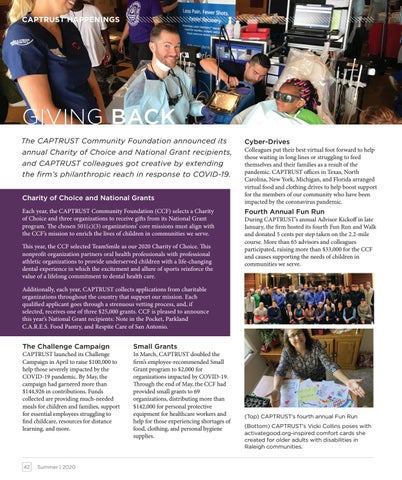
4 8
Lifestyle Lockdown
Tom Forst Blues Tour de Forst PLUS Try It on for Size Planning a Post-Pandemic Portfolio Learning to Talk the Talk More Than a Drop in the Bucket
SUMMER 2020
At CAPTRUST, we believe we have a profound responsibility to share our success with those less fortunate than we are. One way we do that is through the activities of the CAPTRUST Community Foundation, our in-house, employee-run charitable foundation. Its mission is to enrich the lives of children in communities we serve. The foundation, a registered 501(c)(3) charity, was formally organized in 2007 to provide our employees with opportunities to participate as a group in community outreach efforts and to offer their time, passion, and financial support as a way to give back.
“Our most important task as a nation is to
make sure all our young people can achieve their dreams.
�
Barack Obama
We invite you to like the CAPTRUST Community Foundation on Facebook.
COMMUNITY FOUNDATION
capcommunityfoundation.org | toll-free: 855.649.0943 4208 Six Forks Road, Suite 1700 | Raleigh, NC 27609
Volume 6, Issue 2 | Summer 2020 PUBLISHER
Just a few months ago, I drafted the opening letter to the winter issue of VESTED on an optimistic note. Little did I—or any of us—know at that time the hardships that would ensue. Many of our fellow citizens are suffering great adversity and pain—far too many. While better days must certainly lie ahead, please know that we are here to help you through this challenging time in any way we can. Hopefully, this issue of VESTED provides a positive distraction and a few ideas for down the road. This edition’s Second Act hero is Tom Forst, a telecommunications executive who restarted the career as a full-time professional musician that he put on hold in 1974. Known in blues guitar circles as “The Suit,” Forst has since recorded two albums, launched a podcast, and traveled the world living his dream. This issue also features a wide range of other topics, including: • the value of giving your retirement plan a practice run; • reflections on the coronavirus lockdown; • language learning lessons from a master polyglot; • harnessing the power of positive money habits; and • the mental and physical merits of yoga. This issue’s must-read feature, “More Than a Drop in the Bucket,” by longtime contributor Kim Painter, takes a critical look at the popular notion of the bucket list, the collection of goals you’d like to accomplish within your lifetime. She offers ideas on why it is important to
J. Fielding Miller Chief Executive Officer EDITORS John Curry Editor-in-Chief
Alysa Cronin Managing Editor
EDITORIAL ADVISORY BOARD
aspire to more than ticking off a list of travel destinations and how to craft a truly rewarding list of your own. Lastly, in this issue’s installment of Investment Strategy, Chief Investment Officer Kevin Barry and Investment Strategist Sam Kirby take a look at the early economic and societal impacts of the COVID-19 pandemic and how investment portfolios may change to reflect the emerging new normal. As always, we appreciate your article ideas, reactions, and feedback. Please keep them coming.
Jeremy Altfeder Financial Advisor
Linda McBrayer Associate, Advisor Group
Kathleen Carlson Vice President, Financial Advisor
Jon Meyer Chief Technology Officer
Rhonda Downum Manager, Client Solutions Group
Greg Middleton Director, Advisor Group
Philip D’Unger Senior Team Leader, Client Solutions Group
Steve Morton Principal, Financial Advisor
Kathleen Hopkins Manager, Advisor Group
Michelle Scarver Vice President, Financial Advisor
Mario Giganti Senior Vice President, Financial Advisor
James Stenstrom Senior Manager, Client Solutions Group
Wat Keys Vice President, Financial Advisor
Tiffany Walker Financial Advisor
Ted Lew Vice President, Financial Advisor
Colby Warren Manager, Advisor Group
ART DIRECTION AND MARKETING Lonzetta Allen Associate Art Director
Harrison Brackett Graphic Designer
Elizabeth Altman Distribution Manager
John Curry Art Director
All the best, WITH THE ASSISTANCE OF
J. FIELDING MILLER CAPTRUST Chief Executive Officer
Azul Photography Raleigh, NC
Worth Higgins & Associates, Inc. Richmond, VA
Gabrielle Burke Pittsburgh, PA
Getty Images Seattle, WA
Justin Gartman Raleigh, NC
1
CONTENT AND CONTRIBUTORS
4
8
18
Gabrielle Burke
26
KEVIN BARRY
JOHN CURRY
SAM KIRBY
Kevin Barry is CAPTRUST’s chief investment officer and leads the Investment Group, the team responsible for investment manager due diligence, asset allocation, and discretionary investment management for the firm’s wealth management and institutional advisory clients. Barry studied finance at La Salle University in Philadelphia and the University of London, where he received a Master of Science degree in financial management.
As chief marketing officer, John Curry is responsible for all areas of strategic marketing and branding for CAPTRUST. In the industry since 1986, Curry has served in senior management roles with firms such as ProShares and AllianceBernstein and has experience in areas of strategic marketing, including product development and design, market research, branding, and sales campaign management.
As leader of CAPTRUST’s Investment Strategist team, Sam Kirby works with the firm’s financial advisors to assist clients with investment strategy, portfolio construction, and monitoring. He has 15 years of financial services experience. Kirby earned a Bachelor of Arts degree in journalism from the University of North Carolina and a Master of Science degree in management from North Carolina State University. He is a CFA charterholder.
2
Summer | 2020
Features
Columns
4
LIFESTYLE LOCKDOWN
15
PASSION PURSUITS
35
LASTING LEGACY
8
BLUES TOUR DE FORST
23
EXPERT ANGLE
38
GLEANINGS
31
MARKET REWIND
39
CLIENT CONVERSATIONS
32
MONEY MINDSET
42
CAPTRUST HAPPENINGS
18
26
by Sylvana Smith
by Sylvana Smith
TRY IT ON FOR SIZE by Kim Painter
PLANNING A POSTPANDEMIC PORTFOLIO by Kevin Barry and Sam Kirby
JEANNE LEE Jeanne Lee is a freelance writer living in the lovely college town of Oberlin, Ohio. She has written about consumer and business topics for 20 years, including stints at Fortune and Money. Her work has appeared in publications like USA TODAY, Fortune Small Business, and Health. She loves thinking about ways for people to hack their finances and daydreams of paying off her mortgage before she has to pay for college for her two boys.
In-Home Yoga by Jeanne Lee
Learning to Talk the Talk by Jeanne Lee
Putting Money Habits to Good Use by John Curry
KIM PAINTER Kim Painter is a freelance writer specializing in health and lifestyle issues. She was a USA TODAY staffer for many years and has continued to contribute to the newspaper as a reporter, columnist, and blogger. She lives in McLean, Virginia, where she practices what she preaches: wearing sunscreen, eating broccoli, and getting at least 10,000 steps a day.
More Than a Drop in the Bucket by Kim Painter
SYLVANA SMITH Sylvana Smith is a freelance writer living on an antebellum farm in central North Carolina. Educated at Carnegie Mellon University and the University of North Carolina, she writes marketing communications for Fortune 100 companies. She has been a professional journalist and marketing writer for more than 20 years.
All publication rights reserved. None of the material in this publication may be reproduced in any form without the express written permission of CAPTRUST: 919.870.6822. Š2020 CAPTRUST Financial Advisors. The opinions expressed in this report are subject to change without notice. This material has been prepared or is distributed solely for informational purposes and is not a solicitation or an offer to buy any security or instrument or to participate in any trading strategy. CAPTRUST does not render legal, accounting, or tax advice. If you require such advice, you should contact the appropriate legal, accounting, or tax advisor. The information and statistics in this report are from sources believed to be reliable but are not warranted by CAPTRUST Financial Advisors to be accurate or complete. Performance data depicts historical performance and is not meant to predict future results.
3
Lifestyle Lockdown by Sylvana Smith
Imagine 10 or 20 years from now, telling our grandchildren and great-grandchildren about the coronavirus pandemic of 2020. What will we say? For many of us, we will first think of the great tragedy.
4
Summer | 2020
We will recall the trauma and mourn the loss of life. We will remember how we faced the burdens of being separated from loved ones and, for some, isolated entirely from the outside world. We will grieve the long-anticipated milestones that will never be reached and the embrace of those lost forever. Some of us will share an Orwellian version, one of partisan divides and conspiracy theories, fake news, and shifting predictions. We could speak of stranded travelers, dystopian policies, and standing in seemingly endless lines because each person had to be six feet apart. We could tell how every day brought some new anxietyprovoking development—how people worried about themselves, their families, and their livelihoods. Those lucky enough to emerge on the other side of this crisis emotionally and physically intact might share the silver-lining version. They could say that 2020 was the year we met the unique character Joe Exotic, rediscovered sidewalk chalk, vegetable gardening, home-baked bread, and family dinners at home. We will tell them about drive-in church services, livestreamed concerts, virtual happy hours via Zoom and FaceTime, and the previously absurd prospect of doing corporate work at home in pajamas for weeks on end. We will tell them about teacher car parades, virtual proms, and teddy bear window scavenger hunts. Whichever version becomes most pronounced in our memories, what is certain is that we will not soon forget the year of COVID-19. In fact, many of us are just beginning to grapple with the challenges of an uninvited new normal.
Alone, Together Measures to suppress the spread of coronavirus profoundly changed our lives—in ways good and bad. For many of us, stay-at-home orders gave us back our commute time. Gone were the distractions of group activities. Gifts of newfound time offered the freedom to plant a garden, read those books on the nightstand, explore hobbies, study a language, or learn to play banjo. That freedom also marked the loss of the in-person communion of school or work environments—and of life rituals such as graduations and weddings.
We will tell them about drive-in church services, livestreamed concerts, virtual happy hours via Zoom and FaceTime, and the previously absurd prospect of doing corporate work at home in pajamas for weeks on end.
“The comfort, predictability, and familiarity of my routine is gone due to the pandemic,” wrote human resources consultant Kevin Yates in a recent LinkedIn essay. “I used to travel to our offices in Menlo Park, New York City, and Austin. Hugs, handshakes, and fist bumps were how we’d greet each other.” “We worked shoulder to shoulder in conference rooms. We ate lunch together and talked about our families, our projects, or whatever came up in conversation. We laughed together. We brainstormed together. We looked for answers to the hard stuff together. I don’t do any of that now,” Yates wrote during the initial outbreak. “The bond and connection I had through physical proximity is gone due to the pandemic. No, I’m not okay.” Humans are social creatures. We need that bond even more in times of duress. “At a moment of profound dread and uncertainty, people are being cut off from soothing human contact,” wrote Ed Yong, a staff science writer at The Atlantic. “Hugs, handshakes, and other social rituals are now tinged with danger.” 5
Humans Are Wonderfully Adaptive
replicate a formal model from traditional education institutions, yet the actual practice of homeschooling is very different.”
“People are reaching out to form new types of social bonds across the divide of spaces,” said Caela O’Connell, assistant professor of anthropology at the University of North Carolina at Chapel Hill. “A lot of those ways are digital, which of course has limitations. A virtual hug doesn’t have the same warmth and biofeedback of an actual hug, but it goes a long way compared to no hug at all.” As COVID-19 locked down travel and in-person gatherings, we adopted visual remote tools to work and socialize. “Rather than ‘social distancing,’ we should be framing this as physical distancing that includes a lot of social connection,” explains O’Connell. Will we see a wholesale shift to remote work? Not necessarily. Some love it, while others confirmed that they never want to work from home again. Granted, a pandemic is not an ideal time to assess the options, said O’Connell.
“
“There’s a subtle expectation that parents must find creative ways to handle this on their own,” says Chloë Cooney, writer and advocate for global health and human issues. “My inbox, social media feeds, and countertops are filled with creative ideas for educating and caring for your kids.”
Rather than ‘social distancing,’ we should be framing this as physical distancing that includes a lot of social connection.
”
Caela O’Connell
“None of this was a very good natural experiment for what working at home actually entails,” says O’Connell. “As parents, we are trying to provide childcare while doing our jobs, and our jobs are not the same as they were. The dynamic acrobatics of this is like extreme parenting and extreme working, not a good example of the work-athome experience.”
Extreme Parenting: K-12 Edition With schools closed, K-12 students became home-based learners. Parents became educators and facilitators—roles for which most had little preparation. “The burden right now on parents with school-age children is a very high one,” said O’Connell, who was homeschooled until college and is working from home with her three-year-old son, who is home from his shuttered preschool. “Parents are trying to
6
Summer | 2020
“Workbooks, games, creative projects and experiments, virtual yoga, virtual doodling, virtual zoo visits, virtual everything,” says Cooney. “I honestly am too tired and stretched thin to read the suggestions, let alone try them. The few I have tried have been met with astounding and fierce rejection by my son.”
Businesses Pivot and Press On
After only four weeks under restrictions, small businesses were already struggling with the economic impacts. By late March, one-third of businesses surveyed by the news site WalletHub had already laid off workers, and another 36 percent planned to do so, while 35 percent feared the closure of their businesses. Others pivoted on what they do best and adapted to a new order. For example, IL Palio, a AAA Four Diamond restaurant, offered patrons the option to cook alongside executive chef Adam Rose from the comfort of their kitchen. The Chapel Hill, North Carolina, landmark is offering meal kits and a live, online class with Rose, as well as curbside pickup from a special dinner takeout menu. Closed as nonessential businesses, local day spas are teaming up with their nearby wedding and event venues to host American Red Cross blood drives. And with grocery store shelves stripped nearly bare of meat, bars and restaurants across the country became grocers, offering produce, bread, meat, canned goods, wine, cases of beer, toilet paper, and other disposables—some with free local delivery to seniors.
Silver Linings The pandemic response—and the surreal slowdown of life as we know it—produced some positive side effects. Time opened up for idle conversation, neighborhood strolls, and quieter living, at least for those of us not working in essential services. Families are playing backyard games instead of dashing to organized practices and leagues. People are making art, music, and memories. In urban areas around the world, air pollution is measurably reduced. People in the northern Indian state of Punjab are in awe of the sight of the Himalayan mountain range, now visible from more than 100 miles away for the first time in decades.
Time opened up for idle conversation, neighborhood strolls, and quieter living, at least for those of us not working in essential services. Families are playing backyard games instead of dashing to organized practices and leagues. People are making art, music, and memories.
And with no tourists around, animals at the shuttered Yosemite National Park are making the most of the extra space. CNN Travel reported bears have been spotted out and about at Yosemite a lot more frequently than would be considered typical for this time of year.
The Ironic Benefits of Epidemics “The effects of epidemics extend beyond the moments in which they occur,” wrote Katherine A. Foss, author of the forthcoming book Constructing an Outbreak: Epidemics in Media and Collective Memory. “Crisis sparks action and response. Many infrastructure improvements and healthy behaviors we consider normal today are the result of past health campaigns that responded to devastating outbreaks,” writes Foss. For example, thanks to epidemics of tuberculosis, typhoid, and cholera in the 1800s and early 1900s, we no longer spit in public places, leave deceased cart horses in the streets, or empty chamber pots out of windows. Just as the effects of September 11 are so embedded in our lives that we scarcely recall the previous normal, COVID-19 will transform our culture and practices.
An Optimistic Perspective As we all navigate this extraordinary human moment together, musician Lukas Nelson put his Facebook page to work spreading hope and good vibes. He features Plant a Seed days, solicits fans’ stories about what makes them smile, and hosts regular “Quarantunes” jam sessions and upbeat talks with his famous dad, Willie. “At the very least in these troubled days, the quality time spent with family has been a great blessing,” Nelson posted. “These are some of the most important times in our lives, and we would never have stopped to really soak them in were we not forced to.” Nelson’s points resonate. People of every age should take this time to cultivate the garden that is family and friends and the budding joy those people bring. Savor the moments we have together today. Take care to see the lessons behind every new challenge. Use the opportunities set in front of you to find new forms of gratitude and perhaps even an inner strength not yet discovered. 7
BLUES TOUR DE FORST by Sylvana Smith
It’s June 2008. Tom Forst, a regional vice president at Cox Communications Group, is about to walk away from 25 years as a corporate suit to chase a lifelong passion. The dream to be a full-time musician had been on hold since his post-college touring days, circa 1974. He recalls the exact moment his life changed course. “My wife was sitting in the living room. She pays the bills, and she said, ‘Look at that, I’m paying our last two $30,000 college tuition bills for our last two kids.’ I looked at her and said, ‘I’m going to quit.’”
8
Summer | 2020
“My wife simply said, ‘Go ahead,’ and that’s kind of the way she is. Her attitude was, what’s the worst that can happen?” She only wanted assurances they wouldn’t starve. So Forst, then 57, gave his six-month notice at Cox Communications. At the end of that year, he stepped away from legions of direct reports, the jet-setting lifestyle, power, prestige, and pay. Big pay. What followed is a wild ride of a second act—from boardroom to bandstand, Forst was on his way to be a successful indie blues musician. Now 69, Forst, known as The Suit, has gained acclaim as a guitarist, vocalist, and songwriter performing and recording with well-known musicians from the Johnny Winter Band and Saturday Night Live Band to the Allman Brothers Band, Paul Nelson Band, Stephen Colbert Show Band, and Grammy-winning artists and producers. He has played hundreds of live shows and toured China as the headliner with a ChineseAmerican blues band. In 2018, he was inducted into the Connecticut and New York chapters of the Blues Hall of Fame. In February 2020, he released his second album, followed by a sold-out release party at a Hartford, Connecticut, blues hot spot. When he isn’t performing, teaching a guitar master class, writing new music, or recording, Forst hosts a weekly podcast, Chasing the Blues. The postponement of his second China tour due to the coronavirus outbreak opens up creative space to produce yet another album in 2020. It’s an aggressive schedule, and Forst thrives on it. Follow the journey, and it’s clear that the leap from media executive to music was not as rash as it might sound. It was actually the next step in a plan that had been set in motion nearly a half-century earlier and driven with intention for a quarter-century.
The Early Days Forst didn’t always cotton to the guitar. When he was eight years old, his parents offered him the choice to take up an instrument, with the proviso that if he did, he couldn’t quit. “It seemed like the guitar was the way to go, because, you know, Elvis.” “I hated it, I just hated it,” Forst recalls. He admits to flinging the guitar out a second-story window at one point. “But my parents wouldn’t let me quit.”
9
The elder Forsts were on to something. By 13, Forst had landed paying gigs. By 15, he was invited to teach guitar at a local music store. He recalls sneaking into clubs and even playing a strip club at age 16. All through college, music helped make tuition money. A week after graduation, Forst was in a band that hit the road. “In those days, around ’74, you could make good money doing that,” he says. After two years as a musical nomad, Forst changed course. He got a Master of Science degree in education. He taught first grade for five years, then changed course again. “I realized there was no money in teaching, so I went into the business world.” In the next 25 years, he would get an Executive Master of Business Administration degree from the University of Connecticut and advance to regional vice president at Cox in Atlanta, overseeing advertising sales operations across the country. But Forst never stopped playing whenever he could.
Working for The Man “Everyone wants to hear I really hated working for The Man,” Forst says. He enjoyed his job, but clearly, for Forst, the dream of being a musician never flagged. “I had always planned to go back into the music business, but I had a family—and I had wants and needs myself that music wasn’t going to support. I said: OK, I can put it off as long as I need to.” Forst would do what it took to advance his earning power, and frugality would channel those earnings into freedom reserves. “There’s luck in there, for sure, but I kind of made my own luck. I knew I needed an MBA to get up to the next step. The sooner I could get to that next step, the sooner I could make the choice to leave. An MBA takes two years out of your life. Every night, you come home from work, you’re going to work until 1:00 or 2:00 in the morning, but I just did it. Yes, it’s inconvenient, but so is being broke,” says Forst. “People who make a good amount of money also spend a good amount of money,” he says. “They get the big McMansion, the really top-of-the-line car, and all that. I never did that. We got a really nice farmhouse, and I drove a Ford, then a Prius for my last couple of years. I wanted to have freedom more than I wanted any kind of status. Even if I didn’t want to be a musician, I wanted the freedom to make a choice.”
10
Summer | 2020
After two years as a musical nomad, Forst changed course. He got a Master of Science degree in education. He taught first grade for five years, then changed course again.
Building a New Career When it finally happened, chasing the dream was a stark change. At Cox, Forst was a prominent executive with 1,000 people reporting to him. In New York City, he was just another musician going from audition to audition. He had given up a lot, says Forst. “The first-class life, the limos waiting—you can really get caught up in it. The transition was tough. It was the loss of some status, the loss of some security, because I really did give up a ton of money to do this. I felt a little guilty about it, because I still have a family, and I could have made a ton more money.” Then there were the travails of building a new career. Even though Forst was an accomplished musician, he had to build his name almost from scratch, because he’d been out of the scene for 30 years. And music can be a young person’s game. He admits to being self-conscious about his age at first. “One time I auditioned in this place in the middle of New York City, and there were about 50 guitar players. They all looked like my kids, the perfect rock stars. I’m 57, standing there in my short hair, and I’m thinking, ‘This is going to be brutal.’” To Forst’s disbelief, he got the gig, playing in a hip-hop band of 20-somethings. It didn’t always go so well, he explains. “Sometimes I auditioned for things and was told, ‘You’re a little too old for the person we want.’ As I gained self-confidence, now my age is a benefit. I see myself kind of as a mentor.” His young audiences are sometimes dumbfounded when he talks about listening to this kind of music in the 1960s, decades before they were born. But he relishes it. “Now I want my age.”
If the Suit Fits Shortly after Forst left Cox, his son, Michael, then 22, was keyboard player and leader of a hardcore punk band. Michael invited his dad to a gig in Brooklyn at a good-sized venue filled with young people, none older than 25. Michael had planned a surprise. 11
“
As the band moved on to the next song, somebody started to yell, ‘Suit, suit,’ and then the whole audience started to yell, ‘Suit, suit, suit.’ Michael turned to me and said, ‘I guess that’s your new name.’
”
12
Summer | 2020
“He said, ‘You just sit in the front row. We’re not going to say anything. I’m going to set up your guitar and amp, and I’ll give you the nod.’ Finally, Michael calls me upstage. The punk rockers are in red long johns with the flap in the back. And there I am on the edge of the stage with a blue blazer, gray wool slacks, and penny loafers. The audience is staring at me,” recalls Forst. “Then Michael gives me the nod where I’m supposed to do the lead, and I do, and the place is just shocked. You wouldn’t expect a guy who looks like me to do what I did.” “As the band moved on to the next song, somebody started to yell, ‘Suit, suit,’ and then the whole audience started to yell, ‘Suit, suit, suit.’ Michael turned to me and said, ‘I guess that’s your new name.’” Known thereafter as The Suit, Forst hasn’t entirely given up his corporate persona. He has grown a neat beard and traded the executive haircut for shoulder-length waves. He still dons a jacket everywhere he goes—some with elaborate embroidery, others more subtle and classic, but always with panache. “The stage is a temple in a way. When I get up on stage, you’re never going to see me in ripped jeans and an old shirt. I think that’s disrespectful to the art. So it’s not quite a suit, but I always wear nice jackets,” says Forst. He has had some good-natured differences of opinion with Factory Underground, his label, that wants him to adopt a more stereotypical blues image—more ragged. “Just last week, I said to them, what you don’t understand about me is that I’m a very neat person. I like to have every hair in place, my beard has to be trimmed, I wear well-fitting clothes. I’m not going to look like the guy who just stepped out of a weeklong binge.” For his latest video, they compromised on a brooding Johnny Cash-style look. Black hat, plain black denim suit, black Chuck Taylors. It works.
Bona Fide Blues Guitarist On Valentine’s Day 2020, Forst released his second album, World of Broken Hearts—a five-song extended play record, or EP—of Forst originals and a unique cover of “Hoochie Coochie Man,” originally recorded by Muddy Waters in 1954. “EPs can feel like speed dating,” wrote Steven Ovadia in a review for American Blues Scene. “Artists are trying to get across their essence in a few pithy moments. It’s not just a hard thing to do, it’s arguably impossible. Yet Forst has managed it here, wisely selecting strong songs that, while thematically similar, also spotlight his range. Also helping things are stellar performances, all of it making you grateful that Forst traded his suits for a guitar.” Ovadia praises Forst’s “soulfully worn voice, huge rock grooves, and thoughtfully layered tracks.” Another reviewer characterizes Forst’s style as “a force of nature controlled with journeyman precision.” “I definitely poured my heart out into the album,” Forst said. “It took more than a year to put it together. The whole album is about relationships, the idea that no matter how bad it is or was, the sun is still going to shine the next day, and we just have to realize this is what happens in life, and you can’t be surprised. This is what happens, and deal with it.” The haunting video for “Late Night Train,” the first track on the EP, puts a modern-day take on the classic blues train theme, updated to the streets of Harlem and the New York City subway. The video went viral, garnering more than 225,000 views in the first 30 days and landing on YouTube’s recommended list.
13
Magic Inside the Music “People who know my story will say to me all the time, ‘Wow, what a wonderful thing; you’re living the dream.’ I want to say, ‘Be careful what you wish for.’ You’ve got to be realistic. I don’t wake up every day and go, ‘Oh, you know, it’s the dream.’ I wake up every day happy that I’ve got another job that I really, really like. Music is a business like anything else.”
“
There’s a magic inside the music. It’s not just the music, it’s how you approach it and the dynamics. Music is about emotion. You have to know how to sell it, and that’s how I approach it every minute. Tom Forst
“I always knew it would be difficult. In the music business, people aren’t quite the same; they’re loosey-goosey on things. Some days get frustrating. I still have not calmed down in that area,” says Forst. Will the musicians arrive an hour late? Will the show get a good audience? Will the sound man say there’s not enough room for the equipment? Will audiences like the new music? According to Forst, while work and worry surround the halcyon moments of actually making music, he says that to him, “There’s a magic inside the music. It’s not just the music, it’s how you approach it and the dynamics. Music is about emotion. You have to know how to sell it, and that’s how I approach it every minute.” In the opening to the Chasing the Blues podcast, Forst quips that he sold his soul to the devil to become a corporate executive, then quit it all to play the blues. “Not my soundest financial decision, as you can imagine, but I am working as hard on this as I possibly can, and I’m enjoying every second of it. I live every note that I play and breathe every lyric that I write. To have others be touched by my music is the ultimate reward.”
TOM FORST: Snapshot of a Music Man Rolling out two albums of rocking blues tunes in three years is something to boast about. Tom The Suit Forst’s collection includes the 2017 album On Fire, perfectly sized with just under 45 minutes of soulful music and featuring 11 songs. The Suit also released a second album, World of Broken Hearts, on Valentine’s Day 2020. The five-song EP features harmonic rock grooves with cozy rhythm, and, of course, a healthy dose of blues. His unique story, which has been chronicled by Forbes Magazine, television news programs, radio, and newspapers, includes the two aforementioned albums, touring China, and induction into the New York and Connecticut Blues Hall of Fame. The weekly podcast he started in 2018, Chasing the Blues, just completed its 50th episode, the finale of its first season. The podcast, endorsed by the Blues Foundation, explores the history and impact of the blues as world music and features interviews with other blues artists such as Mike Zito, Anthony Gomes, and Joe Louis Walker.
14
Summer | 2020
”
In-Home Yoga by Jeanne Lee
by Jeanne Lee
If you're not yet ready to get back into group exercise, you can still embark on a fitness journey that will take you places and open amazing vistas within yourself, sans the membership fee, group exercise, or even stepping off your property. Yoga is an ancient form of mind-body practice that does a lot with very little, boosting your physical strength, immune system, and spirit. People of any age can practice. And to get started, all you need is to carve out a small space in your house or yard, just big enough for you and your yoga mat.
15
“The wisdom of yoga teaches us to accept the reality of the moment and do the best you can to deal with the situation,” says master teacher Krishan Verma, a yoga practitioner for more than 50 years and founder of the Sri Sri Yoga Teacher Training program in Québec City, Canada. “Yoga can be helpful for anyone, regardless of their age, health condition, or religion.” This gentle but powerful exercise is growing in popularity, with one in seven Americans now practicing yoga, according to the National Center for Complementary and Integrative Health.
There’s also good news for the more than half of U.S. seniors who struggle with various forms of chronic pain. Yoga can soothe their suffering while helping them avoid the dangers of opioid painkillers. Scientists have learned that longtime sufferers of chronic pain experience physical alterations to the neural circuitry of the brain, and these changes can cause drugs to lose effectiveness. But mind-body practices like yoga appear to protect against, and even undo, these neurodegenerative effects, according to research from the National Institutes of Health.
One of the most fascinating scientific discoveries about yoga One of the most fascinating scientific has to do with its ability to keep Part of yoga’s unique appeal is how the brain youthful and positive. An discoveries about yoga has to do with little it demands. Unlike spin anti-aging effect was observed after its ability to keep the brain youthful classes, CrossFit, or Tabata, yoga just eight weeks of a mindfulness requires no pain, sweat, or tears. stress reduction program. While and positive. An anti-aging effect was There is no leaderboard in yoga, no it’s a normal part of aging for the observed after just eight weeks of a winners or losers, and never a need brain to shrink and lose some gray to step on a scale. The perfect matter, researchers using magnetic mindfulness stress reduction program. resonance imaging (MRI) scans activity for introverts, yoga does not pressure you to measure up to were able to see that practitioners any standard—or even leave the of yoga retained more of their house. Yoga only asks that you remove all judgment and be present brain volume. Their brains were more similar to those of much in the moment. An antidote to a competitive society, yoga teaches younger people. that simply spending time on your mat, at home, is the perfect way to join this 5,000-year-old tradition. Interestingly, this protective effect was found to be more pronounced on the left brain, which is the side that is associated “Yoga means union. It is time to connect and unite, something that with joy and relaxation. “Years of yoga experience correlated we may have neglected previously because of our busy lives,” says mostly with GM [gray matter] differences in the left hemisphere ... Verma. “Use this time wisely. Learn new things. Stay connected suggesting that yoga tunes the brain toward a parasympathetically with people.” driven mode and positive states,” researchers wrote in Frontiers in Human Neuroscience. While this form of movement is perhaps best known for improving flexibility and balance, the physical and mental benefits of yoga This happy phenomenon may help explain why two-thirds of yoga actually go much further, as a slew of scientific research reveals. students and 85 percent of yoga teachers who initially are attracted to yoga’s many physical benefits so often end up exploring the Yoga brings out the power that lies in passivity and sitting with your practice’s deeper dimensions. “Most initiate yoga practice for breath. The ultimate low-impact exercise, yoga is, surprisingly, as exercise and stress relief, but for many, spirituality becomes their protective of heart health as much more strenuous forms of primary reason for maintaining practice,” according to a study exercise. Those who practice regularly can experience weight loss, published in the Journal of Health Psychology in 2016. reduced blood pressure, and lowered cholesterol counts, according to a study in the European Journal of Preventive Cardiology. Body, Breath, Mind, and Spirit
No Pain, Lots of Gain
Researchers found that yoga practitioners exhibited more vitality, better sleep patterns, and less depression in a meta-analysis published in the International Journal of Behavioral Nutrition and Physical Activity. There’s also strong evidence that yoga can relieve chronic low back pain, according to a review in the Clinical Journal of Pain. Other research suggests yoga can relieve some chronic illnesses, including chronic fatigue syndrome, asthma, irritable bowel syndrome, and others, just as well as pharmaceuticals—but without the side effects.
16
Summer | 2020
“Yoga is good for the well-being of all layers of our existence—that is, body, breath, mind, and spirit,” says Verma. “The wellness of each layer affects the wellness of the other layers. For that reason, yoga teachers talk about mind and spirit. Also, many yoga students want to know more about themselves and are very interested in spirituality. Yoga provides answers to their questions and provides a spiritual path for them to learn and understand more about themselves.”
Breath is life, says a Sanskrit proverb popular among yogis. From a scientific point of view, the type of mindful breathing known as pranayama can trigger the body’s relaxation response, signaling the parasympathetic nervous system to slow the heart rate, soothe digestion, and reduce stress levels. Do you want to experience these benefits, but you’re worried you’re not fit or flexible enough for yoga? There’s no such thing. An easy path for beginners is restorative yoga, a meditative and relaxing style based on yoga that emphasizes passive stretching and long-held poses. The gentle work of restorative yoga poses can lower cortisol levels, relieve pain and anxiety, and assist with weight loss. Restorative yoga helps counter the hectic forces of modern life with stillness and breathing. While seated or lying down, you move through a restorative yoga sequence of five or six poses, such as gentle twists, reclining poses, or forward bends. For example, you might lie with your legs up against the wall or sit on the floor folding over your legs, perhaps supported by a yoga block or folded blanket. For five or 10 minutes, you remain in the posture, focusing on your breath, gradually allowing gravity and the weight of your own body to take you deeper. Without conscious effort, you’ll notice your mind calming and tense muscles releasing. As your at-home yoga practice becomes a consistent part of your daily routine, you may begin to notice small changes. You might feel more flexible, or you may be more at ease when picking things up or bending over. Perhaps you’ll develop a habit of simply noticing when negative emotions rise and start to accept them and let them go without judgment. You may find space in formerly tight joints and tendons, as well as more capacity in your mind and spirit. These are signs that you are reaping the benefits of yoga, in being present to yourself and the ones around you.
YOGA ESSENTIALS One of the great things about yoga is that you don’t need a lot of gear to practice it! Here is a list of recommended items if you want to try your hand at yoga, according to yogabasics.com. Yoga Mat A yoga mat provides padding as well as a nonslip surface to practice on. A classic yoga mat is best for beginners, but upgrading to a thicker mat is recommended if you are practicing on a wood floor. Yoga Props Yoga props are very helpful when starting yoga. Use a yoga block to stabilize standing poses, use a yoga strap to stretch further in seated poses, and use a bolster or a blanket for restorative poses. Yoga Clothing Wearing loose or stretchable clothing is best for practicing yoga poses. There are many clothing manufacturers that specialize in yoga clothes, but you will pay a premium for the fit and performance, so you might want to start with what you already have in your closet. Instructional CD, Book, or DVD Find a resource to help you learn the standing poses that form the foundation of a complete yoga practice and get you up to speed on the fundamentals of yoga. Look for a CD, book, or DVD specifically for someone just beginning a yoga practice. Yogabasics.com recommends Yoga: Mastering the Basics and Yoga Journal’s Beginning Yoga Step by Step instructional DVD.
17
Try It On for Size by Kim Painter
Today’s healthy retirees may live 25 years or more beyond their primary working years. That’s a lot of years. But more importantly, that’s a lot of days—more than 9,000 days to wake up, greet the dawn, and then . . . What? Maybe you picture days filled with tennis, boating, reading, travel, volunteer work, or a part-time job. You may imagine spending time with your spouse, friends, grandchildren, or new acquaintances who share your pastimes.
18
Summer | 2020
But what if you did more than just imagine—and gave your retirement at least as much consideration as a new car? In other words, what if you took your retirement plans for a test-drive? Kevin Deiters, 60, of Austin, Texas, has done something like that twice in the past decade, when he voluntarily left jobs and took several months off, knowing he would return to work eventually. During those career breaks, he says, he learned how important it was to have a sense of purpose. In his case, that included increasing his volunteer work with the National Forest Service and a trail-building group. “The thing with having a regular job is that you are kind of on autopilot,” says Deiters, who is now executive director for the Texas state pension system for volunteer firefighters. When you get a taste of retirement, you learn that “you have to get up and plan each day,” he says. “You need something to belong to, something to do.” It’s a lesson more of us might learn if we took off a few weeks or even a few months to wake up each day and live like retirees—and find out just how much mileage we really might get out of our plans (and our budgets). But retirement experts say that if you can’t do that, it’s still possible to test-drive aspects of retirement.
“
The goal: to avoid the scenario that executive coach Marilyn Bushey, of Dallas, says she heard about from one client. The man’s father always said that when he retired, “he was going to go fishing every day,” says Bushey, who, with fellow coach Gail McDonald, is the co-author of a book called Retirement Your Way. “When he actually retired, he went fishing three times the first week, two times the second week, and then he never went fishing again.”
I ask people all the time, ‘What are you going to do in retirement?’ and they say, ‘We’re going to golf, we’re going to travel,’ and I tell them that’s not going to be enough.
”
Steven Morton, CAPTRUST Financial Advisor
If the fishing enthusiast had test-driven his boat-based lifestyle, he would have learned that he needed a bigger retirement plan. Many people do, experts say. “I ask people all the time, ‘What are you going to do in retirement?’ and they say, ‘We’re going to golf, we’re going to travel,’ and I tell them that’s not going to be enough,” says Steven Morton, a CAPTRUST financial advisor in Greensboro, North Carolina. Morton says he has not had any clients who took significant time off work to test-drive their plans. “In the real world, it’s very difficult to take a sabbatical,” he says. Patrice Jenkins, a retirement consultant and author of What Will I Do All Day?, says many people, especially those in corporate jobs, are hesitant to “show their cards” while plotting career exits because they fear they will be sidelined prematurely. But those concerns should not stop anyone from test-driving aspects of their retirement plans, she and other planning experts say. “I advise a modular approach,” says Joe Casey, a coach at Retirement Wisdom in Princeton, New Jersey. “Start to look at the different parts of your life that are most important … and find ways to test those.” Here are a few common retirement goals and how you might test them out. 19
Making a Big Move One of the biggest mistakes new retirees make is immediately selling their home and buying one in a new community, says Seattle-based career and retirement coach Robin Ryan, author of Retirement Reinvention. Too many end up isolated and unhappy in a place that’s not right for them, she says. The best way to avoid that mistake is to rent for at least a few months in your target location, she says. You could do that during a sabbatical or other career break. Another option: living part time in a new locale while starting to scale back on your career. That’s what Jenkins, 61, and her husband, a 68-year-old veterinarian, have done. They own one home in the rural area where he continues to practice part time and another in downtown Saratoga Springs, New York. They rented before they bought in their new neighborhood. If you can’t manage a months-long rental, you should at least spend a week or two in your prospective location “not in vacation mode,” Casey says. “Check out the medical facilities, educational facilities. Spend time talking to the locals. Really get a sense of what a week would be like, what a day would be like, if you were living there.” If you are thinking of living somewhere year-round, visit that spot year-round. If it’s a tourist spot, visit at busy and less busy times. “Some people will find that places that they really liked when they visited as a tourist are a lot more boring when they go there not in vacation mode,” Casey says. Something you don’t notice or don’t mind as a tourist can turn into a deal-breaker when you are a resident. Morton says he knew one man “who always wanted to retire next to the beach.” So he bought some property and, while he was having a house built, rented nearby. “What he discovered was that he had to wash sand out of his sheets every night—and he hated it,” Morton says. When the new house was finished, the man sold it and moved elsewhere.
Devoting Yourself to a Favorite Activity You may think you will never get too much golf or tennis. But most people do find “that playing endless rounds of golf every day gets really boring,” Morton says. And there are other realities that might become apparent during a long-enough retirement testdrive. “The truth is that your body is not going to allow you to play golf every day or play tennis seven days a week,” Ryan says.
20
Summer | 2020
“
Check out the medical facilities, educational facilities. Spend time talking to the locals. Really get a sense of what a week would be like, what a day would be like, if you were living there. Joe Casey
”
Maybe you think you would take up some new hobby. Even if you can’t take a lot of time off to explore your interests, it’s a great idea to experiment while you are still working, experts say. You may find a new passion, or you may find disappointment. That’s what happened to Bushey, who is 72 and working fewer hours than she used to. “I thought I might like to build kaleidoscopes in my retirement,” she says, so she signed up for a kaleidoscope-building class. “I found out that I didn’t like to use a soldering iron,” she says. “So instead of building them, I started a collection.”
Do yo activi friend hours think
Jenkins had a similar experience with pottery-making. “I took a couple of lessons and found out that it’s really hard and that I’m not passionate about it,” she says. Jenkins adds the caveat “that sometimes you have to give something time to find out whether you might become passionate about it.” Think about what “your future self ” might like, she suggests. Jenkins says, with that in mind, she might give pottery another try someday—but now she knows it won’t be easy.
Spending Time with Your Spouse or Friends “Work has all this built-in socialization,” Jenkins notes. In retirement, maintaining relationships and social ties can take a new level of effort. And the effort may need to start at home. Retiring couples may find they have differing plans, interests, and expectations. A retirement test-drive period is a good time to work on reconnecting, Ryan says. “Develop a couple’s activity you can do together,” she says, even if it’s as simple as going to dinner and a movie together once a week. And talk about how much time you expect to spend together. What about friends? One thing many younger retirees or test-drivers discover is that they struggle to find golf, hiking, or card buddies on a random Wednesday morning, Ryan says. And the last thing they want to do is to check out the local senior center, which many perceive, rightly, as geared toward much older folks. The solution, Ryan says, is to become an organizer. So, if you have some time off, “host a poker game or a new book club,” she says. “Invite people you know and invite new friends.”
“
One thing many younger retirees or testdrivers discover is that they struggle to find golf, hiking, or card buddies on a random Wednesday morning. And the last thing they want to do is to check out the local senior center—which many perceive, rightly, as geared toward much older folks.
”
Robin Ryan
Also, reconsider groups you may have overlooked in the past. Ryan says she’s found that her local Rotary Club is a great place to make social connections.
21
SHOULD YOU TEST-DRIVE YOUR FINANCES, TOO? Yes, says CAPTRUST Financial Advisor Steven Morton. While you have probably worked with your advisors to figure out how much you need in retirement, living within the budget is another matter, he says.
Many retirees are eager to learn, and options abound. You can take courses online or in person, for credit or not, for new career skills, or just for fun. Going Back to School Many retirees are eager to learn, and options abound. You can take courses online or in person, for credit or not, for new career skills, or just for fun. If you are thinking of investing in an advanced degree or any other option that will require a lot of time and money, it’s a good idea to test yourself first, Ryan says. The best way to do that, she says, is to audit one or more college courses. You can often do it free or for a minimal fee, especially if you are over age 60. Rules vary state to state. Though auditing students do not get credit, “you should buy the books and do the work,” Ryan says, to see if the rigors of academia are a good fit for you at this life stage.
Leading for a Good Cause
Morton advises clients nearing retirement to put their paychecks into a money market account for a while and to withdraw only the monthly amount they’ve set for their retirement budget. You will quickly learn if you can go out to dinner or splurge on your grandchildren as often as you’d like. And you will see whether you’ve allowed enough income to cover life’s little emergencies. One habit that Morton says some new retirees and test-drivers find hardest to break: saving. Some people feel wrong about spending everything they withdraw, he says, but in a comfortable, well-planned retirement, that’s the idea. For lifelong savers, “spending is a learned behavior,” he says.
Hard-driving careerists often see retirement as a chance to use their leadership skills for the greater good. That’s a wonderful thing, Morton says, but too many people end up charging into situations that are not good fits. In his book, Ten Common Mistakes Retirees Make, Morton says that the best way to test your fit is to work in the organization’s trenches. So, before you start a new chapter of Habitat for Humanity and promise to build 200 houses in six months, he writes, “why not be one of the rank-and-file [volunteers] and drive 200 nails? By then, you’ll know whether you really want to be involved in Habitat for Humanity for the rest of your life, or whether it was an idea that didn’t quite pan out ... The best advice: Try before you buy.”
22
Summer | 2020
Learning to Talk the Talk
by Jeanne Lee
Vacationers often pick up a French or Mandarin phrase book to prepare for a trip overseas, but did you know that the benefits of language study go far beyond being able to order a croque monsieur at a café or ask for directions to the Forbidden City? Language learning is a wonderful pursuit for brain health, with some scientific research suggesting that studying languages can help build up the brain’s cognitive reserve—a complex neural network that accumulates over a lifetime and makes the brain more resilient in the face of Alzheimer’s disease, Parkinson’s disease, or other ravages of time.1 And, according to PBS NewsHour, bilingualism is a better hobby than sudoku puzzles when it comes to keeping your cognitive skills in tip-top shape for a lifetime.
23
VESTED reached out to London-based language expert Olly Richards to hear his take on the benefits of bilingualism and how best to go about acquiring a new language. Richards is founder of I Will Teach You a Language books, courses, and podcasts, and is a self-taught polyglot who speaks an astonishing eight languages—Arabic, Cantonese, English, French, Italian, Spanish, Portuguese, and Japanese—many of which he learned while traveling or living abroad. Richards has always been drawn to languages through his love for different cultures. At age 19, working in a London cafe, he practiced French and Italian in order to be able to chat with the many interesting people he met. Later, he spent time in Argentina, Brazil, France, and Japan, all the while forcing himself to find more efficient ways to quickly improve his conversational abilities without too much hard studying. He also learned Spanish, Portuguese, and Cantonese—the last being a language that he shares with his Hong Kong-born, UK-raised wife, Connie, and their bilingual four-year-old daughter, Elina. He has observed that each new language he studies brings out a different side of his personality. “In Brazilian Portuguese, I’m very outgoing. In Japanese, I’m more timid and deferential. In Spanish, I’m direct, bordering on what would be considered rude in English.” Richards’s teaching methods are a far cry from the rote memorization of vocabulary and grammar rules that you may have dreaded in high school. Instead, he relies heavily on stories, which he calls the most basic and human form of communication. “When you’re learning through a story, you’re not just memorizing a list of words. From the ancient cave paintings to the Bible and the Koran to the stories our mothers read to us at bedtime when we were kids, stories immerse you in the language,” says Richards. Students don’t always have the option to live in a foreign country, but spending time with stories is a fun and natural way to absorb new words and phrases, and it mimics the experience of language immersion.
Being Bilingual Has Benefits Many of Richards’s students pursue language study for both pleasure and brain agility. “A lot of people want to keep their brain sharp,” he says, and that “they may be worried that their memory is getting worse.” Learning multiple languages can boost thinking, processing, and executive function. Research in the Journal of Clinical and Experimental Neuropsychology found that speaking more than one language on a regular basis improved verbal abilities and processing speed in older adults. More benefits found by the National Center for Biotechnology Information tell us that bilingualism could delay the onset of dementia by between four and five-and-a-half years. On top of that, positive effects for cognition, including reading, attention, focus, and fluency, were discovered even among people who learned their second languages later in life, and stronger benefits were seen with those who acquired three languages, according to the American Neurological Association.
24
Summer | 2020
Learning multiple languages can boost thinking, processing, and executive function. Research in the Journal of Clinical and Experimental Neuropsychology found that speaking more than one language on a regular basis improved verbal abilities and processing speed in older adults.
Richards’s own view is that studying a second language pushes you into unfamiliar territory, forcing you to use trial and error to reach the next level of understanding. “One of the more important tools is making mistakes,” says Richards. “Viewed through the lens of brain health and cognitive ability, progress always lies just on the other side of your comfort zone.”
Confidence Is Key At university, Richards trained as a musician, studying jazz and improvisation. His musical sensibilities inform his view on achieving fluency in a second language. Musicians must do their daily drills to free themselves up for creative expression. “As a musician, you practice your scales every day because you need to keep your chops up and your hands nimble. When it’s time to perform, you’re not thinking about it, you’re improvising from the heart,” says Richards. With language study, “the equivalent is getting a daily dose of exposure to the language, so your brain stays tuned in to the language,” he says.
Some language students watch movies, but he doesn’t advise that. “They’re too long and are at native-speaker level. You want something bite-sized.” The best study materials are stories that are just a bit beyond your current level of comprehension, so you’ll stretch without getting discouraged. Listening while reading is highly recommended. “My Short Stories books all come with audio books, so you can read along to the story and listen at the same time. When you hear the words that you see, it sticks in your mind and helps fill in your gaps in understanding,” says Richards. Finally, leap into live conversation as soon as you can. Don’t wait out of shyness or nervousness. “The psychology is, they’re terrified of speaking with a native speaker because they think, ‘I’m going to make mistakes.’ But the day never comes when you’re completely confident,” he says. So find a safe person—a teacher, language partner, or friend with whom you’ll feel it’s OK to make mistakes. “This is the only way to become fluent and to speak confidently in a language,” says Richards.
Communicating with a native speaker requires putting performance anxiety aside and presenting yourself more confidently than you may feel. “When you’re face to face, people look at your eyes, demeanor, and smile. They aren’t focused on your mistakes, but on whether you’re a friendly person that they want to talk to,” says Richards.
It may feel awkward at first as you fumble to find and create the Spanish or Italian version of yourself. But Richards says that after you’ve had a hundred conversations in Spanish or Italian, you won’t be nervous anymore. “So go ahead and start one hundred conversations with that safe person.” Then, one day, when you do meet a native speaker, you’ll feel more than ready to improvise from the heart.
Read, Hear, and Speak the Target Language
1
Godman, Heidi “Can I Bank Cognition Now for Old Age?” health.usnews.com, 2018
Richards says the goal is to consume as much spoken and written material as possible in your target language so you’ll absorb it naturally. “If you give your brain a chance, by spending time with your language every day, it will do much of the work for you without your being conscious of it.”
OLLY RICHARDS: An Expert in Language Education Olly Richards started learning his first foreign language at the age of 19. Today, Richards speaks eight languages fluently. A few of the tongues this seasoned polyglot has learned include Portuguese, Japanese, Arabic, Cantonese, and German. He is known for teaching students the secrets to learning foreign languages quickly by using an innovative story-based method that puts the fun back into learning. His work includes producing more than 30 language books and courses across a variety of media with the goal of helping other people elevate their thinking about language learning for maximum results in a minimum amount of time.
25
Planning a Post-Pandemic Portfolio by Kevin Barry and Sam Kirby
We are living through a significant moment in history: the first pandemic of the modern era. The COVID-19 virus has rocked the global economy, disrupted lives and livelihoods, and sadly, claimed Gabrielle Burke
hundreds of thousands, if not millions, of lives worldwide.
26
Summer | 2020
We know that for many of you—our clients and colleagues—the grief caused by the pandemic has been personal and devastating. Even as we write about the paths to recovery, we do not forget or minimize the tremendous human costs. In this edition of VESTED, we consider significant events that changed us and think about the ways our lives, businesses, the economy, and our investments could be affected. Even if we are far from having answers, it is essential to frame the questions about our economic future in a post-pandemic world.
Events That Have Changed Us There are other points in history when the world has radically changed, virtually overnight.
felt that they may never fly again. However, just 13 months later, the number of departures reached new highs. Things returned to normal, even if security lines became longer. There are also highly relevant examples of pandemic scares that provide room for caution, and for optimism. In some examples, such as Zika (2016), West African Ebola (2014–2016), and the pandemic flu of 2009, although scientists raced to develop vaccines, they weren’t ready in time to slow the spread of disease.1 Nonetheless, these examples provide lessons learned and a glimpse of post-pandemic life.
As air travel fell by 25 percent following the 9/11 attacks, many felt that they may never fly again. However, just 13 months later, the number of departures reached new highs.
In 1957, faint beeps from a beach ball–sized satellite named Sputnik spurred not only fear, anxiety, and an escalation of the Cold War, but also a doubling of research and development spending that launched an era of American innovation, with long-term implications for our global competitiveness.
Other examples, such as the assassinations of John F. Kennedy and Martin Luther King Jr., or the terrorist attacks of September 11, 2001, were shocking, terrifying, and tragic. As shown in Figure One, as air travel fell by 25 percent following the 9/11 attacks, many
Perhaps the most useful precedent comes from the 2003 SARS outbreak in Hong Kong. As we have interviewed dozens of portfolio management teams over the past two months on behalf of our clients, including some of the world’s top international investors, a common theme has been how this crisis defined the modern pandemic response playbook.
Thankfully, the SARS crisis was short-lived, with fewer than 9,000 reported cases worldwide. But during its peak, the parallels with the current COVID-19 crisis are striking—including the complete shutdown of schools, restaurants, and public places for weeks, and unemployment soaring to all-time highs. Today, eight bronze statues in a Hong Kong park stand in tribute to medical workers who died during the outbreak.
Figure One: Total Air Passenger Departures (2001 to 2002) 1,000,000
900,000
800,000
700,000
600,000
500,000
400,000 Jan ‘01
Apr ‘01
July ‘01
Oct ‘01
Jan ‘02
Apr ‘02
July ‘02
Oct ‘02
Source: Bureau of Transportation
27
In the same way that a vaccine protects by exposure, Hong Kong’s painful experience with SARS seems to have contributed to its success in managing the current crisis. Despite its high population density and proximity to the initial epicenter of the COVID-19 virus, through mid-May, Hong Kong has reported just over 1,000 cases and four deaths, and without a complete economic shutdown. This level of success is attributable to the healthcare infrastructure, capacity, and public awareness garnered by its SARS experience. We hope and expect that the next time a pandemic arrives on our shores, the U.S. will likewise be better prepared and equipped.
Known Unknowns
financial plan. The more confidence in your plan, the less confidence you need in volatile, short-term price behavior of the markets. But this does not imply that we can ignore the potential for significant changes in behavior and the economy or how those changes could affect our investment strategy.
Corporate Health The pandemic shock creates the potential for winners and losers and for innovation. Massive fiscal relief and stimulus packages may provide support to some companies and industries while others are left behind. And the disruptive nature of the crisis creates tailwinds for some companies and grave risks for others.
How Will We Change?
Regardless of the shape of the recovery, we know there will be permanent changes from the COVID-19 pandemic. And while government policies can change overnight, behavior change is far less predictable, as shelter-in-place moves from a mandate to a choice. Reopening the economy will not mean a return to normal. Investors must always make decisions in the face of uncertainty. For long-term investors, the best approach to navigating uncertainty is to stick to the asset allocation prescribed by a well-developed 28
Summer | 2020
Facing a pandemic, it seems natural to consider leaving densely populated areas—particularly if workers and employers have seen success in work-from-home arrangements. According to The New York Times, even before the pandemic, large cities had seen their growth rates cut in half, as wage growth has not kept up with rising rents. If crowded streets, bustling restaurants, and ballparks become viewed as risks rather than perks, we could see this trend accelerate, with major impacts to city budgets and real estate prices. At a minimum, we would expect a spike in home offices, new home plans, additions, and remodels.
Seader
In the period from late March (the nadir Even as parts of the U.S. begin to of the stock market decline thus far) to reopen, significant questions remain early May, nearly 30 stocks within the on both the medical and economic S&P 500 index saw their stock prices not Fighting SARS Memorial Architectural Scene in fronts. Medical questions include only fully recover, but advance to fresh Hong Kong Park whether the disease is seasonal, how all-time highs—a list dominated by infectious people without symptoms health care and technology companies are, who has recovered, and which activities pose the greatest risk. positioned to benefit from virus-related disruption. We have seen a The economic questions are tightly linked to the medical ones, and similar number of stocks continue their slide into April and May include the tally of bankruptcies and defaults, how quickly lost jobs despite the broader market rebound, particularly firms exposed to return, how much additional fiscal relief and stimulus will be challenges in the retail, travel, and energy sectors. required, and, ultimately, what the timing and shape of the economic recovery are. Across all industries, the pandemic disruption presents a new way to innovate and differentiate. We will see changes in how goods are Will jobs, growth, and earnings rebound quickly, with a rapid produced and how services are delivered, with market share gains snapback that resembles the letter V? Or will the recovery follow a for the firms best able to adapt. more gradual U shape? There are other alphabetical possibilities as well, such as a sawtooth W pattern if we see a second round of Where We Live infections and shutdowns before effective treatments or vaccines are available, or in the worst case, an L-shaped scenario with a Migration to cities represents a centuries-long demographic trend. prolonged period of stagnation. It was only about a dozen years ago that, for the first time in human history, more people in the world lived in urban versus rural areas.2
Figure Two: Year-over-Year Data Usage Growth
How We Work
Median Usage
70%
Total Usage 60%
60% Percentage Growth
An enduring symbol of this crisis will be virtual online gatherings with coworkers, friends, and family from kitchens, bedroom offices, patios, and even closets. Congressional hearings and Supreme Court deliberations have been conducted via webcam. As shown in Figure Two, telecommuting combined with streaming movies and games caused a doubling in the amount of Internet bandwidth consumed by the median subscriber in the first quarter of 2020.
50% 40% 30% 20%
32%
32%
27%
47%
25%
27%
25%
27% 21%
10% 0%
1Q19
2Q19
3Q19
For many organizations, remote working may Source: OpenVault Broadband Insights Report, 1Q 2020 persist well after the crisis has passed. The trend will also likely extend beyond office workers and virtual happy hours to areas including telemedicine and education, as an estimated 1.2 billion children worldwide were forced out of the classroom by the pandemic.3
4Q19
1Q20
How We Shop In 2000, the poster children for preposterous dot-com business models were online grocery delivery services (remember Webvan and Pets.com?). What seemed absurd 20 years ago has become commonplace, even essential services to maintain social distance. As consumers become more comfortable ordering a broader set of products online, some retailers will fold while others creatively adapt.
What seemed absurd 20 years ago has become commonplace, even essential services to maintain social distance.
Nothing has shifted faster than how and where we eat. As restaurants nationwide closed their doors, Figure Three shows how consumers stocked the fridge for stay-athome meals. Even as social distancing rules begin to relax, restaurants will continue to face challenges from half-full dining rooms and supply chain disruptions. Figure Three: Food Sales (April 2010–March 2020) $80,000
$75,000
$70,000
$65,000
Millions
$60,000
$55,000
$50,000
$45,000
$40,000
$35,000
$30,000
2010
2011
2012
2013
Retail Sales, Grocery Stores
2014
2015
2016
2017
2018
2019
2020
Retail Sales, Food Services and Drinking Places
Source: FRED
29
Travel, Entertainment, and Leisure Until effective virus treatments and vaccines are widely available, every group gathering represents some measure of risk. And as with investing, consumers will weigh the risk and reward trade-offs of such activities and prioritize those (schools and worship, perhaps) where the rewards are high and the risks may be manageable. Other activities may not provide this trade-off—movies, concerts, athletic events, and, as we move toward fall, our beloved state fairs.
potential risks to be mindful of. These include the risk of reversing course and tightening policy too soon, thereby starving a fragile recovery, the potential for expansionary policy to crowd out private investment, reduced capacity to counter the next crisis, and inflationary pressures if the policy response overshoots the mark.
Inevitable but Uncertain Change
Each of the categories above will bring investment implications. Equity investors today have extremely low earnings visibility, with No industry has been affected more than travel and hospitality, and investors focusing just as much on firms’ post-pandemic the questions facing these industries are significant. Even with the survivability as on their profitability. Bond investors are scrutinizing backstop of billions of federal aid, airlines and hotels face an financial strength in search of fortress balance sheets and are uncertain future. Will travel coming to terms with an interest volumes rebound quickly as they rate environment likely to remain With border closures, travel restrictions, and did after 9/11, or will consumer much lower for far longer. And preferences change? Although it’s real estate investors face perhaps finger-pointing over virus response, the far too soon to tell, according to the toughest questions as we global flow of goods, services, capital, and fastcompany.com, one cruise line await the economic fallout of has reported cruise bookings for virus-driven changes in the way people is likely to change. August at 200 percent of 2019 we interact with physical spaces levels—suggesting pent-up of all types. demand for travel after months trapped at home. Just about four months ago, more than 60,000 fans packed the Hard Globalization and Trade Rock Stadium in Miami, Florida, for Super Bowl LIV. Today, it is hard to imagine when we will again feel the same thrill of a crowd With border closures, travel restrictions, and finger-pointing over rather than the fear of a crowd. The answer will depend completely virus response, the global flow of goods, services, capital, and upon medical progress, and the reopening process is likely to be people is likely to change. The post-World War II globalization slow and fitful. But there is room for optimism, even as significant trend has contributed to lower costs and higher profitability—but questions remain. even before COVID-19, heightened trade tensions had caused many firms to reconsider their far-flung supply chains as potential points Regardless of the shape of the recovery, we must adapt to the of business risk. As firms seek to relocate or reshore production, inevitable long-term impacts of this shock and recognize that they may seek to reduce cost and productivity impacts via new investing for the next decade will likely differ significantly from the technologies, such as automation and 3D printing. last. The CAPTRUST investment committee has been hard at work analyzing these risks and opportunities to help shape our ongoing Debt, Deficits, and Inflation advice to clients. Perhaps the biggest open question is the long-term impact of record-shattering levels of fiscal and monetary aid. The CARES Act and follow-on measures have provided significant relief to businesses and consumers and set the stage for a swifter economic recovery. History will judge whether the magnitude of the response was appropriate, but when the crisis has passed, there are several
30
Summer | 2020
Cohen, Jon, “Scientists Are Moving at Record Speed to Create New Coronavirus Vaccines—but They May Come Too Late,” Science, 2020
1
2
Ritchie, Hannah; Roser, Max, “Urbanization,” ourworldindata.org, 2019
3
Li, Cathy; Lalani, Farah, “The COVID-19 Pandemic has Changed Education Forever. This Is How,” World Economic Forum, 2020
A ROCKY YEAR SO FAR The year so far has been marked by a spike in volatility for all asset classes, sparked by the COVID-19 pandemic and subsequent economic lockdown. Historic levels of fiscal and monetary stimulus have helped moderate the market shock and have provided support for stocks. But uncertainties related to both the public health and economic impacts of the pandemic remain. • After starting the year on a positive note, U.S. stocks skidded in February and March on coronavirus concerns. While they have since rebounded, they remain in negative territory for the year. • International stocks followed a trajectory similar to their U.S. counterparts, although they fell further and have not rallied quite as much. Some countries have been hit much harder than others. • Bond market performance has been mixed in 2020. Treasurys performed well as interest rates fell, while corporate and high yield bonds experienced significant stress in February and March. • While real estate typically holds up well when interest rates decline, it has not recovered from the selloff due to concerns about the economic lockdown’s impact on commercial real estate. • Strategic opportunities have posted a small loss for the year.
MARKET INDEX PERFORMANCE
Q1 2020
YTD 2020
(as of 5.31.2020)
U.S. Bonds 5.5%
Strategic Opportunities
U.S. Stocks
International Stocks
Real Estate
3.2%
-2.5% -5.2%
-5.6%
LOOKING FORWARD The COVID-19 pandemic pushed the global economy into recession, with a sharp slowdown and a surge in unemployment. The response from policy makers around the world has been swift and unprecedented in size, with the U.S. leading the way. As the U.S. economy reopens, this combination of fiscal and monetary policy should fuel a recovery, but the shock to global growth has been severe and has certainly left lasting damage. Investors should expect continued market volatility as the markets absorb new information about unemployment, economic growth, corporate earnings, and other key metrics, as well as data on new COVID-19 cases and progress toward a treatment or vaccine for the virus.
-14.6% -15.9%
-20.9% -23.4%
-24.4%
Asset class returns are represented by the following indexes: Russell 3000 Index (U.S. stocks), MSCI All-Country World ex-U.S. Index (international stocks), Bloomberg Barclays U.S. Aggregate Bond Index (U.S. bonds), Dow Jones U.S. Real Estate Index (real estate), and HFRX Absolute Return Index (strategic opportunities).
31
PUTTING MONEY HABITS TO GOOD USE by John Curry
The habits that we’ve formed over our lifetimes help define us. We have physical habits, mental habits, habits of character, personal hygiene habits, and productivity habits. We have good habits, and we have bad habits. Habits are automatic—almost involuntary—behaviors. Actions that happen so automatically, we often don’t recognize they are there. All told, about 40 percent of our daily activities are performed each day in almost the same situation.1 These activities make up our personal collections of habits. Compounding Results James Clear, author of Atomic Habits: An Easy & Proven Way to Build Good Habits & Break Bad Ones, became an evangelist on the topic when a freak baseball accident sent him to the hospital with serious injuries to his face and brain. His long road to recovery led him to believe that creating small, simple habits can bring about powerful change over time. Clear makes the case that individuals can harness the power of these incremental behavioral changes to affect improvements in their productivity, physical well-being, business, and social lives. “Habits are the compound interest of self-improvement,” says Clear. “The same way that money multiplies through compound interest, the effects of your habits multiply over time and as you repeat them.” 32
Summer | 2020
And like compound interest, the impact of these tiny changes is difficult to grasp in the short term, but the difference they make over months and years can be enormous. “It’s only when looking back two, five, or 10 years later that the value of good habits and the cost of bad ones becomes striking,” says Clear. Comparing these incremental changes to compounding—what Albert Einstein supposedly called the “most powerful force in the universe”—has its merits. But is it possible to apply Clear’s ideas to compound interest itself? In other words: Can we make our money multiply faster by creating new, positive money habits—or by cutting out a few problematic ones? Clear’s answer is, um, clear. “Your net worth is a lagging measure of your financial habits.” Good financial habits create good outcomes; bad financial habits create bad outcomes, he says.
The Power of 1 Percent Clear believes in thinking small. Small changes are easier to make—and easier to stick with—than bold, life-changing moves. And small changes in your daily habits can guide your life to a very different destination. “Making a choice that is 1 percent better or 1 percent worse seems insignificant in the moment, but over the moments that make up a lifetime, these choices determine the difference between who you are and who you could be,” says Clear.
“
Making a choice that is 1 percent better or 1 percent worse seems insignificant in the moment, but over the moments that make up a lifetime, these choices determine the difference between who you are and who you could be. James Clear
If you got 1 percent better every day for a year, after a year, your results would be 37 times better.
”
Of course, there’s a dark side as well. “When we repeat 1 percent errors, day after day, by replicating poor decisions, duplicating tiny mistakes, and rationalizing little excuses, our small choices compound into toxic results,” says Clear. “If you’re a millionaire but you spend more than you earn each month, then you’re on a bad trajectory; if your spending habits don’t change, it’s not going to end well.”
Decoding Habits Unless you’re a habit nerd like Clear, you probably haven’t pondered the habits that make up your daily routine. Many habits are ways to automate chores: fastening our seatbelts when we get behind the wheel, pulling out a credit card when the dinner check arrives, and brushing our teeth after flossing. They help us get things done using minimal mental energy so we can focus on more important things. Habits are small but mighty behaviors made up of four simple steps. “If a behavior is insufficient in any of the four stages, it will not become a habit,” says Clear. The four steps are: • Cue. A cue is an environmental trigger that prompts you to execute a habit. Habits can be triggered by time, place, emotional state, people, or something that just happened. • Craving. Cravings are the motivation behind habit. Our desire for a change in state—a relief, reward, or release—is what moves us. • Response. The response is the habit that you perform. It’s the way you scratch the itch to satisfy the craving. • Reward. The reward is the goal of every habit, and achieving the reward further ingrains the habit. That seems a little abstract and impersonal, so let’s bring it to life. Sitting in your favorite chair after dinner with the TV remote control near your right hand is a cue. You crave entertainment. You respond by reaching for the remote and tuning the TV to your favorite channel. You are rewarded with an emotional news story, a cathartic true crime mystery, or 60 minutes of reality show drama. And by satisfying your craving, the success of closing the habit loop reinforces the habit itself. Over time, you become an evening TV watcher. “Every action you take is a vote for the type of person you wish to become,” says Clear. If you aspire to be an evening TV watcher, more power to you. But if you’d rather be a better father, guitarist, or Spanish speaker, spending your evenings watching TV is stealing votes from those goals. That’s why it makes sense to pay attention to your habits and build the right ones. And the sooner the better. 33
• Automate your savings. Set up an automatic draft to build an emergency fund. Try to max out your health savings account (HSA) and employer retirement plan every year. Start small and increase your contributions annually.
More Money, More Habits Many of us have developed quite a few bad money habits, and it’s understandable why. We are bombarded by ads that urge us to buy a new car, go to the Caribbean, eat out, buy an exercise bike, and so on. These things or experiences confer status on us, which is a feeling we crave. But these expenditures drain our paychecks and savings accounts when we respond.
• Eliminate an expense. We all make small, habitual purchases that can add up. Find one that you can lose. Drop your daily latte habit. Then downgrade your super-premium cable subscription. • Delay a major purchase. Is your two-year-old iPhone really obsolete? Do you need a new car every three years? Try delaying major purchases—even for a few months. The benefits add up over time.
Therein lies the problem: Many bad money habits provide instant gratification. Meanwhile, good money habits feel like sacrifices. You’re giving something up today for the future gratification. But it is possible to end bad money habits. It just takes a little work. “One of the most practical ways to eliminate a bad habit is to reduce exposure to the cue that causes it,” says Clear. “For example, if you’re spending too much money on electronics, quit reading reviews of the latest tech gear.” Or replace undesirable habits with beneficial habits that provide similar benefits. Over time, these new habits will tend to crowd out the bad ones. Here are a few examples of good money habits—and the kind of 1 percent changes you can put in place today—to crowd out your bad habits: • Always pay in full. Open and pay your credit card bills as soon as they arrive. Pay them off each month if you can—or better yet, only pay with cash or debit card. It may hurt at first, but you will grow to love it. • Auto-pay your bills. Set up automatic payment for your monthly household expenses. You have more important things to think about.
“These one-time choices require a little bit of effort up front but create increasing value over time,” says Clear. The growing impact of these changes will flip the script and soon won’t feel like sacrifices. “You can associate it with freedom rather than limitation if you realize one simple truth: Living below your current means increases your future means.” Clear cautions that even when you know you should start small, it’s easy to start too big. “You want to take on the smallest possible behavior that gets you moving in the right direction.” He suggests using the Two-Minute Rule, which states, “When you start a new habit, it should take less than two minutes to do.” “The idea is to make your habits as easy as possible to start,” says Clear. “A new habit should not feel like a challenge; the actions that follow can be challenging, but the first two minutes should be easy.” 1
Society for Personality and Social Psychology, "How We Form Habits, Change Existing Ones," ScienceDaily, 2014
JAMES CLEAR: Best-Selling Author and Habit Nerd James Clear is the author of The New York Times bestseller Atomic Habits: An Easy & Proven Way to Build Good Habits & Break Bad Ones, which has sold more than one million copies since it was published in 2018. Packed with evidence-based self-improvement strategies, Atomic Habits shows readers how to use small changes to transform their habits and deliver remarkable results. Clear’s work has appeared in The New York Times, Entrepreneur, Time, and on CBS This Morning. His website receives millions of visitors each month, and hundreds of thousands subscribe to his popular email newsletter at jamesclear.com. He is currently at work on his next book.
34
Summer | 2020
More Than a Drop in the Bucket by Kim Painter
If you’ve ever seen the 2007 film The Bucket List, you probably remember that it’s about a couple of terminally ill but amazingly energetic old guys (played by Morgan Freeman and Jack Nicholson) who set out to complete a mutual bucket list—the things they want to do before they die. They drive race cars, fly over the North Pole, visit the Taj Mahal, and ride motorcycles across the Great Wall of China. It is easy to forget, though, that the real message of the movie is summed up by one item on their list: Help a complete stranger for the good. That’s what each man does for the other in the few months they share. The movie popularized the bucket list idea. But the concept that it should include more than exotic trips and adventures seems to have gotten lost along the way. One survey found that 95 percent of Americans have bucket lists and that the most common goals involve travel. The website bucketlist.org says that the most popular goals today include swimming with dolphins, bungee jumping, and visiting a volcano. There’s nothing wrong with taking a nice trip or seeking a few thrills—especially if you have the money to do it and you pick experiences that matter to you—rather than those that made the latest list of 1,000 things to do and places to see before you die. 35
???? Ask Yourself a Few Questions
But here is a question to ask yourself: If you never swim with dolphins, will you regret it on your deathbed?
Need more food for thought? Mintzer, the psychologist and coach, suggests asking yourself these questions:
“None of us know when our time is going to be up,” says Dorian Mintzer, a Brookline, Massachusetts, psychologist who works as a transition and retirement coach and is the author of The Couple’s Retirement Puzzle: 10 Must-Have Conversations for Creating an Amazing New Life Together. Mintzer urges her clients to really consider the lives they want to live and the legacies they want to leave behind. That is the path, she says, to building a better bucket list.
Make It Meaningful
• If you had five healthy years to live, what would you do? Why not start doing those things now?
In theory, “a bucket list is a great idea,” says Jim Emerman, vice president of encore.org, a nonprofit organization that focuses on intergenerational connection and helps older adults find meaningful second-act roles in the nonprofit world.
• If you had unlimited money, how would you live? Which of those things can you afford to do now?
“It’s really important for people to think about what they want to do with the years they have left and what they want to leave as their legacy, for their family, and more broadly than that,” says Emerman.
• What makes you curious? • What do you want to learn?
But “a lot of people don’t think it through,” he says. “They tend to go to the usual: ‘Where haven’t I been, and what haven’t I seen?’”
• What do you have to give? • What experiences would you like to have?
So, what might be on a more meaningful bucket list? For some people, the answers include nurturing relationships with big gestures like reuniting with an estranged sibling or small daily acts such as handholding walks with a spouse or storytime dates with a grandchild. Some lists might include spiritual or intellectual quests, from reconnecting with a childhood faith to learning a new language to spending more time in museums, libraries, and symphony halls. And many people who want to leave a better world will commit to more acts of kindness, giving, and service. They’ll find ways, Emerson says, to combine the things they enjoy doing with activities that lift up their families, communities, and humanity at large.
“
“Ultimately, these are things that will change your life more than any trip,” says Erica Brown, director of the Mayberg Center for Jewish Education and Leadership and an associate professor at The George Washington University in Washington, D.C.
• If you knew you had 24 or 48 hours to live, what would you regret not having done or said? Could you do any of those things today?
• What experiences would you like to help other people have?
It’s really important for people to think about what they want to do with the years they have left and what they want to leave as their legacy, for their family, and more broadly than that.
Brown, who is the author of Happier Endings: A Meditation on Life Jim Emerman and Death, recommends that people considering a bucket list try what might seem like a morbid exercise: writing their own obituaries. Better yet, she says, write one that would run if you died tomorrow and one that could run if you died many years from now. “It’s a humbling experience that helps you think about how you want to be remembered,” Brown says. Many high achievers may find themselves pondering what The New York Times columnist David Brooks calls résumé virtues and eulogy virtues, she adds.
36
Summer | 2020
”
In a 2015 column, Brooks wrote: “The résumé virtues are the skills you bring to the marketplace. The eulogy virtues are the ones that are talked about at your funeral— whether you were kind, brave, honest, or faithful. Were you capable of deep love?” Brown also says that it’s important to actually go to funerals, both for the solace you offer others and for your own good. “No one goes to a funeral and doesn’t think about their own death,” she says. “It does sober us up and makes us think, ‘One day someone is going to stand there and talk about me.’” If you do not like what your mourners might hear, she says, your bucket list is a chance to do something about it.
Creating the List Asking yourself a few key questions just might help you come up with a bucket list that will “give more meaning and depth to your life,” Mintzer says. It may well include travel and adventure, but might also include new commitments to mentorship, charity, and other forms of service. Brown says she has listened to recordings of many deathbed conversations and is struck by one thing. When people express regrets, they are almost always about relationships—the people they lost touch with, the thanks they never gave, the forgiveness they never sought. Avoiding those regrets should be the starting point for any bucket list, she says.
When people express regrets, they are almost always about relationships—the people they lost touch with, the thanks they never gave, the forgiveness they never sought.
British psychologist Philippa Perry put it this way in an interview with The Guardian newspaper: “What we should be doing in our bucket lists is learning how to be open with our own vulnerabilities so that we can form connections with other human beings … We don’t all like swimming with dolphins, but we are all made to connect to each other. That’s the really fun thing to do before you die.”
GO-TO GURUS With more than 40 years’
Dr. Erica Brown is an
experience at her craft,
accomplished author
psychologist and author
specializing in books about
Dorian Mintzer presents at a
leadership, the Hebrew
number of local, national, and
Bible, and spirituality. Brown
international events and conferences each year, speaking on
has degrees from Yeshiva University, the University of
retirement transition issues. In her book The
London, Harvard University, and Baltimore
Couple’s Retirement Puzzle: 10 Must-Have
Hebrew University. Her book Happier Endings:
Conversations for Creating an Amazing New Life
A Meditation on Life and Death was one of two
Together, she shares smart, practical advice,
of her 12 books to win the Wilbur and Nautilus
engaging anecdotes, and helpful exercises.
awards for spiritual writing.
37
Tom “The Suit” Forst’s favorite guitar is the OCG 2 Tom Forst model, handcrafted by Master Builder Peter A. Occhineri of Occhineri Custom Guitars.
Klingon enthusiasts can get certified in the warrior tongue through the Klingon Language Institute’s certification program (kli.org).
Average weightlifters can deadlift between 1 and 1.5 times their body weight; James Clear’s best deadlift was just over 500 pounds.
Unused Footage Provision Living surveyed 2,000 people and found that 95 percent had a bucket list, 21 percent update it at least monthly, and 66 percent plan on checking off an item within the year.
From deadlifting to warrior tongues and a U.S. Air Force mechanic turned movie star— some of the gleanings we gathered up while making the summer 2020 installment of
San Francisco International Airport has two 24-hour yoga rooms—simply look for the meditation icon signs throughout the airport.
VESTED were just too good to leave on the The health risk of isolation equates to smoking 15 cigarettes a day, according to Brigham Young University professor, Julianne Holt-Lunstad.
cutting room floor. Take a read to find out this issue’s best bits that
Playing a humble mechanic in the 2007 film The Bucket List came naturally to Morgan Freeman. He served as one in the U.S. Air Force from 1955 until 1959.
didn’t quite fit.
23%
of companies now offer sabbaticals
A reported 23 percent of companies in the U.S. now offer sabbaticals from work, including Adobe, Boston Consulting Group, Autodesk, and even The Cheesecake Factory.
As a pitcher at Denison University, James Clear received Academic AllAmerica® honors, a premier, nationwide award program sponsored by ESPN The Magazine.
38
Summer | 2020
People living in Japan, China, and Taiwan have been wearing face masks outdoors for a host of cultural and environmental reasons, including nonmedical ones, since the 1950s.
Using the term ax to describe guitars dates back to 1955 when it was jazz slang for the saxophone.
READER Q & A
?
In this issue, VESTED explores what opportunities a holiday from required minimum distributions presents to retirees in 2020, a few planning ideas to consider during market declines, and what readers should know about their chances of getting audited by the Internal Revenue Service.
I’ve heard that I am not required to make withdrawals from my retirement account this year. Why is that, and what does this mean for me?
A
You’re probably referring to a provision in the Coronavirus Aid, Relief, and Economic Security (CARES) Act that’s been in the news. The CARES Act is the $2 trillion stimulus package passed by Congress and signed into law by President Trump in March to help alleviate financial pressures resulting from the COVID-19 pandemic. This provision waives required minimum distributions (RMDs) from defined contribution plans, including 401(k), 403(b), and 457(b) plans, and individual retirement accounts (IRAs) for calendar year 2020. This waiver also includes RMDs from both inherited Roth and traditional IRAs.
As always, new tax rules create tax-planning opportunities. Here are few quick examples: • Usually, an RMD cannot be rolled over or converted to a Roth IRA where it benefits from tax-free growth (and no future mandatory distributions). However, since the CARES Act waived 2020 RMDs, any RMD already taken is no longer considered an RMD. That means it can be rolled over into a Roth IRA. • If you turned 70 1/2 last year and you were required to take your first RMD on April 1, 2020, any 2019 RMD amount not already withdrawn by January 1, 2020, is waived and you can return or roll over the RMD back into the retirement account to avoid taxation for 2020.
RMDs are Internal Revenue Service-mandated distributions from retirement accounts for people 72 and older. The starting age for RMDs was raised from 70 1/2 to 72 thanks to the SECURE Act, a piece of legislation that passed in late 2019. Regardless, the IRS rules require withdrawals based upon life expectancy to ensure that these accounts are depleted as the account holder ages. The distributions are taxable as ordinary income.
In both cases, there are finer point, caveats, and restrictions to consider. These things can get confusing quickly, but the tax planning opportunities can be meaningful and might be something you want to consider.
The good news is that, at least for 2020, if you don’t need money from your retirement account, you aren’t required to take a withdrawal—and won’t incur taxes on the withdrawal amount. If you are set up on a monthly distribution schedule, you may want to stop or reduce your payments so that you won’t owe unnecessary taxes.
New tax rules—even temporary ones—take time to digest and often require further clarification from the IRS. That’s certainly the case here. That’s just one more reason to make sure that you speak with your tax and financial advisors and view these opportunities through the lens of your unique financial situation.
39
What kind of financial planning decisions should I be thinking about with the markets down?
A
$
It is normal to worry about personal finances after a sudden downturn in the market. Volatile markets are never easy to endure, but expecting volatility and putting a sound financial strategy in place is the best defense when things get rocky. Part of coping with market volatility is taking advantage of market downturns, because they can also create opportunity. Understanding that every investor’s financial situation is unique, we firmly believe that the best strategy for most is to stay the course. But there are a few silver linings to stock market declines that are worth commenting on. • Tax loss harvesting. The practice of selling an investment for a loss, tax loss harvesting is a strategy that takes advantage of temporary declines in taxable investment accounts to offset future tax liabilities. By realizing—or harvesting—a loss, investors can offset taxes on gains. When clients have significant financial life events that create capital gains, such as the sale of a business or appreciated property, tax loss harvesting can be particularly beneficial. • Rebalancing. An investment account’s asset allocation can be distorted by sharp moves in financial markets like the ones we have seen over the past few months. Periodic rebalancing during these declines provides an opportunity to get an account back on its target asset allocation—selling outperforming asset classes to buy underperforming asset classes—and add to solid, long-term investments that are trading at discounts to recent prices. • Roth conversion. The recent market decline also makes now a good time to consider converting a portion of a traditional individual retirement account (IRA) to a Roth account to take advantage of benefits, including tax-free income and no required minimum distribution. While you will pay taxes on the converted amount, lower account values mean that you can convert a larger portion of your account for the same tax amount to take advantage of the eventual market rebound. While market declines are not something anyone looks forward to, a few smart moves when they happen can make a positive difference for long-term investors. Every investor’s situation is unique, so you’ll want to discuss these or any other planning ideas you are considering with your tax and financial advisors.
Part of coping with market volatility is taking advantage of market downturns, because they can also create opportunity.
40
Summer | 2019
Roth IRA
Are some tax returns more likely to be audited than others? What happens if I get audited?
A
Being an honest taxpayer might not be enough to protect you from an audit by the Internal Revenue Service. Several factors can lead the IRS to single out your return for an audit, including having higher income. Even if you follow all the rules, a return reporting income of $200,000 or more has an increased chance of getting flagged. The same goes for taxpayers who are self-employed or run cash-intensive businesses. The IRS may also pay more attention to professionals such as doctors, lawyers, and accountants, who often run their own businesses and do their own bookkeeping. Since 2017’s Tax Cuts and Jobs Act, most people take the standard deduction. However, if you are one of the few people still itemizing and your medical and dental expenses, taxes, charitable contributions, and miscellaneous deductions are greater than the statistical average, you might want to arm yourself with information so you understand what the audit process is all about, why your return could be audited, and what your rights and responsibilities are. You can either agree or disagree with the auditor’s findings. If you agree, you’ll complete some paperwork and pay what’s owed (and maybe some penalties and interest). If you disagree with the auditor, the issues in question can be reviewed informally with the auditor’s supervisor, or you can appeal to the IRS Appeals Office, which is independent of the local office that conducted the audit. You can appeal the auditor’s findings by sending a protest letter to the IRS within 30 days of receiving the audit report. If you do not reach an agreement with the appeals officer (or you do not wish to use the appeals office), you may be able to take your case to the U.S. Tax Court, U.S. Court of Federal Claims, or U.S. District Court where you live.
Even if you follow all the rules, a return reporting income of $200,000 or more has an increased chance of getting flagged. The same goes for taxpayers who are self-employed or run cash-intensive businesses.
First and foremost, you can help protect yourself against an IRS audit by ensuring that your tax return is not missing required schedules or forms, that your records clearly substantiate the items claimed on your return, and that your return is not signed by a preparer associated with problems in the past.
If you have a question for the VESTED team, we’d love to hear from you and see if we can help. Please send your questions to us at VESTEDmagazine@captrust.com.
41
GIVING BACK The CAPTRUST Community Foundation announced its annual Charity of Choice and National Grant recipients, and CAPTRUST colleagues got creative by extending the firm’s philanthropic reach in response to COVID-19. Charity of Choice and National Grants Each year, the CAPTRUST Community Foundation (CCF) selects a Charity of Choice and three organizations to receive gifts from its National Grant program. The chosen 501(c)(3) organizations’ core missions must align with the CCF’s mission to enrich the lives of children in communities we serve. This year, the CCF selected TeamSmile as our 2020 Charity of Choice. This nonprofit organization partners oral health professionals with professional athletic organizations to provide underserved children with a life-changing dental experience in which the excitement and allure of sports reinforce the value of a lifelong commitment to dental health care.
Cyber-Drives
Colleagues put their best virtual foot forward to help those waiting in long lines or struggling to feed themselves and their families as a result of the pandemic. CAPTRUST offices in Texas, North Carolina, New York, Michigan, and Florida arranged virtual food and clothing drives to help boost support for the members of our community who have been impacted by the coronavirus pandemic.
Fourth Annual Fun Run
During CAPTRUST’s annual Advisor Kickoff in late January, the firm hosted its fourth Fun Run and Walk and donated 5 cents per step taken on the 2.2-mile course. More than 65 advisors and colleagues participated, raising more than $33,000 for the CCF and causes supporting the needs of children in communities we serve.
Additionally, each year, CAPTRUST collects applications from charitable organizations throughout the country that support our mission. Each qualified applicant goes through a strenuous vetting process, and, if selected, receives one of three $25,000 grants. CCF is pleased to announce this year’s National Grant recipients: Note in the Pocket, Parkland C.A.R.E.S. Food Pantry, and Respite Care of San Antonio.
The Challenge Campaign
CAPTRUST launched its Challenge Campaign in April to raise $100,000 to help those severely impacted by the COVID-19 pandemic. By May, the campaign had garnered more than $144,926 in contributions. Funds collected are providing much-needed meals for children and families, support for essential employees struggling to find childcare, resources for distance learning, and more.
42
Season | |20XX Summer 2020
Small Grants
In March, CAPTRUST doubled the firm’s employee-recommended Small Grant program to $2,000 for organizations impacted by COVID-19. Through the end of May, the CCF had provided small grants to 69 organizations, distributing more than $142,000 for personal protective equipment for healthcare workers and help for those experiencing shortages of food, clothing, and personal hygiene supplies.
(Top) CAPTRUST’s fourth annual Fun Run (Bottom) CAPTRUST’s Vicki Collins poses with activategood.org-inspired comfort cards she created for older adults with disabilities in Raleigh communities.
Montgomery, AL
CAPTRUST GROWTH Over the past several months, CAPTRUST has added five notable hires and three financial advisors to its ranks and opened four new regional offices. Marc Casiano
CAPTRUST welcomed a new manager to the Wealth Client Service team in April. Casiano is charged with leading a team of client service representatives responsible for supporting the firm’s wealth management clients. Prior to joining the firm, he was a branch manager for TD Ameritrade. He earned his Bachelor of Science degree in accounting and finance from the University of Central Florida.
Kathleen Hopkins
The firm welcomed Hopkins to CAPTRUST in April. She is charged with leading trade, national, and local media relationships, and overseeing client, business development, and marketing communications. Previously, Hopkins served as a senior vice president at FiComm Partners. She earned her Bachelor of Science degree in public relations from the S.I. Newhouse School of Public Communications at Syracuse University.
Laurie Lange
In March, Lange transitioned to a senior manager position leading the firm’s onboarding and integration of acquired advisor practices. Lange originally joined CAPTRUST in 2018 from FCE Group, where she served as a member of the advisory team, helping clients with their financial planning and investment needs.
Andrew Raggio
Raggio joined CAPTRUST in 2020 as a senior manager, centralized trading. As part of the Business Operations Group, he is responsible for coordinating trade execution to fulfill client investment strategies. Prior to joining the firm, he was a manager with Securities Compliance Management.
Phyllis Tuttle
Tuttle joined CAPTRUST from DMJ Wealth Advisors in January. As a wealth client service manager with the firm’s Client Solutions Group, she is charged with monitoring service metrics and standards and advancing the overall client experience. Tuttle earned a Bachelor of Science degree in accounting and a Master of Business Administration degree from Wake Forest University’s School of Business.
Birmingham and Montgomery, Alabama In March, Welch Hornsby joined the firm. The Montgomery and Birmingham, Alabama, based investment advisory practice brings more than $5.5 billion of client assets under advisement to CAPTRUST, along with 13 financial advisors and research professionals as well as 12 operational staff. Founded in 1988 by Edward V. Welch Jr., the Welch Hornsby team offers investment advisory services focused on the needs of high-net-worth individuals and families, endowments, foundations, corporate and municipal retirement plans, and other institutional clients.
Wilmington, North Carolina Fountain Financial Associates, a Wilmington, North Carolina, based wealth management practice, joined the firm in February, bringing more than $650 million in client assets under advisement to CAPTRUST. Established in 1998 by Vinton Fountain, Fountain Financial Associates is one of Wilmington’s oldest and largest independent financial planning and investment management firms.
Lakeside Chesterton, Indiana, based Lakeside Wealth Management joined CAPTRUST in May, bringing $1.6 billion in assets under advisement and 27 employees to the firm. Lakeside specializes in retirement plan design, investment management, and participant education for institutions and comprehensive financial planning for wealth management clients. Founded in 2002 by Chief Executive Officer Mark Chamberlain, the firm was also led by President Tim Rice and senior leaders Chip Mang and Timothy VerSchure, all of whom joined CAPTRUST as principals.
43
CAPTRUST GROWTH Andrew Costello, CFP®
Costello joined CAPTRUST’s San Ramon, California, office in March from Illumination Wealth. As a financial advisor, he is charged with supporting wealth management clients with financial planning and portfolio management. He received his Bachelor of Science degree in marketing from Azusa Pacific University.
Will Chitwood
In January, Chitwood was promoted to vice president, financial advisor, responsible for providing investment and fiduciary advisory services to retirement plan sponsors and endowments and foundations. Chitwood earned his Bachelor of Science degree in finance from the Pamplin College of Business at Virginia Tech. He is based in the firm’s Raleigh headquarters.
Tyler Pugh
Pugh joined CAPTRUST in March as a financial advisor specializing in providing comprehensive wealth management services to high-net-worth individuals and families. Pugh received a Bachelor of Science degree in business administration from the University of Richmond, Robins School of Business. He is based in CAPTRUST’s Roanoke, Virginia, location.
PROMOTIONS Ben Goldstein
Goldstein, with more than a decade of tenure at CAPTRUST, has been promoted to president and charged with overseeing critical functions of the firm. Prior to this role, Goldstein served as CAPTRUST’s chief operating officer and head of business operations.
Jennifer Doss
The firm promoted Doss in March to the position of director, defined contribution practice leader, responsible for leading the development of defined contribution services to address the needs of CAPTRUST’s retirement plan clients. She has been with the firm since 2007.
Women’s Initiative Meeting
In February, CAPTRUST hosted a Women’s Initiative meeting at the Crabtree Marriott in Raleigh, North Carolina. Financial Advisors Beryl Ball, Jean Duffy, Heather Darcy, Erica Blomgren, and Abigail Russell spoke with Triangle Business Journal Senior Staff Writer Lauren Ohnesorge at the event. The initiative was founded by CAPTRUST in 2017 to help support and increase the number of female advisors at the firm. The company has a large number of women at all ranks, and CAPTRUST leads industry peers with women making up 27 percent of its advisor team.
44
Summer | 2020
John Leissner
Leissner was promoted to senior director, head of institutional client services and operations this past March. As a leader in this team, Leissner oversees client service and operations for CAPTRUST’s retirement plan and endowment and foundation clients.
Michael Vogelzang
CAPTRUST announced in March that Vogelzang now serves as the firm’s chief investment strategist, working in the Investment Group. Vogelzang oversees the firm’s management of individual securities portfolios. Prior to joining the firm in 2019, Vogelzang was president and chief investment officer of Boston Advisors.
CAPTRUST RECOGNITION Barron’s Honors 11 Advisor Teams
We are pleased to announce that 11 CAPTRUST advisor teams have been named among Barron’s 2020 Top 50 Institutional Consultants. This is the publication’s sixth annual institutional consultant ranking, which recognizes the nation’s top teams specializing in investment consulting for defined contribution and defined benefit plans, endowments, and foundations. The CAPTRUST teams and their lead advisors ranked as follows:
Excellence Award
#11 – Team Schott, led by Stephen Schott, Hollywood #14 – Team Esch, led by Dan Esch, Minneapolis #16 – Team Dallas, led by John Pickett and Travis Whitten, Dallas #18 – Team Allentown, led by Jim Edwards, Jeff Loehwing, and Wes Schantz, Allentown
#24 – Team Strickland, led by Jon Strickland, Raleigh #25 – Team Atlanta Perimeter, led by Philly Jones, Evan Melcher, and Zack Sadler, Alpharetta
The following excellence award winners were recognized at the firm’s April Synergy meeting:
#39 – Team Eskamani, led by Shaun Eskamani, Raleigh
Jacob Munster
#21 – Team Schmitt, led by Barry Schmitt, Richmond
#41 – Team Strodel, led by Jim Strodel, Charlotte
Tiffany Larew
#23 – Team Stanicek, led by Jason Stanicek, Raleigh
#49 – Team Wilt, led by Steve Wilt, Akron
Denise Collins
NEW SHAREHOLDER PARTNERS In January, CAPTRUST recognized two advisor colleagues who have made invaluable contributions to the organization, its clients, and the communities we work in, by naming them as the firm’s newest financial advisor shareholder partners.
Travis Whitten, CFP®
Whitten joined CAPTRUST in 2011 and serves as a senior vice president and financial advisor charged with providing retirement plan advisory services to corporate fiduciaries. During his time at CAPTRUST, he has received several accolades. Most recently, as part of our Dallas team, Whitten took the no. 16 spot on Barron’s 2020 Top 50 Institutional Consulting Teams.
Drew McCorkle
The Excellence Award is a way for CAPTRUST associates to recognize coworkers who consistently perform at the highest levels and exemplify the firm’s culture. Award winners represent an elite group whose attitudes and performance positively impact CAPTRUST’s clients and the firm more broadly.
McCorkle joined CAPTRUST in 2014 as a senior vice president and financial advisor. He is responsible for providing retirement plan advisory and fiduciary consulting services to corporate fiduciaries. Author of CAPTRUST’s quarterly Fiduciary Update, McCorkle has worked in the industry since 1988.
Data Analyst, Business Operations Group Manager, Employee Relations Administrative Associate, Corporate Services
ABJ’s Top RIAs and Financial Planners
The Austin Business Journal recently named CAPTRUST the 10th-largest registered investment advisor in the Austin market, as measured by assets under management. In addition, the firm was named the 15th-largest financial planning firm in the market, ranked by the number of CERTIFIED FINANCIAL PLANNER™ professionals in offices in the Austin area.
PLANADVISER Top 100 List
This year, CAPTRUST was named to the 2020 PLANADVISER Top 100 Retirement Plan Advisers list. At more than $364 billion in assets under management, CAPTRUST was listened in the section of “Mega Teams With $12 Billion or More in Retirement Plan Assets Under Advisement.” Additionally, CAPTRUST was named to the list segment titled “Mega Teams With More Than 300 Retirement Plans Under Advisement.”
Top DC Honors from NAPA The National Association of Plan Advisors (NAPA) recognized CAPTRUST on two prestigious lists for 2019: Top Defined Contribution (DC) Advisor Teams and Top DC Advisor Multi-Office Firms. The Top DC Advisor Teams online list highlights the nation’s leading retirement plan advisory teams. This year’s list includes 25 CAPTRUST teams—earning the firm more spots on the list than any other advisory firm recognized. The Top Defined Contribution Advisor Multi-Office Firms list places CAPTRUST at no. two.
45
We know that investors are looking for experienced and trusted advisors who can provide wealth management services that are focused on their unique circumstances and tailored to their goals. In more than 30 years of acting as a fiduciary to some of the country’s biggest retirement plans, we have
Julia Gavrilov, CFA® Vice President, Financial Advisor Austin, TX Michelle Scarver, CPA Vice President, Financial Advisor San Antonio, TX David W. Mize, CFP® Vice President, Financial Advisor Dallas, TX
gained valuable insights that we can apply to your wealth planning and investment challenges.
captrust.com • 919.870.6822 | toll-free: 800.216.0645 • 4208 Six Forks Road, Suite 1700 | Raleigh, NC 27609