“People tell me ‘I don’t go shopping anymore to buy groceries because I don’t feel safe.’” Even young people who are ostensibly protected by the Deferred Action for Childhood Arrivals (daca) program are under great strain, says the Rev. José Arroyo of La Iglesia Episcopal Sagrada Familia in Lake Villa, and not simply because the program is in legal limbo. There are almost 700,000 Dreamers, as daca recipients are sometimes called, in the United States, and almost 42,500 in Illinois. “Families with kids in college under daca are stressed and tense because that young person is the only person in the family who can open a bank account, drive legally, etc.,” Arroyo says. “So that young person is the legal center of the family.” Irma Hernandez, a member of Sagrada Familia, was one such child. “I arrived in 2000 at 15,” says Hernandez, who works in the real estate business in Chicago’s northwest suburbs. “I didn’t want to come because I was going to school in Mexico and everything was fine. But there had been an economic crisis in the 1990s. My dad, who was a heavy machinery mechanic, lost a lot of his business. He worked for the municipality from 1995 to 1998, but then both he and my mom came on tourist visas and they came to stay with my sister, who was about to have a baby. They soon got jobs, and most of our family is in the United States. So, the answer to me was, ‘We are not returning. You have to come up.’” The climate for immigrants in the United States changed after 9/11, Hernandez says. “Our immigrant community was blamed in general for the terrorist attacks, and also heavily persecuted due to the Patriot Act. They almost had an immigration reform bill right before that, then it all went to flames. Our community continued marching, but nothing happened.” After her family moved to Illinois and joined Sagrada Familia, a high school teacher called to ask if she would be interested in being the receptionist at the Mano a Mano Family Resource Center in Round Lake. “It was a two-room non-profit offering English classes, computer classes and employment referrals,” she says. “The kids in the area had issues with the gangs, and the parents didn’t know what to do about it.” In 2008 Hernandez began the complex process of obtaining an employment visa. She received protection from deportation under the daca program, instituted during the Obama administration, and finally received the visa in 2014. Her experiences taught her how government bureaucracies work,
and that the cost of making them work is high. “The reason I am so passionate about immigration reform is that every time I had to provide immigration officers with paperwork, you are talking about two binders of papers,” she says. “My boss paid $8,000 to get me through the process and to make sure I had lawyers at my interviews. Most of the families in this country have probably already spent more than $3,000 trying to get their status figured out. They have at least two to three cases open and pending without response. “The system forces you to consider quitting due to feeling constantly rejected and unwanted,” she says. “And our community thinks that the reasons of such rejection have nothing to do with the law and all to do with anti-immigrant attitudes.” Solving the community’s problems, however, cannot be accomplished only by passing new laws, Hernandez says. “My biggest concern is that the president will say either ‘Everybody is sent back,’ or ‘Fine, we have an immigration reform,’ because people don’t have the money or the help that they need to take advantage of these legal processes. “You can see this with the Dreamers issue. There are more than a million eligible people who haven’t applied because of lack of money, misinformation and lack of help. So, you will have a lot of people who aren’t going to apply.” Leaders of Spanish-language congregations say there are myriad ways in which members of the diocese can be helpful to immigrants if they choose. “People tell me ‘I don’t go shopping anymore to buy groceries because I don’t feel safe,’” Conrado says. “So, we must find someone who can help them, someone from the English-speaking services at our church.” Arrests and deportations present a particular challenge. “I know all the county jails, and we try to help people with lawyers,” Díaz says. Sometimes, however, arrestees are moved quickly to the detention center in El Paso, Texas. “We connect with the center and with family if there are family that live in the area, so we can discuss the time the person is supposed to arrive,” he says. Providing immigrants with accurate, up-to-date information is essential, says Arroyo, who has welcomed Congressman Brad Schneider and speakers from the Mexican consulate to visit Sagrada Familia. “The fact that President Trump hasn’t shown any interest in looking for solutions and says only negative stuff, especially in his behavior toward the Latino community, specifically Mexico, makes people frustrated,” he says. “They feel like their dream is disappearing in front of their eyes. All of their successes and achievements are for nothing. “It is important to have Anglo brothers and sisters near to show their opinion or attitude toward all of this.” Conrado agrees. “I have been telling white people to go to court because the court will value their presence,” he says. “Their testimony is taken more seriously than that of a person of color. I feel that this is a time when we need to be aware of the power of advocacy, especially from our white sisters and brothers in our congregations.”
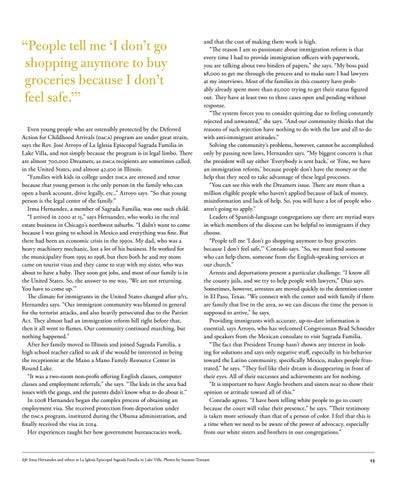
left: Irma Hernandez and others at La Iglesia Episcopal Sagrada Familia in Lake Villa. Photos by Suzanne Tennant