BALDUR BRAGASON
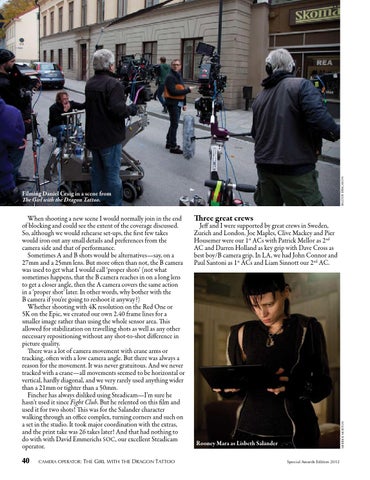
Filming Daniel Craig in a scene from The Girl with the Dragon Tattoo.
40
CAMERA OPERATOR: THE GIRL WITH THE DRAGON TATTOO
Jeff and I were supported by great crews in Sweden, Zurich and London. Joe Maples, Clive Mackey and Pier Housemer were our 1st ACs with Patrick Mellor as 2nd AC and Darren Holland as key grip with Dave Cross as best boy/B camera grip. In LA, we had John Connor and Paul Santoni as 1st ACs and Liam Sinnott our 2nd AC.
Director of Photography Jeff Cronenweth ( seated behind camera), Daniel Craig (center) and Christopher Plummer (far right) on the set of Columbia Pictures’ The Girl with the Dragon Tattoo.
Our dolly grip was Mike Brennan, a veteran of many David Fincher productions—a real class act! Incidentally, we had two Swedish grips—Emil Hall and Fredrik Johansson—who constructed some fantastic 200ft tracks over rough ground with heavy timber at short notice, which really impressed David Fincher, amongst others.
conditions in Sweden in October and November, and in particular night work on a tracking car! In fact, the effects team spent a weekend laying artificial snow at the Venger Mansion location, only for it to snow the night before shooting—at least we got the real stuff !
A great cast
Nearly every shot we did had a precise start and end, so no particular shot stands out technically. But there was one scene that I remember, bringing Rooney Mara from one room, down a corridor, tracking right laterally and panning left with her into another room, dead centre and symmetrical onto her see-through screen in foreground. I knew that I had panned a little far too left on the first take—I looked over at Jeff and he gave me a wry smile—but, between us all, we nailed the other 4 or 5 takes! There were very few handheld scenes in the film. One involved a fight on an escalator in an Underground station— taking two full nights to complete. In another handheld sequence, I was closely following an actor running from a room, along a passage and up a narrow flight of stairs, off at right angles. I was holding the camera at knee height with a very wide lens, with our first AC and grips holding batteries, cables etc, bringing up the rear. At first David said, “Try to get so you can see up the stairs at the end of the shot.” But, by the time we had done quite a few takes with Fincher yelling, “Wilder, Worley!” I managed
Memorable shot
Special Awards Edition 2012
Cleaning condensation off the lens filter Special Awards Edition 2012
ANDERS LINDEN ANDER
Our cast, led by Daniel Craig and Rooney Mara, were very adept with marks, eye lines etc. I would particularly mention Rooney had to do a lot of tough, harrowing stuff on camera, which she performed with great stoicism—a real trouper! There were many challenges: braving the extremely cold
Rooney Mara as Lisbeth Salander
MERRICK MORTON
Three great crews
MERRICK MORTON
When shooting a new scene I would normally join in the end of blocking and could see the extent of the coverage discussed. So, although we would rehearse set-ups, the first few takes would iron out any small details and preferences from the camera side and that of performance. Sometimes A and B shots would be alternatives—say, on a 27mm and a 25mm lens. But more often than not, the B camera was used to get what I would call ‘proper shots’ (not what sometimes happens, that the B camera reaches in on a long lens to get a closer angle, then the A camera covers the same action in a ‘proper shot’ later. In other words, why bother with the B camera if you’re going to reshoot it anyway?) Whether shooting with 4K resolution on the Red One or 5K on the Epic, we created our own 2.40 frame lines for a smaller image rather than using the whole sensor area. This allowed for stabilization on travelling shots as well as any other necessary repositioning without any shot-to-shot difference in picture quality. There was a lot of camera movement with crane arms or tracking, often with a low camera angle. But there was always a reason for the movement. It was never gratuitous. And we never tracked with a crane—all movements seemed to be horizontal or vertical, hardly diagonal, and we very rarely used anything wider than a 21mm or tighter than a 50mm. Fincher has always disliked using Steadicam—I’m sure he hasn’t used it since Fight Club. But he relented on this film and used it for two shots! This was for the Salander character walking through an office complex, turning corners and such on a set in the studio. It took major coordination with the extras, and the print take was 26 takes later! And that had nothing to do with with David Emmerichs SOC, our excellent Steadicam operator.
CAMERA OPERATOR: THE GIRL WITH THE DRAGON TATTOO
41