KAREN BALLARD
Did you get to rehearse much? How does that affect your work?
For the musicals, there were full rehearsal and lighting days which we watched but did not rehearse with the cameras. On the shooting days, we generally started to shoot as soon as the
What made this project stand out from previous projects?
Obviously what made this project stand out was that it was a musical. I remember telling Rob that ‘these films rarely cycle past London,’ so we considered ourselves really lucky to be doing it. Ultimately what really made this project stand out in the end was working with Rob, Dion and Daniel. They were amazingly talented and that encouraged me and the crew I work with to step up a notch and try to be that much better. What are the challenges to operating Steadicam?
My greatest personal challenge while operating Steadicam is the weight. I’m only 150 lbs and 5´10˝, so managing the time wearing the rig is important. I try not to wear it anywhere on set outside a rehearsal and between the words “action” and “cut.” Technique is everything if you are not big and strong. A good technique is the most important thing with Steadicam. What do you say when a neophyte asks what it takes to be an operator, and do they need to do Steadicam?
As far as advising new operators goes, I would say you need to try a Steadicam on before making any decisions on whether to do it. You really need that to decide if you want to do something that physical. You certainly don’t need to operate Steadicam to be an operator!
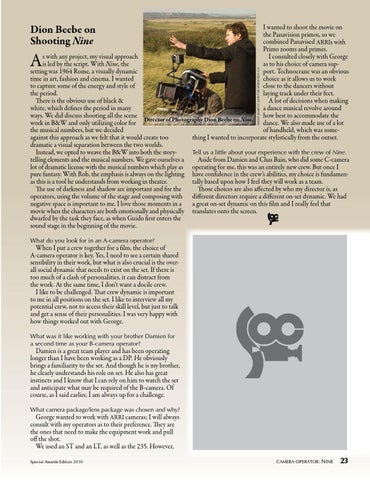
I wanted to shoot the movie on the Panavision primos, so we combined Panavised ARRIs with Primo zooms and primes. I consulted closely with George s with any project, my visual approach as to his choice of camera supis led by the script. With Nine, the port. Technocrane was an obvious setting was 1964 Rome, a visually dynamic choice as it allows us to work time in art, fashion and cinema. I wanted close to the dancers without to capture some of the energy and style of laying track under their feet. the period. A lot of decisions when making There is the obvious use of black & a dance musical revolve around white, which defines the period in many how best to accommodate the ways. We did discuss shooting all the scene Director of Photography Dion Beebe on Nine. dance. We also made use of a lot work in B&W and only utilizing color for of handheld, which was somethe musical numbers, but we decided thing I wanted to incorporate stylistically from the outset. against this approach as we felt that it would create too dramatic a visual separation between the two worlds. Instead, we opted to weave the B&W into both the storyTell us a little about your experience with the crew of Nine. telling elements and the musical numbers. We gave ourselves a Aside from Damien and Chas Bain, who did some C-camera lot of dramatic license with the musical numbers which play as operating for me, this was an entirely new crew. But once I pure fantasy. With Rob, the emphasis is always on the lighting have confidence in the crew’s abilities, my choice is fundamenas this is a tool he understands from working in theater. tally based upon how I feel they will work as a team. The use of darkness and shadow are important and for the Those choices are also affected by who my director is, as operators, using the volume of the stage and composing with different directors require a different on-set dynamic. We had negative space is important to me. I love those moments in a a great on-set dynamic on this film and I really feel that movie when the characters are both emotionally and physically translates onto the screen. dwarfed by the task they face, as when Guido first enters the sound stage in the beginning of the movie.
Dion Beebe on Shooting Nine
A
DAVID JAMES © 2009 THE WEINSTEIN CO
I
dancers were up and running so as not to waste their energy. It was pretty much the same with the drama, always ready to shoot when the actors were. It seems to be the way these days—not much rehearsing takes place What camera support equipment (Techno/ and I’m pretty used to it and comfortable Steadicam/stabilized heads) was used for with it, because when things go wrong the show and what were its advantages for it’s nobody’s fault. Once you can feel this particular project, being a huge comfortable with that, it allows you musical and all? to be more adventurous. We used some Steadicam, but in general The concentration level around the Rob preferred the urgency and feel of the camera was high—all the actors and handheld camera. We used a mixture of 30 Camera Operator Rob demanded it. And with so many and 50 ft Technocranes, mainly 30s. We used George Richmond Oscar winners around us, who were the Scorpio stabilized head on the cranes we to argue. (which Dion allowed me to choose.) When we were shooting the numbers, I would typically start wide—with the other cameras on longer lenses but at Describe a typical shot/scene set up. roughly the same distance as my camera. Then we would For all the dance numbers, the music tracks were played move the cameras closer and shoot medium. Then closer back and lighting cues were set up with Time Code so the again to shoot the tight shots. operating was “old school.” We always had to figure out how All this time, the number would run from beginning to to be at the right place at the right time. I always referred to it as “analogue” operating. We would then finish the number end. In the process, we would learn the beats and the timing. by shooting detail or picking up any of the bits that we could My grip and I were always connected with open headsets and had a continuous dialogue, and also learned to count eights not get during the full run throughs. as the dancers do to help stay in time with the number. had never worked with Rob Marshall or Dion Beebe before. My understanding was that Dion interviewed a bunch of operators and I got lucky.
What do you look for in an A-camera operator?
When I put a crew together for a film, the choice of A-camera operator is key. Yes, I need to see a certain shared sensibility in their work, but what is also crucial is the overall social dynamic that needs to exist on the set. If there is too much of a clash of personalities, it can distract from the work. At the same time, I don’t want a docile crew. I like to be challenged. That crew dynamic is important to me in all positions on the set. I like to interview all my potential crew, not to access their skill level, but just to talk and get a sense of their personalities. I was very happy with how things worked out with George. What was it like working with your brother Damien for a second time as your B-camera operator?
Damien is a great team player and has been operating longer than I have been working as a DP. He obviously brings a familiarity to the set. And though he is my brother, he clearly understands his role on set. He also has great instincts and I know that I can rely on him to watch the set and anticipate what may be required of the B-camera. Of course, as I said earlier, I am always up for a challenge. What camera package/lens package was chosen and why? George wanted to work with ARRI cameras; I will always
Photos from Nine by David James © 2009 The Weinstein Co. Nicole Kidman and Daniel Day-Lewis Saraghina (Stacy(Claudia “Fergie” Jenssen) Ferguson) and dancers perform the musical Italian.”Nine. ((Guido Contini) ) starnumber in Rob “Be Marshall’s
22
CAMERA OPERATOR: NINE
Previous page: Guido (Daniel Day-Lewis) agonizes over starting his new film in the musical number “Guido’s Song.” Special Awards Edition 2010
consult with my operators as to their preference. They are the ones that need to make the equipment work and pull off the shot. We used an ST and an LT, as well as the 235. However, Special Awards Edition 2010
CAMERA OPERATOR: NINE
23