20
Mayer
of the presented material. For example, Bransford, Brown, and Cocking (1999, p. xi) note that “in the last 30 years … views of how effective learning proceeds have shifted from the benefits of diligent drill and practice to focus on students’ understanding and application of knowledge.” In short, the knowledge construction view offers a more useful conception of learning when the goal is to help people understand and use what they have learned.
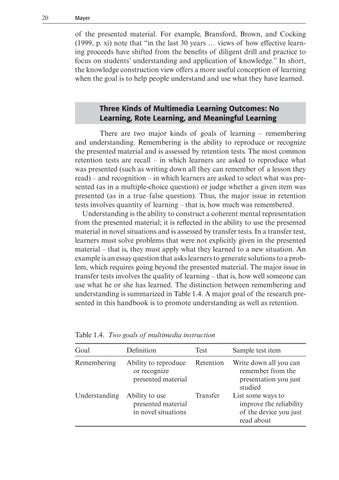
Three Kinds of Multimedia Learning Outcomes: No Learning, Rote Learning, and Meaningful Learning There are two major kinds of goals of learning – remembering and understanding. Remembering is the ability to reproduce or recognize the presented material and is assessed by retention tests. The most common retention tests are recall – in which learners are asked to reproduce what was presented (such as writing down all they can remember of a lesson they read) – and recognition – in which learners are asked to select what was presented (as in a multiple-choice question) or judge whether a given item was presented (as in a true–false question). Thus, the major issue in retention tests involves quantity of learning – that is, how much was remembered. Understanding is the ability to construct a coherent mental representation from the presented material; it is reflected in the ability to use the presented material in novel situations and is assessed by transfer tests. In a transfer test, learners must solve problems that were not explicitly given in the presented material – that is, they must apply what they learned to a new situation. An example is an essay question that asks learners to generate solutions to a problem, which requires going beyond the presented material. The major issue in transfer tests involves the quality of learning – that is, how well someone can use what he or she has learned. The distinction between remembering and understanding is summarized in Table 1.4. A major goal of the research presented in this handbook is to promote understanding as well as retention.
Table 1.4. Two goals of multimedia instruction Goal
Definition
Test
Sample test item
Remembering
Ability to reproduce or recognize presented material
Retention
Understanding
Ability to use presented material in novel situations
Transfer
Write down all you can remember from the presentation you just studied List some ways to improve the reliability of the device you just read about