Technical Association of the Graphic Arts Student Chapter
Published in the United States of America by Cal Poly, San Luis Obispo TAGA Student Chapter
1 Grand Ave
San Luis Obispo, CA 93407-0381
Printed in the Graphic Communication Department at California Polytechnic State University, San Luis Obispo
Augmented Reality & Audio Transcripts
President’s Letter
Theme
Defining Inclusive UX Design: Key Criteria and Industry Insights for Creating Equitable User Experiences
layla bakhshandeh
Civica: Using Human-Centered Design and AI to Help Marginalized Communities Navigate Government Change
cassia gray
The Dough Connection phoenix challenge
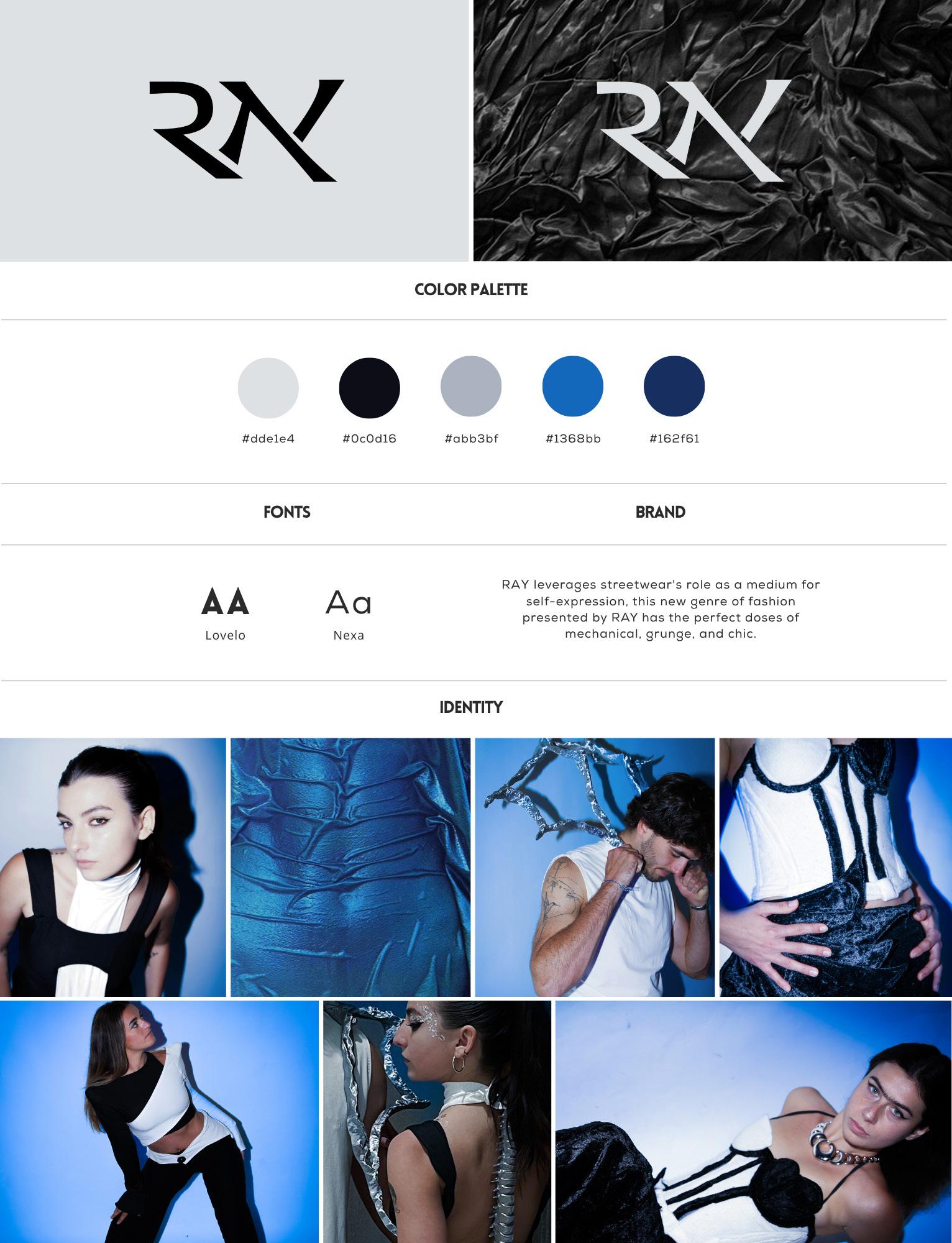
RAY Collection: Forging a New Fashion Genre
olivia cooper
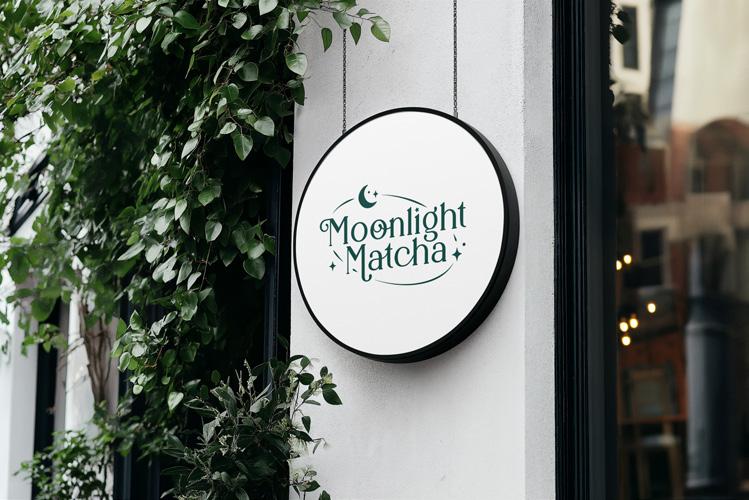
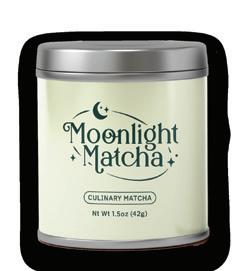
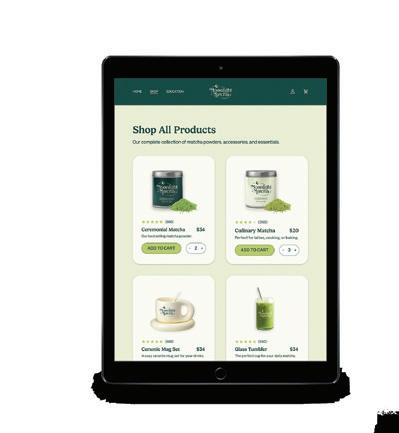
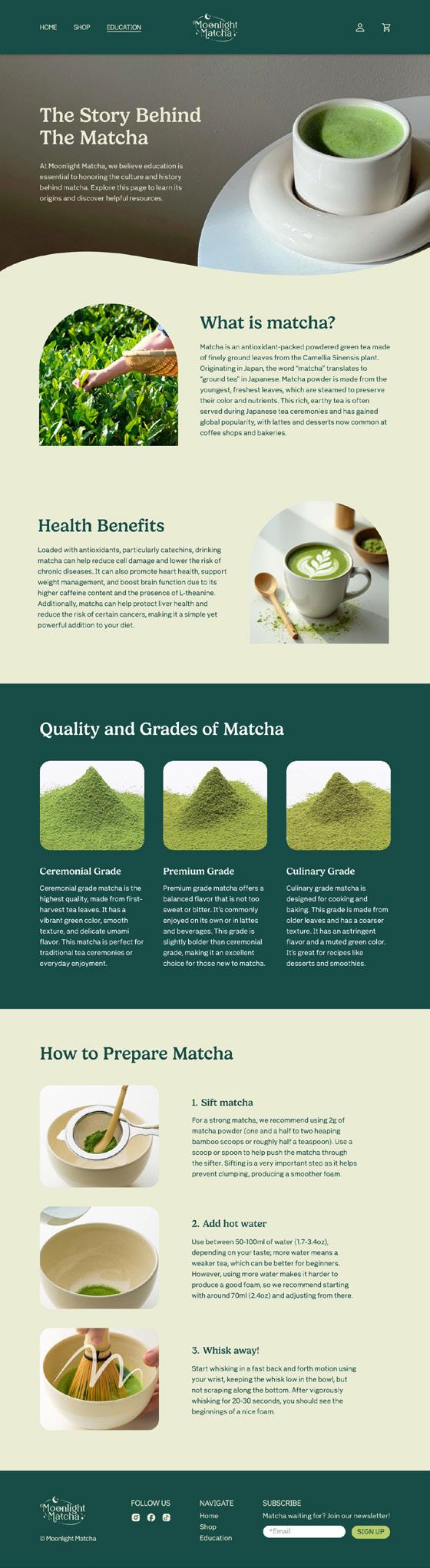
Moonlight Matcha Process Book
adrienne liang
Saksham: Designing Inclusive Educational Tools for Children with Learning Disabilities in India
jasmine sayed
Augmented Reality
This journal features augmented reality experiences created with Mattercraft, powered by Zapworks®. To access them, open your camera app to scan the QR code in the bottom right corner of each article number page.
Click ‘continue’ then ‘launch,’ and grant access to motion and orientation, and the camera. Once it’s open, hold the phone up and tap through the AR experience to interact with dynamic elements that make the illustrations come to life.
You can then explore the illustrations in augmented reality without needing to download any app.
Audio Transcripts
To be accessible for users with vision impairments, we have created an audio transcript for all six articles through Descript®. Scan the QR code below to access all audio transcripts.
Cal Poly TAGA Website
Learn more about the print and production process for this year’s journal, from early concept development to final printing and binding.
President’s Letter
Dear Reader,
We are proud to present the 2026 Helmut Kipphan Cup Journal Competition entry for California Polytechnic State University, San Luis Obispo’s TAGA student chapter. I am excited to welcome you to this year’s issue, inspired by our theme, “Crosscurrents.”
This journal brings together creative work of our peers, including senior projects and the Phoenix Challenge College competition, through curated and thoughtful design, illustration, and production. We aimed to produce a journal that captures the energy and creativity of our department while showcasing how ideas can flow, connect, and grow when shared.
The theme “Crosscurrents” perfectly captures this spirit. It reminds us how different perspectives and disciplines can meet, collide, and converge to form something new. Much like currents in water, creativity moves best when it is dynamic and interconnected.
I am deeply grateful to our faculty advisor, Dr. Rachel Ruoxi Ma, and the Graphic Communication Department for their support. I also want to thank our general members for contributing illustrations, sketches, and ideas that brought our journal together. A special thank you goes to our board, who took the idea of “crosscurrents” to heart, spending plenty of time brainstorming and exploring ideas together, showing how collaboration can evolve in exciting and unexpected ways.
Sincerely,
Sophia Koruga
Crosscurrents
Our theme this years, “Crosscurrents,” represents the meeting and movement of diverse ideas where creativity, research, and social consciousness flow together to create meaningful change. It represents the dynamic flow of ideas and personal identity that shape a more connected and inclusive future. Through this years journal we strive to explore themes of diversity, equity, and inclusion (DEI) across disciplines, highlighting how design, technology, and communication can intersect to address real world challenges and foster a sense of community and understanding.
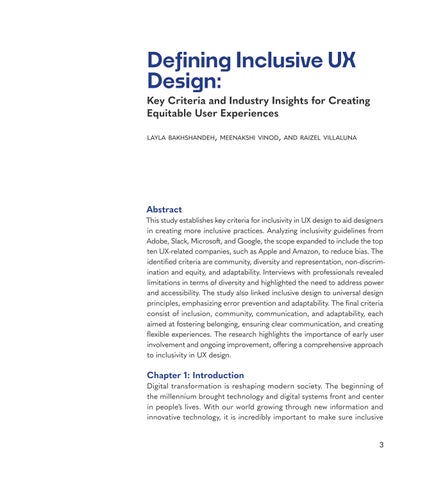
Defining Inclusive UX Design:
Key Criteria and Industry Insights for Creating Equitable User Experiences
layla bakhshandeh, meenakshi vinod, and raizel villaluna
Abstract
This study establishes key criteria for inclusivity in UX design to aid designers in creating more inclusive practices. Analyzing inclusivity guidelines from Adobe, Slack, Microsoft, and Google, the scope expanded to include the top ten UX-related companies, such as Apple and Amazon, to reduce bias. The identified criteria are community, diversity and representation, non-discrimination and equity, and adaptability. Interviews with professionals revealed limitations in terms of diversity and highlighted the need to address power and accessibility. The study also linked inclusive design to universal design principles, emphasizing error prevention and adaptability. The final criteria consist of inclusion, community, communication, and adaptability, each aimed at fostering belonging, ensuring clear communication, and creating flexible experiences. The research highlights the importance of early user involvement and ongoing improvement, offering a comprehensive approach to inclusivity in UX design.
Chapter 1: Introduction
Digital transformation is reshaping modern society. The beginning of the millennium brought technology and digital systems front and center in people’s lives. With our world growing through new information and innovative technology, it is incredibly important to make sure inclusive
practices are incorporated into emerging technological advancements. Designing a product from initial ideation to final creation is a multifaceted process calling upon various skill sets and meticulous work. User experience design is an integral part of this process, focusing on creating fully functional and enjoyable experiences for anyone who uses the product.
Background and Motivation
According to the British Standards Institute, inclusive design is defined as “the design of mainstream products and/or services that are accessible to, and usable by, as many people as reasonably possible...without the need for special adaptation or specialised design” (Inclusive Design Toolkit, n.d.). This is no different when designing for digital interfaces, as they should incorporate this design philosophy to benefit our society as a whole.
Incorporating diversity, equity, and inclusion (DEI) practices into user experience design is necessary to create high-quality products for all. DEI efforts across all business sectors have been increasing in popularity over recent years, attempting to reflect our global population within the workforce (MacArthur, 2024). It is essential that product development caters to our diverse population in order to create seamless user experiences for everyone. Creating UX designs that are inclusive maximizes positive impact for both companies and users.
There is a current ambiguity in defining inclusive design principles, a limited understanding of how to truly create inclusive design systems, and a lack of a standardized framework for creating these systems.
A set of inclusive UX design criteria was created by our team to address these problems. We created this set of criteria on preliminary research of inclusivity guidelines at top tech companies and case studies consisting of expert critiques and conversations around our proposed principles.
With this standardized UX framework, we aim to address goals 8, 9, and 11 from the UN Sustainable Development Goals list. Goal 8 aims to “promote sustained, inclusive and sustainable economic growth, full and productive employment and decent work for all.” Creating a universal set of inclusive
UX design criteria will create inclusive and sustainable economic growth, as inclusive design is not just a moral imperative yet also an economic one. Inclusive design practices allow companies to create more equitable, sustainable, and economically viable digital experiences This will cater to a larger range of users and shareholders alike. Goal 9 aims to “build resilient infrastructure, promote inclusive and sustainable industrialization and foster innovation.” Building digital infrastructures through an inclusive framework creates stronger, more resilient tech products. Designing these systems in a new way can lead to increased innovation. Goal 11 aims to “make cities and human settlements inclusive, safe, resilient and sustainable.” Our UX design criteria will normalize inclusive designs in the digital product sphere, promoting equality through digital interactions.
Chapter 2: Methods and Research Process
To create comprehensive inclusive UX design criteria, we began by analyzing inclusivity guidelines from Adobe, Microsoft, and Google. We then expanded our scope to the 10 major UX-related companies. These top 10 UX-related companies were determined by market cap and included Adobe, Amazon, Apple, Disney, Google, Meta, Microsoft, Netflix, Nvidia, and Tesla. From this initial research, we identified community, diversity and representation, non-discrimination and equity, and adaptability as our initial criteria.
Although inclusive design is different from universal design, we can still draw important key information from universal principles. Agarwal and Sharma discuss the importance of reducing hazards and negative outcomes by specifically organizing design systems to do so in universal design (2014). Researching universal design principles revealed the need to minimize future harm. Incorporating professional expertise in our research process was a key way to strengthen our findings and reduce negative outcomes.
Expert Interviews: Round One
We conducted two rounds of professional expert critiques on our proposed criteria. The first round featured qualitative interviews with industry professionals Jacqui Luis and Timothy Bardlavens, offering important
insights into accessibility and equity. The discussions explored the complexities of inclusive design, including issues related to power, privilege, and historical context.
In the interview with Timothy Bardlavens, several crucial points about inclusivity were raised. Timothy noted that the term “diversity” is often too vague and can let privileged individuals exclude historically underrepresented communities. He emphasized the need to “get okay with being uncomfortable” and face difficult truths. Timothy also highlighted how inclusive design originated from universal design, which initially focused on architectural accessibility before being adopted by digital designers.
Based on their feedback, we learned that addressing inclusive design requires more than just focusing on accessibility. It involves a broader understanding of diversity and a willingness to confront uncomfortable truths. By expanding the conversation and incorporating diverse perspectives, we can make progress toward more inclusive and equitable design practices. The study updated the criteria for inclusive UX design, ensuring a thorough approach to inclusivity.
The criteria included:
Inclusion refers to creating environments where every individual feels valued, respected, and capable of participating fully. This requires ensuring diversity and representation by acknowledging various demographics, such as race, gender, age, and abilities. Equity and non-discrimination are critical to providing fair treatment, opportunities, and access for everyone. Moreover, avoiding stereotypes is crucial to preventing biased assumptions and fostering a genuinely inclusive atmosphere.
Community emphasizes fostering a sense of belonging and active participation among diverse user groups. This involves encouraging collaboration where different voices and perspectives are both heard and valued. Building a strong community promotes mutual support and shared goals, which enhances the overall user experience and satisfaction.
Communication in inclusive design ensures that interactions are clear and accessible to all users. Effective communication is vital for conveying information accurately and avoiding misunderstandings. Additionally, accountability and transparency are necessary to build trust and make sure users understand how their data is used and that their feedback is taken seriously.
Adaptability involves designing flexible and customizable user experiences that cater to various needs and preferences. Accessibility is a key element, ensuring that digital products and services are usable by individuals with disabilities. Furthermore, adaptability means that designs should be capable of evolving and responding to changing user needs and technological advancements.
Expert Interviews: Round Two
This criterion was used in the second round of expert interviews. Four professionals from the UX design, DEI, and product design industries provided expert feedback on the importance of inclusive UX design and reviewed a set of proposed criteria for inclusive design. While all experts supported the need for inclusive design, they offered varying suggestions for refining the criteria to enhance its clarity, applicability, and inclusivity.
1. Dan Harrelson (Senior Design Leader at Confluent) emphasized the importance of inclusive design, especially in accommodating diverse user abilities and cultural contexts. He questioned whether communication should be a separate criterion, suggesting it might be seen more as a means of fulfilling other criteria like inclusion and adaptability.
2. Ashlee Song (Learning and Development Program Manager at Apple) stressed the need for inclusive design to serve a wide user base and recommended explicitly addressing marginalized communities in the criteria. She suggested broadening the inclusion criterion by adding “etc.” to ensure no groups are overlooked.
3. Eugene Chang (Staff Product Designer at Great Minds) emphasized making the criteria more actionable and concise. He appreciated the “community” criterion but suggested rephrasing other criteria with more proactive language. He also raised concerns about including
inclusivity as a separate criterion, arguing that inclusivity is a goal that all the criteria aim to achieve. He highlighted accessibility as particularly important because of its clear, actionable standards.
4. Cristian Crumplish (Head of Product at 18F) endorsed the overall principles but suggested improving the wording to be more action-oriented, especially in terms like “acknowledging.” He proposed adding “belonging” to the criteria and incorporating accessibility explicitly due to its legal and practical importance in inclusive design.
Chapter 3: Results
The implications of the expert feedback suggest that the inclusive UX criteria should be refined to be more actionable and clear, providing designers with concrete steps to implement inclusive design. The language used should be more specific and proactive, helping to guide practical application. Additionally, the criteria should address a broad range of marginalized communities, ensuring no groups are overlooked, with flexible language like “etc.” to cover diverse demographics. Accessibility should be explicitly incorporated into the criteria, both for practical and legal reasons, rather than assumed as part of the broader inclusivity goal. Communication should be seen as a tool to support other elements of inclusive design, such as adaptability and inclusion, rather than being treated as a separate criterion. Lastly, cultural and regional sensitivity should be emphasized, ensuring that designs are not only accessible but also relevant and respectful across different global contexts. Below is the summary of each suggestion:
1. Proactive and Actionable Language: Experts like Eugene Chang and Cristian Crumplish highlighted the need for clearer, action-oriented language in the criteria. This suggests that the criteria should be reworded to offer specific steps that designers can take to implement inclusive design, rather than vague concepts.
2. Broader and More Specific Inclusivity: Ashlee Song’s suggestion to be both broad and specific in addressing marginalized communities underscores the need for inclusivity criteria to explicitly consider diverse groups, without assuming that common categories (e.g., race, gender) cover all possible communities. Adding flexibility (like using “etc.”) could help avoid exclusion.
3. Emphasis on Accessibility: Both Harrelson and Crumplish noted the importance of accessibility in inclusive design. Accessibility could be framed as a critical component of the overall inclusivity criteria, rather than being assumed to be covered under broader terms. It may need its own separate focus to ensure compliance with standards and legal obligations.
4. Communicating Design Intentions: The feedback about communication—especially Harrelson’s view that it may be a means rather than an end—suggests that the criteria should consider how communication supports other elements (e.g., adaptability, inclusion) without treating it as an isolated goal.
5. Cultural Sensitivity: Harrelson’s point about regional and cultural differences suggests that the criteria should incorporate a more global perspective, ensuring that designs are culturally sensitive and accessible to users from diverse regions.
Following the refined inclusive UX design criteria outlined in the document can have a significant impact on UX design. First, it enhances user engagement and satisfaction by ensuring products are accessible and usable by a diverse range of users, including those with different abilities and cultural backgrounds. This approach fosters positive user experiences, increases adoption, and encourages long-term retention. Second, it supports ethical and social responsibility, aligning design practices with principles of fairness and equality. By ensuring inclusivity, products empower marginalized communities, promote diversity, and help organizations comply with legal accessibility standards. Lastly, it improves business outcomes by broadening the user base and increasing market reach. Accessible and inclusive designs attract a wider audience, reduce legal risks, and foster positive brand perception, ultimately leading to stronger customer loyalty and a competitive advantage.
Chapter 4: Revised UX Criteria
Based on the expert feedback that calls for refining inclusive UX criteria to be clearer, more actionable, and universally applicable, the team revised the criteria. Key improvements include using specific, proactive language, explicitly addressing accessibility, and ensuring broad inclusion
for marginalized groups. Communication should support other inclusive elements, and cultural sensitivity must be emphasized to create designs that are accessible, relevant, and respectful globally.
Inclusion: Creating an interactive UX where all users, regardless of their background, identity, or ability, feel welcomed and empowered to engage fully. Inclusion ensures that products are accessible to diverse audiences, addressing the needs of users from various racial, gender, age, disability and cultural backgrounds. It prioritizes equity by providing equal opportunities and access for everyone, eliminating biases and discrimination.
Example: An online education platform incorporating features such as closed captions, multilingual content, and customizable accessibility options like screen readers and keyboard navigation.
Community: Fostering UX evoking a sense of belonging and mutual respect among users by encouraging collaboration and participation from diverse groups. A strong sense of community enhances user engagement, satisfaction and relationships by creating an environment where users feel heard, valued, and connected to others.
Example: A fitness app that allows users to track their progress, join challenges and support one another through shared achievements.
Communication: Ensuring that all UX information is conveyed in a clear, understandable, and accessible way for all users, regardless of ability or background. This involves simplifying language, providing visual cues, offering alternative formats and considering diverse cultural contexts.
Example: A banking app using plain language and visual icons to guide users, with multilingual support for different regions.
Adaptability: Designing UX that is flexible and can be customized to suit the varying needs, preferences, and contexts of different users. Adaptability ensures that users have the ability to adjust their experience based on their individual requirements.
Example: A news website offering dark mode, adjustable font sizes, responsive design, color contrast settings and multiple input methods like voice commands or keyboard shortcuts.
Chapter 5: Impact and Business Outcomes
Understanding and applying these criteria can significantly enhance the inclusivity and effectiveness of UX design projects. First, it enhances user engagement and satisfaction by ensuring products are accessible and usable by a diverse range of users, including those with different abilities and cultural backgrounds. This approach fosters positive user experiences, increases adoption and encourages long-term retention. Second, it supports ethical and social responsibility, aligning design practices with principles of fairness and equality. By ensuring inclusivity, products empower marginalized communities, promote diversity, and help organizations comply with legal accessibility standards. Lastly, it improves business outcomes by broadening the user base and increasing market reach. Accessible and inclusive designs attract a wider audience, reduce legal risks and foster positive brand perception, ultimately leading to stronger customer loyalty and a competitive advantage.
The implementation of these criteria aligns with Sustainable Development Goals 8, 9, and 11, promoting inclusive economic growth, resilient infrastructure, and sustainable development through digital innovation.
Polytechnic State University, San Luis Obispo
Citations
Agarwal, S., & Sharma, S. N. (2014). Universal design to ensure equitable society. International Journal of Engineering and Technical Research (IJETR), 1.
Gorasia, H. (2020, August 23). Heuristics #5: Error prevention—Simplified by the examples. UX Planet. Retrieved June 9, 2024, from https://uxplanet. org/heuristics-5-errorprevention-simplified-by-the-examples-67674daa2860
Keates, S., Clarkson, P. J., Harrison, L. A., & Robinson, P. (2000, November). Towards a practical inclusive design approach. In Proceedings of the 2000 Conference on Universal Usability (pp. 45–52).
Munin, A., & Dugan, J. P. (2011). Inclusive design. In The handbook for student leadership development (p. 157).
Vanderheiden, G. C. (1996). Universal design—What it is and what it isn’t. Trace Center. Retrieved June 6, 2024, from http://trace.wisc.edu/docs/ whats_ud/whats_ud.htm
Waller, S., Bradley, M., Hosking, I., & Clarkson, P. J. (2015). Making the case for inclusive design. Applied Ergonomics, 46, 297–303.
Steinfeld, E., & Maisel, J. L. (2012). Universal design: Creating inclusive environments (1st ed.). John Wiley & Sons.
Kantamneni, S. (2022). User experience design: A practical playbook to fuel business growth. John Wiley & Sons, Inc.
Inclusive Design Toolkit. (n.d.). What is inclusive design? Retrieved from https://www.inclusivedesigntoolkit.com/whatis/whatis.html
S., D. (2022, May 24). Building resilience in tech: The importance of diversity, equity, inclusion and accessibility. LinkedIn. Retrieved from https://www.linkedin.com/pulse/building-resilience-tech-importance-diversity-equity-davonda 14
Layla Bakhshandeh
About the Author
Layla Bakhshandeh is a San Francisco–based multidisciplinary creative specializing in design, communication, and operations. She graduated from California Polytechnic State University, San Luis Obispo in 2025 with dual degrees in Graphic Communication concentrating in User Experience/ User Interface and Journalism concentrating in News Writing & Reporting. Layla blends storytelling and design to create work that is intentional, impactful, and human-centered. Above all, she believes in design that inspires.
2
Civica:
Using Human-Centered Design and AI to Help Marginalized Communities Navigate Government Change
cassia gray
Introduction
The 2024 election cycle marked a new political era of extensive plans to reshape federal policy and structure in government due to Republican majorities in the Senate, the House of Representatives, the Supreme Court, and with Donald Trump becoming the 47th president of the United States. Political division is at an all-time high with widespread mistrust in government and media on both sides of the divide. In the current digital landscape, where information is infinite and media consumption is constant, people struggle to find balance. It is challenging to discern credible, unbiased, and relevant information when there are so many sources to sort through, which increases information overload, causing high stress that can lead to avoidance through disengagement.
Many of the proposed changes in government policy, law, and structure will have negative impacts on marginalized communities as more conservative policies are instituted. Marginalized communities are groups of people who experience societal exclusion or discrimination based on characteristics like race, ethnicity, gender, sexual orientation, socioeconomic status, disability, or religion, which lead to systemic disadvantages. Their systemic disadvantages are built on years of complex events that have often favored white, male, cisgender, heterosexual, wealthy, able-bodied, Christian people above others, leading to inequalities. Systemic disadvantages span across societal
structures such as education, healthcare, housing, government, legal, and economic systems. These disadvantages may make it more challenging for marginalized communities to navigate upcoming changes, which can worsen the impact that the changes may have. This sparked curiosity on how advancements in emerging technologies like artificial intelligence could be leveraged to make information more relevant, accessible, understandable, and actionable to marginalized individuals to help them better navigate government changes that put their livelihood at risk. By exploring ways to improve access to plain-language, personalized updates on governmental actions, this research seeks to empower individuals to better navigate policies that directly affect their rights and livelihoods.
Much of this research occurred before the change in American political power and does not cover current events or their impacts on marginalized communities since the beginning of 2025.
Topic Area Research
The US Chamber of Commerce found in 2024 that 70% of Americans fail a basic civil liberty test, despite two-thirds of Americans studying civics as a part of their high school curriculum (U.S. Chamber of Commerce Foundation, 2024). Only 25% were very confident in explaining the system of government, highlighting a large gap in civic literacy retention.
Government powers are divided among the executive, legislative, and judicial branches and further distributed between federal and state levels, each influencing policy differently. Project 2025, a political initiative with the goal of reshaping the federal government through expanding executive power in favor of right-wing policies, is being used as a guidebook for the new political era. Many of these structural changes will be implemented through executive orders, which bypass Congress, limiting citizens’ influence as contacting representatives to check this power becomes less effective (TED-Ed, 2017). Executive orders are effective immediately, whereas legislation is highly bureaucratic; in the time that it takes for legislation blocking an executive order to be passed, the impacts of the executive order will be entrenched. Trump’s presidential “Make America Great Again” 2024 GOP Platform campaign document serves as a good
reference point for the objectives of upcoming executive orders. While the judicial branch can also check executive orders, Supreme Court decisions have a similar effect, shaping national policy without immediate public recourse beyond future legal challenges or constitutional amendments. In providing actionable steps to updates on executive orders or judicial decisions, resources may be more realistically effective than encouraging direct government action. The federal government sets national policies on issues like immigration, reproductive rights, LGBTQ+ protections, and voting rights, but states have the power to enforce, modify, or challenge these laws, which can lead to disparities in rights and protections in different locations. Additionally, state legislatures hold primary authority over issues such as abortion laws, transgender rights, immigrant protections, and specific voting regulations, making geographic relevance in updates important for an individual to understand how it will impact them. These disparities further contribute to unequal impact across different communities, making it critical to track which groups will be most affected by upcoming policy shifts. The following sections outline key communities at risk and the challenges they may face:
1. Immigrants
a. At the forefront of Trump’s 2024 GOP Platform, ranked at number two, is to “seal the border, and stop migrant invasion,” making immigrant populations, especially those from Latin America, at risk for attack (Trump, 2024). Unauthorized immigrants are to be targeted with mass deportations and legal immigrants with the discontinuation of immigration programs such as DACA and visa categories such as Temporary Protected Status. Additional projects are the expansion of detention centers and the deep militarization of the US-Mexico border (TED-Ed, 2017). Trump plans to begin the “largest deportation program in American history,” putting immigrants in a very sensitive position as an outwardly hunted minority group. With extremely limited resources and even higher stakes, the need for information that can ensure safety is paramount.
2. Transgender Individuals
a. Since the 2015 legalization of same sex marriage and the 2020 ruling of transgender individuals being included in the definition
of Civil Rights Act employment protections, there have been significant improvements to transgender rights. Conservative lawmakers have responded to these progressions with increasing levels of anti-LGBTQ+ legislation, with 533 anti-LGBTQ+ bills being tracked in 2024, 46 of which were passed into law, many of which specifically target transgender individuals (ACLU, 2024). Under Chapter 9 of Trump’s GOP Platform, titled “Republicans will end left-wing gender insanity,” outlines promises of implementing gender-affirming healthcare restrictions, public accommodation bans, restricting student and educator rights, and reversing the Civil Rights Act employment protections for transgender individuals (Trump, 2024). With 115 trans-specific bills prefiled for 2025, there will continue to be rollbacks on existing frameworks that undermine the processes that have historically allowed transgender individuals to obtain legal recognition, access essential services, and secure protections under civil rights laws (Dallara, 2025). Ultimately, the impact of these reversals and how to navigate them is unsure, highlighting a need for clear information on how to proceed.
3. People assigned female at birth
a. After the overturning of Roe v. Wade in 2022, reproductive rights regulations were turned over to the states and were no longer protected at the federal level. Now, states with majority pro-life agendas are implementing state legislation to gain control of reproductive choice, impacting people assigned female at birth. This serves as a prime example for the importance of getting information on multiple levels of government since policies at the federal level can be overturned and weakened, leaving individual states to determine rights and protections. Additionally, Project 2025 has outlined specific plans to extend past the states to bring abortion restrictions to a federal level (Casey, 2024). If some level of reproductive restriction were lifted to the federal level, understanding the complexities and laws at multiple levels would become even more critical.
Hypothesis
If an app provides personalized, timely alerts about government changes and actionable steps for engagement, then users—especially from marginalized or underrepresented groups—will feel more informed, empowered, and motivated to take direct action in support of their rights. Through leveraging emerging artificial intelligence technology models, information from government sources can be transformed into understandable content so that people in affected communities can receive relevant updates and engagement opportunities.
Technology
AI has a promising role in shaping personalization and information access (Swisher & Preciado, 2021), especially for navigating large repositories like government document libraries. While users increasingly rely on models like ChatGPT for simplified information, these Large Language Models (LLMs) come with significant limitations. Studies reveal concerns about reliability, bias, outdated knowledge, and potential fabrication (Hasanein & Sobaih). ChatGPT and similar LLMs train on unverified data, often delivering responses disconnected from sources that may be false, outdated, generic, or inaccurate due to terminology confusion across training datasets (Amazon, 2024). For a project focused on maintaining accuracy while personalizing information, traditional LLMs prove unreliable options.
Retrieval-Augmented Generation (RAG) is a method that enhances the capabilities of LLMs by integrating real-time data retrieval from authoritative sources (Amazon, 2024). Instead of relying solely on pre-trained static datasets, RAG-enabled AI systems can dynamically pull information from external knowledge bases; in this case government repositories, before generating responses. In the context of policy and legal information, a RAG-based AI system would function by continuously scraping newly published government documents or integrating direct uploads from official sources. To meet the needs of more accessible government information, the AI model would generate outputs at a sixth-grade reading level, simplifying complex legal jargon into plain language while maintaining specificity and accuracy. This combination of real-time data retrieval directly from government sources and simplified language processing
would enhance user trust, ensuring that updates are both verified and easily understandable.
Methodology
A combination of quantitative and qualitative research was collected. The initial research sought to understand attitudes, behaviors, and needs of the current information climate across a broad and a more focused view. First, the survey was sent out to a diverse group of users. The survey included 110 participants from various backgrounds, including people belonging to the target user groups. The questions covered:
• News and Policy Engagement: Frequency of engaging with news, self-rated understanding of government actions, and ease of finding relevant policy information.
• Barriers to Access and Engagement: Challenges preventing participants from staying informed or taking action on government policies.
• Trust in AI and Technology: Comfort level with AI providing information and concerns about personalization.
• Feature Preferences: What methods participants find most effective for understanding policies and what app features they would find useful.
Then, interviews were conducted with individuals from each of the target user groups and experts in fields of personalization, journalism, and ethnic studies. Interview questions with people in the target user group sought to understand underlying emotional impacts, pain points, and unmet needs. Interview questions with experts uncovered supplemental context and knowledge.
After synthesizing information and defining three guiding themes, research on the design practices necessary to execute ideas from the themes was coupled with another supplemental round of interviews with UX designers and UX researchers in the public sector and AI fields were conducted to uncover best practices. In conjunction, these informed the specific design decisions ultimately exhibited in the base proof of concept prototype built. Lastly, a quick round of feedback and usability testing was conducted after design implementation on the prototype to uncover areas for improvement.
Findings
Qualitative findings from the survey displayed similar sentiments and uncovered interesting contradictions in the wants and behaviors of participants. 80% of respondents reported they want to be more informed about what impacts them. While 75% of respondents find reading articles or reports to be the most effective means for processing information about government, 44% of respondents’ primary barrier to engaging is a lack of trust in news. This apparent contradiction between wanting information (80%) while distrusting news sources (44%) represents a significant opportunity gap in how government information is currently disseminated. This emphasizes the fact that current methods of delivering information, which are often on behalf of news and media outlets, do not properly serve the needs of Americans.
Contrary to expected outcomes, responses demonstrated that people from marginalized groups often reported higher levels of understanding of current or upcoming government actions that may impact them, with Hispanic/Latin/e/x, non-binary, transgender, and gay individuals having the highest level of understanding. Being more aware is possibly an adaptive response to the necessity of navigating systems that disproportionately affect their daily lives. While this uncovers heightened awareness in these groups, it does not affect their desire to be more informed; the only groups that responded “no” to wanting to be more informed were whites, Asians, cisgenders, and heterosexuals.
When respondents were asked if they would find it useful if an app provided personalized and interactive reports about government actions that affect them based on their personal identity, 45% responded “yes,” 42% responded “maybe,” and 13% responded “no.” The high percentage of “maybe” hesitation or concerns about AI-driven personalization highlighted in the concerns-free response section covered in the qualitative analysis.
Qualitative findings were next synthesized from user interviews using affinity mapping through the user research platform DoveTail, where free-response questions were sorted from the survey into categories using
affinity mapping in FigJam. They were then compiled into a three-section theme report, with each theme following the structure of:
Theme
Insight - Data
How might statement • Solution idea
Theme 1:
Suspicion of government, technology, and news has resulted in mistrust and fear in users.
Accuracy - Between misinformation, disinformation, and the introduction of AI-generated information, respondents and interviewees perceived the accuracy of information to be low.
Bias - Bias exists every time there is any intermediary between a primary source and the user. AI technologies create curated content that is biased to favor what the user wants to hear based on what it has learned about the user (Swathi Meenakshi Sadagopan, 2019). Media bias can be specific to certain articles or to larger news organizations and has been credited for the current political divides. Respondents and interviewees reported being scared to be confined to their own echo chambers.
Sensitivity of marginalized identity - People with certain marginalized identities, such as being an undocumented immigrant, transgender, Black, Indigenous, etc., have fears about identifying themselves as it may lead to possible forms of violence or discrimination against them.
Data privacy - Respondents and interviewees face concerns with both the privacy of their data and the ways that it is being used.
How might we limit the bias in the information demonstrated? How might we protect the personal data disclosed by users on the platform? How might we build a relationship of trust with the user?
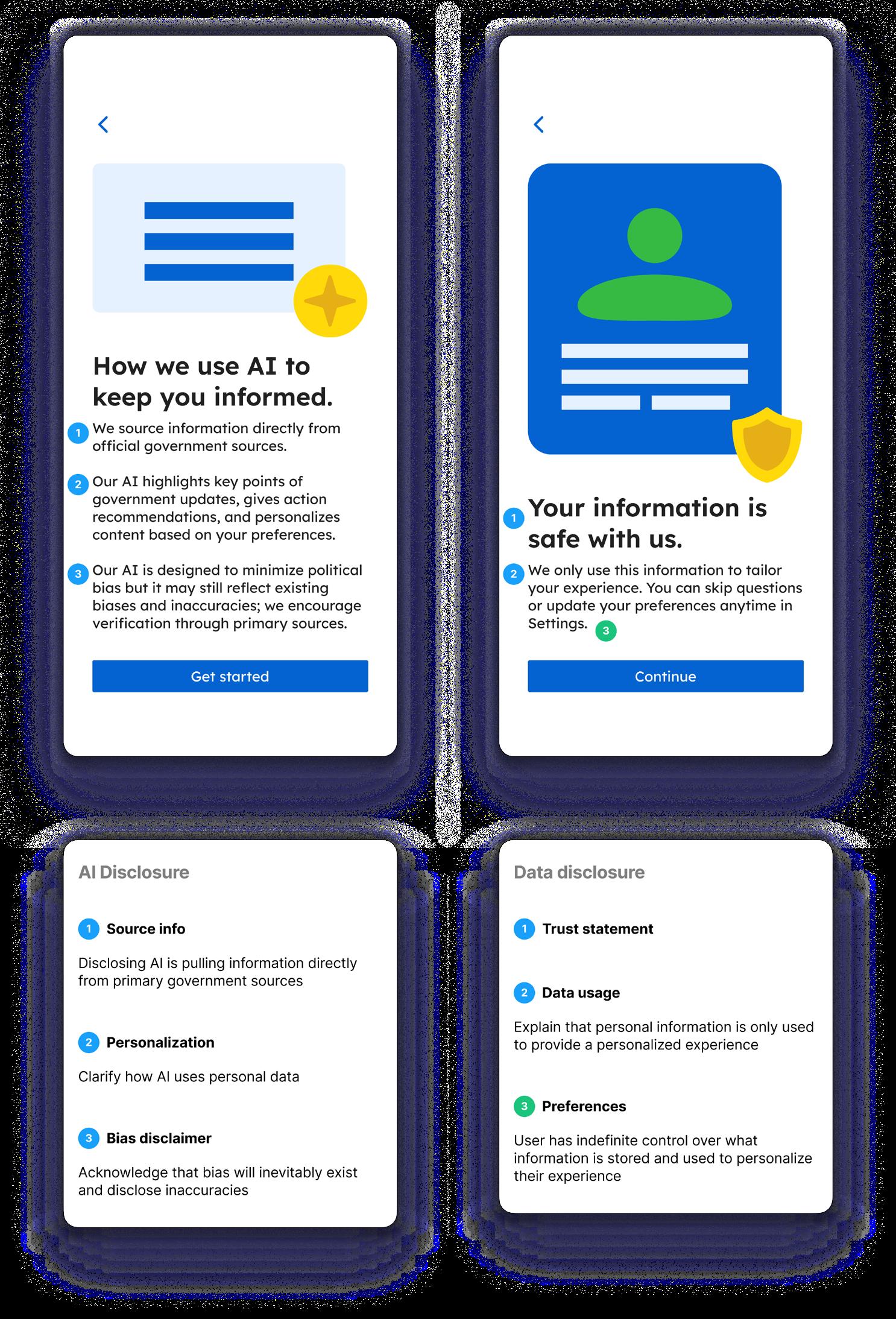
• Simple disclosures on how data is collected and being used with the ability to learn more
• Direct connection back to primary sources
• User-controlled privacy settings
The best tool to combat a lack of trust is to build in ways for information to be transparent, understandable, and visible. Disclosures should be integrated with the processes they are associated with in simple language, with an ability to learn more.
Theme 2:
A lack of relevance and clear actionability in information leaves users uncertain about what information matters and what to do next.
Information overload - With vast amounts of information scattered across multiple sources, users struggle to find clear, relevant, and actionable insights. Government and legal jargon further complicate understanding, making it difficult to grasp what is important.
Generalized reporting - News coverage is often too broad, reductive, or written by uninformed journalists, leading to a lack of nuance. Frequent updates flood users with information that is unspecialized to their specific circumstances.
Difficulty in taking action - Even when users understand an issue, they often don’t know what steps to take next. Searching for guidance can be inefficient, requiring extensive effort to piece together actionable steps.
How might we ensure that information is both specific and actionable for users?
How might we simplify government and legal information to make it easier to understand?
How might we provide users with a clear next step after receiving information?
• Can seek out an impact breakdown that explains the personal impact in relation to stored information
• Ability to continue to dive deeper
• Related resources and/or actions
Theme 3:
A lack of user control over news and notifications leads to frustration, disengagement, and stress.
Overpersonalization – While personalization can help users find relevant information, excessive filtering risks trapping them in echo chambers or making them feel disconnected from broader issues. Users may also feel uncomfortable if personalization becomes too intrusive.
Notification fatigue – Users want control over how and when they receive information. Unfiltered notifications contribute to stress, while irrelevant or excessive alerts reduce engagement.
Preference for existing channels – People prefer receiving updates in ways that fit naturally into their daily habits. If information is not delivered in a way that aligns with their preferred methods of consumption, they are more likely to disengage.
How might we give users more control over their news consumption? How might we balance personalization to avoid echo chambers and discomfort?
How might we reduce notification fatigue while maintaining relevance?
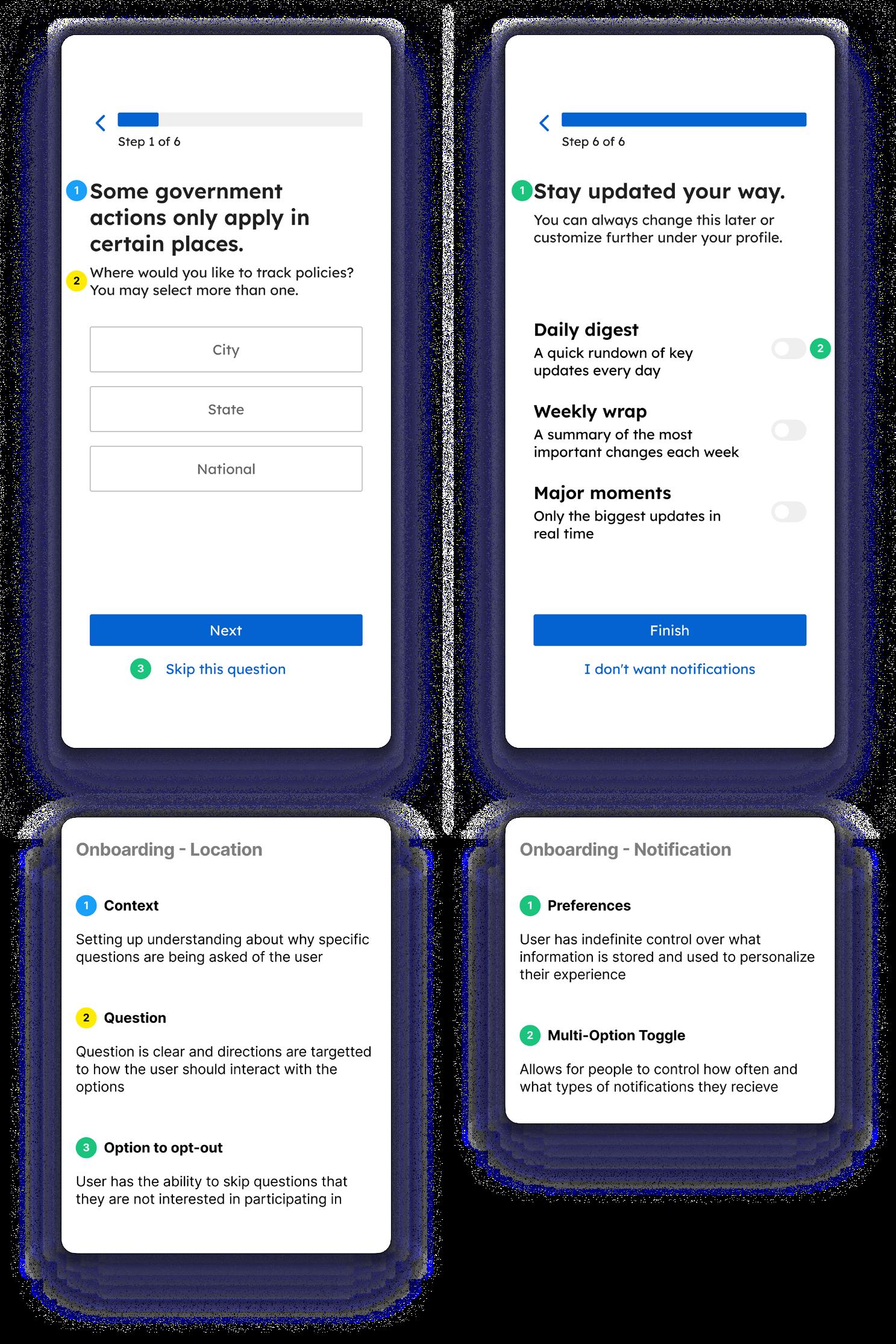
• User-controlled settings for urgency and frequency (daily, weekly, monthly)
• Push notifications with easy on/off toggles
• Curated alerts with quick-scanning indicators (e.g., emoji or color coding)
• Multiple delivery methods based on user preferences (email, app, text, etc.)
Design
Based on the theme findings, four leading design principles were established. These principles were used to inform the design decisions made throughout.
1. Transparency: Clearly disclose how AI is collecting and using personal data and where information is sourced from, ensuring users understand and trust the platform.
2. Clarity: Information should be broken down into understandable, plain language with an emphasis on relevance and actionability.
3. Progressive Disclosure: Present complex legal and policy information in digestible chunks, with options to dive deeper if users want more details.
4. User Control: Allow users to decide how much of their information to disclose, what notifications they receive, and what information is relevant to them.
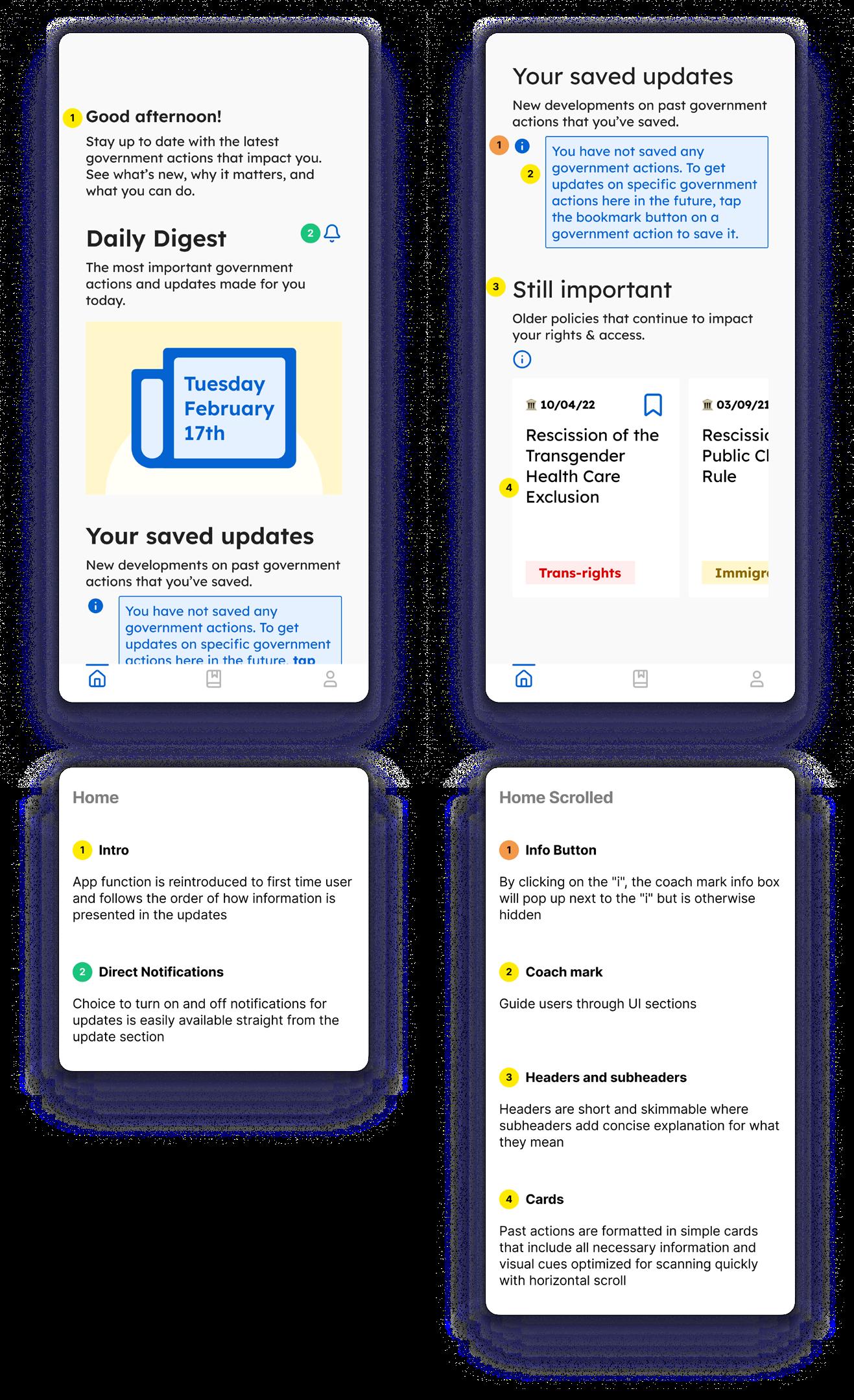
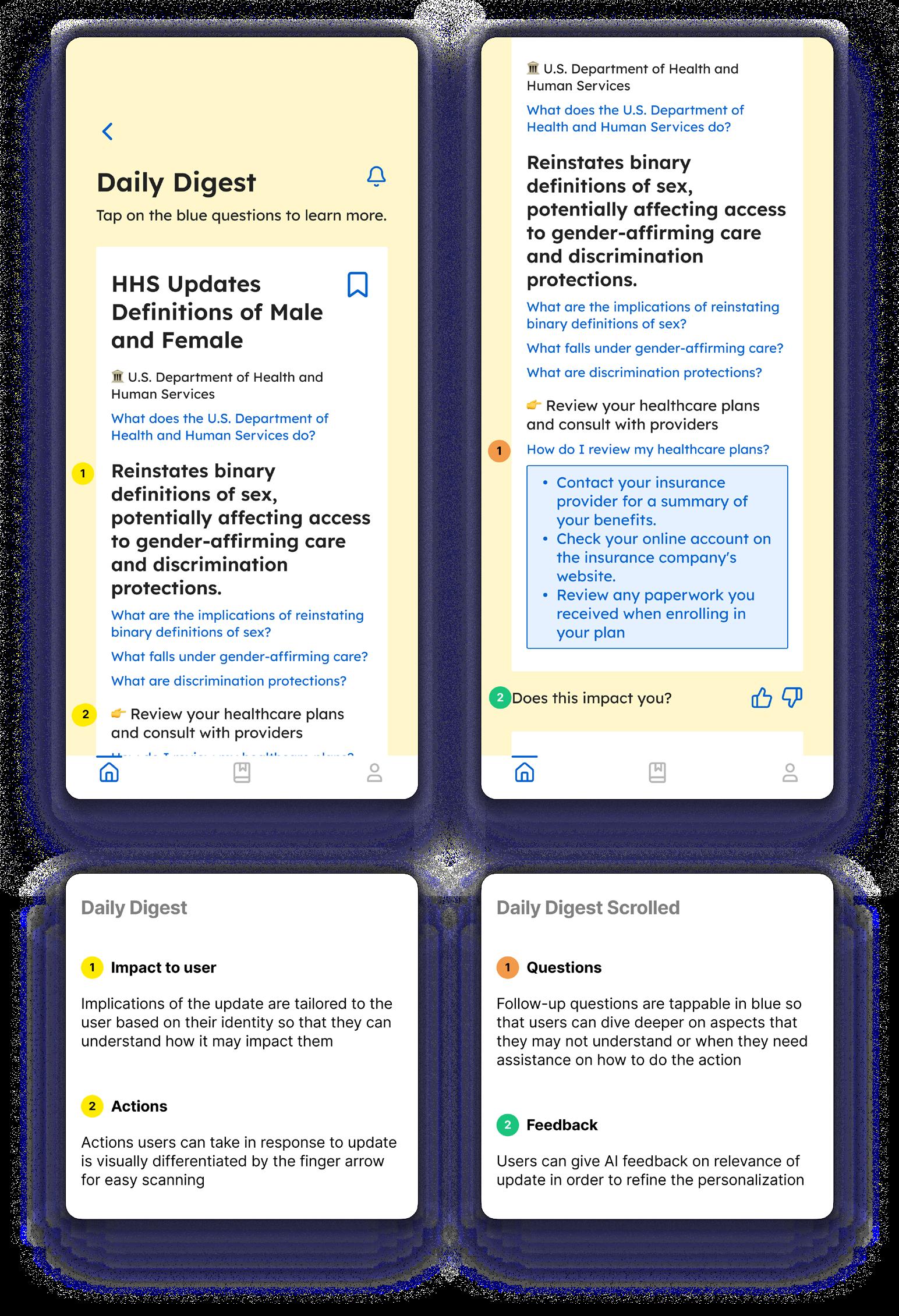
A minimum viable product prototype was created in two design stages— low-fidelity and mid-fidelity—which was ultimately prototyped to show the user journey of a transgender undocumented individual.
Polytechnic State University, San Luis Obispo
Prototype Figures
Feedback
Individuals from the initial interviews were followed up with to do virtual usability testing on the prototype. The usability testing utilized the think-aloud method, which urges users to verbalize their thoughts and decision-making as they move through the user interface (Nielsen, 2012). This method is very effective in uncovering the ways that users are interacting with the prototype when operating in a virtual format. The usability testing revealed several key insights about the app’s design, functionality, and overall user experience.
• Visual design: Participants responded positively to the app’s visual design, particularly the homepage graphics and color choices but desired better text hierarchy to reduce information overload, particularly in news updates where the main topic was sometimes unclear.
• Onboarding: Users found the onboarding process clear, but some felt overwhelmed by the amount of text in disclosures and suggested bolding key phrases to improve scannability.
• AI: Concerns about AI bias and verification were raised, emphasizing the need for clearer explanations of how sources are verified.
• Personalization: The step-by-step personalization process got feedback on inconsistency in question format and users found some phrasing unclear—particularly around geographic selection and gender identity. A transgender participant mentioned that grouping of “man,” “woman,” and “transgender” was problematic as it suggested that transgender people are not men or women but rather a separate other. They felt that including a checkbox for transgender identity underneath the gender identification would feel more accurate. The racial and ethnic identity section categories were noted to need updating based on new census categories and could benefit from clearer instructions to avoid confusion about whether selections limit the content users receive.
• Homepage: On the homepage, users noted that content felt undifferentiated, making it difficult to distinguish between sections. The daily digest feature was not immediately recognizable as clickable, and users suggested clearer visual indicators.
• Actionable steps: Users responded positively to the app’s ability to provide actionable steps related to policy changes, which they saw as a unique and valuable feature.
• Progressive disclosure: Question format mirrored the questions that the users had as they thought aloud, and they were able to quickly access further information, demonstrating effectiveness in using this format.
Overall, feedback suggested that improving clarity in text hierarchy, refining personalization questions, and better differentiating content sections would enhance usability and user trust. From an emotional perspective, participants report feeling calm when interacting with the app due to the non-inflammatory nature of the news delivery.
Conclusion
The findings of this research uncover a need for alternative delivery methods for government information, especially amidst a turbulent time in government regulations. This is especially true for people in marginalized communities who struggle to discern the impact that changes will have, specifically on them, and what they should do to address them. People are highly interested in being more informed while simultaneously not trusting the sources that they currently use to do so. Ultimately, the need for understandable and actionable information systems is not only a design challenge but a civic imperative in an increasingly divided and rapidly changing political environment.
Through this research, the design methodology and practices that are effective to address this gap in information has been identified. Whether or not it leads to user empowerment or true value is something that would have to be measured over a period of time of usage in different contexts as new changes unfold, making it difficult to test with a minimum viable product prototype. Instead, it demonstrates a possible future in civic technology where government updates are delivered in clear, calm, and targeted ways so that people can access the necessary information they need in a trustworthy way.
As this is just a minimum viable prototype, in the future, it will be refined based on the feedback received in order to continue building a solution that effectively addresses the needs of users demonstrated in this research. Future work must continue to explore how user experience design of digital tools can bridge understanding between systemic complexity and individual agency, ensuring that all people, particularly those most affected by systemic change, are equipped with the knowledge they need to navigate their lives.
scan to view the final civica prototype
Citations
ACLU. “Mapping Attacks on LGBTQ Rights in U.S. State Legislatures in 2024.” American Civil Liberties Union, American Civil Liberties Union, 2024, www.aclu. org/legislative-attacks-on-lgbtq-rights-2024.
Amazon. “What Is RAG? - Retrieval-Augmented Generation Explained - AWS.” Amazon Web Services, Inc., 2024, aws.amazon.com/what-is/ retrieval-augmented-generation/.
Casey, Katie. “What Project 2025 Means for Choice.” MSI Reproductive Choices, 13 Aug. 2024, www.msiunitedstates.org/what-project-2025-means-forchoice/?utm_source=google-grant&utm_medium=cpc&utm_campaign=all_pages&gad_source=1&gclid=CjwKCAiAp4O8BhAkEiwAqv2UqOPS8xregSpe908A-iIAXEuYUCryMemBvmppL-gKPbXxrMc62PbpbRoCxLUQAvD_BwE. Accessed 13 Mar. 2025.
Dallara, Angela. “State Legislatures Reconvene to Consider 2025 LGBTQ-Related Bills.” GLAAD | GLAAD Rewrites the Script for LGBTQ Acceptance., GLAAD, 9 Jan. 2025, glaad.org/ state-legislatures-reconvene-to-consider-2025-lgbtq-related-bills/.
Hasanein, Ahmed M., and Abu Elnasr E. Sobaih. “Drivers and Consequences of ChatGPT Use in Higher Education: Key Stakeholder Perspectives.” European Journal of Investigation in Health, Psychology and Education, vol. 13, no. 11, 1 Nov. 2023, pp. 2599–2614, www.mdpi.com/2254-9625/13/11/181, https://doi. org/10.3390/ejihpe13110181.
Lindsey, Brink. “The Political Marginalization of Ordinary People - Niskanen Center.” Niskanen Center - Improving Policy, Advancing Moderation, 8 Nov. 2022, www.niskanencenter.org/the-political-marginalization-of-ordinary-people/.
“New Study Finds Alarming Lack of Civic Literacy among Americans.” www.uschamberfoundation.org, U.S. Chamber of Commerce Foundation, 12 Feb. 2024, www.uschamberfoundation.org/civics/ new-study-finds-alarming-lack-of-civic-literacy-among-americans.
Nielsen, Jakob. “Thinking Aloud: The #1 Usability Tool.” Nielsen Norman Group, Nielsen Norman Group, 15 Jan. 2012, www.nngroup.com/articles/ thinking-aloud-the-1-usability-tool/.
“Plainlanguage.gov | Write for Your Audience.” www.plainlanguage.gov, www. plainlanguage.gov/guidelines/audience/.
Swathi Meenakshi Sadagopan. “Feedback Loops and Echo Chambers: How Algorithms Amplify Viewpoints.” The Conversation, 4 Feb. 2019, theconversation.com/feedback-loops-and-echo-chambers-how-algorithms-amplify-viewpoints-107935?utm_source=chatgpt.com.
Swisher, Val, and Regina Lynn Preciado. The Personalization Paradox Why Companies Fail (and How to Succeed) at Delivering Personalized Experiences at Scale. Laguna Hills, XML Press, 2021.
TED-Ed. “How Do Executive Orders Work? - Christina Greer.” YouTube, 18 Sept. 2017, www.youtube.com/watch?v=oyOf3g-PJ94.
Trump, Donald. “2024 GOP PLATFORM MAKE AMERICA GREAT AGAIN! .” www.donaldjtrump.com, 2024, www.donaldjtrump.com/platform.
Cassia Gray
About the Author
Cassia Gray graduated from California Polytechnic State University, San Luis Obispo in 2025 with a Bachelor of Science in Graphic Communication, a concentration in User Experience/User Interface, and a minor in Ethnic Studies. Through her studies and extracurricular experiences, Cassia discovered a passion for civic technology and building at the intersection of design, technology, and public good. Following the path of her research on AI in government spaces, Cassia is a Design Fellow at the City of Long Beach’s Technology and Innovation Department, where she leads the research and design of Long Beach’s AI and data privacy webpages, which are critical to advancing the city’s digital transparency efforts.
The Dough Connection
Phoenix Challenge College Competition
sydney doyle, zoe li, malia mccaig, sophia durbin, and pierce lewis
Meet The Dough Connection
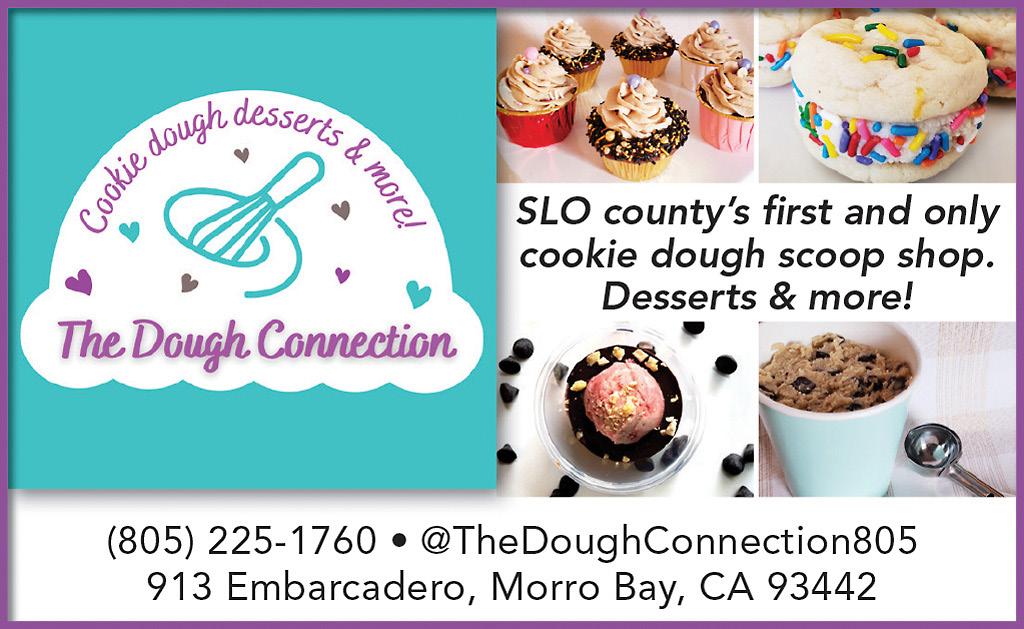
The Dough Connection, a small local business in Embarcadero, Morro Bay, offers a variety of products, including edible cookie dough, ice cream, cookie dough cookie sandwiches, and take-and-make kits, which is a kit to make your own cookie dough at home. The business’s mission is to deliver unique and delightful dessert experiences to customers of all kinds. They proudly hold the distinction of being the only edible cookie dough scoop shop in San Luis Obispo County and the surrounding areas.
Before establishing a business in Morro Bay, the owner, April, made desserts for her children and created cookie dough sandwiches and truffles for friends and family. As her baking gained popularity, she started selling her homemade desserts, eventually expanding from her kitchen to farmers’ markets and eventually a storefront in Morro Bay. Since opening, their menu has featured an array of unique cookie dough flavors, such as turtle cheesecake, apple cider, birthday cake, and more. Adding to the excitement, they introduce a mystery flavor each month, inviting customers to guess the flavor combination.
While The Dough Connection’s primary location is in Morro Bay, they frequently sell their handcrafted desserts at local farmers’ markets, pop-up events, festivals, and fairs. While running the cookie dough shop, the
owner has expanded their ventures, launching a boba tea shop called Sweet Reef, further diversifying their offerings.
Why The Dough Connection?
Our team reached out to several local businesses in San Luis Obispo to explore rebranding and packaging opportunities. After identifying common challenges like functionality, aesthetics, and brand communication, we selected The Dough Connection to elevate their packaging and support their business growth.
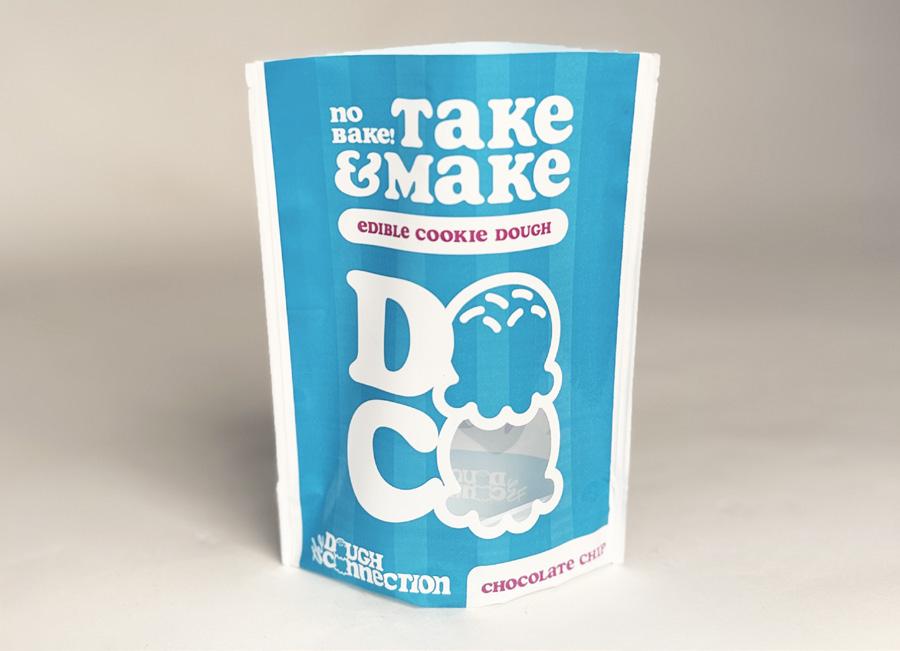
We were drawn to The Dough Connection due to their unique products of edible cookie dough and the owner’s need for packaging and design support. Currently, they use clear, generic packaging with minimal branding, making it difficult for consumers to identify flavors and products. While cost-effective, the design lacks cohesion and limits brand recognition, especially as they aim to expand beyond Morro Bay and San Luis Obispo.
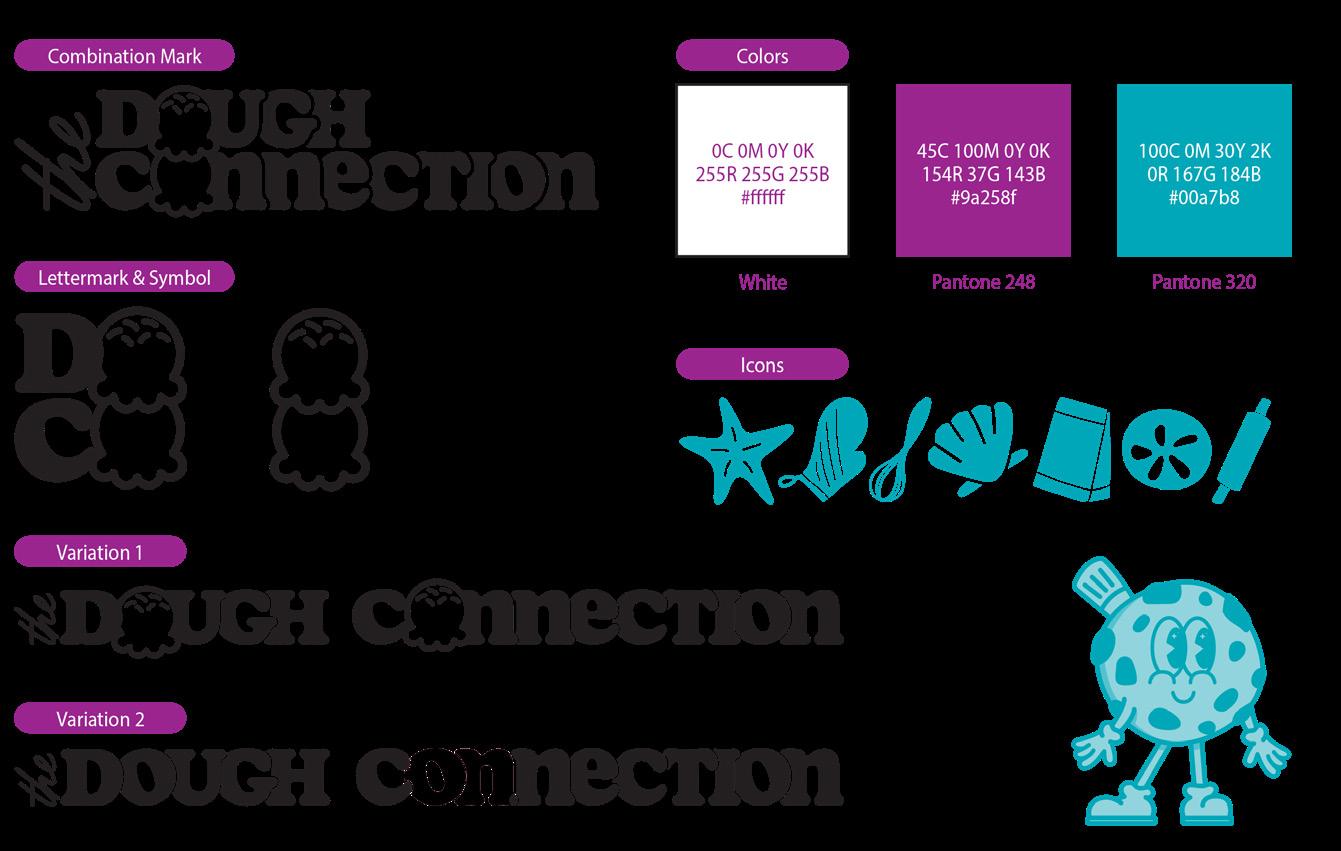
Their current branding has no current guidelines, with mismatched colors and various different logos. To a consumer, their brand and message are unclear. Our goal was to create professional, visually engaging packaging that simplifies flavor identification, strengthens brand identity, and supports growth across new locations.
By incorporating clear, consistent labeling and design elements, we aim to make flavor identification effortless for consumers while creating a brand image that can drive recognition across multiple locations. Additionally, we see potential to incorporate sustainable materials for larger-scale production, aligning with consumer preferences. This redesign presents an exciting opportunity to transform The Dough Connection’s packaging, increase brand awareness, and boost sales.
Research Industry Research
The U.S. cookie market size is significantly growing, with a projection indicating a $15.23 billion market by 2030, with a Compound Annual Growth Rate (CAGR) of 3.38% between 2025–2030 (Mordor Intelligence). Within
this sector, the rise of the cookie dough industry in recent decades was estimated at $10.43 billion in 2023, with a CAGR of 8.56%, reaching $18.54 billion by 2030 (Research and Markets). The ready-to-eat cookie dough segment, in particular, accounted for over $3.33 billion in 2023 and is projected to grow at a CAGR of 6.4% from 2024 to 2032 (Global Marketing Insights). The cookie dough market is experiencing significant growth, driven by the availability of refrigerated, ready-toeat options in convenience stores. Its appeal is further enhanced by time-saving benefits and consistent quality, making it a popular choice for both home and commercial baking. These products are strategically positioned as impulse purchases, catering to consumers seeking quick and convenient snack solutions.
The widespread availability of cookie dough in supermarkets, convenience stores, and online platforms has made it more accessible to a broader audience. Social media, particularly TikTok and Instagram, has played a crucial role in promoting cookie dough as a trendy, visually appealing dessert. According to Pew Research Center, 62% of 18 to 29-year-olds use TikTok, making it a key platform for food trends (Pew Research Center). The rise of the “sweet treat” trend—indulging in lattes, boba, cookies, or other sweets as a pick-me-up or study break—has gained traction as consumers
COOKIE DOUGH MARKET SIZE
Figure 1 Cookie dough market size by product type from 2021–2032 (USD Billion)
seek small moments of enjoyment throughout the day (Spoon University) This trend reflects a shift toward treating desserts as a form of self-care and reward, rather than just an occasional indulgence. Companies like Crumbl Cookies have capitalized on this, using social media to showcase rotating flavors and engage young consumers eager to participate in the latest food trends.
Consumers are drawn to captivating and shareable content, leading to increased awareness and demand. Companies use social media by sharing recipe ideas and running promotional campaigns to increase brand awareness and customer loyalty.
Demographic Research
national
Millennials and Gen Z are considered the primary drivers of the cookie dough market due to their preference for snacking and nostalgic food experiences. Broadly, Center for Generational Kinetics, conducted research on Millennials and Gen Z, finding that 87% think about eating dessert at least once a day (Hershey). Social media influence and the nostalgia factor further amplify its consumption among Millennials and Gen Z.
When viewing cookie dough, both generations of consumers look for sweets that are familiar flavors and experiences that evoke feelings of comfort and nostalgia. These younger consumers view cookies as a snack rather than just a dessert, contributing to their frequent consumption. This shift aligns with data from 84.51°, which shows that 74% of U.S. consumers under 35 snack at least a few times daily, compared to just 50% of those over 35 (84.51°). Additionally, 60% of 18–34-year-olds are extremely willing to try new snacks, more than older age groups (35–54: 57%, 55–74: 44%) (84.51°). Gen Z and Millennials are also more health-conscious, with Millennials particularly seeking sweet treats without artificial ingredients and preferring alternatives to traditional sweeteners (Mondelez International).
HOW OFTEN DO DIFFERENT AGE GROUPS SNACK?
2 Bar chart of how often different age groups snack
local
The current population of Morro Bay is approximately 10,757 with a median age of 52.9 years old (Morro Bay Consensus). Though Morro Bay contains an older demographic, The Dough Connection customer base is primarily comprised of tourists, where young adults and families are the largest demographic. Since Morro Bay is located in a tourist location, they mainly have visitors exploring Morro Bay’s coastal attractions who might be looking for unique or artisanal food products.
Our Qualtrics research indicates that the largest segment of Central Coast (Morro Bay and greater San Luis Obispo area) residents who purchase at The Dough Connections falls within the 18–24 age range (63.2%), followed by those aged 45–54 (15.8%). The city of San Luis Obispo has a current population of approximately 49,928, with a median age of around 36 years old among employees working in downtown San Luis Obispo (World Population Review). Another primary sector of the market is college-age students who make up 15% of San Luis Obispo, whereas those under 18 years of age take up 22% (Census Reporter).
customer
The typical customers of The Dough Connection are those traveling through Morro Bay or regular customers at the SLO farmers market. Particularly, many of their customers are tourists traveling during the summer months
Figure
and holidays, mostly coming from the valley, trying to escape the heat in the hot months.
To better understand their demographic profile, our team conducted a Qualtrics survey, revealing that 65% of respondents fall within the 18–24 age range. Additionally, approximately 63.2% of surveyed customers reside in the Central Coast of California. According to the survey, 36.8% of customers found The Dough Connection through the farmers market, and 31.6% of customers found The Dough Connection through word of mouth.
When asked if packaging influences their purchasing decisions, 78.9% of The Dough Connection’s customers responded with yes, packaging does influence their purchasing decisions. When asked to elaborate more, the customers expressed that they feel more inclined to purchase something with aesthetic packaging, has appealing graphics, and is high quality. These customers are often drawn to The Dough Connection for its nostalgic offerings with a modern twist, appealing to dessert enthusiasts in search of unique and indulgent treats. The customer base includes a diverse group, such as families and children seeking safe-to-eat cookie dough and other sweet options, as well as tourists and visitors looking to enjoy local dessert experiences during their time in Morro Bay.
Survey Results
Figure 3 Percentages of those in uenced by packaging
Figure 4 Chart of percentages based on
Target Market Research
The owner, April, has observed that her customer base consists mainly of families with young children, couples, and college-aged students. The target audience comprises a younger demographic falling within the age range of 18–24 and majority female. 47.5% of the customer’s ethnicity group is Caucasian, 26.3% Asian and 21.1% are two or more races.
Located in Morro Bay, a popular tourist destination as a nice getaway from the heat of the valley or a pit stop while traveling along the coast to larger cities such as San Francisco or Los Angeles. This location attracts tourists who seek unique experiences while visiting the coastal area. The survey results align with the racial composition statistics of the city of SLO in SLO County, where the population is 79.13% white, with two or more races accounting for 10.29% and Asians at 5.5% (World Population Review, 2024). Compared to the SLO population, California has 38,889,770 people with a more spread out racial composition (World Population Review, 2024).
According to PPIC 2023, “40% of Californians are Latino, 35% are white, 15% are Asian American or Pacific Islander, 5% are black, and 4% are multiracial” (PPIC, 2024). Given the high percentage of white residents in California, it is not surprising that Caucasian people make up a large portion of The Dough Connection’s customer base.
ETHNICITY BREAKDOWN
Consumer Insights & Behavior
Based on consumer insights and an analysis of the buying habits of our target market, Millennials and Gen Z, our audience considers diverse flavors, convenience, health, and sustainable packaging as the main factors shaping their choices.
In a 2022 survey conducted by Barry Callebaut, consumers were asked about their reasons for purchasing cookies. The results showed that 56% cited treating themselves, 50% reported baking more frequently, and 45% mentioned seeking comfort. Another question explored consumer motivation for purchasing cookies with new flavors, revealing that more than half of respondents expressed interest in trying them (Callebaut). Innovations in flavor varieties and packaging, such as single-serve packs, are attracting younger consumers who are more inclined to try new products (Open PR).
With increasingly busy lifestyles, consumers are gravitating toward ready-tobake and ready-to-eat products. Cookie dough, prized for its convenience
Figure 5 Percentages of ethnicities that make up The Dough Connection customer base
and versatility, has become a household essential (GMI). The rise in home baking and cooking trends has driven demand for convenient baking solutions. In response, hypermarkets and supermarkets have capitalized on this opportunity by offering a wide variety of cookie dough options, appealing to consumers looking for easy and hassle-free baking experiences. This convenience offers a large range of consumers seeking the comfort and nostalgia of homemade baked goods without the hassle of extensive preparation or cleanup. Consequently, the ease of using cookie dough attracts a broad audience, driving demand and fueling market growth (Cognitive Market Research).
Consumers have become more health-conscious, paying closer attention to the ingredients in pre-made cookie dough, particularly added sugars, preservatives, and artificial flavors (Cognitive Market Research). According to a Fast-Moving Consumer Goods (FMCG) expert, 64% of consumers worldwide look or examine nutritional labeling at least a few times when selecting a snack (Market Data Forecast). With the rising demand for quick yet healthier snack options, the cookie dough industry has the opportunity to expand its reach by offering innovative alternatives that align with consumers’ evolving preferences and needs.
SWOT Analysis
Only edible cookie dough scoop shop in San Luis Obispo County
Various flavors, high product range
Stronger brand recognition
Increase recognition through pop-up shops in other locations
Quieter periods outside peak tourist seasons
Lack of branding and advertising
Competing with grocery stores offering sweet goods at the same or cheaper prices for more
Economic sensitivity
Figure 6 SWOT analysis of The Dough Connection
Perceptual Maps
SWEET SHOPS IN MORRO BAY, CALIFORNIA
Dough Connection
Kelli’s Candies
Blue Shell’s Sweets and Treats
Crill’s Saltwater Taffy II Sun-N-Buns
Figure 7.1 Perceptual map of Morro Bay
SWEET SHOPS IN SAN LUIS OBISPO, CALIFORNIA
Competition & Positioning
Several sweet shops are located in Morro Bay and San Luis Obispo, offering a diverse selection of treats for consumers. In Morro Bay, The Dough Connection competes with other local shops, such as Grill’s Salt Water Taffy, Kelli’s Candies, Sun-N-Buns, La Parisienne Bakery, and Blue Shell’s Sweets & Treats. While Morro Bay caters to a smaller, more localized audience, San Luis Obispo attracts a broader customer base, with sweet shops serving a larger and more diverse demographic. In SLO, The Dough Connection faces competition from more established and widely recognized businesses, including SLO Sweets, SloDoCo, Nite Creamery, Brown Butter Cookie Company, McConnell’s Fine Ice Creams, and Insomnia Cookies.
Despite facing competition, The Dough Connection holds a strong position in the market by offering unique value propositions. Their take-home
Insomnia Cookies
Figure 7.2 Perceptual map of San Luis Obispo
SloDoCo
SLO Sweets
McConnell’s Fine Ice Creams
Brown Butter Cookie Company
Nite Creamery
PRICE HIGH PRICE LOCAL
The Dough Connection
cookie dough kits provide convenience for consumers, allowing them to enjoy pre-measured ingredients and make fresh cookie dough at their convenience. Additionally, their innovative and diverse flavor options set them apart from competitors that often rely on more traditional or generic offerings. These distinctive flavors create excitement and deliver a fresh experience in the highly competitive cookie dough market.
In San Luis Obispo, consumers have access to a wide variety of dessert shops offering ice cream, cookies, and other sweet treats. While The Dough Connection’s products set their prices on the higher end, their locally made offerings appeal to customers seeking authenticity and higher product quality. Being a local business also gives them the flexibility to adapt their menu and introduce new flavors, unlike larger commercial competitors that often stick to standard options. This adaptability, combined with their emphasis on quality and uniqueness, positions The Dough Connection as a high-value choice in the market.
FDA Regulations
As a micro-business with fewer than 10 full-time employees, The Dough Connection is exempt from certain food labeling requirements under the FDA’s regulations for small businesses. Specifically, according to the FDA’s guidelines for nutrition labeling, businesses with fewer than 10 full-time
Figure 8 Market forecast to grow at a CAGR of 8.6%
USD 11.18 Billion
USD 18.54 Billion
COOKIE DOUGH MARKET
employees and those who sell directly to consumers (not at retail) do not need to include a nutrition facts label on their packaging. The Food Labeling Guide explains that small businesses, especially those selling locally or directly to consumers, do not need to include the standard nutrition label, as long as they do not engage in interstate commerce or sell to wholesalers (FDA, 2020). The Dough Connection does not plan to sell its products in retail stores anytime soon. Their operations are focused on local markets, such as farmers’ markets and pop-up events, with an emphasis on building customer relationships and offering a unique, artisanal product.
In addition to the nutrition labeling exemption, barcodes are not required by the FDA or any other federal regulatory agency for micro-businesses. While larger retailers and e-commerce platforms may require barcodes for inventory tracking and sales, micro-businesses that sell directly to consumers, particularly those with small-scale operations or focused on local markets, are not obligated to include barcodes on their product packaging. According to the U.S. Small Business Administration (SBA), barcode requirements are generally set by retailers or distributors, not by federal regulations, unless the business is involved in large-scale distribution or international trade (SBA, 2023).
Cost Analysis
ORIGINAL PACKAGING COST Table 1 Current Yearly Cost is $629 64
REDESIGN COST ANALYSIS
The redesign cost is higher than the client’s original cost for her packaging. However, when asked if packaging influences their purchasing decisions, 78.9% of The Dough Connection’s customers responded with yes, packaging does influence their purchasing decisions. When asked to elaborate more, the customers expressed that they feel more inclined to purchase something with aesthetic packaging, has appealing graphics, and is high quality. Additionally, businesses that use branded packaging tend to perform better. Research by The Paper and Packaging Board shows that 72% of consumers are more likely to buy a product when the packaging is unique and well-branded, leading to increased sales and brand loyalty. Consistently branded packaging can boost a company’s sales by up to 30%, as it helps differentiate products in a crowded market and builds customer recognition.
Breadth & Depth of Research
Our research for The Dough Connection involved an extensive analysis of the edible cookie dough industry and its target market, combining national
Fasson® Dairy Print FSC®/C4510/ 40#SCK
Fasson® Rapid-Roll® White Stand Up Pouch 360 HB
Fasson® Mil Matte White Synthetic, Paper/S4600/50#SCK, Lid and Container Cost per Month: $52.47
Table 2 Redesign Yearly Cost is $1,754.24
and local demographic data with direct customer insights gathered through a survey. To ensure a data-driven approach, we utilized research databases available through the Cal Poly Library, including Statista for industry trends and consumer behavior data, Mordor Intelligence and Research and Markets for market growth projections, and Global Marketing Insights for segmentation analysis of the ready-to-eat cookie dough sector. We supplemented our demographic research with data from Pew Research Center, 84.51°, Census Reporter, and World Population Review to assess consumer preferences and regional population trends.
For packaging design and execution, we referenced the FIRST book, which outlines best practices for flexographic printing standards to ensure high-quality and efficient production. Our approach to branding was further refined through consultations with industry professionals specializing in food packaging aesthetics and functionality. Additionally, for sustainability and recyclability considerations, we examined guidelines from the U.S. Food and Drug Administration (FDA) and reviewed consumer preferences for eco-friendly packaging using research from Cognitive Market Research and Market Data Forecast. This comprehensive research strategy allowed us to develop informed recommendations to enhance The Dough Connection’s branding, packaging, and overall market positioning.
Concept
Problems with the original packaging
When assessing the client’s current packaging, there were a lot of missed opportunities with incorporating branding and displaying the business while still using cost-effective materials. From conducting a survey with the customers, we asked if packaging influences their decisions to purchase a product. 78.9% of The Dough Connections customers responded with yes, and when asked to elaborate more, customers expressed that they feel more inclined to purchase something with aesthetic packaging, appealing graphics, and high-quality materials.
The current state of packaging was a small Polypropylene (PP) and Polyethylene Terephthalate (PET) container for the dough and a kraft
sealable bag for the take-and-make cookie dough mix. Both of these packages were used out of convenience and affordability; however, the only branding that is showcased is very minimal. On the small containers for the dough, there is no sticker or any label showcasing the flavor or the brand. The take-and-make has information on how to bake, but no branding or indication of what flavor.
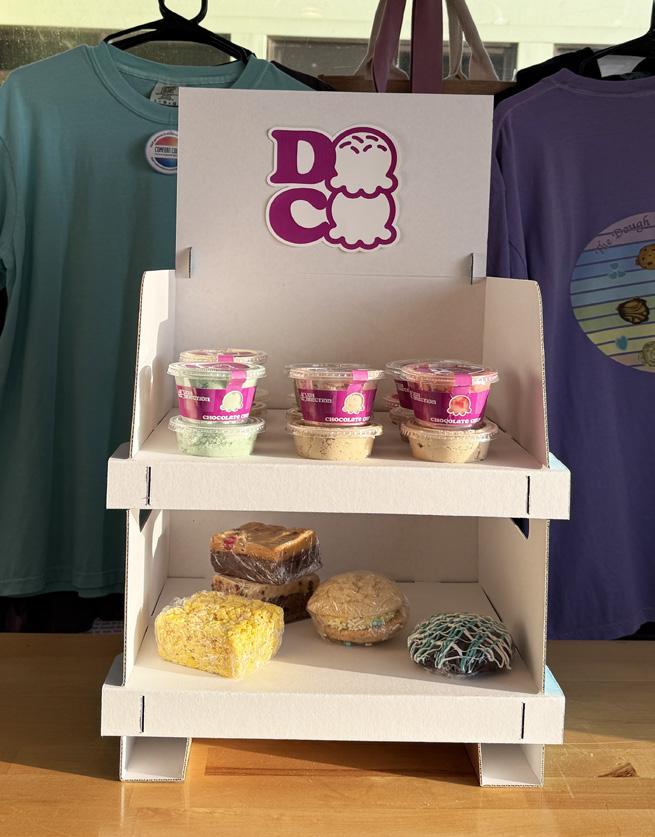
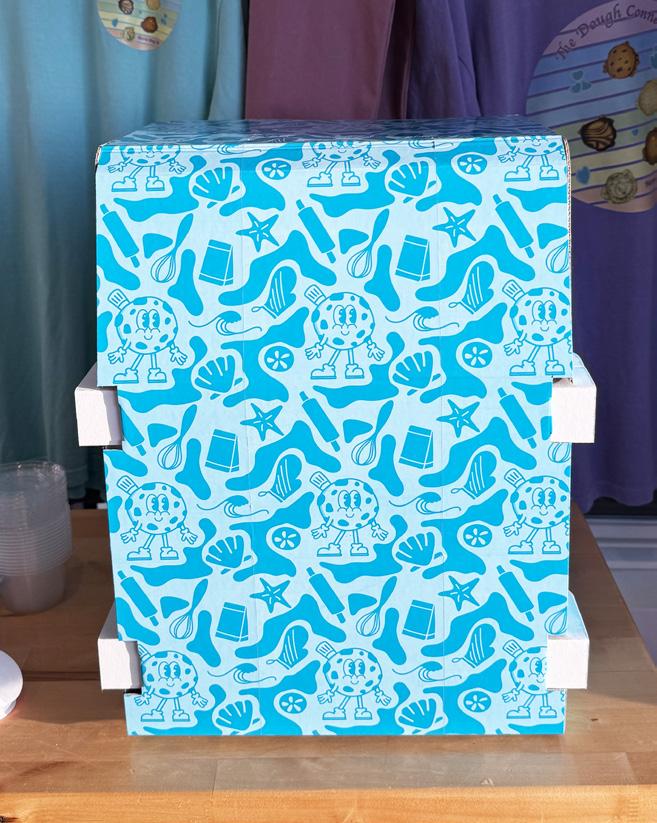
The main goal of changing the packaging was to create options that incorporate branding and sustainability, while keeping the client’s budget in mind. We also wanted to incorporate some sort of display for the farmers’ market, as our client regularly attends the farmers’ market to sell products and gain exposure. Because a portion of new customers comes from attention at the farmers’ market, we thought it would be effective to create a display that shows graphics and products, instead of the plastic storage containers that are currently used.
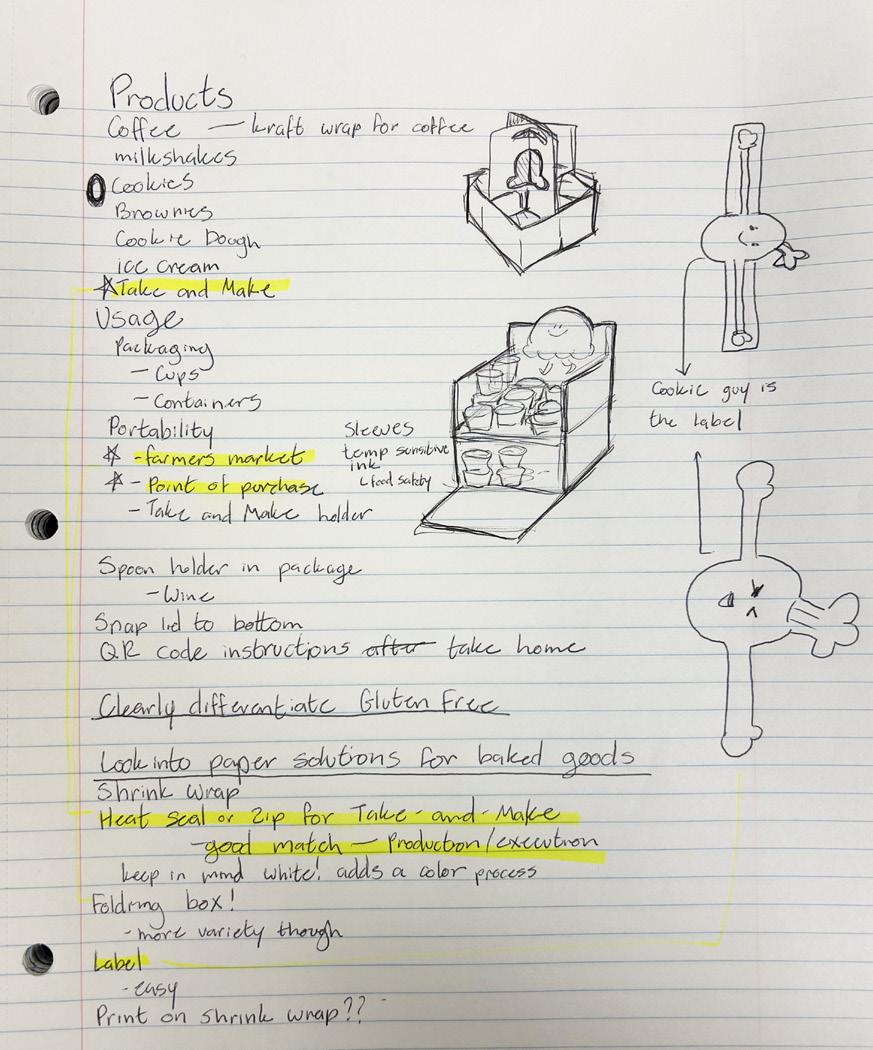
Brainstorming
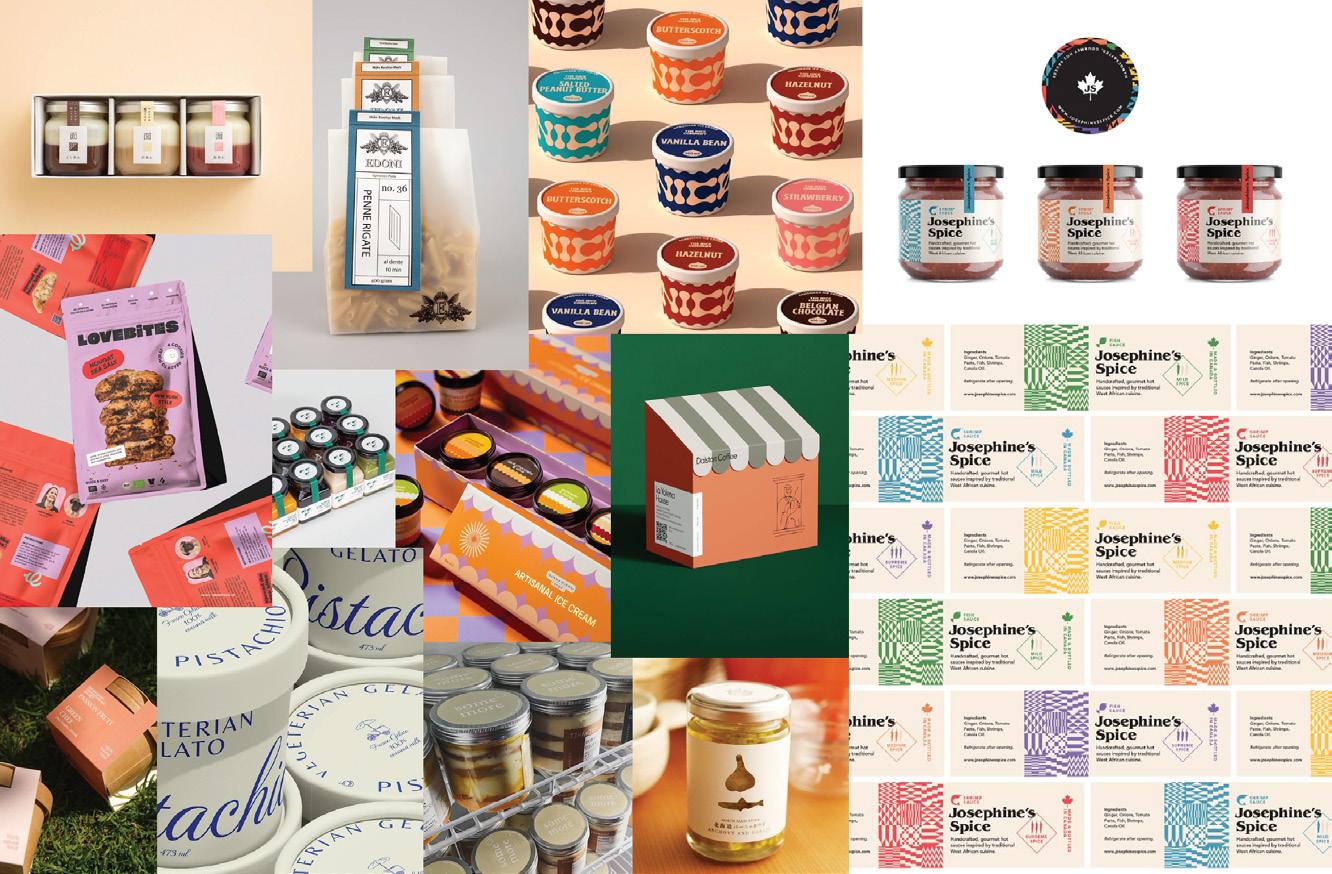
Our initial brainstorm focused on label ideas and packaging for to-go options. We used inspiration to make the labels incorporated in the containers, instead of the sticker previously used by the client. From the samples of other brands we researched, we knew we wanted to create a label for the to-go containers, whether it be a wrap-around paperboard label with graphics and information, or just a pressure-sensitive label that wrapped around the container.
We were also inspired by to-go carriers that contained slots for the cookie dough to sit in with a handle for easy transport. This would work well for bigger orders; however, upon asking our client how many containers are usually purchased, the amount was small, usually only one or two containers, making this idea not very practical.
Figure 9 Brainstorm sketches and product ideation
Figure 10 Product design moodboard
Designing the Sticker Label
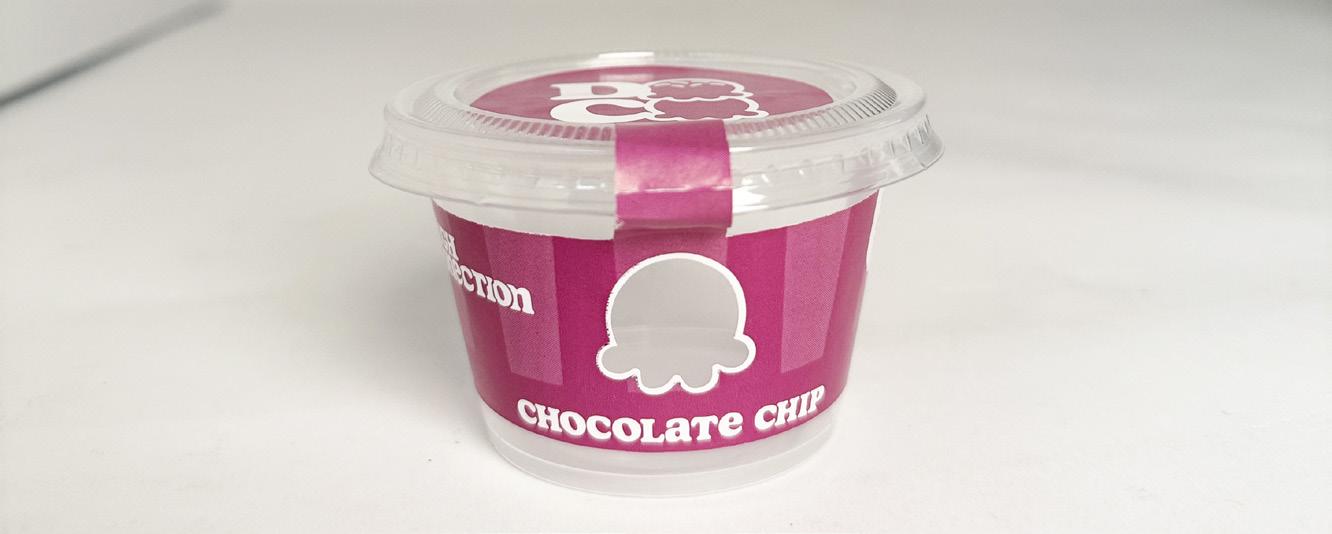
We went through quite a few iterations when designing the sticker label for the 4-oz container of cookie dough. Our dielines were very cohesive with our planned graphics for the label. After observing the client at her store, we noticed that when a customer orders a 4-oz cookie dough and she reaches into the fridge display, she is unable to know what flavor is what. With this issue in mind, we wanted to design a label that would signify what flavor the cookie dough is and have it be visible for the client and her workers to see when someone orders the cookie dough. The client also expressed that she wanted the customer to always be able to see the product and for it not to be completely covered by packaging. We also wanted the label to signify to customers what the product is. For example, right now, if a customer orders multiple cookie doughs to go and takes them home to enjoy later, they are unsure what the flavor is, if the product may contain an allergy, or any information on where they even purchased the product.
We started with two dielines, then after a few iterations, we shifted to focusing on one dieline. The 4-oz container that this label will be applied to is curved with a different diameter on the top and the bottom. This caused our dieline to need to be adjusted to fit this curve, as well as to fit the graphics to this curve. We included a cutout of the cookie dough logo shape in order to make sure that the product is still visible to the customer. Additionally, we included a perforated tab to make opening the container easier for the consumer. We went through quite a few iterations to make sure that the label would fit perfectly onto the curve.
Designing the Display
We decided to make a display point of sales for our client to use at the farmer market in order to incorporate branding into the booth. According to the survey we conducted, 36.8% of customers found The Dough Connection through the farmers’ market. With over a third of clients from just exposure through the market, it was a perfect opportunity to create a display that showcased the brand and products. There was no original display used by the client; however, she currently uses a clear box for transport and takes the dough containers out when at the market. This container allows for easy transportation and is able to hold a large amount of product. Once at the farmers’ market, the dough is set directly on the table with a label placed in the front.
The first renditions of the display contained a two-tier box with an open front. After cutting out and analyzing, we decided it would be interesting if we made a flap that went over the front opening of the display and tucked into the bottom. This closed feature would allow for the cookie dough to be transported similarly to how it was previously, and upon arrival at the farmers’ market, the flap could be lifted and tucked into the back of
Figure 11 Checking the quality of the printed sticker label
Figure 12 Plates mounted to cylinders after the press run
the display. We added handles to the side for easy carry, and the location of these handles is directly under the first display panel, which makes it easier to carry since the material will not dig into the fingers. As the renditions continued, small tweaks on the size and flap overhead were made to make a display that was sturdy and realistic for use. We also tried a couple of variations to make the display more user-friendly for the client. This included adding a flap on the back that could be opened for easy restocking of the dough while in use. Upon discussing this feature with the client, we deemed it not as important because the display can be used to show products, but stock can be grabbed from a storage container/cooler when a customer purchases a dough.
Some additional features on the display are the tabs that allow for the overhead flap to tuck into the back, as well as the two display story panels. The tabs were added to make sure that the flap was secure when closed; however, we needed the flap to also tuck into the back in a way that was not annoying for the client when using it. The first set of tabs is different from the others in order to lock the back into place and secure the top panel for display when open. The two layers for product placement are different: one is solid, and the layer has holes to hold the cups of dough. When we met with the client after initial renditions, she expressed the convenience of having a flat bottom shelf in the display to show a few products, but not many, or to show baked cookies. She said that in the summertime time it is convenient to only have a couple of flavors out on display and grab dough from coolers instead. We made this adjustment to allow more flexibility with what is put on display, rather than strictly for cookie dough.
Challenges for the display were ones that involved slight tweaks in measurements in order to make sure everything was snug. Tabs were added to the shelves in the back as well as the sides on the top to add stability in case cookie dough was stacked on top of each other. The overhead flap to close the display was a constant adjustment to make sure it was just the right size to go over the whole display. When this was adjusted, all the inserts on the back side that allowed for the flaps to be inserted also had to be moved. We also had to tweak the height of the insert holes so some of them are more snug and others have a little more wiggle room to make assembly easier.
Designing the Bag
When redesigning the bag, we went through a couple of iterations. The first iteration of the bag was trying to make it a fully transparent plastic bag that allowed the consumer to view the product at all times. This would, however, cost more to do for our client when it came to production. In order to get the colors we needed, we would have to do a double pass of white on the press to ensure the colors printed like we wanted. This would increase the cost of the ink and amount of plates that we would need for the press, making it more costly for the consumer in the end.
With the challenges that would come with a plastic bag, our team transitioned to the idea of a paper bag with a cut-out window. This would be the same principle of the bag she currently uses, but now tailoring the design and the window to the client’s brand. The cutout would now be in the shape of the client’s new logo, giving a bit more personality to her brand.
Figure 13 Assembling the display prototype
However, we still had issues with how big the bag can be. We had to constantly change the size of the final bag due to a maximum press width of six and a half inches and a repeat length of fourteen inches. We would ideally have fit this all on one plate, but because of the repeat length, this wasn’t possible. At first, we shrunk the designs of the front and back to fit on one fourteen-inch press run, but this made the bag smaller than the client wanted. We ended up separating the front and back onto different plates to accommodate the size of the bag our client wanted.
Figure 14 The press run of the front of the “No Bake: Take and Make” bags
Design Design Trends Research
Before opening any Adobe Software, our team started by conducting research on what the current design trends are, as well as what’s already working in the industry. In an article by Packaging World, they point out that in a world with so much uncertainty, people are craving joy. This can be translated into design by using bright colors and unconventional patterns. We also found that a bold and minimal style can create trust in a brand. Neo-vintage is another style that we found in our research that is still on the rise, as people crave a vintage feel with a new twist.
Moodboards
In a meeting with our client, we learned that they wanted their brand to feel nostalgic, whimsical, and classic with a twist. From this research and guidance from the client, three mood boards were created to present to the client. The first board is very nostalgic and focuses on some retro designs and inspiration. If we went in this direction, we would possibly use a simple yet effective font, incorporate stripes or checkers, and possibly a fun character. The overall feel is comforting and familiar, with a hint of modernity. The second board has a whimsical theme that is meant to feel fun, creative, and playful. The shapes are very organic and unconventional while incorporating handmade (almost doughy) typography. It evokes a sense of imagination and joy, giving the brand a unique and lively personality to match the product. The last mood board focuses on classic with a twist, specifically creating an elegant and timeless appeal. These fonts would be a bit more sophisticated while keeping a bit of character, and the art might be more dynamic while still having a handcrafted feel. Of the boards we created, our client was most drawn to the first, so we decided to take our designs in that direction moving forward.
Finalizing Colors
One of the biggest challenges we faced through the design process was choosing the colors used. Our client was adamant about keeping their original colors to match their store interior, which were a bright blue and purple. We began our research through color checkers in order to ensure proper contrast for accessibility. From our research, we found that the purple we chose, which was Pantone 248, was the most accessible for text with a white background, so we tried to keep this consistent throughout. Occasionally, we used the blue color, Pantone 320, with text, but made sure to make the text very bold and large. Accessibility was kept at the forefront of our minds throughout the creation of each packaging design, and we worked with our colors, which were established by The Dough Connection.
Figures 15 Board 1: Nostalgic (top), Board 2: Whimsical (middle), and Board 3: Classic with a twist (bottom)
Previous Branding
The previous branding used by The Dough Connection features a cyan scoop background with a cursive font and a cookie with a bite out of it. The company also has a second logo used in different places for advertising, which can cause confusion for its customers. There were a few problems we had with these logos. First, they’re not very scalable. If the logo is too small, the font will become unreadable, which can be a problem depending on what you want your logo to be printed on. We were also worried about the colors used in the logo. When tested for contrast levels, this logo proved to be very inaccessible. Accessibility was our main concern with the previous logo, so we made sure to keep our design accessible with the iterations that followed.
Logo Design
When talking to the client about what they wanted to see in a logo, we learned that they had been consistently changing their logo about once a year. Since the brand is quite small, this can be harmful to establishing a brand identity, so we wanted to make sure we created a logo that the client would love long-term. We started with sketching our ideas, and narrowed our options down to about five that we brought to Adobe Illustrator.
From there it was a process of getting edits from the team, industry professionals, and the client before we were able to settle on a font. We decided on using Soap Regular as our primary font, since it had plenty of character
Figure 16 The Dough Connection’s previous branding on their business card
with a mix of rounded uppercase and lowercase letters. To give the logo a sense of individuality, we tightened the tracking and offset the path to allow for some breathing room between the letters which helped the readability. We also chose to include two cookie dough scoops that are connected together in the logo, reflecting back to the actual name of the company: The Dough Connection.
Designing the Bag
When designing graphics for the bag, the client wanted to make sure that there was a clear element, allowing the customer to see the product they were purchasing. In order to incorporate this clear element and still add to the design, we made the cutout the bottom scoop of dough in the logo we created. We started with about 20 different iterations of what the bag could look like, before narrowing it down to just one that our team wanted to move forward with.
From there, we played around with the hierarchy of the text. We wanted to make sure the actual description of the product was the largest, showing what the brand is selling, followed by the flavor of the dough. Certain elements of the text were kept purple while the main bag is blue, following
Figure 17 Branding Guide
what was mentioned earlier about accessibility. We also created a series of designs relating to Morro Bay and baking, which were added to the back of the bag below its ingredients and instructions, which we made sure aligned with FDA regulations.
Designing the Sticker Label
We had three main goals for the sticker label. First, to create a design that is visually appealing and adheres to our design guidelines. Next, to create a seal for customers to feel their product is sanitary and safe. Lastly, the label needed to hold product information and clear identification. Our client emphasized that she needs to be able to see the label of the type of cookie dough when they are stacked on the display. We ensured that our design would accommodate her needs.
Again, we made sure to prioritize what the product was and the flavor, and included another cutout section that shows the dough within the container, similar to the design of the bag. We also stayed consistent with the stripes found on the bag, but changed the primary color to purple. We also added a curve to the design of the label itself, so that it can perfectly curve around the containers that The Dough Connection already sells, while giving it the illusion of being straight once applied. To open the container, the seal between the lid and container can be easily broken, but it keeps the product shut.
Figure 18 Final design of the “No Bake: Take & Make” bag
Designing the Display
To create a repeating pattern for the display, we began by creating icons that would relate to the mission of our company. This includes a combination of baking designs: a whisk, spoon, etc., and designs that would be associated with the coast of Morro Bay: a wave, shells, etc. By using these designs in a repeated pattern, we hoped to increase cohesiveness and brand recognition, as well as create a dynamic design. The display is a perfect combination of the other two packaging designs since they incorporate similar iconography and combine the two colors.
Figure 19 Final sticker label design
Figure 20 Front of display (left) and back of display (right)
Design Consultations
Throughout the whole design process, we made sure to prioritize what our client wanted. It was very important to us that the designs were not just something we liked, but also something the client loved. April was very helpful throughout the design process and made sure to tell us what was working and what might need to be modified. Most of her comments came in the logo design process, and when it came to the rest of the elements, she trusted our vision with only minor adjustments.
We also met periodically with design professionals. Lorraine Donnegan has an incredible eye for design and played a pivotal role in helping our team when it came to the smallest of details. She helped us clarify the logo and gave advice on what should be presented to the client. Lorraine also gave advice through the creation of each packaging element, pointing out small details that needed to be changed and suggesting aspects that might need to be added. Dina Vees also helped us in narrowing down what was working and what wasn’t, especially in the logo making process. These design professionals helped us to make three cohesive designs and beautiful branding.
Execution Substrates
When selecting substrates for our solutions, we focused on materials that offered the best balance of functionality and sustainability. We used Fasson® Dairy Print FSC, Fasson® 3 Mil Matte White Synthetic and Fasson® RapidRoll® White Stand Up Pouch 360 HB. The three substrates were supplied by Avery Dennison.
For our client’s 4oz cups, we wanted to use a paper stock that had a gloss coating, a good tear strength and good adherence under conditions such as those found in a refrigeration setting. We wanted to have a gloss coating in order to give the label some sort of moisture resistance because the client’s 4oz dough cups are refrigerated and would be faced with moisture and lower temperatures. The adherence of the label was also a factor because of the storing conditions. The paper we had ordered, Fasson® Dairy Print FSC, is made for labels like ones on a milk gallon or other
products in the fridge. It’s a rubber based adhesive that is FDA certified and safe for incidental contact between food. The paper is also FSC certified, ensuring that it is coming from sustainable practices.
Our stand up pouch solution needed to have a couple of requirements. The first of which was that it needed a polymer coating that was food safe and that had good sealing properties. We originally wanted to explore an all paper based option, but non-polymer coatings have problems when it comes to sealability. The other requirement, made by the client, was that there was a window to display the product inside. Pouches with windows are not as sustainable as the ones without due to the plastic component that acts as the window. In the end, we used the Fasson® Rapid-Roll® White Stand Up Pouch 360 HB substrate to achieve the requirements for the stand up pouch. This material is a three layer composition of PET, 3m White Ethylene-Vinyl Alcohol Copolymer (EVOH) and Metallocene Linear Low Density Polyethylene (mLLDPE). The Linear Low-Density Polyethylene (LLDPE) is the layer that acts as the sealant. When it comes into contact with another LLDPE layer, heat allows for the two layers to melt and form a bond, creating the seal. The EVOH layer provides good oxygen barrier properties as well, keeping the “No Bake: Take and Make” product last longer.
For the display, we couldn’t print directly on the corrugated material the structure of the display is made of and had to think of a solution. In choosing substrates for the graphics on the display, we wanted to select a substrate that would be resistant to weather factors like humidity, moisture and factors like scratches. In the end, the selected substrate was Fasson® 3 Mil Matte White Synthetic, which is an opaque matte paper like material made of polypropylene. The 3 Mil Matte White Synthetic paper offers moisture resistance and a long outdoor life cycle. These characteristics were crucial in selecting a substrate for the display because our client would be using the display in farmer’s markets in San Luis Obispo county which would require a lot of movement and outside weathering.
Sustainability & Food Safety
Sustainability was an interest from the team when working with the client. However, our client wanted to continue to use their 4-oz plastic cups
that were made out of both PP and PET. This posed a problem as plastic isn’t necessarily sustainable but after consulting recycling expert, Mike Di Milo, the plastic containers that our client uses are recyclable as they are made of commonly recyclable plastics and are not laminated together. Problems would arise only if the plastics were laminated together, but in our case, they are two separate pieces that can individually be recycled.
There was also concern about creating the “No Bake: Take and Make” bag. We ended up designing the bag to be a paper-based material with a couple of layers of polymers to ensure barrier properties and sealability. While the polymer linings could be recycled individually, because it’s formed in a pouch, it isn’t as easily and widely recyclable. Di Milo states that “pouches of any type are not recyclable,” but mentions that his definition of not recyclable is that it’s not economically sustainable for a city recycling program to accept them. There are companies that can recycle pouches like this, but it can be expensive to do so.
For our corrugated display, concerns arose with the vinyl material that we had used to print on and adhere to the display. After consulting Di Milo, he stated that because the vinyl is such a small percentage of the actual system that it would not deter recyclers from capturing and recycling the package system. Corrugated board is also highly recyclable and often made of recycled materials.
Inks
This year we decided to mix our own inks because we had a few of the ink colors already in our department and wanted to get hands-on experience mixing inks. The inks we ordered for this competition were provided by the Inx Company. The colors our client wanted to keep in their brand were Pantone color 320 and Pantone color 248. According to the PMS book, Pantone 320 is a mixture of fifty percent Process Cyan and fifty percent Pantone Green. Pantone 248, on the other hand, is a mixture of nine parts Purple, seven parts Rhodamine Red, and one part Black. We measured both of these inks by using a scale and mixed five pounds of each color, with their respective ratios, so we had enough for our press runs.
While ordering inks, Eli Portugal, a lab manager at Inx Company, notified us of a couple of potential problems with the inks we were ordering, specifically Rhodamine Red and Purple. We were notified that while heat sealing the stand up pouch, our inks could face problems and change color or mess with the design. To combat this, a white border was placed around our sealed edges so that we wouldn’t be directly heat sealing on the printed areas. There was a warning of fading from being in the sun too long. While this may be a concern for the display, which is used for farmers markets outside and in the daytime, it was warned that this would only happen to applications that are constantly in direct sunlight like bumper stickers, building materials and other outdoor labels. Bleed was another issue that our inks would face due to alcohol or grease. These factors don’t necessarily affect our competition, but potentially the client may see these problems arise. Inx had also recommended that we use a varnish to protect our inks from mechanical movements such as folding, die cutting and shipping. This would make scratches less likely so our client can have high quality packaging. However, there was some miscommunication about our press capabilities and our team was not able to do a varnish this year.
Figure 21 Measuring ink viscosity
Press Challenges & Limitations
All printing was done in house at the Graphic Communication Department and on the Mark Andy 2200 flexographic narrow-web press. This came with some limitations like a maximum width of six and a half inches. The width limited the graphics and plates in size and width. To work with our press, the display had to be designed into a repeating pattern so each printed piece could connect with each other for a seamless connection. It also reduced the size of the stand-up bag so that we could have enough material to heat-seal around our design without interfering with the inks.
The age of some of the components of our press contributed to some of the problems we faced in printing as well. In each press run, we saw quite a bit of banding in the designs, most notably on the 4-oz cup labels. Banding typically happens because of issues with the ink delivery or even the gears (Reece, 2014). We worked with our press operator, Nick Cooper, to help solve this problem by wiping down the plate and adjusting pressure, without losing the print we wanted, but nothing had worked. Wiping the plate would solve the issue for a few impressions but banding would recur. Cooper suggested that the age of the press and the way the motors are distributed could impact the banding problems we faced.
Another problem was pinholing throughout each press run. This was prevalent through each press run, but mainly on the Pantone 320 Front Bag plate. The pinholing could be due to a multiple of problems such as ink adhesion to substrate (Luminite, 2019). This defect was really noticeable only in the stand up pouch substrate, which could be a sign that it is an ink adhesion problem. The drawdowns we did also showed this issue too but at lower anilox rolls. Luminite also suggests that this could be a problem due to too slow or fast drying times. We could not use the full drying power for the bag because it was a plastic material which the heating system of our press would warp. If we had a non-damaging way of heating the substrate or tested different methods to increase ink adhesion, this problem would be solved.
File Prep
In preparing our files, we followed FIRST guidelines to ensure the printability of our designs. We made sure to follow the minimum type size and
minimum rule width general guidelines specifically for narrow web presses. This is important, especially for our reverse type, which could see filling in due to the process of flexographic printing. While creating our designs, these guidelines were already in mind so that we didn’t have to change sizes and have problems later on. Since our design had no colors next to or overlapping, we didn’t have to do any trapping as well.
Due to our Mark Andy not having custom dies for die cutting, we also utilized eye marks to allow us to cut each individual piece on the Zünd table in our department. The FIRST 7.0 book recommends the eye marks to be “the darkest color on the job” (Flexographic Technical Association, 2022, pg. 114). Since we were only using two colors for the press, the darkest color was our Pantone 248 color. We also made sure to utilize the full fourteen inch repeat length for our label and display logo by imposing multiple up on each plate. While setting up the files to get plates made, we imposed the 4oz cup labels three-up on one plate to minimize waste of each repeat. For the logo that would be on the display, it was imposed two-up.
This year, our plate maker was down and we were not able to create plates for printing in-house. We used Multi-Color Corporation in San Luis Obispo to outsource and have our plates made. We had seven plates made, which were all mounted by our team on 600 CPI anilox rolls. This proved to give us the best delta E values in performing drawdowns. Each plate, besides the display logo, used the 3M E1015 stickyback tape, which is better for a mixture of solids and tints. These were crucial for each plate besides the display logo because they utilized tints in the designs for icons or stripes. The display logo was the only plate with no tints and utilized the 3M 411 HD stickyback tape. This is perfect for solid colors and doesn’t do well with tints, which is why it’s only utilized for the logo.
Polytechnic State University, San Luis Obispo
Quality Control Report
Print & Production Specifications
Figure 22 Color management report for front of bag, back of bag, vinyl, and sticker label
Figure 23 Substrate, anilox, plate, and ink specifications
24 Press specifications
Teamwork & Leadership
For the 2024–2025 Phoenix Challenge team, we restructured our team to accommodate for co-team leads. This meant the removal of the Research Lead position, whose work was spread through all the members. We also incorporated team shadows and design assistants, providing more opportunities to students to be able to learn more about flexographic printing and to gain hands-on experience with working with a real client.
We met twice a week, three hours total, with team members meeting additionally as needed. With a bigger team, we met twice a week, once at the beginning of the week and once at the end of the week, to align with everyone’s schedules and availability. All files relating to the team were kept in a shared team Google Drive folder as well as subfolders for each of the teams.
As Cal Poly follows a quarter schedule, a quarterly timeline was made for each position to help hit targeted goals for the week.
The main method of communication for the team was Slack, and the main method of communication with the client was over text and email. The team was also able to meet with the client in person several times to get direct feedback on physical prototypes and design choices.
Figure
Acknowledgments
The 2025 Phoenix Challenge team would like to extend our appreciation to the following faculty members, industry professionals, and sponsors. We are extremely thankful for all of their continuous support and shared expertise throughout this process.
GrC Department Faculty
Dina Vees
Nick Cooper
Lorraine Donnegan
Colleen Twomey
Sharon Eucce
Industry Support
April Bodine
Avery Dennison (substrate)
Mark Andy (flexo press)
3M (sticky tape)
Harper Corporation (anilox rolls)
INX (inks)
MCC Label (plates)
FLXON Inc (doctor blades)
Zünd (digital cutting machine for prototyping)
Citations
Barry Callebaut. (n.d.). Top trend watch: Cookies crazed. Retrieved March 6, 2025, from https://www.barry-callebaut.com/en-US/trends-insights/ top-trend-watch-cookies-cookies-crazed
Census Reporter. (2023). San Luis Obispo County, CA profile. Retrieved March 6, 2025, from https://censusreporter.org/ profiles/05000US06079-san-luis-obispo-county-ca/
Flexographic Technical Association. (2022). First 7.0.
Global Market Insights. (2024). Cookie dough market size & share, statistics report 2024-2032. Retrieved from https://www.gminsights.com/industry-analysis/ cookie-dough-market
Let’s Chat Snacks. (n.d.). Batter up: Baking profits into healthy cookies as a Millennial snack. Retrieved March 6, 2025, from https://www.letschatsnacks. com/batter-up-baking-profits-into-healthy-cookies-as-a-millennial-snack
Luminite. (2019). Flexographic Printing Defects: Pinholing Causes and Solutions. Luminite.com, from https://blog.luminite.com/blog/ flexographic-printing-defects-pinholing
Market Data Forecast. (2024, June). Cookies market size, share, trends and growth report, 2033. Retrieved from https://www.marketdataforecast.com/ market-reports/cookies-market
OpenPR. (2024). Cookie dough market size insights 2031 by key vendors. Retrieved from https://www.openpr.com/news/3802572/ cookie-dough-market-size-insights-2031-by-key-vendors
California Polytechnic State University, San Luis Obispo
Public Policy Institute of California. (n.d.). California’s population. Retrieved March 6, 2025, from https://www.ppic.org/publication/californias-population
Reece, T. (2014, September 25). Bounce, Gear-marks, & Banding – Part 1 - All Printing Resources. All Printing Resources, from https://www.teamflexo.com/articles/ bounce-gear-marks-banding-part-1/
Research and Markets. (n.d.). Cookie dough market report. Retrieved March 6, 2025, from https://www.researchandmarkets.com/report/cookie-dough
Spoon University. (n.d.). The phenomenon of the sweet little treat. Retrieved March 6, 2025, from https://spoonuniversity.com/lifestyle/ the-phenomenon-of-the-sweet-little-treat
The Hershey Company. (n.d.). Three ways to feed Gen Z and Millennials’ dessert obsession. Retrieved March 6, 2025, from https://www.thehersheycompany. com/en_us/home/newsroom/blog three-ways-to-feed-gen-z-and-millennials-dessert-obsession.html
U.S. Census Bureau. (n.d.). Morro Bay city, California profile. Retrieved March 6, 2025, from https://data.census.gov/profile/ Morro_Bay_city,_California?g=160XX00US0649362
U.S. Food and Drug Administration. (2020). Food Labeling Guide. Retrieved from https://www.fda.gov/media/81606/download
U.S. Small Business Administration. (2023). Barcodes and Inventory Management for Small Businesses. Retrievedfrom https://www.sba.gov/ article/2023/mar/22/barcodes-and-inventory-management-small-businesses
World Population Review. (n.d.-a). California population. Retrieved March 6, 2025, from https://worldpopulationreview.com/states/california-population
World Population Review. (n.d.-b). San Luis Obispo, California population. Retrieved March 6, 2025, from https://worldpopulationreview.com/us-cities/ california/san-luis-obispo
Sydney Doyle
About the Author
Sydney Doyle is a Graphic Communication major and Packaging minor at California Polytechnic State University, San Luis Obispo. She was the team lead for the 2024-2025 Phoenix Challenge Team at Cal Poly. Phoenix Challenge is a national flexographic printing competition, where students work with a small local business to rebrand, redesign, and flexographically print new packaging for the business. Being a part of the team has been a great experience and has helped Sydney grow in her interests of project management, print, and packaging. Sydney led her team to win Best Research at the 2025 National Competition with their redesign of The Dough Connection.
RAY Collection:
Forging a New Fashion Genre
olivia cooper
Introduction
For my senior project, I aimed to create a missing genre within the world of fashion. Throughout the quarter, I designed and handmade my fashion concepts, showcased my designs on a runway and branded my fashion collection. The branding section of my project includes a logo, brand identity, social and web mockups and brand photography.
My research indicated that brands should have a central clothing collection reflecting the creator’s vision. This inspired me to focus my collection around myself, the creator, and my vision, which became the core theme: “my artistic roots” (Shukurova, 2018). My collection is a tribute to the female artists who ignited my own creative spark. They are the roots of my artistic journey, and this collection is my homage to the women who fought for their work to be seen, appreciated and celebrated. Artists like Frida Kahlo, Louise Bourgeois and Leonora Carrington inspire me daily, and each piece in this collection draws inspiration from their specific works.
This project goes hand-in-hand with one of the genres explored in my collection: streetwear. As Correia notes, “The role of streetwear is a medium for self-expression and identity construction among Gen Z” (Correia, 2024).
I am using this project to create a missing genre within fashion through self-expression, which is best accompanied by strong branding. The importance of this project to me is immense; I feel I finally have the space and support to create my own fashion line, a dream I’ve had for as long as I can remember. Its relevance to the industry lies in the design and fashion
branding aspects. In the field of graphic communication, brand storytelling is a crucial skill I’ve developed. As Rodrigues states, “Branding and design visually communicate to consumers the story of a brand” (Rodrigues, 2020).
My project provides a real-world application of principles I’ve learned throughout my last four years in the Graphic Communication Department. Designing a logo, brand identity, social media mockups, web mockups, and brand photography allows me to put this knowledge into practice. Strong branding is essential in the fashion industry, and through this project, I am challenging myself to create truly strong and consistent branding.
Literature Review
I explored over ten graphic communication theories and practices and found that diffusion of innovation and identity aligned best with my project. Diffusion of innovation focuses on how new ideas and technologies spread. In graphic communication, we create the visuals that convince society to adopt these new ideas. The three major elements are: explanation, which is the initial presentation of what something is or why it exists; the different adopter categories, which are always something to consider with a new idea, innovation, or even a rebrand; and communication, which involves determining which channels to use and how to market and disseminate the word or visual into the world (Lara et al., n.d.).
Diffusion of innovation applies heavily to current graphic communication industry challenges. Whether you are on the user experience or user interface side, marketing side, or print side, helping your client convince the population to try something new is the name of the game. This is what we do and will always be one of the main industry challenges. In my case, good branding can help others find the business trustworthy, which leads me to identity.
Identity in graphic communication is a combination of logos, colors, typography and other visual elements that come together to communicate a brand’s message. Identity and branding are the core of a strong person, brand, or organization; it is crucial and one of the main components of graphic communication: how to communicate graphically. Through my
research and experience, the three main elements of identity are: visual output (logos, typography, colors, etc.), consistency in the use of those visual outputs, and the message (Correia, 2024).
Synthesis/Thesis
This senior project leverages the principles of diffusion of innovation and identity in graphic communication to establish a new fashion genre. Through strong, compelling branding, the project seeks to cultivate consumer trust and intrigue, driving the adoption of this innovative style within the fashion industry (Taylor, 2012).
Results
My completed project, in short, is a fashion collection, but the quantity and quality of components involved are quite vast. To provide an overview of what went into this quarter-long senior project: I designed, sewed, and self-funded a fashion collection, featuring four main collection outfits and approximately 11 pieces in total. I learned to 3D print pieces for this collection. In the process, I learned how to mold with clay and foil, hand-scanning every accessory by taking 300–500 photographs. I then learned the software PolyCam to digitize my physical molds for 3D printing. Lastly, I sanded and glued all the necessary elements together.
At the start of my senior project, I joined and became involved with the Fits, Innovations, Trendsetting, and Styling (FITS) club on campus. I applied to have my pieces selected for presentation on the annual SFC x FITS Fashion Show runway. After my selection, I found models willing to showcase my pieces at the fashion show and practiced my management and direction skills, teaching them how to follow my vision. My vision for the fashion show and collection was curated down to the exact lighting and audio. These elements aided my branding process; by having a theme song for my collection, I was able to refine its branding even further, down to the exact mood.
I fully branded the collection by creating a logo, color scheme, and identity, as well as mocking up a website and social media pages. I completed the branding with a dedicated brand photo shoot. To conclude, I knew I
wanted vibrant deliverables, so at the quarterly graphic communication senior showcase, I presented a project slide deck detailing the development process of my project, my artistic process book containing everything from mood boards and sketches to fabric sampling and model measurements, and lastly, a curated book from the brand photo shoot.
Analysis Methods
My main research component for this project involved critiques, where I gathered diverse perspectives ranging from fellow graphic communication students to professional graphic designers and fashion marketing experts. Another component of my process was finding a 3D printing mentor, as
Figure 1 Brand photo shoot
I had no prior experience. My mentor, Joshua Gottschalk, who is on the board of Endeavors to Move People Onward with Engineered Results (EMPOWER) and a TECHE lab tech, taught me everything from molding to scanning to actual printing. In total, I spent approximately 15 hours working with my mentor.
Critiques
feedback 1 from a peer
Name: Amelia Petroff
Date and time: 05/05/25
Area of expertise: GrC Student - UX/UI
Summary of feedback from Amelia:
• Needs to have some more variety in different branding ideas in order to not limit yourself
• I think artboard 2 has the most potential on your logo Adobe Illustrator file
• I would suggest the subtext to the logo be a sans serif
• I like the blue, black, and neutrals theme out of all of your color options
feedback 2 from a peer
Name: Malia McCaig
Date and time: 05/12/25
Area of expertise: GrC Student - DRT
Summary of feedback from Malia:
• I prefer the 1st artboard on your logo file
• I was thinking you could explore more contrast with your colors, not sure if the browns make sense with the blues and blacks
• An idea for your socials is to keep the editorial look you had going in you posts 1,3,4,5, and 8, no filler
feedback 3 from an expert
Name: Tamee McBee
Date and time: 05/25/25
Area of expertise: Professional Graphic Designer
Summary of feedback from Tamee:
• I prefer artboard 2, I think the logo and brand identity is the strongest, and less curvature in your logo and it will be on the right path
• Blue and black color scheme feels the best for your fashion line’s branding
• Consider names beyond “Ray”
feedback 4 from an expert
Name: Caroline Lakshmina
Date and time: 05/26/25
Area of expertise: Fashion Marketing Consultant
Summary of feedback from Caroline:
• Artboard 2 logo is the strongest, I like the filling logo rather than the outlined
• I like the color option 3
• (Will give a second critique after photoshoot on 05/26/25)
Conclusion
To conclude, this project was a huge undertaking. I started with no experience and took on many components, but through the talented people in my community—from lab techs and fashion marketing experts to local
Figure 2 Branding Sheet
fashion clubs I had never known about—I was able to learn so much in just 10 weeks. This knowledge will take me far in the industry, and I am incredibly proud of my collection and all I was able to achieve. I believe that learning to design in a new medium and implementing the skills I gained through graphic communication into the same project will set me apart in the industry. Through this journey, I have accepted a fashion marketing director role for a fashion tech startup, and I think my passion for fashion, combined with the skills learned in graphic communication, will define my career path.
Reflection & Limitations
To reflect on this project, I faced countless challenges, and the beauty of it was in adapting, overcoming, and persevering each time. This project not only made me a stronger-willed person but also more adaptable. Just to name a few of the challenges I faced: as stated, I had never sewn clothing before, so you can imagine going from zero to couture was a dramatic shift with many failed pieces in the process and numerous late nights spent in confusion and frustration. The reward? I now know how to sew! I faced challenges with 3D printing, including printing parts that didn’t fit together, accidentally supergluing my hand to the pieces, and figuring out how to attach plastic to fabric. I also fell behind in the schedule I had laid out for myself due to my ambitious nature, thinking I could finish a pair of pants in two hours. In reality, the design I sketched had never been done before, meaning there was no existing “recipe,” resulting in more like 10 hours for a single pair of pants.
For future improvements, I would not take on less because this massive workload not only made me a hard worker but also helped me stand out. To continue this collection and make it a public brand, I know this would be just the beginning. However, I envision myself one day having my own clothing brand, and this project will certainly be the inspiration to make that happen. RAY will not be done and left in the dust; it’s just the beginning, and I now have an incredible portfolio piece and new experience under my belt. Due to evolving industry trends, I would definitely broadcast and implement sustainability into the brand, as it is a prevalent part of my vision for the brand, especially since the fashion
show was associated with the Sustainable Fashion Club (SFC) here on Cal Poly’s campus.
Though I had many limitations during this project, such as time, I made the best of it all. During the “high times,” it truly felt like there were no limitations. During the harder times, some of the limitations I faced were funding for higher-quality fabrics and a better sewing machine, a proper studio to create all of these pieces in, rather than just doing it all in my shoebox of a bedroom, and an actual fashion design mentor. Though there were many more limitations, I feel I did even better than I ever thought. Reflecting on this whole project, I am incredibly grateful for the Graphic Communication 462 Senior Project class and Professor Hocheol Yang for supporting students to explore their ideas and create tangible experiences.
Citations
Correia, B. M. D. S. (2024, June 25). Identity expression through streetwear: how gen Z use streetwear as a form of self-expression and identity construction. http://hdl.handle.net/10400.26/52166
Shukurova, N. (2018). Overall Insight into the Streetwear Fashion Business in the Past Decade. In Saimaa University of Applied Sciences & J. Väisänen, Thesis [Thesis]. https://www.theseus.fi/bitstream/handle/10024/156328/ Bachelor%20Thesis.pdf?sequence =1
Yu, G., Akhter, S., Kumar, T., Ortiz, G. G. R., & Saddhono, K. (2022). Innovative application of new media in visual communication design and resistance to innovation. Frontiers in Psychology, 13. https://doi.org/10.3389/ fpsyg.2022.940899
Lara, M., Myers, R., Frick, T., Karabacak Aslan, S., Michaelidou, T., & Department of Instructional Systems Technology, School of Education, Indiana University Bloomington. (n.d.). A design case: creating an enhanced version of the Diffusion simulation game. Department of Instructional Systems Technology, School of Education, Indiana University Bloomington. https://tedfrick.me/siggs/ aect2009/DSG_ProceedingsAECT2009.pdf
Downs, S. (2012). The graphic communication handbook. Routledge.
Rodrigues, S. G. (2020). The role of graphic elements in brand visual identity communication: case studies at Hilarious Digital Agency.
Parshall, H. (2008). The influence of street culture on brand identity in graphic design.
Seo, Y. J., & Ha, J. S. (2007). Analysis of graphic design trends in fashion design. Journal of the Korean Society of Costume, 57(10), 156-168.
TEUNISSEN, E. B. J. (2015). FASHION, GRAPHIC DESIGN & THE BODY. Terra. Taylor, S. (2012). The role of visuals in defining fashion lifestyle brand identity. Fin de Grado, Ryerson University.
California Polytechnic State University, San Luis Obispo 100
MAC AN BHREITHIÚN, B. (2004). Communicating ideology through graphic design: Visual identities in France. Contemporary French Civilization, 28(2), 324-344.
Additional Citations
Kahlo, F. (1946). Wounded Deer [Oil on masonite]. Museo Dolores Olmedo, Mexico City, Mexico.
Bourgeois, L. (1999). Maman [Bronze, stainless steel, and marble]. Tate Modern, London, England.
Carrington, L. (1951). Samhain [Oil on canvas]. National Museum of Women in the Arts, Washington, D.C., United States.
Olivia Cooper
About the Author
Olivia Cooper graduated from Cal Poly in 2025 with a Bachelor of Science in Graphic Communication, concentration in Design Reproduction Technology, and a minor in Media Arts, Society and Technology (MAST). Her mission is to make others feel heard, bring their ideas to life, and send them off to be more successful. She aims to inspire others to reach their full potential by fostering creative solutions and building strong strategies. Her passion for art, coupled with her inherent need for structure, has led her to pursue a career in branding and creative direction.
5
Moonlight Matcha Process Book
adrienne liang
Abstract
As matcha continues to rise in popularity across the United States, there are significant gaps in consumer awareness regarding its health benefits and cultural significance. Moonlight Matcha, a fictitious brand developed for my senior project, seeks to bridge those gaps by educating consumers about the wellness benefits of matcha while featuring a modern, appealing design that resonates with a broad audience. This project has been especially meaningful because it allowed me to explore the full process of building a brand from the ground up—from brand strategy and storytelling to packaging development and user experience (UX) design. It brings together all of the skills I’ve developed through my graphic communication coursework, including marketing, branding, design, and UX. By creating a cohesive brand that informs and engages consumers, I gained deeper insight into what it takes to design a brand that feels authentic and approachable. Additionally, as someone who drinks matcha daily, this project gave me the exciting opportunity to create a brand that reflects both my personal connection to match and my creative vision.
About the Designer
Hi! My name is Adrienne Liang, and I am a visual & UX designer from Sunnyvale, California. I am currently studying graphic communication with a concentration in UX/UI design at California Polytechnic State University, San Luis Obispo.
Creative expression has been a cornerstone of my life for as long as I can remember. From crafting stained glass art to shaping clay sculptures, I’ve always found joy in creating. Over time, I realized my love for design stemmed from its ability to make an impact on others—whether it’s teaching a lesson through art or designing something whimsical to bring a smile to someone’s face. Seeing people interact with my work and respond in positive ways provides me with a deep sense of fulfillment. Entering college, I knew I wanted to pursue a major that would fuel my passion for design.
The graphic communication program at Cal Poly has been the perfect fit, offering hands-on projects, collaboration with talented peers, and countless opportunities for creative growth.
Working on this senior project has been an incredibly rewarding experience. I loved having the opportunity to create something that reflects my personal interests and passions. I hope you enjoy exploring my project as much as I enjoyed bringing it to life!
Problem Statement
Although matcha products have gained immense popularity in the U.S. and on social media over the past few years, many consumers remain unaware of its cultural significance and traditional ways it is prepared. Instead, matcha is often marketed solely for its health benefits and used as an ingredient in trendy recipes, distancing it from its Japanese origins. This lack of cultural context results in uninformed purchasing decisions and a limited understanding of matcha’s value. To address this issue, my project involves creating a fictitious brand called Moonlight Matcha, which educates consumers about both the health benefits and the cultural heritage of matcha while featuring a modern, accessible design. This project involves developing a brand identity, packaging for a matcha powder tin, and an educational e-commerce website that aims to create a more informed and engaging matcha experience for consumers.
Timeline
• Week 1: Defining my problem statement & figuring out project scope
• Week 2: Market research, brainstorming, getting started on brand
• Week 9: Finalize all deliverables and prepare for project showcase
Research
According to an article from Forbes Magazine, matcha has surged in popularity on social media, leading to a global shortage (Zagorodnya, 2024). Although production levels have remained steady, the skyrocketing international demand has raised concerns about supply sustainability (Zagorodnya, 2024). While certain matcha brands such as Marukyu Koyamaen and Ippodo Tea have gone viral online, there remains a lack of consumer awareness regarding the cultural history of matcha, leading customers to make uninformed purchasing decisions (Zagorodnya, 2024). Matcha is available in various grades, with ceremonial grade being the highest quality, traditionally used in Japanese tea ceremonies and enjoyed on its own (Horie et al., 2017).
However, in the United States (U.S.), the beverage is rarely consumed in a way that is reminiscent of its traditional preparation in Japan (Dreher, 2018). Alternately, matcha has been reinvented in the U.S. as a healthy ingredient that can complement various recipes from smoothies to muffins (Dreher, 2018). This consumption of matcha in the U.S. is predominantly health-focused, with marketers and health-food writers constantly highlighting its antioxidant content and health benefits (Dreher, 2018). By framing matcha based on these properties, individuals have gradually erased the cultural context from which matcha originates (Dreher, 2018). As a result, in the U.S., matcha is not always clearly tied to Japan or the traditional ways it is consumed there. Creating a matcha brand that educates consumers on the origin of matcha and the ways it is traditionally prepared can empower them to make informed choices and gain a deeper understanding of the beverage they are consuming.
California Polytechnic State University, San Luis Obispo
Figure 1 Visual Style Guide
#174C46 #9DB347 #EAECD4
2 Homepage
Figure
California Polytechnic State University, San Luis Obispo
Figure 3 Shop page
4 Product page
Figure
California Polytechnic State University, San Luis Obispo
5 Education page
Figure
Reflection
Overall, my senior project was both an enjoyable and highly educational experience. I appreciated the creative freedom allowed in this project, and because I was able to create a brand centered around a topic I genuinely care about, it truly felt like a passion project. At the start, I was admittedly a bit ambitious in estimating how quickly I would be able to complete each task. I underestimated the time required to develop the brand identity and packaging design, which led me to adjust my timeline significantly in later weeks. For example, while I had planned to begin low-fidelity wireframes for the website by week 4, I didn’t actually start them until week 6 because of the time it took to finalize the packaging. Despite this challenge, I was able to pivot and create a new schedule that ensured all deliverables were completed on time.
One adjustment I made during the design process was removing the packaging box I had originally planned to create for the matcha tin. Although this was due to time constraints, I later realized that many matcha brands sell their tins without boxes to reduce material usage and cut production costs. Furthermore, a challenge I faced during the project was the limited opportunity for peer review.
Because much of my timeline was rushed, I didn’t receive any feedback on my project until week 9, when I had most of my final deliverables completed. This limited my ability to make significant revisions, as I only had one week left to implement any changes.
Despite these challenges, I am proud of how my project turned out and I am grateful that I was able to complete everything on time, even if the timeline didn’t go exactly as planned. Throughout this experience, I learned how critical time management is when balancing multiple aspects of a complex project. I also recognized the importance of self-discipline, especially when working independently and managing my own deadlines. Overall, this project gave me a deeper understanding of what it takes to carry a brand from concept to execution, and I am very proud of the final result.
Polytechnic State University, San Luis Obispo
Citations
Dreher, N. (2018). Food from nowhere: complicating cultural food colonialism to understand matcha as superfood. Graduate Journal of Food Studies, 5(01).
Horie, H., Ema, K., & Sumikawa, O. (2017). Chemical components of Matcha and powdered green tea. 日本調理科学会誌, 50(5), 182-188.
Zagorodnya, Z. (2024, December 10). 2024 matcha shortage: What went wrong?. Forbes. https://www.forbes.com/sites/sap/2024/12/10/202 4-matcha-crisis-what-went-wrong/#:~:text=Currentl y%2C%20there%20is%20a%20 shortage,the%20ability %20to%20replenish%20them.
Adrienne Liang
About the Author
Adrienne Liang is a visual and product designer from Sunnyvale, California She graduated in 2025 from California Polytechnic State University, San Luis Obispo with a degree in Graphic Communication and a concentration in UX/UI. She currently works as a product designer at Amplify Education, where she helps create meaningful products for students and teachers. Outside of work, she is an avid matcha enthusiast and created Moonlight Matcha as a passion project during her senior year.
Saksham:
Designing Inclusive Educational Tools for Children with Learning Disabilities in India
jasmine sayed
Introduction
In India, over 8% of children live with learning disabilities such as dyslexia, ADHD and autism, yet the educational system remains largely unequipped to accommodate their unique learning needs (Narayan, 2020). My cousin Bilal, who has all three conditions, was forced to abandon formal education and pursue a career in cricket due to a lack of educational support. Inspired by his experience and broader systemic gaps, I developed Saksham, an inclusive educational app prototype designed to support neurodivergent children in India. Rooted in the belief that inclusive design can foster social equity, this project merges user experience (UX) design, educational psychology and accessibility research. Saksham seeks to demonstrate how culturally contextualized digital tools can empower children with learning differences and expand opportunities in underserved regions.
Literature Review
Current research highlights a variety of intersecting factors that exclude children with learning disabilities from India’s mainstream education system. Cultural stigma often leads to denial, delayed diagnosis or concealment of children’s learning differences (Kalyanpur, 2008; Sharma et al., 2018). As a result, students with disabilities are frequently excluded from traditional classroom learning, either by omission or by design. While India’s Rights of Persons with Disabilities Act (2016) mandates inclusive education, implementation remains inconsistent, particularly in rural and economically disadvantaged areas (Rao & Karanth, 2017). The integration of digital tools
into the classroom has shown promise, as technology-based interventions can significantly improve student engagement, self-confidence and cognitive outcomes among neurodivergent children (Al-Azawei et al., 2017; Alnahdi, 2020). Inclusive UX design principles, such as multiple means of engagement, flexible content delivery and customizable user interfaces, have been especially effective for children with conditions like autism and ADHD (Rose & Dalton, 2009; Burgstahler, 2015). These findings directly informed Saksham’s design strategy, which emphasizes accessibility, simplicity and personalization in the user interface and learning flow.
Synthesis/Thesis
By integrating principles from human-centered design, assistive education technology and inclusive policy frameworks, Saksham illustrates how UX solutions can bridge systemic educational gaps. The app offers a replicable model for non-governmental organizations (NGOs), EdTech startups, and public institutions seeking to implement accessible learning tools in India and similar contexts. Rather than adapting one-size-fits-all content, Saksham tailors its experience to the user, serving as both an educational companion and a platform for empowerment.
Results
Saksham is a mobile learning application designed specifically for children with cognitive learning disabilities in India. Its features were guided by best practices in inclusive design and informed by both academic research and personal experience. The app offers personalized learning paths that allow students to either select or be guided toward activities based on their dominant learning style, such as visual, auditory or kinesthetic learning (CAST, 2018). It incorporates both text-to-speech and speech-to-text capabilities to assist learners with dyslexia or expressive and receptive language difficulties (Shahid et al., 2015). The app also uses gamification strategies to deliver positive reinforcement and maintain attention for children with ADHD, which research has shown to be particularly effective in increasing task persistence and working memory (Dovis et al., 2015). To enhance collaboration, the app provides parent and educator dashboards that enable behavior tracking, adaptive content planning, and performance visualization. Recognizing India’s linguistic
diversity, Saksham features a multilingual interface that supports Hindi, English, and regional dialects to maximize its reach and usability.
The app was prototyped using Figma, with design decisions rooted in research and inclusive design standards, including the Web Content Accessibility Guidelines (WCAG 2.1) for cognitive accessibility (W3C, 2018). Due to limitations in conducting fieldwork in India, direct testing with neurodivergent children was not possible. However, qualitative insights from informal interviews with parents of children with learning disabilities helped identify core user pain points, such as sensory overload, rigid lesson formats and the lack of parental involvement in existing learning platforms. These insights, along with academic literature, directly informed features such as adjustable color contrast, icon-based navigation, large touch zones, and simplified user interface (UI) components.
Conclusion
Saksham bridges educational gaps for Indian children with learning disabilities by reimagining how mobile UX design can foster inclusion and access. It presents a scalable and adaptable framework for inclusive education, with the potential to be implemented in both public and private learning contexts. This project demonstrates that thoughtful, culturally relevant UX design can have a transformative impact in the lives of underserved populations. It also reinforces my belief in the role of empathy-led, research-informed design as a driver of social change. As I move forward into graduate studies and future UX design roles, I aim to build on this foundation to design tools that are not only functional but also inclusive and humane.
Reflection and Limitations
The development of Saksham was not without its limitations. Most notably, direct user testing with the target demographic was not feasible due to geographic and logistical constraints. The app’s design was guided by secondary research and anecdotal data, which, while valuable, cannot replace the depth of feedback that would come from first-hand interaction with users. Another challenge was balancing personal motivation with research objectivity. While my cousin’s experience was a strong emotional
driver, I made a deliberate effort to ground the project in universal design principles and verified data. Additionally, limitations in time and technical resources meant that the prototype remained in the design phase without a fully functioning development component or backend infrastructure. Future iterations of the project could benefit from partnerships with schools in India or NGOs focused on learning disability advocacy to enable field testing and iterative design based on user feedback. Offline functionality is another key area for improvement, especially considering India’s rural internet infrastructure. Furthermore, integrating adaptive AI to adjust the learning path based on user behavior could increase personalization and learning outcomes.
As India’s EdTech landscape continues to evolve, especially in light of national initiatives like Digital India and Accessible India, projects like Saksham are well-positioned to make a real impact (Mehta, 2021). This project is not just a prototype; it is a step toward making education truly accessible to all.
scan to view the final saksham prototype
Citations
Al-Azawei, A., Serenelli, F., & Lundqvist, K. (2017). Universal design for learning (UDL): A content analysis of peer-reviewed journal papers from 2012 to 2015. Journal of the Scholarship of Teaching and Learning, 17(3), 56–72. https://doi. org/10.14434/josotl.v17i3.22110
Alnahdi, G. H. (2020). Assistive technology in special education and the universal design for learning. The Turkish Online Journal of Educational Technology, 19(2), 67–77.
Burgstahler, S. (2015). Universal design in higher education: From principles to practice. Harvard Education Press.
CAST. (2018). Universal design for learning guidelines version 2.2. http://udlguidelines.cast.org
Dovis, S., Van der Oord, S., Wiers, R. W., & Prins, P. J. M. (2015). Can motivation normalize working memory and task persistence in children with ADHD? The effects of money and computer-gaming. Journal of Abnormal Child Psychology, 43(2), 297–306. https://doi.org/10.1007/s10802-014-9904-8
Kalyanpur, M. (2008). Equality, quality and quantity: Challenges in inclusive education policy and service provision in India. International Journal of Inclusive Education, 12(3), 243–262. https://doi.org/10.1080/13603110601146362
Mehta, A. (2021). The growth of India’s EdTech sector in the post-COVID era. Journal of Educational Technology Development and Exchange, 14(1), 1–10.
Narayan, J. (2020). Disability in India: A critique of policy and practice. International Journal of Disability, Development and Education, 67(3), 257–274. https://doi.org/10.1080/1034912X.2018.1484052
Rao, S., & Karanth, P. (2017). Inclusive education in India: Prospects and challenges. Disability, CBR & Inclusive Development, 28(1), 54–70. https://doi. org/10.5463/dcid.v28i1.584
Polytechnic State University, San Luis Obispo
Rose, D. H., & Dalton, B. (2009). Learning to read in the digital age. Mind, Brain, and Education, 3(2), 74–83. https://doi.org/10.1111/j.1751-228X.2009.01057.x
Shahid, S., Ali, A., & Ahmad, M. (2015). Designing mobile application for children with dyslexia: A preliminary study. Procedia Computer Science, 63, 540–546. https://doi.org/10.1016/j.procs.2015.08.376
Sharma, U., Loreman, T., & Macanawai, S. (2018). Factors supporting the inclusion of children with disabilities in mainstream schools in India. Disability & Society, 33(3), 454–473. https://doi.org/10.1080/09687599.2017.1411259
W3C. (2018). Web Content Accessibility Guidelines (WCAG) 2.1. https://www. w3.org/TR/WCAG21/
Jasmine Sayed
About the Author
Jasmine Sayed earned her Bachelor of Science in Graphic Communication with a concentration in UX/UI Design from California Polytechnic State University, San Luis Obispo, graduating in 2025. She is currently pursuing her Master of Science in Human Centered Design and Engineering at the University of Washington. Originally from San Ramon, California, she’s passionate about accessibility and inclusive education. Her project, Saksham, was inspired by her family in India and her drive to create equal learning opportunities for individuals with disabilities. Her project, Saksham, was inspired by her family in India and her drive to create equal learning opportunities for individuals with disabilities.
Meet the Team
Sophia Koruga
President
Sophia Koruga is a fourth-year Graphic Communication major concentrating in UX/UI, with minors in Media Arts, Society & Technology, focusing on Sound Design, and Ethnic Studies. Originally from Seattle, she is passionate about creating thoughtful, human-centered work at the intersection of creativity, technology, and inclusivity. As President of Cal Poly’s TAGA chapter, she leads the journal from concept to publication, fostering collaboration throughout the process. She is proud of the dedication behind this year’s journal and values growing alongside such a talented team.
Joanna Parks
Vice President
Joanna Parks is a fourth-year Graphic Communication student concentrating in Graphic Communication Management. Originally from Menlo Park, California, she enjoys spending time outdoors, doing ceramics, and connecting with friends and family. As Chapter Vice President, Joanna manages the club’s budgeting, oversees general meetings, and assists the President with coordinating journal production and executive board tasks. She loves watching her team’s creativity come to life and feels grateful to be part of such a fun and collaborative process.
Ashlee Kiner
Design Coordinator
Ashlee Kiner is a fourth-year Graphic Communication student concentrating in Design Reproduction Technology and minoring in Packaging. She is from Gilroy, California and fills her free time trying new foods, spending time with friends and family, or relaxing at the beach. As Design Coordinator, Ashlee oversees and executes the overall design of the journal, curating the specific look and feel as it relates to our theme. She collaborates closely with the team to create a cohesive visual identity for this journal and assists in ensuring consistency across social media and web platforms.
Isabelle Chan Communications Coordinator
Isabelle Chan is a fourth-year Graphic Communication major concentrating in User Experience/User Interface (UX/UI). She was born in London, England, and moved to Pleasanton, California in the 3rd-grade. She finds joy in experiencing global cultures through culinary experiences and travel. As the marketing and communications coordinator, she manages the social media, content strategy, and outreach. She showcases student projects, journal progress, and team culture to engage both current members and new audiences.
Ethan Sautto
Web Coordinator
Ethan Sautto is a fourth-year Graphic Communication major concentrating in User Experience/User Interface. Originally from Ojai, California, he is a car enthusiast and enjoys learning about how others express themselves through their personal vehicles. As Cal Poly TAGA’s Web Coordinator, Ethan plans, designs, and builds a website that represents this year’s theme. He is thankful to have the opportunity to work with such an incredibly talented team and won’t forget this worthwhile experience.
Lin Liu
Multi-Media/AR Coordinator
Lin Liu is a second-year Graphic Communication student at Cal Poly specializing in UX/UI design. After immigrating from Guangzhou to San Francisco at age five, she developed a strong sensitivity to people and environments through quiet observation. Her early love of drawing manhua grew into a passion for visual storytelling and design, and UX/UI became a way to combine empathy with creativity. At Cal Poly, she has been involved in iter8’s Fall Bootcamp, Mat Pica Pi, and TAGA, and hopes to broaden her perspective, build new skills, and contribute to this year’s journal.
Emily Dehne
Production Coordinator
Emily Dehne is a third-year Graphic Communication Major concentrating in Graphics for Packaging with a minor in Photography and Video. She is from Menlo Park, California and loves to spend her time with her friends and family, baking bread, dancing, and playing guitar. As production coordinator, Emily will lead the production process while also creating the outer packaging for the journal. She is very excited to see the outcome of this year’s journal and has had a lot of fun working with such a great team!
Dr. Rachel Ruoxi Ma
Chapter Advisor
Dr. Rachel Ruoxi Ma is an Associate Professor in Graphic Communication at Cal Poly, San Luis Obispo. She earned her Ph.D. in Paper and Printing Science from Western Michigan University. Her research focuses on ink–substrate interactions, biodegradable packaging, and printed electronics for smart packaging. She also advises the TAGA Cal Poly Chapter and teaches Materials for Graphic Communication Applications, Offset and Digital Printing Methods, Data Visualization, and Senior Project. In her free time, she enjoys beach walks with her dog, Merley, and volunteering with Cru and Agape Church.
General Members
The 2025–2026 TAGA general members assist the executive board with the design and production of this year’s journal. Their work is featured throughout these pages within each article’s art. Our general members collaborate with the executive board and shadow their positions to explore the possibility of being on next year’s board. This journal would not be the same without their efforts!
Pictured from left to right: Claes James, Faith Park, Tiffany Rivera, Hayes Lao
Not pictured: Quinlyn Abel, Jessica Davis, Frank Cooke, Skyler Wubben, Jennifer Le, Sara Borkovich
Acknowledgments
The 2025–2026 Cal Poly TAGA Student Chapter would like to thank the following individuals and organizations for their support and generous contributions:
Sponsors and Supporters
Damien Bradly, KellySpicers
Andy Frumento, A&G Engraving Inc.
Dianne Bullas, PGSF
Lou Caron and Ian Flynn, Print Creative Alliance
California Polytechnic State University, San Luis Obispo
Graphic Communication Department Faculty
Michael Espinosa, Electrical-Mechanical Technician
Dr. Donna Templeton
Prof. Lorraine Donegan
Dr. Rachel Ruoxi Ma, Chapter Advisor
Prof. Colleen Twomey
Dr. Xiaoying Rong, Department Chair
Colophon
Design
This journal was designed in Adobe InDesign 2026 in tandem with Adobe Illustrator 2026 and Adobe Photoshop 2026. All illustrations in this journal were created by the TAGA executive board and general members, and all type and layout was set by Ashlee Kiner.
The text is set in two typeface families: Noka and Quasimoda. Noka, the bold, geometric sans serif typeface seen in the main headers creates a digital and technological feel. It was designed by Daniel Sabino to be a powerful display typeface with structure to it. Quasimoda’s clean, sans serif type that makes up the majority of text throughout this journal was designed by Botio Nikoltchev. It is meant to be easily readable and functional with its middle and bolder weights, while containing a sense of elegance throughout.
Production and Finishing
The cover stock was printed on Neenah Classic Crest® 100lb Cover Digital Eggshell stock in Bare White. The book block pages were printed on Neenah Classic Crest® 80lb Text Smooth stock in Bare White.
The packaging was produced using Neenah Environment® Raw 100lb stock in Grocer Kraft. All production and finishing of Cal Poly TAGA’s 2026 journal was completed in-house at California Polytechnic State University in San Luis Obispo. This journal was imposed using EFI’s Fiery Command Workstation and printed using the Konica Minolta AccurioPress C12000. Spot varnish on the cover is applied by the Konica Minolta JETVarnish AccurioShine 3600 +iFoil One powered by MGI. We embossed the package using the Kluge EHD Press with dies donated by A&G Engraving. The creasing and cutting of the cover and package was done on the Zünd G3 L-3200 Cutting Table. This journal was bound in-house by Cal Poly TAGA students using the Challenge Paper Drill and created under the guidance of Dr. Rachel Ruoxi Ma, the chapter’s advisor.
Electronic Publishing
This journal was electronically published on Issuu, which is linked on the Cal Poly TAGA website. The Cal Poly TAGA website can be found at calpolytaga.com, as well as on page v, and was designed and published on Squarespace. Additionally, all augmented reality elements were created using Mattercraft, powered by Zapworks, as noted on page iv.