L
I
F
E
S
T
Y
L
E
27
S
“A lot of people say ‘you must love dead people’ but in the end when you pack up and go home, you feel the satisfaction that you have helped someone, or a bunch of people get closure.” - Misque Tszchun Ng either get his Red Seal, or make a drastic career change. With that, he enrolled in the Funeral Director and Embalmer Certificate program at MRU in Sept. 2011. One of the main reasons Ng chose the program was his interest in people’s perception of death, and how everyone seeks to understand the meaning of life. He said that he was used to seeing dead bodies because the media in Hong Kong didn’t refrain from showing graphic pictures of an accident, or of diseased people in newspapers. It was his fascination with mortality in general that makes him comfortable around a dead body. “It’s a restorative art, and it’s an interesting look at humans in general.” “No other animal holds as much respect and dignity for their dead as we do, and that’s fascinating,” Ng elaborated. Embalmers in Alberta spend two years in school learning the process of sanitation, restoration and preservation. They also have to complete an internship and write a provincial exam that grants them their certification. Patricia Rye, student and program liaison for the Funeral Services and Continuing Education programs, mentioned that the majority of students range from 18-25 years old. “I think that it’s popular among that age group because the majority of students have had a positive experience at a funeral home when they’ve lost someone,” Rye said. “They find qualities in themselves that they want to share.” Jason Trout, 33, worked in a funeral home shortly after high school. He eventually left that job to work in the oil industry because he wanted to make more money; despite his hopefulness to someday
return to the funeral services industry. It wasn’t until 2007, when his wife got a job in Calgary that he decided it was time to get his certification as a funeral director and embalmer.
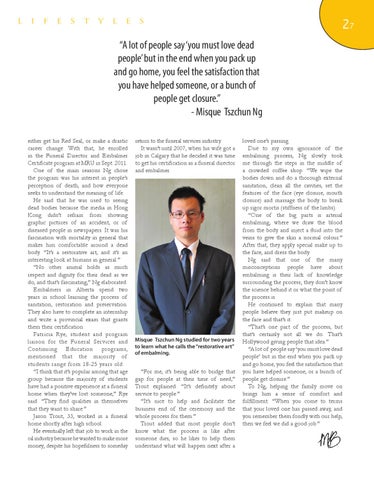
Misque Tszchun Ng studied for two years to learn what he calls the “restorative art” of embalming.
“For me, it’s being able to bridge that gap for people at their time of need,” Trout explained. “It’s definitely about service to people.” “It’s nice to help and facilitate the business end of the ceremony and the whole process for them.” Trout added that most people don’t know what the process is like after someone dies, so he likes to help them understand what will happen next after a
loved one’s passing. Due to my own ignorance of the embalming process, Ng slowly took me through the steps in the middle of a crowded coffee shop. “We wipe the bodies down and do a thorough external sanitation, clean all the cavities, set the features of the face (eye closure, mouth closure) and massage the body to break up rigor mortis (stiffness of the limbs). “One of the big parts is arterial embalming, where we draw the blood from the body and inject a fluid into the veins to give the skin a normal colour.” After that, they apply special make up to the face, and dress the body. Ng said that one of the many misconceptions people have about embalming is their lack of knowledge surrounding the process; they don’t know the science behind it or what the point of the process is. He continued to explain that many people believe they just put makeup on the face and that’s it. “That’s one part of the process, but that’s certainly not all we do. That’s Hollywood giving people that idea.” “A lot of people say ‘you must love dead people’ but in the end when you pack up and go home, you feel the satisfaction that you have helped someone, or a bunch of people get closure.” To Ng, helping the family move on brings him a sense of comfort and fulfillment. “When you come to terms that your loved one has passed away, and you remember them fondly with our help, then we feel we did a good job.”