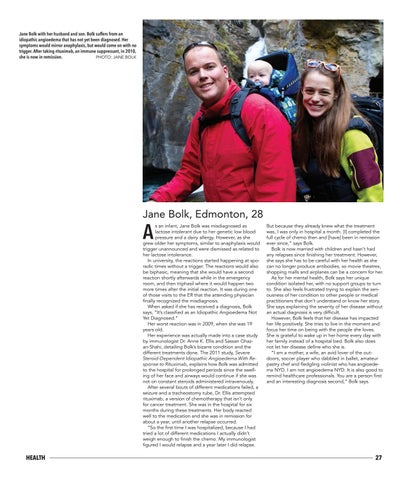
Jane Bolk with her husband and son. Bolk suffers from an idiopathic angioedema that has not yet been diagnosed. Her symptoms would mirror anaphylaxis, but would come on with no trigger. After taking rituximab, an immune suppressant, in 2010, PHOTO: JANE BOLK she is now in remission.
Jane Bolk, Edmonton, 28
A
s an infant, Jane Bolk was misdiagnosed as lactose intolerant due to her genetic low blood pressure and a dairy allergy. However, as she grew older her symptoms, similar to anaphylaxis would trigger unannounced and were dismissed as related to her lactose intolerance. In university, the reactions started happening at sporadic times without a trigger. The reactions would also be biphasic, meaning that she would have a second reaction shortly afterwards while in the emergency room, and then triphasil where it would happen two more times after the initial reaction. It was during one of those visits to the ER that the attending physician finally recognized the misdiagnosis. When asked if she has received a diagnosis, Bolk says, “It’s classified as an Idiopathic Angioedema Not Yet Diagnosed.” Her worst reaction was in 2009, when she was 19 years old. Her experience was actually made into a case study by immunologist Dr. Anne K. Ellis and Sassan Ghazan-Shahi, detailing Bolk’s bizarre condition and the different treatments done. The 2011 study, Severe Steroid-Dependent Idiopathic Angioedema With Response to Rituximab, explains how Bolk was admitted to the hospital for prolonged periods since the swelling of her face and airways would continue if she was not on constant steroids administered intravenously. After several bouts of different medications failed, a seizure and a tracheostomy tube, Dr. Ellis attempted rituximab, a version of chemotherapy that isn’t only for cancer treatment. She was in the hospital for six months during these treatments. Her body reacted well to the medication and she was in remission for about a year, until another relapse occurred. “So the first time I was hospitalized, because I had tried a lot of different medications I actually didn’t weigh enough to finish the chemo. My immunologist figured I would relapse and a year later I did relapse.
HEALTH
But because they already knew what the treatment was, I was only in hospital a month. [I] completed the full cycle of chemo then and [have] been in remission ever since,” says Bolk. Bolk is now married with children and hasn’t had any relapses since finishing er treatment. However, she says she has to be careful with her health as she can no longer produce antibodies, so movie theatres, shopping malls and airplanes can be a concern for her. As for her mental health, Bolk says her unique condition isolated her, with no support groups to turn to. She also feels frustrated trying to explain the seriousness of her condition to other people or medical practitioners that don’t understand or know her story. She says explaining the severity of her disease without an actual diagnosis is very difficult. However, Bolk feels that her disease has impacted her life positively. She tries to live in the moment and focus her time on being with the people she loves. She is grateful to wake up in her home every day with her family instead of a hospital bed. Bolk also does not let her disease define who she is. “I am a mother, a wife, an avid lover of the outdoors, soccer player who dabbled in ballet, amateur pastry chef and fledgling violinist who has angioedema NYD. I am not angioedema NYD. It is also good to remind healthcare professionals. You are a person first and an interesting diagnosis second,” Bolk says.
27