“Nobody will listen” Members of local non-profit for people with mental illness say their program suffers after massive changes to staff and management
Photo courtesy of Stephanie Lovatt
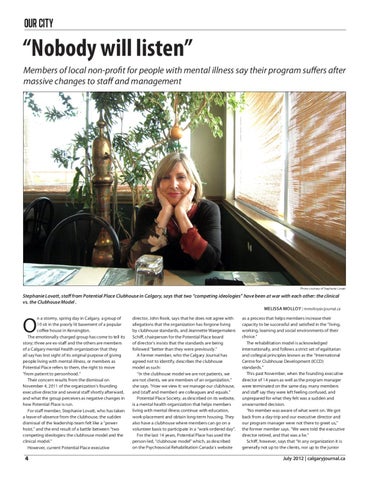
Stephanie Lovatt, staff from Potential Place Clubhouse in Calgary, says that two “competing ideologies” have been at war with each other: the clinical vs. the Clubhouse Model . melissa molloy | mmolloy@cjournal.ca
O
n a stormy, spring day in Calgary, a group of 10 sit in the poorly lit basement of a popular coffee house in Kensington. The emotionally charged group has come to tell its story; three are ex-staff and the others are members of a Calgary mental-health organization that they all say has lost sight of its original purpose of giving people living with mental-illness, or members as Potential Place refers to them, the right to move “from patient to personhood.” Their concern results from the dismissal on November 4, 2011 of the organization’s founding executive director and several staff shortly afterward, and what the group perceives as negative changes in how Potential Place is run. For staff member, Stephanie Lovatt, who has taken a leave-of-absence from the clubhouse, the sudden dismissal of the leadership team felt like a “power hoist,” and the end result of a battle between “two competing ideologies: the clubhouse model and the clinical model.” However, current Potential Place executive
4
director, John Rook, says that he does not agree with allegations that the organization has forgone living by clubhouse standards, and Jeannette Waegemakers Schiff, chairperson for the Potential Place board of director’s insists that the standards are being followed “better than they were previously.” A former member, who the Calgary Journal has agreed not to identify, describes the clubhouse model as such: “In the clubhouse model we are not patients, we are not clients, we are members of an organization,” she says. “How we view it: we manage our clubhouse, and (staff and member) are colleagues and equals.” Potential Place Society, as described on its website, is a mental health organization that helps members living with mental illness continue with education, work-placement and obtain long-term housing. They also have a clubhouse where members can go on a volunteer basis to participate in a “work-ordered day”. For the last 14 years, Potential Place has used the person-led, “clubhouse model” which, as described on the Psychosocial Rehabilitation Canada’s website
as a process that helps members increase their capacity to be successful and satisfied in the “living, working, learning and social environments of their choice.” The rehabilitation model is acknowledged internationally, and follows a strict set of egalitarian and collegial principles known as the “International Centre for Clubhouse Development (ICCD) standards.” This past November, when the founding executive director of 14 years as well as the program manager were terminated on the same day, many members and staff say they were left feeling confused, and unprepared for what they felt was a sudden and unwarranted decision. “No member was aware of what went on. We got back from a day-trip and our executive director and our program manager were not there to greet us,” the former member says. “We were told the executive director retired, and that was a lie.” Schiff, however, says that “In any organization it is generally not up to the clients, nor up to the junior
July 2012 | calgaryjournal.ca