Lighting up the world
Local non-profit organization aims to make a big difference with just a little light bulb TANIS BROWN | tbrown@cjournal.ca
F
rom a little white house nestled amongst the skyscrapers of downtown Calgary, local non-profit organization, Light Up The World, is attempting to conquer a hefty goal — to bring light to the roughly 1.4 billion people across the world who have no access to electricity. Working in remote villages in over 50 countries across the globe, Light Up The World and its partner organizations work with communities to implement a sustainable energy system using LED lights to brighten the homes, — and the lives — of local families. “Energy and light are a basic service, like water, that is integral in the daily lives of people,” said Ada Yee, the manager of Light Up The World’s regional office in Peru. Bright light now bursts from the 27,000 homes Light Up The World has touched — replacing the flickering candlelight and kerosene lamps that many families use in the absence of electricity, with solar-powered LED lighting systems. Just a simple change has proven to have huge effects on the community: boosting the economy, allowing for better educational opportunities and improving health — all while doing right by the environment, Yee said. “The technology exists to give a better quality and higher quantity of light in a safe, environmentally friendly, efficient and cost-effective manner to countries that may possibly never have access to the type of electricity that we are familiar with,” Yee said. The organization got its start when Dave IrvineHalliday, a professor of electrical engineering at the University of Calgary, stumbled across a dimly lit classroom in rural Nepal in 1997. Children could be seen hunched over books trying to study by candlelight, their eyes squinting as they struggled to read. “The issue that he was trying to address was not the fact that they didn’t have light, but that they were using kerosene, which is very polluting and still doesn’t produce a lot of light,” said Christoph Schultz, the organization’s program director. Irvine-Halliday had heard about advances in technology that made it possible for LEDs to be used for general illumination instead of just indicator lights and saw this as a solution to the children’s problem, Schultz said.
Photo courtesy of Christoph Schultz
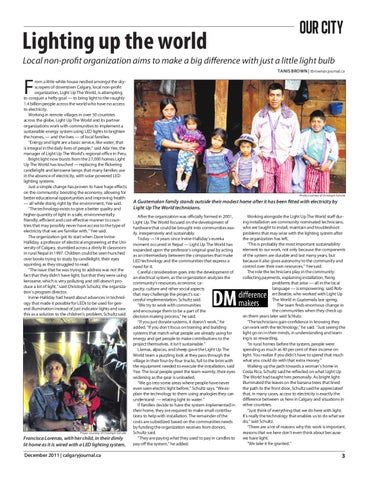
Francisca Lorenzo, with her child, in their dimly lit home as it is wired with a LED lighting system. December 2011 | calgaryjournal.ca
Photo courtesy of Christoph Schultz
A Guatemalan family stands outside their modest home after it has been fitted with electricity by Light Up The World technicians. After the organization was officially formed in 2001, Light Up The World focused on the development of hardware that could be brought into communities easily, inexpensively and sustainably. Today —14 years since Irvine-Halliday’s eureka moment occurred in Nepal — Light Up The World has expanded upon the professor’s original goal by acting as an intermediary between the companies that make LED technology and the communities that express a need for it. Careful consideration goes into the development of an electrical system, as the organization analyzes the community’s resources, economic capacity, culture and other social aspects that may challenge the project’s successful implementation, Schultz said. “We try to work with communities and encourage them to be a part of the decision making process,” he said. “If you just donate systems, it doesn’t work,” he added. “If you don’t focus on training and building systems that match what people are already using for energy and get people to make contributions to the project themselves, it isn’t sustainable.” Llamas, alpacas, and sheep gave the Light Up The World team a puzzling look at they pass through the village in their four-by-four trucks, full to the brim with the equipment needed to execute the installation, said Yee. The local people greet the team warmly, their eyes widening as the gear is unloaded. “We go into some areas where people have never even seen electric light before,” Schultz says. “We explain the technology to them using analogies they can understand — relating light to water.” If families decide to have the system implemented in their home, they are required to make small contributions to help with installation. The remainder of the costs are subsidized based on the communities needs by funding the organization receives from donors, Schultz said. “They are paying what they used to pay in candles to pay off the system,” he added.
Working alongside the Light Up The World staff during installation are community nominated technicians, who are taught to install, maintain and troubleshoot problems that may arise with the lighting system after the organization has left. “This is probably the most important sustainability element to our work, not only because the components of the system are durable and last many years, but because it also gives autonomy to the community and control over their own resources,” Yee said. The role the technicians play in the community: collecting payments, explaining installation, fixing problems that arise — all in the local language — is empowering, said Robert Beattie, who worked with Light Up The World in Guatemala last spring. The team finds enormous change in the communities when they check up on them years later said Schlutz. “The technicians gain confidence in knowing they can work with the technology,” he said. ”Just seeing the light go on in their minds, in understanding and learning is so rewarding. “In rural homes before the system, people were spending as much as 40 per cent of their income on light. You realize if you didn’t have to spend that much what you could do with that extra money.” Walking up the path towards a woman’s home in Costa Rica, Schultz said he reflected on what Light Up The World had taught him personally. As bright light illuminated the leaves on the banana trees that lined the path to the front door, Schultz said he appreciated that, in many cases, access to electricity is exactly the difference between us here in Calgary and situations in other countries. “Just think of everything that we do here with light. It’s really the technology that enables us to do what we do,” said Schultz. “There are a lot of reasons why this work is important, reasons that we here don’t even think about because we have light. “We take it for granted.”
3