HEALTH CARE OUTSIDE THE US
It’s Always What Happens Between a Physician and a Patient Interview with Richard Roberts, MD, JD, President, World Organization of Family Doctors (WONCA) – Shelly B. Rodrigues, CAE, CCMEP IT STARTED EASILY ENOUGH – inviting Dr. Roberts to write the opening article for this issue of California Family Physician. He’s written for us before and has spoken at our meetings many times. He even did his family medicine training in Santa Monica, so we lay some claim to him. He emailed that he’d love to write, but given his schedule, he might not be able to meet the deadlines. Our solution – I was lucky enough to grab an hour of phone time with him – made easier by a blizzard in Wisconsin, where he happened to be spending some “home time” that shut down his clinic and opened his schedule.
fied 145 clinical measures for improvement, tying them to increased payment. “Physicians, being genetically-bred and sociologically-trained to ace the curve, met 90 percent of the targets in year one, nearly doubling their payments.” The flip side, though, according to Dr. Roberts, is that they met asthma goals by hiring “respiratory nurses,” and now find themselves less able to manage total asthma care, resulting in decreased patient satisfaction. A significant problem with many performance metrics is that they may not measure or predict accurately what we intend. For example, several recent large studies on diabetes
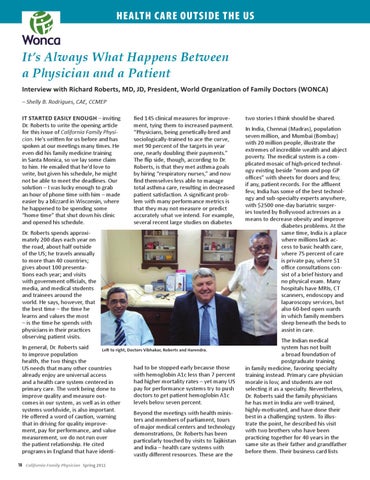
Dr. Roberts spends approximately 200 days each year on the road, about half outside of the US; he travels annually to more than 40 countries; gives about 100 presentations each year; and visits with government officials, the media, and medical students and trainees around the world. He says, however, that the best time – the time he learns and values the most – is the time he spends with physicians in their practices observing patient visits. In general, Dr. Roberts said Left to right, Doctors Vibhakar, Roberts and Harendra. to improve population health, the two things the had to be stopped early because those US needs that many other countries with hemoglobin A1c less than 7 percent already enjoy are universal access had higher mortality rates – yet many US and a health care system centered in pay for performance systems try to push primary care. The work being done to doctors to get patient hemoglobin A1c improve quality and measure outlevels below seven percent. comes in our system, as well as in other systems worldwide, is also important. Beyond the meetings with health minisHe offered a word of caution, warning ters and members of parliament, tours that in driving for quality improveof major medical centers and technology ment, pay for performance, and value demonstrations, Dr. Roberts has been measurement, we do not run over particularly touched by visits to Tajikistan the patient relationship. He cited and India – health care systems with programs in England that have identivastly different resources. These are the 18 California Family Physician Spring 2011
two stories I think should be shared. In India, Chennai (Madras), population seven million, and Mumbai (Bombay) with 20 million people, illustrate the extremes of incredible wealth and abject poverty. The medical system is a complicated mosaic of high-priced technology existing beside “mom and pop GP offices” with sheets for doors and few, if any, patient records. For the affluent few, India has some of the best technology and sub-specialty experts anywhere, with $2500 one-day bariatric surgeries touted by Bollywood actresses as a means to decrease obesity and improve diabetes problems. At the same time, India is a place where millions lack access to basic health care, where 75 percent of care is private pay, where $1 office consultations consist of a brief history and no physical exam. Many hospitals have MRIs, CT scanners, endoscopy and laparoscopy services, but also 60-bed open wards in which family members sleep beneath the beds to assist in care. The Indian medical system has not built a broad foundation of postgraduate training in family medicine, favoring specialty training instead. Primary care physician morale is low, and students are not selecting it as a specialty. Nevertheless, Dr. Roberts said the family physicians he has met in India are well-trained, highly-motivated, and have done their best in a challenging system. To illustrate the point, he described his visit with two brothers who have been practicing together for 40 years in the same site as their father and grandfather before them. Their business card lists