Youth watch June 2021∣Youth Hong Kong
Taking on the challenge Global citizens under 30 are inheriting a hotter, more unpredictable climate that has enormous implications for their future. But they also represent the power to change, by calling on policy–makers, implementing innovative solutions and building a global movement of youth climate champions. 2021 is a year of climate action, young activists say. Their network aims to inspire, empower and mobilize a generational movement to take positive action on climate change.
Surveys w Global emergency Over half a million young people aged 14-18 in 50 countries took part in a survey by the UNDP this year. Almost two thirds viewed climate change as a global emergency. w Climate change and loss of biodiversity A survey by UNESCO based upon more than 15,000 responses, revealed that of all the challenges faced by the world, climate change and loss of biodiversity were the biggest according to 67% of respondents, 57% of whom under 35, and 35% under 25. w Environmental sustainability A third international survey asked youth about sustainable development goals (SDGs) and the number one priority to make the world a better place in 2030. Environmental sustainability was top of the list. Among them, in Asia, Europe, mainland China, and North America China, the majority prioritized “a sustainable environment” above all else. Sources • undp.org/publications/peoples-climate-vote • en.unesco.org/news/unesco-world-2030-survey-report-highlights-youth-concerns-over-climate-change-and-biodiversity • worldbenchmarkingalliance.org/news/young-people-and-the-sustainability-agenda-three-avenues-for-impact/
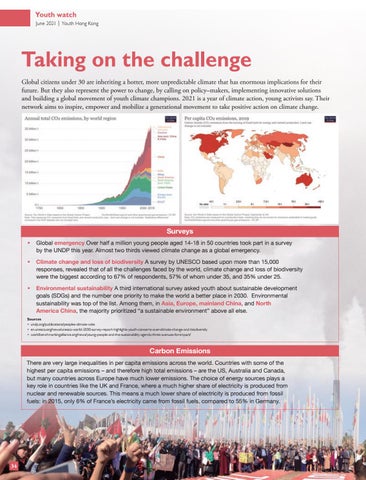
Carbon Emissions There are very large inequalities in per capita emissions across the world. Countries with some of the highest per capita emissions – and therefore high total emissions – are the US, Australia and Canada, but many countries across Europe have much lower emissions. The choice of energy sources plays a key role in countries like the UK and France, where a much higher share of electricity is produced from nuclear and renewable sources. This means a much lower share of electricity is produced from fossil fuels: in 2015, only 6% of France’s electricity came from fossil fuels, compared to 55% in Germany.
34