14
THE C21 CONTENT TRENDS REPORT: Spring 2024
Channel21 International | Spring 2024
Gecko’s Garage
Roblox
Social storytellers With new TV shows often going undiscovered by audiences whose attention is more divided than ever, launching fledgling IP on social platforms such as Roblox, TikTok and YouTube could be the key to finding relevancy in a fragmented digital landscape. By Nico Franks
I
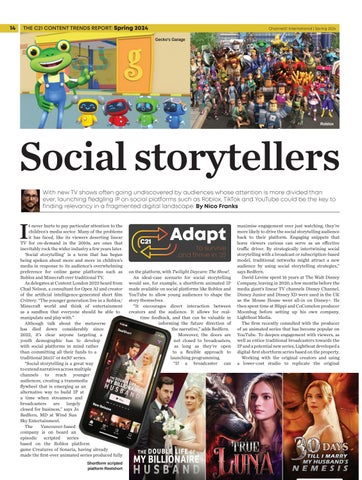
t never hurts to pay particular attention to the children’s media sector. Many of the problems it has faced, like its viewers deserting linear TV for on-demand in the 2010s, are ones that inevitably rock the wider industry a few years later. ‘Social storytelling’ is a term that has begun being spoken about more and more in children’s media in response to its audience’s overwhelming preference for online game platforms such as Roblox and Minecraft over traditional TV. As delegates at Content London 2023 heard from Chad Nelson, a consultant for Open AI and creator of the artificial intelligence-generated short film Critterz: “The younger generation live in a Roblox/ Minecraft world and think of entertainment as a sandbox that everyone should be able to manipulate and play with.” Although talk about the metaverse has died down considerably since 2022, it’s clear anyone targeting a youth demographic has to develop with social platforms in mind rather than committing all their funds to a traditional 26x11’ or 6x30’ series. “Social storytelling is a great way to extend narratives across multiple channels to reach younger audiences, creating a transmedia flywheel that is emerging as an alternative way to build IP at a time when streamers and broadcasters are largely closed for business,” says Jo Redfern, MD at Wind Sun Sky Entertainment. The Vancouver-based company is on board an episodic scripted series based on the Roblox platform game Creatures of Sonaria, having already made the first-ever animated series produced fully Shortform scripted platform Reelshort
on the platform, with Twilight Daycare: The Show!. An ideal-case scenario for social storytelling would see, for example, a shortform animated IP made available on social platforms like Roblox and YouTube to allow young audiences to shape the story themselves. “It encourages direct interaction between creators and the audience. It allows for realtime feedback, and that can be valuable in informing the future direction of the narrative,” adds Redfern. Moreover, the doors are not closed to broadcasters, as long as they’re open to a flexible approach to launching programming. “If a broadcaster can
maximise engagement over just watching, they’re more likely to drive the social storytelling audience back to their platform. Engaging snippets that leave viewers curious can serve as an effective traffic driver. By strategically intertwining social storytelling with a broadcast or subscription-based model, traditional networks might attract a new audience by using social storytelling strategies,” says Redfern. David Levine spent 16 years at The Walt Disney Company, leaving in 2020, a few months before the media giant’s linear TV channels Disney Channel, Disney Junior and Disney XD were axed in the UK as the Mouse House went all-in on Disney+. He then spent time at Blippi and CoComelon producer Moonbug before setting up his own company, Lightboat Media. The firm recently consulted with the producer of an animated series that has become popular on YouTube. To deepen engagement with viewers, as well as entice traditional broadcasters towards the IP and a potential new series, Lightboat developed a digital-first shortform series based on the property. Working with the original creators and using a lower-cost studio to replicate the original