from the
Dean
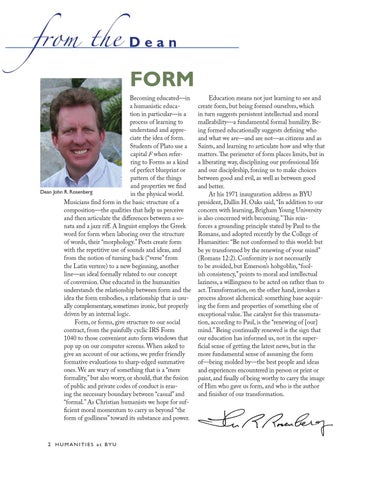
FORM Becoming educated—in a humanistic education in particular—is a process of learning to understand and appreciate the idea of form. Students of Plato use a capital F when referring to Forms as a kind of perfect blueprint or pattern of the things and properties we find Dean John R. Rosenberg in the physical world. Musicians find form in the basic structure of a composition—the qualities that help us perceive and then articulate the differences between a sonata and a jazz riff. A linguist employs the Greek word for form when laboring over the structure of words, their “morphology.” Poets create form with the repetitive use of sounds and ideas, and from the notion of turning back (“verse” from the Latin vertere) to a new beginning, another line—an ideal formally related to our concept of conversion. One educated in the humanities understands the relationship between form and the idea the form embodies, a relationship that is usually complementary, sometimes ironic, but properly driven by an internal logic. Form, or forms, give structure to our social contract, from the painfully cyclic IRS Form 1040 to those convenient auto form windows that pop up on our computer screens. When asked to give an account of our actions, we prefer friendly formative evaluations to sharp-edged summative ones. We are wary of something that is a “mere formality,” but also worry, or should, that the fusion of public and private codes of conduct is erasing the necessary boundary between “casual” and “formal.” As Christian humanists we hope for sufficient moral momentum to carry us beyond “the form of godliness” toward its substance and power.
2 HUMANITIES at BYU
Education means not just learning to see and create form, but being formed ourselves, which in turn suggests persistent intellectual and moral malleability—a fundamental formal humility. Being formed educationally suggests defining who and what we are—and are not—as citizens and as Saints, and learning to articulate how and why that matters. The perimeter of form places limits, but in a liberating way, disciplining our professional life and our discipleship, forcing us to make choices between good and evil, as well as between good and better. At his 1971 inauguration address as BYU president, Dallin H. Oaks said, “In addition to our concern with learning, Brigham Young University is also concerned with becoming.” This reinforces a grounding principle stated by Paul to the Romans, and adopted recently by the College of Humanities: “Be not conformed to this world: but be ye transformed by the renewing of your mind” (Romans 12:2). Conformity is not necessarily to be avoided, but Emerson’s hobgoblin, “foolish consistency,” points to moral and intellectual laziness, a willingness to be acted on rather than to act. Transformation, on the other hand, invokes a process almost alchemical: something base acquiring the form and properties of something else of exceptional value. The catalyst for this transmutation, according to Paul, is the “renewing of [our] mind.” Being continually renewed is the sign that our education has informed us, not in the superficial sense of getting the latest news, but in the more fundamental sense of assuming the form of—being molded by—the best people and ideas and experiences encountered in person or print or paint, and finally of being worthy to carry the image of Him who gave us form, and who is the author and finisher of our transformation.