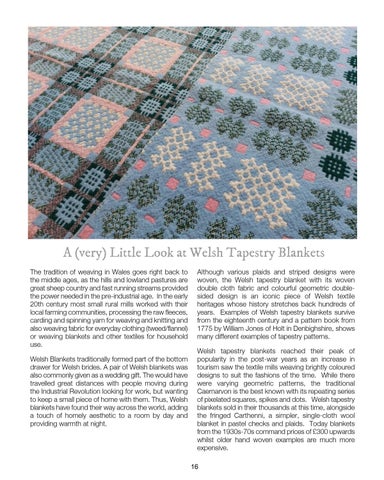
A (very) Little Look at Welsh Tapestry Blankets The tradition of weaving in Wales goes right back to the middle ages, as the hills and lowland pastures are great sheep country and fast running streams provided the power needed in the pre-industrial age. In the early 20th century most small rural mills worked with their local farming communities, processing the raw fleeces, carding and spinning yarn for weaving and knitting and also weaving fabric for everyday clothing (tweed/flannel) or weaving blankets and other textiles for household use. Welsh Blankets traditionally formed part of the bottom drawer for Welsh brides. A pair of Welsh blankets was also commonly given as a wedding gift. The would have travelled great distances with people moving during the Industrial Revolution looking for work, but wanting to keep a small piece of home with them. Thus, Welsh blankets have found their way across the world, adding a touch of homely aesthetic to a room by day and providing warmth at night.
Although various plaids and striped designs were woven, the Welsh tapestry blanket with its woven double cloth fabric and colourful geometric doublesided design is an iconic piece of Welsh textile heritages whose history stretches back hundreds of years. Examples of Welsh tapestry blankets survive from the eighteenth century and a pattern book from 1775 by William Jones of Holt in Denbighshire, shows many different examples of tapestry patterns. Welsh tapestry blankets reached their peak of popularity in the post-war years as an increase in tourism saw the textile mills weaving brightly coloured designs to suit the fashions of the time. While there were varying geometric patterns, the traditional Caernarvon is the best known with its repeating series of pixelated squares, spikes and dots. Welsh tapestry blankets sold in their thousands at this time, alongside the fringed Carthenni, a simpler, single-cloth wool blanket in pastel checks and plaids. Today blankets from the 1930s-70s command prices of £300 upwards whilst older hand woven examples are much more expensive. 16