My mom’s side of the family is very much into passing down family heirlooms. It comes from a place of both sentimentality and sustainability – hey, that old brass touch lamp with the yellowing shade still technically works fine, right? While I’ve resisted several of these gifts under the guise of lack of storage and space, there are a few precious items that have made their way into my home.
Purchased for my grandpa by my aunt from the Land’s End catalog about 50 years ago, I am now the owner of a wood and wicker rocking chair. It was gifted to me when I was pregnant with my first daughter, and it has since rocked both of my girls to sleep through bedtime stories, latenight feedings, and upset tummies. Perhaps one day it will do the same for their children.
wheels and decorated with a lace skirt, this bassinet has been in my family for over 75 years. It was first used in 1949 by my aunt and has since traveled around to expectant parents in our family every few years – it was even mine when I was first born. On the bottom are all the names of the babies who have used it, totaling 14 family members. Some upgrades have been made to the hinges on the legs and linens inside, of course, but just knowing that so many fellow Deans (my mother’s maiden name) have laid their little heads to rest inside of it is such a comforting thought.
I am now the owner of a wood and wicker rocking chair. It was gifted to me when I was pregnant with my first daughter, and it has since rocked both of my girls to sleep through bedtime stories, late-night feedings, and upset tummies.
Adorning the corner of my bathroom vanity, I have a collection of antique glass perfume bottles that used to belong to my great-grandma. I actually “won” them during a game of white elephant at a family Christmas party. My mom’s cousin had brought them to the party, and I knew I had to have them. They are elegant, timeless, and really only special to me because of where they came from.
Perhaps the greatest heirloom I’ve ever received is no longer in my possession - and that’s by design. Again, when we were expecting our first child, I became the temporary owner of a white wicker bassinet. Perched on
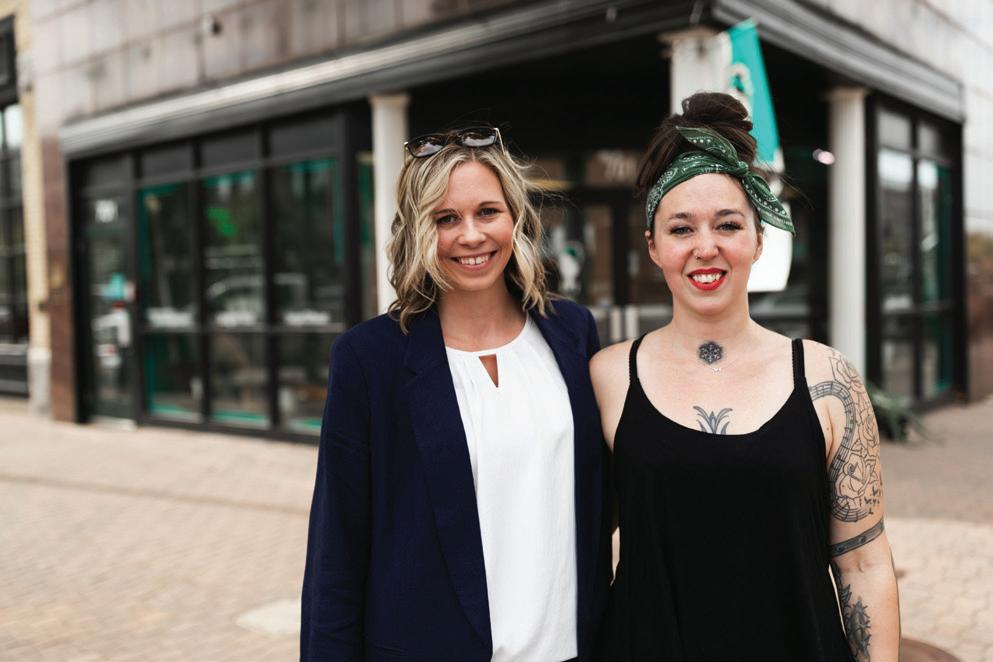
Ashley Green has a keen sense for the sentimental and unconventional. Whether it’s in designing a funeral flower arrangement for a loving spouse, restoring an antique chair for a beloved family member, or telling the love stories of Central Minnesota and beyond through her work in the wedding industry, Green understands the value of honoring a memory. You can read more about all of her “hobbies” on page 32.
Today, the bassinet is at my brother’s home, where my sweet newborn niece is continuing the family tradition. She is one more name to add to the list, and one more reason to honor family heirlooms. Until next issue,
Lynn MacDonald and Nazimuddin Shaikh, St. Cloud State University
Jeanine Nistler, freelance writer
Sarah Noble, AIS Planning
Karen Pundsack, Great River Regional Library
Taylor Sellnow, Moxie Creative
Ann Wessel, freelance writer
ADVERTISING
Associate Publisher/Sales
Melinda Vonderahe, Marketing Consultant
Ad Traffic & Circulation
Yola Hartmann, Hazel Tree Media
ART
Design & Production
Yola Hartmann, Hazel Tree Media
Cover Story Photography
Guytano Magno, Switchboard
WEBSITE
Vicki Lenneman, St. Cloud Area Chamber of Commerce
1411 West St. Germain Street, Suite 101, St. Cloud, MN 56301
Phone: (320) 251-2940
Fax: (320) 251-0081
BusinessCentralMagazine.com
For advertising information contact Melinda Vonderahe, (320) 656-3808
Editorial suggestions can be made in writing to: Editor, Business Central, 1411 West St. Germain Street, Suite 101, St. Cloud, MN 56301 or emailed to ebertram@stcloudareachamber.com Submission of materials does not guarantee publication
THIS ISSUE: Digging History / Do it Now! / Your Voice in Government / Trouble with Business / Top Hats
Building Belonging
Authentic leadership fosters deeper connections and drives employee engagement in diverse workplaces.
By Karen Pundsack
Engaging and retaining employees is top of mind for many leaders. In Leading Below the Surface: How to Build Real (and Psychologically Safe) Relationships with People Who Are Different from You, LaTonya Wilkins shares a unique perspective and concrete actions to develop a workplace where everyone feels they belong.
This book was recently shared in a Minnesota Department of Employment and Economic Development article titled “Improved Employee Engagement through Authentic Leadership.” Authentic leadership is key to recruiting and retaining top talent with today’s workforce. As our workplaces become more diverse, leadership strategies need to foster this change.
The author is an MBA and executive and team coach who specializes in building cultures of belonging. As a starting point, she shares her
own experiences as a BIPOC (Black, Indigenous, and People of Color) professional. She references studies and data to outline the importance of this work. The later chapters offer many examples on how to address everyday situations in new ways to create a more welcoming workplace. She shares methods of empathy and active listening to build trust among people who are different from each other.
The book is divided into three parts and 11 chapters. The first part covers why the author wrote the book. Part II gives pointers on becoming a “Below the Surface Leader.” The last part goes over how to apply the principles organizationally.
Chapter 1: Why I Wrote this Book
Chapter 2: The Flaws with the Dominant Leadership Standard
Chapter 3: Humans Were Born to Exclude
Chapter 4: The Leading Below the Surface Approach
Chapter 5: Navigating a Surface World
Chapter 6: Becoming a Below the Surface Leader
Chapter 7: Living on the Edge with Empathy
Chapter 8: Moving Into Psychologically Safe Relationships
Chapter 9: Building a Below the Surface Culture
Chapter 10: Leading Below the Surface as an Effective Diversity, Equity, Inclusion and Belonging (DEIB) Strategy
Chapter 11: We Can All Do ThisManaging Your Below the Surface Journey Ahead
Doss joins Great River Children’s Museum
Great River Children’s Museum has hired Kelly Doss as its new development director. She will lead all fundraising efforts to support the museum’s programs and operations. Doss has over 12 years of experience in the nonprofit sector working in fund development and community engagement roles. She has B.A. degrees in political science and psychology and a master’s degree in politics.
Jacobson
joins St. Cloud Financial
CHECK IT OUT!
Karen Pundsack is the executive director at Great River Regional Library.
Wilkins has a podcast available as well as other resources regarding leveraging the principles within the book at leadingbelowthesurface.com. The book is available for checkout at the public library. Reserve your copy at griver.org.
Credit Union
Chelsea Jacobson joined St. Cloud Financial Credit Union (SCFCU) as branch manager at SCFCU’s flagship St. Cloud location. Jacobson brings more than five years of experience in managing credit union branches, most recently serving as a multi-branch manager in Central Minnesota.
Theis joins United Way of Central MN
Jenny Theis joined the United Way of Central Minnesota as donor engagement director. In her new role, Theis will cultivate and steward donors and gifts to support the organization’s long-term sustainability.
Leading Below the Surface: How to Build Real (and Psychologically Safe) Relationships with People Who Are Different from You; LaTonya Wilkins, 2021,
Business Central asked:
What is one piece of financial advice you would give to your younger self?
Brooke VanderLinden, AMG Promotions and Apparel
Immediately start putting money into a Roth IRA after getting your first job.
Kelly Zwick, Ridge Consulting and Therapy
Roxanne Ryan, WACOSA
Create a budget and have a fun account and a savings account.
Start investing small amounts in stocks. Do college slowly so that you can pay as you go, and learn about your career path and income trends so that you can prepare.
Jeff Jenson, West Central Technology
Start saving right away and put money into your 401k.
Melody Vachal, Arise Cares and RiseUP Care and Wellness
Start saving now and put a small amount away each paycheck. Also, don’t stress too much about money!
Dr. Stephen Cragle has immersed himself in the world of cochlear implants for more than twenty years. As a general otolaryngologist with expertise in all areas of the head and neck, Dr. Cragle became particularly fascinated by the intricate connection between our ears and brains.
This passion, combined with his 30+ years of experience as an ENT physician, made him the ideal candidate to introduce cochlear implants to Central Minnesota. As of September 2024, he remains the only surgeon in the region performing these life-changing procedures.
To learn more about making a better choice for your cochlear implant surgery, call us today at 320.251.8385.
Blake Kral joined Jacobs Financial as a wealth management advisor. Kral, who currently lives in Crosslake, Minn., is a registered representative and investment advisor representative of Cetera Advisor Networks LLC.
Isaiah Gerads joined Jacobs Financial as client service assistant. In his role, Gerads maintains client relationships and assists advisors.
Noah Dendinger has joined Jacobs Financial as a wealth management advisor. A graduate of Mankato State University, he previously worked at State Farm Insurance. In his current position he uses his risk management experience to create customized financial advice for clients.
Falcon National Bank and Jacobs Financial have developed a new partnership. This partnership provides an expanded set of banking, financial, insurance, and investment options to their customers.
Vasquez joins Apex Apex Engineering Group hired Tatiana Vasquez as a graduate engineer to assist with wastewater group projects. A South Dakota School of Mines & Technology graduate, she holds a master's degree in civil and environmental engineering and a bachelor's degree in chemical engineering.
DIGGING HISTORY
Nifty at 150
What started as a hobby near some ice-cold springs is now one of Minnesota’s oldest and most successful breweries.
By Eric Cheever
150 years is a long time — and a milestone that Cold Spring Brewing Company recently celebrated. It has endured, while nearly all of its contemporaries are now a footnote in history. There have been tough times for the business for certain — the brewery’s very survival hung in the balance more than once. But today it is still here, still producing beer and soda as it has since 1874, making Cold Spring Brewing Company one of the oldest continuously operating businesses in Central Minnesota.
Red River Avenue, the street that borders the brewery, was originally part of the Red River trail, a sprawling network of two-rut trails used to haul furs and other goods from Winnipeg, Canada to St. Paul. Heavy, cumbersome two-wheel ox carts squeaked down the trails at two miles an
hour on a good day, requiring many rest stops. One of the most anticipated stops, situated just north of the Sauk River in what would become Stearns County, featured several ice-cold fresh water springs. Naturally, this spot became known as Cold Springs. In 1874, a German-born brewer named Michael Sargl purchased the property and began to brew a small amount of beer on the site. At first, his main customers were the monks at nearby St. John’s Abbey, as well as the few early settlers in the area. In 1890 a fellow named John Oster join the firm. He brought a steam-powered tractor for the plant, which made it far more efficient. Oster was joined by Ferdinand Peters in 1899. The two hired Eugene Hermanutz as the new brewmaster, and he was also given a partnership in the business.
The new partners renamed their brewery the Cold Spring Brewing Company in 1900 and began a program of modernization and expansion. By the eve of WWI, Cold Spring Brewing was the twelfth largest brewer in the state. National prohibition presented profound challenges to the brewing industry.
Cold Spring was fortunate that it already had several very successful nonalcoholic products, among them Red Star Mineral Water, Red Star tonic, Cold Spring Brew (a near beer), and a full line of soft drinks. Because Cold Spring continued to produce products and kept its brewing equipment maintained, it was one of the few Minnesota breweries able to sell real beer when prohibition ended at midnight April 7, 1933.
In the early 1940s, Myron Johnson, formerly an executive with Coca-Cola, was brought in to shake things up. Johnson began by redesigning product labels and increasing marketing, streamlining sales procedures, and expanding distribution. By 1944, Johnson had full ownership of the brewery.
Johnson and Cold Spring Brewing were considered one of the models of a successful
Women from a St. Stephen Mission Group say "Cheers!" with Cold Spring Brewing beer in 1949.
unpaid employees, until an investment group stepped in and purchased the plant.
small to midsize brewery through the 1950s and up into the 1970s. The 1980s and 1990s were tumultuous, seeing the brewery lose market share and
WINNING SPARK!
Today Cold Spring Brewing, although no longer locally owned, is a powerhouse in the beverage industry. Along with beer, brewed under the Third Street Brewhouse banner,
contract beverages.
With 150 years of hard work, innovation and tenacity, the Cold Spring Brewing Company is a testament to what is possible in Central Minnesota.
Eric Cheever is a collections
Local marketing agency Moxie Creative received the 2024 Better Business Bureau of North Dakota and Minnesota Spark Award. This award recognizes an emerging business in North Dakota and Minnesota that
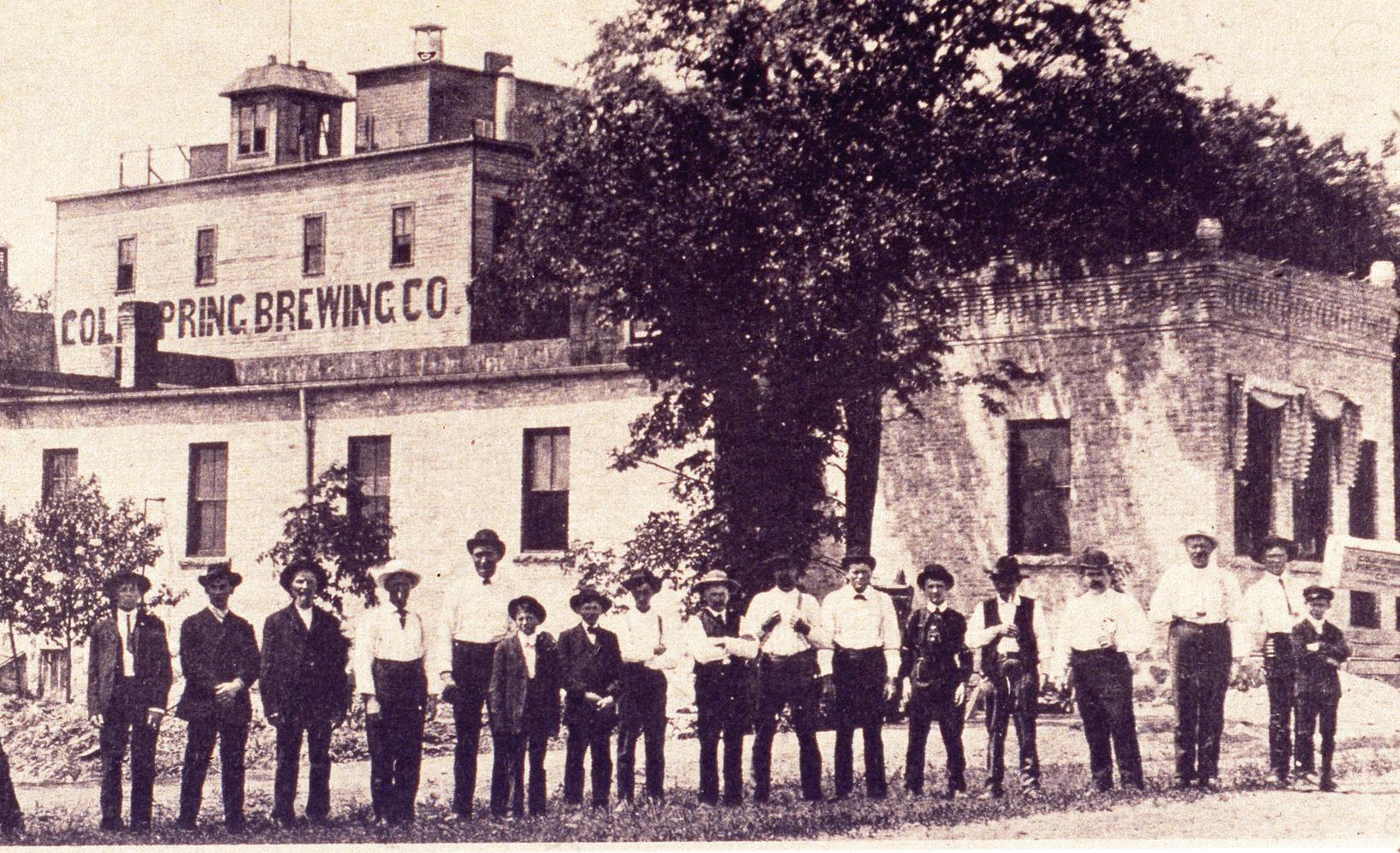
Employees pose outside Cold Spring Brewing and Mineral Water Company in 1906.
Metro Bus takes home gold
Six Metro Bus operators took part in the 37th Annual Minnesota Public Transit Association Statewide Bus Roadeo. For the second year in a row, Metro Bus Dial-a-Ride Operator David Peacock took first place in the Small Bus Division, while the other five operators all placed high in their divisions as well.
Soukup joins WhiteBox Marketing
Frank Soukup joined WhiteBox Marketing as senior strategist. Soukup spent 14 years in hospitality marketing with Grand View Lodge and Tanque Verde Ranch, and previously owned a marketing agency. He will focus on growth in the Brainerd market, where he still serves on the boards for Explore Minnesota, Hospitality Minnesota and the Brainerd Lakes Area Chamber of Commerce.
Lawrence named CEO of Vye
Jennifer Lawrence takes over as the new CEO of Vye in January 2025. She has been with the agency since 2012 and most recently held the role of vice president. She will succeed Dan Soldner, who will transition to a founder/board member role and focus on business development for the company.
Email Hacked! Now What?
Awareness and swift action are keys to protecting yourself and your company.
By Clint Lentner
“Mondays,
am I right?”
You sit back in your office chair after a long weekend, power on your computer and begin your morning email review. As you scroll through your inbox, you notice an email from a co-worker replying to one of your messages, but don’t recall sending it. You probably did before rushing out the door on Friday and just forgot. Suddenly, your phone rings. It’s an important prospect you’ve been working with for months. Instead of their usual banter, they sound concerned, asking if the email you sent was legitimate. The message seemed off and included a link requiring the prospect’s email address and password to view a secure document. Your heart sinks and you
let out a sigh as you realize your email account has been compromised.
In our digital age, cyberattacks like this are an unfortunate reality. When a threat actor, or “hacker,” first gains access to your digital account, they often look for information to help them steal something of value: Passwords for other accounts, financial data, personal identification details, sensitive information, etc. And what better place to start than your email? Due to its low risk and high payoff, email compromise is one of the most common cyberattacks. If you find yourself in a similar situation, don’t panic — take immediate action to secure your accounts and prevent further damage.
Change Your Password
The first step is to change your email password immediately so the hacker can’t easily get back in. Select a strong, unique password you haven’t used before that isn’t easily guessable (don’t use your old password plus an extra character or number). If you haven’t done so already, enable multifactor authentication (MFA), such as a code sent to your phone in addition to the password. This helps prevent a hacker from getting into your account if they have your email address and password.
Remove Active Sessions
Most email providers allow you to see active sessions, which is a list of people currently logged into your
email account. After changing your password, remove all other active sessions to ensure the hacker is forced out.
Review Email Settings
Check your email settings for mail forwarding rules, display filters, and changes to the recovery email and phone number. Hackers often modify these settings to hide their presence while accessing your email.
Notify Contacts
Notify your affected contacts, confirming your email has been compromised and not to open any suspicious messages from you. Although uncomfortable, this helps prevent others from falling victim to the fake emails sent from your account.
Secure Your Other Accounts
Since many digital accounts are linked to your email, it’s essential to secure them as well. Change the passwords for any accounts that use the compromised email for login or password recovery. Enable
MFA and use a new unique password for each account.
What’s Next?
Unfortunately, once an email account has been compromised, hackers know they have a successful target. You should assume that they
When it comes to your spine, finding the right orthopedic care should be simple and stress-free. At St. Cloud Orthopedics, we have a team of academic-level doctors and specialists under one roof. From diagnosis to treatment, to recovery and rehabilitation, we work together to ensure that you receive the personalized attention you deserve. For spine care that keeps you standing tall, look no further than St. Cloud Orthopedics.
NATIONAL EXPOSURE
Local dealership
Gilleland Chevrolet received the 2024 National Dealer of the Year Award from Chevrolet. Only 60 out of 2,900 Chevrolet dealers earn this distinction, largely based on customer satisfaction. It also received the Elite Leaders Award, recognizing the top 250 dealerships nationally, based on retail sales.
NETWORK UP FRONT
Local lenders recognized by SBA
The U.S. Small Business Administration’s Minnesota District honored 10 lenders throughout the state for their commitment to helping small businesses succeed.
Several local lenders made the list:
SBA Minnesota National Lender:
U.S. Bank, National Association
SBA Minnesota Lender Assets $1B and over: Frandsen Bank & Trust
SBA Minnesota Lender Assets
$500MM to $1B: BankVista
SBA Minnesota Credit Union: Magnifi Financial Credit Union
SBA Minnesota CDC (Certified Development Company) by Loan Volume: Minnesota Business Finance Corporation
Park Industries promotes Hegland
Park Industries announced the promotion of Meagan Hegland to vice president of sales and marketing. In this role, Hegland will continue to lead Park Industries’ sales team, remaining focused on the development and execution of sales strategy, and assume the responsibility of overseeing the marketing department. Previously a national sales manager for Park Industries, Hegland has been with the organization since 2021.
PleasureLand RV Center donates to conservation
PleasureLand RV Center and the Dan Pearson family made a donation to Pheasants Forever (PF) in memory of Justin Pearson, an upland hunter and conservationist. The contribution was used to fund a trio of mission priorities in Minnesota, including the 267-acre Justin V. Pearson Memorial Tract at Powers Lake Wildlife Management Area, the 280-acre Wendland Waterfowl Production Area as an addition to Beyer WPA, and the expansion of PF’s private lands biologist team.
YOUR VOICE IN GOVERNMENT
Retirement, Reinforced.
SECURE 2.0 Act can help make saving for retirement easier and more accessible for employees, business owners, and retirees.
By Sarah Noble
SECURE 2.0 Act, officially known as the Setting Every Community Up for Retirement Enhancement Act, is a piece of legislation aimed at making retirement savings more accessible and effective for Americans.
Building on the original SECURE Act of 2019, this updated version in 2024 introduces several key changes designed to help more people save for retirement and simplify the rules for businesses that offer retirement plans.
Who and What
workers, and quicker eligibility into retirement plans for part-time workers.
Business Owners: Employers will need to adjust their retirement plan offerings to comply with the new rules. This includes setting up automatic enrollment for new employees, adjusting matching contributions, and potentially dealing with new tax credits and penalties.
Retirees: The act raises the required minimum distribution (RMD) age from 72 to 75, giving retirees more flexibility in how they manage their retirement savings.
SECURE 2.0 Act impacts a wide range of individuals and organizations, including: Employees: The act provides more opportunities and incentives for employees to save for retirement. This includes automatic enrollment in retirement plans, increased catch-up contributions for older
Changes and Updates
Business owners should be aware of several key changes that may affect their businesses.
Automatic Enrollment
:
One of the standout features of SECURE 2.0 Act is the push for automatic enrollment. Beginning in
2025, businesses with more than 10 employees will be required to automatically enroll new employees in their retirement plans. This aims to increase participation rates and help more people save for the future.
Increased Catch-Up Contributions: For those aged 62, 63, and 64, the catch-up contribution limit to 401(k), 403(b), and governmental 457(b) plans will increase. This gives older workers a greater chance to boost their retirement savings as they approach retirement age.
Expanded Eligibility for Part-Time Workers: Under SECURE 2.0 Act, part-time employees who work at least 500 hours a year for two consecutive years are eligible to participate in their employer's retirement plan. This is a significant change that expands retirement saving opportunities for
a broader segment of the workforce.
Small Business Tax
Credits: To encourage small businesses to set up retirement plans, SECURE 2.0 Act offers increased tax credits. These credits can help offset the costs of starting and maintaining a retirement plan, making it more feasible for small employers to provide these benefits.
What To Do
Take a close look at your current retirement plan offerings and determine what changes are necessary to comply with Secure Act 2.0. Keep your employees informed
about the changes to their retirement plan options.
Help is Available
Navigating the intricacies of SECURE 2.0 Act can be challenging. Here are some resources to help you get started:
Financial Advisors: Work with a trusted financial advisor who can help you understand the new rules and how they impact your business.
Retirement Plan
Consultants: These professionals specialize in helping businesses design and manage retirement plans that comply with current regulations.
IRS and Department of Labor Websites: These sites offer detailed information on SECURE 2.0 Act and other retirement-related regulations. Industry Associations: Groups like the Society for Human Resource Management and the American Benefits Council provide valuable insights and resources for business owners.
By staying informed and proactive, you can ensure that your business and your employees are well-prepared to take advantage of the benefits offered by SECURE 2.0 Act.
Sarah Noble is an associate advisor, PPC® at AIS Planning.
SCSU MAKES FORBES LIST
St. Cloud State University made the Forbes list of America's 500 Top Colleges for 2024. Rankings are determined based on factors including student success, return on investment, and alumni salaries and influence. SCSU is the only school in the Minnesota State system to be named to the list.
NETWORK UP FRONT
NEWS REEL
CentraCare named Level 5 Partner
CentraCare Hospice is now a Level 5 Partner with We Honor Veterans (WHV), a program of the National Hospice and Palliative Care Organization. This Level 5 Partner distinction — the highest level possible — makes CentraCare Hospice the only hospice agency in Minnesota to achieve this ranking.
SCSU represented on AI Leadership Council
St. Cloud State University’s vice president for strategic enrollment management and the division of student affairs, Jason Woods, has been named an inaugural member of the Ruffalo Noel Levitz (RNL) AI Leadership Council. The AI Leadership Council will serve as a forum for university executives to discuss emerging AI trends, explore innovative applications, and address the challenges and opportunities presented by AI.
Stearns Electric Association gives back Stearns Electric Association employees volunteered their time with local students from the Boys & Girls Clubs of Central Minnesota (BGCMN), educating them on energy and electrical safety. Twelve cooperative employees spent time with two groups of students who participate in summer programming at Talahi and Westwood schools as part of BGCMN.
Vye earns recognition Marketing agency Vye was named to the Inc. 5000 list of fastestgrowing companies in America for the second year in a row. Companies on the list are ranked according to percentage revenue growth over three years.
Name: Cheryl Thieschafer
Age: 59
New Title: Executive
Director, St. Cloud VA Health Care System
When did you start at the St. Cloud VA? I started at the St. Cloud VA in June 2000, after serving 13 ½ years on active duty in the U.S. Army.
What was your previous position/work history?
While on active duty, I was in the Army Medical Specialist Corps and served in a variety of positions, including administrator, management consultant, and dietetic professional. I obtained a Master of Health Administration from Baylor University in 1997. After the birth of my second child, I chose to leave the military and return to Minnesota to be near extended family. Wanting to continue my service in federal
Meet Cheryl Thieschafer
Executive Director, St. Cloud VA Health Care System
government, I accepted a part-time position at the St. Cloud VA to get my foot in the door, while raising my children. I enjoyed many positions of increasing responsibility while at the St. Cloud VA Health Care System, including positions such as facility planner, management analyst, executive assistant to the director, and for the past 12 years, associate health care system director (chief operating officer).
What is something that you really enjoyed in your previous positions?
While the best part of my job is and has always been working with people, I have really enjoyed being a part of the tremendous growth and transformation of the St. Cloud VA Health Care System from a small community hospital into a dynamic and growing regional health care system. The health care system today is focused on the delivery of a comprehensive array of services, including primary and specialty medicine,
mental health, and extended care. One of my fond achievements was developing the business plan to procure the first CT scanner for the St. Cloud VA.
What are you looking forward to the most in your new position? Serving veterans. As a proud veteran myself and being married to a combat veteran, my passion is to ensure veterans receive the healthcare they earned. I can’t think of a better job or mission than that.
Where did you grow up?
I grew up in Long Prairie, Minn. where, in addition to their jobs in the community, my parents operated a small hobby farm. I credit my parents for instilling in me a strong work ethic and desire to make a difference in the greater community.
What are your hobbies?
I enjoy traveling, home improvement projects, lake activities (especially fishing), and quilting.
FUN FACT: When I was in the military and stationed at Fort Wainwright, Alaska, I achieved my goal of catching every type of salmon you can fish. I also caught a 105-pound halibut and had to purchase a freezer to store all the fish.
Line-X of St. Cloud, MN, custom vehicle accessories, 1010 County Road 138, Waite Park. Pictured: Rachel Layton, Bethany Dalen, Nick Neu, Kurt Neu, Jake Neu, Rory Cruiser.
Opportunity Services, non-profit assisting adults with disabilities, 1717 W St. Germain St., St. Cloud. Pictured: Debbie Clausen, Craig Zack, Alyssa Zirbes, Roger Schleper, Mike Brower.
Companies Inc., contractors, 20326 Minn. Hwy 15, St. Augusta.
Catholic United Financial Center, not-for-profit financial service company, 120 10th Ave. N, St. Cloud. Pictured: Clint Lentner, Emily Ripplinger, Bishop Neary, Dave Stang, Andrea Ferkingstad, Bailey Wiczek, Mike Ahles, Greg Gall, Rachel Layton.
Dream Home Furniture, furniture store, 265 Division Street, Waite Park. Pictured: Donna Roerick, Ben Sanders, Mike Brower.
Launch Talent Group,
Fuzzy Loon Designs, custom print, engraving, apparel, unique gifts and promotional items, 806 Sundial Drive, Waite Park. Pictured: Sarah Fitzgerald, Dan Fitzgerald, Jason Miller.
Health Chiropractic, chiropractic services, 80 37th Ave. S, Ste. 8, St. Cloud.
River Valley Law PA, law office, 187 7th Ave. S, Waite Park. Pictured: Mike Brower, John Abress, Julie Kelly, Ashley Cadreau, Deana Marthaler, Sarah Jewel, Donna Roerick.
Three Elected to Chamber Board
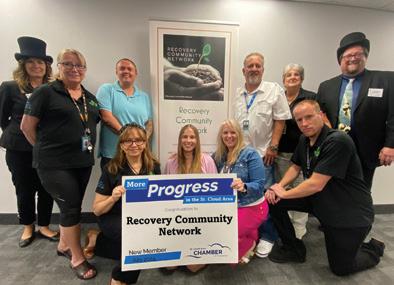
Recovery Community Network, non-profit providing peer recovery support services, 3400 1st Street N, Ste. 404, St. Cloud. Pictured standing (L-R): Donna Roerick, Mollie Brown, Shawna Beckers, Sean Partch, Peg Thielman, Rory Cruiser. Pictured kneeling (L-R): Rosalinda Miller, Ashley Schlichting, Katie Blue, Robert Burrow.
Ridge Consulting & Therapy LLC, mental health care, 12390 Sherburne Ave., Becker. Pictured: Chris Jacques, Kelly Zwick, Donna Roerick.
The following individuals were elected in September to fill three-year terms on the Board of Directors of the St. Cloud Area Chamber of Commerce.
New Ownership & 50 Years in Business: Evenson Decker P.A., law office, 1011 2nd Street N, St. Cloud. Pictured: Patrick Hollermann, JoAnne Evenson,
(320)654-4580
Moss & Barnett
Infinite
Pictured: Annika Larson, Jenna Binsfeld.
Granite City Food & Brewery, restaurant and craft beer, 3945 2nd Ave. S, St. Cloud. Pictured: Brady DeGagne, Brian Thomas.
Moxie Creative, marketing firm, 713 W St. Germain Street, Ste. 200, St. Cloud. Pictured: Rory Cruiser, Kelly Cane, Donna Roerick.
Harren
Pictured: Tauna Quimby, Mark Harren, Rory Cruiser.
Careers
recruiting firm. Pictured: Donna Roerick, Travis Cariveau, Mike Brower.
Kasey Brinker recently passed his CPA exam and received his license. Brinker joined the St. Cloud office as an intern in 2022. He graduated from Saint John’s University and started working fulltime in the tax department in 2023.
Stephanie Bonebrake was promoted to senior payroll specialist
Megan Borash was promoted to HR generalist
Shelly Kelm was promoted to payroll specialist II
Sydney Wittnebel was promoted to senior manager
Coborn’s opens new location
Coborn's Inc. announced the construction of a new, state-of-the-art grocery and liquor store as part of a new development, “The Boulevard” in Plymouth, Minn. This project marks Coborn's debut in the Plymouth market.
Got News?
Send news releases, announcements, or anything you think is newsworthy to Emily, ebertram@ stcloudareachamber.com, and we will try to include it.
Mastering Email Marketing
Email marketing – when done correctly – offers a direct line to customers while establishing trust and building authority.
By Taylor Sellnow
In today’s digital world, email marketing remains a powerful tool for businesses of all sizes. First explored in the 1970s, email marketing has become a trusted and cost-effective way to reach customers, nurture relationships, and drive sales. However, not all email marketing campaigns are created equal. To maximize the benefits and avoid pitfalls, one must understand the do’s and don’ts of email marketing.
Do: Build a Quality Email List
Any marketer will tell you your email list is worth
Contributor
its weight in gold, and they aren’t wrong. When customers sign up for your emails, they want to hear from you. They have physically opted in to hear what you have to say. How cool is that? When building your email list, it’s essential you do it ethically. Sign-up forms on your website, in-store promotions, or community events are great ways to obtain addresses. Adding someone to an email list without explicit consent breaks trust and creates more opportunities for the email to enter spam.
Don’t: Purchase Email Lists
As a business owner, purchasing an email list is tempting, especially considering how much time it takes to build one organically — but it’s a risky
move. Often, purchased lists are outdated and inaccurate, leading to a large amount of spam. While purchasing lists is not illegal, it can harm your reputation and reduce your email deliverability rates. Don’t fall prey to purchased email lists. Instead, commit to putting in the work.
Do: Craft Compelling Subject
Lines
Your subject line is the first thing a customer sees, and it can make or break the success of your campaign. It’s the difference between being opened or overlooked. When writing a subject line, keep it short, sweet, and relevant to the content of your email. It should instantly hook the reader and make them want to learn more about your offer.
Taylor Sellnow is an account manager at St. Cloud based marketing firm Moxie Creative.
Don’t: Mislead with Your Subject Lines
Today’s consumers are savvy. What they want in their inbox is a message from a brand they can trust. Creating irrelevant subject lines filled with spammy words frustrates users and can cause them to hit the dreaded unsubscribe button. Be authentic and truthful.
Do: Focus on Valuable Content
There’s no way around it: when it comes to digital marketing, content is king. Provide value to your recipients by sharing helpful information, special offers, and updates relevant to their interests. Content
ideas for businesses might include tips and tricks, event announcements, or exclusive discounts for loyal customers. The goal? Make your email a must-read for your audience.
Don’t: Neglect Email Design
Prioritizing the look and layout of your email blast is essential. Content may be king, but if paired with a weak design, the message doesn’t matter. Use a clean, professional layout with visually appealing images and easy-to-read fonts. Break up text with headings, bullet points, and white space to enhance readability. A well-designed email reflects positively on your brand.
Do: Optimize for Mobile Devices
Because 75 percent of consumers report using their mobile devices to check email, you cannot skip this step. You can make an email mobile-friendly by using responsive design, concise content, and clear calls to action. Before you send your email to the masses, test it on various devices to ensure it displays correctly. Taking the time to check your email’s readability shows that you care about your customer’s experience.
Don’t: Overwhelm with Too Many Emails
The frequency of emails will
vary from business to business. Staying in touch with your customers is important, but bombarding them with emails will surely backfire. Find what works best for you and your audience and stick to a schedule. Once you’ve gotten into a rhythm, you can monitor your metrics and adjust the frequency accordingly.
By following these do’s and don’ts, you can create effective email campaigns that engage your audience, drive sales, and enhance your brand’s reputation. The key to success is committing to learning from your audience and improving their experience with every message you send. Happy emailing!
and click on “Calendar.”
Network!
Business After Hours is a fun and relaxed way to network and learn more about local businesses. Thank you, Switchboard, for hosting in August.
Taylor Feero, Kinder Coffee Lab, (L) and Mike Brower, American Family Insurance
Kris Crandall, AGC Agency, (L) and John Henry, Profusion CBD
Kenley Just, BankVista, (L) and Jim Knoblach, Crown Properties
Robert Murphy (L) and Shane Murphy, Really Cool Living
Jodie Pundsack (L) and Lauren Fencl, Evermore Co.
Doug Cook, Headwaters Strategic Succession Consulting, and Melody Vachal, Arise Cares and Rise Up Care and Wellness
Ryan Schoepf, Switchboard; Mo Philippi and Isabella Severson, Moxie Creative
Sauk Rapids Chamber meetings take place on the fourth Thursday of every month. During meetings, attendees learn more about the host, the community, and fellow members.
Waite Park Chamber meets on the third Wednesday of every month, with a different host and presentation each time. Meetings include city and school district updates, as well as plenty of networking.
Megan Pflipsen, Gate City Bank, and Brandon Voit, Falcon National Bank
Kelly Doss, Great River Children’s Museum, and Travis Theis, Dick’s Nuisance Animal Control
Caitlin Heglund and Kyle Hedtke, Kyle Hedtke State Farm
Sean Alpert (L) and Carl Bourdages, T-Mobile Fiber
Carmen Hernandez, Advantage Chiropractic, and Todd Myra, Todd Myra Photography
Sheri Moran, Gabriel Media; Julio Garcia, Palmer Printing; and Rory Cruser, Lamar Advertising
James Neppl (L) and Steve Larson, Williams Dingmann Family Funeral Homes, and Jon Copeland, Roof Maxx of St. Cloud and Bee on the Beach
Lisa Vouk, InteleCONNECT (L); Brian Jarl, Advantage 1 Insurance Agency; Lisa Braun, City of St. Cloud; Steve Nusbaum, St. Cloud Technical and Community College; Carol Copeland, Cabi by Carol Copeland and Bee on the Beach
BUSINESS TOOLS
GROW | NETWORK | PROFIT
TECH STRATEGIES
Data Privacy Gets Personal
New legislation may affect your business when it comes to personal consumer data. Are you ready?
By Jessica Brigman
Minnesota is the 19th state to enact a data privacy law protecting the personal data of consumers and giving consumers rights over their data. The Minnesota Consumer Data Privacy Act (MNCDPA) goes into effect July 31, 2025. It requires certain entities conducting
Contributor
business in Minnesota, with access to the personal data of consumers, to comply with requirements in the handling of that data.
What is personal data?
Personal data is defined as “any information linked or reasonably linkable to an identified or identifiable natural person,” (Minn. Stat. 325O.02(p)). This
Brigman is an attorney at Moss & Barnett. She is certified as an information privacy professional (U.S.) by the International Associate of Privacy Professionals.
includes names, email addresses, phone numbers, etc. Personal data is heightened to “sensitive data” if it includes:
Personal data that reveals racial or ethnic origin, religious beliefs, mental or physical health information, sexual orientation, or citizenship or immigration status; Genetic or biometric information;
Personal data of a child (under 13); specific geographical location.
Businesses subject to the MNCDPA need to think about it sooner rather than later, as it may require alterations to internal systems, websites, and employee training.
Who is impacted?
The MNCDPA applies to entities conducting business in Minnesota, or producing products or providing services targeted at Minnesota residents, that meet one of the following:
1 In a calendar year, it controls or processes the personal data (defined above) of 100,000 or more Minnesota consumers (excluding personal data processed solely for payment); or 2.Obtains over 25 percent of its gross revenue from the sale of personal data, and processes or controls the personal data of 25,000 consumers or more.
The MNCDPA also applies to entities that process personal data for a controller (e.g., a software company providing customer relationship management services to a business is the processor of the personal data and the business collecting that information is the controller).
What comes next?
The MNCDPA requires transparency in how your business protects personal data. Businesses should provide a privacy notice informing consumers about the information collected, how it is collected and stored, and what rights the consumer has over their personal data. The MNCDPA affords consumers the following rights to their personal data collected by a business:
Access to it
Correction or deletion of it
Data portability, meaning they can get a copy of it
The ability to opt-out of:
• Personal data sales;
• Targeted advertising based on the personal data;
• Profiling for decisions producing legal or similarly significant effects
Businesses must also minimize the amount of personal data they collect to what is reasonably necessary,
Jessica
obtain consent before processing any sensitive data, and not retain personal data longer than necessary.
These are only highlights of the MNCDPA — there are several more requirements. To confirm the MNCDPA applies to your business and ensure compliance, you should contact a data privacy attorney now to be ready when the MNCDPA takes effect.
Trailblazing
The pandemic changed human habits as people began to spend a lot more time outdoors. By the end of 2023, outdoor participation grew to a record 175.8 million people, or 57 percent of all Americans aged six and older, according to the Outdoor Industry Association. While interest grew, innovation in the outdoor space did, too.
Started in 2022 after its founder struggled to find guide information online, AnyCreek builds booking and back-end business software for fishing and hunting guides.
When Matthew Holder realized that the rise in interest in golf that occurred postpandemic wasn’t going away, he co-founded Loop Golf, which automates finding and booking a tee time at a public golf course.
Hipcamp allows users to easily find campgrounds to suit their needs all over the U.S. – all in one spot. Source: TechCrunch
Leveling Up
Boost customer loyalty and employee engagement by making business more fun.
By A.J. Kaufman
The term "gamification" was coined about 20 years ago. Wikipedia describes gamification as “the strategic attempt to enhance systems, services, organizations, and activities by creating similar experiences to those experienced when playing games in order to motivate and engage users.”
In simpler terms, gamification is a way to make non-game activities feel like they are indeed games, often within a business environment. This could mean incentivizing engagement or sales, with rewards like earning badges, rewards, accumulating points and so on.
The origins of gamification lie in basic psychology and the human need for recognition and reward. The three main psychological drivers that make gamification effective are:
Achievement: Earning points and achieving goals motivate people by giving them a sense of accomplishment, which keeps them coming back.
Competition: Competition drives people to perform better — to beat their peers and strive for the top.
Rewards: Perhaps the most common form of gamification, tangible rewards such as gift cards or swag, create extra incentives and increase motivation.
These drivers are generally accomplished through the application of game design elements and where you’d not necessarily expect games to occur. There are many examples of this in today’s business world.
Duolingo: This language learning app tracks progress and encourages users to return so they can extend their “streaks” of learning.
Peloton: A workout equipment and software company, Peloton uses a leaderboard to motivate users to compete and outwork each other.
Starbucks: The coffee chain’s mobile app is responsible for
one in four of Starbucks’ transactions, with over 30 million users. It rewards users for purchases through earning stars/bonuses that get them free drinks.
LinkedIn: The professional networking site displays a progress bar to encourage members to complete their profile pages and earn a trophy icon.
Scouting America: Perhaps one of the longest running examples of gamification, the scouts have long awarded badges for successfully completing activities.
IBM: Gamification isn’t just for consumers – it can also be useful for employee engagement. IBM implemented a digital badge program, where employees earned badges for completing different courses, and saw a 226 percent increase in course completions.
Competition like trivia, quizzes and creating communities are a major part of gamification strategies. Showing players whether they are winning is the key to almost any game. By adding a score-keeping component, customers or employees are encouraged to keep pushing forward. Gamification therefore builds customer loyalty, first and foremost. It also motivates engagement with a product or service.
Both the company and customers can receive benefits. For the company, gamification
makes it easier to track the habits of their customers and help them form new habits using the features they’re interested in, mainly by promoting within the system. Many customers like this style, especially in this era, as they are
rewarded for a small effort. While progresss often comes with monetary benefits, it is not mainly about money or gift cards, but about higher status or other psychological rewards. Studies show people are motivated when
they’re rewarded for their actions.
Sound Innovation
Hearing care company Sonova has launched a new hearing aid that uses real-time artificial intelligence (AI) to improve speech clarity from background noise. According to Sonova’s website, the hearing aid’s “proprietary AI chip instantly separates clear speech from background noise and allowed users in a clinical study to more than double their speech understanding in noisy environments, compared to current products in the market.”
Source: Reuters
Slicing Time in Hal f
When you think robots, what comes to mind? Transformers? Jetsons? How about avocado slicing? Chipotle Mexican Grill is testing out The Autocado, which can cut, core and peel avocados in 26 seconds on average – half the time it takes a human. While employees will still need to mash the avocado by hand to make guacamole, it will save hours of time, since Chipotle expects to go through roughly 129.5 million pounds of avocados at its 3,500+ locations this year.
Source: CBS News
A former schoolteacher and historian, A.J. Kaufman is managing editor for the Business Journal of Tri-Cities
WEATHERING THE STORM
Forecasters are turning to machine learning, a form of artificial intelligence (AI) that trains computers to detect patterns in weather trends, to get ahead of deadly storms. By providing a more advanced warning, emergency crews can be better prepared, airlines can more efficiently reroute, and farmers can make better judgments on their crop care. The key to training these models lies in better observations (more Doppler radars, monitoring stations, weather balloons, etc.).
Source: Vox.com
MANAGEMENT TOOLKIT
The Clock is Ticking
Avoid penalties with a well-structured overtime policy.
By Christina Hopke
Being careless about overtime compliance is akin to licking a metal pole on a cold winter day – you will learn an unpleasant lesson the hard way. Employers can avoid an unwanted lesson on overtime violations by developing a good understanding of overtime requirements so they can effectively implement a compliant policy.
An effective overtime policy requires the following:
Identify what overtime is and when it is applicable. The threshold for overtime
Contributor
under the federal Fair Labor Standards Act (FLSA) is 40 hours in a workweek. Minnesota state law sets the threshold at 48 hours. Most employers are likely to be governed by the lower federal threshold. A policy needs to make clear when overtime applies by defining employees’ standard working hours.
Clearly establish who is eligible to receive overtime pay.
Ensure that employees know their classifications. This
Christina Hopke is an employment law and litigation attorney at Rinke Noonan.
should be specified on the Employee Notice provided at the start of employment, as required by Minnesota law.
The U.S. Department of Labor
employees paid on an hourly basis. However, the calculation can become complicated if there are any variants in employee pay (e.g., shift
The threshold for overtime under the federal Fair Labor Standards Act (FLSA) is 40 hours in a workweek. Minnesota state law sets the threshold at 48 hours.
recently revised its regulations implementing the FLSA, which narrowed the application of exempt classifications. This means more workers will be considered non-exempt employees and overtime requirements will now apply to those workers.
Explain how overtime is calculated.
Avoid misunderstandings among employees by making clear that overtime is based on actual hours worked. Holiday hours, vacation time and sick leave do not count toward hours worked. The workweek does not need to match the calendar week but does need to be a fixed period of seven consecutive 24-hour periods. When calculating overtime compensation, employers need to determine whether there are any unique factors relevant to determining an employee’s regular rate of pay. Determining the “regular rate of pay” is generally straightforward for
differentials). The regular rate of pay also typically needs to factor in commissions, certain bonuses, and other incentive payments.
Identify the procedure for overtime requests.
Address how overtime needs will be communicated to employees, including any minimum notice employees will be given of an overtime request, whether accepting overtime work is optional or mandatory, and what excuses are sufficient to avoid mandatory overtime. Employers also need to ensure it is clear who within the company can make the decision to have employees work overtime and how that decision must be documented. Typically, employers want to clearly communicate that working unauthorized overtime will result in disciplinary action. A clear process ensures that both management and employees have shared expectations.
Develop proper documentation procedures. Make sure it is clear how employees need to document and report overtime work, and that everyone involved in payroll understands the proper process to ensure wages are paid correctly.
Like other wage laws, overtime requirements are not something to be casual about. Noncompliance could result in penalties and other costs, in addition to paying back wages to employees who were not compensated correctly. Just as with that frozen metal pole — don’t be the one who has to learn the lesson the hard way.
DOING GOOD
AWARDS IN GIVING
Department of the Year: Freeport Fire & Rescue
Greater St. Cloud Public Safety Foundation (GSCPSF) presented five awards recognizing the good work of first responders who serve Minnesota communities in Benton, Sherburne and Stearns counties.
Outstanding Contribution to Public Safety:
• Scheels Corporation
• St. Cloud Police Officer Nicholas Tylutki
• City of Rockville Fire Chief Rodney Schaefer
Life Saving Award: City of St. Joseph Police Department and Fire Department, Mayo Ambulance, and staff members of Little Saints Academy
ECONOMY CENTRAL
Elections, Uncertainty, and Economic Impact
Businesses of all sizes have their eyes on the election this year.
By Nazimuddin Shaikh and Lynn MacDonald
November. Election season. This time of year has us wondering: what are the economic effects of elections? Politics and elections influence the economic environment, not just for individuals, but for businesses, too. Elections bring uncertainty — whether over regulatory policies, taxation, or something else, and businesses start reacting to this uncertainty. Businesses have to find ways to navigate the possibility of changing environments, either by taking proactive action or a wait-and-see approach. A team of economists led by Scott Baker, associate professor of finance at the Kellogg School of Management, Northwestern University in Evanston, Ill., learned that this sense
of economic and political uncertainty is heightened when elections are closely contested, the involved parties are polarized, or there is an expectation of a different political party winning.
There’s some evidence to suggest that there is a general rise of taking a “wait-and-see” approach among business owners (Stokey 2013). Business owners may hesitate to make strategic decisions, such as expanding or hiring, due to potential shifts in regulations, taxation and other related policies. Small businesses may find themselves exerting more caution due to their limited resources as compared to their larger counterparts (Galli-Dabicella 2021). Thinner profit margins and lack of
Contributors
Nazimuddin Shaikh is a graduate student in computer science and Lynn MacDonald, Ph.D., is associate professor of economics at St. Cloud State University.
political influence may mean that small businesses operate using a more guarded approach in the year leading up to an election and a year after the election as well (Gonçalves, Barros, and Serra 2022)
This general trend has some exceptions. Andreas Dibiasi, a post-doctoral researcher at the University of Bozen-Bolzano, Italy, led a team of economists to look at the impacts of Brexit in Switzerland. They found that uncertainty affected firms differently, depending on how capital-intensive their investments were. The economists learned that firms with largely “reversible investments” — investments that can return their initial investment value within a year — are not as affected by the uncertainty over political and economic conditions as companies with, what they term, irreversible investments. As such, businesses that are less capital-intensive and more service-based still tend to continue investing in their products and/or marketing strategies.
Another significant aspect of economic uncertainty is in possible shifts in tax policies. Changes in corporate tax rates influence the decisions businesses make regarding their operations. Changes to personal income tax rates can directly affect consumer spending power. Small business owners might be doubly impacted if they report their business revenue as part
of their personal income. This uncertainty is heightened in years where there is a strong possibility of a new administration implementing different tax policies. Interestingly, tax policy shifts demonstrate a cyclical pattern where taxes may decrease in the lead-up to elections, only to rise within a year afterward (Foremny and Riedel 2014). Not surprisingly, a study by the European Central Bank shows consumers mirror the same “wait-and-see” attitude as businesses, becoming more restrictive and cautious with their spending. Specifically, they cut back on non-essential goods and services, such as health and personal care products, entertainment, and luxury goods (Coibion et al. 2024). Election years undeniably bring heightened uncertainty to both businesses and consumers, significantly influencing their behavior. Small businesses, with their limited resources, adopt a cautious approach due to potential shifts in regulations, taxes, and economic policies. This caution is reflected in their hesitancy to expand or make substantial investments as they await the outcome of elections and the potential implications for their industry. Consumers exhibit similar behaviors, reducing or eliminating unnecessary spending in anticipation of potential changes in economic conditions.
Sources cited here can be found at BusinessCentralMagazine.com
Permits
ECONOMIC INDICATORS & TRENDS
Compiled by Shelly Imdieke, St. Cloud Area Chamber of Commerce
USA Today reported that, according to the Deloitte 2024 Holiday Forecast, holiday retail sales are predicted to increase between 2.3 percent and 3.3 percent this year. Deloitte is an audit, consulting, tax and advisory services firm. It also predicted that holiday sales are expected to return to pre-pandemic levels - which were higher than average. It signifies slower growth than last year, attributed largely to slower growth of disposable income versus last year, as well as high credit card debt.
The predicted total in holiday sales from November 2024 to January 2025 is between $1.58 and $1.59 trillion, which is about $100 billion higher than last year, according to Deloitte. Online sales are predicted to be a large part of that growth, increasing up to 9 percent and totaling up to $294 billion this season. Deals will still be popular among consumers this year, and people are shopping early - with 48 percent of respondents in the Deloitte report saying they would begin shopping in October. Source: USA Today
Source:
Source:
BLOOM WHERE YOU ARE PLANTED
WHAT DO UNUSUAL HOUSEPLANTS, SNARKY GIFTWARE, ARTISTIC CHAIRS AND A WEDDING EXPO HAVE IN COMMON? ASHLEY GREEN.
BY EMILY BERTRAM // PHOTOGRAPHY BY SWITCHBOARD
Afew years into owning her business, Ashley Green was having coffee with a colleague who remarked, “I think some small businesses are hobbies that got out of control,” followed by a pointed look around Green’s shop. She laughs about it now, acknowledging that, “Yeah, I do kind of feel that way. But I actually do good business!”
Hobbies or not, Ashley Green, owner of Green Thumb Etc. and The Love Story Wedding Show, has made a name for herself in the floral, furniture, gift shop and wedding businesses. While she admits that she wasn’t always sure where her path would take her, she’s pretty happy with where she has ended up. “I love doing floral, I love doing furniture, and I absolutely love shopping for ridiculous, crazy stuff,” Green said.
BUDDING CURIOSITY
The oldest of three sisters, Green grew up in Duluth, Minn. “My grandma had a bait shop, and my mom had a daycare, so running a business has always been in my life,” Green said. They relocated to St. Cloud the summer after her sophomore year of high school, when her mom fell in love with an inmate at the Correctional Facility in St. Cloud. They moved in with his family at first, and then in with him when he got out of prison. “It was kind of chaotic and all over the place,” Green said. When she found out she was pregnant the summer following her junior year of high school, Green was able to condense her senior year down to two trimesters and graduate in March of 2006. “There was no expectation of, ‘you better graduate or else,’ so I kind of thought I never would,” Green said. She gave birth to her son Jakob two-and-a-half weeks later. “I also never really thought I would be a mom,” Green said. “But I had to
WORDS OF ADVICE TO OTHER ENTREPRENEURS
It works because you work it, err on the side of authenticity, and don’t be afraid to start over if your gut is telling you that you could do better.
figure it out.” Three years after Jakob was born, Green welcomed her daughter Eryka.
Green wasn’t sure what her future career would hold following high school graduation. “I didn’t have anyone telling me what they expected me to be — we didn’t come from a long line of doctors or lawyers,” she said. As she learned the ropes of motherhood, she gained an interest in teaching and enrolled in St. Cloud Technical and Community College with the goal of becoming a second-grade teacher. After spending a few years in the program, Green realized that it wasn’t a good fit. “I was doing an internship at Oak Hill Elementary School, waking up at the same time every day, and going into this first grade classroom,” Green said. “I felt like I was put into a box and every day was exactly the same. It was not fulfilling for me.”
PASSION BLOOMS
Around that same time, she was watching a movie when a scene in a floral shop caught her attention. “I saw that, and I thought, that’s what I want to do for the rest of my life,” Green said. The next morning, she began calling around to local floral shops and asking, “What do I need to do to be you?” It was during those early days that Green connected with Donna Wright at Stems and Vines. She referred Green to several different floral schools, and Green soon enrolled in the floral design program at Hennepin Technical College.
BUSINESS PROFILE
Green Thumb Etc.
701 W St. Germain Street, Suite 101, St. Cloud, MN 56301 (320) 493-2955
hello@greenthumbetc.com greenthumbetc.com
Owner: Ashley Green
Employees: Just Ashley
Business Description: Green Thumb Etc. offers custom furniture upholstery, designer floral, and exclusive giftware.
Opened: 2017
Member of the Chamber since 2018
PERSONAL PROFILE
Hometown: Duluth, Minn.
Children: Jakob and Eryka
Work History: Old Chicago, Stems & Vines, Blooming Creations, Coborn’s Sauk Rapids, Coborn’s Sartell-Pine Cone, and seasonal holiday work at St. Cloud Floral.
Hobbies: Traveling and eating while traveling
“It was a lot of fun,” Green said. “While everyone else was talking about their difficult math finals, I got to spell flower names.” At the end of the first semester, she was required to get an internship at a floral shop. Fortunately, she had met Hennepin Tech teacher John Malikowski, who, along with Jim Beck, owned Blooming Creations. Through this connection, she was able to do her internship at Blooming Creations. “Listening to their story and how intentional it was — they knew what they were doing,” Green said. “I soaked up everything they had to say.”
After completing her internship and graduating from the program, she went to work at Stems and Vines while also working as a waitress at Old Chicago. “It was a lot of hustle, a lot of working very long days,” Green said. After a few years, she was offered a rare
full-time position in the floral department at Coborn’s Sauk Rapids. During her tenure with Coborn’s, she also helped build the wedding business at the Sartell store. “Every step of the way, every piece with everywhere I worked, I didn’t realize at the time that it was setting me up to go off and do my own thing.”
ART AND SOUL
While Green was working at Stems and Vines, she had an idea to create a sitting area in one corner of her apartment. She found a used table on Craigslist and, while looking for a chair to go with it, stumbled across an upholstery business online. She was tempted to purchase a chair, but the cost was outside her budget. She recalls thinking, “That would be ridiculous. You can do this yourself.”
So she went back to Craigslist, found a chair in need of a lot of love, and convinced a friend to pick it up for her from a home in Cold Spring. She met up with the friend and then had to figure out how to get it into her Pontiac G6. “I was babysitting someone else’s kid at the time, so I have three kids in the back seat, we had bought a watermelon at a roadside stand, and now I have to get this chair in there,” Green said. She recalls thinking that if she could just get the armrest over the center console it would fit. Amidst the pushing and pulling, she suddenly heard wood and glass crunching. It was the sound of her windshield and the chair’s armrest … breaking.
“It was in that moment of anger that I became determined to make this into a successful business,” Green said. She fixed the broken armrest, got her windshield repaired, reupholstered the chair and had a ton of fun doing it. Soon, it became more than a side hobby. “I was scouring the internet for all the old chairs I could find,” Green said. She would sand, paint and upholster them on her back patio, then sell them on Facebook and Etsy, shipping them all over the country via Greyhound buses.
Yes, buses. The chairs had to be boxed, which required some extensive hunting in the Benusa Appliance dumpsters for large enough boxes. Then, the boxes were placed in the luggage storage on the bus where they rode from station to station until they
Fun Fact: Beehive Ginger is Green's favorite flower. “I like the weird flowers,” she said. “It looks ridiculous and it has a soft honey smell. It’s one of those that you don’t see every day.”
reached their destination. “The bummer is, there was no tracking information, but it was incredibly cheap,” Green said.
She also began to sell her chairs in local stores like the former Gypsy Lea’s in Sauk Rapids to gain exposure, and Modern Barnyard, where she learned about running a store. “It was a good way to experience having a little gift store, but I didn’t really have it all worked out in my brain yet,” Green said. She slowly began to toy with the idea of having her own space.
At the same time, Green started showcasing her work at art shows around the nation, including shows in Hudson, Wisc., Chicago, Ill., and Calabasas, Calif. “If I can make it in California, that must mean I’m pretty good,” Green said. During her first appearance at the Wayzata Art Experience in 2018, she won Best in Show. The last show she did was the Made in Minnesota Show at U.S. Bank Stadium. It was while working there that she got a call. The Regency, a building with showroom space in downtown St. Cloud that Green had recently inquired about, was available for her to rent if she wanted it. Green moved her floral and upholstery business into the space in 2019.
THE PEAK OF UNIQUE
“I knew that I was on the path to doing the things I wanted to do,” Green said. “It was all just in the very early stages.” Her goal was to have a full-scale retail storefront that offered the whole gifting experience, so she started sourcing fun things to sell and talking to people about where she wanted to open her store. “I had already been downtown, I love downtown and I didn’t really consider anywhere else,” Green said.
In the summer of 2020, a space opened for rent across the street from her Regency showroom location. “I moved over there and opened up in October of 2020,” Green said. It was one location where she could bring it all together - the floral, the upholstery, and
the giftware. It didn’t take long for Green to outgrow the space, and within six months she began looking for something bigger. “There were still more fun things that I wanted to sell — things that rounded out the whole shopping experience,” she said.
In July of 2021, her current location on the corner of 7th Ave. South and West St. Germain Street — a larger space with a walk-in cooler — became available. Green packed up and moved down the street. Since then, everything has been on a growth trajectory. “The wedding work is ramping up, the furniture work continues to explode,” she said.
For those who have not visited Green Thumb Etc., the vibe is decidedly edgy. A wall of houseplants greets you first, followed closely by snarky clothing, unique dinnerware and food, punny home décor, mildly inappropriate office accessories, and more than a few cuss words. “You walk in and you know exactly what you’re going to get — out of me and out of the store,” Green said. She has found success by not letting others tell her what her business should be. “What sets me apart is that everything is so weird. But when you come in, all the pieces of the puzzle fit together.”
Everything in her store comes with an Ashley Green stamp of approval. “I sell it because I like it,” Green said. Like one hot summer afternoon, when she was craving ice cream. She sourced Alec’s Ice Cream and a freezer, and now sells it in her store. “If I want it, there’s probably other people who want it.”
Have there been ideas that have flopped? Of course. “I’m a yes-person, so of course I don’t have a 100 percent success rate,” Green said. “Because I’m willing to try, I’m willing to fail.” Failures don’t seem to bother her loyal customer base. “I’ve been fortunate that, either I’ve been too ignorant to hear the negativity, or I haven’t had a lot of negative outside interference,” Green said. Plus, she works hard to make things right when she needs to. “If you do right by people in the face of a mistake, then you’ve got a loyal following.”
A LOVE OF LOVE
Another thing that Green always enjoyed was the St. Cloud Wedding Expo. Held annually at the River’s Edge Convention Center, it was a way for brides to meet dozens of wedding vendors under one roof as they planned their big day. “I like doing wedding shows,” Green said. “Connecting with other wedding vendors, it was a great networking experience.” After the pandemic, though, the expo did not return. So, Green set off to start one on her own. The Love Story Wedding Show took place in January of 2024, with plans to become an annual event.
“I talked to a lot of people who said, ‘That’s a huge undertaking, you shouldn’t do that,’ ” Green said, which served to motivate her even more. Combining the things she liked about the old show with more immersive experiences like a makeover bar and bouquet building, Green sought to make the event all about the engaged couples. “If you’re getting married, the whole vibe of it is for you to feel like you are the star. You have a love story and part of your love story was to get married,” Green said. “Then there’s everybody else who was a part of it, like the person who helped with your dress, your flowers, your photographer.” These people all play a part in telling your love story, a fact which Green is now embracing in yet another form.
The Love Story Podcast, launched in September 2024, is a weekly podcast where Green interviews local couples about their stories — how they met, what they have been through, and everything in between. “The best part about being in the wedding industry is when you get to know your people,” Green said. The podcast is a natural extension of her wedding business, and one that Green enjoys. “I love talking to people,” Green said. “The stories of life are all of the things that I’m just naturally drawn to.”
FLOURISHING
TIMELINE
2006
Ashley Green graduates from Apollo High School.
2011
Green graduates from Hennepin Technical College with a diploma in floral design.
2011-2019
Green grows her floral experience with jobs at Stems & Vines, Blooming Creations and Coborn’s Sauk Rapids and Coborn’s Sartell-Pine Cone.
2012
Green purchases and reupholsters her first chair.
2013 Green starts selling her work on Etsy.
2017 Green establishes Green Thumb Etc.
2018 Green takes home Best in Show award at Wayzata Art Experience for her upholstery work.
2019
Green opens Green Thumb Etc. showroom space in The Regency.
2020
Green Thumb Etc. moves across the street and opens a retail store at 915 W St. Germain Street.
2021
Green Thumb Etc. moves to its current location at 701 W St. Germain Street, Suite 101.
February 2024
Green organizes the inaugural Love Story Wedding Show.
September 2024 Green launches The Love Story Podcast.
Green Thumb Etc. has entered its fourth year at the current location. “The thing that drives me and keeps me grounded is being a part of the community,” Green said. Her goal is to be a place where people can come, take a seat, relax and chat. “Everything that I’ve created here makes it the place that I want to be.” She also loves the opportunities she has to help patrons with their questions about anything from house plants to antique furniture. “I wanted to be a therapist in
high school, and I kind of am. I wanted to be a teacher, and I kind of am.”
Green has a knack for surrounding herself with people who have helped her along the way. “Am I self-made? Absolutely not,” she said. “My lawyer and my accountant are my best business friends.” She also credits a hundred little moments — bits of advice, certain customers, networking groups — for helping her grow. “There have been a lot of little interactions,” Green said. “Even the things that you don’t realize — they’re making a difference.”
Those little interactions work both ways, as Green often finds herself placed in others’ lives at a time when they are looking for advice, comfort or joy. It’s part of owning a floral shop, yes, but also through her upholstery work. “We tie emotions into things,” Green said. “The only thing we have in this world are memories and relationships, and we tie that into pieces of furniture or flowers, and you don’t realize the emotions that go into them.”
As far as what the future holds, Green is excited to see momentum in downtown St. Cloud, and looks forward to welcoming new businesses, opportunities, and customers. “I invest in downtown — some of my favorite restaurants and places to get a drink are downtown,” Green said. “How can I expect anyone to support me if I show up just to make money and then leave?”
She also finds time to pause and reflect on her journey and what got her to where she is today. “Someone sent me a picture of one of my chairs and said, ‘You should do a chair like this!’ ” Green said. It was a moment of clarity for her, a moment that told her she is doing what she’s meant to do, a moment that Green didn’t really see coming. “I feel like my life has just been a series of stumbling up,” she said. “I didn’t think that I would graduate, until I did. I didn’t think I’d have a real career, until I did.” Green spends the majority of her days and evenings at Green Thumb Etc., whether she’s working on a chair, arranging wedding bouquets, or enjoying a cigar on the sidewalk — and she relishes every moment of it. “When you didn’t know where you were going to go, what you were going to do, who you were going to be … I love to just be able to say, this is mine.”
Emily Bertram is director of marketing and communications at the St. Cloud Area Chamber of Commerce and editor of Business Central Magazine.
BETTER TOGETHER
By Jeanine Nistler
How Central Minnesota businesses are joining forces to boost visibility, share costs, and grow their customer base.
You know that two heads are better than one.
But are you familiar with this quote from industrialist Henry Ford? “Coming together is a beginning, staying together is progress, and working together is success.”
Several local companies are putting these words into action by collaboratively marketing their products and services. They are proving that shared efforts + shared costs = more buzz and more customers.
HEALTH & WELLNESS
Julia Krengel and Allen Brinkman began collaborating in 2021 after several people told Krengel, “You need to meet Allen.” She soon learned that “we are so likeminded” and a partnership was born, according to Krengel.
Krengel owns and operates
The Perfect Fit, a personal training studio that also provides services such as muscle activation. Brinkman owns and operates Forever Young Two, a skin care clinic and medical spa. Both businesses operate under the umbrella of St. Joseph Health + Wellness. If Krengel and her staff can’t meet all of a customer’s needs, they refer the individual to Brinkman — and vice versa.
When Krengel opened The Perfect Fit in 2015, she set her sights on establishing relationships with other businesses. Brinkman, she said, “filled one of the puzzle pieces for that dream of mine.” Today, an array of services is available through St. Joseph Health + Wellness (SJHW). Customers can get supplements,
nutrition advice, fitness training, help with injury prevention and rehabilitation, and more. Krengel and Brinkman promote a community approach to clients’ physical and emotional health.
The St. Joseph Health + Wellness website encourages other businesses to join their collaborative. “St. Joseph Health + Wellness is a collection of likeminded businesses and are always looking for more ways to extend our services to the St. Joseph area. Partnering with SJHW means joining the collaboration and giving more to your clients.” Not just any business can rent space there. “We only allow people to rent who are collaborative like us,” Krengel said.
GOVERNMENT & BUSINESS
The City of Sauk Rapids and Gate City Bank have been working together since 2021 on the Neighborhood Revitalization Program, which provides loans at below-market rates to homeowners to repair and upgrade their residences. The aim? Boosting what Megan Pflipsen calls “more mature neighborhoods.” Pflipsen is assistant vice president/retail manager for Gate City Bank in Sauk Rapids, Waite Park, and St. Cloud.
Loan applicants must be the owners/occupants of the home and meet the bank’s credit standards for repayment. The application form is clear and simple — and “people are shocked by the savings they can get,” Pflipsen said. “The revitalization program is one of my favorite things that we do. We live here.
We work here. We want to make sure our community is thriving, so we make this investment.”
The City of Sauk Rapids promotes the program by displaying a giant check and regular-sized applications in the City Hall lobby. The city and bank jointly highlighted the program at a St. Cloud Area Chamber Connection meeting at City Hall. “We could not be more thankful for the partnership with Sauk Rapids,” Pflipsen said.
YOU & ME
Joe Weller, vice president for demand generation at Smartsheet, recently commented in an online article about the range of possible partnerships: “Collaborative marketing can be as simple as co-produced social media posts or as complicated as launching an entirely new product created for the brands’ target audiences.”
He suggested tips for identifying potential collaborators: Partner with like-minded brands. Businesses working together should hold the same values, goals, and general campaign expectations. “Each goal should benefit — and be attainable by — every brand involved. Collaboration marketing should never benefit only one partner,” he said.
Think outside your industry. Different industries with similar values and audiences can make powerful partners.
If you’re thinking large scale, Weller suggested seeking out industry leaders that have vastly larger audiences and more experience in using new marketing strategies.
“As
a for-profit company, we often exchange money or services, but our primary focus is on fostering relationships that keep our partners coming back, satisfied with the outcomes for their business or mission. When we collaborate with small businesses, our goal is to help them grow into something bigger!”
—"KAT", LEIGHTON MEDIA'S CO-HOST/PRODUCER OF 104.7 KCLD PLAYHOUSE
Weller also listed some ideas for joint marketing: Offer discounts or giveaways for the other’s products or services.
Create co-branded ads across multiple platforms. Share information on each other’s websites and Facebook pages.
Krengel said collaboration can be a lot of fun, citing a
humorous Christmas video that The Perfect Fit, Forever Young Two, AGC Agency, and Yuppy Photo created together. The video got laughs while subtly promoting each of the businesses.
In a referralrock.com piece, content marketer and strategist Irene Lopez cited examples of successful nationwide collaborative marketing. She
outlined a Doritos/Taco Bell strategy that showed how “two businesses within the same niche/industry can work side by side and produce impressive results beneficial to both collaborators.”
The companies produced and promoted Doritos Locos Tacos, a Taco Bell taco inside a large, crispy Dorito shell. Lopez referred to a Business Insider
summary of the collaboration’s impact: Taco Bell “sold more than a billion Doritos Locos Tacos in the first year and hired an estimated 15,000 workers to keep up with the demand.”
FOR PROFIT & NOT-FOR-PROFIT
Success on that scale may be outside the reach of St. Cloud-area businesses
focused on serving Central Minnesota residents, but it is possible to reach hundreds and even thousands of customers. Event sponsorships are a great example of collaborative marketing that can impact large numbers of people, according to “Kat,” Leighton Media’s co-host/ producer of the 104.7 KCLD Playhouse.
Leighton Media partners with a number of different fundraising and communityfocused events, some of which they own and some of which they partner with — like the INDY Foundation Gala, benefiting cancer patients. “We gauge our collaborative success by the number of people who seek us out afterward — those
who benefited from the event, were inspired to get involved, or want our help in achieving similar results for their own goals,” Kat said.
Each year since 2017, through its Gratitude on Repeat program, Leighton has awarded a free advertising campaign to a not-for-profit organization in each market it serves. Among St. Cloud winners: Central Minnesota Mental Health Center, Tri-County Humane Society, and Quiet Oaks Hospice House. “As a for-profit company, we often exchange money or services, but our primary focus is on fostering relationships that keep our partners coming back, satisfied with the outcomes for their business or mission,” Kat
said. “When we collaborate with small businesses, our goal is to help them grow into something bigger!”
Sometimes paid business relationships, such as paying for radio advertising, carry free benefits. “One complimentary, high-value service that we enjoy offering to our past and present clients is our BrandKamp,” a half-day marketing workshop, Kat said. “By making this a free event, we hope to show our belief in every business, in any area that Leighton Media services, and our commitment to strengthening local communities and economies.”
Doesn’t collaborating with other businesses just seem like extra work? Aren’t they likely to
steal your marketing ideas and then bolt?
“Small business is getting harder and harder,” said The Perfect Fit’s Krengel. “We have to work together for the benefit of the client and to stay in business.” Other businesses, she said, “are not the enemy — they’re your asset. I found the more we work together, the more we help each other, and the more we grow.”
Jeanine Nistler is a St. Cloud-based freelance writer whose career has included daily newspaper reporting and editing, as well as communications work in healthcare, higher education, and state government settings.
Dollars & Sense
Financial literacy can stabilize family finances, inspire students’ career choices and strengthen small businesses.
By Ann Wessel
The distilled definition of financial literacy — effectively understanding and managing budgets, investments and debt — is often a one-time exercise necessary to apply for a loan or avert a crisis. But three St. Cloud area professionals who provide counseling, courses and other resources on the topic, frame financial literacy in terms of possibilities
A Lifelong Process
“I think the biggest obstacle to financial literacy is the lack of awareness of how important this skill is and how it affects so many areas of your life,” said Lois Rengel, Catholic Charities’ financial and housing
"When they [Small business owners] start working on their business and not just in their business — and start paying attention to financial literacy and actions they can take, and using those drivers to increase profitability — it really fosters success with their small business.”
— BARRY KIRCHOFF, CENTRAL MINNESOTA SMALL BUSINESS DEVELOPMENT CENTER (CMSBDC)
supervisor. “Health. Work. Family. It doesn’t matter how much you make. Being able to manage is a skill you’re going to use every day.”
Rengel counsels people in financial crisis, often prompted by a foreclosure notice. That work starts with creating a budget — the one element of financial literacy she wishes everyone knew. “Really, it’s a spending plan. If every dollar doesn’t have a job, then you’re probably going to spend it where you probably don’t want to spend it,” Rengel said. “The fun thing about budgeting is you get to decide. You get to decide where you want to
put it, what categories. And it’s going to be based off of your values.”
Once monthly expenses are tracked, clients track flexible spending such as groceries, recreation and entertainment. Seeing the tallies reveals spending leaks — small, unchecked habits, such as eating out once a week, that add up over the course of a year. An action plan focuses on ways to increase income or decrease spending. That might involve working a temporary second job or clearing out a storage unit to eliminate that expense.
That could lead to stable housing and the accompanying benefits. Rengel referred to a 2011 study conducted by Boston College, which showed that stable housing led to more self-assured parents and healthier children who did better in school.
Start Early
Meggan Schwirtz, chief engagement officer at St. Cloud Financial Credit Union, oversees financial literacy programs as part of her job. The credit union, which has a financial literacy team and a director of multicultural Story continued on page 44
RANKED
TOP MINNESOTA SBA 504 LENDER
FOR THE 10TH CONSECUTIVE YEAR
MBFC has been awarded the Top Minnesota SBA 504 Lender for 2024 based on loan volume. MBFC is honored to deliver the SBA 504 Program's below market, fixed rate and low down payment advantages to small businesses with excellence! Small businesses across the region are the reason these successes are featured and celebrated. Thank you! Serving all of Minnesota and North Dakota, as well as Western Wisconsin, Eastern South Dakota and Northwestern Iowa. We’ll come to you! MBFC.org | Offices in St. Cloud ● Excelsior ●
initiatives, offers classes on everyday spending, digital assets, retirement and home-buying. Two programs focus on students in the classroom.
Over the past three years staff members at St. Cloud Financial Credit Union have worked with 61 schools and nearly 100 teachers to educate more than 14,000 students through Banzai, an online financial educational program. The credit union sponsors the program, making it free to schools, students and parents. Employees volunteer to present the curriculum, and parents can access the resource at home.
“This financial education program really works with kids to be able to give them real-world experiences in a way that’s fun and safe, that really talks about how to
achieve financial success,” Schwirtz said. In one scenario, students explore what sort of housing they could afford with a certain job and a certain salary.
When parents come in to set up kids’ accounts, Schwirtz encourages them to have those conversations at home, too. “Teach them about saving and how important that is. Teach them about credit and what that means for their future, and how it works to buy a car, and how it works to buy a house,” Schwirtz said. “Being able to walk through that process with your kids really helps set them up to be successful.”
Make or Break
Barry Kirchoff, the Central Minnesota Small Business Development Center (CMSBDC) director for 17 years, now works
directly with clients as one of the center’s part-time professional business consultants. He brings expertise in operations and retail warehousing.
The CMSBDC serves Stearns, Benton, Sherburne and Wright counties, southern Morrison County and western Mille Lacs County. Its consultants work with businesses making anywhere from a few thousand dollars to $10 million a year. Its clients typically want to start a business, grow a business, or help a struggling business. Its services are free. The CMSBDC has access to industry benchmarks and its counselors can offer industry-specific insights to help business owners work through scenarios.
“Small business owners work hard,” Kirchoff said. “But when they start working Story continued on page 46
Banking just got Better.
Aaron Meester
Curt Gainsforth
Lisa Koster
Elizabeth Statsick
Matt Laubach
POWERING PROSPERITY
FFalcon National Bank and Jacobs Financial partner to offer more robust services.
alcon National Bank and Jacobs Financial announce a partnership to provide an expanded set of banking, financial, insurance, and investment options to their customers.
“As trusted advisors to our customers, with a continued focus on helping them succeed financially, we identified a need to offer options within Wealth Management, Trust, and Insurance services,” says Mark Nettesheim, Chief Sales Officer, Falcon National Bank. “Recognizing Jacobs Financial’s outstanding reputation, we immediately identified them as a preferred partner.”
Falcon National Bank, with six branches in central Minnesota and the northern metro, has built a strong reputation as a community-focused institution. Renowned for championing small businesses, actively giving back to the community, and delivering personalized service, Falcon National Bank stands out as a trusted partner for every
customer. “Jacobs Financial’s dedication to exceptional service and lasting relationships aligns perfectly with Falcon’s mission,” says John Herges, CEO of Falcon National Bank. “Their talented, customercentric team will bring added value to our customers and communities through this partnership.”
Jacobs Financial is a familyowned financial services firm with 50 years of experience providing comprehensive financial planning and investment management solutions with a focus on personalized service. From their broker dealer Cetera Advisor Networks, LLC, Jacobs Financial leverages extensive resources and investment options.Their partnership with NorthStar Resource Group ensures access to specialized expertise and industry knowledge, offering clients top-tier advice and support. Their focus is on
building long-term relationships based on trust, integrity, and a deep understanding of their clients’ unique financial needs. Offering personalized financial planning and investment options, insurance, as well as retirement benefit packages for small business.
Falcon National Bank shares this approach.”
to partner with us in our efforts to make a difference
Recently, opening a new office location in Maple Grove, Jacobs Financial’s expanded footprint is a strategic move to service more of central Minnesota.
“When customers come to us seeking investment and financial planning advice, we take the time to understand their values and goals to create a holistic plan that supports what matters most to them,” says Dave Jacobs, senior partner at Jacobs Financial. “The team at
“This partnership allows us to better serve our customers by providing a reliable resource when their bank doesn’t offer products and services that meet their goals,” says *Andy Jacobs, senior partner at Jacobs Financial. “We are excited to partner with Falcon to offer our customers trusted banking solutions to complete their financial foundation” •
on their business and not just in their business — and start paying attention to financial literacy and actions they can take, and using those drivers to increase profitability — it really fosters success with their small business.”
Kirchoff cited a 2024 survey commissioned by Intuit QuickBooks in which 42 percent of small business owners said they had little or no financial literacy before starting a business. Eighty percent of those that remain in business after five years have worked with the CMSBDC, the Small Business Administration’s mentoring program or another service provider.
The Ultimate Payoff
Financial literacy means understanding balance sheets and income statements, industry benchmarks, credit reports, return on investment, cash flow, and tax impacts. Kirchoff focuses a lot on cash flow. “We can demonstrate to them that you can be profitable, but you may not have cash. Or you can have cash and you may not be
profitable. And the key is to do forecasting and track your cash and understand your cash flow cycle as it goes through the business,” Kirchoff said.
Pricing, the rate of inventory turnover, and accounts receivable terms could improve profitability. Bankers like to see a cash-flow budget, but, Kirchoff said, tracking expenses — everything from utilities to insurance — helps the business, too. One thing he wished every small business owner knew is their actual cost of delivering a service or making a product — from materials and labor to energy costs and transportation.
A casual observer might not know how a business remains profitable. A successful family business may serve as a tax shelter. A retailer may stay competitive and maintain
A journey of 1,000 miles begins with a single penny.
profit margins by getting better pricing from vendors with whom he or she has developed business relationships.
“There’s always a backstory. There’s a lot of ways you can be profitable,” Kirchoff said.
Financial literacy equips business owners with knowledge of where to look for the numbers that will inform their decisions. In the food industry, where margins are tight, that might mean reviewing invoices to see if food prices have increased, and if so, offering smaller portions and implementing price increases. In the trucking industry, success might depend upon a good maintenance program, a drivers’ training program and a positive culture. Manufacturers might investigate insurance costs or the return on investment when installing solar panels.
“Financial literacy is like preventive health care,” Catholic Charities’ Rengel said. The community benefits when students know how to navigate the financial system, when families can support themselves and have more buying power, when businesses can thrive and invest in the community.
“If you have healthy businesses,” Kirchoff said, “they’re investing in the community. They’re investing in the community to grow their business. They’re investing in the community to make the community a better place to live. They’re investing in the youth. They’re investing in schools.”
Ann Wessel is a St. Cloud-based freelance writer. Reach her at ann.wessel@icloud.com.
Special Focus continues on page 48
At Magnifi Financial, we understand that no two businesses are the same. Whether you’re launching a new venture or expanding your operations, our commercial lending solutions are tailored to fit your needs. We help you unlock new opportunities and navigate challenges.
Financial Know-How
As business communities grow and change, so do their needs when it comes to financial services.
A Forbes Advisor survey asked business owners how they used their latest business loan funds:
42.4% said expansions
29.4% said equipment purchases
28.6% said marketing and advertising
Business owners are also demanding more out of their lenders. Unique options, customized solutions, flexible financing – Central Minnesota financial institutions have it all. Read on to learn more about the banks and financial organizations that are changing the business landscape, both now and for years to come.
& Professional
Central Minnesota is constantly expanding and changing.
Check out these local businesses for resources to help make change possible.
BUSINESS SPOTLIGHT
STATEWIDE PROPERTY INSPECTIONS
Following the Blueprint
Statewide Property Inspections owner
Scott Anderson has found 24 years of success by keeping it simple and trusting his network.
By Emily Bertram
How long have you been in the St. Cloud area?
I’m originally from Petaluma, California and I attended college at Humboldt State. After college, I ended up working for the National Parks Service at Glacier National Park for a few summers, where I met my wife. We moved to St. Cloud in 1988 to be with her family.
How did you start in the home inspection industry?
I worked a few odd jobs when I moved to town, but nothing really stuck. I’ve always been interested in owning my own business, but I wasn’t sure what I wanted to do. I followed the inspector around when we bought our house, and it was a light bulb moment for me. To get started, I bought into an Omaha-based franchise in 2000 called National Property Inspections, and they were wonderful. I got a lot of great training, and they supplied
me with everything I needed. I could also call them with questions as I learned the ropes. The franchise sent me a lot of business — both commercial and residential jobs.
What was it like when you decided to go out on your own?
My first big job after going out on my own was a partnership with the CapX power line project. They found me through Google — so thank you, Meta13 marketing agency, for the search engine optimization help! As the poles were going up, if there was a homeowner who didn’t want a pole in their yard, CapX would purchase their house from them, and I would do the inspection. Things just really took off from there.
What has your growth looked like?
I’ve never had any employees, because I’d rather work a
weekend than deal with the stress of having employees. What I always wanted out of business was to keep it simple. When it comes to growing, I do a lot of networking — one of the first things I did was join the Chamber. Now I get a lot of referrals, and I’ve made connections with a lot of realtors.
What do you like best about working in this industry?
Like any business owner, the freedom of owning my own business is great. I never missed any of my kids’ activities. Also, I just love working with people. I never go home after my workday and talk about the house itself — no matter how strange or impressive some things may be. But I do talk about the people I’ve met. These are their homes — there is a lot of emotion tied to it.
Owner: Scott Anderson / (320) 761-2100 / scott@statewidepropertyinspections.com
SCOTT ANDERSON
Age: 62
Family: Wife Mary and children Maria and Sam
Hometown: Petaluma, Calif.
Education: Cal Poly Humboldt
Hobbies: Spending time outdoors biking, hiking and canoeing
1987
Scott Anderson moves with his wife-to-be Mary to California
Business Description: Statewide Property Inspections offers complete home and property inspection services throughout Minnesota and beyond.
First Opened: 2000 as a franchise holder with National Property Inspections; 2005 as independent Statewide Property Inspections / Joined the Chamber: 2002
1988 Anderson and Mary move to St. Cloud
2000
Anderson purchases a National Property Inspections franchise.
2005
Anderson starts his own inspection company,Statewide Property Inspections.
BEST ADVICE: Be persistent - don’t get bummed when things don’t go right.