Infrastructure & transport
THE SOLOMONS' HYDROPOWER FUTURE
Like many Pacific countries, the Solomon Islands is dependent on imported fossil fuels for power generation. This reliance, which places a S$420 million annual burden on the Solomon Islands Electricity Authority, is a serious impediment to widespread electrification and, consequently, economic development. The September 2011 Pacific Infrastructure Performance Indicators study ranked the Solomons last among 12 Pacific territories for power generation per capita. In this context, the planned Tina River Hydropower Development Project is likely to be a major transformative project. The project, still subject at the time of writing to Government approvals, would see the building of a 145 metre dam across the Tina River south west of Honiara and the construction of a 14 megawatt hydropower facility that could provide up to 50% of Guadalcanal’s power needs. Since we first reported on the project in the last edition of Business Advantage Solomon Islands (February 2010), a two-stage European Investment Bank-funded feasibility study has been completed by Entura (the consulting arm of Hydro Tasmania in Australia). Expressions of interest have also been sought for the completion of an environmental and social impact assessment. Funding such a major project represents a challenge. Under the 2005 Honiara Club Agreement, the Solomon Islands Government voluntarily placed limits on its ability to borrow, meaning major projects such as Tina River must be funded
‘Some estimates suggest that only 20% of the Solomon Islands population has access to electricity.’ Tina River Hydropower Development Project could enable power to be generated onshore as opposed to importing expensive diesel (see box above). Other renewable forms of energy could potentially be used to provide electricity to the country’s rural population.
Water The situation in the area of water supply and sanitation is especially poor, with estimates suggesting 50% of water in Honiara is lost to leakage and another 20% to illegal tapping. This is the area where the Solomons fares worst in relation to the United Nations’ Millennium Development Goals. However, a program of reform and donor-funded infrastructure investment is underway in this area (see box 1).
Shipping & ports International shipping services, operated mainly by Swire Shipping, stop fairly regularly in the Solomons. The problem,
using a public-private partnership (PPP) model. ‘This is a hugely important project for the Solomon Islands,’ notes Marcos Vaena, Country Coordinator for the International Finance Corporation, which is advising the Solomons Government on structuring the PPP component of the project. Vaena told Business Advantage he has been encouraged by early interest from potential developers. At the time of writing, a request for proposal was expected in the second quarter of 2012, with final bids for building the project due in early 2013. If all goes according to plan, the Tina River hydropower facility could be operational as early as 2016, providing not only increased baseload power to the island of Guadalcanal but also a blueprint for hydropower projects elsewhere in the Solomons.
Credit: World Bank
The Solomons’ first major hydropower project would reduce fuel imports.
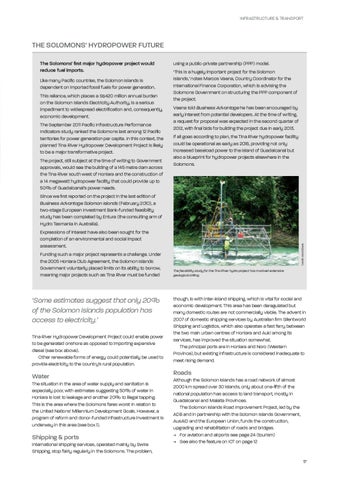
The feasibility study for the Tina River hydro project has involved extensive geological drilling.
though, is with inter-island shipping, which is vital for social and economic development. This area has been deregulated but many domestic routes are not commercially viable. The advent in 2007 of domestic shipping services by Australian firm Silentworld Shipping and Logistics, which also operates a fast ferry between the two main urban centres of Honiara and Auki among its services, has improved the situation somewhat. The principal ports are in Honiara and Noro (Western Province), but existing infrastructure is considered inadequate to meet rising demand.
Roads Although the Solomon Islands has a road network of almost 2000 km spread over 30 islands, only about one-fifth of the national population has access to land transport, mostly in Guadalcanal and Malaita Provinces. The Solomon Islands Road Improvement Project, led by the ADB and in partnership with the Solomon Islands Government, AusAID and the European Union, funds the construction, upgrading and rehabilitation of roads and bridges. > For aviation and airports see page 24 (tourism) > See also the feature on ICT on page 12 17