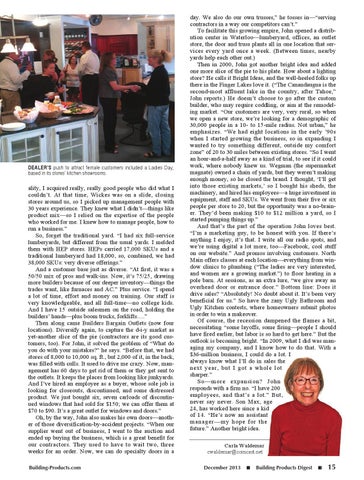
DEALER’S push to attract female customers included a Ladies Day, based in its stores’ kitchen showrooms.
ality, I acquired really, really good people who did what I couldn’t. At that time, Wickes was on a slide, closing stores around us, so I picked up management people with 30 years experience. They knew what I didn’t—things like product mix—so I relied on the expertise of the people who worked for me. I knew how to manage people, how to run a business.” So, forget the traditional yard. “I had six full-service lumberyards, but different from the usual yards. I melded them with HEP stores. HEPs carried 17,000 SKUs and a traditional lumberyard had 18,000, so, combined, we had 38,000 SKUs: very diverse offerings.” And a customer base just as diverse. “At first, it was a 50/50 mix of pros and walk-ins. Now, it’s 75/25, drawing more builders because of our deeper inventory—things the trades want, like furnaces and AC.” Plus service. “I spend a lot of time, effort and money on training. Our staff is very knowledgeable, and all full-time—no college kids. And I have 15 outside salesmen on the road, holding the builders’ hands—plus boom trucks, forklifts….” Then along came Builders Bargain Outlets (now four locations). Diversify again, to capture the d-i-y market as yet-another slice of the pie (contractors are its good customers, too). For John, it solved the problem of “What do you do with your mistakes?” he says. “Before that, we had stores of 8,000 to 10,000 sq. ft., but 2,000 of it, in the back, was filled with culls. It used to drive me crazy. Now, management has 60 days to get rid of them or they get sent to the outlets. It keeps the places from looking like junkyards. And I’ve hired an employee as a buyer, whose sole job is looking for closeouts, discontinued, and some distressed product. We just bought six, seven carloads of discontinued windows that had sold for $150; we can offer them at $70 to $90. It’s a great outlet for windows and doors.” Oh, by the way, John also makes his own doors—another of those diversification-by-accident projects. “When our supplier went out of business, I went to the auction and ended up buying the business, which is a great benefit for our contractors. They used to have to wait two, three weeks for an order. Now, we can do specialty doors in a Building-Products.com
day. We also do our own trusses,” he tosses in—“serving contractors in a way our competitors can’t.” To facilitate this growing empire, John opened a distribution center in Waterloo—lumberyard, offices, an outlet store, the door and truss plants all in one location that services every yard once a week. (Between times, nearby yards help each other out.) Then in 2000, John got another bright idea and added one more slice of the pie to his plate. How about a lighting store? He calls it Bright Ideas, and the well-heeled folks up there in the Finger Lakes love it. (“The Canandaugua is the second-most affluent lake in the country, after Tahoe,” John reports.) He doesn’t choose to go after the custom builder, who may require coddling, or aim at the remodeling market. “Our customers are very, very rural, so when we open a new store, we’re looking for a demographic of 30,000 people in a 10- to 15-mile radius. Not urban,” he emphasizes. “We had eight locations in the early ’90s when I started growing the business, so in expanding I wanted to try something different, outside my comfort zone” of 20 to 30 miles between existing stores. “So I went an hour-and-a-half away as a kind of trial, to see if it could work, where nobody knew us. Wegman (the supermarket magnate) owned a chain of yards, but they weren’t making enough money, so he closed the brand. I thought, ‘I’ll get into those existing markets,’ so I bought his sheds, the machinery, and hired his employees—a huge investment in equipment, staff and SKUs. We went from their five or six people per store to 20, but the opportunity was a no-brainer. They’d been making $10 to $12 million a yard, so I started pumping things up.” And that’s the part of the operation John loves best. “I’m a marketing guy, to be honest with you. If there’s anything I enjoy, it’s that. I write all our radio spots, and we’re using digital a lot more, too—Facebook, cool stuff on our website.” And promos involving customers. North Main offers classes at each location—everything from window clinics to plumbing (“The ladies are very interested, and women are a growing market.”) to floor heating in a pole barn. At sessions, as an extra lure, “we give away an overhead door or entrance door.” Bottom line: Does it drive sales? “Absolutely! No doubt about it. It’s been very beneficial for us.” So have the zany Ugly Bathroom and Ugly Kitchen contests, where homeowners submit photos in order to win a makeover. Of course, the recession dampened the flames a bit, necessitating “some layoffs, some firing—people I should have fired earlier, but labor is so hard to get here.” But the outlook is becoming bright. “In 2009, what I did was managing my company, and I know how to do that. With a $36-million business, I could do a lot. I always know what I’ll do in sales the next year, but I got a whole lot sharper.” So—more expansion? John responds with a firm no. “I have 200 employees, and that’s a lot.” But, never say never. Son Max, age 24, has worked here since a kid of 14. “He’s now an assistant manager—my hope for the future.” Another bright idea. Carla Waldemar cwaldemar@comcast.net December 2013
Building Products Digest
15