LABOR
OUT OF PLANE
Tanya Afroz, George Behn, Orghya
Daniel Vrana
Bhattacharjee, Niloofar Ghobadi, Taras
Omar Khan + Nicholas Bruscia | Thesis
Kes, Andrew Kim, Cortland Knopp, Kenzie McNamara, Kyle McMindes, Mathew Meyers, Timothy Rhul Fall 2015 | Chris Romano | ARC 609
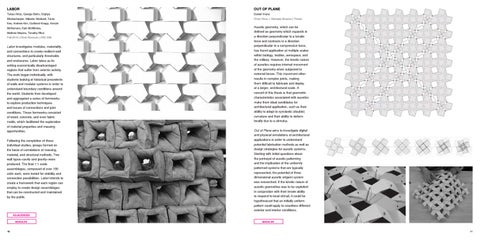
Labor investigates modules, materiality, and connections to create resilient wall structures, and particularly thresholds and enclosures. Labor takes as its setting economically disadvantaged regions that suffer from seismic activity. The work began individually, with students looking at historical precedents of walls and modular systems in order to understand boundary conditions around the world. Students then developed and aggregated a series of formworks to explore production techniques and issues of connections and joint conditions. These formworks consisted of wood, concrete, and even fabric molds, which facilitated the exploration of material properties and massing opportunities. Following the completion of these individual studies, groups formed on the basis of correlations of massing, material, and structural methods. Two wall typesď„„cavity and gravityď„„were produced. The final 1:1 scale assemblages, composed of over 100 units each, were tested for stability and connection possibilities. Labor intends to create a framework that each region can employ to create design assemblages that can be constructed and maintained by the public.
Auxetic geometry, which can be defined as geometry which expands in a direction perpendicular to a tensile force and contracts in a direction perpendicular to a compressive force, has found application at multiple scales within biology, textiles, aerospace, and the military. However, the kinetic nature of auxetics requires internal movement of the geometry when subjected to external forces. This movement often results in complex joints, making them difficult to fabricate and deploy at a larger, architectural scale. A conceit of this thesis is that geometric characteristics associated with auxetics make them ideal candidates for architectural application, such as their ability to adapt to synclastic (double) curvature and their ability to deform locally due to a stimulus. Out of Plane aims to investigate digital and physical simulations of architectural applications in order to understand potential fabrication methods as well as design strategies for auxetic systems. Starting with initial questions about the portrayal of auxetic patterning and the implication of the uniformly patterned systems that are typically represented, the potential of three dimensional auxetic origami system was researched. If the kinetic nature of auxetic geometries was to be exploited in conjunction with their innate ability to respond to local stimuli, it could be hypothesized that an initially uniform pattern could apply to countless different exterior and interior conditions.
ADJACENCIES MODULES
10
MODULES
11