A COMPELLING JOURNEY
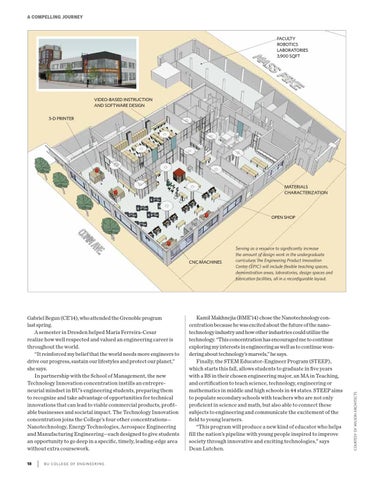
FACULTY ROBOTICS LABORATORIES 3,900 SQFT
VIDEO-BASED INSTRUCTION AND SOFTWARE DESIGN 3-D PRINTER
MATERIALS CHARACTERIZATION
OPEN SHOP
Gabriel Begun (CE’14), who attended the Grenoble program last spring. A semester in Dresden helped Maria Ferreira-Cesar realize how well respected and valued an engineering career is throughout the world. “It reinforced my belief that the world needs more engineers to drive our progress, sustain our lifestyles and protect our planet,” she says. In partnership with the School of Management, the new Technology Innovation concentration instills an entrepreneurial mindset in BU’s engineering students, preparing them to recognize and take advantage of opportunities for technical innovations that can lead to viable commercial products, profitable businesses and societal impact. The Technology Innovation concentration joins the College’s four other concentrations— Nanotechnology, Energy Technologies, Aerospace Engineering and Manufacturing Engineering—each designed to give students an opportunity to go deep in a specific, timely, leading-edge area without extra coursework. 18
B U CO L L EG E O F E N G I N E E R I N G
Kamil Makhnejia (BME’14) chose the Nanotechnology concentration because he was excited about the future of the nanotechnology industry and how other industries could utilize the technology. “This concentration has encouraged me to continue exploring my interests in engineering as well as to continue wondering about technology’s marvels,” he says. Finally, the STEM Educator-Engineer Program (STEEP), which starts this fall, allows students to graduate in five years with a BS in their chosen engineering major, an MA in Teaching, and certification to teach science, technology, engineering or mathematics in middle and high schools in 44 states. STEEP aims to populate secondary schools with teachers who are not only proficient in science and math, but also able to connect these subjects to engineering and communicate the excitement of the field to young learners. “This program will produce a new kind of educator who helps fill the nation’s pipeline with young people inspired to improve society through innovative and exciting technologies,” says Dean Lutchen.
COURTESY OF WILSON ARCHITECTS
CNC MACHINES
Serving as a resource to significantly increase the amount of design work in the undergraduate curriculum, the Engineering Product Innovation Center (EPIC) will include flexible teaching spaces, demonstration areas, laboratories, design spaces and fabrication facilities, all in a reconfigurable layout.