Instant Messenger: Raj Manchanda Builds Results-Oriented, High-Tech Communities Sitting next to an engineer from General Electric at an American Society of Mechanical Engineers (ASME) technical conference, Raj Manchanda (ME’89) wastes no time. He peppers the man for the latest news on what GE is doing in energy storage; the conversation sparks a series of meetings; and ASME winds up with a plenary speaker for an upcoming fuel cell engineering conference. A self-styled advance man for the ASME, Manchanda is constantly scouting for innovative people and ideas to help the organization carry out its 120-year-old mission to help the global engineering community develop solutions to critical, real-world problems. As director of emerging technologies in ASME’s Knowledge and Community Sector, he works to facilitate collaboration and knowledge-sharing across all engineering disciplines. “We gather physicists, chemists, engineers and other multidisciplinary professionals around common problems through forums, publications, joint projects and other platforms,” says Manchanda, who has served the 127,000plus member organization for 19 years. “The idea is to form communities of interested ASME members and partners, and give them the information and tools they need not only to advance viable technology solutions, but also to commercialize them.” Advancing 21st-Century Energy Solutions These days, Manchanda is building a community of experts to advance a groundbreaking ASME initiative addressing three major energy challenges: how to store energy produced by photovoltaic cells, wind farms and other renewable power sources; how to design energyefficient building equipment and systems; and how to use less water in energy extraction, production, processing and distribution—and, conversely, less energy in water extraction, purification and distribution. Particularly excited about stimulating solutions to the energy-water challenge, Manchanda is jump-starting one high-tech community to devise ways to reduce high rates of energy and water consumption in power, agriculture, mining and other sectors of the economy. Potential solutions include the use
of nanotechnology for more energy-efficient desalination and innovative advanced cooling technologies in power plants. “The amount of fresh water is limited, and we’re saying it’s time for technology to play a greater role in increasing efficiency of both energy and water consumption,” he stresses. “By bringing together industry professionals, researchers and regulators and talking to congressmen and senators to expose the problem, we can amplify and advance technology-based solutions.” Igniting High-Tech Communities Former and current supervisors describe Manchanda as a connector, a term popularized by author Malcolm Gladwell that refers to individuals with an extraordinary ability to bring people from disparate worlds together through a mix of “curiosity, self-confidence, sociability, and energy.” Manchanda has spent nearly two decades at ASME inspiring thought leaders from technology, business and other fields to unite around common goals. Manchanda’s current supervisor, Noha El-Ghobashy, director of technical programming and development in ASME’s Knowledge and Community Sector, marvels at his ability to connect subject matter experts, organizations and ideas. “His ability to excite and move large groups of people is exemplary,” she says. “He has an incredibly positive attitude, and that’s really important in trying to build something from the ground up.” When Manchanda was assigned the task of initiating the ASME Nanotechnology Institute in 2001, knowledge about the emerging field was limited. To get the institute off the ground, he worked with visionary Arun Majumdar—an ASME Fellow who now heads the Department of Energy’s ARPA-E organization—to focus on the design, synthesis and integration of nanostructures to develop functional nanosystems. A community of materials researchers, electrical engineers, chemists, physicists, biologists and other technical professionals was formed. “We organized the key players and facilitated workshops, forums and training courses to disseminate knowledge across disciplines,” Manchanda recalls. “This interdisciplinary
Fall 2 010 M A G A Z I N E
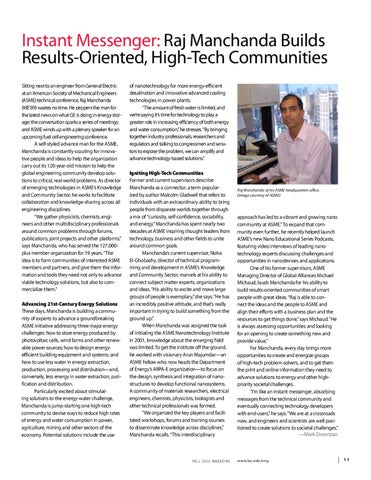
Raj Manchanda at his ASME headquarters office. (Image courtesy of ASME)
approach has led to a vibrant and growing nano community at ASME.” To expand that community even further, he recently helped launch ASME’s new Nano Educational Series Podcasts, featuring video interviews of leading nanotechnology experts discussing challenges and opportunities in nanodevices and applications. One of his former supervisors, ASME Managing Director of Global Alliances Michael Michaud, lauds Manchanda for his ability to build results-oriented communities of smart people with great ideas. “Raj is able to connect the ideas and the people to ASME and align their efforts with a business plan and the resources to get things done,” says Michaud. “He is always assessing opportunities and looking for an opening to create something new and provide value.” For Manchanda, every day brings more opportunities to create and energize groups of high-tech problem-solvers, and to get them the print and online information they need to advance solutions to energy and other highpriority societal challenges. “I’m like an instant messenger, absorbing messages from the technical community and eventually connecting technology developers with end-users,” he says. “We are at a crossroads now, and engineers and scientists are well positioned to create solutions to societal challenges.” —Mark Dwortzan
www.bu.edu/eng
11