GETTING STARTED Booth’s place on the Board wasn’t something he might have expected when he first came to Brooks in 1963. After attending Fenn School in Concord, Mass., Booth felt he was ready to go away for high school. The Brooks campus was about 40 minutes from his home, which was far enough away that boarding made sense but close enough that he could stay connected to his family. “We always talk about Brooks being a small school,” said Booth. “But when I arrived as a third-former, the campus felt huge. Mr. Ashburn, the founding headmaster of the school, had a certain gravitas as did many of the senior faculty members. It was an intimidating place for a 14-year-old.” Over the next four years, Booth would thrive in classes and athletics under the tutelage of Brooks legends Graham Ward, Doc Scudder, George Waterston, Ox Kingsbury, Frank Jackson, Warren Flint, Tom Vennum, Ray Eusden and Jack McVey. The same was true in athletics with talented and experienced faculty coaches. “The school was a different place back then,” said Booth. “Brooks was an all-boys school. It was also a relatively young school with a much smaller endowment than its New England peers. It was a formal place with lots of rules, and you had to have your wits about you to do well.” Booth did well enough at Brooks to earn admission to Trinity College, where he was a history major. “I had some great professors, but unfortunately the late ’60s was a turbulent time with lots of distractions,” said Booth. “I wish I had taken better advantage of the academic opportunity.” Booth graduated from Trinity in 1971 and his first job out of
22
college was at State Street Bank and Trust Company in their trust management training program. “I had always been interested in investing,” said Booth. “And in the early ’70s, Boston and New York were at the epicenter of the investing world. State Street was a great place to get my feet wet and learn the business at a nationally recognized institution.” After a few years in Boston, Booth moved to New York to work at TIAA-CREF. “That was my first ex-pat experience,” joked Booth. “Up until 1978, I had spent my entire life in New England. Now all of a sudden I was living in New York, and the fast pace of the city was a great experience.” As much as he loved New York, Booth and his young wife, Molly, whom he married in 1976, soon found themselves back in Boston. After a short stint at David L. Babson, Booth jumped at the chance to work at Wellington Management.
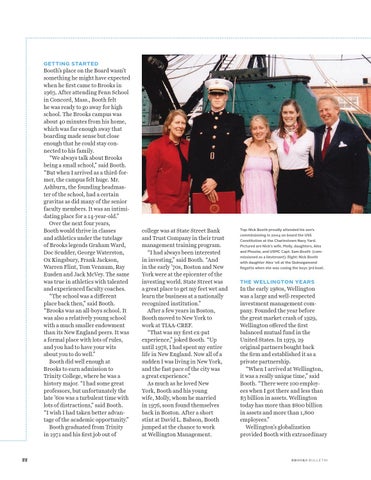
Top: Nick Booth proudly attended his son’s commissioning in 2004 on board the USS Constitution at the Charlestown Navy Yard. Pictured are Nick’s wife, Molly, daughters, Alex and Phoebe, and USMC Capt. Sam Booth (commissioned as a lieutenant). Right: Nick Booth with daughter Alex ’06 at the Quinsigamond Regatta when she was coxing the boys 3rd boat.
THE WELLINGTON YEARS In the early 1980s, Wellington was a large and well-respected investment management company. Founded the year before the great market crash of 1929, Wellington offered the first balanced mutual fund in the United States. In 1979, 29 original partners bought back the firm and established it as a private partnership. “When I arrived at Wellington, it was a really unique time,” said Booth. “There were 100 employees when I got there and less than $3 billion in assets. Wellington today has more than $800 billion in assets and more than 1,800 employees.” Wellington’s globalization provided Booth with extraordinary
B RO O KS BUL L E TI N