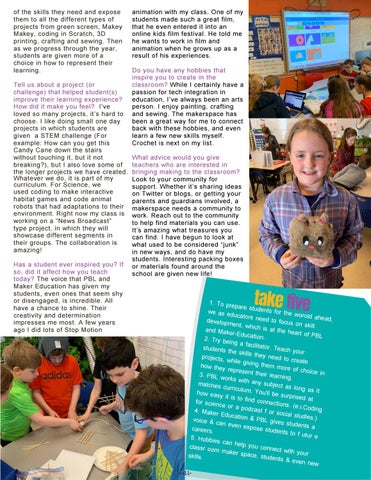
of the skills they need and expose them to all the different types of projects from green screen, Makey Makey, coding in Scratch, 3D printing, crafting and sewing. Then as we progress through the year, students are given more of a choice in how to represent their learning. Tell us about a project (or challenge) that helped student(s) improve their learning experience? How did it make you feel? I’ve loved so many projects, it’s hard to choose. I like doing small one day projects in which students are given a STEM challenge (For example: How can you get this Candy Cane down the stairs without touching it, but it not breaking?), but I also love some of the longer projects we have created. Whatever we do, it is part of my curriculum. For Science, we used coding to make interactive habitat games and code animal robots that had adaptations to their environment. Right now my class is working on a “News Broadcast” type project, in which they will showcase different segments in their groups. The collaboration is amazing! Has a student ever inspired you? If so, did it affect how you teach today? The voice that PBL and Maker Education has given my students, even ones that seem shy or disengaged, is incredible. All have a chance to shine. Their creativity and determination impresses me most. A few years ago I did lots of Stop Motion
animation with my class. One of my students made such a great film, that he even entered it into an online kids film festival. He told me he wants to work in film and animation when he grows up as a result of his experiences. Do you have any hobbies that inspire you to create in the classroom? While I certainly have a passion for tech integration in education, I’ve always been an arts person. I enjoy painting, crafting and sewing. The makerspace has been a great way for me to connect back with these hobbies, and even learn a few new skills myself. Crochet is next on my list. What advice would you give teachers who are interested in bringing making to the classroom? Look to your community for support. Whether it’s sharing ideas on Twitter or blogs, or getting your parents and guardians involved, a makerspace needs a community to work. Reach out to the community to help find materials you can use. It’s amazing what treasures you can find. I have begun to look at what used to be considered “junk” in new ways, and do have my students. Interesting packing boxes or materials found around the school are given new life!
1. To pre pare stu dents fo we as e r the wo ducators rold ahe n ad, e e d to focus developm on skill ent, whic h is at th and Mak e heart o er-Educa f PBL ti o n. 2. Try be ing a fac ilitator. T students e a ch yo u the skills r they nee projects, d to crea while giv te ing them how they m o re of choice represen t their le in 3. PBL w arning. orks with any subje matches ct as lon curriculu g as it m . You'll b h o w ea s e surpris y it is to e d at find conn for scien ections. ce or a (e .i .C oding podcast 4. Make f or socia r Educati l s tu d ie o s.) n & PBL voice & gives stu can even d e n ts e a xpose stu careers. dents to f utur e 5. Hobbie s can he lp you c classr oo onnect w m make ith your r space, s skills. tudents & eve n n ew