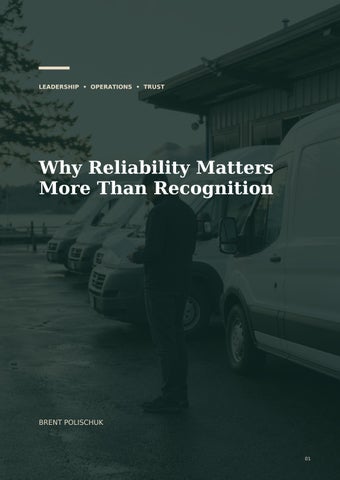
LEADERSHIP • OPERATIONS • TRUST
Why Reliability Matters More Than Recognition
BRENT POLISCHUK
01
Brent Polischuk
Over the years, I have learned that some of the most important work happens behind the scenes. People often notice the final result. They see a successful event, a smooth delivery, or a team that performs well. What they do not always see is the planning, preparation, and follow-through that made those outcomes possible. In many cases, success comes from a long series of small decisions that happen long before anyone notices the result.
Reliability Is Built Through Daily Habits My professional life has been built around reliability. As the owner and operator of a delivery business in Victoria, British Columbia, I am responsible for many different moving parts every day, some of which includes: ·
Vehicle maintenance and fleet oversight
·
Route planning and scheduling
·
Customer communication and service
·
Operational coordination and logistics
·
Budgeting and financial management
To expand on that a little, vehicles need to be maintained, schedules need to be organized, routes need to be planned, and customers need to know they can depend on the service being provided. While every day brings new challenges, the goal remains the same: create a system that people can trust.
WHY RELIABILITY MATTERS MORE THAN RECOGNITION
02
One lesson I have learned is that reliability is not something you achieve once. It is something you practice every day. It starts with preparation. The more prepared you are, the fewer surprises you encounter. That does not mean every problem can be avoided, but it does mean many problems can be reduced or solved before they grow into something larger. Whether it is reviewing a schedule, maintaining equipment, or planning ahead for busy periods, preparation creates stability. I have also found that trust is closely connected to consistency. People want to know that they can rely on you to do what you said you would do. They want confidence that when challenges arise, someone will step in and handle them responsibly. Trust is not built through one big action. It is built through many small actions repeated over time.
WHY RELIABILITY MATTERS MORE THAN RECOGNITION
03
Lessons Learned Through Hockey
My involvement in competitive hockey has reinforced these ideas. Over the years, I have been involved as a player, coach, and operations contributor. Those experiences taught me that successful teams depend on much more than talent. They depend on preparation, communication, and accountability. One of the most valuable lessons I learned through hockey is that leadership is not always loud. In fact, some of the best leaders are the people working quietly in the background. They pay attention to details, support others, and help solve problems before those problems affect the team. They may not receive the most recognition, but their contributions are often essential. I have seen the same principle apply outside of sports. In business, customers rarely think about the planning that goes into a successful delivery. They simply expect the service to be reliable. That expectation creates responsibility. It means staying organized, communicating clearly, and following through on commitments.
WHY RELIABILITY MATTERS MORE THAN RECOGNITION
04
The Importance of Financial Discipline Financial discipline is another important part of that responsibility. Good financial management is not about making dramatic decisions. More often, it is about developing consistent habits. Understanding expenses, planning for future costs, and making practical decisions all contribute to long-term stability. Careful financial planning also creates flexibility when unexpected situations arise.
Another lesson I have learned is that staying calm matters. Pressure is part of almost every leadership role. When people are looking for answers, they often take cues from the person responsible for the situation. If you remain calm and focused, it becomes easier for everyone else to do the same. In my experience, taking the time to assess a situation and think through the options usually leads to better decisions than reacting too quickly. I also believe that respect plays a major role in building strong relationships. Whether you are working with customers, colleagues, athletes, volunteers, or community members, people want to feel valued. Listening carefully, communicating honestly, and treating people fairly helps build the kind of trust that lasts over time.
WHY RELIABILITY MATTERS MORE THAN RECOGNITION
05
Today, I continue to believe that reliability is one of the most valuable qualities a person can develop. Recognition may come and go, but trust is built through consistency. Showing up prepared, keeping commitments, and helping others succeed may not always attract attention, but those habits create lasting results. In business, sports, and community involvement, I have found that doing the quiet work well often has the greatest impact. The people who consistently follow through, support others, and take responsibility help create environments where everyone can succeed. In the end, that kind of reliability is worth more than recognition.
RELIABILITY IS NOT SOMETHING YOU ACHIEVE ONCE. IT IS SOMETHING YOU PRACTICE EVERY DAY.
WHY RELIABILITY MATTERS MORE THAN RECOGNITION
06