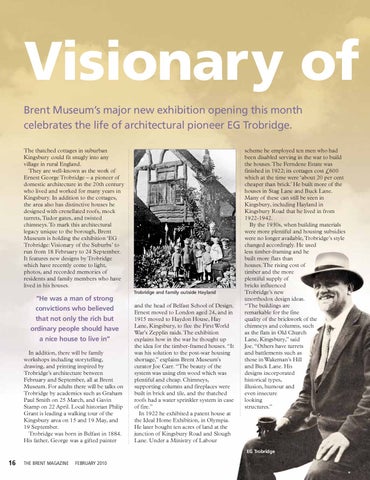
Visionary of Brent Museum’s major new exhibition opening this month celebrates the life of architectural pioneer EG Trobridge. The thatched cottages in suburban Kingsbury could fit snugly into any village in rural England. They are well-known as the work of Ernest George Trobridge – a pioneer of domestic architecture in the 20th century who lived and worked for many years in Kingsbury. In addition to the cottages, the area also has distinctive houses he designed with crenellated roofs, mock turrets, Tudor gates, and twisted chimneys. To mark this architectural legacy unique to the borough, Brent Museum is holding the exhibition ‘EG Trobridge: Visionary of the Suburbs’ to run from 18 February to 24 September. It features new designs by Trobridge which have recently come to light, photos, and recorded memories of residents and family members who have lived in his houses. Trobridge and family outside Hayland
“He was a man of strong convictions who believed that not only the rich but ordinary people should have a nice house to live in” In addition, there will be family workshops including storytelling, drawing, and printing inspired by Trobridge’s architecture between February and September, all at Brent Museum. For adults there will be talks on Trobridge by academics such as Graham Paul Smith on 25 March, and Gavin Stamp on 22 April. Local historian Philip Grant is leading a walking tour of the Kingsbury area on 15 and 19 May, and 19 September. Trobridge was born in Belfast in 1884. His father, George was a gifted painter
and the head of Belfast School of Design. Ernest moved to London aged 24, and in 1915 moved to Haydon House, Hay Lane, Kingsbury, to flee the First World War’s Zepplin raids. The exhibition explains how in the war he thought up the idea for the timber-framed houses. “It was his solution to the post-war housing shortage,” explains Brent Museum’s curator Joe Carr. “The beauty of the system was using elm wood which was plentiful and cheap. Chimneys, supporting columns and fireplaces were built in brick and tile, and the thatched roofs had a water sprinkler system in case of fire.” In 1922 he exhibited a patent house at the Ideal Home Exhibition, in Olympia. He later bought ten acres of land at the junction of Kingsbury Road and Slough Lane. Under a Ministry of Labour
scheme he employed ten men who had been disabled serving in the war to build the houses. The Ferndene Estate was finished in 1922; its cottages cost £600 which at the time were ‘about 20 per cent cheaper than brick.’ He built more of the houses in Stag Lane and Buck Lane. Many of these can still be seen in Kingsbury, including Hayland in Kingsbury Road that he lived in from 1922-1942. By the 1930s, when building materials were more plentiful and housing subsidies were no longer available, Trobridge’s style changed accordingly. He used less timber-framing and he built more flats than houses. The rising cost of timber and the more plentiful supply of bricks influenced Trobridge’s new unorthodox design ideas. “The buildings are remarkable for the fine quality of the brickwork of the chimneys and columns, such as the flats in Old Church Lane, Kingsbury,” said Joe. “Others have turrets and battlements such as those in Wakeman’s Hill and Buck Lane. His designs incorporated historical types, illusion, humour and even insecure looking structures.”
EG Trobridge
16
THE BRENT MAGAZINE
FEBRUARY 2010