Instead, she looked to the possibilities in plants. Taking the DNA Plant Technology internship may have paid little in salary but it definitely offered “a long-term gain,” Verchot says. “In those days, internships in biotechnology were rare … [but] the experience was really enjoyable.” “The company is no longer in existence,” says Verchot. “However, the experience was life-changing because I learned that I loved plant biology.” Working side-by-side with scientists at DNA Plant Technology, which partnered with Campbell Soup, Verchot helped engineer more flavorful vegetables for soups using tissue culture to enrich them. Verchot also worked in industry. She worked for a small start-up company in ag biotechnology after she graduated from Rutgers. She then went back to school for a doctorate at Texas A&M University and a post-doctoral appointment at Sainsbury Laboratory in the United Kingdom. “In all my projects, we have always used tissue culture for research and for understanding fundamental processes,” Verchot says. “Tissue culture is always the basis for engineering and for understanding biological processes. In my work, we look at viruses and understanding virus life cycles, as well as trying to develop strategies to control viruses. [Tissue culture is] a pervasive tool as well as a product.” Bringing that experience with her to the Noble Research Center at OSU, Verchot first dived into experiments with wheat and what improvements could help Oklahoma’s farmers. “It has always been a broad project. Our goal is to meet the needs of the state,” says Verchot. “I have always been looking for opportunities to help. The project with canna lilies came up, and it seemed like there was a real need and a real solvable problem. It seemed like the natural way to go.” The state agreed. With support from the Oklahoma Center for the Advancement of Science and Technology and Horn Canna Farms, the largest wholesaler of canna lilies in the nation, Verchot went to work. She soon proved that virus-free canna lilies could
be produced by micro-propagation of embryo and shoot tip cultures. “The value of tissue culture production has been in the back of my mind through my career, and it has been a major influence in establishing VF Canna,” says Verchot about the company she’s established through OSU’s Cowboy Technologies to commercialize her research. “There are some issues that we felt we could contribute to the production in helping growers to support the industry.”
nologies’ chief executive officer. “The process we’ve established at OSU is designed to identify and foster projects, like hers, that are based on sound science, are economically viable and stand to benefit not only Oklahoma but the world.” The partnership with Horn Canna Farms takes place at the Ridge Road greenhouse facilities at OSU. Horn provides planting, harvesting and weed control; in return, it is anticipated that Horn will receive an exclusive right to the commercial bulb market. Every growing season, VF Canna will screen plants from Horn for certification and sale. During the screening process,
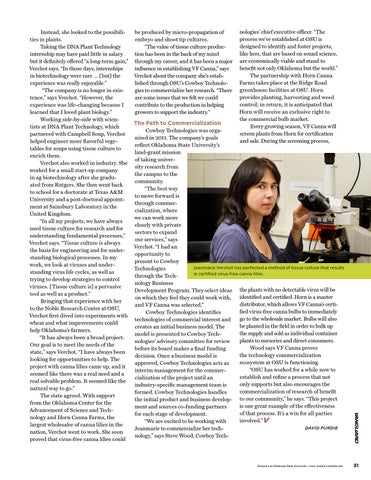
The Path to Commercialization Cowboy Technologies was organized in 2011. The company’s goals reflect Oklahoma State University’s land-grant mission of taking university research from the campus to the community. “The best way to move forward is through commercialization, where we can work more closely with private sectors to expand our services,” says Verchot. “I had an opportunity to present to Cowboy Jeanmarie Verchot has perfected a method of tissue culture that results Technologies in certified virus-free canna lilies. through the Technology Business Development Program. They select ideas the plants with no detectable virus will be identified and certified. Horn is a master on which they feel they could work with, distributor, which allows VF Canna’s certiand VF Canna was selected.” fied virus-free canna bulbs to immediately Cowboy Technologies identifies go to the wholesale market. Bulbs will also technologies of commercial interest and be planted in the field in order to bulk up creates an initial business model. The the supply and sold as individual container model is presented to Cowboy Techplants to nurseries and direct consumers. nologies’ advisory committee for review Wood says VF Canna proves before its board makes a final funding the technology commercialization decision. Once a business model is ecosystem at OSU is functioning. approved, Cowboy Technologies acts as “OSU has worked for a while now to interim management for the commerestablish and refine a process that not cialization of the project until an only supports but also encourages the industry-specific management team is commercialization of research of benefit formed. Cowboy Technologies handles the initial product and business develop- to our community,” he says. “This project is one great example of the effectiveness ment and sources co-funding partners of that process. It’s a win for all parties for each stage of development. involved.” “We are excited to be working with David Purdie Jeanmarie to commercialize her technology,” says Steve Wood, Cowboy Tech-
Research at Oklahoma State University • www.research.okstate.edu
31