At Byford, we believe in priorities - and you’re at the top of that list. We want every customer who comes through our door to have the best experience possible. From vehicle selection to pricing, financing and superior service after the sale, we work
hard to earn your business. After all, what better way to make sure our customers are happy? We invite you to visit Byford Buick GMC and experience it for yourself. We hope to see you soon!
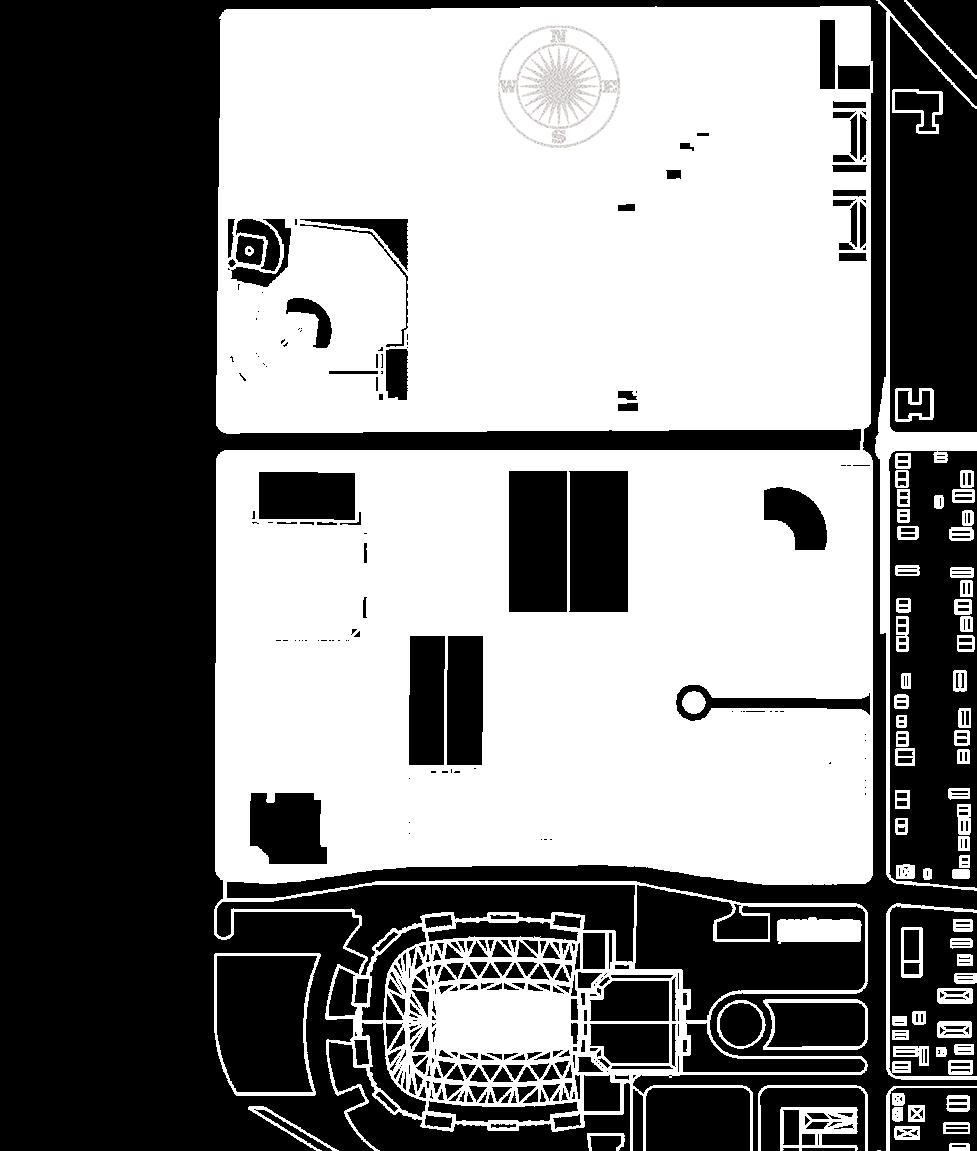
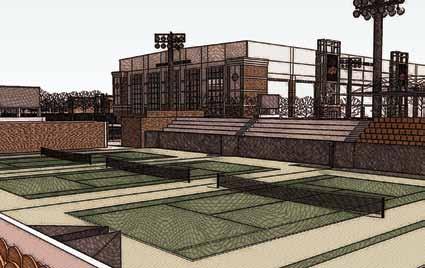
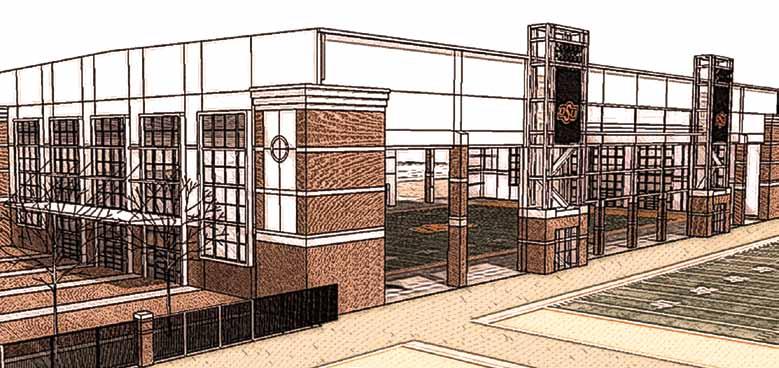
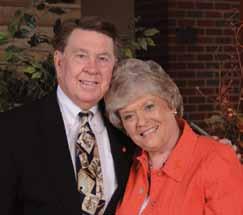
When the Michael and Anne Greenwood Tennis Center opens later this year it will be one of the finest indoor tennis facilities in the nation. The 50,000 square-foot structure will house six courts, coaches’ offices, locker rooms, a sports medicine area and air-conditioned seating for at least 350. The exterior will feature 12 lighted courts and grandstands. The Greenwoods’ gift to OSU is making the goal of offering student-athletes the very best facilities a reality.
THANK YOU, Michael and Anne Greenwood, for creating the momentum to build the second major Athletic Village project.
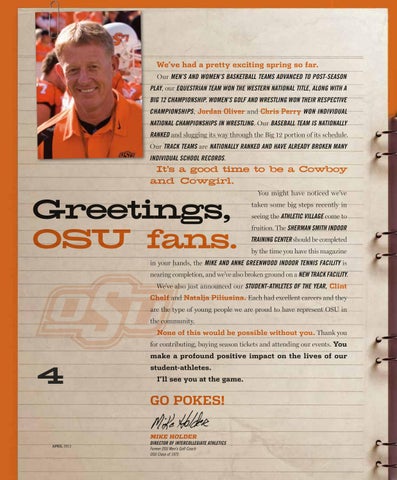
We’ve had a pretty exciting spring so far.
Our men’s and women’s basketball teams advanced to post-season play, our equestrian team won the western n ational title, along with a big 12 championship. women’s golf and wrestling won their respective championships , Jordan Oliver and Chris Perry won individual national championships in wrestling . Our baseball team is nationally ranked and slugging its way through the Big 12 portion of its schedule. Our track teams are nationally ranked and have already broken many individual school records .
It’s a good time to be a Cowboy and Cowgirl.
Greetings, OSU fans.
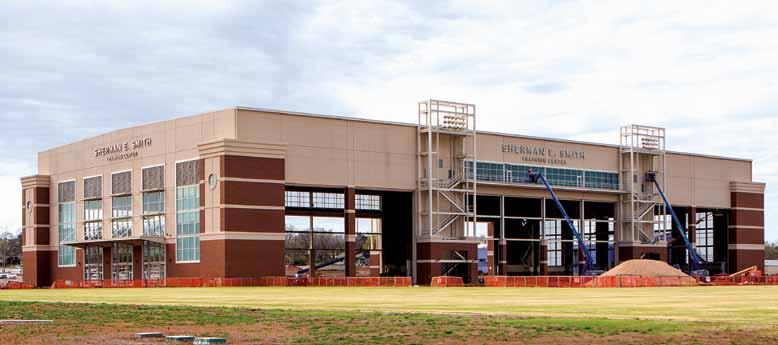
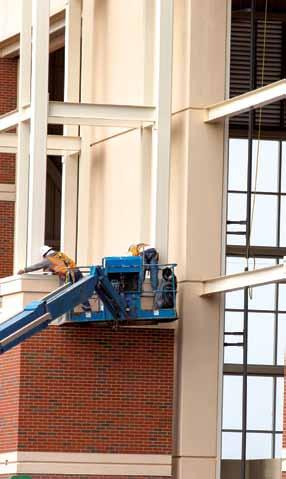
You might have noticed we’ve taken some big steps recently in seeing the athletic village come to fruition. The sherman s mith indoor training center should be completed by the time you have this magazine in your hands, the m ike and anne greenwood indoor tennis facility is nearing completion, and we’ve also broken ground on a new track facility.
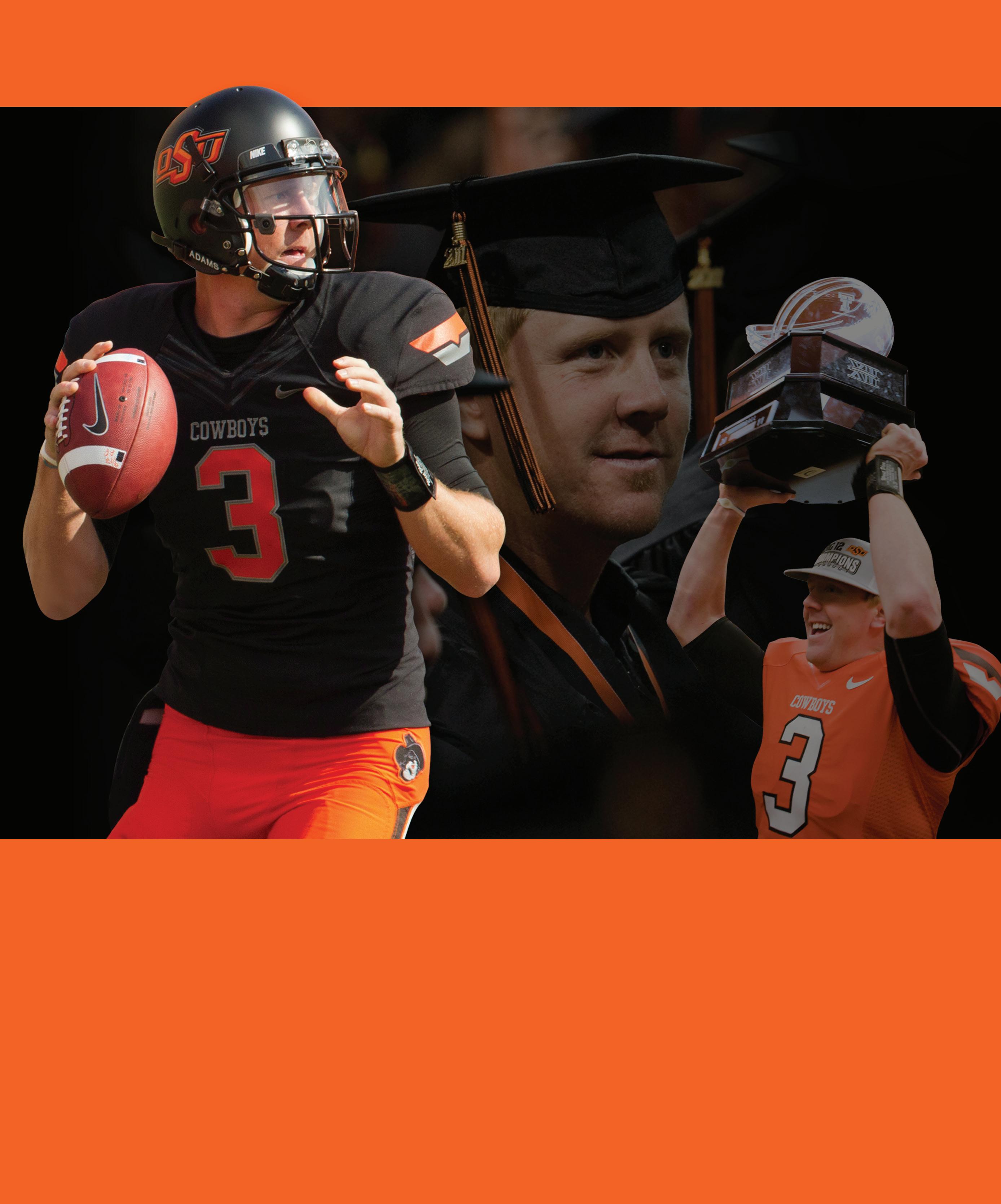
We’ve also just announced our student-athletes of the year, Clint Chelf and Natalja Piliusina. Each had excellent careers and they are the type of young people we are proud to have represent OSU in the community.
None of this would be possible without you. Thank you for contributing, buying season tickets and attending our events. You make a profound positive impact on the lives of our student-athletes.
I’ll see you at the game.
Go Pokes!
MIKE HOLDER Director of i ntercollegiate athletics
PHOTO / PHil sHOckley
posse pokes
POSSE Magazin E Staff
Vice President of e nrollment m anagement / m arketing Kyle Wray
e ditor Cory Cheney
a rt d irector / d esigner Paul V. Fleming
d irector of Photogra P hy Phil Sho CK ley
assistant editor Clay Billman
a ssistant a rt d irector / d esigner r o SS m aute
contributing Photogra P hers g ary l a WS on, Bru C e W ater F ield
c ontributing Writers m att e lliott gene john S on
contributing designer mi C hael o rr a thl E tic S a nnual g iving (POSSE) D E v E l OPME nt Staff
associate athletic d irector / external affairs j e SS e m artin
P osse d irector e llen a yre S
Premium s er V ices d irector Karyl h enry
Publications c oordinator Clay Billman
Programs c oordinator / b enefits m ary l e W i S
eV ent c oordinator / g ame d ay Parking m anager j ame S Batley
athletic d e V elo P ment a ssistant Ste P hanie Boe S e a thl E tic S Maj O r g
Project m anager Sha W n t aylor
OS u POSSE
102 athletics c enter
s tillW ater, ok 74078-5070
P 405-744-7301
F 405-744-9084
o KS t ate P o SS e. C om o KS t ate P o SS
ADVERTISING 405.744.7301
EDITORIAL 405.744.7192
Donations received may be transferred to Cowboy Athletics, Inc. in accordance with the Joint Resolution among Oklahoma State University, the Oklahoma State University Foundation, and Cowboy Athletics, Inc. POSSE magazine is published four times a year by Oklahoma State University Athletic Department and the POSSE, and is mailed to current members of the POSSE. Magazine subscriptions available by membership in the POSSE only. Membership is $150 annually. Postage paid at Stillwater, OK, and additional mailing offices. Oklahoma State University, in compliance with Title VI and VII of the Civil Rights Act of 1964, Executive Order 11246 as amended, Title IX of the Education Amendments of 1972, Americans with Disabilities Act of 1990, and other federal laws and regulations, does not discriminate on the basis of race, color, national origin, sex, age, religion, disability, or status as a veteran in any of its policies, practices or procedures. This includes but is not limited to admissions, employment, financial aid, and educational services. Title IX of the Education Amendments and Oklahoma State University policy prohibit discrimination in the provision of services or benefits offered by the University based on gender. Any person (student, faculty or staff) who believes that discriminatory practices have been engaged in based upon gender may discuss their concerns and file informal or formal complaints of possible violations of Title IX with the OSU Title IX Coordinator, Mackenzie Wilfong, J.D., Director of Affirmative Action, 408 Whitehurst, Oklahoma State University, Stillwater, OK 74078, (405) 744-5371 or (405) 744-5576 (fax).
This publication, issued by Oklahoma State University as authorized by the Assistant Athletic Director, POSSE, was printed by Southwestern Stationers at a cost of $0.9577 per issue. 10M/Apr 2013/#4701.
POSSE magazine is published four times a year by Oklahoma State University, 121 Cordell North Stillwater, OK 74078. The magazine is produced by OSU Athletics and University Marketing, and is mailed to current members of the POSSE Association. Membership starts at $150/year and includes benefits such as the POSSE Magazine and member auto decals.
POSSE annual funds contribute to student-athlete scholarships and operating expenses, which are critical to helping our teams stay competitive. Gifts of all sizes impact all areas of athletics. Postage paid at Stillwater, OK, and additional mailing offices.
of attending an to enhance we are coming up with for our the
EvEry day nEw ways experience oSusporting event loyal fans.
This time, I would like to highlight some of OSU athletics’ best assets — our employees. Our staff is the single most important asset we have in our quest to offer great customer service. Our employees work diligently to ensure you have the best experience possible when dealing with the athletic department, whether it’s gameday or an average weekday.
So, without further ado, I would like to introduce you to one of our many departments within OSU Athletics — the posse office and its staff
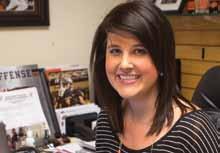
karyl hEnry Director of Premium ServiceS
Karyl directs and coordinates all our premium areas, such as club and suite levels, during football and basketball games. She’s in charge of our court-side concierge service during men’s basketball. She makes sure all of our fans are having a first-class experience from the time they enter our sports facilities until the time they leave. She also employs more than 70 part-time staff. Their main focus is to make sure you have the most enjoyable gameday experience possible.
When the Cowboys are on the move, Karyl is in charge of organizing the r oad r allies , as well as the annual cowboy c aravans , which are our traveling pep rallies that hop from city to city in Oklahoma and Texas.
If that’s not enough, in the last year, Karyl has taken on the responsibility of constantly updating the POSSE website content.
A lot of times, if you walk into the office and have a question about payments or something, Stephanie is the person you’re going to sit down and talk to. She’s the main liaison between the POSSE and the o SU Foundation . She manages the coordination of information. If you look at who’s processing the money from our donors, 90 percent of that is Stephanie. A lot of her time is spent interacting with donors, whether on the phone or face-to-face.
On home football gamedays, she’s in charge of our fan a s sistance areas and employs a staff of six or seven part-time employees. They handle everything from coordination of mobility seating to fan questions of any kind.
ellen ayrES Director, PoSSe
stephanie BOESE
DeveloPment ASSiStAnt / Gift ProceSSor
A 14-year veteran of the POSSE Ellen runs the day-to-day operations of the POSSE office. She oversees the donor database, everything from reconciliation with the o SU Foundation to ensuring each donor has the proper amount of donor points and assisting fellow staff members with all events planned through the POSSE. She takes an active role in the hiring and managing the student employees. If you come into the POSSE office, Ellen can help you with anything you need done. She can answer questions about donations and OSU athletics.
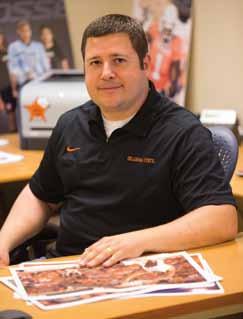
c lay d oesn’t directly report to the POSSE , but he is integral for the experience of the fans. Many of our marketing collaterals are created and designed by Clay — including the POSSE brochure, fundraising literature, team posters, pocket schedules, gameday ads, E-news or a host of other projects. Over the course of 15 years in our athletic department, he’s had a hand in helping make sure our message and brand are consistent across all methods of printed communications. He also writes feature stories and is assistant editor of POSSE magazine, and serves as a Sports Marketing lecturer in the Spears School of Business.
Mary ’s in charge of the O- c lub , which is a social organization for former OSU letter winners/ student-athletes. She handles all the membership drives, billing, processing of benefits, merchandise sales, and is in charge of gameday events for O-Club. She’s also responsible for taking student-athletes to c amp c owb oy every summer where they talk about tickets and do a Q&A with incoming freshmen.
Mary lEwiS eventS coorDinAtor
As always, if you know someone who would like purchase season tickets or join the POSSE , please call us at 877-al l -4 -OSu (877255-4678) or visit www.okstate.com . Annual contributions to Athletics totaling $150 or more qualify for membership in the POSSE and includes an annual subscription to the award winning POSSE magazine, the POSSE star decal for your automobile and an educational tax deduction.
Mary also manages the annual POSSE auct ion and Dinner. She runs the auction top to bottom, from meeting with various committee members who are out soliciting donations for the auction, to compiling the program and coordinating everything for that night’s big event.
And that’s the staff. If you see one of us at a ballgame on campus, on the road or in the community, please introduce yourself and say, “hel lo” or “go Pokes!” Now if you need anything from the POSSE , you’ll recognize a familiar face.
We are very appreciative of your consideration and support of osu ath letics! THEPOSSEIS YOURTEAMBEHINDTHETEAMS!
Jesse Martin associate aD / e xternal affairs okl ahoma state athletics jesse.martin@okstate.edu 405-744-3322
clay BillMan PublicAtionS coorDinAtor
PhotograPhy by phil shockley
PhotograPhy by gary lawson
april 2013
Oklahoma State University’s School of Hotel & Restaurant Administration has been a LEADER in Global Hospitality and Tourism.
The POSSE is “the team behind the teams” … and now you can be an integral part of whichever team you choose. These sport-speci c clubs help raise money for Cowboy and Cowgirl individual programs with funds directed where it’s needed the most.
Revenues generated help supplement annual budgets, fund facility improvements, aid in travel expenses, provide new equipment and enhance the overall student-athlete experience.
AddressINg a
Nee
DUring the PaSt 30 yearS , michael and anne greenwood have been to a lot of OSU tennis matches, which is impressive given how difficult it can be to attend an OSU tennis match.
OSU has never had dedicated tennis facilities. There are no locker rooms, no indoor or outdoor courts dedicated to the teams’ use.
There are, of course, the tennis courts next to the Colvin Center Annex, but those are open, at any time, to any OSU student. There are no restrooms. There are no scoreboards.
OSU tennis players often travel to Ponca City, Tulsa, Edmond and Oklahoma City just to practice during poor weather conditions. Sometimes the coaches make multiple trips because players’ class schedules don’t allow them to all go at once.
aS oF right
now,
osu is the only b ig 12 program with no tennis facilities.
But that’s about to change, thanks in large part to the Greenwoods and their donation to build the Michael & Anne Greenwood Indoor Tennis Center. And once again, we have Boone Pickens to thank.
“First of all, our inspiration is Boone Pickens,” says Michael. “Not only because of the donations he has made to OSU over the years, but also from his comment a few years ago on how he did not understand why so many people rely on their estates to make gifts instead of making your gift now when you can actually see its beneficial impact. Mr. Pickens’ comment really touched us. We were going to do the same thing. We had OSU in our estate plans. We thought, ‘You know, Boone is right. Let’s do something now.’
“When we decided to make an immediate impact, we looked across campus and asked, ‘What seems to be one of the biggest needs?’ For 40 years, former head coach James Wadley led a successful OSU tennis program without the benefit of any facilities at all. We started working with the OSU Tennis staff and Mike Holder and with Coach Wadley ’s pending retirement, we transitioned to developing the facility with Coach Chris Young We Wanted to build off CoaC h Wadley’s legaCy and turn this vision into a reality.”
The Greenwoods were already well aware of the deficient facilities for tennis. They’ve sat through matches in inclement weather. They’ve watched tennis matches clad in winter parkas. Once they were even given hand warmers by Coach Wadley.
“We were at a match one time when osu had the n o. 1 ranked player in the u nited s tates . During a match played in gusty winds, the opposing player hit a hard drive into the corner, and our player returned it with a very high lob shot. The wind was blowing so strong that the ball actually went across the net while in the air, then came all the way back and landed on his side. To his credit, he just grinned and shook his head, along with the rest of us,” says Michael.
The Greenwood’s gift ensures OSU tennis players will get to play and practice, rain or shine or wind.
“The players will not have as many good stories to tell on dealing with the elements,” says Michael, “but they will benefit from a consistent practice schedule. When these facilities are completed, it will change the entire recruiting landscape. We have great head coaches, both Chris Young and Jay Udwadia , and great assistant coaches, but they have been hindered by the lack of facilities. A lot of the players use college as the development ground for going pro. However, if they cannot practice every day because we do not have an indoor facility, then they will not come to OSU. With the new tennis facilities, that limitation is now behind us.”
“It’s going to be exciting, and I can’t wait for people to get the opportunity to see just how good OSU tennis players are,” says Anne. “ t his is going to be perfeC t. to have all the tennis Courts together and W ithin the osu athleti C v illage is going to be fabulous.”
That they’re so dedicated to the tennis teams has more to do with Anne than Michael, but she’s passed that enthusiasm onto him.
“I have always loved tennis,” she says. “My father loved tennis. He would drive up from our hometown of Carnegie, Oklahoma, and meet me for OSU tennis matches. They were consistently good. i t’s just a sport that i love to WatC h. i t requires su C h great athleti C ability.
t hey are extraordinary athletes and good students. it’s an easy sport for me to support.”
They don’t just support OSU tennis. Michael and Anne Greenwood are OSU superfans.
“We have season ti C kets for every sport that sells season ti C kets,” says Michael.
“When I came to college here, it was just where I wanted to go my whole life. My parents said, ‘You can go, but you have to get scholarships.’ So I did,” says Anne. “I loved OSU when I was in high school even though I grew up in a predominantly OU community. But I didn’t care. This is where I was going to go. I’ve always supported OSU. I’ve never missed a bowl game. Because I enjoyed OSU tennis so much, I’ve watched the program for many, many years. I even went to one of Coach Wadley’s tennis camps back in 1981.
And on C e W e got married, i brought out the Orange in m i C hael . He already loved OSU, but I made sure we went to the events. You just have to support it. i hope W e’re the best kind of fans.”
It became easier for the Greenwoods to attend OSU events when they moved to Stillwater to “retire.”
“Anne retired after a 30-year corporate accounting career with major Fortune 500 companies,” says Michael. “After my long career as an executive with several energy companies, I decided to retire from Corporate America and start my own financial advisory firm.
“When Anne retired, we lived in Tulsa. As a consultant, it does not matter where I reside. I told Anne we could live anywhere in the world that she chooses. She said, ‘I want to go back to our old college town.’ So here we are.”
Relocating to Stillwater made it easier for the Greenwoods to volunteer at the University as well, not to just attend athletic events.
“I’m retired, but I’m a full-time volunteer,” says Anne, “and 90 percent of my time is spent at
is hard to put in words the impact Michael and Anne Greenwood have made on our program with their generous donation. Because of their gift, the dreams of our program can now become a reality. Their humble spirit is inspires me every day to work hard and display the characteristics that make this university great!
It
’S te n n i S hCaoC
— ChriS yoUng,heaDwoMen
to my former high school in Carnegie, and Michael’s is tied to Will Rogers High School in Tulsa. We also have an endowed scholarship for the OSU Marching Band and we are one of the lead supporters for the OSU Student Foundation where students raise scholarship funding for fellow students.”
They each believe they would not have achieved what they have in life without the education they received from OSU, an education they would not have gotten without financial assistance.
“a nne and i W er e only able to go to College beCau se of finanC ial aid,” says Michael. “Neither one of us came from privileged backgrounds. That was why we started giving back to the University. We Wanted to make sure that other students Could folloW us , that there would be scholarship money available so they would be able to attend OSU and enjoy the same benefit that we received.”
Anne said, “Both Michael and I know where we came from and can see the difference in our lives education has made.
multi-millionaire to make a difference,” says Michael. “But you can provide only a small scholarship, even $500, and change someone’s life. a s C holarship does not have to be funded W it h millions of dollars. I cannot tell you between the two of us how many additional scholarship funds we have generated just from people we know, and talking to them about the possibilities. They had this mistaken belief that they do not have the kind of wealth to support scholarships. Yes, you do. It does not take millions of dollars to make a signifi Cant differen C e i n a student’s opportunity to su CC ee d.”
The fundraising for the tennis facility is ongoing, and the Greenwoods have pledged to match up to $4 million in donations from other donors.
Oklahoma State, where I am involved in many activities including Friends of the OSU Library, OSU Friends of Music, Women for OSU and freshmen orientation programs. Anything and everything. That’s where my passion is.”
They also support OSU on the academic side of things, contributing to several scholarships. “We each have endowed scholarships linked to our hometown communities,” says Anne. “Mine is tied
“The tennis facility construction is scheduled for completion late summer,” says Michael, “but if we want all the facilities needed to attract regional and national NCAA tournaments, then additional donations are required. And hosting NCAA events is our ultimate goal. ”
“It’s going to be remarkable to be able to watch six matches inside at once, and
michael and anne greenwood are osu sup erfans .
Our
goal in life needs to be to give back and try to help those people who follow us. From where we came from to where we are today would not have been possible without our education, and we know that. Because of that, how can we not help others have the same opportunities we had?”
As a Trustee of the OSU Foundation, Michael often gives fundraising speeches to potential donors, and he believes he’s opened a lot of eyes to how simple it is to make a big impact in a student’s life.
“Many times people think to support scholarships that you have to be a
then walk on the outside concourse, and watch as many outdoor matches,” says Anne. “ i t’s also a Way f or us to honor some of the very best student-athletes W e h ave at the u niversity. Not just in the classroom, but also the way they give back to the community.”
“One thing that surprises many people who have thanked us for our tennis facility donation,” says Michael, “is when they learn that we do not even play tennis. s o this is not about reliving any past glory on the tennis Courts. i t is simply about identifying a key need for the u ni versity and making the C om mitment to fulfill it.”
to the
FRONTLINE GRIdIRON
(and Back Again)
story by matt elliott
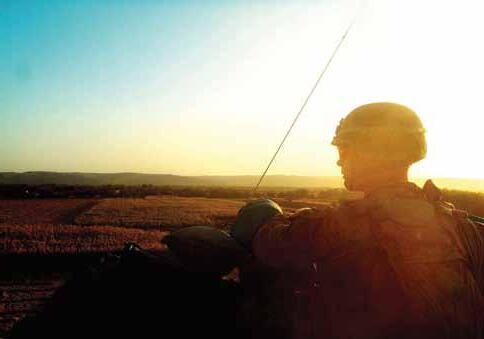
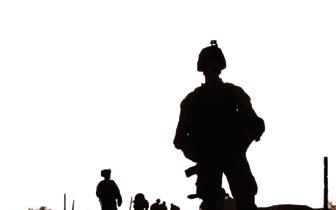
Marine 1st Lt. nathan Peterson isn’t one to ta Lk war stories.
“But i do enjoy teLLing Peo PLe aBout My guys,” says the former Cowboy defensive lineman. “I never miss an opportunity. i wear this ho Ping Peo PLe ask M e a B o ut hiM so i can te L L theM a Bout hiM.”
t hat’s a reference to the bracelet on his right wrist. It reads “ Lance Cpl. Christopher Phoenix ‘Jacob’ Levy.”
Levy was a Marine fatally wounded in Afghanistan while on patrol seeking a group of Taliban fighters who had shelled his platoon’s mud compound with mortar fire a few days before. He was one of Peterson’s Marines.
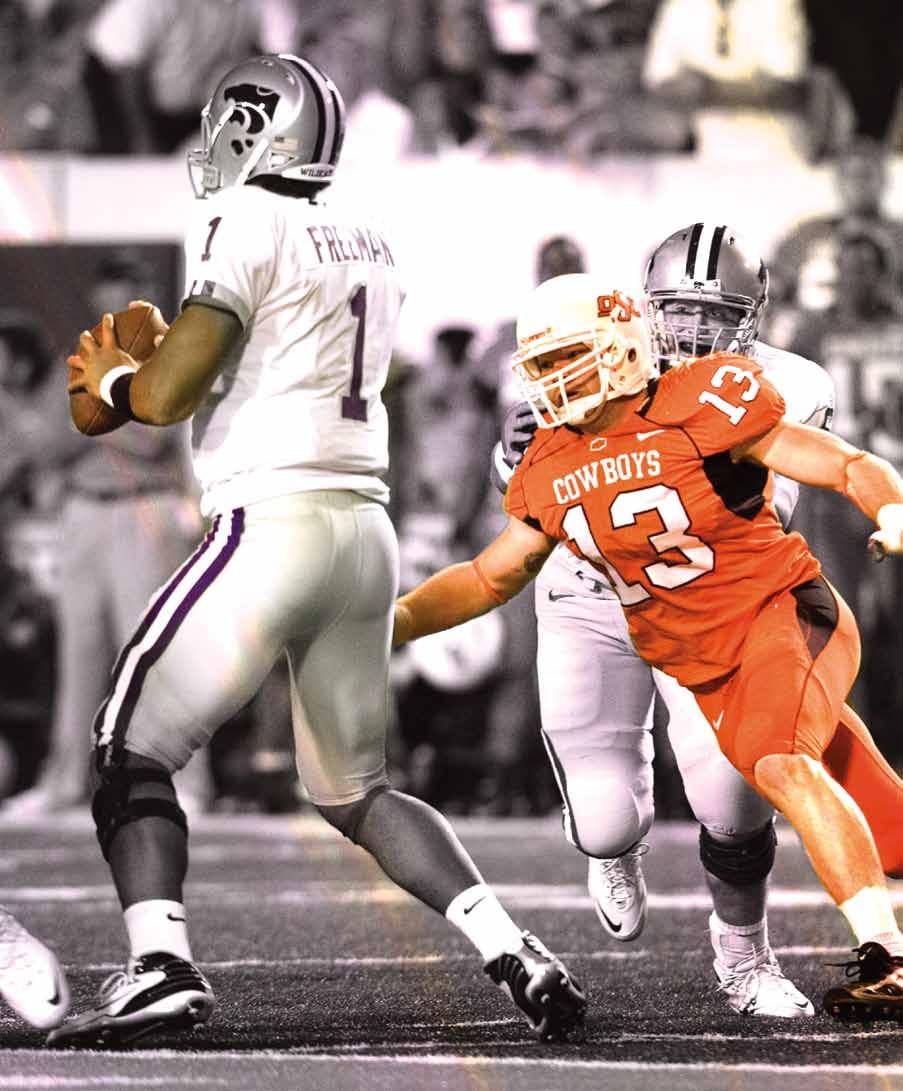
Peterson, a Tulsa native, finished his career as a star osu defensive end in 2008 and graduated from OSU with a management degree. His friends were headed to the corporate world, but that wasn’t for him. He signed up to be an officer in the Marine Corps
In July 2011, he stepped off a plane and into the crucible of restive helmand Province in south afghanistan. The region is a hotbed of heroin production and fighters affiliated with the Taliban, the regime ousted by the NATO invasion following the Sept. 11, 2001, terrorist attacks.
the only thing hotter than the region’s combat was its climate. Temperatures would climb to the 110s during the summer but would plunge to near zero in the winter. Nearly every form of wildlife had skipped the area except for gigantic (but harmless) camel spiders that skittered around camps and dusty trails.
His unit fought in and around the “Green Zone,” an area of irrigated farmland around the Helmand River developed through cooperation with the West in the 1950s, an area neglected by decades of war. Peterson fought an enemy he rarely saw, one that had been at war since before he was born. two of his men, Lance Cpl. Cody Evans and Cpl. Christian Brown , were injured in addition to Levy.
his tour ended in February 2012 , and he was discharged Dec. 31, 2012. Peterson took a job last January as a quality assurance coach at osu under defensive coordinator glenn sp encer. He serves as a mentor for OSU players off the field.
“Some of the players came up and ask me, ‘Oh, you were in the Marines. Was that like Special Forces? ‘No, I wasn’t in Special Forces. i was just in the reguL ar Marines ,’” laughs Peterson.
It’s hard to imagine the 6-foot 2-inch former college defensive end being uncomfortable, but he admits he’s a little uncomfortable talking about his personal experience in war. Not because of trauma. But because he says he’s nothing special. He prefers to talk about his men and to tell what they do each day, saying “the young enlisted are the backbone of our military. in the end, it is a LL a Bout theM.”
Nevertheless, he met with POSSE recently to reflect on his service, working with local Afghanis, sacrifice and how similar leading men on a football field is to leading men at war.
The biggest difference, he admits, is one is a game, and the other is not.
photography by gary lawson
P oSSe: Take me back to your senior year at OSU. why join the military?
NP: It was just something that started to eat at me. A lot of it started when I met a friend of my wife’s. I was in college playing football. And this guy was doing backto-back tours overseas. I don’t say everyone should think this way. But I just felt, “I’m a military-aged male. we’re in a time of war. i should do my part.” I decided it was now or never.
P o SS e : Di d you go immediately after graduation?
NP: I interviewed a few places. My heart just wasn’t in it. And I think it was showing in some of the interviews I had. I called my recruiter in the summer of 2009, and three months later I was in Quantico at Officer Candidate School Coach (Rob) Glass wrote me a great letter of recommendation. I started training on my own about six months before I had officially decided what I was going to do.
P o SS e: You weren’t married at the time, but you were engaged. What did your fiancée say?
NP: She wasn’t thrilled by any means. But she was so supportive. She knew how important it was to me. Our first three years of marriage, we probably weren’t together for more than two or three weeks at a time. She moved with me to North Carolina when I got stationed there. She has made so many sacrifices for me.
P o SS e: Helmand Province is basically a desert with mountains, but there’s the Green Zone around the river. What was your first deployment like?
NP: There’s so much going on. You don’t really have time to sit and focus on how scary where you’re at and what you’re doing is. Sometimes you sit there, and you’re like, “ i’M in aFgh anistan. h o Ly cra P.” When I got my platoon, I had 34 guys under me. I was so busy and focused on our day-to-day patrols, it kept my mind off of thinking too much.
P o SS e : W hat happened once you got there?
NP: Our battalion went to our area of operations which was Sangin first. We were there for two-and-a-half months. Then, we were assigned to clear from there to the Kajaki Dam. (Drawing a map with his hands on a table.) We had an artillery unit up at Kajaki. Our battalion was down here in Sangin, but there was this big space in between. They wanted to fill that. So we helicoptered in during the middle of the night.
P o SS e : t his is in the middle of nowhere. you’re outside all the time. you’re leading guys who are basically teenagers. what’s it like? where did you live?
NP: We took over a compound. A mud compound. We gave this family money — a lot of money for what they had to do. And we told them, “Hey, we have to take this for our safety.” It’s hard to make them understand. But you have to make them understand that we’re doing this for the stability of their village. we want to run the taliban out of here. They don’t always understand.
PoSSe: They incur some danger upon themselves by taking the money, don’t they?
NP: Yeah, they probably do. But they always want money. So we took that compound over. It’s got four corners. We built posts up. Sandbags. Tried to fortify it the best we could. That mud that they build with is surprisingly strong. Some of the compound has a roof, and there’s a courtyard. But as long as there’s a roof — a place where you can take cover from mortars and stuff — you’re ok . The few times it rains it just turns into a big mud slosh.
P oSS e: S o, it’s dirty. There’s no running water. No electricity. Are there animals running around? Are the bugs bad? Are there like cobras laying around?
NP: no, no cobras. We came across camel spiders. We didn’t have any problems with bugs. I know some other units had some problems with scabies and stuff. Because they would come in to these compounds and sleep on some of the locals’ rugs and stuff. Guys would get sick all the time. It’s just part of it. You just get sick because it’s just so dirty.
P o SS e: What was a typical day?
NP: I had my platoon divided into three squads. During daylight hours, a squad was patrolling at all times. My intent was, as they’re going in, another would push out. We had a constant presence in the area.
P o SS e: Were the locals still there?
NP: Kind of. They were there at first when we got there. No American had ever been to where we were (since the invasion). i reMeMBer the First day we got there. I went on a patrol and talked to an old man through our interpreter. He said, “ t here are ta L iB an c o M in g. we’re Leaving.” I’ll never forget that moment because he shook my hand and said, “Be careFuL .” I didn’t realize what we were in for. Later that day is when it started, and it didn’t really stop much for the next month-and-a-half.
P o SS e : Wa s this the start of the engagement that killed Lance Cpl. Levy?
NP: Yes. It was an every day thing. He’s one of the bravest Marines I’ve ever seen. He was our designated marksman. We gave him a special rifle with a highpowered scope. We were taking mortar fire on our compound, and it was very close. We had a policy that, if you start taking mortar rounds, everybody gets in their rooms and takes cover. Unless you’re me, or the guys on post, you’re in your hut. The first round hits, and within seconds the first thing I see is Levy sprinting to the roof with his rifle to look for the (mortar crew’s) spotters. He didn’t hesitate. He found the spotter. And we didn’t get mortared again.
A week later, when he was wounded with what ultimately was the cause of his death, his squad was out, and he put himself on a roof again returning fire, covering and spotting for his guys. And that’s when he got hit. He died saving his friends’ lives. And I just can’t say enough about the kid.
PoSSe: what is it like for you to lead people in that situation?
NP: it’s diFFicuLt. you have to tell them to do things that you know could kill them. it’s the hardest thing. When you survive, it’s hard to reconcile that for a while. But that’s just part of it. I think it’d be easier to be told what to do, personally. I was fortunate. I rarely had to push my guys. If anything, I had to pull the reins back. That’s a good problem to have if you’re a platoon commander.
P o SS e : I u nderstand this area is incredibly difficult terrain to fight in. One area may be rocky and barren, another may be thick with vegetation.
NP: we had to wear different color of camouflage depending on where we were patrolling. In the Green Zone, we had our green “camis” on. In the brown zone, we had to wear our desert camis. Depending on where you are, it’s so hit or miss. Some areas are so wide open, there are just a few compounds and some ditches maybe. Then, some areas in the green zone will have cornfields and trellises — stuff like that. It just varies.
P oSS e: Wa s this fighting where you could see the enemy, or could you not? Could you tell who he was?
NP: i saw the eneM y o ne tiMe. one time i saw him. i mean clearly — one time. Other than that, you just see some muzzle flashes. Or you’ll see a few things here and there. The one time I saw them, it was only because we saw them before they saw us. That was it. They’d shoot through holes in walls. Stuff like that. They’re very crafty. They know they’re outmatched so they’re crafty.
P o SS e: A nd they’ve been fighting for years.
NP: They have. They don’t even know who they’re fighting sometimes. t hey caLLed us russians PLenty oF tiMes.
P o SS e: Re ally? The circumstances were so different. It’s crazy that they would lump you in to the same category.
NP: And that was the difficult thing. As the platoon commander, you have to fight your urge to just be barbaric. You have to be the one that says, “Guys, we’re here for these right reasons. We have to help these people understand that.” Ninetynine percent of the time, they’re going to be ungrateful. But every once in a while, you’ll find those good people who mean it and thank you for what you’re doing.
PoSSe: do any of those people stand out in your mind?
NP: y eah a n older gentleman. a schoolteacher. When I got to go talk to him he just wanted to thank us for coming. He was like, “Three months ago I couldn’t do this.” I sat there and watched him teach a class full of kids. Boys and girls. Which is not supposed to happen.
helping the army and the cops. We’re helping them stand up. But eventually we’re going to have to pull that chair out, and they’re either going to fall on their butts, or they’re going to stand up. Eventually it has to happen. Because it’s going to get ugly.
PoSSe: Did you work with the police and the army a lot?
NP: We did a little bit. We had to do some partnered stuff sometimes. We preferred not to, but we understood it was part of the deal.
P o SS e: Why did you prefer not to? Because of insider attacks?
NP: For the reasons you hear about now and all the stuff that’s been happening lately. It was happening then, too. It just wasn’t as bad as it is now. Not saying they’re all like that. there’s one bad guy, and there are 50 great ones. You question sometimes their motives and stuff like that. But there are guys out there that just hate the Taliban and really want their country back.
P o SS e: D id you feel like you were making a difference when you were there, or did you think the Taliban were just going to come back after NATO leaves?
NP: It’s all dependent on the government, the police and the Afghan army. It’s all dependent on them. We’ve been there forever — 11 years now. We’ve been
PoSSe: What sticks out in your mind looking back on your service?
NP: When you’re the platoon commander, you’re in charge. Guys aren’t always going to like you. Because you have to be the one that makes them do stuff that they don’t want to do daily. I had a great platoon sergeant. as platoon commander, i’m POSSE
in charge of everything overall tactically and what we do in our planning. He was the disciplinarian. The guys loved him, too. But what makes it worth it for me, is when I see my guys, and they tell me, “Sir, we miss you. You were one of the good ones.” I wish I could change outcomes. But I wouldn’t have changed the opportunity to work with those guys.
P o SS e: What outcomes would you have changed? The casualties you suffered?
NP: t he hardest thing was seeing M y guys get hurt. I understand this was part of war, but ultimately, they were my responsibility. And that is something that will always weigh on me. I was pleased with the overall proficiency of my platoon at the end of our deployment. When my sergeant and I took over, it was in real bad shape. Our company commander said we went from worst to first, and we had the toughest assignment in our area of operations. I couldn’t be more proud of our guys.
c pl. Brown is one of my soft spots. i’m going to see him next month. May 1st, he’s getting presented with the Silver Star i’m going back to north c arolina to be there in the ceremony. He wanted me to be there, and that means a lot to me. He’s coming along very well. The guy is just all around my hero. As well as Lance Cpl. Cody Evans, who was one of our engineers, the guys who have to walk in front of everybody with the minesweeper. Can you imagine? To be that guy? He never complained once. He did everything the squad leader told him to do. He did everything I told him to do.
P o SS e : Were they injured in the same explosion?
NP: No. Two days apart. Lance Cpl. Levy was shot on Dec 7th. He died on the 10th. Cpl. Brown was on the 13th. The 15th was when Evans was hit.
PoSSe: This was all part of the same long fight?
NP: Yeah. It would stop at night. Basically, a squad would go out in the
morning and, at some point it would start, they would be in contact throughout the day. Generally, once it would start, it would go for a few hours. Then, you’d go out the next day and it just starts again. And then they started planting the IEDs. Because there weren’t any there when we first got there.
P o SS e : Would they put them on the roads?
NP: There were no roads, really. They would focus on areas they knew we were going to go. Our job was to make sure that we avoided common paths. They’d put them in areas we called “choke points,” like a tight alley between houses. They didn’t care if they hit us or if they hit civilians. They hit civilians all the time.
P oSSe: These would be made out of old artillery shells?
NP: Traditionally, yeah, but with our mine detectors they started getting real crafty. They could make them so they were 100 percent undetectable.
P o SS e : What would you look for, then?
NP: Disturbed earth. Sometimes they would put a sign out like a rock pile in the area to let the locals know. But they made it clear to the locals that if they told us where the IEDs were, they’d stop putting the rock piles out. So we found several. We found a lot. But we didn’t find some, too. Sometimes they were obvious. Sometimes you would never know. Evans was hit right after he found one. He was checking to be sure the area was clear after he found the first one. Because where there’s one, there are ten. That’s just the mentality we have. He turned and stepped on the second one. That’s just the way they fight.
P o SS e : Do you know how many people you faced since you mostly never saw them?
NP: I’d say the most at once maybe a dozen. The way it is now, you can’t locate an enemy and maneuver on them. Because usually they’ll fire on you and then try to
lure you in to an IED belt or something. Traditionally, you try to just fix them in to place, and maybe you can get some kind of support — air support or something. But the rules of engagement are very strict. We don’t want to cause collateral damage. Other compounds. Innocent people. That’s the biggest struggle. And it’s totally validated. If you kill 10 Taliban and one innocent person, it doesn’t matter that you killed 10 Taliban.
P o SS e : What were your dealings with the locals like?
NP: At Sangin, my first patrol base, it was very calm. And so I would host shuras with my interpreter and all the elders. Everything is about the elders. The elders would come, you talk with them and tell them what you’re trying to do, ask them what they need. Can we build you anything? Do you want a freshwater pipeline? It’s usually stuff like that. Just let them talk and raise issues. We talk to them about how we’re going to try and help them.
P o SS e : What were these interactions like?
NP: Sometimes, they’re angry, and they just want you to fix everything. Sometimes, they just want you to leave. It just depends. There are guys that are there for false reasons. There are some older guys who are brave and will stand up and scold the other men for not doing so. It’s just very different. In Kajaki, we couldn’t get anyone to come because the area was so bad. But it’s a lot better now, so that’s good.
P o SS e: You left Kajaki in January 2012, left the country in February and were honorably discharged Jan. 1, 2013. What happens now?
NP: My name is on a scroll. Inactive ready reserve. I don’t have any involvement or anything. My name is in a database somewhere should World War III break out. But it’s only for a few years. I came home to Tulsa.
P o SS e: How are you handling the transition?
NP: Good. I’ve got a great wife. I’m just so blessed to have her. She’s done so much for me. When I was gone and in Afghanistan, I’m so busy focusing on my day-to-day stuff, I don’t really think about what’s going on. She was the one who was having to struggle every day, wondering what I’m doing, what’s going on. Everyone was asking her what I was doing. And she didn’t know. She hadn’t talked to me in three months. I can’t imagine how hard that was for her. To get back and get out and come home and now I get to see her every night. That’s great for me.
The hardest thing is I was used to the structure. But being here I’m excited to get up and come to work every day. I can’t wait. After the first day of practice, I woke up the next morning at like three. I couldn’t sleep, so I came up here. For her to go through the military stuff, and then allow me to do this, I couldn’t ask for a better wife.
P o SS e: How did you get back with the football program?
NP: When I left North Carolina in December, I came home. I knew what I wanted to do. I was waiting for the right time after the season ended to talk to Coach Gundy. I just basically went into Coach Gundy’s office and started chatting with him. He asked what I was looking forward to doing now. And I told him, if there are any opportunities you guys have opening up, I wouldn’t let you down, and I’d be forever indebted to you. He gave me an opportunity, he and Coach (Glenn) Spencer. I’m so blessed. I’m just so thankful they’re giving me a chance, someone who was out of the game for four years. i’M the Luckiest guy in the worLd, iF you ask Me.
P o SS e: what’s it like going through what you’ve been through as a player, as a Marine, and now as a coach?
NP: i t’s not a who L e L ot d i FFerent FroM Being a PL atoon coMMander in charge o F guys. Just like the coaches have to go through, at the end
of the day you’re responsible for what happens or doesn’t happen in your program. Players may not always think it, but the coaches have their best interests in mind.
P o SS e: Football is full of so many cliché war-drawn terms. Battle in the trenches and so forth. Do people check that stuff when they’re around you?
NP: I don’t take it the wrong way. The team mentality they have to have is very similar to combat. e very Person in the squad is resP onsiBLe For one certain thing, and they have to work together. if one guy messes up his job, the whole squad could be put in danger. On defense, if one guy makes a bust, the whole play could result in a touchdown or vice versa. you are your B ro ther’s keePer, i Like to say. A sergeant major I worked with used to say that. And that’s something I’ve always remembered. It’s the same thing here.
PhotograPhy by bruce waterfield
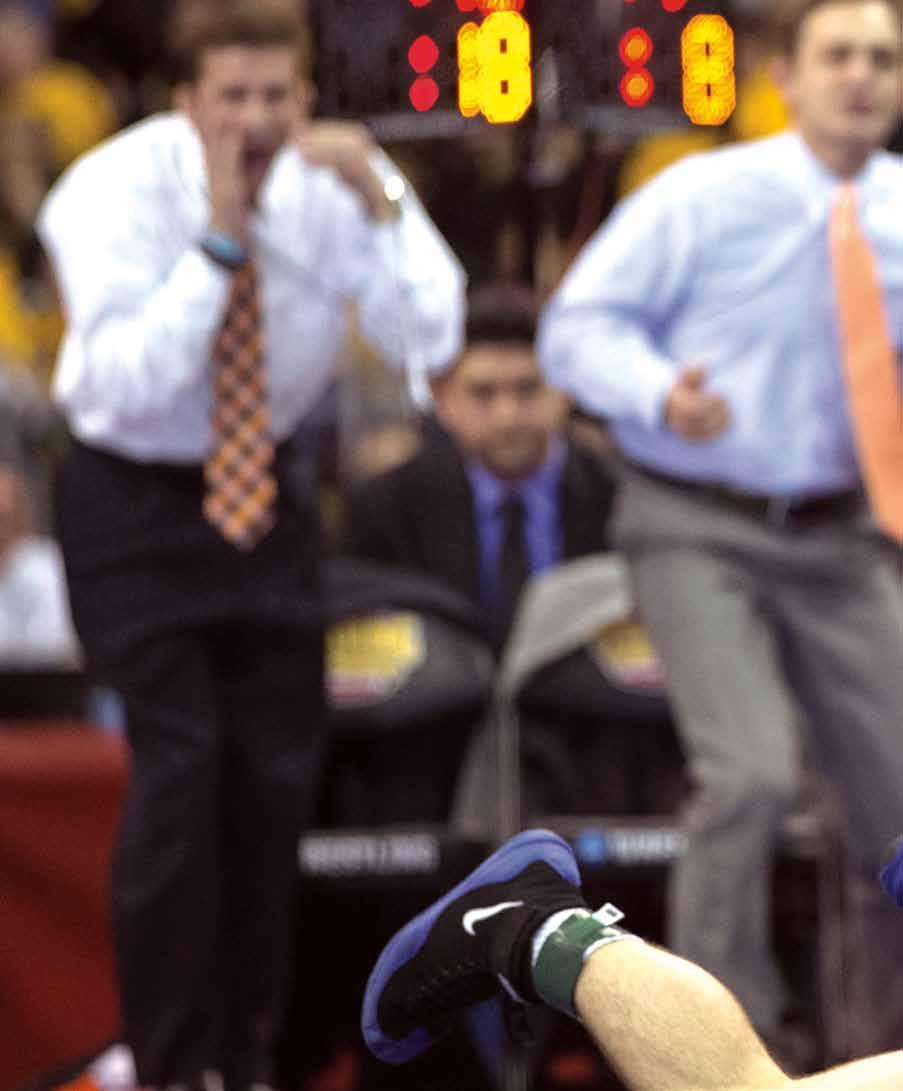
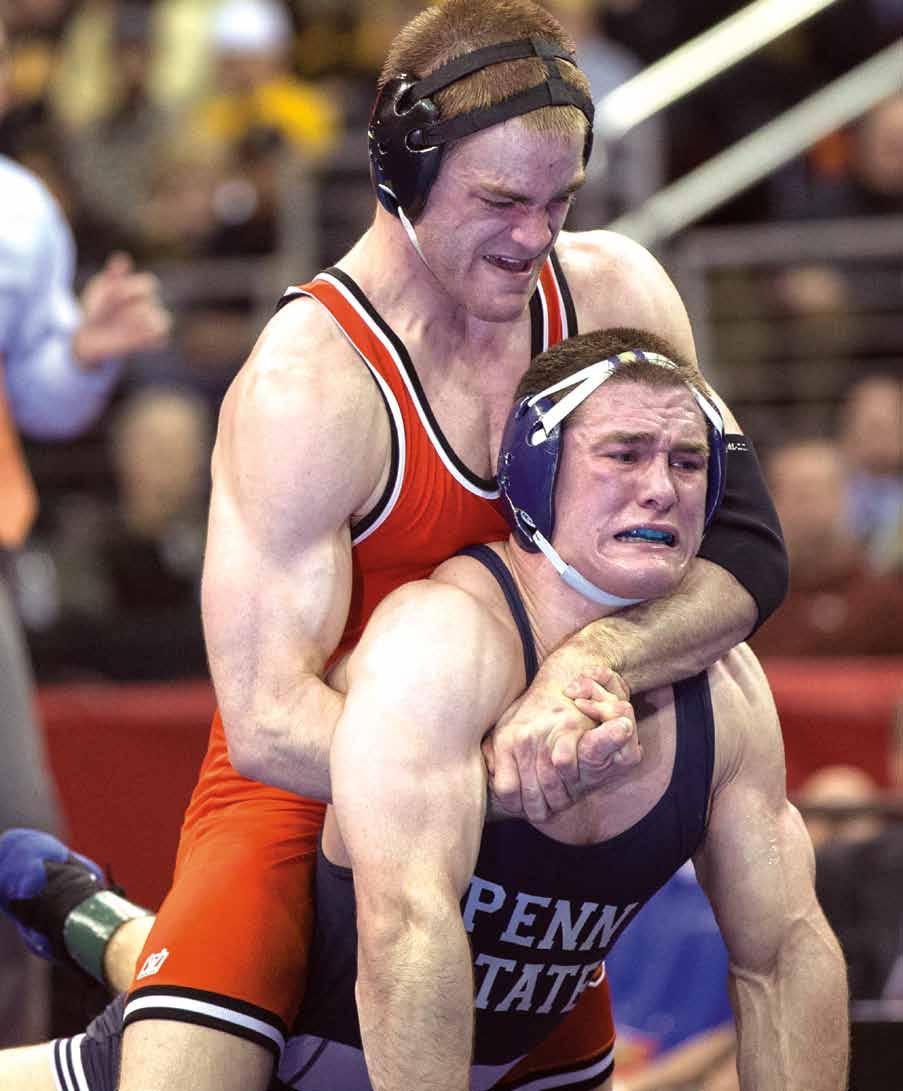
Ind I v I dual nat I onal Champ I ons Chris Perry and Jordan o liver, along with five other a lla meri C ans , helped oSU to a runner-u P team finish
Coach Smith Reacts to IOC Decision
story by matt ElliOtt
Cowboy wrestling coach John Smith doesn’t mince words. When the International Olympic Committee group recommended wrestling be dropped from the 2020 Summer Olympic Games, It made hIm sIck.
He wasn’t alone. The news generated a backlash from Terre Haute to Tehran. Chief among those speaking out was smith, a two-time olympic gold medalist who coached the american team last summer and in 2000 the neWs shook the WrestlIng World to Its core and motivated the sport’s members to come together. They’re organizing to lobby the International Olympic Committee and public opinion to ensure wrestling remains in the Games.
Smith, in his characteristically frank way, sat down with POSSE magazine ’s Matt Elliott recently to talk about the decision, which is yet to be finalized, and its effects. A final vote is in September, Smith says, and that will ultimately decide wrestling’s fate.
POSSE: What were you doing when you heard the announcement?
JS: I was down in our weight room. One of my wrestlers came in and goes, “Is it true?” I said, “What?” “has wrestling been dropped from the olympics in 2020?” I asked him where he heard that. He goes, “It’s all over the Internet.” I went in to one of our coaches’ offices down there, pulled it up, and I saw it. Sick feeling. Pretty emotional there for a while. You’re just wondering how this happened. It felt like a death in the family. I mean, it’s nothing equivalent to a death in the family, but I definitely felt as bad as I’ve felt in a long time.
I was just so caught off guard with it. There was just no sign of this happening. I’m involved with the Olympics. You hear things. You’re in committees. You’re in meetings. They talk about where wrestling stands and this and that. You hear of programs dropping from the Olympic core group. But never once was wrestling brought up.
POSSE: Because it doesn’t make sense to get rid of wrestling. It’s one of the main Olympic sports.
JS: We’ve got to be careful about What We do and what we think about how it happened. It wasn’t done in a democratic way. I’ll just say that. It should’ve never been on the chopping block. They listed five of the 39 IOC criteria used to evaluate an Olympic sport as reasons why they made the recommendation. It was quite interesting the ones they put out. We meet 90 percent of them with high marks. And that’s why we have a great shot at getting back in.
POSSE: From what I understand, the sport didn’t have a representative on the committee that made the recommendation.
JS: there Was no representatIon from WrestlIng. there was no representation from the united states of america. there was nobody from the united states olympic committee who was aware they were going to drop wrestling. It was a little bit behind closed doors. You wonder what’s happening. For the U.S., since the games began in 1896, wrestling has won the third most medals behind track and swimming. The last sports they dropped were baseball and softball. I don’t need to tell you how we were doing in that.
And the u.s. was the medal winner in the last o lympics . You don’t want to think there’s something going on here. I think it’s probably a little of that. I don’t want to be paranoid. But I think we’ve got to look at all angles and try to figure out why we weren’t informed.
POSSE: When the news came out, people were crying foul all over the place.
JS: We have almost 200 countries participating in wrestling. That’s is probably one of the highest in all Olympic sports. This past Olympics, we had 71 countries participating. that was the largest in any single sport. Of course, in the United States, wrestling has its place. It’s by far not the most popular sport. But in some of these countries, it’s their only Olympic sport. I was just glad and encouraged to see that, one day after the announcement, the president of the IOC called fIla, our international governing body, and said we need to get a meeting. So, some positive things happened. t he roar that came was definitely heard. We cannot let off the pedal right now. We’ve got to hit it hard. I don’t know what’s going to happen. I know that in May they’ll vote in St. Petersburg and again in September for a sport to be added back to 2020. Have they historically ever taken a sport off the docket and put them back on so quickly? No. There are a lot of things we’ll have to get through and be a first. If anyone can do it, we can. the world of wrestling feels like we’ve been blindsided. the final vote was a secret ballot. Who does a secret ballot? The communists do secret ballots. Not the world of Olympics.
POSSE: What did the committee say wrestling needed to do differently? Start breaking chairs over people’s heads?
JS: (Laughs) I think a little bit of it is TV exposure. But if the network’s not showing the sport, you can’t get exposure. If it’s glued on track and field or swimming, then that’s what the viewer is glued on. There were great wrestling matches to show. We had two Olympic gold medalists that people would’ve loved to see. (OSU bronze medalist) coleman scot t was on.
POSSE: You’ve said the IOC is being pushed this way and that way by sports that want in. Is it like a lobbying process?
JS: They’re getting an earful from everyone. they’ve turned it in to a lobbying nightmare. Who knows what’s happening behind closed doors. But there is a process for getting back in to the Olympics. We’re going to take it. We’re going to fight. They’re in for a fight. And I’ll just say this. You shouldn’t pick a fight with a wrestler.
POSSE: No. Wrestling is so brutal. They put themselves through such hell.
JS: Honestly, when we get back in 2020, we’ll look back on this and go it was one of the greatest things for us. It helps us revaluate ourselves and our place in the world. We have a tendency in wrestling to lock ourselves in a room, train, focus on our skills and our wrestling and go to class. promoting ourselves has never really been important to us. this is a chance for us to tell the world about wrestling. We’ve already put a committee together and raised over a million dollars in two days. That’s not enough. But we’re going to get there. We’re going to have to hire a PR firm. We’re going to need to do things to make sure there’s no reason they won’t choose to keep wrestling in the Olympics.
POSSE: The positive side of this is it seems to have brought the wrestling world together
JS: Everybody who is familiar with the sport of wrestling has a great respect for it, and the student-athletes who train for it.
POSSE: I don’t know how studentathletes do it.
JS: It’s a way of life for us. I’ve heard that all my life. How do you do that? We don’t ever look at it that way when you start at a young age. I’ve heard the words “you’re crazy” and things like that. I’m not crazy. You’re crazy for not doing it. It’s not a glamour sport. I wish wrestling was, in the eyes of people. But that’s OK. It’s bigger than media attention and a payday. We do It because We love It.
POSSE: Does this affect wrestling at any other level in the States?
JS: There are only seven freestyle wrestlers who are going to represent the United States. There are seven GrecoRoman wrestlers. Only a small percentage get that opportunity. most of wrestling’s importance lies in education. Most kids wrestle in high school so they can get a scholarship and their education.
But one thing I always enjoy is seeing those kids in our summer camp, second or third graders who tell me they want to grow up to be an o ly mpic champion. I think it’s wonderful, but the reality is the kids don’t understand what the probability is.
On the other side, here in stillwater, we’re very close to the olympic movement . We can come in to Gallagher and see Olympic champions on the walls. You get to interview an Olympic champion. Coleman Scott was a bronze medalist last summer. Eric Guerrero on my staff is an Olympian. (1988 gold-medalist) Kenny Monday lives in town. We have Olympic champions from Ponca City back in the ’60s. There’s one in Perry from 1932. We have one from Cushing, Frank Lewis, from the 1936 Olympics in Berlin when Adolph Hitler presented him with the medal around his neck. We’ve cultivated and believed in the olympic movement. It’s been a lot of years here at okl ahoma state.
Through all these years, through Coach Gallagher and all the way to myself, and every coach in between, we recognize that the reason we fight for the Olympic spirit, to be the best in the world, is to make Oklahoma State wrestling stronger. That’s our purpose.
Help the high school student you know see campus through the eyes of a current OSU student. Register a future Cowboy at admissions.okstate.edu/visit for an official student-led campus tour.
STORYBY CLAY BILLMAN
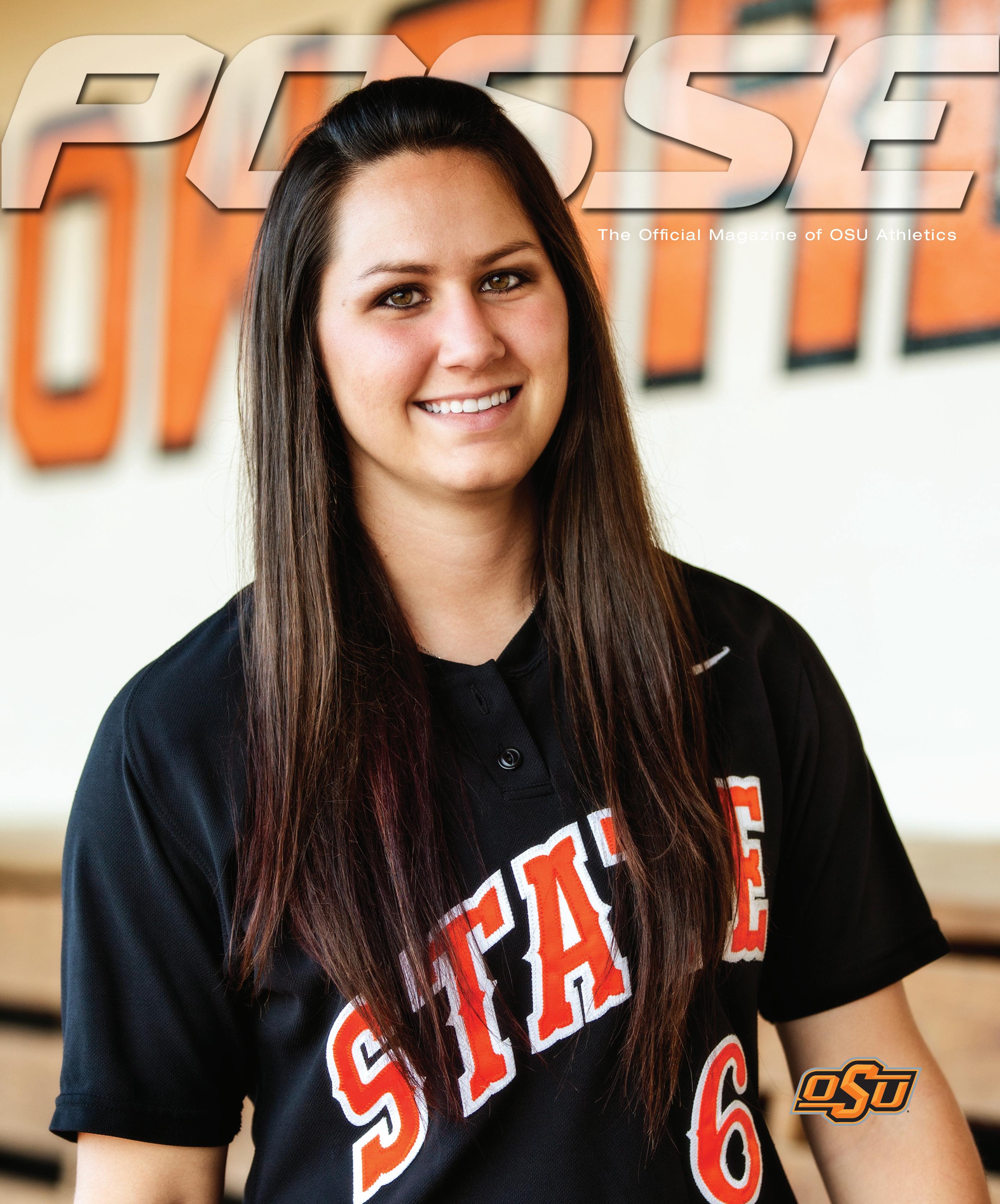
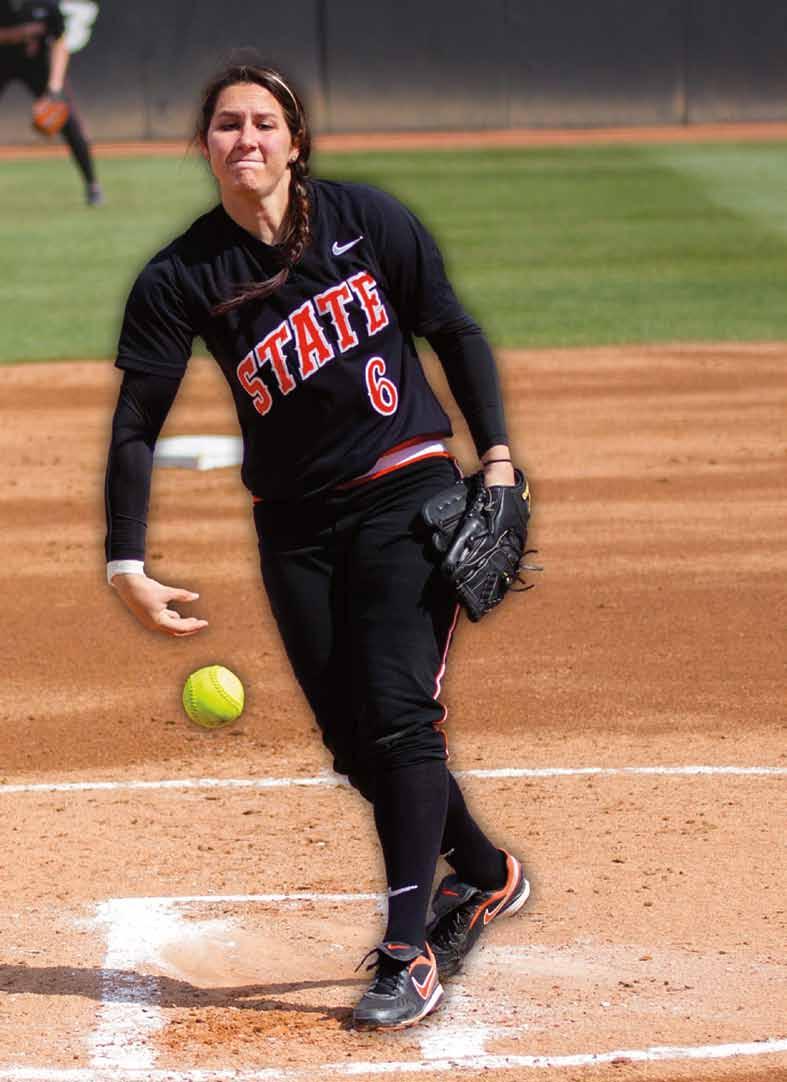
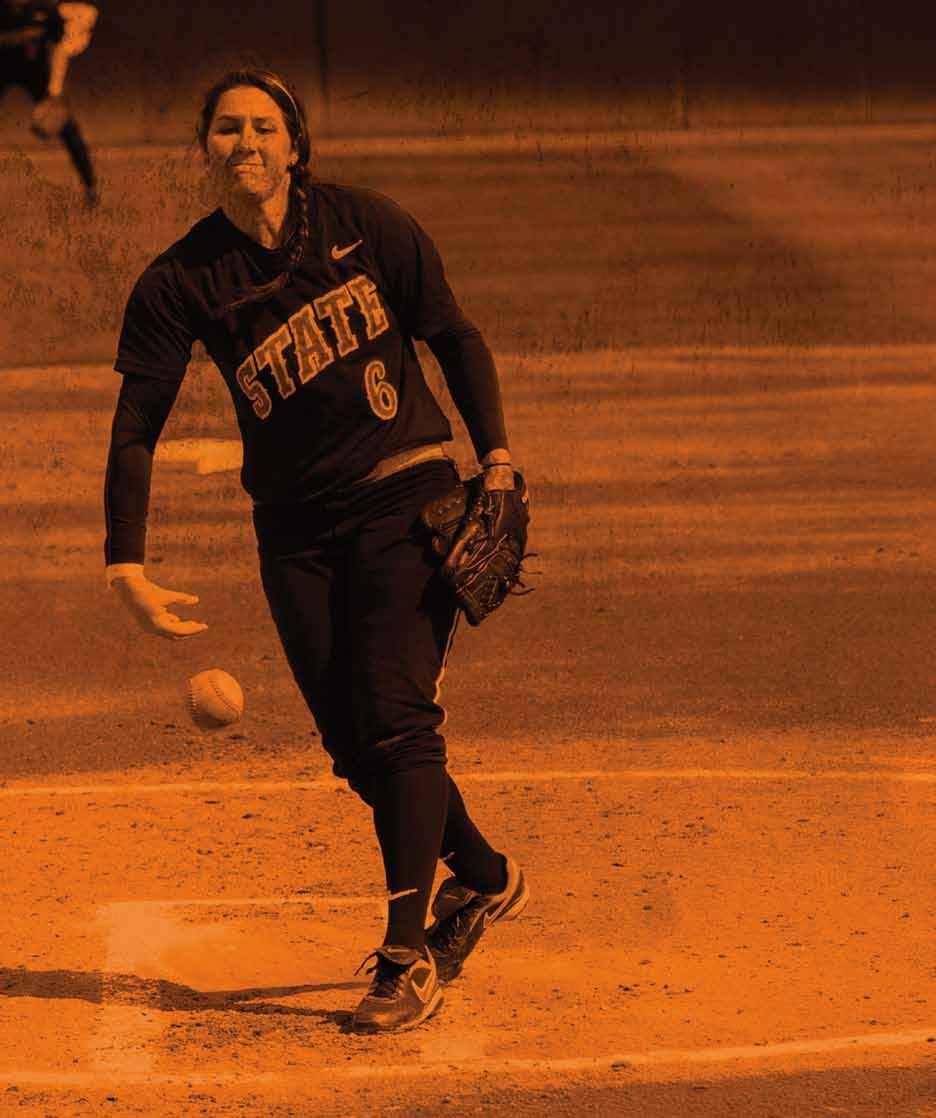
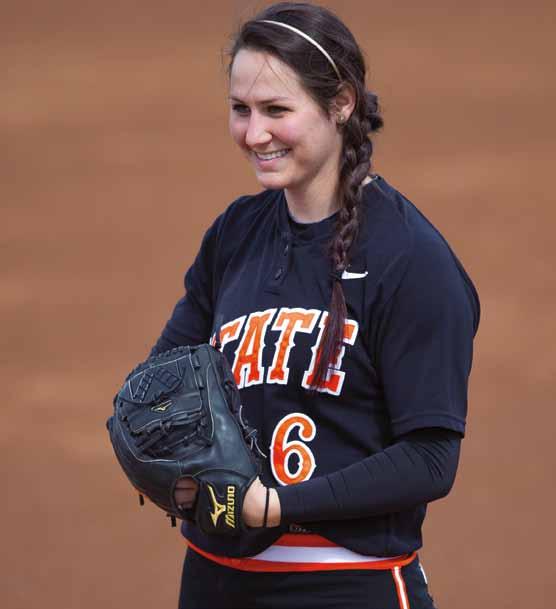
Kat Espinosa
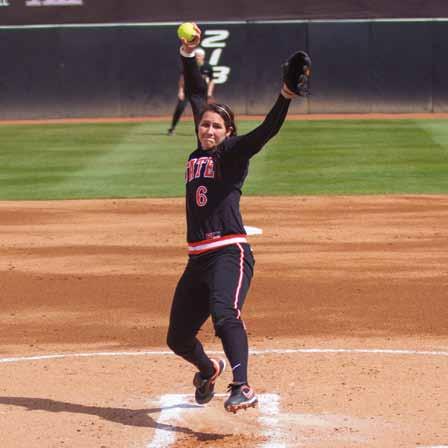
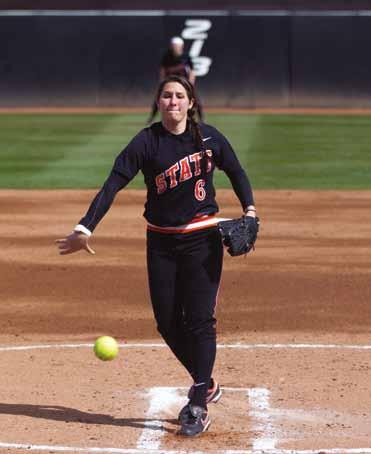
oK lahoma stat E pitch E r Kat Espinosa has h E r nam E E tch E d throughout th E c owgirl s oftball
r E cord boo K . a foury E ar fixtur E in th E circl E for r ich w i E ligman’s squad, th E s E nior is among th E school’s all-tim E
l E ad E rs in victori E s, innings pitch E d, stri KE outs, sav E s and a host of oth E r pitching m E trics.
a ccording to Espinosa, how E v E r, th E most important m E asur E of succ E ss is not a quantifiabl E statistic.
i t’s “fun.”
“I’m trying to remind myself and my teammates that we’re all here to have fun,” she says. “I love this sport. This is the sport that we chose to play as little kids and wanted to grow up to play in college, maybe get a scholarship. Luckily, I was one of them.
“Despite the games that we’ve lost, I remind myself that I had fun playing. Even if we lost, I still had fun.”
Midway through her final season in an OSU uniform, Espinosa isn’t taking anything for granted.
“This is my last year of playing softball. I’m going all out, and my teammates know that. We’re all striving for the same thing. We want to go far this year.”
The 2013 season has had its ups and downs, but Espinosa remains confident in herself and teammates.
“I know that we’re all going to come together at the right moment, the right time,” she says. “I think we’re really going to be good this year. I have this weird feeling in my stomach every time I think about May, and it’s going to happen this year. We’re going to go far. We just have to believe in ourselves.”
“This team can play with anybody,” her head coach says, “but the thing that we have to do that we haven’t been doing is getting base hits at clutch times and making the clutch play or clutch pitch at the right time. We’ve got to get a little tougher and understand that we’re going to play close games this year. That’s who we are. We’ve got to make our opportunities
count. That’s what separates the good teams from the great.
“That’s why we got to the World Series in 2011—that run from Regionals through Super Regionals,” Wieligman adds. “We were making the pitches, we were making the plays.”
a s a sophomore, Espinosa was a key element of the Cowgirls’ journey to the Women’s College World s eries.
“We had lost seven games in a row before we made it to Regionals,” Espinosa recalls. “That was a big deal, because we all knew we were in a hole. We tried to do anything to stay positive no matter what happened. Somehow we punched through that wall and made it.”
“Kat carried us through that Tennessee regional,” Wieligman says. “She set the tone for that tournament, and brought it back to Stillwater for the Super Regional.”
Espinosa pitched a shutout in the first game against Houston, but lost game two of the best-of-three series 1-0. In the deciding contest, she came on in relief, giving up just one hit before closing out the Cougars with a K. t he strikeout punched the Cowgirls’ ticket to Oklahoma City for the first time in more than a decade, and players erupted in celebration on the infield.
“Honestly, I don’t remember it because I was in such shock,” she says. “I was in game mode the whole time. If anything exciting happened, I had to cut it off and focus on the next pitch, the next inning. I have to always hold my emotions in, because when I do show it, it affects me when I pitch. And at the end, when I finally struck that last batter out, I guess I was finally able to express how I felt at the end of the game. We were going to the World s eries. it wa s a dream come true. I don’t remember it, but I have so many pictures from that moment. Every time I look at it, it just makes me smile.”
After experiencing the high of a World Series appearance, last season’s 25-26 record was a disappointing setback for the squad, particularly Espinosa.
“Last year we didn’t have the year we wanted, and I think she took a lot of it on her shoulders,” Wieligman says. “It really wasn’t her fault. It’s not a black and white game. You can go 4-for-4 and not hit a ball well, and you can go 0-for-4 and scorch a ball. The same with pitching. You can win a lot of games and not pitch very well, or you could be pitching lights out and not win a game. So, from that perspective, it was a tough year last year. I thought Kat pitched really well for us, and we couldn’t ever get runs for her.”
“Last year I had a lot of confidence issues,” Espinosa admits. “I was struggling. Our whole team was struggling. It was like a tease not even making it to regionals after going to the World Series … I don’t want to talk about last year.”
This year is different, she says, turning the conversation to the present.
“Our team is strong. Our coaches and players are on the same page. We’re all working together as one. For those who are struggling, we try to lift each other up.”
Wieligman agrees.
“This year it started out the same way, but I feel like this year she’s handling it so much better. She understands what her role is for the wins, and that’s all she can control. She’s putting up the numbers she needs to put up. I think last year she tried to control too much.”
“Our team is strong. Our coaches and players are on the same page. We’re all working together as one.”
— Kat Espinosa
Espinosa credits a renewed faith with helping her confidence in the circle.
“I built a better relationship with God,” she says. “Because I trust in Him so much more, it’s helped me keep my anxiety down. One of my teammates, Shianne Hughes, has really helped me trust in God’s plan for me and realize that I can’t always do all the work. I can’t take all the weight all the time. It’s helped me to just have fun in my last season of softball.”
“I can’t believe it’s been four years. It’s gone fast, that’s for sure,” Wieligman says. “It’s been fun watching her grow and learn different experiences throughout her career.”
“Yesterday I was a freshman, and now I’m a senior,” she says. “I’m almost done with my softball career. I’m going to be a coach when I’m done, but it’ll be a different perspective in life. This is the sport that I love. I started playing when I was like four or five, in tee-ball. It’s all coming to an end.”
As a freshman, Espinosa experienced immediate success. Splitting time with veteran Anna Whiddon, the Houston native won 19 games, including a no-hitter against the Texas Longhorns in Austin.
“I had no idea I was throwing a no-hitter until that last at-bat in the 7th inning, that last pitch,” she recalls. “I was like, ‘Oh my gosh, I’m throwing a no-hitter!’ I pitched the ball, and the girl popped up to left field. That was a really big experience for me because my entire family was there and happened to watch it all. I’m a very family-oriented person, and I don’t get to see them that often, so it was a big deal because they actually got to see me throw a no-hitter.”
39
Espinosa’s pitching coach her first three years at OSU was Clarisa Crowell, now the head coach at Miami University (Ohio). This season, first-year assistant coach Kelsi Dunne (an All-American hurler for Alabama from 2008-11) has taken on that role since joining the staff last summer.
“I am very grateful that I had the chance to work with Coach ‘C’ for three years.
She was always there for me and helped me become stronger every year to this point. For me, mentally, she left at the right time, because of what she instilled in me.
“Kelsi has taken care of me ever since, and she’s helped me in so many ways,” she adds. “Coach ‘C’ was more of my mental coach, and Kelsi is more of my physical coach to go along with the mental aspect.”
“As a new coach, you get to know your players and you see what their strengths and weaknesses are,” Dunne says. “Coming in to this job I knew Kat had pitched in the World Series when I was there my senior year at Alabama, so I already knew that she was a tremendous pitcher, and I was really excited to get to work with her. In the short time I’ve been here, I feel like I’ve been working with her for years. She’s not just a great pitcher, she’s also a great person.”
Dunne says opposing coaches have noticed, as well.
“Earlier this season when we played in a tournament in California, I had pitching
coaches from two different schools come up to me and tell me that they watched her throw and that she looks world class. She has great movement. So she’s got it, she just has to get out there and do it.”
In the offseason, Coach Dunne worked with Espinosa to develop a changeup and drop ball.
“Right from the beginning, we talked about her goals for this year and what she wanted to achieve,” Dunne says. “Knowing that she had strengths in other pitches, we really wanted to work on making her changeup a lot more reliable. In the fall we definitely worked on it a lot, and she now believes in it a whole lot more than she did in the past. She also worked on her drop ball quite a bit, so Kat’s definitely added to her arsenal of pitches this year.”
“Kelsi has helped me to have confidence in every one of my pitches,” Espinosa says. “I don’t know what it was, but I had a mental block whenever I’d throw that changeup. This year I just believe in every pitch. My freshman year I only had two
pitches, my curveball and screwball. Now I have a curveball, screwball, a changeup, a rise and sometimes a drop ball.”
“Calling pitches for Kat is so much fun,” Dunne says, “sitting in the dugout, just knowing that you’re setting up a hitter for a certain pitch that they’re not expecting. She’s got movement on every side of the plate and different speeds, so it’s really fun to set up hitters and make them look silly. That’s what she’s been doing all year. I don’t think her record shows that, but her statistics definitely do.”
Boasting an earned run average around 1.50, a 4-1 strikeout to walk ratio and holding opposing hitters to below a .200 average, Espinosa has been a model of consistency during her career.
“Kat has done such a good job of learning how to prepare to play every game she pitches,” Wieligman says. “She competes. She’s been consistent all four years. That’s the biggest thing you’ve got to have in the circle—consistency—and that’s what you’re going to get.”
Along with junior Simone Freeman, Espinosa provides OSU with a formidable pitching rotation.
“Kat and Sim alternate starts, and we’ll use them both out of the bullpen,” Wieligman says. “We try to keep it as even as we can, just because we know it’s a long season.”
By season’s end, espinosa’s name will be near the top of the OSu record book for appearances and innings pitched. But despite the heavy workload, she has managed to remain relatively injury-free.
“Under my shoulder blade, there’s a giant knot that will never go away,” Espinosa says, “probably even after I’m done pitching.”
There’s also a faint scar on her forehead, barely visible now, but it comes with an embarrassing backstory that the coach will never let her forget.
“In January before my junior year, I was visiting a former teammate and her dad offered to teach me how to shoot a gun.
That’s the first time I’d ever held a gun. I put my eye up to the scope, but I didn’t know you were supposed to rest the gun against your shoulder. I put it under my arm instead.”
Espinosa squeezed the trigger. The rifle’s recoil sent the scope backward in an instant, landing a serious blow just above her right eye socket. OSU’s star pitcher was headed to the hospital for seven stitches.
“I had to tell Coach when we got back to Stillwater. I don’t know how I worded it, but he wasn’t very happy.
“At the time, I didn’t realize it was that big of a deal,” she adds. “I had a headache, but I didn’t know it was a concussion. It was the week before the season started, and I had to lie in bed in a dark room. Couldn’t watch TV, couldn’t look at my phone, couldn’t look at anything bright. It was horrible. It lasted several days. It was not fun.”
Although Wieligman’s political leanings aren’t publicly known, it’s fair to say
he’s in favor of gun control … at least for his players.
“When I got back to campus, he actually made me sign a contract that said I can’t shoot any guns until after I graduate,” she says.
Both Espinosa and “Coach Wigs” can laugh about it now. That’s indicative of the tone in the clubhouse.
“When it comes to playing the game, let’s just play every pitch as hard as we can and make sure we stay in the moment of that pitch,” Wieligman says.
Work hard, but enjoy the moment. Espinosa is a living testament to that philosophy.
“I appreciate everything my coaches and teammates have done for me and how they have helped me along in so many different ways,” she says. “They’ve been there for me the times I’ve needed them the most, and I’ve tried to do the same for them. I am very glad and grateful for the people that I’m around. I love our team and how our atmosphere is. No pressure ...
“Fun and games.”
She’s not just a great pitcher, she’s also a great person.”
— OSU pitching coach Kelsi Dunne
41
Stillwater Families
Utilizing SST’s FarmRite product, our customers can remain focused on their core competencies of agronomy, sales and customer service, while leaving most of the computer work to us. With our around-the-clock data processing service and lightning-fast turnaround-time, they can rest assured they’re getting the information products they need when they need them.
That’s right. Our local families are the driving force for the
lygons Harvest Summary Soybean Yield Points
Yield by Crop Protection
Corr
PISTOL PE TE’S PARTNERS
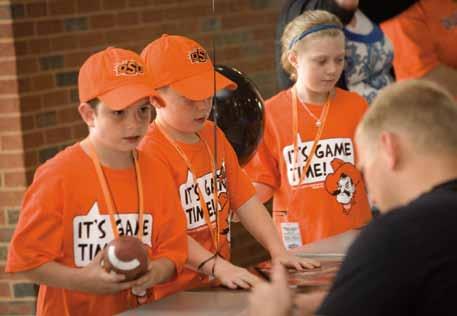
Annual kids club membership (8th grade & under) is just $25 per child. Benefits include:
• FREE ADMISSION to OSU soccer, wrestling, women’s basketball, baseball & softball
• Exclusive members-only t-shirt & ID lanyard
• Invites to autograph parties & other special events
• Birthday card from Pistol Pete
• Pistol Pete picture & more ... For details, visit at okstate.com/kidsclub
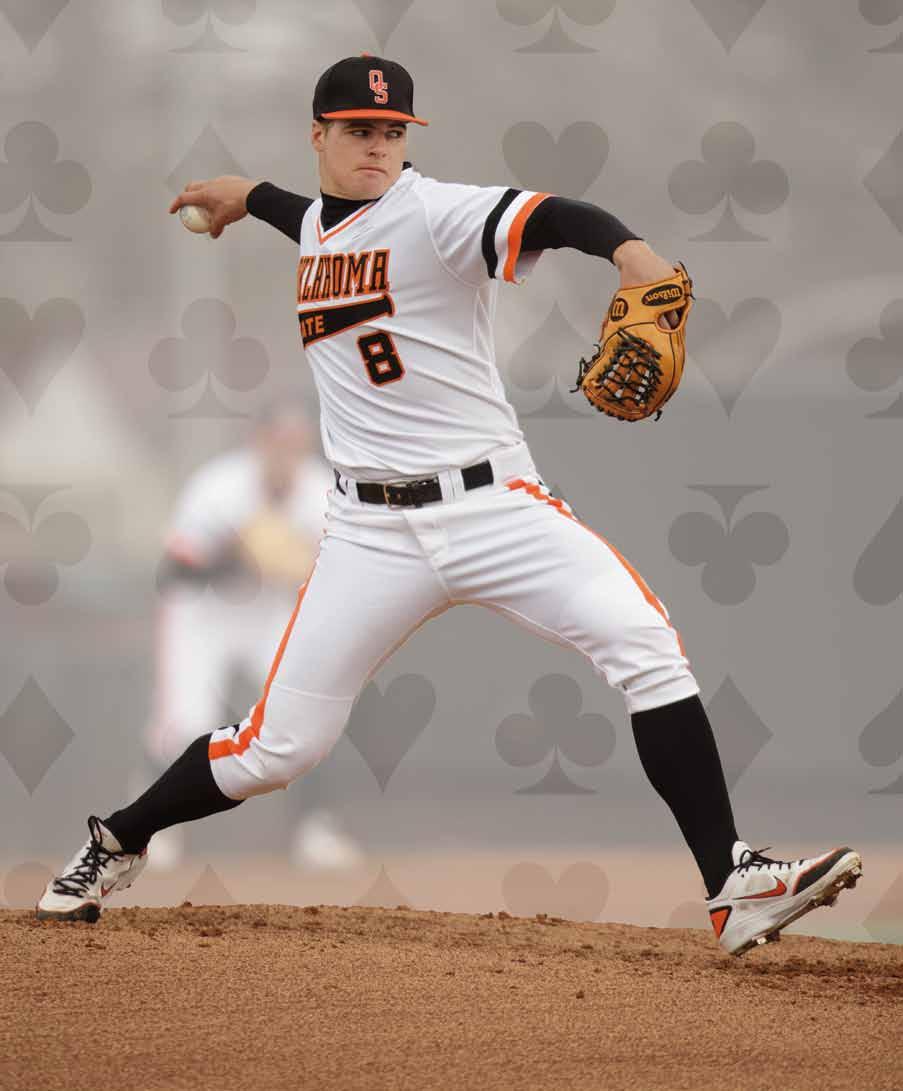
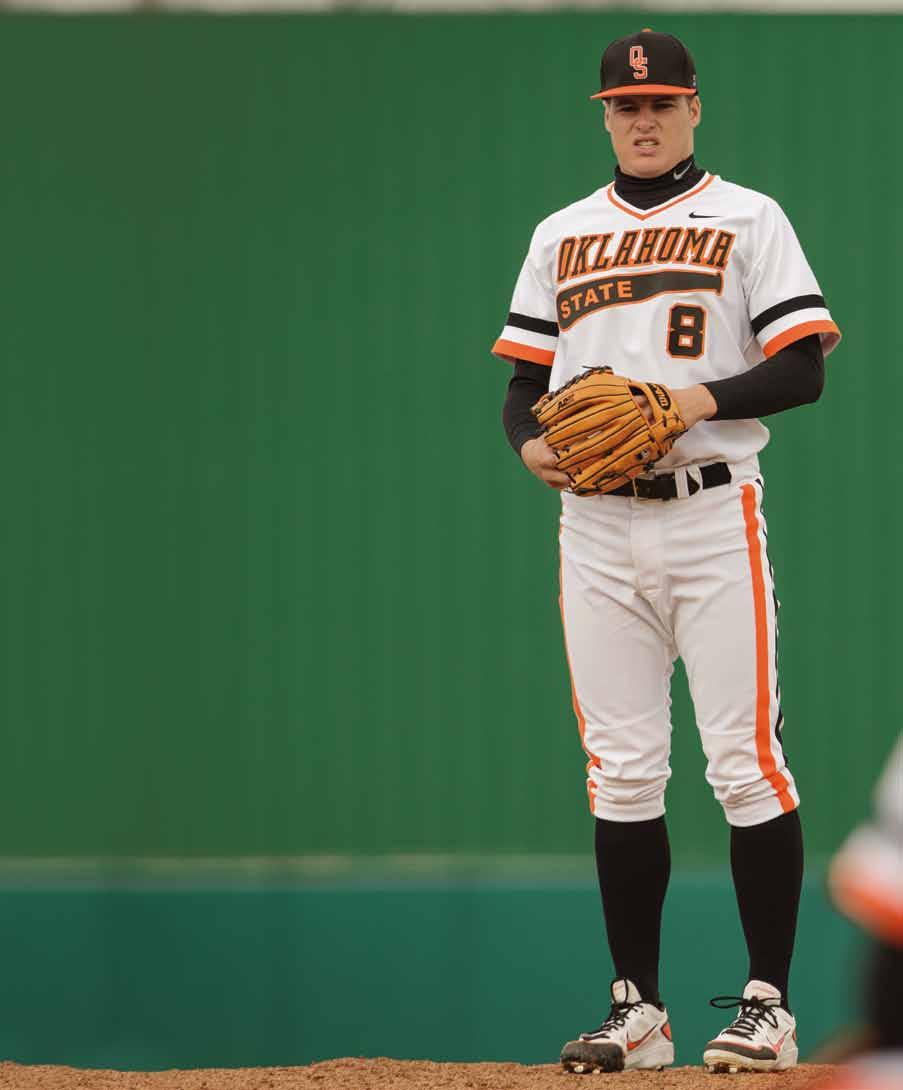
Cowboy hurler makes a comeback
STORY BY CLAY BILLMAN
jason hursh
Ulnar collateral ligament reconstruction
— not the most commonly used phrase in the vernacular.
Baseball fans know it as “Tommy John surgery.”
Jason Hursh simply calls it a second chance.
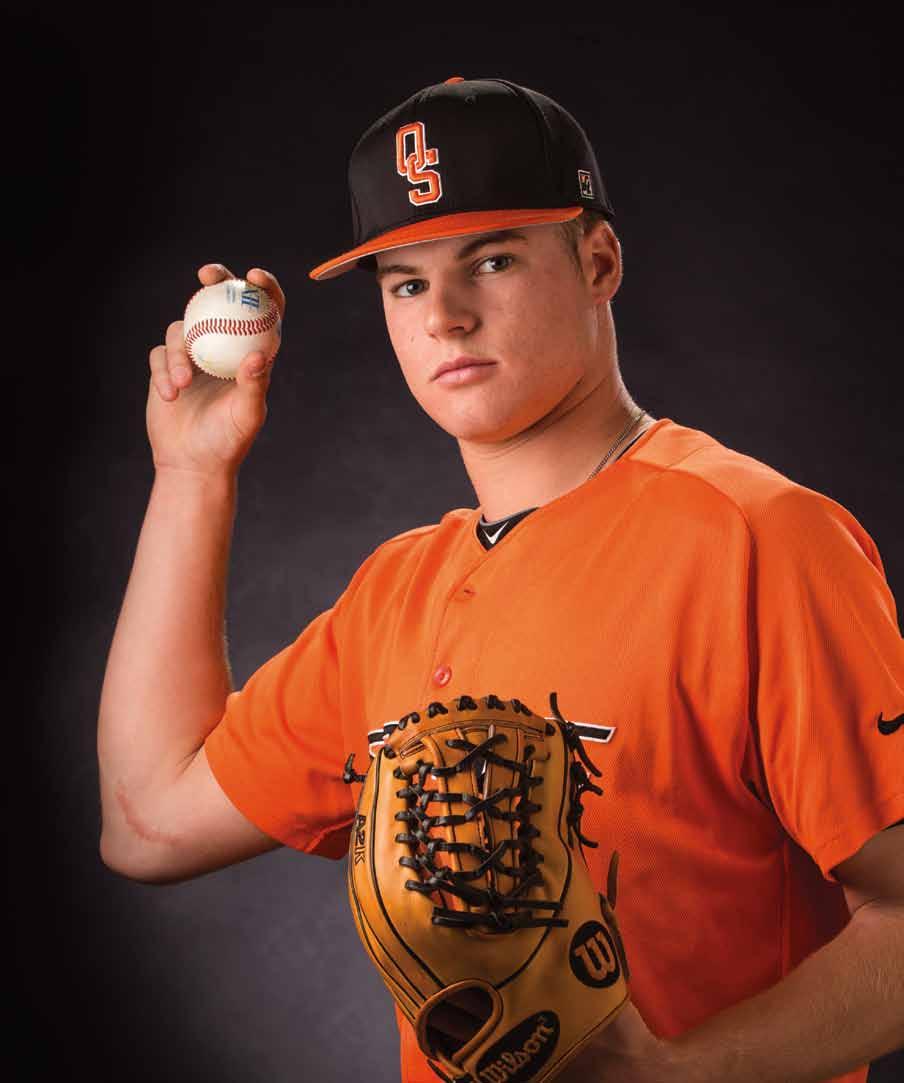
The right-handed hurler is Oklahoma State’s ace, and what he’s got up his sleeve is a scar.
The surgery was pioneered by Dr. Frank Jobe in the 1970s and named after his most famous patient, Los Angeles lefthander Tommy John. John went under the knife midseason in 1974 and made an unexpected Major League comeback in 1976, winning 10 games for the Dodgers. More than half of John’s 288 career wins came post-surgery, and he retired in 1989 a three-time All-Star.
Prior to the procedure, damage to the UCL (the main elbow ligament connecting the humerus and ulna) was a careerender, particularly for pitchers. Dr. Jobe’s solution was to take a donor tendon (ideally harvested from the patient’s opposite forearm) and literally lace it through holes drilled in the bones to create a figure-eight pattern. The result is a restabilized elbow, as strong — if not stronger — than before.
Injured arms now had hope, and “Tommy John” was its name.
In the spring of 2011, Hursh was a promising pitcher in the Cowboys’ bullpen. He saw limited duty on the mound as a frosh (throwing only 29.2 innings in 10 appearances), but showed signs of the potential that made him a 6th round MLB draft pick out of Trinity Christian Academy (Carollton, Texas) a year earlier.
After a summer honing his skills for the Santa Barbara Foresters of the California Collegiate League, Hursh was expected to be a regular in the OSU rotation as a sophomore.
“I was playing out in Santa Barbara, and my arm felt great that day,” Hursh recalls. “After one particular pitch I felt a little tweak in my elbow, but I shook it off. The very next pitch I felt a pop. I knew at that point I did something serious to my elbow and immediately walked off the mound.”
An MRI confirmed the worst.
“I talked to the team doctors, and they said I’d probably need to go ahead and get surgery.”
In the nearly four decades since Tommy John had “Tommy John,” the procedure has become almost commonplace, and thousands of baseball careers have been extended. As many as 10 percent of current professional pitchers bear the trademark scar, as do a number of Hursh’s own teammates.
“We have a lot of those scars on our squad, that’s for sure,” he says. “Randy McCurry. Mark Robinette. Phillip Wilson. Rick Stover, a catcher.”
The post-op rehabilitation process is long (up to a year or more), but the surgery’s success rate was encouraging to Hursh.
“I just thought of it as a second chance for me,” he says. “The doctors do it in their sleep these days. My surgery only took like 45 minutes. I knew if I rehabbed and did my throwing program and everything, I could come back stronger.”
Back in Stillwater, John Stemm serves as OSU’s director of athletic training and rehabilitation. The first thing Stemm tells his student-athletes is they can’t pick up a ball for six months.
“This might be the first time since they were probably 11 or 12 that they haven’t thrown a baseball for six months,” Stemm says. “Kids these days are becoming onesport athletes. Some throw year-round. That’s why we’re seeing a huge increase in this number of these injuries, even at younger ages. It’s just a lot of throwing.”
Several years ago, a panel of physicians studied the success rate of Tommy John surgery, Stemm says. Their conclusion was unanimous.
“They all said the reason why there are failures is that people do not stick to the rehab program. They looked at Major League guys who didn’t get back and found that they may have tried to come back too soon or started throwing too quickly. They didn’t do things by the book.
“The doctors all have their own protocol,” he adds, “So Jason’s doc came up and said, ‘This is what I like to follow,’ and we just went from there. I like to do certain things, and we just married that together.”
Hursh says it helped to have a teammate at his side while going through the rigors of rehab.
“Mark (Robinette) had the surgery three days after me, so we were pretty much on the same page throughout all of it. It definitely helps having someone right there with you, to make sure you’re accountable and doing all your reps. We just followed the program and did what it said. We got in the weight room and got after it.”
“They would come to rehab four times a week,” Stemm says. “The other days they are lifting, working on abdominal strength, working on legs, those kind of things. Once they’re cleared to start running, they start working on conditioning.”
Stemm says the key to a strong throwing arm starts at the shoulder.
“There are some mechanical things that certainly play a role in elbow injuries,” Stemm says. “In the throwing motion, the arm is kind of like a whip. All your force and all your torque come from your legs and your core. Your arm is just going along for the ride, and the shoulder’s only job is to slow itself down as it throws. Everything else is generated from what we call ‘beach muscles.’ If you’re not using those big muscles, you tend to use your shoulder more. What ends up happening is your shoulder gets tired. Now you drop your elbow because your rotator cuff is getting tired or weak or inflamed, and that puts your elbow at risk.
“In my experience, every kid that comes in with elbow problems has shoulder weakness,” he adds. “Hursh is a classic example.”
“Obviously I was doing something wrong beforehand that ended up with me injuring myself,” Hursh admits. “So I just focused on the proper throwing mechanics and kind of learned how to throw again. I really focused on keeping my shoulder up high and using proper form.”
Once he was cleared to throw, Hursh was still brought along slowly.
“TH e sky’s TH e lI m IT for THIs kI d. I THI nk H e’s goT A cHA nce To pITcH I n TH e bIg leAg U es AT some poI nT.”
— rob WAlTon
“In our return-to-throwing program, they usually start at 45 feet, throwing at about 80 percent,” Stemm says. “We play catch. I describe it as being in the backyard throwing with your dad. We’d do 25 throws and take a break and then do 25 more. That’s day one. The whole thing is a 16-step process. In order for them to go to the next step — 60 feet, 90 feet — they have to have 80 percent of the throws inside the box, hip to shoulder. As the distance increases, we still want them to be able to control the baseball.
A“People have to understand it’s a process,” Stemm adds. “It takes some time, but the athletes that are patient and do what they’re supposed to do have tremendous success here. Jason is a great kid and he works hard.”
He also throws hard, Stemm says, even when playing catch in the backyard.
“He can wing it.”
At that point, it was time for Stemm to put Hursh’s health in the capable hands of graduate assistant Eli Williams, athletic trainer for baseball. Assistant coach Rob Walton, a standout OSU pitcher from 1983-86, arrived last summer as part of Josh Holliday’s new staff.
“I didn’t get to be here through the rehab process, but Eli has done a nice job making sure all of our guys were doing the things necessary to stay healthy,” Walton says. “The elbows aren’t a big concern for me, but when guys are sitting out, that’s when you worry about them, because mentally they’re not competing. I think it’s more of a mental anguish than it is a physical one.
“When a guy comes off an injury, there’s always some doubt that comes into play,” he adds. “But there’s been so much coverage of Tommy John over the past several years, knowing so many guys have had it and come back, I think it alleviated much of the pressure. Those first times they get to throw a ball and it’s free and easy and they don’t feel anything, their trust starts to come back, and they can start getting back into a normal workload.”
It’s the journey back to the mound, and there are no shortcuts.
“It kind of takes a toll on you because you’ve played this game your whole life,” Hursh says. “They say you can’t throw or anything, but you’ve still got to practice every day and see all your teammates playing and getting better. You wish you could be out there, but at the same time, you don’t want to cheat it, because you don’t want to mess it up. You just have to dig deep and find that inner will and get after it once you’re released.”
The extra effort has been worth it, Hursh says.
“Honestly, it probably benefited me more in my career. I feel stronger than ever. It’s a great feeling of satisfaction, knowing that all your hard work paid off.”
The early season stats testify to that. Through his first six starts, Hursh had a 3-0 record with a 1.23 earned run average.
Despite Hursh’s relative lack of experience, Walton is relying on the redshirt sophomore to be the leader of the Cowboy rotation.
“We didn’t have a whole lot of returning arms,” Walton says, “so he’s got to take on a role that he might not necessarily be in. Obviously you like your Friday night guy to have experience, but so far, he’s competed very well. It’s still pretty new for him, but he’s understanding how to get hitters out. He’s understanding the value of getting ahead in the count early.”
Hursh has embraced the role as the Pokes’ No. 1 starter.
“It’s nice to know that you get the first game to start the series and hopefully get your team off on a good foot and get a game in the win column,” he says. “It’s a big responsibility to have, and it’s a great privilege.”
With a growing number of m ajor league scouts in attendance at Allie p. r e ynolds stadium for each of his appearances, radar guns consistently clock his fastball in the mid-to-upper 90s . But it’s not just his velocity that turns heads. Walton says Hursh is a more complete pitcher now.
“He had trouble throwing strikes as a freshman. That was kind of the M.O. He’s always had a good arm, but now he’s commanding his stuff. He has late movement on his fastball. For him it’s about being able to repeat the locations, being able to set up hitters.
“Jason was always a kid who had a good arm, but pitchability was an issue for him as far as being a strike thrower. Really the credit goes to Jason. He’s cleaned up his delivery, and he’s worked hard, week-in and week-out.
Walton worked with Hursh in the fall to add some new weapons to his arsenal.
“He really didn’t have a breaking ball, so we got him a slider going. That’s becoming a really good pitch, and he’s developed a changeup to go along with it. Now he’s got a legitimate three-pitch mix. In the beginning he could only throw one pitch around the zone. Now he’s throwing three pitches for strikes.”
“I just try to hit my spots and let my stuff work,” Hursh says. “As a starter, you’re not trying to strike out every guy. You want to be out there for as many innings as you can. If you punch a lot of guys, it’s nice. But if you pitch to contact and throw one pitch to a guy and get an easy out, that’s great too. If I’m getting ground ball outs and cruising through the game, that’s fine with me.
“I just want to keep improving,” he adds, “keep learning a lot about myself with each start, keep getting better and give my team a chance to win. I haven’t had a lot of experience in college, and I really only threw my senior year in high school, so I’m still learning the game, still learning how to pitch. I’m only a sophomore so I could be here a while. It’s been awesome with the coaches so far. Coach Walton has helped me tremendously.”
“Jason just continues to grow each week,” Walton says. “The sky’s the limit for this kid. I think he’s got a chance to pitch in the big leagues at some point, but right now I think he’s just embarking on the beginning of how to learn how to pitch. His upside is unlimited.”
49
THE
Honor Roll
When OSU announced its scholarship endowment initiative, the athletic program was last in the Big 12. Now, more than halfway through the 10-year program, OSU leads the conference.
But we’re not finished yet.
OSU awards 229 full scholarships to student-athletes each year at a cost of $4.5 million. Each dollar freed up through endowed scholarships goes back into our programs. Better equipment. Better facilities. Better support. Each dollar has a direct impact on the lives of our student-athletes.
“Each scholarship we endow secures the future of OSU athletics and provides more opportunities for our student-athletes on and off the field,” says Mike Holder, Vice President for Athletic Programs and Director of Intercollegiate Athletics.
This is the list of all the generous supporters who have helped to provide a bright Orange future. They are our Honor Roll .
To learn more about scholarship opportunities and how you may contribute, please contact Larry Reece ( 405-744-2824 ) or Matt Grantham ( 405-743-5938 ).
baseball 8
Dennis and Karen Wing
Jennifer and Steven Grigsby / Gary B. Reid Endowed Men’s Baseball Scholarship
Bryant and Carla Coffman
Hal and Lynne Tompkins
Dennis and Karen Wing
Martha Seabolt / James Seabolt Memorial Endowed Baseball Scholarship
David and Grace Helmer
Mike Bode and Preston Carrier / Berkeley Manor Enterprises Baseball Scholarship
Sandy Lee
Sally Sparks
Jill Rooker
football 32.25
Mike and Robbie Holder / Vernon Grant Memorial Endowed Full Football Scholarship
Dennis and Karen Wing
Ross and Billie McKnight
Dr. Mark and Beth Brewer
Ken and Jimi Davidson
Mike and Kristen Gundy
David LeNorman
Wray and Julie Valentine
Dennis and Karen Wing
Bob Norris
Ike and Marybeth Glass / Glass Family Endowed Football Scholarship
State Rangers
Bryant and Carla Coffman / Merkel Foundation Endowed Football Scholarship
Mike and Judy Johnson
Doug Thompson / M.W. Thompson Football Scholarship
Howard Thill
Cindy Hughes
Steve and Diane Tuttle
Brian K. Pauling
Randal and Carol White
R. Kirk Whitman
Bill and Ruth Starr
Ken and Leitner Greiner
Flintco
Bridgecreek Investment Management LLC
James and LaVerna Cobb
Eddy and Deniece Ditzler
Dr. Berno Ebbesson
Fred and Janice Gibson
Dr. Ron and Marilynn McAfee
Tom Naugle
Paul and Mona Pitts
Al and Martha Strecker
Dr. Zane Uhland
Jerry and Rae Winchester
Arthur Couch / A. Allen Couch Memorial Endowed Football Scholarship
David and Cindy Waits
Barry and Roxanne Pollard
Brad and Leah Gungoll
Fred and Karen Hall
Leslie Dunavant
Sandy Lee
John and Gail Shaw
John and Patti Brett
Greg Casillas
Kent and Margo Dunbar
Jerry and Lynda Baker
Roger and Laura Demaree
John P. Melot
Sally Sparks
Cindy Hughes
Donald Coplin
Arthur “Andy” Johnson, Jr.
David and Gina Dabney
Tony and Finetta Banfield
Terry and Martha Barker
Kenneth and Susan Crouch
David and Judy Powell
Sally Sparks
g radua te a thlete 1.25
Tom and Cheryl Hamilton
Neal Seidle
Tom and Cheryl Hamilton
Dennis and Karen Wing
Kent and Margo Dunbar
Douglas and Nickie Burns
Griff and Mindi Jones / Nate Fleming Endowed Men’s Basketball Scholarship
Ken and Jimi Davidson
A.J. and Susan Jacques
Jim Vallion
Chuck and Kim Watson / Billie Hogan Memorial Endowed Men’s Basketball Scholarship
Dennis and Karen Wing
David and Shannon Hill
Bill and Marsha Barnes
Robert and Sharon Keating
Calvin and Linda Anthony
Bill and Marsha Barnes
Stan Clark / Eskimo Joes Endowed Men’s Basketball Scholarship
Michael and Heather Grismore
David and Julie Ronck
Dr. Scott Anthony
Steve and Suzie Crowder
Holloman Family
Rick and Suzanne Maxwell
James and Mary Barnes
Calvin and Linda Anthony
Brett and Amy Jameson
Jay and Connie Wiese
Sandy Lee
Sally Sparks
Gary and Sue Homsey
Dr. Mark and Susan Morrow
Dennis and Karen Wing
Stillwater National Bank
Garland and Penny Cupp
Bob and Elizabeth Nickles
Men’s t ennis 0 .25
Tom and Cheryl Hamilton
Men’s t ra ck 0 .5
Susan Anderson / Ralph Higgins Endowed Men’s Track Scholarship
Dr. Mark and Susan Morrow
s oftball 0 .25
Tom and Cheryl Hamilton
Wo M en’s basketball 7
Ken and Jimi Davidson
Brad and Margie Schultz
Calvin and Linda Anthony
Bill and Sally Cunningham
Richard and Linda Rodgers
John and Caroline Linehan
Baloo and Maribeth Subramaniam
Baloo and Maribeth Subramaniam
Jon and Nancy Patton
Calvin and Linda Anthony
Mike Bode and Preston Carrier
Donald Coplin
Don and Mary McCall
Jill Rooker
John and Caroline Linehan
Wo M en’s e q uestrian 0 .25
David and Gina Dabney
Wo M en’s golf 0 .5
Amy Weeks
Kent and Margo Dunbar
Wo M en’s t ennis 0 .25
Jamie Maher
Wrestling 9.25
Lon and Jane Winton
OSU Wrestling — White Jacket Club / Ray Murphy Endowed Scholarship In OSU
OSU Wrestling — White Jacket Club / Tommy Chesbro Endowed Scholarship For OSU
OSU Wrestling — White Jacket Club / Myron Roderick Endowed Wrestling Scholarship
OSU Wrestling — White Jacket Club / Gallagher Scholarshp Fund
A.J. and Susan Jacques
Chuck and Kim Watson / W.D. Hogan Wrestling Scholarship
R.K. Winters
Danny and Dana Baze / Cory and Mindy Baze
Mark and Lisa Snell
John and Beverly Williams
Bruce and Nancy Smith
Mark and Lisa Snell
It has been amazI ng to see 315 donors step up to get us past the $58m I llIon m ark I n co mm Itm ents to the leave a legacy campaIgn . the bottom lI ne Is o su s upporters get It … scholarsh I ps h elp our student-athletes today wh I le strengthen I ng our athletIc budget forever.
— Larry Reece, Associate Athletic Director — Development
BASEBALLCHAMPIONSHIP
OKLAHOMACITYI MAY22-26 CHICKASAWBRICKJOWNBALLPARK
A. Nike Baseball Ori-FIT Cotton Practice Tee (2328912)
Get geared up for baseball with this Oklahoma State Dri-FIT performance T-shirt that will keep you comfortable during even the most heated games. Sizes S-XXXl/$28.00
B. Nike Ladies Seasonal Tempo Short (2318783)
Are you a Cowboys fan who loves to show your team pride while you work out? These Tempo shorts with Ori-FIT technology will make sure that your school spirit is on display while you are breaking a sweat. SizesXS-Xl/$38.00
C. Nike Ladies Symbol Tri-Blend V-Neck Tee (2329142)
You love showing up to the big Cowboys home game wearing your chic OSU garb! The next time Oklahoma State scores the winning point, make sure you're celebrating in this slim fit, tri-blend tee. Sizes XS-XXl/$30.00
0. Nike State Outline Cotton Crew T-shirt (2328761)
Show your Cowboy pride from the first whistle of the season through the playoffs in this tee featuring a state screen-print outline. Cheer your favorite team to victory in this one of a kind T-shirt. Also available in black and gray. SizesS-XXXl/$25.00
E. Nike Ori-FIT Swoosh Flex Cap (2329062)
In order to keep your head in the game, you'll need a cap that can stand up to the pressure.This Dri-FITcap ensures you can stay cool, calm and collected when the next Cowboys game heats up. Also available in black and white. $25.00
F. Nike Ladies All-Purpose Seasonal V-Neck Tee (2318792)
Ladies, show up to the next game strutting OSU style in this fun and flirty v-neck. All eyes will be on you in this tee and you'll be sure to make the competition green with envy at the way you show off your Pokes pride. Sizes S-XXl/$25.00
G. Nike School Tribute Tri-Blend T-shirt (2328850)
As an OSU fan, you are delighted to inform everyone which school is the best in the nation. Let this soft, tri-blend shirt do the talking for you and everyone will know that you are a true Cowboys fan. Sizes S-XXXl/$30.00
H. Nike Pre-Game Short (2318345)
Whether you're playing ball, bumming around the house or heading to the gym to watch the big game, be sure to rep your team in style with these OSU Dri-FITshorts, perfect no matter how hard you work, play or cheer! SizesS-XXl/$38.00
I. Nike Ladies Foundation Slim Fit Tee (2329124)
You love OSU more than any other team out there. Featuring a slim fit and a glitter-accented logo, this shirt will guarantee that your shining display of Cowboy pride won't be missed. Also available in white and black. SizesXS-XXl/$25.00
J. Nike Ori-FIT Heritage86 Campus Cap (2329026)
Whether you're heading to class or hanging out on the weekend, your OSU pride needs to be seen. On campus or off, this adjustable cap is the perfect go-to option for representing your Cowboys! Also available in orange and white. $24.00
universitystore
story By Matt Elliott
welcomed some new faces after the team’s 8-5 finish and the heart of dallas Bowl win over purdue.
OklahOma State’S fOOtball cOaching Staff
Chief among those
were additions to the defensive and offensive coordinator positions, Glenn Spencer and Mike Yurcich
Spencer has been an OSU coach since 2008 and takes over for his predecessor, Bill Young. While Spencer is known, Yurcich is new to the c owboy family.
The 37-year-old came to OSU from Pennsylvania’s s hippensburg University, a Division II school. Yurcich has been calling plays for more than a decade. He had his first coordinator job at an NAIA school, the University of s ai nt f ra ncis in Indiana, when he was finishing a master’s degree in education.
Their backgrounds couldn’t be more diverse. But spencer and Yurcich share one trait. t hey relish a challenge.
They will have that in spades. Both men will lead a team’s two halves that have Been among the nation’s Best since 2009. Spring ball kicked off in April and three of the Big 12’s top returning quarterbacks are in Stillwater. While he hasn’t had much of a chance to evaluate players, Yurcich’s first season will start off with a three-headed monster of a quarterback quandary, trying to figure out who will start out of the three who started last season due to injuries.
Meanwhile, on the defensive side in 2013, the conference’s vaunted offenses will likely remain the yardage gobbling machines to which we’ve all grown accustomed. Spencer has his work cut out for him, as well.
The two coaches recently sat down with P osse to talk about the upcoming season.
c all him f rank
Well, i mean, his name is glenn. But he’s knoW n for his frank nature. a nd “Blunt” isn’t a first name.
Spencer perches his 6-foot 5-inch frame on the edge of his seat in his Boone pickens stadium office, his legs bouncing up and down as he talks. h is message is this:
oklahoma state fans will see an aggressive defense in 2013. their c owboys will be trying like hell to pressure quarterbacks and receivers. opposing running backs won’t be spared either. they’ll likely face run blitzes from osU’s talented linebackers and safeties, led by seniors Caleb Lavey and Daytawion Lowe.
“BY sit Uation,” Spencer says. “By down and distance. By your personnel on defense. That will dictate how aggressive you can be … You have to affect the quarterback.”
he wants offenses reacting to him. He also wants his guys to be fundamentally sound enough to change what they do on the field when the offense adjusts at the line of scrimmage before snapping the ball (as the Big 12’s spread offenses are wont to do). He wants them to do that without indicating to the offense they’ve changed anything, thus disguising their coverage.
“ people have no idea the mental challenges of plaY i ng against spread teams,” Spencer says.
d e fense is a taller order these days with increased foci from the NCAA and the medical community on player safety. In fact, given those issues, and changes making the game more fast paced (favoring offenses), it’s hard to imagine why anyone would want to be a defensive coordinator these days, especially one for OSU, whose defense logged nearly 80 plays per game in 2012.
“Am I on the wrong side of the ball? Probably,” Spencer says. “But in reality I’m not because the challenge is good. I’ve got the opportunity to do something about our defense and that’s it. i’ ve got the opportUnit Y to pUt the most effective prod U c t on the field that we can. ”
In his matter of fact tone, Spencer talks in general terms about the horrors in store for his defense before the first game, m i ssissippi s t ate, kicks off au g. 31 . He believes in putting his players through hell to breed toughness and camaraderie that will show itself in onthe-field play. Defense is going to be all about team — players playing for each other, rather than fear of him.
On the order too are subtler changes fans may not notice, such as techniques per position.
“You’re going to do things your own way. And then all the criticism is on you, and you realize that. But there are just technique issues we’ve looked at. alignment. assignment. steps. Just fundamental stuff that we as a defensive staff feel strongly about that are going to make us better on defense.”
Spencer came to OSU in 2008 to coach the defensive line, part of the resurgence of osU f ootball that culminated in 11-2 and 12-1 seasons in 2010 and 2011. That was the most successful stretch in the school’s history and included OSU’s first BCS bowl win
“That’s the philosophy I want them to have. That’s what we’re trying to develop here in the offseason. And that will be a main emphasis in spring ball. Because i ’ m going to take them places where the Y ’re going to saY, ‘this is ridicUlo Us.’ i’m going to take them places where everY thing in their Bo dY is going to saY, ‘i want to shUt down.’ ”
Like Louisiana in July?
“The demands we’re going to have from them, effort-wise. If it’s not there, they’re all going to have a piece of it, and they’re all going to get discipline from it, not because they’re going to be afraid of me, but because they have to think they can’t let what happened happen again.’”
It’s a group accountability that, in its purest form, requires no spittle-flecked, vein popping, Bear Bryant or Henry Ibalike excoriations to motivate players. It’s also the kind of motivation that will last, he says.
“Yo U ’ ve got to p U t plaY e rs throU gh the fire. Yo U’ ve got to test them. if YoU’re never tested, YoU never know where the trUe effort is. YoU never know where the trUe m otivation is. if the Y ’re not tested in life, the Y ’ll never know where the trUe love is.”
OSU’s defense was frequently the press’s whipping boy, Spencer recalls, despite banner years in scoring allowed. That practice — abusing the defense — probably won’t change, no matter how many games OSU wins.
“The few interviews I’ve done since I’ve been here, it’s all about what’s been wrong. I’m like, ‘Yeah, i’m a Big BoY. I can deal with that. And we’re going to get those things corrected.’ That’s the world I live in.”
Spencer is used to meeting challenges. When he was at Duke , he took a non-contender in football and helped bring in one of the best recruiting classes in the nation
He never shrank from a challenge as a player, either. spencer was a defensive tackle in college at g eo rgia tec h , a feat the then undersized 275-pounder accomplished through technique, skill and sheer hard work. That’s the sort of thing he relies upon as a coach, dating back to his first coordinator position at West g e orgia in 1997 (he was head coach there from 1998 to 2000).
He and his staff will spend spring football, the series of practices leading up to the orange and white scrimmage in April, fixing technique issues, alignment issues, et cetera. Big emphases will be finishing games and tackling , he says.
It’s the latest chapter in a long career for Spencer who, since he came to OSU, has turned down many offers to coach other teams
“i t ’s b E c aus E i E njoy this placE,” he says.
i t’S pr O n O
unced Yur- S itch
most osu fans don’t recognize their neW offensive coordinator yet.
“ t hat’s probably a good thing,” says Yurcich, seated inside his bare office down the hall from s pencer’s. Just a few days before, he was moving his family in to a stillwater rent house 1,200 miles from their home in s hippensburg, p a.
“i think there are a lot of similarities,” he says. “Obviously, the student population is one of them, but it’s a bigger university. i think there’s a Bigger focUs on athletics here. it causes a bigger stir. Just a bigger stage.”
Yurcich was hired last January after a long search for the replacement of todd m onken . Much like Monken, who led OSU’s offense for two years, Yurcich took the helm of an established system that eats up records as much as it does yardage. And, much like Monken did when he started, Yurcich says he’ll spend much of his time early on learning the system and listening to his players. He says he’s the new guy so he has to be flexible. He has to be a good listener.
“That’s my role. To be organized. To get us moving in a direction. As far as the system, I just have to get used to it, learn it, become an expert at it, and then my role can grow. BUt for now i have to Be more of a learner. ”
Yurcich likes what he sees on paper. He notes the offensive line has two stalwart seniors, Parker graham and Brandon Webb . He says it all starts with them. He mentions the quarterbacks, returning receivers and tailback Jeremy s mith as big plusses.
“We’ve got three quarterbacks who each passed for over one thousand yards in the Big 12. We’ve got five of our top pass catchers coming back. We’ve got Jeremy Smith at tailback who has just been really outstanding in all the workouts I’ve seen him perform in.”
the biggest thing for him now is to earn their trust, he says. He’ll do that by being sure what he tells them will help on the field. That will make them listen to him.
“That’s the most important thing any coach can do at any level, and I don’t know of any other way to earn their trust, he says.”
This isn’t his first time being in such a situation.
“ mike JUst had the X factor,” says Donley, of his former protégé. “ some people have it and some don’t. I think you can improve your skill. You can learn the game. When you have the X factor, you just have an edge. You just know what to do.”
Donley, the winningest coach in NAIA history, came to St. Francis in 1997 and hired Yurcich, a 23-year-old education graduate student in 1999. A few years later, Yurcich was calling plays as the offensive coordinator.
d onley says Yurcich always had good opinions and “good soUnd footBall ideas.” A degree in psychology made him “a unique guy,” as well, who had major input in what the team did.
“I’m not going to give anybody that responsibility (to call plays) if they can’t do it,” he says. “He was very, very capable with it. He did extremely well. Probably better than I did.”
Nothing about Yurcich’s success since then surprises his mentor. He always knew that if Yurcich got a break, something would work out. Donley says Yurcich fits well with osU’s offensive philosophY of getting players the ball in space, or as the coach calls it, “go where he ain’t — not where he is.”
“It doesn’t surprise me he ended up at Oklahoma State,” he says. “I’ve had a lot of outstanding young coaches through the years. I’ve got one who’s an offensive line coach with the Houston Texans. I’ve got one who’s a linebacker coach with the Arizona Cardinals. So much of it is getting a break … YoU and YoUr c owBoY fans are going to get to know him prett Y qUicklY. he’ll get the Ball moving. ”
Other formative experiences came later thanks to other coaches. At Indiana from 2003 to 2004, they came from then-coach g erry Di n ardo , today a college football analyst for the Big 10 Network, and a l Borges , today the offensive coordinator
While the stadium may be bigger and the players bigger as well as faster, he had to do the same thing when he arrived at e dinboro in 2005. He was an offensive coordinator stepping in to an established system with a quarterback who won allconference honors the year before he arrived.
With him leading the offense, the school had nine-win seasons in 2008 and 2009, a year in which the team made the playoffs, too. His offenses there ranked among the country’s best in points scored. At s hippensburg , his team led the nation in total offense and was second in scoring in 2012.
He has worked for a host of coaches, but his biggest influence was the first guy who hired him, Kevin Donley, at the University of s aint f rancis . Yurcich was Donley’s starting quarterback when Donley coached at Pennsylvania’s California University
at the University of Michigan. Later, there was Lou tepper at Edinboro and m ark m aciejewski at Shippensburg.
“YoU get inflUenced BY everYBodY JUst a little Bit,” Yurcich says.
“You listen to philosophies. You take some. You leave some. It helps mold who you become. You’re never going to be somebody else. You can never try to be. all of those gUYs i’ve worked for have had their imprint on me. ”
With spring ball looming, much of what Yurcich will do early at OSU includes figuring out what makes his players tick, making sure everyone is “assignment sound,” preaching the message of ball control and emphasizing playing fast. his unique background as a licensed school counselor is an asset.
“It helps with being able to listen to all players, coaches, et cetera,” Yurcich says. “However, i’m not here to coUnsel. i am here to coach. And there’s a big difference between those two roles.”
The new OSU Spirit Club is organized for the sole purpose of supporting the Oklahoma State Spirit Squad, which includes the coed cheer squad, pom squad and Pistol Pete mascot.
Donations are POSSE-eligible and will fund partial scholarships for all squad members and provide additional merit-based scholarships for excellence in academics or nancial hardship. Additionally, gifts will supplement the budget for equipment, travel and competition expenses. For
Athletic Village THE
Back in 2006 when the there was a lot of excitement, land north of Boone Pickens Stadium was cleared.
And then … all that cleared land sat. It would’ve been easy, as an outsider, to think that we’d given up the dream. In the last year, however, visible progress has been made. The Sherman Smith Indoor Training Center should structurally complete by the time you hold this magazine, though the field surface will not come until later in the summer. The new tennis facilities are nearing the halfway point in the construction process. A new track is being installed just north of McElroy, and is on pace to be ready for the fall.
“I’m pleased with the progress in the athletic village,” says Mike Holder, Vice President for Athletic Programs and Director of Intercollegiate Athletics.
“I think eventually it will turn out like I imagined it could. Back in 2006 when we announced it, we essentially had all the money then. It was a matter of when it would be completed, and money was no object. After the financial meltdown
100 acres of land north of Hall of Fame. We had a great place to build these facilities. A lot of schools, that’s not the case. They have two problems: money for the facility and a place to locate it. Having that vacant land north of us created a sense of urgency from our donors to want to see something done there.”
Cowboy Athletic Facilities manager, John Houck, has overseen the massive project since the fall of 2005, and he has witnessed all the ups and downs.
“In December of 2005, $165 million was given to the university to develop the west end zone of Boone Pickens Stadium . That money, along with about $35 million additional, was invested in Mr. Pickens’ hedge fund. The agreement was there was no commission. Whatever the money made would come back, which
high. The whole world turned in about 120 days. That nest egg, basically, was gone by Thanksgiving of ’07. We finished the WEZ, and we purchased Scholar’s Inn. And we purchased all the land from BPS to Will Rogers School. And we cleared it.
“So there it sat. We were land-rich and money poor.”
As it turns out, that was just a temporary set-back. In typical OSU fashion, donors have been inspired by Boone Pickens and have come forward to get the Athletic Village back on track.
“Sherman Smith, before his passing, gave us the money to do the indoor facility,” says Houck. “The Smith family provided the resources to do everything, not just the building itself. We had a larger vision for it, once upon a time. But the building will be completed by early April, and then we have to go in and put the rug down inside, and put in the outdoor field, which is also a synthetic surface.”
The outdoor synthetic surface will be directly east of the Smith center, sitting inside the L of the two natural practice fields that were installed almost two
“I think eventually it will be as good, or better than, we originally planned. It just took a little longer.”
— Mike Holder
“They are maturing,” says Houck. “We wanted two growing seasons to make sure they take and can put up with a beating.”
In addition to the Smith training center, construction is well underway on the tennis facility on the southeast corner of McElroy and Washington.
“Mike and Anne Greenwood have stepped forward to help us build the tennis facility. There will be six indoor courts and an additional 12 outdoor courts,” says Houck. “We will get the outdoor courts in, but not much more. At least we have the building and the outdoor courts, and we will have a grandstand essentially against the building looking south.
“There are other things we want to do in there, but that’s all we can get done right now, until someone else steps up to the plate.”
In addition to the tennis facility, the new track is being built to the north of McElroy. Construction crews
are currently grading out the area for the track, and new steel has gone up on the track administration building and locker rooms.
“That is essentially the east one-half of the area north of McElroy,” says Houck. “It will essentially be what we have right now, but in this new location, and everything will be new and up to today’s standards. We toyed with making the new track surface orange. We decided not to because eventually it would’ve turned red.
That covers what’s currently under construction. Wheels are turning for the other facilities as well, such as a new baseball park on the northeast corner of McElroy and Washington. When that happens, what is now Allie Reynolds stadium will be converted to parking. The softball facility, for the time being, is staying where it is, though upgrades are not out of the question. There is also talk of a new soccer stadium.
“We have engaged a design firm to help us study whether soccer should remain where it is, and to put together a concept we can take out and sell,” says Houck. “There’s a lot of interest in soccer. The jury is still out on whether we should keep it where it is. We have parking available. It’s a good field in good condition.
“Also, it’s in the middle of our student housing, and a lot of our students like to come watch the ‘real’ football. There are some plusses to keeping it where it is. The minus is that it is where it is. It’s disconnected from the rest of athletics. We would also have more development costs. People would have to find it. Parking. There are plusses and minuses.”
There is another major project getting underway that is not part of the Athletic Village footprint, but is part of upgrading the facilities for all OSU sports — the equestrian center. The new facility would be built at the old swine barn on the south side of state highway 51, and run to Sangre Road, covering approximately 120 acres of land.
“The swine farm will be developed into the training/ competition/show center for Equestrian,” says Houck. “Immediately adjacent to that would be pasturing and a place for coach Sanchez to exercise his animals.
“Wouldn’t that be a neat entrance to Stillwater?”
As with the rest of the Athletic Village, it’s a work in progress.
“It’s kind of a start, stop, start,” says Houck. “We had a huge gift years ago. That gift doubled in 18 months, and then it went away. I couldn’t sleep at night. Who would’ve thought? But it happened. We took a real gut punch. We had to stake stock of things for 18, 24 months. And now it’s coming back. And that’s cool. We’ll pick ourselves back up again and go. We don’t have the huge resources that we did, but it’ll happen.
“One of Mr. Pickens’s things is, ‘Don’t get in a hurry. If it’s right, it’ll come about.’ And that’s what’s going to happen. It won’t even take a decade. In five or six years from now, it’ll be there. I’m confident that’s what’s going to happen.”
The Ranch will redefine everything you ever thought you knew about retirement. Featuring elegantly appointed cottage and apartment homes, superior amenities and numerous social events, The Ranch will encourage an active, fulfilling and independent lifestyle. Our vision celebrates the beauty of Oklahoma ranchland, its people, passion and heritage. Pioneer Club Members, Wes and Lou Watkins
Wes Watkins is quick to sing the praises of OSU and Stillwater. “Oklahoma State University opened up the world to me and introduced me to my wife. We always said we’d come back and in 1990 we retired here. Now with The Ranch in our future plans, we look forward to being a part of this wonderful new community—we get more excited every day.”
Endorsed By
We are currently taking fully refundable deposits for priority reservations through the Pioneer Club. For more information call 405-743-2990 or 866-463-6726.
Who influenced c oach Sutton? Why did he go to o klahoma a & m ? Wha t W a S it like to pla y for m r. i ba? Wha t about hi S fir S t coaching job? w e c ow B oy f ans e
Becoming a legend doesn’t just happen. t he re is a B eg inning. And so it is with Collegiate Hall of f ame b asketballC oa CH
jus T some of T he ques T ions i ’d ask if given T he chance T o in T erview him.
courtesy Patsy sutton
ddie s ut ton . basketball fondly rec A ll e ddie’s guiding the Pokes program from o B sc urity to prominence . These were
story by Gene Johnson | photos
I walked I nt o w h I sp er I n’ r I ch ard’s
August afternoon
On a hot
barber shop on s t I ll water’s c am pus c or ner w I th t hree of my former teammates. We had just finished lunch. Richard, an interesting and fun guy, who speaks softly , is a local icon. He’s been cutting hair, in the same shop, going on 60 years. t o my surpr I se , Eddie Sutton sat I n the shop, waiting for his turn in Richard’s chair. We four former players, all seve ral years younger than the 76-year-old coach, hold Eddie in the highest regard, mainly in appreciation for what he did for the Cowboy program. The fact that we all played for Mr. Iba makes us somewhat of a Band of Brothers . We exchanged small talk.
“Gene, I enjoyed that POSSE article you did on Doc Cooper,” Eddie said, “Doc’s one of my favorite people.” I was thr I lle d. Eddie had read my article. “Thanks, Coach,” I replied, and then hesitated. “Coach, if you’d be agreeable, I’d like to do a story on you from the angle of your growing-up years, plus playing ball for Mr. Iba, maybe up to your first coaching job?”
“I’d be happy to,” said Eddie, handing me a business card. “Call me anytime.”
e ddie and i
met several weeks later in the board room of Stillwater’s Spirit Bank where he is Vice-Chairman and a Director. Wearing jeans, a navy blazer and opened collar-blue dress shirt, Eddie looked dapper. “Gene, I’ve been trying to call you for a few days. You must have been on vacation,” he said, which made me feel at ease.
I told eddIe I’d been with some old basketball buddies and our wives on a trip to Alaska. This reminded him of a fishing story he proceeded to tell.
“Several years ago, while I was in Anchorage, an OSU alum invited me to go fishing. The next day, after a one-hour flight, we were surrounded by majestic snow covered peaks. The pilot told me we were in the Aleutian Islands, which I thought was part of Russia, but I was wrong.” After the four passengers exited the plane, they made ready their fishing gear.
“Fishing was great,” recalled Eddie, “you’d catch a nice salmon about one out of four casts. I wasn’t comfortable fishing that close to people … . afraid I’m going to hook someone or get myself hooked, so I moved 100 yards upstream where the fishing was even better. I’d catch one about every second time I’d throw. If I didn’t catch one, I’d hook one. Thickest bunch of fish I ever saw. After a while I glanced upstream and saw a grizzly bear, about 150-200 yards away. He was bent over, supported himself with one paw and fished with the other. I wasn’t sure what to do, so I hollered and waved my hands, thinking I’d scare him away. That didn’t work. He stood up and was well over six feet tall, glanced at me, then slowly started lumbering my direction.” Eddie continued, “I froze for a second, then I dropped my pole and started moving, fast as I could, back
toward the plane, hollering for help. The guys yelled back, ‘run, eddie, run!’ I thought to myself, I’m going fast as I can and I hope its fast enough. Finally I made it to the plane, completely out of breath. The pilot held a loaded rifle. I turned around. That darn grizzly stopped right where I was fishing, sat down and was eating my catch. Must have been a dozen fish on the ground.” Laughing, Eddie added, “I made that bear’s day, and he almost ruined mine!”
o ur conversat I on changes to eddIe’s early years. Eddie was born in Bucklin, Kansas, 136 miles west of Wichita, population 750 in 1936 — the same year pitcher Dizzy Dean won 26 games for the Cardinals.
“My earliest memory, when I was five years old , was of the Japanese bombing Pearl Harber. Both my parents and the town-folk were anxious, alarmed. It was front-page news and all over the radio. I can still feel the fear Mom and Dad had. People speculated, ‘Would the Japanese invade our country and take over?’”
Eddie’s father worked building military installations during the war and moved his family to a different Kansas town every time he began work on a new base. “Dad had an 8th grade education, but was real intelligent. He dropped out of school to go to work. But he could do anything — mechanic, carpenter, plumber, electrician, farmer, rancher — he did it all and worked hard.”
After the war, when Eddie was a sixth-grader, his uncle leased Eddie’s dad 160 acres outside Bucklin in a share-cropper arrangement. Eddie’s Dad kept two-thirds of the crops, usually maize and wheat, while the uncle got one-third.
On the farm, the Sutton family had no electricity or indoor plumbing until Eddie was in the eighth grade. “That’s just the way it was … didn’t think anything about it. We did have kerosene lanterns for our house plus a Sears catalogue for the outhouse.”
Eddie’s senior class totaled 18. “Great place to grow up … everybody knew each other. No one locked their doors. Friendly people would pitch-in and help each other. Our school system had dedicated, demanding teachers and coaches who encouraged us students.”
Working on the farm Eddie spent many a 10- to 12- hour day on a tractor and did all the chores of a farmhand, which later, made Mr. Iba’s five hour practices seem like a “piece of cake.” His Mom and Dad extolled old-fashioned virtues including thriftiness, hard work, honesty, integrity and humility, all of which helped prepare Eddie for the rigors of college life and a coaching career.
Standing 6’1” as an eighth grader, Eddie had almost reached his full height and excelled, both as a student and athlete. “Today’s kids all specialize and are involved in one sport or an activity or two. In Bucklin, I participated in everything — track, baseball, football, basketball, glee club, debate, school plays, student council. If anything was happening, I was there.”
Most farms around Bucklin had a basketball goal nailed to the side of the barn. “m om, who played high school basketball, shagged balls for me. Shooting on that old goal I played hundreds of make-believe games. I never lost a contest.”
Growing up, Eddie listened to the St. Louis Cardinals on the radio. First baseman Stan Musial was his hero. to th is day edd ie is an avid cardinal fan.
Four of the country’s best college basketball coaches, who were later inducted into the Collegiate Basketball Hall of Fame, coached within radio-broadcast range of Bucklin. his senior year eddie was recruited by these coaches: p hog a llen of k ansas , r ed m iller of Wichita , Henry Iba of Oklahoma A&M and tex Winter of k ansas s tate . “I listened to the radio and rooted for all those teams. My senior year I visited KU three times. Everyone in Bucklin knew that’s where I was headed. When I visited stillwater, it was a positive experience. m r. I ba was not a hard salesman. He pointed out the advantages, as he saw it, of me playing for the agg ies. He was honest, direct and impressive. I liked him. t he students and players w ere friendly and down-to-earth, my kind of people.”
At that time the Missouri Valley Conference, with Oklahoma A&M, St. Louis, Drake, Cincinnati, Houston and Wichita were, by far, the toughest conference in the country. “Stillwater felt like home and the rest is history. For me, it’s been a great decision, no regrets .”
s am a ubrey coached eddie as a freshman. In W WII, during the U.S. invasion of Italy, Sam’s leg was severely wounded. Doctors predicted he’d never play basketball again, but he proved them wrong. Returning from the war, Sam rehabbed and started on the Oklahoma Aggies 1945 NCAA championship squad. “Sam knew his basketball, was a good coach and a wonderful man. I learned a lot but didn’t get to play much that year. Looking back, they worked our butts off, but it didn’t hurt us. my sophomore year I played a little. But I practiced a lot. I started at guard my junior and senior seasons.
Eddi E , lower left ,relaxes during a family fishing trip to Canada. At Oklahoma State, above , during Sutton ’s junior year. d igg E r Ph E lPS, at right , confers with Arkansas basketball coach Eddi E Sut ton
“In 1957, we went from being the Oklahoma A&M Aggies to become the Oklahoma State University Cowboys. You remember how Mr. Iba’s practices were. It was common to have three-to four-hour practices. On Christmas break we’d do three-a-days, spend as much as ten hours a day on the court. Of course we couldn’t drink any water during practice which, in retrospect, was a bad idea.”
Eddie shook his head, “That afternoon practice was the most spirited, intense practice I ever saw. Guys dove into the bleachers for loose balls and went all-out, took charges, ran over each other, committed hard fouls, all with the intent of making sure we got the night off. Toward the end of practice, another team entered through the south door of Gallagher Hall. The
eddIe recalled a partIcular practIce on new year’s e ve. “We practiced three hours that morning and, knowing we had two more practices, we paced ourselves a little, not wanting to run out of gas before the end of the day. At the end of that morning practice, Mr. Iba had us to take a seat on the bleachers. ‘Boys, he said, looking us square in the eye, Sam and I’ve decided if we have a real good practice this afternoon, and I mean all out , that this evening we won’t practice.’ It was hard for us to conceal our joy. When we got over to the chow hall for lunch we called our girlfriends and told them the good news.”
team, from East Texas State was coached by one of Mr. Iba’s former players. After our afternoon practice ended, Mr. Iba changed plans and told us to come back at 7:30 p.m. and we’d have a short scrimmage with this visiting team. That evening we went six halves or three full games. Having been on the court a total of 11-anda-half hours, our squad was past exhaustion. After a quick shower, I walked into the gym. That old Longines clock on the south end of the field house read 12:05 a.m. Not only had we missed welcoming in the New Year but our girlfriends got tired of waiting and went home!”
eddIe’s junIor year the cowboys pulled a major upset. the n o. 1 rated k ansas Jayhawks and Wilt Chamberlin came to Stillwater. “Wilt was the best center to ever play the game … not only huge but a splendid athlete, virtually unstoppable. Wilt had 18-20 points at the half. During halftime Mr. Iba made an adjustment. He told us guards to slow Wilt down, bump him as he crossed half court so he couldn’t get the ball on the low block. It worked. We forced Wilt to catch the ball at the free throw line, and he had to work harder, but he still scored 33 points.” Eddie paused, “With the score tied, we froze the ball for the final four minutes. The plan was, when the clock got down to eight seconds, for me or m el Wright to take the last shot. Mel flashed open at the top of the key with 10 seconds remaining and hit the shot. g allagher Hall went wild.” In that longtalked-about game, Eddie scored 18 points, drilling nine of 12 tries, all from what today would be 3-point range, which made him the Cowboy’s leading scorer. t he p okes ended the season ranked 16th in the ap poll.
“The University President cancelled classes the next day. Our student body celebrated!” Later that season, the Jayhawks lost the National Championship game to UNC in three overtimes.
Next season the Pokes were improved, although returning starter Jerry adair left school after signing a baseball contract with the Baltimore Orioles. “We finished 21-8 and beat the University of Cincinnati with o scar r oberson , the best skill player I’d ever seen.
Oscar averaged a ‘triple-double’ in the NBA. As an independent we beat Texas to get in the NCAA tournament. Once in, we whipped Arkansas 65-40, which put us in the regional finals against Kansas State and a chance to go to the Final Four. We lost by eight points … tough loss . But, looking back, I had a great career, wonderful university, super teammates. Those were memorable years.”
After graduating, the following year Eddie earned his master’s degree and worked as a graduate assistant for Mr. Iba, while Patsy, his future bride, finished her last year of college. “ I learned more basketball as a grad assistant than I did the previous four seasons as a player. Being able to sit in on strategy sessions with Sam Aubrey and Mr. Iba proved invaluable for me in developing my philosophy of coaching.
“that following summer i got to select our wedding date and, unbeknownst to pat sy, i p icked a week in j uly when the St. lou is cardinals hosted a three-game series against the dodgers, the two best teams in the National League. Asked about the honeymoon , I innocently suggested St. Louis. The city had one of the best zoos in the country, gourmet Italian food, and was only a day’s drive away. patsy bought in . O ur afternoon ceremony took place in the University Chapel on a hot humid afternoon with no air-conditioning. Everyone perspired a lot. After the ceremony, we drove to St. Louis. We saw some great baseball. It wasn’t until years later that Patsy found out that she’d been set up,” Eddie chuckled. eddIe’s fIrst coachIng job was at tulsa central, the largest hIgh school In the state, with over 3,000 students in the top three grades. “At the age of 23, I was lucky to get that job. Patsy got a position teaching junior high home economics for $3,500 a year. I coached basketball and assisted in football; taught five history classes, had no planning period and they paid me $4,250 for nine months. I earned an extra $250 coaching the golf team. I didn’t know anything about the game. My responsibility was to chauffeur the golfers to matches, wait five hours and then drive them home. That’s when I decided to take up golf, rather than just sit around, watching and waiting.”
“how was tulsa?” I asked.
“ Great community, super people — we rented an apartment for $75 and a Cokes were a dime, so we did OK financially. One of the toughest things for me, as a new coach, was that we’d have 100 boys try out for basketball, and I had to cut that down to 30 within two weeks.”
after seven years as a successful high school coach, eddie began his college coaching career at an Idaho junior college that didn’t have a campus. Later, after three years and an 83-14 record, e ddie left Idaho for successful stints at Creighton, a rkansas , k entucky and then, returned to stillwater.
“Throughout my career I’ve had a lot of wonderful players and quality assistant coaches. p atsy was the best assistant I ever had. I’m serious, she knew the game and provided valuable input!”
“ I invited Mr. Iba to the press conference when I accepted the OSU job. He was tickled to have one of his boys returning. It was a homerun for me to come back. We had some good players, so we hit the ground running. I couldn’t have gone to a better place.”
When Mr. Iba was alive and in good health, Eddie would send a trainer to pick him up and drive him to practice.
Eddie Sutton’s coming home was a grand-slam homerun for the Cowboy program. During the 31 years prior to 1990, the year Eddie became OSU’s coach, the Cowboy basketball program had been in post-season play only three times. Eddie took the Cowboys to post-season play 14 times in 17 seasons, twice to the Final Four. This was quite an achievement for a Kansas farm boy who spent long days on a tractor, had no electricity, used an outhouse and everyone in Bucklin thought was headed to the University of Kansas …
Send comments to the author @ o S u 52j oh nson@yahoo.com
Eddi E and PatSy Sutton, above , with their three boys: StE vE , S E an and Scott. ab E lE mon S, far left , with Eddi E , when Sutton was coaching at Arkansas. Eddi E , above left , shakes hands with m r. i ba at a press conference when Sutton returned to OSU to coach.
PhotograPhy by bruce waterfield
2013 nat I onal Champ I ons the Cowgirls captUred the n C ea western title , along with the Big 12 Cham P ionshi P thiS SeaSon.
2013 nat I onal Champ I ons oklahoma State’S l arge Co-ed C heer s quad took the diviSion 1a national championShip.
PhotograPhy by gary lawson
Programming O range -inal
The evils of Technology have inspired me To wriTe arTicles on many occasions, some of The m in Thi s very space. Those technologies and the stresses associated with them cause me, like many of you, to gaze wistfully into the past for simpler times and more wholesome ways to relax and unwind.
The advances in television, however, are one of the wonders of the 20th and 21st centuries. You can view multiple live sporting events across the US and the world on almost any given night.
One of the major changes in TV over the last 30 years is in programming and providing what a multitude of viewers want to watch. We all remember what it was like to have a tuner knob and rabbit ears for your relatively small color Zenith or Sylvania sets (remember those household names?).
when we only had ne T wo rk Television, viewing opTions were pre TT y limiTed. Bad programming or shows people found uninteresting inspired them to get up off the couch, pick up a
football, basketball, baseball and bat or just go outdoors and find something to do. Instead of watching Dick Van Dyke, you could pick up a book and read about pirates, King Arthur, princesses, wicked witches, Hank Aaron or anything that struck your fancy and stimulated your mind.
Then the 1980s came and you got a cable box, complete with the line that stretched from your TV to your chair and that clicky channel changer. There were some good stations, but the airwaves were still dominated by network programs and staple network shows — Alice and Dallas, Little House and Mickey Mouse, Family Ties and Magnum PI — were the driving forces. The list was long, but still limited. The remoTe di d away wiTh The channel clicker , televisions have gone HD, and those little cable networks are now producing the country’s hottest programs. What you can watch on television is virtually limitless. If I had told you 20 years ago people would like shows starring zombies, duck hunters, glorified garage sale junkies and flipping houses, you would have called me crazy. Yet, The Walking Dead, Duck Dynasty, American Pickers and Love It or List It are among the hottest TV shows. None of them are on what many would call “major” networks. I knew I had to reevaluate my top five shows when they were: Duck Dynasty, The Walking Dead, Rattlesnake Republic, Finding Bigfoot and Gator Boys . Not exactly Happy Days, Laverne and Shirley or M*A*S*H, but indicative of what’s happened since the ’70s and ’80s. Heck, if I had known half crazy people dressed up in camouflage, running around with shotguns, performing stupid stunts and saying, “Hey Jack,” was going to be popular, most all the people I hung out with could have co-starred. Even I would have given it a shot.
w e are also T he beneficiaries of The r each of aThle Tic s on Television. Network agreements have spread major money to conferences and given great exposure to teams, and in many cases, sports, that might not have ever seen the light of a camera in the past.
os U aThle Tic s cer Tai nly has iTs share of The limelighT. Most all football and men’s basketball games are televised. Many women’s basketball games are available and other sports are getting into the action. Bowl games, tournaments, regionals and a plethora of other competitions showcase the Cowgirls and Cowboys on TV throughout the year.
There are, however, a few T hings T v c annoT r eprod U ce n ever will. Television can’T re plicaT e T he e xciT em en T yo U g e T when yo U have a Ticke T and go To The games live. There’s the smell of the popcorn, the roar of the crowd, the feeling you get when you help will a player over the goal line or get the pin, score two points or slide into second base with a run-scoring double. Plus, you get the benefit of owning the brag-point in saying you were there when.
So the next time you begin watching one of those hot new shows on TV, j U sT remember anoTher greaT experience of waTch ing o s U m igh T be j UsT aroU nd The co rner. and while advances in T v m ay be greaT, noThi ng beaTs e xperiencing iT live and in-person.
And see if you can find me some of that new Duck Dynasty camouflage, size large … in Orange
Kyle Wray Vice President enrollment management & marketing