2026 April issue

Page 16


Celebrate Special Occasions with BES NV!

Whether it’s a birthday, anniversary or other special event, BES NV has you covered. With traditional birthday themes available as well as brand new celebration themed grids, guests will have multiple ways to celebrate their special occasion. For customers with Neoverse, guests can choose exclusive fun and fully immersive environments that introduce guests to a cast of animated birthday candle characters and a Monster Birthday theme that brings a new level of birthday fun to the lanes!

The Ultimate Bowling Entertainment Experience from QubicaAMF

BUILDING WHAT LASTS CONNECTION.

CONSISTENCY. STAYING POWER.

Th ere’s a lot of talk in this industry about what’s next. New attractions. New formats. New revenue streams. And those things matter. But sometimes the real story isn’t about what’s fresh and new; it’s about what’s working.

This month’s issue takes a closer look at four areas where operators are proving that thoughtful strategy and consistent execution still win: leagues, summer programming, tournament longevity, and digital visibility.

Our cover story, In a League of Their Own, takes us to Maplewood Lanes in Omaha, Nebraska, where full league schedules aren’t a thing of the past; they reflect the present reality. Under the leadership of Jeanne Belitz Jr., Maplewood has built a culture around personal contact, smart communication, and formats that work for today’s bowlers. From packed 6:30 p.m. starts to multi-generational teams and early-bird leagues that fit real-life schedules, this is deliberate leadership in action. It’s a strong reminder that leagues thrive when they’re nurtured with consistency and hands-on leadership.

Shifting to the seasonal side of the business, Brandon Willey’s Summer That Sells tackles one of the biggest demand swings of the year. Summer can be a goldmine or a margin leak, depending on how it’s handled. Brandon walks through how to build weekday packages and passes that create value without cheapening your pricing. His approach focuses on protecting your rack rate while filling underutilized hours by using structure, smart bundling, and limited-time urgency instead of blanket discounts. If summer has ever felt like a pricing tug-of-war, this one is worth a close read.

And then there’s longevity.

In A Tournament That Endures, we look at the Jackpot Classic and the 30-year evolution that’s kept it relevant. What started with

100 players now draws hundreds and pays out roughly $120,000 in cash annually. The secret is honoring tradition while evolving for today’s bowlers. New formats, optional events that energize younger competitors, bundled entries that reflect what bowlers were already choosing, and a simple philosophy: pay attention to what participants want and build around it.

Visibility plays its own role in staying power.

In Understanding What Drives Google Visibility, Sarah Vigil explains how local search directly impacts bookings, parties, leagues, and walk-in traffic. When someone types “bowling near me,” they’re not browsing; they’re ready to make a decision. Sarah breaks down the difference between local and national SEO, why Google Maps placement matters, how paid and organic search work together, and why even something as simple as directory accuracy can influence revenue. Showing up at the right moment and having a website that converts is now part of daily operations.

Taken together, these stories share a common thread: sustainable growth is built on attention, adaptability, and intentional execution. Whether it’s filling leagues, structuring summer demand, evolving long-standing tournaments, or strengthening digital visibility, success comes from doing the fundamentals well and committing to them consistently.

ere’s to building what lasts.

s always, we love hearing from you. If your center has news, lessons, or ideas worth sharing, drop us a note. The best strategies in this business are often happening quietly, and we want to tell those stories.•

BOOST ST

USBC-CERTIFIED, PBA-APPROVED DUAL-PURPOSE STRING PINSETTER FEATURING THE 360 TOUCHSCREEN CONTROLLER

Boost ST is in a class by itself. As the industry’s proven USBC-certified, PBA-approved dual-purpose string pinsetter, Boost ST supports league and tournament play while handling the demands of high-volume open play. Advanced sport technologies—including Precise String-Length Optimization, an intuitive touchscreen interface, and the 360 Controller—elevate performance, safety, operational efficiency, and the bowler experience. The world’s only cloud-enabled string pinsetter, Boost ST is ready to evolve with your business. Compatible with any major scoring system—and even better with Sync. BRUNSWICKBOWLING.COM/BOOST

What’s the Buzz With Brian Duke

DISCOUNT TRAP BEYOND THE

Competing on Guest Experience, Not Price Cuts

Brian Cohen and I have been friends for a long time. We've chatted about strategies over coffee, told stories at trade events, and compared notes on what's working in the entertainment world right now. So, when I say that I like what he and his team are doing at Pinstack, it's because I've watched them work and grow for years.

When I went to one of their locations, I saw something that operators everywhere are looking for: energy that feels entirely natural but is clearly the result of careful preparation and execution. It can be seen in the little things that happen every day in and around the building.

You see it when a 36-inch pizza is carried through the center and guests actually stop to watch it go by. You hear it when a kid rings the redemption bell after finally getting a prize they've been wanting, or when a group of people from a corporate outing laugh louder than they do at work.

Those moments come from having a distinct concept and a way of doing things that make it real. As Cohen, vice president of operations, puts it, Pinstack isn’t simply in the bowling business, it’s in the memory-making business. If guests leave talking about one moment they won’t forget, the team has done its job.

Once you look at your center through that lens, everything shifts.

C OMPETE ON MEMORY AND PRICE

L OSES ITS POWER

Pinstack works on a vast stage. In places like Dallas-Fort Worth, Austin, and San Antonio, each facility is more than 50,000 square feet. When guests walk in, they see a bold, modern venue featuring high-end bowling, lane-side service, special VIP rooms, a full-service restaurant and bar, ropes courses, rock climbing, bumper cars, laser tag, and a big arcade.

Their locations are impressive, but the most important thing to remember is how the business is positioned. In a congested market for location-based entertainment, people often try to compete on pricing. When traffic softens, the promotion machine kicks into gear. More discounts. More deals. More urgency.

That might work for a while, but Cohen says that Pinstack's long-term aim is something else. You don't have to compete on pricing as much when you focus on the feelings you're giving your guests. "When people feel something for your building, price isn't as important," Cohen said. "You aren't just another choice. You're the spot where things took place."

That's a strong place to be in the mind of the customer.

M OMENTS THAT BRING THEM BACK

Think about how your own family chooses where to go out. It’s rarely about who’s cheapest. It’s about where you had a great night. Where the kids were happy. Where the food surprised you. Where the service felt effortless.

Those experiences become mental bookmarks, and mental bookmarks turn into repeat visits.

The attractions at Pinstack are set up so that people of all ages can make those bookmarks at the same time across many attractions. Cohen says that variety is important, but it’s not the only thing that matters. It's having engagement at the same time. Cohen said, "We make our attraction mix so that everyone can have their own 'wow' at the same time. Nobody should feel like they're waiting for someone else to have fun."

You don’t need 50,000 square feet to apply that thinking. Think about this: can people of different ages find their own space in your building at the same time? Or does someone always feel like they're just going along for the ride?

Brian Cohen

Transform even the coziest corners into profit-generating entertainment zones with Betson Enterprises!

No room is too small for arcade excitement. We specialize in helping you choose the perfect games to fit your layout and audience.

From

Start your arcade journey today with tailored financing options that work for your

Online ordering and phone support from a vast parts inventory with convenient shipping from both coasts.

What’s the Buzz With Brian Duke

C LEANLINESS: THE QUIET MONEY MAKER

We don't talk enough about how rapidly guests judge us. They can scan your center in only a few seconds. Floors. Table tops. Bathrooms. Light. Corners. Cohen calls being clean the "silent communicator." I love that phrase because it’s true.

Clean floors signal well-maintained attractions. Spotless restrooms build confidence in your kitchen. Orderly redemption areas signal operational discipline. Parents are especially tuned in. A sticky table or overflowing trash cans erodes trust fast. And once trust slips, it’s hard to earn back.

"If a manager walks by trash, that sends a message. If they stop and pick it up, that sends a different message. Those little instances reflect culture," said Cohen.

Sometimes, operators look for complicated ways to get people to come back. Cohen suggests that managers and staff should walk through the center as if they were first-time visitors. Where does confidence grow? Where does it drop without making a sound?

F OOD AS A PART OF THE SHOW

“We don’t look at the kitchen as an add-on,” Cohen says. “It’s a core part of the experience.” Front and center is Pinstack’s 36-inch “King Pin” pizza, which makes its way across the floor with undeniable presence. Cohen laughs when he calls it marketing in motion. Guests notice. They point. They pull out their phones. It instantly becomes part of the visit.

The huge "WTF Platter,” short for “Wings, Tenders and Fries,” is meant to be shared and is stacked sky high. It gets the same reaction from everyone at the table. Before the first bite, its strong name and presentation make people want to talk about it.

Pinstack's menu has both comfort food and more upscale dishes, like bacon-wrapped filet, grilled prawns, and seasonal chef-driven features. Cohen remarked, "We want people to think of us for dinner, not just food between games."

C ULTURE IS A COMPETITIVE ADVANTAGE

Many of Pinstack’s senior leaders have been with the company for over a decade. That kind of stability creates operational maturity. There’s a shared understanding of

standards, expectations, and what the guest experience should feel like.

Managers are coached to develop team members rather than solve every problem themselves. That builds ownership. Ownership builds consistency. Consistency builds trust. “You can buy attractions,” Cohen told me. “You can renovate a building. But you can’t fake consistency.”

M AKING THE RETURN VISIT EASY

Emotion may spark the first visit, but a clear system encourages the next one. Cohen describes it as building a framework that supports the entire guest journey, from booking lanes to earning rewards to planning the next outing.

The Pinstack Perks app supports the entire guest journey from lane reservations, game card purchases, points tracking, and rewards management in one place. The relationship doesn’t end at the exit door. Rewards post quickly, keeping the visit fresh in guests’ minds. When someone sees benefits waiting for them shortly after their visit, it reinforces the connection.

Behind the scenes, data provides insight into guest behavior: when they visit, what they purchase, and how often they return. That information allows targeted outreach instead of blanket promotions.

T HE BIGGER LESSON

The Pinstack story is about a mindset. Yes, attractions matter and food matters, so does cleanliness and culture. And having the right systems in place sure helps, too. But what ties it all together is emotion. Guests don’t return because of a coupon alone. They return because they remember how your place made them feel.

In an increasingly competitive market, that kind of positioning is priceless.•

B IG RESULTS DON’T REQUIRE A BIG FOOTPRINT

Start with a few honest questions:

• What are we known for — really?

• Does every age group have a clear “wow” moment here?

• Are we leaning on price because it’s easy?

• Can guests actually see our culture on the floor?

• How simple is it for someone to come back?

Brian Duke is an industry consultant who helps companies boost sales, strengthen connections, and stay competitive in family entertainment. A veteran of the FEC and arcade world, he is known for his big personality, deep industry know-how, and ability to connect with just about anyone. When he is working with IBI, Brian focuses on uncovering great stories, connecting with standout suppliers, and helping us shine a brighter light on the FEC side of the business, all while keeping things fun and real. Contact Brian at brianduke2012@gmail.com.

UNDERSTANDING WHAT DRIVES GOOGLE VISIBILITY

Turn Local Searches Into Bookings and Events

For bowling and family entertainment centers, competition today is not just from the lanes around town. It is every entertainment option that appears first when someone opens Google. In many markets, operators offer similar attractions, pricing, and amenities. What often separates the busiest centers from the quiet ones is simple: visibility at the moment a guest decides where to go.

Optimizing for local visibility ensures your center appears where it matters most, in your immediate area, at the exact moment guests are deciding where to spend their money.

HOW GOOGLE RANKINGS DIFFER ACROSS PLATFORMS

When families search “bowling near me” or “family entertainment near me,” they are not browsing. They are ready to buy. Showing up in those moments can directly influence revenue-driving activity, whether that means booking a party online, signing up for a league, submitting a group sales inquiry, or choosing to walk into your center that same day.

That is why Google visibility, driven largely by search engine optimization (SEO), has become one of the most important and misunderstood drivers of local demand

LOCAL SEO VERSUS NATIONAL SEO

Search engine optimization (SEO) is often discussed as a single strategy, but for bowling centers and family entertainment centers, there is a critical distinction between local SEO and national SEO.

• National SEO focuses on ranking for broad informational terms across the country. This is something large brands and e-commerce companies pursue.

• Local SEO, on the other hand, is about appearing in searches tied to geography and intent, such as “birthday party bowling in Frisco” or “arcade near me.”

For most operators, local SEO should be the clear priority. Guests are not searching nationally for something to do. They are searching nearby, often on their phones, with the expectation of going out that day or that weekend.

One of the biggest misconceptions operators have is assuming Google rankings are the same everywhere. In reality, visibility varies depending on where and how a guest is searching.

Let’s break it down to traditional search results, Google Maps, and AI-driven search experiences because they all have different factors.

• Traditional search results are the standard blue links.

• Rankings are influenced by website relevance, content quality, basic SEO structure, and overall domain authority.

• Google Maps, including the Local Pack, are often the most valuable placements for bowling and entertainment centers. The Local Pack refers to the group of local businesses that appear prominently on Google search results alongside a map.

• Visibility in this area depends heavily on your Google Business Profile, including reviews, photos, and listing accuracy, as well as physical proximity to the searcher.

• AI-driven search experiences are increasingly surfacing summaries and recommendations.

• These systems rely on consistent business data, strong local signals, and trusted sources across the web.

Digital Marketing

A critical factor across all these platforms is placement on the first page. Fewer than 1% of users click through to the second page of search results on a desktop or tap “more search results” on a phone. A holistic approach to Google visibility increases the likelihood of appearing on that first page, where nearly all traffic, engagement, and conversions occur.

VISIBILITY IS ONLY VALUABLE IF YOUR WEBSITE CONVERTS

Strong Google visibility creates opportunity, but revenue is realized only if those searches land on a website that works.

For many centers, Google searches are the primary entry point for high-value actions such as booking birthday parties online, signing up for leagues, or submitting group sales inquiries. If a website is outdated, slow, difficult to navigate on a mobile phone, or missing clear calls to action, that demand is easily lost.

A strong website should showcase offerings, make booking and inquiry paths obvious, load quickly on mobile devices, and reflect accurate, up-to-date information. Google may help guests find you, but your website determines whether that interest turns into actual revenue.

PAID SEARCH AND ORGANIC SEARCH WORK BEST TOGETHER

There is often a false divide between paid search and organic SEO. Paid search through Google Ads allows centers to immediately appear for competitive, high-intent searches, especially for revenue-driving offerings like parties and events. Organic SEO builds long-term visibility and credibility over time.

Google Ads = fast lane.

If someone types “kids birthday party near me” you can pay to show up at the very top of Google immediately. Those people aren’t casually browsing; they’re ready to book.

Organic SEO = slow burn.

This is your website showing up naturally (not as an ad) because Google sees you as relevant and trustworthy. That happens over time by having strong website content, updated pages, and good reviews. You don’t pay per click, so it takes consistency and patience to build.

A quick example:

• A mom searches: “best birthday party places near me.”

• With Google Ads, you can show up today.

• With SEO, you might rank on page one six months from now if your website is optimized well.

Think of it this way: ads fill next weekend, but SEO builds next year. The strongest operators use both; one drives immediate bookings, and the other builds steady momentum.

Tip: Paid search data can also reveal which keywords and offerings generate the most bookings and inquiries, helping refine both SEO strategy and website content.

WHY DIRECTORY ACCURACY STILL MATTERS

Directory listings may seem outdated, but they remain foundational to local search visibility. Google cross-checks business information across hundreds of sources to confirm accuracy and legitimacy.

Inconsistent names, addresses, phone numbers, or hours can quietly weaken rankings in Google Maps, search results, and AI-driven recommendations. Whether through a service or manual cleanup, maintaining consistent listings can make a measurable impact.

Tip: Ensure Google sees one clear and trustworthy version of your business everywhere it looks.

FOUNDATIONAL BEST PRACTICES ANY OPERATOR CAN IMPLEMENT

Here’s some good news. You don’t need a massive marketing budget to improve Google visibility and conversion. Start with the fundamentals.

1. Fully optimize your Google Business Profile with accurate information, categories, photos, and regular updates.

2. Actively request and respond to guest reviews.

3. Ensure directory listings are accurate and consistent.

4. Maintain a strong, mobile-friendly website with clear booking and inquiry paths.

5. Add frequently asked questions (FAQs) to your website that address common guest needs, such as party pricing, age limits, league schedules, and group events.

6. Use paid search strategically to support key revenue drivers like parties, leagues, and events.

I’ve seen centers in highly competitive markets increase foot traffic, bookings, and leads simply by tightening these fundamentals, often before investing in more advanced strategies.

THE BOTTOM LINE

Google visibility is about showing up when guests are ready to play and giving them a clear path to visit, book, sign up, or inquire.

Prioritizing local optimization, aligning paid and organic search, maintaining accurate digital signals, and investing in a strong website directly impacts revenue.

In today’s environment, visibility is no longer optional. It is operational •

Sarah Vigil is the senior vice president of marketing at Trifecta, where she leads marketing strategy for bowling centers and family entertainment centers. With a focus on local visibility, demand generation, and long-term growth, she helps operators translate digital marketing fundamentals into measurable foot traffic, bookings, and revenue.

KIDS BOWL FREE®

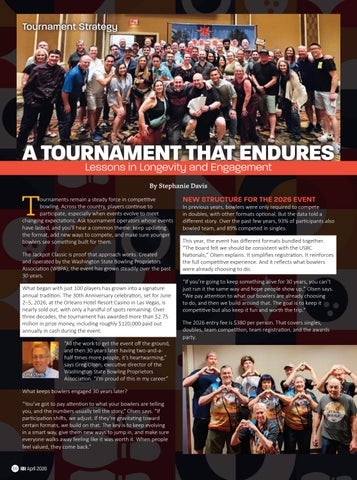
A TOURNAMENT THAT ENDURES Lessons in Longevity and Engagement

Tournaments remain a steady force in competitive bowling. Across the country, players continue to participate, especially when events evolve to meet changing expectations. Ask tournament operators whose events have lasted, and you’ll hear a common theme: keep updating the format, add new ways to compete, and make sure younger bowlers see something built for them.

The Jackpot Classic is proof that approach works. Created and operated by the Washington State Bowling Proprietors Association (WBPA), the event has grown steadily over the past 30 years.

What began with just 100 players has grown into a signature annual tradition. The 30th Anniversary celebration, set for June 2–5, 2026, at the Orleans Hotel Resort Casino in Las Vegas, is nearly sold out, with only a handful of spots remaining. Over three decades, the tournament has awarded more than $2.75 million in prize money, including roughly $120,000 paid out annually in cash during the event.

“All the work to get the event off the ground, and then 30 years later having two-and-ahalf times more people, it’s heartwarming,” says Greg Olsen, executive director of the Washington State Bowling Proprietors Association. “I’m proud of this in my career.”

What keeps bowlers engaged 30 years later?

“ You’ve got to pay attention to what your bowlers are telling you, and the numbers usually tell the story,” Olsen says. “If participation shifts, we adjust. If they’re gravitating toward certain formats, we build on that. The key is to keep evolving in a smart way, give them new ways to jump in, and make sure everyone walks away feeling like it was worth it. When people feel valued, they come back.”

NEW STRUCTURE FOR THE 2026 EVENT

In previous years, bowlers were only required to compete in doubles, with other formats optional. But the data told a different story. Over the past few years, 93% of participants also bowled team, and 89% competed in singles.

This year, the event has different formats bundled together. “The board felt we should be consistent with the USBC Nationals,” Olsen explains. It simplifies registration. It reinforces the full competitive experience. And it reflects what bowlers were already choosing to do.

“If you’re going to keep something alive for 30 years, you can’t just run it the same way and hope people show up,” Olsen says. “We pay attention to what our bowlers are already choosing to do, and then we build around that. The goal is to keep it competitive but also keep it fun and worth the trip.”

The 2026 entry fee is $380 per person. That covers singles, doubles, team competition, team registration, and the awards party.

Greg Olsen

Tournament Strategy

POPULAR OPTIONAL EVENTS KEEP IT FRESH

While the core competition anchors the weekend, several popular optional formats broaden the appeal and keep the energy high. These popular events create new partnerships, spark friendly rivalries, and give players additional opportunities to reconnect year after year.

• Second Chance Doubles draws 150–160 participants each year. It gives players an opportunity to re-partner, often with teammates from their four-person squad, but sometimes with friends they’ve met at the tournament over decades of participation — competitors they may see only once a year at this event.

• The Trio event, introduced six years ago, has become one of the most popular additions, typically selling out at around 52 teams.

YOUNGER PARTICIPATION

Of course, keeping something alive for 30 years means paying attention to who is coming up next. Olsen is quick to point out that the overall field does trend older, which makes it important to build in formats that catch the attention of younger competitors. If they don’t see something that feels exciting, they won’t show up.

That’s where a couple of newer formats, now part of the Jackpot Classic lineup, have really made an impact:

• The Late Night Dumpster Fire, held at 9:30 p.m., lets players drop their lowest score from a three-game series. It regularly draws 50-60 entries and has a lively, late-night energy that feels different from the traditional tournament blocks.

• The Shootout typically begins with 50 to 60 bowlers before the field is cut to 16 finalists across two divisions. From there, it becomes a one-game elimination battle, working down to a single champion. It’s a grind and a true test of focus, drawing strong scratch players who thrive in that head-to-head, highpressure format.

“These optional events really give the weekend some range,” Olsen says. “Our longtime participants still get the structure and format they’re comfortable with, but younger bowlers get something that feels faster, more competitive, and more fun. It lets us serve both groups without losing what makes the tournament work.”

EVERYONE LEAVES A WINNER

Here’s something you don’t see every day: every single bowler cashes. At check-in, participants are handed $50 in cash, before they’ve even thrown a ball. That amount represents last place. If someone bowls four events, they’re getting $200 back right off the bat. It puts a smile on their face right away and, as Olsen notes, takes the edge off those pre-competition nerves.

The idea came from one of the tournament’s founders, Gordy Cea, of Tyee Lanes in Everett, Washington. His philosophy was that if everyone leaves with something in their pocket, they leave feeling good about the experience.

Most participants still come from the Seattle area, but the competition also draws bowlers from Arizona, Oregon, Oklahoma, and even Minnesota. “Many of these bowlers originally came from Washington but moved away and now form teams at their new local center. They love to come back and compete together each year,” said Olsen. For a lot of them, this isn’t just another tournament weekend. It’s an annual trip — part competition, part reunion, part quick getaway.

Olsen has watched firsthand what this event does for the relationship between proprietors and their league bowlers.

“At the end of the day, it’s not just about scores,” Olsen says. “It’s about the relationships. When bowlers travel together, compete together, and come back year after year, that connection carries right back into league night. That’s what keeps this going.”

When a group makes the trip, the dynamic shifts. Some proprietors compete alongside their bowlers, others come to support, but either way, it creates time together outside the usual weeknight routine, sharing dinners, stories, and wins. While fewer proprietors travel than in years past, those who do understand how a few days together can strengthen bonds that last long after the tournament ends.

The most telling sign of the event’s impact is the returning list. Families now compete across three generations. Kids who once sat coloring at lane side tables while their parents bowled are lacing up shoes and competing alongside them.

Thirty years in, the Jackpot Classic remains a working example of how giving bowlers a reason to return pays off. When you watch participation trends, update your offering to attract new players, and make everyone feel valued, you make it easier for them to say yes.•

The Jackpot Classic shows that:

• Competition builds community when structured intentionally.

• Travel events can strengthen the bond between proprietor and league bowlers.

• Optional side events keep programming fresh and attract different demographics.

• Making every participant feel valued increases long-term loyalty.

For more information on the Jackpot Classic visit www.jackpotclassic.org.

SUMMER THAT SELLS

Packages and Passes That Fill Slow Days

Summer brings the biggest demand shift of the year for bowling and other location-based entertainment centers. Kids are out of school, families have time, and the “what are we doing today?” conversation happens every morning.

That’s the opportunity. Your weekends are likely humming already. The real revenue lives Monday through Thursday, late morning to late afternoon, when the doors are open, the bills are running, and too much of your space is sitting idle.

That’s exactly why summer tempts operators into the most common off-peak mistake: trying to fill slow hours with discounts and deals. It feels logical; slow days need traffic, and lower prices drive traffic. But that thinking leads straight into one of the most common and costly mistakes in the business.

WHY DISCOUNTING TRAINS GUESTS TO WAIT

Guests start treating the discount as the real price, which trains families to wait for weekday specials. The downstream effect is brutal: weekend attachment rates soften, the average per cap slips, and the promo becomes your permanent best seller. If you’re winning traffic but losing price integrity, you’re leaking margin, not building weekday demand.

There’s also a more subtle problem: discount culture changes how guests think about your venue. Once they’ve been trained to wait for a deal, it’s hard to get them back to paying full price. You’ve essentially reset their expectations, and that’s a very difficult thing to undo.

The better path is what some operators call value engineering. This means keeping your rack rate intact while creating offers that feel like a genuine win for the guest, without ever cheapening your core pricing.

PRICING PSYCHOLOGY THAT PROTECTS YOUR RACK RATE

A few simple shifts in how you frame and present offers can do a lot of heavy lifting. Start by anchoring guests to value rather than price. You need to frame bundles, like “Includes a $X value!” so guests are comparing what they’re getting, not what they’re saving. When you want to sweeten a deal, offer a “bonus” rather than a “discount.” People love getting something extra, and it avoids the trap of resetting their price expectations. Package the experience in terms that feel premium with perks like reserved lane time, express check-in, and exclusive access rather than falling back on percentage-off language that quietly signals your product isn’t worth full price.

You also need guardrails. Set a price floor and treat your rack rate as something worth protecting. If a weekday package is always available and always cheaper, it becomes the new default price, and your regular pricing loses credibility fast. Run weekday offers in four-to-six-week windows, then rotate to something fresh. Urgency evaporates the moment guests figure out the same deal will still be there next month.

You can spot discount training early if you watch behavior. If guests are clearly delaying visits until weekdays to “get the deal,” weekend attachment rates or the average per cap starts falling, or the promo becomes your permanent top seller, then that is your signal to tighten constraints, refresh the concept, or replace it with a new value-forward program that protects peak pricing.

HOW TO STRUCTURE A WEEKDAY OFFER THAT WORKS

The best weekday packages tend to follow the same basic blueprint. They start with time fences that clearly separate the weekday offer from your regular programming, such as Monday through Thursday only, before 5 p.m., or a specific booking window. That boundary signals to guests that this is a distinct product, not a cheaper version of what everyone else is paying on Saturday. Pair high-perceived-value items like arcade credits, a souvenir cup, or a prize pack with controllable food items that won’t put stress on your kitchen. And don’t forget to layer in those experience perks that feel premium but cost you very little.

Keep the terms simple. Complexity kills conversion and frustrates staff. Clear start times, firm capacity limits, and defined blackout dates make the offer easy to sell and easy to deliver. And pay attention to what you call it. The “Weekday Explorer Pass” reads like a product worth having, while the “Weekday Discount” reads like you’re struggling to fill the building.

PROVEN

FORMATS THAT ACTUALLY SELL

You don’t need a long menu of summer offers. A few strong formats, executed consistently, will outperform a dozen mediocre ones every time:

• The Weekday Family Bundle. A fixed lane or attraction block, one add-on activity, arcade credits, and a food item. It answers the “what should we do today?” question with a complete outing rather than leaving families to piece it together themselves.

• Lunch + Lanes. Removes the friction of combining an activity and a meal into one decision. Keep the food menu tight and batch-friendly to protect your kitchen during the midday rush.

• Punch Passes. Three- or five-visit passes with weekday-only constraints, a clear expiration date, and a small reward for completing the full pass. They build visit frequency without discounting every single trip, and a completion incentive keeps guests coming back to redeem.

• The After-Camp Special (2 p.m.–5 p.m.). Timed to match childcare pickup, this window is a natural fit for a light, fast, easy-to-staff offer. Rotating weekly themes, mini tournaments,

or leaderboard challenges turn it into a communal experience rather than just a deal. And it’s just the kind of thing kids ask to come back to.

MARKETING IT WITHOUT THE COUPON VIBE

How you present these offers matters just as much as the offers themselves. Lead with identity-based language like “Summer Club,” “Camp Legends,” or “Weekday Fun.” Names like these position the program as something guests want to join, not just redeem.

Keep the execution clean on your end. Create a one-page cheat sheet for staff, limit the menu to three to five offers at a time, and use consistent naming across signage, your website, and phone scripts. When everyone says it the same way, it feels intentional instead of improvised.

Next, put your promotion where weekday decisions are actually made. Start with your own channels: email and SMS to your database, including lapsed guests who may just need a summer nudge to return. Expand outward to school and daycare newsletters, community Facebook groups, and local corporate partners who can share family perks with employees. Meet families where they’re already planning their week.

Finally, build a simple internal promotion calendar so the program stays fresh without becoming chaotic. Launch early to establish momentum, refresh mid-summer with a new theme or bonus challenge, and close with a “finish strong” push that encourages punch pass completions and tees up fall bouncebacks. A clear rhythm keeps the energy up and the execution manageable.

BUILD WEEKDAY HABITS THAT OUTLAST SUMMER

The weekday traffic is there. Families need something to do, and if your offer is well-structured and well-priced, you’re going to get a share of it. The question is whether you capture it in a way that builds real value over time, or whether you train guests to expect less and wait for deals.

Summer is short. The families are out there right now trying to figure out what to do with their Tuesday. If your offer is easy to find, easy to understand, and feels like a value rather than a discount, a good chunk of them are going to walk through your door.

Done right, summer becomes the season where you build weekday promotional and operational habits that last into fall through leagues, memberships, and school-night bundles •

Brandon Willey, ICAE, is co-founder of the LBX Collective and Premier LBX Group, co-host of The LBX Daily Show, and founder and CEO of Hownd. Brandon has an intense passion for the attractions industry and extensive knowledge of location-based entertainment. Brandon is the former chair of IAAPA’s FEC Committee and now sits on the North American Manufacturers and Suppliers Committee. You can connect with him at LinkedIn.com/in/bwilley.

How a Nebraska Center Keeps Leagues Full LEAGUE IN A OF THEIR OWN

When was the last time your lanes were packed with league bowlers?

In today’s climate, a full house of organized play night after night is increasingly rare. Unless you’re at Maplewood Lanes in Omaha, Nebraska.

At this 36-lane center on the city’s west side, leagues don’t just survive, they dominate the schedule. More than 25 organized groups fill the calendar for men, women, youth, high schoolers, seniors, and every combination in between. Most evenings at 6:30 p.m., every lane is spoken for. Many leagues run 30 weeks or more, stretching from before Labor Day to Easter. And in a throwback that would make purists smile, nine leagues still field five-player teams.

This didn’t happen by accident. It’s the result of deliberate leadership, relentless personal contact, and a philosophy that empty lanes are simply not an option.

FILLING LANES IS THE MISSION

Jeanne Belitz Jr., Maplewood’s general manager for the past 17 years, grew up in the business. She represents the third generation of her family operating centers in Omaha, dating back to the 1950s.

Before returning to Maplewood in 2008, she spent years in hospitality management, an experience that sharpened her instincts about occupancy and customer service.

That clarity drives everything at Maplewood.

Belitz personally handles league coordination. Not most of it. Not parts of it. All of it. She attends every league meeting. She makes sure she’s visible during the first two weeks of every season to smooth out issues before they snowball. And she hands out her personal cell phone number freely.

Her approach resembles a cruise director more than a distant manager. League bowlers know exactly who to call, and they do. That accessibility isn’t limited to in-person interactions. Maplewood reinforces it with communication systems that keep leagues connected beyond the building.

CONNECTION AS A COMPETITIVE EDGE

In the hotel world, she learned a simple truth: empty rooms don’t generate revenue. The same logic applies to lanes. Her daily mindset is straightforward: fill them.

Social media at Maplewood is much more than just promoting specials. It’s a communication engine.

elitz created private Facebook groups for each league, using them to share announcements, celebrate milestones, promote tournaments, and keep everyone informed during weather disruptions. The groups allow bowlers to interact with one another, reinforcing the social glue that keeps leagues strong.

Building that digital network took real work. Personally connecting with customers online and integrating them into digital groups was a significant undertaking. But the payoff has been speed and accessibility. What once required long evenings on a landline can now be handled in minutes through text or social platforms.

Belitz jokes that she carries her league book everywhere. If a bowler calls while she’s waiting in a parking lot, she can answer questions on the spot. League coordination, in her view, no longer has to be confined to an office desk.

Jeanne Belitz Jr.

To strengthen that effort, Maplewood works with a former general manager who now serves as an outside social media and marketing consultant. Weekly emails go out. Open roster spots are promoted quickly and specifically. If a Thursday mixed league needs one bowler between ages 40 and 55, the message is clear and often filled within a day. Belitz believes that fast communication prevents small gaps from becoming big problems.

FORMATS THAT KEEP LANES FULL

Strong communication keeps leagues informed. Smart formats keep them growing. Maplewood’s league lineup includes some formats that operators everywhere would love to replicate.

Parent-child leagues remain a cornerstone. Maplewood was one of the first centers in Omaha to offer adult-youth leagues decades ago, and today they’re seeing fourth-generation bowlers. One team fittingly calls itself “The Three Gens,” featuring a grandmother, her daughter who grew up in Maplewood’s youth program, and now her grandchildren.

Youth leagues remain strong as well. To maximize revenue and flexibility, Maplewood adopted a pre-pay option and structured pre- and post-bowling opportunities for those who can’t attend regularly. That flexibility helps retain families with busy schedules.

teams. A recently introduced early bird Sunday special, $9.99 for 90 minutes, sold out its first two weeks.

Every time slot has a purpose.

THE 30- AND 40-SOMETHING CHALLENGE

Even with a packed schedule, some demographics require extra attention. One demographic that remains challenging is attracting bowlers in their 30s and 40s. Belitz believes that retention in that age group requires reinforcing value and social ability. She frequently asks prospective league members a simple question: Would you see these same friends every week if you weren’t bowling?

Most leagues are mixed, but Maplewood simplified team rules. Instead of requiring strict male-female combinations, they shifted to a “crazy mixed” format of any combination of genders allowed. That change made roster management easier and eliminated the scramble to find a specific replacement.

Only one league still requires at least one member of the opposite sex. The rest prioritize flexibility over tradition.

There’s room for competitive purity too. The 800 Classic on Thursdays is exclusively men, while the Classy Ladies take over Tuesday nights. Two other men’s leagues also include high-level women competitors.

The common thread? Structure that works for participants, not against them.

SCHEDULING AROUND REAL LIFE

And at Maplewood, structure doesn’t stop with team rules, it extends to the clock. Unlike many centers that open late afternoon, Maplewood starts at 9 a.m. Special needs groups occupy much of the daytime schedule, generating revenue in hours that often sit idle elsewhere.

To bridge the gap before evening leagues, Maplewood introduced Cocktail Hour leagues that consist of three-person teams starting around 4:30 p.m. The concept took off during COVID and never looked back. What once filled 18 lanes now fills 30. These leagues appeal especially to retirees and those who prefer not to drive at night. They still want competition and camaraderie, just on a schedule that fits their lifestyle.

After-school leagues fill Tuesday afternoons. Sunday afternoons feature the Adult/Youth Family Roller league, drawing around 30

The answer is usually no.

That realization reframes league bowling as something bigger than scores. It’s built-in social time. It’s accountability. It’s connection in a world where busy schedules often erode regular interaction.

PURPOSEFUL PROFIT CENTERS

After years of refining her league building model, Belitz has clear opinions on what works and what doesn’t; she has developed a definitive playbook for building strong, sustainable leagues.

• Clear up misconceptions. Many people assume leagues are only for highly skilled players. Belitz reframes the conversation explaining “Skill level isn’t the requirement; personality and fun are. Once bowlers understand how handicap levels the field, hesitation disappears.”

• Promote early. Maplewood often sells out summer leagues by February. Planning five months ahead isn’t aggressive there; it’s routine.

• Leadership involvement matters. Belitz believes league success starts at the top. In her view, ownership should stay closely connected to coordination rather than handing it off entirely.

Recognition — and Community

Maplewood’s efforts have earned them five consecutive Omaha Choice Awards from the Omaha World-Herald and earned repeated recognition in Omaha Magazine’s Best of Omaha competition

But awards aren’t what define success here. What stands out more is the multi-generational community. Bowlers gather for baby showers, birthdays, luncheons, and milestone celebrations. League night extends beyond frames and score sheets. It’s a social anchor.

In an era when many operators are searching for the next attraction, Maplewood doubled down on connection, consistency, and personal accountability.

The result? Packed houses. Loyal customers. And proof that leagues, when nurtured properly, are far from a relic of the past. They’re a strategy.•

Mark Miller is a freelance writer, editor, and public relations specialist from Flower Mound, TX. He’s the author of "Bowling: America's Greatest Indoor Pastime," available at Amazon.com or directly from him at markmywordstexas@gmail.com.

UNDERGROUND BOWLING ASSOCIATION

“The UBA has helped us have a drastic increase in competitive bowling with an age group we have unsuccessfully attempted to target over the past 10 years.”

Tab and Tracy Golding, Northside Lanes, Winston Salem, NC

“We love hosting UBA events. The bowler’s spending on food and beverage is significant, filling slots during slower times for us. Their tournament staff is easy to work with and is always a pleasure to host.”

Bill Cornell, owner High Point Bowling Center, High Point, NC

“The UBA has been hosting events at Triad lanes for many years. The UBA directors running the events are always helpful, ensuring we have everything we need for successful events. Our employees love hosting the UBA because of the atmosphere it brings into the center.”

Robert Klein, GM, Triad Lanes, Greensboro, NC

“The UBA has been a tremendous asset to our center—bringing in new guests, increasing off-peak revenue, and growing our league base. Their events run smoothly, boost food and beverage sales, and generate amazing word-of-mouth buzz.”

Jared McPherson, General Manager, Bowl America Shirley 727

“The UBA bowlers come ready to bowl, eat and drink. Even though they are extremely competitive and have large prize funds, their philosophy is bowl and party, which equals excellent food and bar sales during UBA events. I highly recommend building a strong relationship with the UBA.”

Kathy Kubinak, General Manager, Laurel Lanes, Maple Shade, New Jersey

DETAILS AREN’T SMALL.

THEY’RE THE EXPERIENCE!

Lessons Learned from the Front Lines

After decades covering the industry from the editorial side, I decided to step behind the counter for a while. What was meant to be a short-term, hands-on experience turned into one of the most eye-opening chapters of my career.

At 58 years old, I didn’t expect to feel like “the new kid.” Yet for a season, that’s exactly what I was at one of Kansas City’s most iconic, league-based bowling centers.

After nearly 30 years working on the editorial side of the business at International Bowling Industry magazine, I had spent a career telling other people’s stories. I had toured centers, interviewed operators, written about trends, and watched the industry evolve from the outside. But when my kids became grown and life shifted into that “empty nester” chapter, I felt a nudge to do something different.

Not instead of my role at IBI, but in addition to it.

I wanted to experience the business from the inside. To understand the day-to-day rhythm, the pressure points, the pace, and the pride that came with running a center at ground level. So, I took a part-time position at Gladstone Bowl. And just like that, I became the rookie.

LEARNING EVERY CORNER OF THE HOUSE

One of the first things I realized was that working in a bowling center was a lot like inviting guests into your home. Every shift was hosting. You wanted the food right, the place clean, and the people walking through the doors to feel welcomed before they even knew why.

What surprised me most was just how much went on behind the scenes, and how fast you were expected to get up to speed. I learned how to process league payments, navigate the POS system, cook in the café, explore new HR and scheduling apps, tackle cleaning and maintenance issues, and jump in wherever an extra set of hands was needed.

It was humbling. And energizing. There was always something to do and always something to learn. At this stage of life, stretching in new ways felt less scary and more satisfying.

THE POWER OF SMALL DETAILS

Here’s where the real lesson kicked in. Early on, the proprietor pulled me aside and said something simple: “Clean the fingerprints off the front doors.”

At first, I’ll admit, I didn’t fully get it. It seemed like a small thing. Almost too small to matter. But as I watched him work, I understood exactly what he meant. Clean glass told people they mattered. It was a welcome before the welcome.

That mindset showed up everywhere at Gladstone Bowl:

• Lights adjusted just right

• Tables aligned, not “close enough”

• Taco shells crisped properly

• Lane approaches swept, not skipped

• A genuine hello for every guest walking in

• A

• A

• A

• A

• Something

• How

Inside Perspective

Details were easy to dismiss when you had been in the business a long time. You’d seen it all. You knew how it worked. You were busy. But the longer you were around, the easier it became to overlook the very things guests noticed first.

This is something managers might want to remind their teams of, and something staff members, especially newer ones, should hear loud and clear: Details aren’t small. They’re the experience.

A FAMILY TRADITION, 67 YEARS STRONG

Gladstone Bowl is a living piece of Kansas City history. People talked about it the way they talked about family traditions. “I grew up here.” “My dad bowled league here.” “My kids bowl youth here.” And then there were Smitty’s tacos, famous for that unmistakable sprinkle of Parmesan on top. Unique. Unexpected. Unchanged for 67 years. Watching customers light up when they ordered them was like watching nostalgia served on a tray. Every time I handed one across the counter, I was reminded that consistency was a detail, and one that mattered deeply.

SEEING THE BUSINESS THROUGH NEW EYES

Working there gave me a renewed respect for the frontline perspective. It’s one thing to write about operations. It’s another to live inside them. To see how small choices stacked up over a night, a league season, a year.

A clean table wasn’t just a task.

It was a signal of care.

A warm greeting wasn’t routine.

It was recognition.

For managers reading this, there’s real value in reinforcing these moments with your team, especially when they’ve been around long enough to feel automatic. And for staff members or newcomers, know this: the details you’re asked to focus on aren’t busywork. They’re the reason guests keep coming back.

My time on staff eventually came to an end, but the lessons didn’t. In many ways, they only deepened once I stepped back into my primary role in the industry.

BELONGING TO SOMETHING BIGGER

What I learned most during those months was that Gladstone Bowl is more than a business. It belongs to the community, and the community belongs to it.

Starting something new at 58 could have felt intimidating. Instead, it felt like a privilege. I was proud to learn every day, proud to see the business from the inside, and proud to have played even a small role in carrying forward a tradition that meant so much to so many.

Sometimes, becoming the rookie again is exactly what reminds you why the details matter in the first place.•

Jackie Fisher is the longtime editor of International Bowling Industry magazine and recently spent several months working at Gladstone Bowl in Kansas City, MO.

EXPANSIONS, OPENINGS & NEW BEGINNINGS ACROSS THE POND

UNITED KINGDOM

King Pins is on the move in the UK. It began in 2023 with a Manchester location, followed by another in 2024. The King Pins locations spread and can now be found in Bristol, Glasgow, a new location in Leeds, and one forthcoming in Belfast, Northern Ireland. These popular venues offer a wide range of activities for all ages, typically including arcade games, American pool, karaoke booths, ice-free curling, ten-pin bowling, duckpin bowling, and shuffleboard. Crazy Pool, a game that fuses elements of American pool and crazy golf, is on the roster of immersive games.

The Lane7 Group takes another venue under its wing.

The Lane7 Group, the UK's boutique bowling entertainment company, has acquired one of Glasgow's most high-profile event spots, The Arches. The space will open as Platform, a 35,000-squarefoot hospitality venue built in the arches below Glasgow Central railway station. Each arch of the railway station exposes brickwork dating back to 1879 and features six interconnected halls with vaulted ceilings. The site opened as a nightclub in the 1990s and later became a multipurpose event facility in 2018. Lane7 confirmed that Platform will honor bookings made with The Arches and will bring social activities that Lane7's boutique bowling is known for.

Disco Bowl in Burney, Lancashire, UK, is getting a new face lift which will include a new floor, seating, plus new bowling equipment and lighting. A new bar, reception area, and updated arcade are in the mix. The cherry on the top? A nine-hole mini golf course.

Hupalupa, a family entertainment and leisure company which was founded in 2019, has announced another location in the city of Adana. This will be the third venue alongside Istanbul and Bursa. The new Adana location will cover an area of 6,000 square meters and is set to be the largest site in the Hupalupa portfolio. Its wide variety of activities will include a trampoline park, climbing walls, indoor ropes, soft play areas, redemption games, and, of course, bowling. International markets are on the agenda.

TURKEY

The

(Financing

or your first pair is

“Our experience here at Chatham Bowlerama with New Center Consulting, Inc. was very professional.

New Center Consulting, Inc. usually only deal with 10 pin, duck pin and candle pin scoring systems and pin setters. Glenn and his crew where excited for the challenge of getting the very old Mendes 5 pin machines at our centre to work with their scoring system.

It has been well worth changing the scoring system to Touch Score. Simplicity is the best way to describe Touch Score, ease of use for league bowlers and public bowlers a like.”

“We here at Chatham Bowlerama would suggest New Center Consulting, Inc. for installing Touch Score scoring system.”

Peter Brown Proprietor of Chatham Bolwerama

Guest Experience

FULL TANK. FULL EXPERIENCE.

When Ordinary Becomes Remarkable

Ihad never been to Buc-ee’s. I’d heard people talk about it with a level of enthusiasm that felt… suspicious. It’s a gas station, after all. How exciting could it be?

Then, on a long holiday drive out of state, my daughter made it clear that stopping at Buc-ee’s wasn’t optional. Apparently, missing Buc-ee’s would mean missing something important—though she struggled to explain exactly what that something was.

So, when the fuel gauge dipped low and Google Maps showed a Buc-ee’s nearby, my son and I pulled off the highway. And within about 20 seconds of walking through the door, I realized I’d been very, very wrong. This wasn’t a gas station. This was a spectacle.

The space was massive and spotless, buzzing with energy. Bucee’s branding was everywhere—on walls, shelves, displays, and merchandise that ranged from funny to oddly premium. An antique truck sat inside the building, filled with even more branded merchandise. It was Christmas season, and the festive displays could have rivaled a department store at peak holiday rush. There were food stations I didn’t even know how to categorize.

At one point, I stopped in my tracks in front of an upscale liquor dispenser stone priced at nearly $300. In a gas station.

And the checkout lanes? There were more open, staffed registers than I’ve seen in most grocery stores or big-box retailers lately.

What should have been a quick stop quietly turned into an adventure.

That’s when it hit me: Buc-ee’s didn’t accidentally become a destination. They designed it that way. And if a business built around something as ordinary as fuel could pull this off, what does that say about places built for entertainment?

I smelled a story immediately.

BUC-EE’S ISN’T REALLY SELLING GAS

No one goes to Buc-ee’s because they’re loyal to a particular fuel blend. I’d bet most Buc-ee’s fans couldn’t tell you the price per gallon, but they can describe the bathrooms, the food, the merchandise, and the overall vibe in vivid detail.

People go because it’s Buc-ee’s. They go for the anticipation. The surprise. The sense that even a routine stop might turn into something memorable. Gas is just the excuse to pull over.

OVERDELIVERING ON THE BASICS

One of the most talked-about things at Buc-ee’s, almost comically so, is the bathrooms. They’re huge. Bright. Immaculate. Monitored constantly. People actually look forward to using them.

Extreme Low energy consumption

Here’s to three hours of pinspotting using as little energy as brewing a single pot of coffee

Only EDGE String uses state-of-the-art 24V DC in-line gearmotors to lift pins and return balls—delivering unmatched mechanical and electrical efficiency. Gearmotors run only when needed. And, at just 0.046kWh of power per machine, EDGE String consumes less power than the typical household coffee maker.

Learn how EDGE String can reduce your energy costs

Guest Experience

It sounds ridiculous until you’re there, realizing that something most businesses treat as a necessary evil has been elevated into a point of pride. Buc-ee’s didn’t skip the basics in favor of flash. They nailed the basics so thoroughly that the basics became part of the brand.

Bathrooms, seating, cleanliness, temperature, lighting—these aren’t glamorous investments, but they quietly shape how a place feels. When they’re done right, they make an impact.

FOOD THAT PULLS YOU IN (AND KEEPS YOU THERE)

Another Buc-ee’s surprise? The food. This isn’t a snack rack by the register. It’s more like a roadside marketplace with multiple food experiences under one roof; everything is designed to tempt you into staying just a little bit longer. Depending on the location, you’ll find:

• BBQ and sandwich stations featuring smoked brisket, pulled pork, turkey, and sausage

• Breakfast tacos and burritos loaded with eggs, cheese, bacon, sausage, or brisket

• Kolaches, a Texas favorite, stuffed with sausage, cheese, jalapeño, or fruit

• Fresh bakery items and sweets, from cinnamon rolls and muffins to fudge

• An expansive jerky and meat snack selection, with dozens of flavors and styles

• Signature snacks, including the famous Beaver Nuggets and seasonal treats

• Massive drink stations, coffee bars, iced tea, and quick sides

MERCHANDISE THAT WALKS OUT THE DOOR FOR YOU

Buc-ee’s merchandise is everywhere, and it’s not subtle. It’s bold, playful, and honestly, sometimes ridiculous. People wear it proudly. They gift it. They laugh about it. And without realizing it, they become walking billboards for the brand. Nothing feels generic or like an afterthought.

THE PEOPLE BEHIND THE EXPERIENCE

Part of what makes Buc-ee’s feel so seamless is the sheer number of people working behind the scenes. Employees were everywhere, visible, engaged, and clearly trained to represent the brand. Bucee’s doesn’t run on a skeleton crew; it hires big, and it pays above typical convenience-store wages to do it.

According to job listings and staffing summaries, positions such as cashiers, food service workers, and stocking associates often start around $16–$24 per hour, significantly higher than minimum wage in many states. Management roles pay even more, with general managers reportedly earning well into six figures in some markets.

Benefits include health, dental, and vision insurance, paid time off, and a 401(k) with a company match. Buc-ee’s even advertises double time on major holidays, acknowledging that operating 24/7 means nights, weekends, and peak travel days are part of the job.

Buc-ee’s is recruiting from the same workforce as bowling centers and family entertainment venues. When a place is fully staffed and energized, guests feel it immediately.

That said, keeping employees long-term isn’t simple. While industry analysts point to employee recognition programs and community-building as part of Buc-ee’s retention approach, employee reviews also describe a fast-paced, demanding environment where not everyone stays forever. It’s a reminder that even strong staffing strategies operate within the realities of high-volume, service-driven work.

TURNING A QUICK STOP INTO A STORY

The real genius of Buc-ee’s is that it turns something routine into something worth talking about. No one brags about stopping for gas. But people do talk about Buc-ee’s. They plan trips around it. They tell stories about it. They insist others experience it for themselves.

That’s powerful.

I left Buc-ee’s with a full tank of gas, some branded gifts, and a completely different perspective. If a gas station chain can turn a necessity into an event, imagine what’s possible in a space built for connection, competition, food, and fun.

Sometimes inspiration comes from unexpected exits off the highway. And sometimes, the most ordinary places show us what’s possible when nothing is treated as ordinary at all.•

Apparel

www.funtimefootwear.com

support@experthosiery.com

Expert Hosiery is a premiere supplier of high-quality socks to bowling centers and FECs. We pride ourselves in lifetime relationships. Socks variety includes white bowling socks, glow socks, theme socks, and custom logo socks. Our customers are our best testimonial! For orders, call, email or order online 24/7. LAYMON HUGHES HOSIERY

laymonhughes@bellsouth.net

www.laymonhugheshosiery.com Sharon Hughes

Being a BPAA preferred vendor we are proud to say we are an American family owed manufacturer of quality USA made socks. We are proud to offer many styles of bowling and skating socks to family entertainment centers around the USA and overseas as well. We do not have any minimum orders. Every size center can customize their order each time. We also do custom orders for your center or for special events throughout the year.

www.avscompanies.com

sales@avscompanies.com

Providing best-in-class arcade and vending equipment with decades of unparalleled service. AVS Companies is the trusted choice for world-class amusement solutions.

BETSON ENTERPRISES

Sales Department

www.betson.com/bowling

800.524.2343 Sales@betson.com

Betson Enterprises is the leading worldwide distributor of arcade equipment, parts, and service. A family-owned business offering revenue-generating solutions to its clients since 1934, Betson offers concept-to-completion solutions that maximize the profitability of our clients’ investments.

www.p1-ag.com

GetAnswers@genda-americas.com

At Player One Amusement Group, we specialize in the sourcing and distribution of quality amusement and vending equipment for both commercial and retail customers. We provide end-to-end Total Solutions, from the design and planning of the space, to equipment selection, to best practices for merchandise and redemption counters. Each business is unique so P1AG customizes the appropriate services to meet your business needs.

www.newcenterconsulting.com

ghartsho@yahoo.com

www.steltronicscoring.com

Info@steltronicscoring.com

Arcade Distributor

Capital Equipment/Supplies

The leader in the bowling industry for over 130 years, Brunswick Bowling provides products, services, and industry expertise for new and existing bowling centers.

QUBICAAMF

Sales Department

804.569.1000

www.qubicaamf.com

info@qubicaamf.com

QubicaAMF is the world’s largest manufacturer of bowling and mini bowling products. With our innovative products, we will help our customers fully unleash that potential to extend the bowling population, to reach the younger generations, to increase their spending, frequency of visits—and your revenue.

Intercard introduced cashless technology to the amusement industry and has been leading the way for 30+ years. Award winning cashless systems from Intercard increase customer spending and satisfaction and boost revenues by up to 30% at entertainment centers worldwide.

Food/Beverage

www.pursepegsllc.com

info@pursepegsllc.com

Bowling alleys can install Purse Pegs to their dining tables to provide guests a clean, secure place to hang their valuables while they bowl and dine. This small addition improves comfort, keeps walkways clear, and prevents belongings from getting dirty or damaged on the floor. Purse Pegs enhance the customer experience, making your venue more inviting and accommodating. It’s a simple upgrade that shows attention to detail and encourages repeat business through thoughtful, practical design.

www.drinkslowandlow.com

jholecz@cooperspirits.com

Slow & Low is an award-winning lineup of ready-to-serve Old-Fashioneds, crafted for speed, consistency, and serious barquality. Ranging from 80 to 100 proof, it’s the ultimate plug-and-pour solution for high-volume accounts looking to serve premium cocktails without slowing down.

Helping

tailored to your needs. Contact us today and let’s get your coverage started!

Lighting/Sound

WESTERN BOWLING PROPRIETORS

Cameron Linder

PREFERRED VENDOR LIST

800.200.9998

www.wbpiprogram.com

contact@wbpiprogram.com

WBPI is the largest bowling center insurance program in the nation with more than 35 years of experience and 400 insured centers. Exclusively endorsed by eight state bowling proprietors associations, our staff of insurance partners and professional bowlers provide staff training, insurance education, advocacy, and business advice. No one fights harder for you! Contact us today for a competitive insurance quote!

DECIBEL STUDIOS

Ravi Shankar

Guy O’Hazza

310-693-5210 ext. 1

310-717-1603

www.decibel-studios.com

ravi@decibel-studios.com

guy@decibel-studios.com

Decibel Studios is an innovative global technology solutions company that designs, engineer, installs, and maintains custom controlled audio, video, lighting, show control and special effects systems, including augmented and virtual reality, 3D and 4D interactive theaters, for various entertainment, corporate, hospitality, retail and institutional groups.

DFX SOUND VISION

Mike Bovino

More WOW. More Stay. More Play.

800.555.5280

www.dfxsoundvision.com

info@dfxsoundvision.com

DFX helps Family Entertainment Centers stand out with immersive audio, lighting, video, andautomation systems designed to increase dwell time and drive repeat business. Whether you’rebuilding new, renovating, or adding a feature attraction, we create fully integrated environments thatcaptivate guests and keep them coming back.

Featuring VersaLED Video Walls powered by VersaShow and the Versa product line, your entire facility— audio, lighting, video, and automation — operates seamlessly through one intuitive control system.From design and installation to long-term support, DFX is your turnkey AV partner for unforgettableexperiences.

Design. Integration. Control. Support. One partner. Endless possibilities.

Online Reservations

www.kidsbowlfree.com

Andy.Vasko@kidsbowlfree.com

At BBBI our goal is to create new customers and profits for bowling centers through our time tested Kids Bowl Free Summer Bowing Program and our new League Development System featuring Fun Bowling Leagues for all ages.

www.bowlingleads.com

Zach@bowlingleads.com

We help bowling centers find new leads and turn them into raving repeat customers with our automated marketing system.

ALLEYTRAK

Chris Behling

815.519.9843

www.alleytrak.com

Chris@alleytrak.com

AlleyTrak is the complete lane reservation and management system designed specifically for bowling alleys. Manage your recurring events, leagues, parties, packages, along with many other features AlleyTrak has to offer. Save time by allowing guests to make reservations online 24/7.

PREFERRED VENDOR LIST

Party Supplies and Novelty Products

PARTY DIRECT

Nancy Dye

www.partydirect.com

317.694.8413 nancy@partydirect.com

Elevate your party experience with Party Direct! From exquisite place settings to captivating decorations, delightful party favors, and premium tableware, we’ve got you covered. With our wide range of high-quality products, competitive prices, and hassle-free shopping, Party Direct is your ultimate destination for all your party supply needs. Create memorable celebrations effortlessly. Party Direct is your one stop source for all the party supplies you need to increase guest satisfaction and profitability!

SIERRA PRODUCTS

Shelly Berry 800.900.7695

www.noveltybowlingstuff.com

sales@noveltybowlingstuff.com

Sierra Products is your exclusive source for bowling parties, including party favors, supplies and novelties. Bowling birthday party supplies include bowling pin sipper bottles, mini bowling pin candy containers, bowling coin banks, bowling party cups, napkins, novelty souvenir cups and much more. Most of our items can be personalized with your company’s logo, phone, website, etc.

A&A GLOBAL

Sales Department

800.638.6000 ext. 306

www.aaglobal.com

gclothier@aaglobal.com

A&A Global has been delivering fun since 1938, helping businesses turn joy into revenue. With reliable, strategic support and a full range of toys, candy, novelties, and custom programs, we design the right mix to drive traffic, build loyalty, and create real results.

800.272.6375

www.bmimerchandise.com

Sales@bmimerchandise.com

At BMI Merchandise, we’re in the business of fun—and we take it seriously. For over 30 years, we’ve been a recognized leader in the amusement industry, providing innovative redemption products and services. As an industry pioneer and technologyforward company, BMI helps family entertainment centers improve efficiency and profitability. We offer a constantly evolving mix of redemption merchandise featuring the hottest brands and licenses, all integrated with advanced technology. Beyond merchandise, we deliver innovative technology solutions, including our proprietary AMRS™ system—a 360° solution designed to streamline operations and maximize profits through design, planning, installation, and fulfillment.

SURESHOT REDEMPTION

Corporate Sales

888.887.8738

www.sureshot-redemption.com

Sales@sureshot-redemption.com

Sureshot is your ultimate destination for retail merchandise and redemption prizes. We feature a comprehensive assortment across all major categories, coupled with exceptional customer service, competitive pricing, and premium quality products. Discover our ongoing additions of unique items year-round. We also offer custom logo programs, automatic merchandise replenishment, assortment planning, and planogramming services. Trust Sureshot Redemption to consistently meet your needs with precision and reliability, especially with our Free Freight program. Call or email us for details!

Redemption Plus is your go-to partner for all things redemption! From designing and merchandising exciting redemption centers to offering expertly crafted training resources and a broad selection of trend-worthy prizes, we’ve got you covered. With a fresh approach and top-tier service, we simplify your operations so you can focus on wowing your customers with unforgettable experiences!

RHODE ISLAND NOVELTY

Hutch Costello

401.996.9489

www.rinovelty.com

HCostello@rinovelty.com

Rhode Island Novelty has been in business since 1986 and is the leading Prize provider for the Redemption industry, offering the best case pricing, product selection, and performance. We keep it simple so you can focus on keeping your guests happy. With unmatched variety and value, partnering with us means saving time, reducing costs, and providing prizes that keep guests coming back again.

Turn static files into dynamic content formats.

Create a flipbook