SECRETS & LIVES
By shannon moneo photo by leanna rathkelly
What will you do for Valentine’s Day? Work. Normally it’s just a nice dinner and a bottle of wine. When did you decide to be a doctor? Probably second-year university, in Edmonton. It was the fascination with biology, pathology and the constant challenge of a changing profession. There’s a definite scientific component but also an art in medicine. How many heart surgeons are women? Less than 10 per cent in North America. Training tends to be prolonged. Four years of med school, six to nine years of residency, then one to three years of fellowship and that doesn’t count pre-med. I was a GP for 10 years before becoming a cardiac surgeon. I finished my fellowship in 2005. I wanted to do the surgery, not just help do the surgery. Do you get more female patients? No. It’s first-come, first-served at our four-doctor practice. We have a firstavailable booking model. What is the most common operation you do? Coronary bypass grafting, about 40 to 50 per cent of my work. We also do a lot of valve repairs and replacements. Who is your typical patient? The majority are ages 65 to 80, with heart disease, who have had a heart attack or been living with heart disease that’s progressed. What was it like the first time you held a human heart? Awe-inspiring. It’s one of those things, you look at it and go, “oh my God.” Watching the heart beat is like watching a fire. You can watch it forever. How do patients show appreciation? The most important way you can say thank you is by going on and living your life as well as you can. I still get postcards from one guy who I did a bypass for five years ago, from where he’s travelling, saying, “Hey, I’m here now. Thanks.” What makes a good heart surgeon? Attention to detail. Meticulousness.
Patience. It’s very fine work. You have to have great manual dexterity, good vision and the ability to think outside the box because things are always changing. What’s the most surgeries you’ve done in one day? Four but that doesn’t happen a lot. You’re scheduled to do two cases per day. If you’re on call and emergencies come in at night, you may just keep on going. Should some people be denied surgery? Denied is the wrong word. Some patients do better without surgery than with surgery. There are medical options for them that are less risky than the surgical options. What about those who smoke, have bad diets, don’t exercise? Nobody can dictate the person’s choices. That’s like saying people shouldn’t ski because there’s a risk of breaking their leg. We’re not sociologists. I just try and help fix what’s wrong and suggest alternatives. If you wanted society to dictate how to get rid of heart disease, get rid of deep fryers and cigarettes or say that anybody with a positive family history cannot procreate. You can’t do that.
Could you be enticed out of Victoria? Never say never, however, where is there a better city than Victoria? I lived in Vancouver almost 20 years. I never want to go back. I watched a football game in Calgary last weekend where it was snowing. You know that sensation of your eyes freezing shut? I don’t need that anymore. What do you do for fun? Various sporting activities. Walking the dog, right now a German short hair. Sitting on the beach. Kayaking, vacationing. I love scuba diving. Golf. If not a heart surgeon, what would you do? Go live on a dive boat and teach scuba diving. VB
What role do donations play in your profession? The Uplands Golf Tournament every year provides us with over $100,000 in donations that go directly towards purchasing equipment. The Victoria Visions event in November, through the Hospital Foundation, is all about donations. Victoria Heart House, near the Royal Jubilee, has relatively inexpensive rooms that provide people with the opportunity to stay within walking distance of the hospital. Supporting these charities is huge. You worked in Virginia from 2005 to 2007. Why did you return to Canada? I went there to work with a world-famous surgeon, Irv Kron, now one of my mentors. I stuck around because he offered me a job. The problem is, the American health-care system is so different
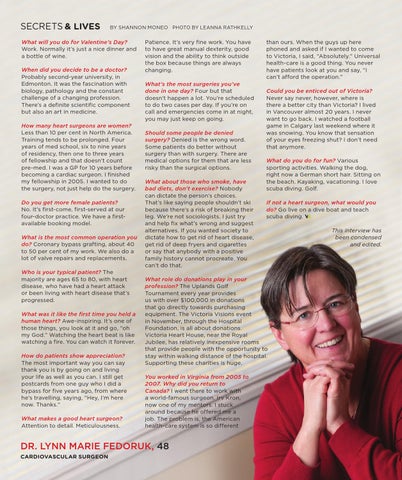
DR. LYNN MARIE FEDORUK, 48 CARDIOVASCULAR SURGEON
than ours. When the guys up here phoned and asked if I wanted to come to Victoria, I said, “Absolutely.” Universal health-care is a good thing. You never have patients look at you and say, “I can’t afford the operation.”
This interview has been condensed and edited.