Trip city PEARL STREET GETS BACK TO BUSINESS P.7
World's largest psychedelic conference returns to Denver P.23
+
Kickoff concert with Flying Lotus P.15
THE YIN AND YANG OF AMYTHYST KIAH P.11
Top Shelf Gifts for Top Shelf Dads
And Thousands of Other Gifts Your Dad Will Love!
28th Street and Pearl, Boulder Hazelsboulder.com Download the Hazel’s app
CONTENTS 06.12.2025 Credit: Kevin & King
11 07
BOCO, BRIEFLY Pearl Street gets back to business after June 1 attack BY BOULDER WEEKLY STAFF
09 DEAR WHOLE FOODS DADDY The raw eroticism of a summer sundress BY GABBY VERMEIRE
11 MUSIC The yin and yang of Amythyst Kiah BY JUSTIN CRIADO 23
ON DRUGS World’s largest psychedelic conference will bring estimated 7,000 to Denver BY DANI DOUGLASS
12
DEPARTMENTS 04 OPINION Spiritual bypass, toxic positivity
12 EVENTS
Country vinyl night and yacht rock bingo
16 ASTROLOGY The fertile void of not knowing
BOULDER WEEKLY
17 SAVAGE LOVE
A red-flag dom
19 NIBBLES
Time for ice cream
22 FILM
The humor is always humane
ONLINE ONLY
•
Gross Dam town hall and other opportunities for public input: bit.ly/ GrossDamTownHall
•
BoCo buys land once pitched as tennis complex: bit.ly/ GovtWatchJune10 JUNE 12, 2025
3
COMMENTARY JUNE 12, 2025 Volume 32, Number 43 PUBLISHER: Stewart Sallo
EDITORIAL EDITOR-IN-CHIEF: Shay Castle ARTS EDITOR: Jezy J. Gray REPORTERS: Kaylee Harter, Tyler Hickman CONTRIBUTING WRITERS: Rob Brezsny, Michael J. Casey, Justin Criado, Dani Douglass, John Lehndorff, Erika Nunn, Dan Savage, Gabby Vermeire
SALES AND MARKETING DIRECTOR OF ADVERTISING: Kellie Robinson SENIOR ACCOUNT EXECUTIVE: Matthew Fischer ACCOUNT EXECUTIVES: Simone Gonzalez, Austen Lopp SPECIAL PROJECTS MANAGER: Carter Ferryman MRS. BOULDER WEEKLY: Mari Nevar
PRODUCTION CREATIVE DIRECTOR: Erik Wogen GRAPHIC DESIGNER: Chris Sawyer
CIRCULATION CIRCULATION MANAGER: Cal Winn CIRCULATION TEAM: Sue Butcher, Ken Rott, Chris Bauer
BUSINESS OFFICE BOOKKEEPER: Austen Lopp FOUNDER / CEO: Stewrat Sallo
OPINION
SPIRITUAL W BYPASSING, TOXIC POSITIVITY How the Boulder yoga circuit indoctrinates indifference BY ERIKA NUNN 4
JUNE 12, 2025
hen I was 18, I found a website called backdoorjobs.com. I was about to graduate high school, and I wasn’t sure what I wanted to do with my life. I knew college wasn’t for me. When I came across the listing for Shoshoni Yoga Retreat in Rollinsville, Colorado, I didn’t know anything about ashrams or spiritual communities. I was drawn to the woman in the ad, eating an orange and smiling, and her seemingly overwhelming sense of peace. I applied for the work study program and was accepted after a phone interview. Shoshoni staff told me I just had to get to Nederland, and they would take it from there. I made it to Nederland during a full-on blizzard, where I was greeted by a woman named Tanya — or as she called herself,
Shakti — a white woman from Florida and long-term resident of the retreat. Nothing extraordinarily traumatic happened during my first stay at Shoshoni. I left and moved to Denver. After some years of baking and biking, doing LSD, climbing rooftops, making art I never shared and swinging on swings in Cheesman Park, I found myself considering going back to Shoshoni. While I was in Denver, I stayed in contact with Faith Stone. When she asked if I would be interested in returning as staff, I agreed. I worked alongside a young white woman from Missouri who went by Tilak. She was almost imperceptibly hostile towards me. She would smile in my face, but I was always uncomfortable with her. I found her antagonistic and irritated by my presence. This was something I noticed in other staff
As Boulder County’s only independently owned newspaper, Boulder Weekly is dedicated to illuminating truth, advancing justice and protecting the First Amendment through ethical, no-holds-barred journalism and thought-provoking opinion writing. Free every Thursday since 1993, the Weekly also offers the county’s most comprehensive arts and entertainment coverage. Read the print version, or visit boulderweekly.com. Boulder Weekly does not accept unsolicited editorial submissions. If you’re interested in writing for the paper, please send queries to: editorial@ boulderweekly.com. Any materials sent to Boulder Weekly become the property of the newspaper. 1495 Canyon Boulevard, Suite CO 1, Boulder, CO 80302 Phone: 303.494.5511, FAX: 303.494.2585 editorial@boulderweekly.com boulderweekly.com Boulder Weekly is published every Thursday. No portion may be reproduced in any form without written permission from the publisher. ©2025 Boulder Weekly, Inc., all rights reserved. Boulder Weekly welcomes your correspondence via email (letters@boulderweekly.com). Preference will be given to short letters (under 300 words) that deal with recent stories or local issues, and letters may be edited for style, length and libel. Letters should include your name, address and telephone number for verification. We do not publish anonymous letters or those signed with pseudonyms. Letters become the property of Boulder Weekly and will be published on our website.
BOULDER WEEKLY
OPINION and work study participants as time went on. One of my most memorable moments with Tilak was when I walked into the communal kitchen while she was whistling and cleaning. When I asked her what song she was humming, she turned to me, smiled and said, “A hanging song” and carried on with her sweeping. Around the same time, another staff member — a young white woman from Iowa called Varanane — was rapping some song with the n-word in it. I told Faith, who then informed the “guru” of Shoshoni, her husband Jim. During the weekly “satsang” — a question and answer meditation — in response to the incident, Jim vaguely addressed what had occurred by saying, “People want to talk about race,” taking a deep breath and concluding, “Just breathe.” Places like Shoshoni are where people go to feel better about doing nothing, where (mostly) excessively rich white people go to learn how to be comfortable being apolitical and apathetic. No one is saying having self awareness is fun or easy. It’s incredibly painful to be ripped
“The world has its own karma,” Jim would routinely claim. But do we not make up the world? Maybe we are not responsible for how it came to be, but are we not responsible for what it becomes? It is a luxury to opt out of political life — a luxury many of us can not afford. Actively programming swaths of people into doing nothing to change the situation is irresponsible at best and predatory at worst. Just a few months ago, I went to their website and saw that my photograph was featured in a number of places. My picture was being used to create the optics of an empty solidarity and inclusion that was nonexistent. I am writing this as a cautionary tale for young Black African people emerging into adulthood who might get caught in this same trap. We are all looking for places to belong, for something bigger than ourselves, dignity, self worth. My hope is that younger generations of Africans will avoid places like Shoshoni Yoga Retreat, Eldorado Yoga Ashram or Konalani Yoga Ashram – all part of the Shambhava School of Yoga. I’m all for breathing and centering myself — so long as the plan doesn’t stop there.
J O I N
U S
F O R
WEEKEND BRUNCH SATURDAY & SUNDAY 10 AM TO 2 PM TheDenOnEleventh.com
Erika is an artist, writer and thinker based out of the northeast region. She is passionate about African Cosmology and cats. Editor’s note: In response to these allegations, Faith Stone wrote via email, “Shoshoni has Erika Nunn, center, with other residents, employees and always been racially inclusive. work study students in front of Shoshoni’s main temple We have made a huge effort to shortly after she left the community for the second time. include in particular Black peoCourtesy: Erika Nunn ple. Any racial prejudice is a fabric of Erika’s imagination.” In a second from the familiarity of a reality that email, Shakti Wood wrote that Faith’s upholds you as the standard of all things “initial email was not an official good and great. How can you overturn a response.” Wood wrote that she was culture of violence if you refuse to accept not aware of issues between the author you are the purveyor of a culture of vioand members of staff, “especially not lence? related to race.” Slavery is white history more than it is “As an organization, we are commitBlack history. It tells the story of a group ted to personal and spiritual growth and of people who have found colorful ways hold inclusivity at the heart of our valto maintain a genocide that has been ues. We hope that the opinion of one ongoing for more than four centuries. does not overshadow the experience of Instead of lynchings, we have police thousands who have come to Shoshoni shootings; instead of plantations, we for peace and nourishment.” have private prisons. BOULDER WEEKLY
JUNE 12, 2025
5
NEWS
BOCO, BRIEFLY Your local news at a glance BY BOULDER WEEKLY STAFF PEARL STREET GETS BACK TO BUSINESS AFTER ATTACK
It’s been just over a week since the attack on Run for Their Lives demonstrators on Pearl Street. There are shoppers and walkers strolling the bricks and diners eating al fresco in the early summer sunshine. “I’m so happy to see that it’s back to normal,” said Avner Gilady, owner of Falafel King, whose business of 45 years is right across the mall from the site of the incident. “A week later, totally back to normal.” It’s a far cry from the evacuated, closed-down blocks in the wake of the June 1 violence. Sanjay Nazir was dishing up dumplings at Chiri’s Momo Delight when he saw flames go up after a man reportedly threw two Molotov cocktails into the group advocating for the release of Israeli hostages taken by Hamas on Oct. 7, 2023. Nazir immediately ran to the scene in front of the courthouse with a water jug in hand to help those who had been burned. “I’m a human. Anybody will do it,” he said. “I’m not like a hero or something;
that’s what we do. We are part of this community. Here, we make great business. Here, we love Boulder.” Chiri’s didn’t reopen until the Tuesday after the attack. “Everything was here,” Nazir, who coowns the dumpling cart, said. “We lost business, merchandise. Food was spoiled.” Pearl Street’s return to normalcy took time, business owners said. “It’s just a wide range of emotions,” said Chance Kraegel, Peppercorn VP. “I mean, some people came in like nothing ever happened. Other people, I had various employees have to take multiple days off of that entire first week. I think there was a balance of fear, frustration and ambivalence as well.” “It was just this big shock and awe, and then everyone just kind of go back to normal as best as you can.” Lindsay Shaw, owner of Lindsay’s Deli, said she and other restaurant owners saw a slow week following the attack. “A lot of us were down [business-wise] this past week,” Shaw said, after coming from a meeting with a coalition of restaurant owners. “And we were wondering, was it what happened on Sunday? But was it also weather? Was it also the beginning of tourist season? So we couldn’t really pinpoint what it was.” Although business is picking back up this week along with the weather, Shaw said she and other restaurant owners from the coalition want to see an increased police presence on the mall “for people to feel safer.”
Shaw, who is Jewish, said she attended the Jewish Festival on Pearl Street over the weekend, which saw a turnout of thousands of people exactly a week after the attack. “There were SWAT teams, there was so much protection and security here,” Shaw said. “You felt really safe, but it also felt slightly bizarre, because you just aren’t used to seeing SWAT teams on the mall.” The JCC announced ahead of the festival that the event would be “reimagined” to center Run for Their Lives and “bring increased awareness to the hostages still held in Gaza, while making space to recognize the survivors of Sunday’s attack.” Of the 251 hostages taken, 58 are still being held, according to the United Nations Office for the Coordination of Humanitarian Affairs. Some 1,195 Israelis were killed. Israel’s subsequent military campaign has killed 54,084 Palestinians as of May 28. Falafel King’s Gilady, who is from Israel and sometimes joined the Run for Their Lives demonstrators, said his shop was “overwhelmed” during the festival. As a Jewish business owner, Shaw said she’s feeling especially supported. “Jewish people in particular, just because that is my community, have been super supportive of the business,” she said. “They’ve been reaching out. They’ve been trying to shop here. They’ve been looking out, you know, wondering how I was doing, and so that’s been just kind of an interesting piece of it to watch that community come together.” The attacker, Mohamed Soliman, now faces over 100 charges, including attempted murder, assault and a federal hate crime. A preliminary hearing is set for July 15.
NORTHERN WATER FINDS URANIUM AT CHIMNEY HOLLOW RESERVOIR
Sanjay Nazir (left), who co-owns Chiri’s Momo Delight on Pearl Street Mall, rushed to help those burned in the June 1 attack. Credit: Kaylee Harter
BOULDER WEEKLY
Northern Water has discovered uraniumbearing minerals in the early phases of water testing at Chimney Hollow Reservoir, a project west of Carter Lake in Larimer County. The project, which will store a maximum of 90,000 acre-feet for the Windy Gap Project that supplies water to Boulder, Broomfield, Larimer
and Weld county, is set to begin filling operations in August — a process expected to be completed in 2027, though these plans could change “based on what further testing shows and what mitigation measures make the most sense,” Northern Water public information officer Jeff Stahla said in an email response to questions. Uranium is found in some of Colorado’s geology. At Chimney Hollow, it is “naturally occurring in the granitic rock formations that were quarried to supply material for the dam,” according to a June 5 press release from Northern Water. “As the reservoir fills, these rocks will be in direct contact with water, leading to the leaching of uranium into the water,” which the conservancy district will closely monitor during filling operations but expects to decrease over time. The maximum amount of uranium permissible in drinking water by the EPA is 30 micrograms per liter. Northern Water is conducting tests and modeling what the extent of the uranium leaching could look like as they begin filling it. Tests will continue over the next several years while Northern Water pursues mitigation strategies, which could include treatment or reduction through significant dilution, according to Stahla. No water will be released from the reservoir until further assessments are completed.
IN OTHER NEWS…
• The U.S. Forest Service approved the
St. Vrain Forest Health project, a plan to conduct forest management across 43,000 acres of national forest west of Lyons. The plan, which has been in development for four years, includes thinning and prescribed burns throughout the area to fortify the St. Vrain Watershed against wildfire. • Safeway and Albertsons workers in 14 cities across Colorado, including Boulder, Broomfield and Metro Denver, voted to authorize a strike against unfair labor practices. No start date has been officially announced, but some media outlets have reported that work stoppages could begin as soon as this Sunday. UFCW Local 7 workers’ union contracts expired in January after months of negotiations, leading to a two week King Soopers workers strike in February. JUNE 12, 2025
7
Hours: Mon-Fri 10am-6pm • Sat 10am-5pm • Closed Sunday
Thank you for voting us
Best Shoe Store!
Hours: Mon-Fri 10am-6pm • Sat 10am-5pm • Closed Sunday
Longmont’s source for BEAUTIFUL QUALITY GLASS 341 MAIN Thank ST. • LONGMONT, CO us you for voting
303-827-3181
Best Shoe Store!
LIKE US! facebook.com/publicmon
Hours: Mon-Fri 10am-6pm • Sat 10am-5pm • Closed Sunday
BLESSINGS DAY SPA FOUR PAWS &anCO t Blessings, we provide award-winning facial
SA
our cozy spa. Our personalized inceexperience opening inin2003, treatments Four Paws & Co.blend has modern techniques with traditional practices, helping you feel radiant and relaxed. specialized in premium natural foods and treats, We pride ourselves including frozen diets on andupholding a no up-charging principle. This raw bones. Along with the means choices you recieve everything excellent in food for catsyour and dogs, we carry skin needs as part of your facialleashes & collars, toys, supplements, grooming supplies, service, without surprise fees hidden We ensure beds, and cat condos. It’s safe toor say therecosts. is something youpet getinthe care without charges. forthat every thebest store. There is alsoany theextra Friends of Four
Longmont’s source for ApplewoodFixIt.com BEAUTIFUL QUALITY GLASS Family-owned and operated for 50 years! 341 MAIN ST. • LONGMONT, CO
303-827-3181 OPEN 6AM to 10PM 7 DAYS A WEEK
LIKE US! facebook.com/publicmon
303-652-0321 Longmont, CO Niwotblessings.com 303-485-1565
FOUR PAWS DAY & COSPA BLESSINGS THE PUBLIC SMOKE SHOPLocally Owned and Operated, Paws Frequent Buyer Program. ince opening inwe2003, Voted Best Women OwnedYou t Blessings, provide an award-winning facial www.fourpawsandco.com
S A T
Four Paws & Smoke Co. hascozy experience in our spa. Our personalized he Public Shop, specialized in premium treatments blend modern techniques with proudly serving the natural foods and treats, traditional practices, helping you Longmont community feel radiant and relaxed. including frozen diets and for over six years! raw Along with We bones. pride ourselves onthe upholding excellent choices inprinciple. food for cats a no up-charging This and dogs, we carry We provide quality supplements, grooming supplies, leashes & collars, toys, meansglass, you recieve everything your blown tapestries, beds, and catascondos. It’s safe to say there is something skin needs part of your facial accessories, hats and for every Products pet in thesurprise store. is hidden also thecosts. Friends Four service, without fees or Weofensure T-shirts. from There that you get the best care without any extra charges. Seedless, No Bad Ideas, Bio Zong, Roor-
receive a punch cardBusiness, and onceBest that Business, Best Day SpaPipes, & Best Independent Liquid, Water Hookahs is filled, you will receive a $10 Four of Boulder 2024. from Egypt (variety from around Paws owned gift card.and Last, but certainly the world). Locally not least, Four Paws operated, competitive pricing, offers two special services. can deliver friendly knowledgeable staff. We Stop the foodby, youthe need to your and and we have pet sitting music is door, playing we aare service. here Stop intosoon and see how Four Paws & Co. can help assist! Blessings Day Spa you care for your best 341 friend. Main Street 1225 Ken Pratt Blvd. #108
240 2nd Ave, Niwot
Longmont, CO Longmont, CO 303-652-0321 303-827-3181 303-485-1565 Niwotblessings.com www.facebook.com/publicmon www.fourpawsandco.com
FOUR PAWS & SMOKE CO THE PUBLIC SHOP
S T 303-477-1468
Repair Services for the Homeowner
Locally Owned and Operated, Voted Best Women Owned Business, Best Day SpaPaws & Best Independent Best Frequent Buyer Business, Program. You of Boulder 2024. receive a punch card and once that is filled, you will receive a $10 Four Paws gift card. Last, but certainly not least, Four Paws offers two special services. We can deliver the food you need to your door, and we have a pet sitting Blessings Day Spa service. Stop in soon and see how Four Paws & Co. can help 240 2nd Ave, Niwot you care for your best friend. 1225 Ken Pratt Blvd. #108
ince 2003, Shop, heopening Public inSmoke Four Paws &serving Co. has the proudly specialized in premium Longmont community natural foods and treats, for over six years! including frozen diets and raw Along with the Webones. provide quality excellent choices in food for cats and dogs, we carry blown glass, tapestries, supplements, supplies, leashes & collars, toys, accessories,grooming hats and beds, and cat condos.from It’s safe to say there is something T-shirts. Products for every petNo in the store. There is also theRoorFriends of Four Seedless, Bad Ideas, Bio Zong,
Frequent Buyer Program. You Liquid, WaterPaws Pipes, Hookahs receive from a punch card and once that from Egypt (variety around is filled, you will receive a $10 Four the world). Locally owned and Paws gift card. Last, but certainly operated, competitive pricing, not least, Four Paws offers friendly knowledgeable staff. Stop two services. by, the musicspecial is playing and We wecan aredeliver the food you need to your door, and we have a pet sitting here to assist! service. Stop in soon and seeMain how Street Four Paws & Co. can help 341 Longmont, CO Pratt Blvd. #108 you care for your best friend. 1225 Ken 303-827-3181 Longmont, CO www.facebook.com/publicmon 303-485-1565
BLESSINGS DAY SPA THE PUBLIC SHOPLocally Owned and Operated, Voted Best Women Owned t Blessings, we provide anSMOKE award-winning facial
www.fourpawsandco.com
A T 303-477-1468
Repair Services for the Homeowner
ApplewoodFixIt.com Longmont’s source for BEAUTIFUL QUALITY Family-owned and operatedGLASS for 50 years!
341 MAIN ST. •toLONGMONT, OPENThank 6AM 10PM 7 DAYS ACO WEEK you for voting us
303-827-3181 Best Shoe Store!
LIKE US! facebook.com/publicmon
Hours: Mon-Fri 10am-6pm • Sat 10am-5pm • Closed Sunday
experience our cozy spa. Our personalized he Public in Smoke Shop, treatments blend modern proudly serving the techniques with traditional practices, helping you feel radiant and relaxed. Longmont community
ApplewoodFixIt.com ApplewoodFixIt.com
Family-owned and operated forfor 5050 years! Family-owned and operated years!
OPEN 6AM toto 10PM 77 DAYS AA WEEK OPEN 6AM 10PM DAYS WEEK
the world). Locally owned and operated, competitive pricing, friendly knowledgeable staff. Stop by, the music is playing and we are here to assist! Blessings Day Spa
for over six years! We pride ourselves on upholding a noprovide up-charging principle. This We quality means you recieve everything your blown glass, tapestries, skin needs as part of your facial accessories, hats and service, without surprise T-shirts. Products fromfees or hidden costs. We ensure that you getNo theBad bestIdeas, care without any extra charges. Seedless, Bio Zong, Roor-
341 Main 240 Street 2nd Ave, Niwot Longmont, CO 303-652-0321 303-827-3181 Niwotblessings.com www.facebook.com/publicmon
FOUR PAWS & CO
S 303-477-1468 303-477-1468
Repair Services forfor the Homeowner Repair Services the Homeowner
Business,Liquid, Best Day Spa &Pipes, Best Independent Water Hookahs Business, Best of Boulder 2024. from Egypt (variety from around
ince opening in 2003, Four Paws & Co. has specialized in premium natural foods and treats, including frozen diets and raw bones. Along with the excellent choices in food for cats and dogs, we carry supplements, grooming supplies, leashes & collars, toys, beds, and cat condos. It’s safe to say there is something for every pet in the store. There is also the Friends of Four
Paws Frequent Buyer Program. You receive a punch card and once that is filled, you will receive a $10 Four Paws gift card. Last, but certainly not least, Four Paws offers two special services. We can deliver the food you need to your door, and we have a pet sitting service. Stop in soon and see how Four Paws & Co. can help you care for your best friend. 1225 Ken Pratt Blvd. #108
THE PUBLIC SMOKE SHOP
Longmont, CO 303-485-1565 www.fourpawsandco.com
ADVICE
DEAR WHOLE FOODS DADDY Your burning Boulder questions, asked and answered BY GABBY VERMEIRE
W
e all have questions and need advice, but sometimes the pseudo therapy in the Instagram stories of astrology girlies doesn’t cut it. Or maybe the gate-keeping culture of adventure bros has you fearing the judgment that comes with revealing yourself as a newbie at anything. This monthly advice column exists to hold space for you and your Boulder queries (especially the uncool ones). This summer, let us pause and appreciate the raw eroticism of the nasty, nasty sundress. Courtesy: Twitter
Sundress or bikini?
This is so important, and you probably know where I’m going — more skin is not necessarily hotter, e.g. lingerie versus nudity, blah blah blah. For sure, bikinis are pretty nakey, but a sundress can be NAKEY. The ubiquity of bikinis has rendered them sexless, especially in a town where it’s entirely professional to wear bitty bike shorts and a crop top to Boxcar for your interview for a job with a startup where the only risk is wearing the same Outdoor Voices bike shorts as your future girl-boss boss but filling them out better. (No six-figure fake job for you!) As for the nasty, nasty sundress, even the sexual tension in a yoga posture adjustment that lingers a touch longer than necessary cannot match the raw eroticism of a Free People mini you indefinitely borrowed from your bff that has a highly sus stain from either period blood or sitting in chocolate. After answering the question, this writer’s Instagram algorithm showed her ads for absolutely filthy sundresses whose total material could fit in BOULDER WEEKLY
a tightly-rolled J and some earth-tone, high-waisted, body-positive bikinis that were hot enough to make her reconsider her answer if not life itself.
How do I suggest to my hippie roomie that their crystal deodorant isn’t cutting it?
I’m pretty sure I got my first and last crystal deodorant from the Alfalfa’s wellness aisle with my employee discount, and I’m also pretty sure that by the end of my shift I smelled approximately like a hypothetical, inperson meet up of r/ Boulder subreddit superusers (ayo!). This is all to say, proceed gently, for we are all either the hippie roommate or the uptight Boulder yuppie (derogatory) roommate in someone else’s story. Use
subliminal messaging by whispering sweet nothings about Tom’s of Maine to their iPhone and let the targeted ads do their thing — no aluminum needed.
As a healthy 55-year-old woman, I’m living with an identity crisis: Am I a “cougar?”
Oh m’lady, there’s no need for false modesty around here! “Healthy?” I think what you’re tryna say is “powerflow-tight body,” amirite? Let’s first dispel the notion that it’s anything special for older women to be hot, because IMO, older women are especially sexy. We don’t have crushes on the baddies-of-advanced-age working in the Natty G’s supplement aisle despite their crow’s feet; it’s their smile lines themselves that make us blush as they It’s time to dispel the notion that it’s anything special for older counsel us: “Yes, that’s defiwomen to be hot. Courtesy: HBO nitely something you need an antibiotic for, and please please pee after waiting to cross and, even though you intercourse from now on.” have the right of way, they look so I get it: You’re smokin’. But here’s the pathetic and helpless on their wittle bitty thing: You don’t have to date younger bike and you wonder, “Will they ever be guys just because you’re hot and you able to cross with all these big strong can. Do you enjoy being forced to watch cars??” Surely they will be so grateful if YouTube videos of gnarly whippers?? you stop and let them go ahead of you! What I’m getting at is that calling yourDespite our frail and childlike phyself a cougar is defining your attractivesiques, I promise, we totally got this. ness based on the age of your fuckboy, Even if you see us slowly rolling towards when you could do so much better. the intersection, that’s just because our Consider the Gen X Boulder men clogbig dorky brains have already timed out ging Daily Camera letters to the editor and anticipated when you will pass by. and our Trident tables with their “hilarious” When you stop, we have to stop too, hot takes, who generally have too much then start up again with no momentum free time. You could find your greater callafter making sure you’re definitely ing by taking them off our collective hands stopped and Jesus Christ please just foland walking those chair pose-toned legs low the traffic rules just trust us we got into their lives. this OK???
We are all either the hippie roommate or the uptight Boulder yuppie (derogatory) roommate in someone else’s story. Either way, maybe wear some real deodorant. Courtesy: Tom’s of Maine
Unsolicited advice: Don’t coddle the cyclists
I get it, you’re driving up Broadway and see a cyclist on the North Boulder park side
Got a burning Boulder question? DM @wholefoods_daddy on Instagram or email letters@boulderweekly.com with the subject line “Dear Whole Foods Daddy.” JUNE 12, 12 2025
9
Presented by:
1300 BLOCK OF THE PEARL STREET MALL BEER GARDEN OPENS AT 5:30 PM
Performance Lineup
Produced by:
Supported by:
BandsOnTheBricks.com
MUSIC
BE HERE NOW The yin and yang of Amythyst Kiah BY JUSTIN CRIADO
T
All eyes are on me,’” Kiah, who is also a member of the banjo quartet Our Native Daughters, explains. “I put myself back into a rat race mentality. I found myself comparing myself a lot to other artists and judging where I was materially versus where other artists were. There’s a tendency to try to climb the ladder, whatever that ladder may be. I realized I just needed to take some time to slow down.”
aking a moment to dive inside the mind of Amythyst Kiah reveals an ‘ALL WE HAVE IS NOW’ odd inner-world where ancient So Kiah downloaded some meditation Eastern philosophies and cosmic horror apps and read books about centering casually comingle. It’s a world where the oneself among the chaos of everyday Old Appalachian Gods and Lao Tzu conlife. She took in Tzu’s Tao Te Ching, verse in a way that makes perfect sense long considered the definitive text on to the southern singer-songwriter. Daoism, and studied similar works, After hearing her explain the machinaincluding those of new-age Western tions behind her latest album, Still + philosopher Alan Watts. Bright, released just before Halloween “Learning to be able to live in the last year via legendary folk label Rounder present as opposed to being lost in Records, these unlikely pairings seem thoughts about the future and the Singer-songwriter Amythyst Kiah straddles the line between mindfulness and music. Credit: Kevin & King more harmonious than first blush may past. That hasn’t been easy all the fiction podcast Old Gods of Appalachia suggest. optimistic point of view — though the time, but the more and more I exercise and Netflix mini-series The Haunting of Kiah, 38, is relaxing at her home in news of the day is often more frightening and practice that muscle the more often Bly Manor as two examples of Johnson City, Tennessee, only than any monsters she can come up with. her strange leanings. weeks before her upcoming tour “It’s the hero’s journey of what it means After all, she does consider herkicks off in Colorado with back-towhen you’re faced with adversity,” she self a “funny-talking, sci-fi-loving, back shows in Boulder and Fort explains. “Whether it’s a totalitarian queer Black” nerd. Collins. She’s going through the regime or an evil deity trying to indoctri“I wanted to reembrace the tracklist of her fourth full-length, nate you, what does it mean to be things that brought me joy, alongexplaining in depth how her reinhuman? What does it mean to look to the side reconnecting with a spiritual vigorated interest in meditation — people around you who rally around you path that really resonates with me,” to help you fight a cause bigger than and by extension, Zen Buddhism Kiah says. “It was a celebration of and Tzu’s Daoism — shaped her yourself? I just love stories that resonate being able to really have fun creatoverall vision for the record. around that.” ing the songs and the record. Even “I had tapped into meditation a Teaming up with Billy Strings (“I Will though the album is called Still + little bit during 2020,” she says. Not Go Down”), Butch Walker (“Silk and Bright and it’s about finding joy in “But as life got busier and crazier, Petals”), S.G. Goodman (“Play God and things, I find joy in the spooky, I sort of became disconnected Destroy the World”) and Avi Kaplan (“Die weird stuff.” from a spiritual path simply Slowly Without Complaint”) proves she’s because I was really focused on not fighting alone. making money, paying bills, being Looking ahead — while that’s not very ‘THE HERO’S JOURNEY’ able to help out with my dad, buyZen — Kiah is about to jump back into the The result is a blues-infused, ing a house and doing all these maelstrom of touring, but it’s clear she’s Southern Gothic Americana offerStill + Bright by Amythyst Kiah was released Oct. 25, 2024. different things.” more ready than ever for what may unfold ing that proves Kiah is one of the Courtesy: Rounder Records After breakout album, Wary + out there on the road: “Meditating doesn’t most unique artists doing it right Strange, which featured Grammyhave to be sitting in one spot.” I can stay in that space,” she says. now. Just listen to the brooding ballad nominated single “Black Myself” and land- “Understanding being in the present is “Gods Under the Mountain,” about an ed on Rolling Stone’s 25 Best Country so important because, as Alan Watts eldritch deity pushing a person to selfand Americana Albums of 2021, Kiah felt would say, ‘All we have is now.’” sacrifice by plunging into the Nolichucky ON THE BILL: Amythyst the need to seize the onslaught of opporThe contemplation also allowed her River, or the intergalactic void-crawling Kiah with Wrenn Van. tunities. She said “yes to pretty much to tap into other interests while working love song “Dark Matter,” and you’ll start to 8 p.m. Thursday, June 19, everything,” as she puts it, but that proved on Still + Bright. That’s where the understand. Fox Theatre, 1135 13th St., to be unsustainable long-term. Lovecraftian themes and Appalachia Exploring themes of injustice and Boulder. $30 “It was like, ‘This is my shot. This is it. folklore come in. Kiah points to horroroppression as well, Kiah offers a more BOULDER WEEKLY
JUNE 12, 2025
11
EVENTS
e 11
Wednesday, jun
FREE
velvet vinyl X Bands on the bricks after parties: vinys by Bob Marley
Thursday, june
12
FREE
Country Vinyl Night with Evan Holm
Friday, june 13
Liver down the river with foggy memory boys
$24
FEES INCL
UDED
presented by kgnu
e 18
wednesday, jun
FREE
velvet vinyl X Bands on the bricks after parties: vinys by r.l burnside
friday, june 20
Bear Hat with Mighty Holler
Sunday, june 22
Candi jenkins with derek dames ohl
e 25
wednesday, jun
velvet vinyl X Bands on the bricks after parties: Studio 54: 70s disco vinyls
26 thursday, june
Twisted Pine with Salomé Songbird
saturday, june
28
The galentines with theoretical blonde
sunday, june 29
Boulder q+ tea dance party
$24
FEES INCL
UDED
$22
FEES INCL
UDED
12
COUNTRY VINYL NIGHT
2
velvet vinyl X Bands on the bricks after parties: vinyls by phish
Thursday, july
3
Phish pre-show with studemann cunnane p.i.
12
JUNE 12, 2025
BIGFOOT OF BOULDER COUNTY
7-9:30 p.m. Thursday, June 12, Velvet Elk Lounge, 2037 13th St., Boulder. Free
8:30-10 p.m. Friday, June 13, Heil Valley Ranch, 1188 Geer Canyon Road, Boulder. Free.
Join Evan Holm of Extra Gold as he spins Waylon Jennings, Marty Robbins, Dolly Parton, George Strait and more country classics. You’ll hear the hits, plus “deep cuts, rare pressings and cult following troubadours from the ’60s, ’70s and ’80s.”
Seasoned Bigfoot trackers will keep you safe as you traipse around Heil Valley Ranch at this family-friendly hunt for the famed cryptid. You’ll use proven techniques, under the guidance of experts, to lure the elusive creature. Organizers promise other “fun, interpretive Bigfoot stuff.” Registration required.
BIG BOULDER DOG WALK
9-11 a.m. Saturday, June 14, Cottonwood Trail, 5102 Independence Road, Boulder. Free Bow wow wow yippie yo yippie yay! Bring your furry four-legged friend to this 2.4-mile leisurely, leashed hike at Cottonwood Canyon for a barkin’ good time. All canines will come home with a doggy bag filled with treats, a toy and poop bags. Leave the not-so-friendly pups at home.
FREE
$22
FEES INCL
UDED
$18
FEES INCL
UDED
$12
FEES INCL
UDED
13
YACHT ROCK BINGO Wednesday, july
13
14
FREE
FREE
6-9 p.m. Friday, June 13, Village at the Peaks, 1250 S. Hover Road, Longmont. Free Yacht Rock is more than those smooth, breezy Southern California sounds — it’s a lifestyle. Show your dedication to the easy-listening genre by dressing in your yacht rock finest for this recurring themed bingo night. There will be gift card prizes for every game, plus music from DJ Rockstar Aaron.
13
14
LEFTAPALOOZA
FREEWHEEL SUMMER VIBES SKATE PARTY
10:30 a.m. to 10 p.m. Saturday, June 14, The Garden at Left Hand, 1245 Boston Ave., Longmont. $22
Strap on your skates and roll out to this pop-up rink, open for two-hour sessions all day Friday and Saturday. DJs Doughboy and Biggdadd will be spinning live sets while you spin around the rink. The last sesh of the weekend is an 18+ adults-only skate.
Left Hand’s annual battle of the bands is on — and you, gentle reader, can help crown the winner. In this all-day event, “the best of the best tribute bands go mic-to-mic” to vie for your votes and the $1,000 prize. The day’s shows range from Coldplay to Rage Against the Machine tributes, and 2024 winner Shotgun Opera promises a “killer” Linkin Park set to close the night.
Noon to 9:30 p.m. Friday, June 13 and Saturday, June 14, Boulder County Fairgrounds, 9595 Nelson Road, Longmont. $13; $6 skate rental
BOULDER WEEKLY
EVENTS
14
1940S BALL
5:45 p.m. to 12:30 a.m. Saturday, June 14, Boulder Municipal Airport, 3393 Airport Road. $95+ Swing dance under the stars with your sweetheart — in appropriate period dress, of course — to the sounds of the Hot Tomatoes Orchestra. Or enjoy acts at this event’s two other stages in between strolling through vintage cars and aircraft, seeing your favorite celebrity impersonators from the era and perusing vintage vendors.
15
ELECTRIC QUEEN: 1970S PRIDE AFTER-PARTY
5-9 p.m. Sunday, June 15, Museum of Boulder, 2205 Broadway. $7 with costume; $13 without Calling all disco divas, glam rockers and funkadelic revolutionaries! Join this radical celebration of Boulder’s gay rights pioneers at the official Pride after party. Come glammed out in your 1970s finest — or let organizers deck you out on-site. BOULDER WEEKLY
17
GUIDED GROUP HEALING
11-11:45 a.m. Tuesday, June 17, The Healing Studio, 18 Garden Center, Broomfield. $20 Embrace the power of the collective at this weekly meditation. Oracle cards give you a starting point, and the guided meditation can be amplified with provided crystals for extra power. This week’s topic? Embracing discomfort as a sign of growth.
18
LYONS SUMMER CONCERT SERIES
6:30 p.m. Wednesday, June 18, Sandstone Park, 350 Broadway, Lyons. Free Let the kiddos run around in the grass while you park your happy ass down on a chair or blanket and enjoy some free live music at this recurring Wednesday night concert series. This week, see Lionel Young Band with Erika Brown. Or plan ahead to see High Lonesome on June 25.
19
MI CHANTLI’S 2025 JUNETEENTH CELEBRATION 4-9 p.m. Thursday, June 19, Mi Chantli Art & Movement Sanctuary, 1750 30th St., Unit 22, Boulder. Free
Celebrate Black history and freedom during this Juneteenth event featuring live music and a keynote from Dr. Reiland Rabaka, along with spoken word poetry, a dance workshop led by Constance Harris, an open mic session and a community potluck
19
ROCK AND RAILS
5-9 p.m. Thursday, June 19, Whistle Stop Park, Murray Street and 1st Avenue, Niwot. Free Party like it’s 1999 with Prince tribute band Paizley Park. Dress in purple and come early to this weekly summer concert series for cocktail specials, food trucks and opening act Wendy Woo. Bring your portable chairs and blankets, but leave the pets at home, please. JUNE 12, 2025
13
LIVE MUSIC TH URSDAY, JUN E 12 TONY CRANK. 6-9 p.m. Bootstrap Brewing Company, 142 Pratt St., Longmont. Free COFRESI WITH ABLE GREY, PHILIA AND SNDY. 7 p.m. Larimer Lounge, 2721 Larimer St., Denver. $24 JULIA WOLF. 6 p.m. Marquis Theater, 2009 Larimer St., Denver. $31 SÆRA FIØRA WITH SHAUN DIAZ AND JACOB SHIT. 6-8:30 p.m. Trident Booksellers & Cafe, 940 Pearl St., Boulder. Free EVAN HOLM. 7 p.m. Velvet Elk Lounge, 2037 13th St., Boulder. Free NIGHT JOBS WITH VALDEZ AND BLACK DOTS. 7 p.m. Hi-Dive, 7 S. Broadway, Denver. $12 THE LAST AMERICAN TRIO. 7:30 p.m. Nissi’s, 1455 Coal Creek Drive, Unit T, Lafayette. Free
FRID AY, JU N E 13 MAX MACKEY BAND. 6 p.m. Wibby Brewing, 209 Emery St., Longmont. Free HARMONY JAZZ COMBOS. 6 p.m. Altona Grange Hall, 9386 N. 39th St., Longmont. Free BLANKSLATE WITH BIG PINCH. 6 p.m. Trident Booksellers & Cafe, 940 Pearl St., Boulder. Free THE DESERT FURS. 6 p.m. Bootstrap Brewing Company, 142 Pratt St., Longmont. Free JAMES TAYLOR & HIS ALL-STAR BAND WITH TINY HABITS (NIGHT 1). 7:30 p.m. Red Rocks Amphitheatre, 18300 W. Alameda Pkwy., Morrison. $269+ LIVER DOWN THE RIVER WITH FOGGY MEMORY BOYS. 8 p.m. Velvet Elk Lounge, 2037 13th St., Boulder. $24
14
JUNE 12, 2025
D.J. WILLIAMS BAND WITH JUICEBOX. 8 p.m. Roots Music Project, 4747 Pearl St., Suite V3A, Boulder. $21 BUCKETHEAD. 8 p.m. Gothic Theatre, 3263 S. Broadway, Denver. $67 THE BURROUGHS WITH HAND TURKEY. 8 p.m. Fox Theatre, 1135 13th St., Boulder. $18 GLASS HUMAN WITH THE MILK BLOSSOMS AND FAINTING DREAMS. 8 p.m. Hi-Dive, 7 S. Broadway, Denver. $12 DAMON WOOD WITH HARMONIOU JUNK. 9 p.m. Mountain Sun Pub, 1535 Pearl St., Boulder. Free
S ATURDAY, J UN E 14 MORGAN HARRIS WITH ANTONIO LOPEZ. 4 p.m. Butterscotch Studios, 620 Kimbark St., Longmont. $15 BIG LOVE CAR WASH WITH WILLIAM THOMAS. 5:30 p.m. Stone Cottage Studios, 3091 7th St., Boulder. $35 BRANDON HARRIS. 6 p.m. Spirit Hound, 4196 Ute Hwy., Lyons. Free TUMBLEDOWN SHACK. 6 p.m. Bootstrap Brewing Company, 142 Pratt St., Longmont. Free BILL MCCROSSEN. 6:30 p.m. Zeal Food, 3101 Pearl Pkwy., Boulder. Free GONZALO TEPPA ORIGINS. 7 p.m. Muse Performance Space, 200 E. South Boulder Road, Lafayette. $20 SUNDANCE HEAD WITH MANY MOUNTAINS. 7:30 p.m. Louisville Underground, 640 Main St. $23 JAMES TAYLOR & HIS ALL-STAR BAND WITH TINY HABITS (NIGHT 2). 7:30 p.m. Red Rocks Amphitheatre, 18300 W. Alameda Pkwy., Morrison. $288+ JUDY COLLINS. 7:30 p.m. Chautauqua Auditorium, 900 Baseline Road, Boulder. $65 BOULDER WEEKLY
LIVE MUSIC
ON THE BILL
Left-field electro psychonaut Flying Lotus, the long-running project of producer Steven Ellison, brings his brainy beats to Mission Ballroom on June 17 as a kickoff celebration for the Psychedelic Science 2025 conference in Denver. He’ll be joined by comic-musician polymath Reggie Watts for a cerebral night of comedy, music and visual art. Check out our story about the conference on p. 23. See listing for details THREE 6 MAFIA WITH YELAWOLF. 8 p.m. Mission Ballroom, 4242 Wynkoop St., Denver. $67 SUNFLOWER BEAN WITH GIFT AND DRY ICE. 8 p.m. Hi-Dive, 7 S. Broadway, Denver. $20 DEADPHISH ORCHESTRA. 9 p.m. Roots Music Project, 4747 Pearl St., Suite V3A, Boulder. $21
SU N D AY, J U N E 1 5 LOCO UKULELE JAM. 2 p.m. Bootstrap Brewing Company, 142 Pratt St., Longmont. Free MELISSA CARPER WITH BONNIE MONTGOMERY AND AMY MARTIN. 7:30 p.m. Globe Hall, 4483 Logan St., Denver. $25
MON D AY, J U N E 1 6 GILLIAN WELCH & DAVID RAWLINGS. 7:30 p.m. Chautauqua Auditorium, 900 Baseline Road, Boulder. $80
T U E S D AY, J U N E 1 7 TYCHO. 8 p.m. Boulder Theater, 2032 14th St. $45 BOULDER WEEKLY
FLYING LOTUS WITH REGGIE WATTS, JIM JAMES (DJ SET) AND VIC MENSA (DJ SET). 8 p.m. Mission Ballroom, 4242 Wynkoop St., Denver. $56 BW PICK OF THE WEEK BRONCHO. 8 p.m. Bluebird Theater, 3317 E. Colfax Ave., Denver. $43
W E DNE S DAY, JUN E 18 TRISH APPLEGATE. 6 p.m. Rosalee’s Pizzeria, 461 Main St., Longmont. Free BIG BAD VOODOO DADDY WITH GUERRILLA FANFARE. 7:30 p.m. Boulder Theater, 2032 14th St. $28 MARCUS MOTEL & THE CLOSERS. 7:30 p.m. Nissi’s, 1455 Coal Creek Drive, Unit T, Lafayette. Free LAKE STREET DIVE WITH DOGTAGS. 8 p.m. Mission Ballroom, 4242 Wynkoop St., Denver. $125
Want more Boulder County events? Check out the complete listings online by scanning this QR code.
JUNE 12, 2025
15
ASTROLOGY BY ROB BREZSNY ARIES (MARCH 21-APRIL 19): Your definition of home is due for revamping, deepening and expansion. Your sense of where you truly belong is ripe to be adjusted and perhaps even revolutionized. A half-conscious desire you have not previously been ready to fully acknowledge is ready for you to explore. Can you handle these subtly shocking opportunities? Do you have any glimmerings about how to open yourself to the revelations that life would love to offer you about your roots, your foundations, and your prime resources? Here are your words of power: source and soul. TAURUS (APRIL 20-MAY 20): Do you have any frustrations about how you express yourself or create close connections? Are there problems in your ability to be heard and appreciated? Do you wish you could be more persuasive and influential? If so, your luck is changing. In the coming months, you will have extraordinary powers to innovate, expand and deepen the ways you communicate. Even if you are already fairly pleased with the flow of information and energy between you and those you care for, surprising upgrades could be in the works. To launch this new phase of fostering links, affinities and collaborations, devise fun experiments that encourage you to reach out and be reached.
Go wild for Front Range air quality. Turn off the engine when you’re parked to reduce ground-level ozone.
Created from pollutants like car exhaust, ozone is the Front Range’s biggest air quality issue and a leading cause of respiratory problems. Know when it matters most: text “BETTERAIRCO” to 21000 to sign up for summer ozone alerts.
16
JUNE 12, 2025
GEMINI (MAY 21-JUNE 20): I’ve always had the impression that honeybees are restless wanderers, randomly hopping from flower to flower as they gradually accumulate nectar. But I recently discovered that they only meander until they find a single good fount of nourishment, whereupon they sup deeply and make a beeline back to the hive. I am advocating their approach to you in the coming weeks. Engage in exploratory missions, but don’t dawdle, and don’t sip small amounts from many different sites. Instead, be intent on finding a single source that provides the quality and quantity you want, then fulfill your quest and head back to your sanctuary. CANCER (JUNE 21-JULY 22): Let’s talk about innovation. I suspect it will be your specialty in the coming weeks and months. One form that innovation takes is the generation of a new idea, approach or product. Another kind of innovation comes through updating something that already exists. A third may emerge from finding new relationships between two or more older ways of doing things — creative recombinations that redefine the nature of the blended elements. All these styles of innovation are now ripe for you to employ. LEO (JULY 23-AUG. 22): Leo psychotherapist Carl Jung was halfway through his life of 85 years when he experienced the ultimate midlife crisis. Besieged by feelings of failure and psychological disarray, he began to see visions and hear voices in his head. Determined to capitalize on the chaotic but fertile opportunity, he undertook an intense period of self-examination and self-healing. He wrote in journals that were eventually published as The Red Book: Liber Novus. He emerged healthy and whole from this trying time, far wiser about his nature and his mission in life. I invite you to initiate your own period of renewal in the coming months, Leo. Consider writing your personal Red Book: Liber Novus. VIRGO (AUG. 23-SEPT. 22): In the coming weeks, you will have chances to glide deeper than you have previously dared to go into experiences, relationships and opportunities that are meaningful to you. How much bold curiosity will you summon as you penetrate further than ever before into the heart of the gorgeous mysteries? How wild and unpredictable will you be as you explore territory that has been off-limits? Your words of power: probe, dive down, decipher. LIBRA (SEPT. 23-OCT. 22): When traditional Japanese swordsmiths crafted a blade, they wrapped hard outer layers around a softer inner core. This strategy gave their handiwork a sharp cutting edge while also
imbuing it with flexibility and a resistance to breakage. I recommend a similar approach for you, Libra. Create balance, yes, but do so through integration rather than compromise. Like the artisans of old, don’t choose between hardness and flexibility, but find ways to incorporate both. Call on your natural sense of harmony to blend opposites that complement each other. SCORPIO (OCT. 23-NOV. 21): Scorpio journalist Martha Gellhorn (1908–1998) was an excellent war correspondent. During her six decades on the job, she reported on many of the world’s major conflicts. But she initially had a problem when trying to get into France to report on D-Day, June 6, 1945. Her application for press credentials was denied, along with all those of other women journalists. Surprise! Through subterfuge and daring, Gellhorn stowed away on a hospital ship and reached France in time to report on the climactic events. I counsel you to also use extraordinary measures to achieve your goals, Scorpio. Innovative circumspection and ethical trickery are allowed. Breaking the rules may be necessary and warranted. SAGITTARIUS (NOV. 22-DEC. 21): My spirit guides enjoy reminding me that breakthrough insights and innovations may initially emerge not as complete solutions, but as partial answers to questions that need further exploration. I don’t always like it, but I listen anyway, when they tell me that progress typically comes through incremental steps. The Sagittarian part of my nature wants total victory and comprehensive results NOW. It would rather not wait for the slow, gradual approach to unfold its gifts. So I empathize if you are a bit frustrated by the piecemeal process you are nursing. But I’m here to say that your patience will be well rewarded. CAPRICORN (DEC. 22-JAN. 19): “Sometimes I’ve got to pause and relax my focused striving, because that’s the only way my unconscious mind can work its magic.” My Capricorn friend Alicia says that about her creative process as a novelist. The solution to a knotty challenge may not come from redoubling her efforts but instead from making a strategic retreat into silence and emptiness. I invite you to consider a similar approach, Capricorn. Experiment with the hypothesis that significant breakthroughs will arrive when you aren’t actively seeking them. Trust in the fertile void of notknowing. Allow life’s meandering serendipity to reveal unexpected benefits. AQUARIUS (JAN. 20-FEB. 18): Are you interested in graduating to the next level of love and intimacy? If so, the coming weeks will be a favorable time to intensify your efforts. Life will be on your side if you dare to get smarter about how to make your relationships work better than they ever have. To inspire your imagination and incite you to venture into the frontiers of togetherness, I offer you a vivacious quote from author Anais Nin. Say it to your favorite soul friend or simply use it as a motivational prayer. Nin wrote, “You are the fever in my blood, the tide that carries me to undiscovered shores. You are my alchemist, transmuting my fears into wild, gold-spun passion. With you, my body is a poem. You are the labyrinth where I lose and find myself, the unwritten book of ecstasies that only you can read.” PISCES (FEB. 19-MARCH 20): What deep longing of yours is both fascinating and frustrating? To describe it further: It keeps pushing you to new frontiers yet always eludes complete satisfaction. It teaches you valuable life lessons but sometimes spoofs you and confuses you. Here’s the good news about this deep longing, Pisces: You now have the power to tap into its nourishing fuel in unprecedented ways. It is ready to give you riches it has never before provided. Here’s the “bad” news: You will have to raise your levels of self-knowledge to claim all of its blessings. (And of course, that’s not really bad!)
BOULDER WEEKLY
SAVAGE LOVE BY DAN SAVAGE
Q: I’ve started seeing someone
recently. They’re cute and I enjoy their company, but they use a lot of cologne, and it’s really hurting my desire to be physical with them. The trajectory we’ve been on has been towards a friends-with-benefits sort of situation at best. Should I say something or back away? A: Asking someone to use less cologne is like asking someone to use less cocaine: They’re going to react defensively, deny using too much and accuse you of being the one with a problem. So, unless this person is someone you’re hoping to get serious about — and it doesn’t sound like they are — it’s not worth it.
Q: Is it unethical to preemptively
block people on Grindr who I know I would never consider fucking? A: A man gets on Grindr because he’s looking for dick and/or ass right now — and if your dick and/or ass isn’t available to him, blocking him is a courtesy, as it frees up room on his grid for guys whose dicks and/or asses are available.
Q: What book do you recommend
for someone just beginning to explore the dom/sub relationship? A: I would recommend Playing Well with Others by Lee Harrington and Mollena Williams, both volumes of The Funny Dom’s Guide to Kink by The Funny Dom, and Dossie Easton and Janet Hardy’s The New Topping Book and The New Bottoming Book. You could also follow Lina “Ask a Sub” Dune, who hosts a podcast and writes a newsletter (where you can find her terrific advice columns), and Alesandra BOULDER WEEKLY
of Dom/Sub Living, who blogs, memes and teaches courses on dom/sub relationships.
Q: I am a (mostly? formerly?)
straight man in a blue city in Texas, but lately my sexuality and kinks have been changing every day. One day Latinas, one day short girls, one day girls into impact play. Then a 5’1” femboy messaged me on Reddit about being my sub. Where do I find these short and feminine adult boys that are into daddies? A: You can meet plenty of people who claim to be 5’1” femboys on the internet. While some of the femboys on Reddit and hookup apps might be who they claim to be and willing to meet up with a hot daddy, some are probably 6’2” masculine dudes or 5’2” cis women who fantasize about being femboys and won’t want to meet up with you in real life.
Q: I “safeworded” out of a kink
scene and my dom pouted for two days. Is that a red flag? A: Doms who pout after subs use a safeword want their subs to hesitate to use their safewords in future scenes — which is a definite red flag. Basically, any dom who responds to the use of a safeword with anything other than an expression of genuine concern, an openness to constructive feedback, and an immediate offer of ice cream isn’t a dom you want to see again. Email your question for the column to mailbox@savage.love or record your question for the Savage Lovecast at savage.love/askdan. Podcasts, columns and more at Savage.Love JUNE 12, 2025
17
HOME HOME COOK COOK CLASSES CLASSES WITH WITH ESCOFFIER ESCOFFIER Sign up for your next book Sign class up fororyour an event us! next classwith or book an event CO with us! Boulder, Boulder, CO
720.457.9613 720.457.9613 www.escoffier.edu/homecook
www.escoffier.edu/homecook
A taste of Japan in the heart of Colorado Where centuries of culinary excellence get a fresh touch. Sushi, modern Japanese, and hand-crafted cocktails. B OULD E R
FORT C OLLINS
1136 Pearl Street Boulder, CO 80302 303-938-0330 JapangoBoulder
125 S. College Ave. Fort Collins, CO 80524 970-413-7436 JapangoFortCollins
JAPANG OSUSHI.C OM
NIBBLES
THE SCOOP ON LINDSAY’S Generations of ice cream lovers have found cool licks at Boulder shop BY JOHN LEHNDORFF
E
very day seems like Father’s Day at Lindsay’s Deli, according to owner Lindsay Shaw. For 21 years, she has watched the parade of bliss only produced by a lick of a favorite frozen flavor. “The kids who came in for a scoop with their dads when I first opened are now coming in with their kids,” Shaw
says. “A lot of them get the same flavor they’ve ordered for years.” The original Häagen-Dazs shop opened in 1976 in the former Valentine’s Hardware Store when the Pearl Street Mall was being constructed. Lindsay’s Deli holds the distinction of being the oldest operating Häagen-Dazs shop from the Mississippi and California. “I have ice cream in my blood,” Shaw says with a wide grin, but she is not kidding. Her dad opened a Häagen-Dazs shop in Atlanta, and her pastry chef mom helped pioneer ice cream cakes for the company, she says.
ICE CREAM CALLING
Shaw’s summers and after-school hours were immersed in sundaes, banana splits and hot fudge. “I was giving out ice cream samples at 7, and I scooped my first scoop at 12,” she says. “I swore that when I grew up, I would never work in the ice cream business.” Shaw moved from the south to Colorado and earned a psychology degree from New York-born and raised in Atlanta, Shaw wanted to CU Boulder. She was represent her Jewish roots at Lindsay’s Deli through looking forward to a sandwiches and her family’s matzoh ball soup recipe. career in teaching One spoonful made me smile, because it tastes when ice cream exactly like the traditional soup is supposed to taste — came calling. without any superfluous spices or toppings. The sea“My dad told me soned chicken broth is rich but not murky, with a healthy the Boulder Häagenslick of chicken fat floating on top. The soup is thick with Dazs was available chunks and shreds of dark and white chicken meat and and that my brother properly diced carrots, celery and onions. The piece de and I should buy it,” resistance is a large matzoh ball dumpling that is spoonShaw recalls. With tender, not rubbery. the help of her family, This bowl of comfort has its own history since Lindsay’s Deli Boulder’s most famous matzoh ball soup was once opened in 2004. served just up the block at the legendary New York Deli. From the start, Lindsay’s was designed to be more than a summer-centric scoop shop. “I wanted people to be able to sit and get something to eat,” the proprietor says. “We started out with 10 sandwiches and three soups using Matzoh ball soup from Linday’s Boulder Deli was the perfect meal recipes from my for a rainy spring weekend. Courtesy: Lindsay’s Boulder Deli mom.”
Lindsay Shaw stands with a cone in front of a wall of family ice cream photos at Lindsay’s Boulder Deli. Credit: John Lehndorff
TASTE OF THE WEEK: REAL MATZOH BALL SOUP
BOULDER WEEKLY
Left: Lindsay Shaw’s mother helped develop ice cream cakes for Häagen-Dazs. Right: Boulder’s Häagen-Dazs shop has been scooping ice cream for nearly 50 years. Credits: John Lehndorff
MORE THAN CONES AND CUPS
According to Shaw, the shop sells more than 2,000 sandwiches a week, but ice cream still rules. There are devout fans of HäagenDazs strawberry, coffee and vanilla varieties, and there are new flavors available like blueberry lemon sorbet. However, the No. 1 ice cream scooped at Lindsay’s Deli is cookies and cream, according to Shaw. Through a recession, a flood, power outages, a pandemic and a slew of ice cream competitors, Shaw has maintained her No.1 rule. “Everybody who comes into the shop gets a free sample, even the mom who says: ‘I don’t want anything.’”
Shaw credits her father with being her guiding light. “My dad was my first mentor,” she says. “He just really loves ice cream: He’d rather work at my store than his shop. If he walked in right now, he would have a grilled cheese with bacon and a bowl of half coffee, half Belgian double chocolate chip.” The shop is gearing up for Father’s Day on June 16 — “always a busy day here,” Shaw says. The seasoned scooper believes ice cream has always been much more than just another sweet dessert. “People are coming for an experience and a memory. They sit like kids together and take selfies with their ice cream to save that moment.” JUNE 12, 2025
19
NIBBLES LOCAL FOOD NEWS: NEW NEDERLAND SUSHI JUNE 15TH SPECIAL - 1/2 RACK OF RIBS, FRIES, MAC & CHEESE 24.95 FULL MENU AVAILABLE BEAUTIFUL PATIO HAPPY HOUR 2-5 10 ROTATING TAPS
Ace Sushi opened recently inside The Market in Nederland, 60 Lakeview Drive. Happy anniversary to the Organic Sandwich Company, opened 10 years ago by Marcy Miller with shops in Boulder and Louisville. Good news! Boulder Weekly’s guide to Boulder County home bakers offering their goods for sale has two additions: Boule Boulder (boule boulder.com) and Penny’s Pie Shop (hotplate.com/pie). Complete local home bakery list: bit.ly/CottageBakeriesBW
Courtesy: Charlie Papazian
NIWOTTAVERN.COM | 303-652-0200 7960 NIWOT ROAD, COTTONWOOD SQUARE
CULINARY CALENDAR: A BOULDER BEER LEGEND
Historian Sam Bock offers a June 25 lecture (with beer served) at Denver’s History Colorado Center. The author of Brewed at Altitude: A Beer Lover’s History of Colorado will highlight the essential role played by Boulder’s homebrew and craft beer pioneer, Charlie Papazian. Tickets: historycolorado.org Longtime Boulder herbalist Brigitte Mars guides a June 15 walk through Lyons’ Food Forest at 315 5th Ave. Information: brigittemars.com. One of the cooler Colorado summer food experiences is Italian dinner movie night at Denver’s award-winning Balistreri Vineyards July 25 (“Bottle Shock”) and July 26 (“The Secret of Santa Vittoria”). Tickets: balistreriwine.com Carnivore alert! The Colorado Beef Challenge, a new tasting that pairs the state’s best chefs and ranchers, is Aug. 9 in Denver. Tickets: colorado beefchallenge.com
WORDS TO CHEW ON: ICE CREAM WITH DAD
“I have the best memories as a kid eating ice cream. It was a family tradition that I had with my father. It was nice.” – Michael Strahan, former NFL player and TV personality
John Lehndorff hosts Colorado’s longest-running broadcast food program, Radio Nibbles, Thursday mornings on KGNU. Listen: kgnu.org/category/ radio-nibbles
20
JUNE 12, 2025
BOULDER WEEKLY
FILM
DAD STRANGELOVE Boulder filmmaker shines a spotlight on his father’s cinematic legacy BY MICHAEL J. CASEY
O
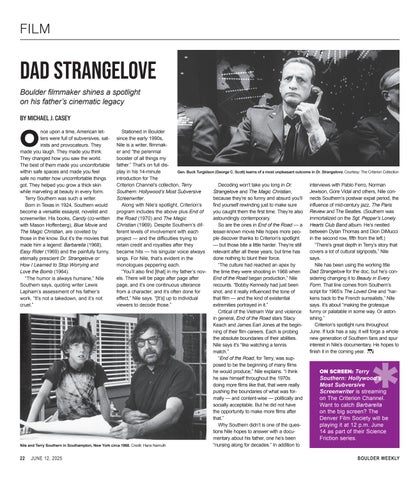
Stationed in Boulder since the early 1990s, Nile is a writer, filmmaker and “the perennial booster of all things my father.” That’s on full display in his 14-minute Gen. Buck Turgidson (George C. Scott) learns of a most unpleasant outcome in Dr. Strangelove. Courtesy: The Criterion Collection introduction for The interviews with Pablo Ferro, Norman Decoding won’t take you long in Dr. Criterion Channel’s collection, Terry Jewison, Gore Vidal and others, Nile conStrangelove and The Magic Christian, Southern: Hollywood’s Most Subversive because they’re so funny and absurd you’ll nects Southern’s postwar expat period, the Screenwriter. influence of mid-century jazz, The Paris find yourself rewinding just to make sure Along with Nile’s spotlight, Criterion’s you caught them the first time. They’re also Review and The Beatles. (Southern was program includes the above plus End of immortalized on the Sgt. Pepper’s Lonely astoundingly contemporary. the Road (1970) and The Magic So are the ones in End of the Road — a Hearts Club Band album. He’s nestled Christian (1969). Despite Southern’s difbetween Dylan Thomas and Dion DiMucci lesser-known movie Nile hopes more peoferent levels of involvement with each in the second row, fifth from the left.) ple discover thanks to Criterion’s spotlight project — and the difficulties trying to “There’s great depth in Terry’s story that — but those bite a little harder. They’re still retain credit and royalties after they covers a lot of cultural signposts,” Nile relevant after all these years, but time has became hits — his singular voice always says. done nothing to blunt their force. sings. For Nile, that’s evident in the Nile has been using the working title “The culture had reached an apex by monologues peppering each. Dad Strangelove for the doc, but he’s con“You’ll also find [that] in my father’s nov- the time they were shooting in 1968 when sidering changing it to Beauty in Every End of the Road began production,” Nile els. There will be page after page after Form. That line comes from Southern’s recounts. “Bobby Kennedy had just been page, and it’s one continuous utterance script for 1965’s The Loved One and “harshot, and it really influenced the tone of from a character, and it’s often done for kens back to the French surrealists,” Nile that film — and the kind of existential effect,” Nile says. “[It’s] up to individual says. It’s about “making the grotesque extremities portrayed in it.” viewers to decode those.” funny or palatable in some way. Or astonCritical of the Vietnam War and violence ishing.” in general, End of the Road stars Stacy Criterion’s spotlight runs throughout Keach and James Earl Jones at the beginJune. If luck has a say, it will forge a whole ning of their film careers. Each is probing new generation of Southern fans and spur the absolute boundaries of their abilities. interest in Nile’s documentary. He hopes to Nile says it’s “like watching a tennis finish it in the coming year. match.” “End of the Road, for Terry, was supposed to be the beginning of many films he would produce,” Nile explains. “I think ON SCREEN: Terry he saw himself throughout the 1970s Southern: Hollywood’s doing more films like that, that were really Most Subversive pushing the boundaries of what was forScreenwriter is streaming mally — and content-wise — politically and on The Criterion Channel. socially acceptable. But he did not have Want to catch Barbarella the opportunity to make more films after on the big screen? The that.” Denver Film Society will be Why Southern didn’t is one of the quesplaying it at 12 p.m. June tions Nile hopes to answer with a docu14 as part of their Science mentary about his father, one he’s been Friction series. “nursing along for decades.” In addition to Nile and Terry Southern in Southampton, New York circa 1968. Credit: Hans Namuth nce upon a time, American letters were full of subversives, satirists and provocateurs. They made you laugh. They made you think. They changed how you saw the world. The best of them made you uncomfortable within safe spaces and made you feel safe no matter how uncomfortable things got. They helped you grow a thick skin while marveling at beauty in every form. Terry Southern was such a writer. Born in Texas in 1924, Southern would become a versatile essayist, novelist and screenwriter. His books, Candy (co-written with Mason Hoffenberg), Blue Movie and The Magic Christian, are coveted by those in the know. But it’s the movies that made him a legend: Barbarella (1968), Easy Rider (1969) and the painfully funny, eternally prescient Dr. Strangelove or: How I Learned to Stop Worrying and Love the Bomb (1964). “The humor is always humane,” Nile Southern says, quoting writer Lewis Lapham’s assessment of his father’s work. “It’s not a takedown, and it’s not cruel.”
22
JUNE 12, 2025
BOULDER WEEKLY
ON DRUGS
DENVER HOSTS LARGEST PSYCHEDELIC CONFERENCE First U.S. city to decriminalize psilocybin is ideal location BY DANI DOUGLASS
W
hen clients of licensed psychotherapist Carrie “Kiki” King partake in ketamine-assisted psychotherapy at The Oracle Institute in Tucson, Arizona, they arrive at the ranchstyle property and are led inside to a dimly lit room. She brings the client to a four-inch plush mat on the ground, surrounded by blankets and a bolster cushion. Prior to the start of the experience, King lights candles and plays the singing bowls. She starts a custom playlist for her client, hands them an eye shade and pushes play on the machine emulating nature sounds. Under the influence of ketamine — a psychedelic used for mental health treatment since the 1970s — patients can feel more able to handle thoughts and feelings they struggle with in the sober light of day. But just as important as the sessions are what happens next: a process known as integration, wherein King guides her clients through reflecting on what hap-
BOULDER WEEKLY
pened while on the drug. 350 therapists in over 30 “Integration helps clicountries since 2023. ents explore and impleThe stakes are high, ment insights,” King said. with millions of “This results in personal Americans struggling growth, emotional healwith their mental health. ing and lasting change.” Mental Health America’s As more Americans 2024 report revealed partake in therapeutic that 23% of adults expepsychedelic experiences rienced a mental health — bolstered by an illness in the past year expanding field of — almost 60 million research and growing list people. of states granting access John Williamson, a to these mostly illegal Honolulu resident, American mycologist Paul Stamets drugs — integration is an presents at Psychedelic Science began ketamine therapy apt theme for earlier this year amid a 2023 in Denver. Credit: Dani Douglass Psychedelic Science lifelong struggle with 2025, being held June 16-20 at the depression. Colorado Convention Center in downtown “After January, the news environment Denver. became increasingly negative, and I “There is a lot for us to integrate right experienced a decrease in social activities now, across disciplines and across combecause of my recent retirement,” munities,” said Zane Bader, communicaWilliamson wrote via email in response to tions manager for conference host questions. “I sank into depression, and at Multidisciplinary Association for that point, I thought it would be worthwhile Psychedelic Studies (MAPS). “This conferto take a radically different approach and ence is not just about showcasing everytry ketamine. I’m glad I did. Since starting thing that’s new; it’s also about discussing ketamine therapy, I’ve had more energy, how as a movement, we can carry this been more productive and felt more hopework forward in responsible ways.” ful about the future.” Willamson will also be attending the conference in Denver for the first time. He A NEW ERA looks forward to interacting with others on MAPS spinoff Lykos Therapeutics a similar healing journey. received a lot of attention last year for its “Psychedelic Science 2025 seemed like failed attempt to make MDMA a federally the best place to access the latest inforapproved and regulated treatment for mation on these therapies,” he wrote. “I post-traumatic stress disorder. But the have long been interested in how psycheorganization’s role in supporting and delic medicine can help me, people I care advancing the psychedelic space is much about and our contemporary society with broader. MAPS’ International Therapist Education Program has trained more than emotional and psychological challenges.”
MEETING THE MOVEMENT
The event will be the largest conference in the world on consciousness-expanding substances, including psilocybin, LSD, MDMA, ayahuasca and ibogaine. More than 7,000 people are expected to attend from all 50 U.S. states and 39 countries. There have been massive legislative shifts since the first conference in Oakland in 2017. As of May 2025, Oregon and Colorado are the only two states with regulated access to psychedelic therapy and healing centers. New Mexico allows growing psilocybin mushrooms, and 19 states have active legislation related to decriminalization, regulation and medical oversight or licensure requirements. Six other states allow for medical research. Williamson said he is glad to see more states moving to dismantle the “fearbased restrictions” established during Richard Nixon’s War on Drugs, which long demonized psychedelics. MAPS’ Zane said honest, nuanced conversations are needed about the risks of psychedelic medicines, but it’s just as important to acknowledge the risks of criminalization. “Keeping them subject to prohibition — where people can get incarcerated for possession — contributes to stigma.” Dani Douglass is a Hawaii-based writer, editor and communications professional.
Psychedelic Science 2025, Monday, June 16 to Friday, June 20, Colorado Convention Center, 700 14th St., Denver. $309-$1,839.
JUNE 12, 2025
23
Met Your Soul Drum Yet? 303-402-0122
HAND DRUMS, DRUM SETS, AND LESSONS FOR KIDS OF ALL AGES
The Drum Shop
3070 28th St., Boulder