What we see when we see food Recalibrating how we view food by Michael J. Casey
A
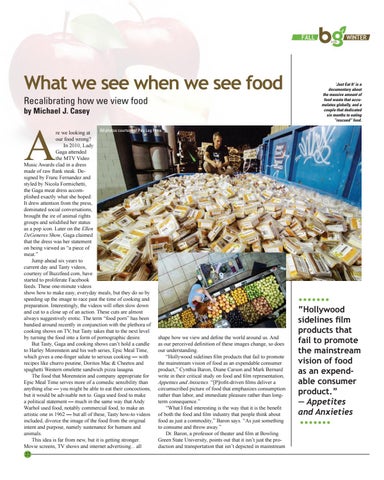
All photos courtesy of Peg Leg Films
re we looking at our food wrong? In 2010, Lady Gaga attended the MTV Video Music Awards clad in a dress made of raw flank steak. Designed by Franc Fernandez and styled by Nicola Formichetti, the Gaga meat dress accomplished exactly what she hoped: It drew attention from the press, dominated social conversations, brought the ire of animal rights groups and solidified her status as a pop icon. Later on the Ellen DeGeneres Show, Gaga claimed that the dress was her statement on being viewed as “a piece of meat.” Jump ahead six years to current day and Tasty videos, courtesy of Buzzfeed.com, have started to proliferate Facebook feeds. These one-minute videos show how to make easy, everyday meals, but they do so by speeding up the image to race past the time of cooking and preparation. Interestingly, the videos will often slow down and cut to a close up of an action. These cuts are almost always suggestively erotic. The term “food porn” has been bandied around recently in conjunction with the plethora of cooking shows on TV, but Tasty takes that to the next level by turning the food into a form of pornographic desire. But Tasty, Gaga and cooking shows can’t hold a candle to Harley Morenstein and his web series, Epic Meal Time, which gives a one-finger salute to serious cooking — with recipes like churro poutine, Doritos Mac & Cheetos and spaghetti Western omelette sandwich pizza lasagna. The food that Morenstein and company appropriate for Epic Meal Time serves more of a comedic sensibility than anything else — you might be able to eat their concoctions, but it would be advisable not to. Gaga used food to make a political statement — much in the same way that Andy Warhol used food, notably commercial food, to make an artistic one in 1962 — but all of these, Tasty how-to videos included, divorce the image of the food from the original intent and purpose, namely sustenance for humans and animals. This idea is far from new, but it is getting stronger. Movie screens, TV shows and internet advertising... all 22
‘Just Eat It’ is a documentary about the massive amount of food waste that accumulates globally, and a couple that dedicated six months to eating “rescued“ food.
shape how we view and define the world around us. And as our perceived definition of these images change, so does our understanding. “Hollywood sidelines film products that fail to promote the mainstream vision of food as an expendable consumer product,” Cynthia Baron, Diane Carson and Mark Bernard write in their critical study on food and film representation, Appetites and Anxieties. “[P]rofit-driven films deliver a circumscribed picture of food that emphasizes consumption rather than labor, and immediate pleasure rather than longterm consequence.” “What I find interesting is the way that it is the benefit of both the food and film industry that people think about food as just a commodity,” Baron says. “As just something to consume and throw away.” Dr. Baron, a professor of theater and film at Bowling Green State University, points out that it isn’t just the production and transportation that isn’t depicted in mainstream
••••••• “Hollywood sidelines film products that fail to promote the mainstream vision of food as an expendable consumer product.” — Appetites and Anxieties •••••••