ULTRAMARATHON from Page 27
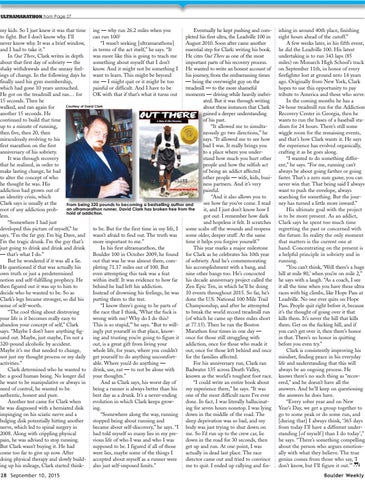
my kids. So I just knew it was that time ing — why run 26.2 miles when you Eventually he kept pushing and comto fight. But I don’t know why. I’ll can run 100? pleted his first ultra, the Leadville 100 in never know why. It was a brief window, “I wasn’t seeking [ultramarathons] August 2010. Soon after came another and I had to take it.” in terms of the act itself,” he says. “It essential step for Clark: writing his book. In Out There, Clark writes in depth was more like this is going to teach me He cites Out There as one of the most about that first day of sobriety — the something about myself that I don’t important parts of his recovery process. shaky withdrawals and the uneasy feelknow. And it might not be something I He wanted to write an honest account of ings of change. In the following days he want to learn. This might be beyond his journey, from the embarrassing times finally used his gym membership, me — I might quit or it might be too — being the overweight guy on the which had gone 10 years untouched. painful or difficult. And I have to be treadmill — to the more shameful He got on the treadmill and ran… for OK with that if that’s what it turns out moments — driving while heavily inebri15 seconds. Then he ated. But it was through writing Courtesy of David Clark walked, and ran again for about these instances that Clark another 15 seconds. He gained a deeper understanding continued to build that time of his past. up to a minute of running, “It allowed me to simultathen five, then 20, then neously go two directions,” he miraculously evolving to his says. “It allowed me to see how first marathon on the first bad I was. It really brings you anniversary of his sobriety. to a place where you underIt was through recovery stand how much you hurt other that he realized, in order to people and how the selfish act make lasting change, he had of being an addict affected to alter the concept of who other people — wife, kids, busihe thought he was. His ness partners. And it’s very addiction had grown out of painful. an identity crisis, which “And it also allows you to Clark says is usually at the see how far you’ve come. I read From being 320 pounds to becoming a bestselling author and root of any addiction prob- an ultramarathon runner, David Clark has broken free from the it, and I just don’t know how I hold of addiction. lem. got out. I remember how dark “Somewhere I had just and hopeless it felt. It scratches to be. But for the first time in my life, I some scabs off the wounds and reopens developed this picture of myself,” he says. “I’m the fat guy. I’m big Dave, and wasn’t afraid to find out. The truth was some older, deeper stuff. At the same I’m the tragic drunk. I’m the guy that’s more important to me.” time it helps you forgive yourself.” just going to drink and drink and drink In his first ultramarathon, the This year marks a major milestone — that’s what I do.” Boulder 100 in October 2009, he found for Clark as he celebrates his 10th year But he wondered if it was all a lie. out that was he was almost there, comof sobriety. And he’s commemorating He questioned if that was actually his pleting 71.17 miles out of 100. But his accomplishment with a bang, and own truth or just a predetermined even attempting this task was a feat nine other bangs too. He’s concocted notion and self-fulfilling prophecy. He within itself. It was evidence to how far his decade anniversary project called the then figured out it was up to him to behind he had left his addiction. Zen Epic Ten, in which he’ll be doing decide who he wanted to be. So as Instead of drowning his feelings, he was 10 events throughout 2015. So far, he’s Clark’s legs became stronger, so did his putting them to the test. done the U.S. National 100 Mile Trail sense of self-worth. “I know there’s going to be parts of Championship, and after he attempted “The cool thing about destroying the race that I think, ‘What the fuck is to break the world record treadmill run your life is it becomes really easy to wrong with me? Why do I do this? (of which he came up three miles short abandon your concept of self,” Clark This is so stupid,’” he says. “But to will- at 77.15). Then he ran the Boston says. “Maybe I don’t have anything figingly put yourself in that place, knowMarathon four times in one day — ured out. Maybe, just maybe, I’m not a ing and trusting you’re going to figure it once for those still struggling with 320-pound alcoholic by accident. out, is a great gift from living your addiction, once for those who made it Maybe it’s me that needed to change, whole life, for years, where you couldn’t out, once for those left behind and once not just my thought process or my daily get yourself to do anything uncomfortfor the families affected. activities.” able. Where you’d do anything — For his anniversary run, Clark ran Clark determined who he wanted to drink, use, eat — to not be alone with Badwater 135 across Death Valley, be: a good human being. No longer did your thoughts.” known as the world’s toughest foot race. he want to be manipulative or always in And as Clark says, his worst day of “I could write an entire book about need of control, he wanted to be being a runner is always better than his my experience there,” he says. “It was authentic, honest and pure. best day as a drunk. It’s a never-ending one of the most difficult races I’ve ever Another test came for Clark when evolution in which Clark keeps growdone. In fact, I was literally hallucinathe was diagnosed with a herniated disk ing. ing for seven hours nonstop. I was lying impinging on his sciatic nerve and a “Somewhere along the way, running down in the middle of the road. The bulging disk potentially hitting another stopped being about running and sleep deprivation was so bad, and my nerve, which led to spinal surgery in became about self-discovery,” he says. “I body was just trying to shut down on 2008. Along with crippling physical had told myself so many lies in my pre- me. So I’d run up to the crew car, lie pain, he was advised to stop running. vious life of who I was and who I was down in the road for 30 seconds, then But Clark wasn’t buying it. He had supposed to be. I figured if all of those get up and run. At one point, I was come too far to give up now. After were lies, maybe some of the things I actually in dead last place. The race doing physical therapy and slowly build- accepted about myself as a runner were director came out and tried to convince ing up his mileage, Clark started thinkalso just self-imposed limits.” me to quit. I ended up rallying and fin28 September 10, 2015
ishing in around 40th place, finishing eight hours ahead of the cutoff.” A few weeks later, in his fifth event, he did the Leadville 100. His latest undertaking is to run 343 laps (85 miles) on Monarch High School’s track on September 11th, in honor of every firefighter lost at ground zero 14 years ago. Originally from New York, Clark hopes to use this opportunity to pay tribute to America and those who serve. In the coming months he has a 24-hour treadmill run for the Addiction Recovery Center in Georgia, then he wants to run the bases of a baseball stadium for 24 hours. There’s still some wiggle room for the remaining events, and that’s how Clark wants it. He says the experience has evolved organically, crafting it as he goes along. “I wanted to do something different,” he says. “For me, running can’t always be about going farther or going faster. That’s a zero sum game; you can never win that. That being said I always want to push the envelope, always searching for something. But the journey has turned a little more inward.” His ultimate goal with the project is to be more present. As an addict, Clark says he spent too much time regretting the past or concerned with the future. In reality the only moment that matters is the current one at hand. Concentrating on the present is a helpful principle in sobriety and in running. “You can’t think, ‘Well there’s a huge hill at mile 80,’ when you’re on mile 2,” he says with a laugh. “As a coach, I see it all the time when you have these ultra races with big climbs, like Hope Pass at Leadville. No one ever quits on Hope Pass. People quit right before it, because it’s the thought of going over it that kills them. It’s never the hill that kills them. Get on the fucking hill, and if you can’t get over it, then there’s honor in that. There’s no honor in quitting before you even try.” Clark is consistently improving his mindset, finding peace in his everyday life and understanding that this will always be an ongoing process. He knows there’s no such thing as “recovered,” and he doesn’t have all the answers. And he’ll keep on questioning the answers he does have. “Every sober year and on New Year’s Day, we get a group together to go to some peak or do some run, and [during that] I always think, ‘365 days from today I’ll have a different understanding [of myself ] than I do today’,” he says. “There’s something compelling about the person who argues emotionally with what they believe. The true genius comes from those who say, ‘I don’t know, but I’ll figure it out.’” Boulder Weekly