WOLVES from Page 11
the entire Medicine Bow mountain range. After this, she returned to Colorado to Larimer County, in the upper reaches of the Cache la Poudre River from where she then headed west. By this time, Shane Briggs, then CDOW wildlife conservation programs supervisor, wrote to the group of federal and state wildlife officials that, “the CDOW has determined that we do not want to get involved with the monitoring of this wolf,” adding if “she gets into trouble,” they’d work with USFWS and [WS] to help, “but otherwise we would like to leave her alone as much as possible.” Briggs went on to state that their field operations manager asked about the potential threat M-44s, aka coyote getters/ cyanide bombs, posed to the Mill Creek disperser, wondering if there was coordination with WS, “as they evidently have a lot of M-44s set north of I-70.” These poison-dispersing M-44s look like a sprinkler head buried in the ground but are actually loaded with an explosive charge containing sodium cyanide that is designed to blast into the mouth and nostrils of wild animals, especially coyotes, and kill them. However, these devices have killed domestic pets like family dogs. One particularly grim instance occurred in Idaho in March 2017 when an M-44 exploded in the face of a 14-year-old boy and his dog as they were walking near their home. The 90-pound dog, “who was writhing in pain on the ground,” died in front of the boy, who himself was seriously injured, but survived the poisoning, according to a Reuters report. M-44s are currently used by WS in Colorado on private lands. As a result of Amendment 14, passed unanimously by Coloradans in 1996, M-44s are banned from public lands in the state. But it wouldn’t be an M-44 loaded with an explosive charge of sodium cyanide that would end up killing the female wolf from the far away Mill Creek pack who had found her way to Colorado. It was a far deadlier poison designed for predators, sodium monoflouroacetate, aka Compound 1080. In a chapter on Compound 1080 titled, “Biography of a master poison,” from the 1971 book Slaughter the Animals, Poison the Earth by Jack Olsen, an in-depth history of Compound 1080 is given. According to Olsen, beginning with Polish scientists in the 1930s that were trying to develop an improved tear gas, different flouroacetate compounds began being developed for poisoning purposes. The U.S. Army made extensive tests of the synthetic sodium monofluoroacetate for a rodenticide in wars, according to Olsen. “It turned out to be the most powerful and effective rat-killer ever known,” Olsen writes. “In 12
I
early use, the chemical killed 42,000 rats in a single day in the Philippines.” Continued experimentation revealed the effectiveness of 1080 in killing canines, “and the USFWS began wholesale use of the poison as a predacide, purchasing the chemical from the Monsanto Company under the trade name ‘1080,’” according to Olsen’s exposé. According to a WS report on predacides, Compound 1080 began being used in the U.S. for killing canids in the mid-1940s as the, “preferred toxicant in meat bait stations used in Western states to reduce coyote populations that preyed on domestic livestock.” Meat bait stations are comprised of pieces of poisoned meat, often injected with a solution of poison. Use of meat bait stations continued until 1964, when approximately 16,000 toxic bait
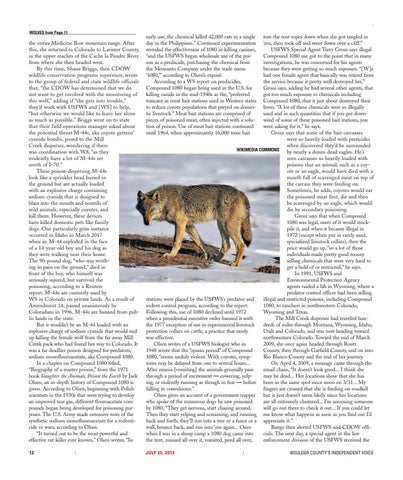
tore the tent ropes down when she got tangled in ’em, then took off and went down over a cliff.” USFWS Special Agent Terry Grosz says illegal Compound 1080 use got to the point that in many investigations, he was concerned for his agents because they were getting so much exposure. “[W]e had one female agent that basically was retired from the service because it pretty well destroyed her,” Grosz says, adding he had several other agents, that got too much exposure to chemicals including Compound 1080, that it just about destroyed their livers. “A lot of these chemicals were so illegally used and in such quantities that if you got downwind of some of these poisoned bait stations, you were asking for it,” he says. Grosz says that some of the bait carcasses were so heavily loaded with pesticides when discovered they’d be surrounded WIKIMEDIA COMMONS by nearly a dozen dead eagles. He’s seen carcasses so heavily loaded with poisons that an animal, such as a coyote or an eagle, would have died with a mouth full of scavenged meat on top of the carcass they were feeding on. Sometimes, he adds, coyotes would eat the poisoned meat first, die and then be scavenged by an eagle, which would die by secondary poisoning. Grosz says that when Compound 1080 was legal, users of it would stockpile it, and when it became illegal in 1972 (except when put in rarely used, specialized livestock collars), then the price would go up, “so a lot of those individuals made pretty good money selling chemicals that were very hard to get a hold of or restricted,” he says. In 1991, USFWS and Environmental Protection Agency agents raided a lab in Wyoming, where a predator control officer had been selling illegal and restricted poisons, including Compound stations were placed by the USFWS’s predator and 1080, to ranchers in northwestern Colorado, rodent control program, according to the report. Wyoming and Texas. Following this, use of 1080 declined until 1972 The Mill Creek disperser had traveled hunwhen a presidential executive order banned it with dreds of miles through Montana, Wyoming, Idaho, the 1977 exception of use in experimental livestock Utah and Colorado, and was now heading toward protection collars on cattle, a practice that rarely northwestern Colorado. Toward the end of March was effective. 2009, she once again headed through Routt Olsen writes of a USFWS biologist who in County, then through Garfield County, and on into 1948 wrote that the “spasm period” of Compound Rio Blanco County and the end of her journey. 1080, “seems unduly violent. With coyotes, sympOn April 4, 2009, a message came through the toms may be delayed from one to several hours... email chain, “It doesn’t look good... I think she After emesis [vomiting] the animals generally pass may be dead... Her locations show that she has through a period of excitement — cowering, yelping, or violently running as though in fear — before been in the same spot since noon on 3/31... My fingers are crossed that she is feeding on roadkill falling in convulsions.” Olsen gives an account of a government trapper but it just doesn’t seem likely since her locations are all extremely clustered... I’m assuming someone who spoke of the numerous dogs he saw poisoned will go out there to check it out... If you could let by 1080, “They get nervous, start chasing around. Then they start yelping and screaming, and running me know what happens as soon as you find out I’d back and forth; they’ll run into a tree or a fence or a appreciate it.” Bangs then alerted USFWS and CDOW offiwall, bounce back, and run into ’em again... Once cials. The next day, a special agent in the law when I was in a sheep camp a 1080 dog came into enforcement division of the USFWS received the the tent, mussed all over it, vomited, peed all over, JULY 25, 2019
I
BOULDER COUNTY’S INDEPENDENT VOICE